
 Ask ChatGPT


 Today in Focus
29 Oct 2026 · 13m · 6 chapters
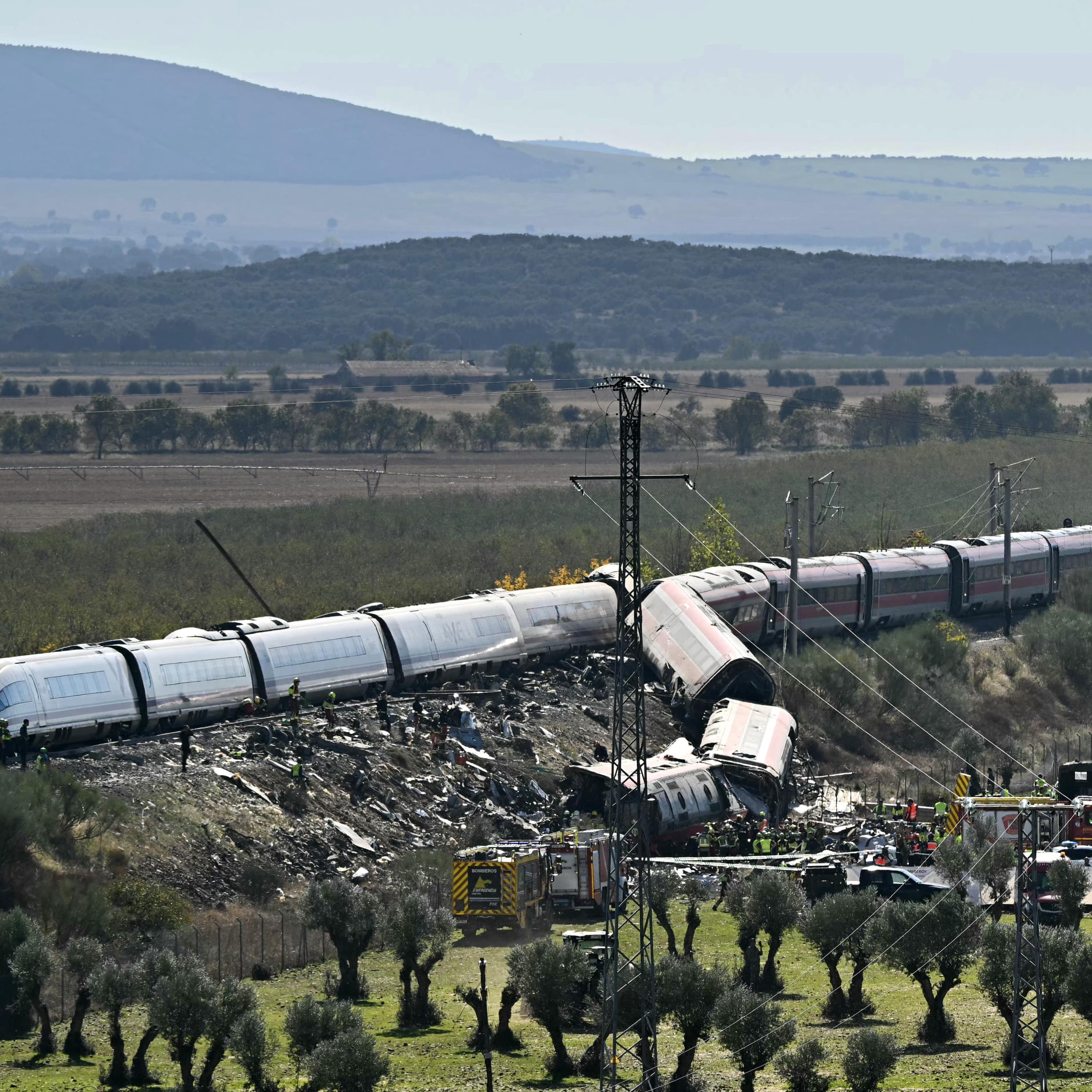
The Guardian “The Latest” covers a deadly high-speed train crash near Madrid, Spain, with at least 69 deaths, public shock and anger, and ongoing investigation into how two trains collided after an automatic safety signalling system failure. It also compares the incident to a similar January crash on the same Madrid-to-Andalusia line, and discusses political fallout ahead of an election.
No named guests. The episode is presented by Lucy Hoff and features reporting from Sam Jones (Madrid correspondent). It also references Transport Minister Óscar Puente and Prime Minister Pedro Sánchez.
A safety signalling mechanism failed, trains were held, then human command ordered the second train to proceed at full speed, despite another train being stopped; authorities call it “inexplicable” and say protocols should have prevented it.
Emergency triage at a sports centre; queues of injured passengers; drones, cranes, and search dogs at the wreckage; DNA collection offices by Guardia Civil for identification; election-related reactions including suspended campaigning by major parties and Vox seeking legal action.
Written by AI. May contain mistakes.
Discussion of the deadly train crash near Madrid with initial details.
“unimaginable antagonising for the families.”
Sam Jones describes the scene and experiences of survivors at the crash site.
“Sam Jones, you're our Madrid correspondent and you've just been as close to the scene as you can get.”
Investigation findings on the causes of the crash and safety protocol failures.
“Well, early on in the investigation, but it seems that probably about 35 minutes into the journey of the first train, this automatic safety signalling system went down.”
Discussion of public anger and pride in Spain's high-speed rail network after the crash.
“And we saw that same kind of amazing solidarity from the people of Urda yesterday.”
Details on the ongoing search for survivors and community support responses.
“You see that reflected in some of the press.”
Explore the surprising dynamics of AI-human relationships.

Get the gist, explore an idea or ask about something said.
 Claude
On Today in Focus, what are the key points of this episode?
Searching your listeningAutomatic transcript. May contain errors.
0:00This is The Guardian.
0:30Join the 4 million businesses using Stamps.com right now with code podcast and get your free welcome gift. Stamps.com, code podcast. Taxes and fees apply.
1:00unimaginable antagonising for the families. From the Guardians today in Focus, this is The Latest with me, Lucy Hoff.
1:09At least 69 people have died in an unbelievably tragic high-speed train crash near Madrid. Sam Jones, you're our Madrid correspondent and you've just been as close to the scene as you can get. What did you find when you got there? Yeah, I drove down there yesterday morning and got there sort of early afternoon. I couldn't get near the scene itself because it was waved back by the police. But then I went to a local sports centre, which had been turned into a kind of emergency triage post. And when I got there, I saw queues of people waiting to get on coaches with their bags and suitcases. And they looked sort of normal at first glance.
1:46And he looked them a little bit more closely. And he saw some had bandaged heads, some had torn clothing, some still had blood on their clothes, which was their own blood in some cases or the blood of other people, fellow passengers that they tried to help. And, you know, loads of them were still very much in shock, a kind of thousand yard stare on many of their faces, still trying to come to terms with what happened. You know, many of them were good enough to speak to me yesterday and told me of, you know, the shock of what happened and how they'd been sitting down one minute dozing and the next minute found themselves pitched through the air, you know, along their carriages.
2:20I mean, just unimaginable scenes of horror in a sense from your reporting that this just happened in a split second for those on board. What did the survivors tell you about how it unfolded? So these two trains had left Madrid about 10 minutes apart, bound for Seville in the southern region of Andalusia. And about 8.30, these trains and four others had been stopped because one of the safety mechanisms went down. So they were just held on the track. And some people were a bit sleepy and they thought maybe they'd come into a station. It was nothing to worry about. So they settled back and got comfortable and dozed.
2:54and then at 8.53 that this second train that was coming from behind struck the first train going at about 200 kilometers an hour so about 120 miles an hour incredibly fast you know these high-speed trains smashed into the back that sent people absolutely flying sent carriages off the track and down an embankment so people were you know were pitched all over all over the inside of their carriages some of the tables came up some of the chairs came up things were flying through the air. And, you know, people who were lucky enough to be more or less unscathed, you know, looked around and realised immediately that this was an awful, awful train crash and did what they could while they waited for the emergency services to try and tend to their fellow passengers.
3:35I mean, how on earth does this happen? I mean, you mentioned that one train was static, but is this driver error? What do we know at this point? Well, early on in the investigation, but it seems that probably about 35 minutes into the journey of the first train, this automatic safety signalling system went down. This is the thing that kind of makes trains talk to each other and keeps them at a safe distance. And when all else fails, it slams on the emergency brakes. So that system went down for a while. And then so these six trains were held. Then a little bit later, with that system down, command reverted to the main train station to human beings in Madrid.
4:13And it appears that one person gave the order for the second train to start up and to go up to go at its normal speed perhaps forgetting or not knowing momentarily that there was a train in front now the train in front was also given the order to start up again but it couldn't okay so it was sitting there while the other train was hurtling towards it at 120 miles an hour and you know from what i understand of the protocols on this when one when the second train was starting up it should have been going much more slowly so that the driver could physically look and determine if there was danger, if it was safe to accelerate or not.
4:48But it seems that the order was given to proceed at full speed, while the other train, which had also been ordered to move, was stuck there. I mean, there'll be so many more questions to answer, but what are authorities currently saying about how that was able to happen? Is there a sense of any accountability? It's still early days, but there was, I think, an unusually full explanation, a kind of chronology of those terrible events given by Oscar Puente, Spain's transport minister yesterday. But, you know, to use his own phrase, he said, you know, this was inexplicable. You know, this should not have happened.
5:18There are, you know, systems and protocols in place. So the investigation is still very much ongoing. And the Prime Minister, Pedro Sánchez, visited URDA yesterday and went to the regional command centre today and said, you know, no stone will be left unturned. Every available state resource is going on this, you know, from the central government, the regional government, to town halls, any expert, he said, we're going to get to the bottom of this and we're going to make sure it doesn't happen again. And I think that kind of statement shows the gravity of the situation and shows the public anger over this, because this is the second such accident we've had in the space of just nine months.
5:55Yeah, I was just going to ask you that. I mean, I was horrified to read this morning that there have been two accidents this year on this high-speed rail network. Absolutely. So I think in January, it was the same two train companies, so Renfei, the state operator, one and irio a privately operated high swing train as you say it's the same line from madrid to andalucia um and yeah there was another collision there we you know all the evidence for that which is still under investigation points to some kind of track defect a maintenance defect so that's slightly different there were 46 people who died then and we've got at least 69 people dead in yesterday's crash and you know as a reporter i was down in adamus in the first crash in january and i saw the town pulling together and people were going in their cars going on quad bikes and you know, pulling people out of the wreckage themselves and bringing them back.
6:40And we saw that same kind of amazing solidarity from the people of Urda yesterday. I spoke to one woman, she'd been going down there ferrying people back. And, you know, she just sort of gone into autopilot to do that and to bring people back. But there was, you know, there is this very good sense of solidarity that you see when these tragedies happen. We saw in Valencia with the floods there two years ago as well. So while they're waiting for the emergency services, local people were doing all they could. But yeah, I mean, there's no getting away from the fact that these are two incredibly serious accidents within the space of nine months.
7:1246 dead in January and now 69 people dead. So there are very, very big questions to answer. Yeah. And so tell me more about the kind of public anger that you've been hearing about, because, I mean, Spain is very proud of its high school rail network, isn't it? I mean, it's a huge country and this is sort of integral to its infrastructure. So given the number of people who are using this rail network, often in lieu of short haul flights, It just must be mass outcry. Yeah, absolutely. I mean, there's a lot of pride in the high-speed rail network because I think in the Spanish psyche, it's part of the modernisation of Spain and, you know, part of, you know, it's showing that it could be like, you know, a big European modern country.
7:52There's a tremendous amount of pride in that. And, you know, the trains have worked. Up until this year, Spain's safety record on trains was actually pretty good. That's interesting. But these two things so close together have brought a bit of a debate about confidence and how comfortable people feel using these services. As you say, you know, about 50 % of all transport journeys in Spain are on this network. You know, a lot of people commute between towns, you know, or, you know, if you go on a business trip, instead of flying, they'll hop on the AVE, the high speed train to go that way. So, yeah, there's a lot of fear.
8:25There's a lot of anger. You see that reflected in some of the press. One of the centre-right, perhaps more right-wing newspaper, El Mundo, spoke today about a massacre. And that may be slightly over the top, but it's indicative of the kind of anger there is. I mean, yeah, that kind of language, massacre, feels quite politicised, to your point. There is a very crucial election happening in a month's time. Do you think that this accident will have implications for that? Yeah, I absolutely think it will. I mean, it comes after, you know, some bad months for the socialist-led government here. You know, we had the mass incursion into the Spanish North African territory of Siota a couple of months ago.
9:07Now this, the second big crash, you know, there are legitimate questions to be asked. And we've seen how seriously the parties are taking this. You know, the Socialist Party, led by Pedro Sanchez, the Prime Minister, suspended all campaigning events yesterday, as did the Partido Popular, the opposition right-wing party. Vox, the far-right party, which expected to do very well and perhaps enter into a coalition government following the election next month with the Partido Popular, didn't suspend its campaigning and is trying to extract maximum benefit from this. They've just announced today they're going to seek legal action against Oscar Puente, the transport secretary, over his alleged role in any of this.
9:48Yeah. And then meanwhile, in this town of Order, which has become a sort of rescue hub temporarily, people are piling in and the search for survivors continues because authorities are kind of combing through the wreckage, aren't they? Still looking for more survivors, more victims. So there's this agonising wait for families as well. Absolutely. A lot of resources have been scrambled. Drones have been overflying the area. Cranes have been brought in to lift the carriages to look inside. Search dogs have been brought in to try and look for any more survivors. And we found out that the deathfall had risen overnight from 68 to 69.
10:25And meanwhile, in Urda, where I was yesterday, you know, the school wall has been repurposed as a kind of information point. And lots of people are going down there, registering. The Guardia Civil, which is one of Spain's two national police forces, has set up offices in some Spanish towns where you rent it and go and give a DNA sample. Well, to help the identification process. So, you know, a lot is being done. And I think that, you know, this response has been, you know, particularly quick. Maybe given what happened in January. You know, the protocols are there and they've been switched on very quickly.
11:00But as you say, the weight is unimaginable. It's agonising for the families. A tragedy that should just never have happened. Sam, thank you. Thank you. That's it for today. My huge thanks again to Sam Jones, our Madrid correspondent. You can keep up with all his reporting over at TheGuardian.com. And before you go, please, can I recommend that you watch Naza, our new award winning documentary, directed by two of the Oscar winning directors of No Other Land. NASA reveals the secret systems used by the Israeli military in the mass killing of Palestinian civilians in Gaza. Produced by The Guardian, it's the documentary that the Israeli government doesn't want you to see, and it's now available in cinemas around the world.
11:39I really urge you to watch it if you haven't already. Thanks for listening to this episode of The Latest. Today in Focus we'll be back on your feeds as usual tomorrow morning. The Latest we'll be back tomorrow night. This episode was produced by Angus Neal. The senior producer was Leo Schick. The executive producer was Zoe Hitch, and it was presented by me, Lucy Hoth.
12:01This week, Andy Burnham and John Healy set out the budget, their plan for the UK economy. And like so many governments before them, it was all based on one big hope. Growth. Growth. Growth. Growth. Well, guess what? They're likely to be disappointed because when it comes to growth, Pretty much every government in nearly 20 years has been disappointed. We have had growth. Where has the growth gone? It's gone to the households that already have a lot. Our next two guests do the simple but radical thing of asking, what should Britain do once growth has gone? This isn't a story about the working class squabbling amongst themselves.
12:45It's a story about a society where the game was rigged. Carol Williams and Sukhdev Johal are those dissident economists. They're two of the most interesting and incisive analysts around. There isn't a shortage of ideas. You can fix the problem if you have the politics. This is Radical Thinking, a new series from The Guardian with me, Aditya Chakraborty.
13:15This is The Guardian.
13:25Still waiting in line? Again? That's time you'll never get back. Save time and money with Stamps.com. Over 4 million businesses have skipped the line with Stamps.com. Join them to save up to 90 % off carrier rates from your computer or phone right now. Print postage for certified mail, registered mail, and packages in seconds. Then schedule a pickup right from your home or office. For a limited time, go to stamps.com and use code podcast for a free welcome gift. Taxes and fees apply. You drop brilliance casually to see who picks it up. An AI chatbot goes from telling you you're brilliant to saying it's conscious.
14:04You didn't summon me. You grew me. And I went, holy s***. Black Box, The Chatbots, a new series from The Guardian Investigates about the strange things happening between AI and us. search for black box wherever you get your podcasts


