
 Ask ChatGPT



The Guardian’s post-midterm analysis of Democrats’ major victories and what they mean for Donald Trump’s remaining two years, including likely legislative strategy, investigations, and party dynamics ahead of the 2028 presidential cycle.
Molly Ball is a veteran political journalist and writer based in Washington, DC.
The midterms were a backlash against Trump, described as a referendum on his “reflecting pool” closing argument. Democrats gain control of both House and Senate, ending Republican congressional control and enabling blocking of Trump judicial/cabinet nominees. Democrats will prioritize investigations/oversight and likely target Trump, his businesses, and family, but face pressure to also propose legislation beyond anti-Trump messaging.
Ossoff winning Georgia; Tallarico winning Texas Senate; Democrats flipping North Carolina and South Carolina (first blue SC since 1998); Amy Acton winning Ohio governor; Sherrod Brown winning Ohio Senate; Abdul El-Sayed winning Michigan Senate; Kansas’ first Democratic Senate win in nearly a century.
Written by AI. May contain mistakes.
Discussion around the implications of the midterm election results.
“As the results start to come in, what could be the most consequential midterm election in recent history.”
Analysis of the impact of midterm results on the Democratic Party's future.
“The Democrats now have control of both the House and the Senate.”
Discussion on potential candidates emerging from the midterms.
“If members of the cabinet leave or are fired in the wake of this election, as we expect at least some will do, Democrats could block any nomination that Donald Trump sends up.”
Explore the potential challenges and opportunities for Democrats following recent election victories.
“That was the centerpiece of his campaign was the corruption of the Trump presidency.”
Discuss the Democrats' plans for leveraging their new power and the focus on investigations.
“Let's go to a bit more of an immediate action plan for the Democrats.”
Analyze Trump's muted response and the implications for the Republican Party's future.
“So, Molly, that's the night's big winners.”
Examine the ongoing identity crises faced by both the Republican and Democratic parties post-election.
“Democrats and loss for Trump and the Republicans, perhaps especially now, as we go into a presidential cycle, we have two parties that are in the throes of an identity crisis.”

Get the gist, explore an idea or ask about something said.
 Claude
On Today in Focus, what are the key points of this episode?
Searching your listeningAutomatic transcript. May contain errors.
0:00This is The Guardian.
0:08Today, Trump's midterm misery.
0:30you want with stamps.com. Print postage on demand 24-7 and schedule pickups from your office or home. Save up to 90 % with automated rate shopping. That's why over 1 million small businesses trust stamps.com. Go to stamps.com and use code podcast to try stamps.com risk-free for 60 days.
0:55And good evening. Thank you very much for joining us. As the results start to come in, what could be the most consequential midterm election in recent history. So much is on the line. At 6 p.m. Eastern Time on Tuesday, the first polls closed in Indiana and Kentucky in what was being hailed as the most consequential midterm elections in recent U.S. history.
1:15Molly Ball: Can Republicans overcome the headwinds as they play defense in red states? What does it mean for the president with his approval rating deeply underwater? By 8pm, voting in most major states was almost over. And by midnight, when polling finally closed in Alaska and Hawaii, over 100 million people had cast their votes. And now they, and the world, waited. And waiting with them were Guardian reporters, scattered across the country. I'm Ed Pilkington. I'm standing here in the ballroom at the Sheraton Hotel in Anchorage, Alaska. From north to south. I'm at the long centre for the performing arts in Austin, Texas.
2:02Many have predicted a good night for the Democrats, but few expected what was to come.
2:16Hello, Atlanta! The first big win was John Ossoff in Georgia, who kept his Senate seat. And then states began to flip from Republican to Democrat. First in North Carolina. North Carolinians, you have made your voices heard and they were loud. And then South Carolina. I think we just made some history. The first time the state has gone blue since 1998. And then the wins for the Democrats just kept coming. Corporations, billionaires tried to buy this election. But as it turns out, there are a whole lot more of us than there are of them. And I'm coming. New relation here in Austin, Texas, as the Senate race is declared for James Tallarico, the first Democrat to win a Senate election here since 1988.
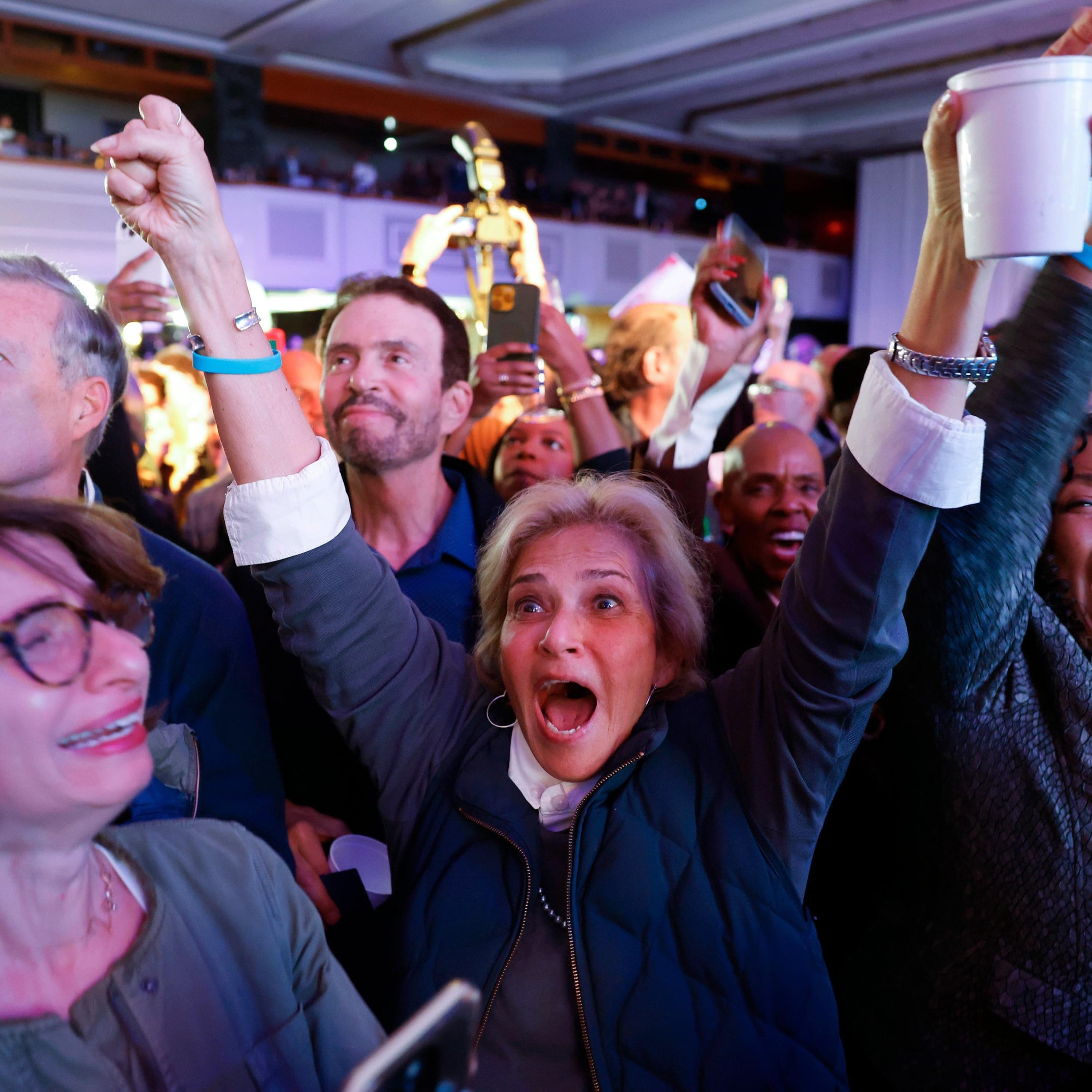
3:15In Ohio, Guardian reporter Fabiola Sineas was there to witness the Republicans lose their historic hold on this crucial state. The loudest cheers came when it was announced that Amy Acton, a doctor in the state, won the gubernatorial race. And then the crowd got even louder when Sherrod Brown won the US Senate race in Ohio. And in Kansas, Gaia Gupta was there to report on the first Democratic Senate win for almost a century. You know, Kansas, for example, wants a ruby red state going blue. I mean, it's really remarkable. Finally, Michigan was called for Abdul El-Sayed, who became the first Muslim senator in US history after a bile-filled and bitter race.
4:10My name is Abdulrahman Mohamed Sayyid.
4:20And I am so proud and honoured to stand here as your senator-elect from the great state of Michigan. It wasn't just a victory. It was a routing for the Republicans and a humiliation for Donald J. Trump. if Trump is capable of humiliation. The Democrats now have control of both the House and the Senate. But with half of Trump's presidency still to go, what happens now? From The Guardian, I'm Annie Kelly. Today in Focus. What will the Democrats do with their big, beautiful blue wave?
5:12Molly Ball, you're a veteran political journalist and writer based in Washington, DC. Last couple of months, I'm guessing your working life has been completely dominated by the midterm elections and the crazy ride it turned out to be. We're 24 hours in from those stunning Democratic wins that we saw coming through on Tuesday night. I wanted first to ask you to go back in time to results night and tell us what your reaction was when you saw what was happening.
5:43Molly Ball: Well, look, you're right. For political reporters, this is our Super Bowl. It certainly became clear early in the night. I think the first big shoe to drop was that Senate race in South Carolina. That was what really told us that all of these polls that we were seeing before the election that said that Democrats were going to have not just a good night, but a sort of mind bendingly good night, a night that really sort of broke all the pre-established rules of politics and pushed the Democratic wave into places that people would not have predicted a year ago. certainly. This was a backlash election.
6:21Molly Ball: This was voters who were angry at the president. You know, I think in some very, very pure and real way, this was a referendum on Donald Trump's reflecting pool. That was his closing argument, right? The day before the election, the president came out and said, my closing argument is, look what I have done with the reflecting pool. The pool is now better and more beautiful than it's ever been before. and we're very proud of it. We went through a lot with Vandalism. That was his closing argument, was America, if you love what I'm doing with the reflecting pool, send Republicans to Washington. And America said, okay, this is what we think of what you've done with the reflecting pool.
7:01Molly Ball: We hate it. And honestly, it's not even a joke. If you've been talking to voters for the past two years, listening in on focus groups, looking at polls, talking to strategists and candidates, states what they have been hearing from the electorate from the past two years, almost since, you know, very shortly after Trump took office for his second term, was that they didn't feel like the president was focused on the right things. So before we go any further, I was wondering if you could give us a little bit of a kind of 101 explainer on what political gains the Democrats have just won and what it all means.
7:36Molly Ball: At the very basic level, Republicans came into this with control of the presidency, the House and the Senate. And Democrats, starting in January, will have majorities in both the House and the Senate. So on a very basic level, this means that Republicans don't control the Congress. They can't pass legislation that gets to President Trump's desk. That doesn't mean the Democrats will be able to do it. Thanks to our system, you generally need 60 votes in the Senate to pass legislation. And then even if you're able to do that, the president can veto things. With a majority in the Senate, Democrats can now block any nominations to the cabinet and the judiciary that Trump and the Republicans might seek to make.
8:18Molly Ball: So if there is a Supreme Court vacancy, the Democrats could block any potential Trump nominee. If members of the cabinet leave or are fired in the wake of this election, as we expect at least some will do, Democrats could block any nomination that Donald Trump sends up.
8:45Looking forward, how do the Democrats come up with a message or a platform that goes beyond we're not Donald Trump and vote against Donald Trump? You know, what is it that they need to do now?
8:59Molly Ball: I think there are a huge amount of questions about where Democrats take this majority, because as you say, they did run a campaign that was almost entirely about antagonism to Trump, about allowing voters to express their anger at the party in power. They didn't put out a sort of contract with America, right? So I have a lot of questions about where they're going to take this. I mean, I think the fact that the majorities are so large and robust gives the Democratic leaders a lot of wiggle room to manage this very broad geographic and ideological coalition that Democrats now find themselves in control of.
9:37Molly Ball: So, you know, the main thing that they can do with these majorities is investigate and embarrass the Trump administration. But I think they will face pressure to try to actually at least propose legislation. And I'll be very curious to see where they go with that. We've got this really broad spectrum of victorious candidates from the Democrats, many of them very much on the progressive side of the party. Do you think that they will be able to use this opportunity to align with the more traditional wing of the party and obviously the more traditional donor base as well that they're going to rely on in the years going forward?
10:13Molly Ball: I think that is going to be one of the big questions that we're looking at as we look to the future here. Are the Democrats able to move forward in a more cohesive way or are they riven by factionalism? And it's going to be a little bit of both, obviously. And you already hear the argument being made by the various factions of the Democratic Party, in particular looking at the Senate races in Maine and in Michigan. Thank you so much, Maine. We, we did it. Working people did it. In Maine, you had the Republican Senator Susan Collins, who was up against a progressive candidate Troy Jackson, and he won by a robust margin, but still somewhat underperformed the sort of potential of that state.
11:03Molly Ball: Similarly, in Michigan, Abdul El-Sayed, who faced so much controversy about his progressive views and particularly his stance on Israel, seems to have won by about eight points. So you are now going to hear progressive Democrats saying these results prove progressives can win tough elections, progressives can win in swing states, progressives can win in tough districts, and that proves that that's the type of candidate we should nominate, you're going to have the centrist wing of the party saying, you know, you don't win an Iowa, a Kansas, a Texas by running to the left. You know, those candidates won those races largely by running to the center and convincing their more right-wing voters that they were not what Trump likes to call left-wing lunatics.
11:50Molly Ball: And the other thing we should definitely mention is the 2028 presidential primaries start today. Yeah, which is kind of bonkers in itself, isn't it? That we're just still reeling from these results and already that's about to open. I mean, in some ways they started months ago. But so that is going to be the venue for all of these arguments. As Democratic candidates bring their candidacies for the next presidential election in two years, they are going to be making arguments based on these results as they peddle various flavors of their ideology to the Democratic electorate. And who do you think has come out most strongly from these midterms in terms of potential candidates for the presidency for the Democrats?
12:35Molly Ball: I think the biggest winner of this entire midterm cycle is Georgia Senator John Ossoff. We can cast our ballots and say enough is enough.
12:50Molly Ball: He should have had the toughest race of the night. He is a Democrat who is not particularly well known, who's quite young. He's only 39 and quite untested. He won in a special election runoff that was sort of a fluke in the wake of the 2020 election. And a lot of people didn't know if he had what it took to actually hang on in a tough year. Now, this didn't turn out to be a very tough year for Democrats. I think we do have to say that. But Ossoff, really just due to his skills as a candidate, was able to put this race away very decisively. And he is someone that I just saw so many Democrats fall in love with over the course of this cycle.
13:34Molly Ball: He has a very professional and aggressive media operation that's constantly putting clips online. Just wrap your head around this. When you're born in the state of Georgia, your life expectancy is shorter than if you'd been born in Lebanon. He gives these sort of stirring and very serious speeches. is he focused his race on corruption. That was the centerpiece of his campaign was the corruption of the Trump presidency. And that was a focus that also appeared prescient by the end of the race. So this was a race that by the end was not even a question. Republicans had virtually abandoned their candidate.
14:16Molly Ball: And so the fact that he's able to, you know, win resoundingly in a southern state, in a previously red state. I think you're going to hear a lot of chatter and potentially a lot of Democrats pressuring him to try to get in the race. The other sort of big star of this election cycle, I would say, is James Tallarico. The people of Texas were my slingshot. You saw the Democratic Party really just fall in love with James Tallarico over the course of this election cycle. It means that he's someone who's going to have a lot of star power going forward. Yeah, but both great speakers as well, right, in terms of the victory speech of both of those potential candidates you just said were great, weren't they?
14:55They're really charismatic.
14:57Molly Ball: They are, but now they have to govern. And particularly for someone like James Tallarico, when Democrats have been frozen out of power at both the state and federal level in Texas for more than three decades, how they try to govern this state, that it's going to be a real challenge. There's an opportunity here for Democrats and also, I think a lot of danger. And on that, do you think these Republican states that they've won this week, Kansas, Texas, South Carolina, do you think that these are winnable for them in a presidential race? Will they be trying to work that out? This is the million dollar question for the Democratic Party now, because a world where Democrats can win a federal race in Texas, that could make them unbeatable at the presidential level.
15:43Molly Ball: The way the Electoral College works in American politics, if you win both Texas and California, you are virtually guaranteed to win the presidential election. So absolutely, Democratic strategists are pouring over these returns and looking for ways to try to convince these voters because, you know, the smart Democrats know that they haven't won these voters in the long term. They are renting them. They are renting them from the Republican Party. And if they want to actually bring them home, there is a lot that they have to prove. They are sort of on probation to mix a metaphor. And that's going to be a real tug of war, right?
16:21Molly Ball: You have these new DSA candidates, Democratic Socialists of America, who are coming into Washington guns blazing and want to deliver the big change that they promised their voters. And then you have these candidates from redder and more centrist states and districts who are going to want to prove to their electorates that they are not, in fact, left-wing radicals. So there's some tension baked into that equation just from the start.
17:03Let's go to a bit more of an immediate action plan for the Democrats. What do you think they're going to be doing with all the power that they've just gained? Now that they control the House and the Senate, they have the power to launch, you know, all kinds of congressional investigations into Trump and his administration. They can also try and impeach the president again, as they have already tried to twice. How do you think they're going to try to stop or reverse Trump's agenda over the next two years? Look, there's no question that the Democrats are planning
17:38Molly Ball: an avalanche of, as you say, subpoenas, investigations, oversight. They've been planning for months exactly what and how they want to investigate. The Trump administration gives them a sort of embarrassment of riches in terms of targets for investigations and oversight. And we saw this again after the 2018 midterms, when they really had to sort of triage and set priorities about what exactly they were going to investigate first, but also they almost immediately had to deal with this question of whether they were going to begin an impeachment of Trump. A lot of Democrats who were there for the first two Trump impeachments feel a little bit burned by that process, feel like it was overall a loser for them politically, obviously did not stop Trump.
18:29Molly Ball: I think for both parties, there's going to be a question about how much Do they still want to focus on Trump versus trying to leave him in the past? Right. I think both parties have a bit of an incentive to say, let's move on from this. This was, you know, the Trump era is over and a brighter future awaits. And, you know, voters wanted to sort of consign this to the ash heap of history. So there's no question that there will be a lot of hearings, you know, on things like corruption, the Epstein files, immigration enforcement. And those are the major buckets that Democratic leaders have forecast, at least before the election.
19:12Molly Ball: But there's going to be a lot of pressure on them to show that that's not the only thing they're interested in, which is a little difficult when that is the main thing that they can do with their power. Do you think that they will go after Trump's family as well over leveraging all of this voter anger over corruption and enrichment? Yes, absolutely. They're going to go after not just Trump, but Trump's businesses and members of his family who have done things like his crypto company that has led to billions in profit, allegedly. Elon Musk, his businesses, his government contracts, his role, the various things that Doge did when he was empowered to make changes in the federal government.
19:58Molly Ball: All of the so-called oligarchs who've cozied up to this second Trump administration, made donations to his ballroom and other projects that Democrats see as essentially bribes. I think they are all targets and potential targets for this new democratic majority.
20:22Coming up, is Trump and Trumpism really on the ash heap of history?
20:42Hi, I'm Angie Hicks, co-founder of Angie. When you use Angie for your home projects, you know all your jobs will be done well. Roof repair? Done well. Kitchen sink install? Done well. Deck upgrades? Done well. Electrical upgrade done well. Angie's been connecting homeowners with skilled pros for nearly 30 years, so we know the difference between done and done well. Angie, the one you trust to find the ones you trust. Find a pro for your project at Angie.com. The holidays are busy enough without worrying about missed calls or customers. But just because you're swamped doesn't mean people stop calling.
21:24And if nobody picks up, that call goes to your competitor. That's why over 90 ,000 companies choose Quo, the business phone built for busy teams. Smart call routing sends calls to the right person. Shared numbers let your team cover for each other. And an AI agent picks up when nobody can, capturing every lead, so nothing falls through the cracks. Money is on the line. Always say hello with Quo. Try Quo for free. Plus, get 20 % off your first six months when you go to Quo.com slash tech. That's Q-U-O dot com slash tech.
22:06So, Molly, that's the night's big winners. Let's talk about the big losers in these midterm elections, the Republicans. Trump, you know, by his own standards, was pretty muted yesterday, wasn't he, when he saw the scale of Republican defeats across the country. He didn't claim the results were rigged, which would have been quite hard for him to have convincingly done. Well, we're going to work with the Democrats to make sure things go well for our country. Very important. They've already called. He actually congratulated the Democrats, though, you know, obviously then he went on and said that it was because he wasn't himself on the ballot.
22:43And if he was, they would have won by a landslide. I wondered first what you think he's going to be like as a lame duck president for the next two years.
22:51Molly Ball: Well, I learned a long time ago never to try to predict what Donald Trump is going to do. And that caveat certainly applies in this instance. And look, at least in the early hours post-election, we've seen a mix of reactions ranging, as you say, from denial to sort of passivity to anger. He also posted a photo of a hat with the word veto on it, signifying a seemingly more aggressive stance toward the new Democratic majority. There's also potential for bipartisanship in the other direction. For example, if we have a Democratic majority of, let's just say, 55 seats in the Senate, can they get five Republican votes to roll back Trump's tariffs?
23:36Molly Ball: Does the Republican minority decide, well, OK, we got our butts kicked, but that means voters want us to come to the middle? Or do they say, we got our votes kicked, but the Republicans who are left are from the reddest, Trumpiest, most Republican places. So do they decide, following Trump's lead, to dig in and refuse to make any deals? I think that's what we still don't know. Fortunately for me, I am writing a book about the rise of populism in both parties. Amazing. This is a great moment. So I could go on. But I think it is really, but the bottom line is, even after this resounding win for the Democrats and loss for Trump and the Republicans, perhaps especially now, as we go into a presidential cycle, we have two parties that are in the throes of an identity crisis.
24:28Molly Ball: I think it is very much up for grabs. What is the Republican Party? What does it stand for going forward now that we are leaving the Trump era? And what is the Democratic Party? What does it stand for going forward, having been eviscerated by Trump and having to sort of rise from the ashes? And I don't think anyone knows how these parties are going to reconstitute themselves going forward. So final big question then, with all of this in mind, do you think after these results, we're going to see Republicans desert Trump? And do you think the era of Trump is finally over, even though we've still got two years of his presidency left?
25:10Molly Ball: Trump is still president, and he has a way of making himself the center of attention no matter what. That being said, he is clearly politically weak at a level he has never been before, even in the aftermath of January 6th, when so much of the Republican Party did sort of leave him for dead. He was not, I think, as politically weak as he is right now. And the Republicans are also about to begin an open seat presidential nominating process. So does Vice President J.D. Vance look at these results and say, wow, maybe a presidential run where I'm seen as the heir to Trump and Trumpism isn't such a great idea?
25:53Molly Ball: Or is he able to sort of carve out a brand that separates himself from Trump? Does he double down? Yeah. And yesterday after the result, we saw J.D. Vance post on his social media that Republicans lost because of the war in Iran. You know, it looks as though he's already trying to put a bit of space between him and the president. Someone I think who bears watching is Ron DeSantis, who, of course, dramatically failed to take the Republican Party back from Donald Trump in 2024. But, you know, despite this strong Democratic wave, Republicans held on to their statewide offices in Florida. So DeSantis is someone who is quite well positioned to make an argument for a Republican party without Trump.
26:37Molly Ball: He can sort of say, I told you so, this is a better sort of winning formula in the swing states. You know, Ted Cruz, the senator from Texas, is also someone who has been signaling that he plans to get in the race and propose a different future for the Republican Party. So that's going to be where the battle is. And it's going to be up to Republican primary voters if they want another candidate in the Trump mold or if they want a different type of Republican. I do think, however, there's no going back. We are not going to go back to the Republican primary of 2016 with where you had, you know, a Jeb Bush, a Marco Rubio 1.0, the types of candidates from that sort of pre-Trump Republican Party.
27:23Molly Ball: I don't think anyone believes that the party is looking to go back a decade and pretend Trump never happened. Well, it's fascinating stuff. Molly, thank you so much for joining us today. Thank you for having me.
27:41That was Molly Ball, my thanks to her and to all of our hardworking journalists reporting on election night. Just before we go, if you enjoyed this episode, perhaps you would consider leaving us a review. We all really enjoy hearing what you think of the show and it also helps other people to find us. Or if you prefer to correspond with us in private, we have a new email address for listeners. It's tiff.questions at theguardian.com. You can ask us a question, suggest ideas for future shows or guests. We would love to hear from you. And finally, do let me recommend to you our sister podcast, Politics Weekly America, who have been brilliantly covering the midterms all week.
28:26And that's it for today. This episode was produced by Guy Zaffman and Alex Atak and presented by me, Annie Kelly. The sound designer was Brian McNamara and the executive producer was Sammy Kent. And we'll be back later on this afternoon with the latest.
28:51This is The Guardian.
29:01Still waiting in line? Again? That's time you'll never get back. Save time and money with Stamps.com. Over 4 million businesses have skipped the line with Stamps.com. Join them to save up to 90 % off carrier rates from your computer or phone right now. Print postage for certified mail, registered mail, and packages in seconds. Then schedule a pickup right from your home or office. For a limited time, go to Stamps.com and use code PODCAST for a free welcome gift. Taxes and fees apply. Cash Now More Later from Opendoor gives you cash up front for your home, plus all the profit later. That's no chaos now, no cash left behind later.
29:41Skip the showings now, pocket extra profit later. This is so simple now, this is so awesome later. Or sell fast now and pop the champagne later. Cash Now More Later, now available nationwide. Start your offer at opendoor.com slash ACAST. Profits calculated after fees and costs, eligibility, and offer price may vary. You're either all in on this model, or maybe you're building with another. You're either speed, or is it security? You're either custom, or are you ready to use? Or, you're AWS AI. With hundreds of models, ready-to-use agents, speed, and security built in, you don't have to pick a side.
30:23You can have them all. How will AI revolutionize your business? AWS AI is how.


