Ask ChatGPT
 Tools and Weapons with Brad Smith
19 Nov 2026 · 49m · 21 chapters
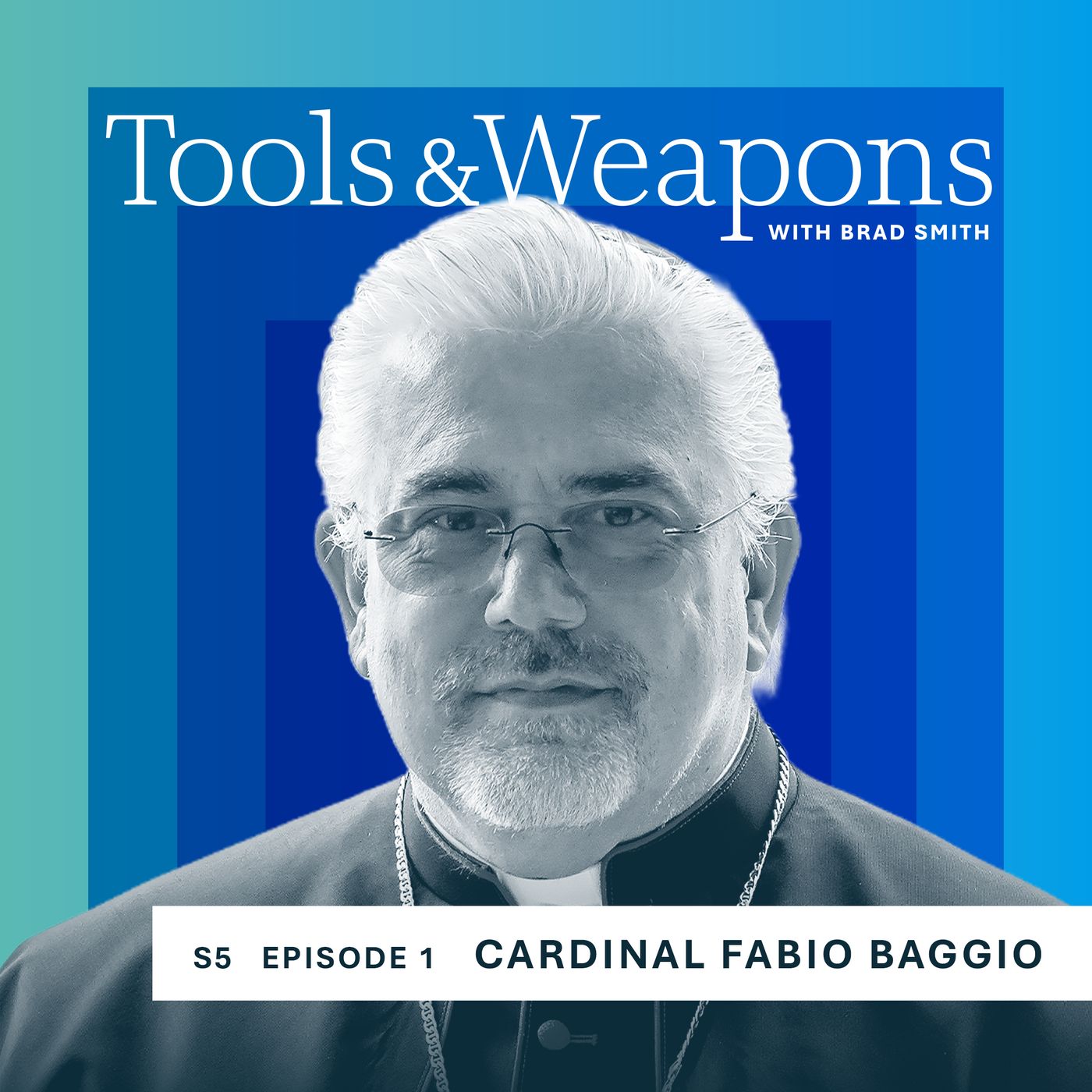
Cardinal Fabio Baggio discusses Pope Leo’s encyclical Magnifica Humanitas on human dignity in the age of AI, arguing AI must remain a tool serving people, not a system that makes humans subordinate to technology. He connects this to Catholic social teaching on migrants, “integral human development,” and the dignity of work, warning that unequal AI access could create new forms of servitude.
Fabio Baggio is a Scalabrinian missionary and Vatican cardinal (named in Dec 2024). He spent decades working with migrants and refugees, including in Chile and Argentina, and became a close collaborator of Pope Francis. He previously led the pastoral office for migrants in Buenos Aires. He now serves in the Vatican dicastery for promoting integral human development, including AI-related work.
AI should not replace human judgment, reason, intelligence, emotions, or relationships. Ethical governance needs real disclosure of scenarios; a Vatican AI commission is being coordinated. AI access should be democratized, not limited to elites.
his migrant-refugee work in Buenos Aires (documentation, housing, work conditions); comparisons to Pope Leo XIII’s industrial-era concerns; references to AI potentially enabling “new slavery” and to ongoing modern slavery/trafficking.
Written by AI. May contain mistakes.
Explore Cardinal Baggio's life as a missionary and his experiences with migrants.
“As a lifelong missionary, he spent decades working alongside migrants and refugees, and he became one of Pope Francis's closest collaborators.”
Discover Cardinal Baggio's insights on migration and the church's role.
“We're here in New York for the week of the UN General Assembly.”
Hear how Cardinal Baggio emphasizes community support for migrants.
“It seems to be such a fundamental part of what the Church does.”
Learn about Cardinal Baggio's relationship with Pope Francis as a close collaborator.
“And it was the first one mentioning about the cure for migrants.”
Understand Cardinal Baggio's view on upholding human dignity amidst challenges.
“Just think about Archidiocese, where 25 % of the population were just coming from other parts of either Argentina or other parts of Latin America.”
Explore what it means to be a cardinal and the responsibilities involved.
“So it was both a mission of faith and a mission to be of help to people.”
Learn about Cardinal Baggio's insights into the conclave process and its importance.
“I thought he was cracking a joke and said, please, not make enough jokes with me.”
Understand the role of dicasteries in the Vatican and human development initiatives.
“for promoting integral human development.”
Explore how the Vatican's focus on integral human development intersects with social issues, including AI.
“And just think about the state where you have different ministries.”
Discuss the philosophical and theological questions of purpose and existence, drawing from Socrates to Pope Leo XIII.
“Well, what's extraordinary to me in part is you're pulling on threads that literally go back to Socrates and Greek philosophy.”
Analyze the evolving understanding of work's dignity in the context of technological advancements.
“One of the things that I really appreciate about Pope Leo's recent encyclical, Magnifica Humanitas, is the title.”
Examine how AI should complement human work rather than replace it, emphasizing relationships and creativity.
“It speaks to the role of work and the impact of AI.”
Exploration of the future of AI and its ethical implications for society.
“then only an informed decision can be made.”
Discussion on AI's potential to improve healthcare and education globally.
“After all, this is a podcast that follows the name of a book that we wrote in 2019 called Tools and Weapons.”
Addressing the risks of AI leading to new forms of slavery and economic asymmetries.
“It's interesting because when I think about your concept of the whole person and how important that is, how central that is to the church.”
The importance of human relationships and dignity in the development of technology.
“I would like to recall Pope Francis talking about human trafficking as a form of slavery that we have today, talking about condition of work in servitude or slavery, as was saying, that they are coming up today.”
Description of Borgo Laudato Si and its mission towards environmental stewardship and collaboration.
“and it is a missionary effort to bring to the world the messages and really principles and values that you're talking about.”
Learn how the Borgo Dialogues aim to create a collaborative space for sharing visions of sustainability.
“So why not connecting one and the other together with the practitioners, with advocates?”
Discover the importance of the Pope's encyclical addressing human dignity in the age of AI.
“How can we change the present in order to have a scenario that we would like to have at the end?”
Understand the significance of having women in leadership roles within the Vatican, as exemplified by Sister Alessandra.
“You're playing a leadership role in that.”
Reflect on the unique moment in history and the role of technology in promoting human unity.
“Even for artificial intelligence, our dicastery is in charge of coordinating the commission that was just mentioned, the commission of AI.”

Get the gist, explore an idea or ask about something said.
 Claude
On Tools and Weapons with Brad Smith, what are the key points of this episode?
Searching your listeningAutomatic transcript. May contain errors.
0:00Pope Francis was frequently referring to the technological paradigm and say just to be careful that when all the technology is taking the place of human beings and becoming even more important, what is the role of human beings? Is that it's becoming an object and a servant of something or it is everything we are building is at the service of human beings? That's Cardinal Fabio Baggio. As a lifelong missionary, he spent decades working alongside migrants and refugees, and he became one of Pope Francis's closest collaborators. That same concern for human dignity now extends to a new frontier, artificial intelligence.
0:47At the heart is Pope Leo's new encyclical. It's called Magnifica Humanitas, or Magnificent humanity. And it poses a simple but profound question. How do we ensure AI remains a tool that serves humanity rather than people becoming servants to the technology we've created? Cardinal Baggio, up next on Tools and Weapons. Cardinal Baggio, Your Eminence, welcome. It's great to sit down with you. We're here in New York for the week of the UN General Assembly. you're playing an important role on behalf of the Vatican on a wide variety of issues, including AI. But I'd first like to start talking a little bit, asking a little bit about you.
1:31You became a cardinal in 2024. I'm curious, growing up, did you ever imagine that that was something you would become? Honestly, no. It was out of my imagination. Never thought about being a cardinal, not even being a bishop. I just, well, I chose in my life to be a missionary, to just go around the world and preach the gospel all around, particularly addressing migrants and refugees. This is part of my congregation goal, but never thought about being a bishop or a cardinal. Well, and you obviously did become a priest and became a missionary and grew up in Italy, but spent a good deal of time in Latin America.
2:13Can you tell us a little bit about that? Yeah, I think it was a grace because I ended my studies in Rome in the Gregorian University. And I was asking my superior to be sent somewhere for mission because they were envisioning for me some kind of study, further study or PhD or whatever. So I just reached a compromise and I was doing my PhD in Latin America. But doing mission in Chile the first time, two and a half years and five and a half years in Argentina. And there I met Bishop Bergoglio. The future Pope Francis. I'd love to ask you about that, but before I get to that, let me ask you, the Vatican, the Catholic Church is so committed to helping and protecting migrants.
3:01It seems to be such a fundamental part of what the Church does. I remember my first interaction with Pope Francis. I went to talk with him about AI, but in truth, I think he was much more interested in the work we were doing to protect immigrants. What drew you to the protection of migrants? Well, I entered the seminary when I was very young. I was 11 years old and I didn't know anything about migrants. But the congregation I entered, they were missionaries for migrants. So I started in my very young age to be knowledgeable about all the migration flows around the world. And I got the, I have said the honor to meet a lot of missionaries that they spent their life for Italian migrants first, and therefore any other migrants around, any other refugee around the world.
3:50And I was really fascinated by the work that they were doing. So I thought this can be my life. And actually, when I was 18, I took my chance and say, well, this is my vocation. This is what God is calling me to do. and I decided to be a missionary. And I became priest when I was 28, and I started my mission there. And I just discovered that that was a passion within the church of many, many popes even before, because since we have to go big to Leo XIII and thinking about how he was really concerned about migrants, it was massive flows of migrants from Europe going to the United States, going to many other countries and continents.
4:36And it was the first one mentioning about the cure for migrants. And the founder of my congregation, Bishop John the Baptist Calabrini, he was the one really advocating for them and going around. So when you were young, you were in Argentina. Tell us a little bit about getting to know the person who we would all get to know as Pope Francis. When I started my missionary work in Argentina, I was immediately appointed as the chief of the office for the pastoral key of migrants of the Archdiocese of Buenos Aires. But the bishop was another one. So I was here when Bishop Bergoglio was appointed archbishop.
5:21It was very interesting because I waited quite a long time to have a first meeting with him. But when we had a meeting, I discovered that he was really following the work that I was doing. And it was telling me, this is a very important work, and I would like you to continue the work that you're doing. Just think about Archidiocese, where 25 % of the population were just coming from other parts of either Argentina or other parts of Latin America. So it was a huge population, many different communities, many of them Catholic, of course, and they were just integrating within the Argentinian society.
5:59But with some hindrances, some difficulties, because, you know, when you are just going to different countries, there is a moment that you have to adapt to the new situation. And it's not always very simple. What did you learn about that community or just about people more broadly from that experience? That was really a learning experience. In Chile, before I was working with refugees, particularly coming from Peru because of different political situation there. And also being exposed to the exiled Chilean and that they were just outside their country and living a very dire situation, I would say.
6:40But then when I reached Buenos Aires, I understood all the importance of accompanying the different communities in a path of faith, but together also with a lot of material help. Many of them were just facing difficulties of documentation on the one side. Dwelling spaces also was one of a problem. And also working conditions. So we were working on the one side with mass celebrations, sacraments. But a lot of work in the office was done also for very material things, I would say, just as social assistance provided to migrants and refugees. So it was both a mission of faith and a mission to be of help to people.
7:25And I understood that it was impossible to split one on the other. I mean, you have to work thinking about the whole person whenever you're working. This is one of the lessons that I learned also from Bishop Bergoglio, that I was saying, when you're looking to a person, it's a whole person. So it's not just splitting the spiritual side from the material side or the physical one. And you have to think about how to uphold the dignity of a whole person, all the dimensions. And have an understanding and empathy and lend a hand to a whole person who is outside the country where they grew up, a foreigner, needing assistance.
8:08I mean, I think that's one of the extraordinary things that the church has done in every country. Yeah, it has been like part of a real missionary work of a local church and all the missionaries coming, taking advantage of the fact that the missionaries many times are coming from the same countries. So they can be very near to the culture, to the language of those who are just newcomers and then new settlers in the different countries. But on the other way, also understanding that the goal that we have is to build united communities in faith, but also to assist them in the process of adapting to a new society and make them proactively agents of change, transformation, and development in the society which welcomed them.
9:08so it was years later you were back in italy your home country you were in rome you were at the vatican pope francis was pope francis um what was it like when he asked you to become a cardinal Well, it was quite a difficult situation for me. And I have to confess that I was not prepared. He tried the first time, maybe two years before, just to hide the possibility. I thought he was cracking a joke and said, please, not make enough jokes with me. I don't think that I can be a cardinal. I'm just a missionary and I would like to be a missionary. We are religious. He was a Jesuit. I am a Scalabrinian.
9:51So just you can understand the situation that they would like at the end of a mission just to go back and do the mission as I was doing before. But then he insisted and he came for the second time and said, oh, this is serious. I say, please let me do the work that I'm doing. The third time he was really insistent. And I think it was also the time that he was really seeing maybe the end of his pontificate. It was not good in health. And he was telling me, now I'm asking you to accept. And I said, well, if you're asking me out of obedience, I'm saying yes. That was December of 2024. Of course, for many folks, including me, who is Presbyterian, I grew up as a Presbyterian.
10:38What does a Cardinal do? What do you do as a Cardinal? Well, that was one of the questions that I asked both friends. and say, what do you want me to do? Because why is the reason that I should be a cardinal? And say, well, you know, the Pope is choosing advisors, counselors and good actors, helpers, assistants. And I think always the cardinal to be assisting me in some specific issues. You're helping me with migrants, refugees. You're helping me in the dicastery for promoting integral human development. And this is why I think you can help from this perspective. Secondly, there is a special role, which is a cardinal would play in the moment of a conclave.
11:21And I think he was already thinking about the conclave. This is why he named several cardinals. We were a very huge batch of cardinals, the last one of the Pope Francis, just thinking maybe of the new election. I see. So one part of it would be the conclave, the selection of the next pope. which is a very, very important responsibility. Clearly. The experience of feeling responsible of what is going to happen is really, I would say, heavy. It's a heavy experience. No, it's a unique moment in, obviously for the Vatican, for the Catholic Church, for not just Catholics, but I think people of almost every faith worldwide.
12:07And unlike regularly scheduled elections, You don't know when it will come. You don't know when the next one will come after that. So you need to get the choice right. And there's a whole exercise of people speaking and listening and talking that goes into that. Yeah. Even if we tried and we were also instructed also to be just only focused on the good food of the church and not reading other things. And we were also prevented from some kind of influences coming from outside. And I think it was a moment, at least for me, and I can confess, a moment, an experience of the Holy Spirit. For believers, of course, those who can believe that the Holy Spirit can influence, it was really the presence of the Holy Spirit for everyone.
12:56And I share the same experience with other companions of the journey, of this journey, that it was exactly the same. and I'm always cracking a joke and saying that irrepeatable experience because I would like to see Pope Leo to go on for the next 20 years, 25 years. So I would be more than 80. And once the Cardinal is 80, the Cardinal no longer - Is not electing anymore. Right, yeah. Mandatory retirement. Which is good. I would say for us even now because it's a very good service, but then leaving also the work to others who are just coming with a younger age and with new ideas. I want to go back to a word you used a few minutes ago, dicastry.
13:40That is not a word that most of us hear in everyday life. Tell us about the role of the dicastries and the role you then played once you became a cardinal. Thank you. The question is well posed because sometimes we are talking about dicastry and everybody's looking at me and saying, what are you talking about? And just think about the state where you have different ministries. And the Vatican is exactly a state with different ministries. All the ministries are deputed to help the Pope in some kind of issues. The ministries that I'm in today is a focus on integral human development. It means all the social issues that you can imagine, even the new ones.
14:26Artificial intelligence is a new one. And our dicastery is collecting a lot of issues from also the word because there are new, new ideas, new theories coming that should be assessed, passing through the social doctrine of the church, which is exactly the mandate that we have to develop also the social doctrine of the church, of course, in assistant to the magisterial work, meaning the teaching work of the Holy Father. So this is what we are producing in consultation. And our ministry, our dicastory, is in charge of assisting local churches in promoting human development, integral human development in the territory of their diocese.
15:08So thinking about parishes, thinking about diocese, working with the Office for Health, for human dignity, human rights, thinking about labor, work, labor, thinking about migrants, refugees, indigenous people. And I can go on with plenty of economy, ecology, and many other issues who are just part of social concerns. And it sounds like there's a real connection, perhaps, between your early years to focus on a whole person and now focusing on integral human development. In other words, how do you nurture that whole person and how do you do it at the local level all around the world? Is that a fair way to think about it?
15:51Yeah, it's a fair way to think, and I think it's part of the teaching of the popes since the real beginning of the social Catholic teaching, meaning the Rerum Novarum of Pope Leo XIII was a starting point. The starting point collecting from the past, how the church developed also the understanding of human beings and human existence. But I think it is mostly based in what is the plan of God for each of us. There is a vocation of existence. We are existing because God wanted us to exist, and there is a plan for each one of us. The fulfillment of a plan in full dignity, I would say, in a full realization of what we are and what we can do is exactly what we are aimed with an integral human development.
16:46With all the dimension, including the transcendental, the spiritual dimension. In so many ways, I think you focus on some of the deepest questions that people may ponder. Why am I here? What's my purpose? What's my role on this earth? You build on the past, but need to take this out to people around the world, very much in the world of the present. Yes, and I think it is so, so urgent for the younger generation are coming that sometimes they are just disturbed by many, many messages received. And they're asking to themselves, why am I here? And the answer to the question of a reason of my existence is so crucial in defining the present of the future of a human existence that we have to insist on.
17:41And everyone, it cannot just be told. You have to discover. It is like what Socrates would say in a maieutical way, that it is the answer is within you. We have to help you to find the answer. And if it is, I mean, for a faithful person, because you are open to faith, it will be God and God's vocation. If you are not a believer, you can still find the reason to be here, being part of a human family who is growing with you and is living something for the forthcoming generations. Well, what's extraordinary to me in part is you're pulling on threads that literally go back to Socrates and Greek philosophy.
18:22But I think even more, as you said, the social mission, the social teachings of the church, going back to Pope Leo XIII, the last pope named Leo before the current pope, Pope Leo XIV. That takes us back to, I think, the connection with technology to some degree, because obviously it was the 1890s. Pope Leo XIII was concerned about the impact of industrialization, mechanization, the plight of workers, the dignity of work. How did that influence, in your view, the course of the Catholic Church to this day? The same concern that was the concern of Pope Leo XIII is now the concern of Pope Francis and Pope Leo.
19:18Magnifica Humanitas and the recent published document, Encyclical Letter, is just focusing on human dignity and the age of artificial intelligence. Just say that it's the new age, exactly as it was industrial age at the time of Leo XIII. New questions coming from the people, from the world, innovation, technological innovation, industrial innovation, changing the life of the people and understanding that might be some concerns or some hindrances coming from what this kind of paradigm is going to propose. Pope Francis was frequently referring to the technological paradigm and say just to be careful that when all the technology is taking the place of human beings and becoming even more important.
20:11But it would say exactly the same when the economy is becoming not at the service of human beings, but human beings serving a certain economic system, which is exactly the same. I would say the centrality of human being in all the world that we are building, being economic or technological, this is what is at stake today and what we have to foster in our discussion. And thinking, what is the role of human beings? Is that becoming an object and a servant of something or it is everything we are building is at the service of human beings?
20:58One of the things that I really appreciate about Pope Leo's recent encyclical, Magnifica Humanitas, is the title. Obviously, it's in Latin, so it may not jump off the page for people who are unfamiliar with the words, but it's Magnificent Humanity. Why those two words? I think I was not part, of course, of deciding the title. Pope Leo decided the title. And I can grasp that he really wanted to have a title as it is. Magnificent Humanity. Just think about how great is the work of God when he created human beings and human family. and we have to refer to each single human being as magnificent. And if it is not, the mistake is in the system that we have to rearrange.
21:57If you are not feeling that you are Magnifica Humanitas in you, there is something missing. It's just because we were not able to produce a system making you Magnifica Humanitas. And I'm thinking about a different situation around the world where this adjective would be difficult to apply when you're looking at different situations around. And, well, we're talking about poverty, of course. We're talking about war or whatever it is. And this is where we have to start thinking what is the role of each one of us in making really Magnifica Humanitas a reality for each single human being. One of the things that is striking to me that I see in Magnifica Humanitas is also a mirror to some degree, an evolution certainly, of some of Pope Leo XIII's writing in his encyclical, because he talked about the role of work and the dignity of work in people's lives.
22:59It's not just a source of income. How do you see the role of work as we look at it today? There was a huge development in thinking about work in the social doctrine of the church. Actually, at the real beginning, many would think about work as a sweat and fatigue and a lot of, I mean, a lot of distress coming from the work, particularly when you're doing something that you don't like. And at the end of the day, you're feeling tired and you don't want to go back to. But I mean that evolution and thinking would say, no, you are provided an opportunity to be creative in the world which has been given to you, the place where you're living and the place of work that you are staying.
23:50Making changes, innovating something and producing something which is good for you and for the rest of humanity. And this is another idea where you yourself would fulfill what you are in the moment that you are doing and that you are working. And if I'm taking out from you this idea of work, I mean, you can just be in ocean. You just stay without doing anything. It's just that you are failing to fulfill one of the very important dimension of your life. And I think my favorite chapter of Magnifica Humanitas is chapter four, which goes to the heart of what has brought you and me together, AI. It speaks to the role of work and the impact of AI.
24:45What do you think we all need to be thinking about as this intersects? As any other technological innovation, and this is a huge one, we are talking about artificial intelligence, is a huge one in the age of soated meaning that is very, very important, even for Pope Leo, is the idea of thinking about a tool which should serve human beings and should make our work easier, but not substitute the role of human beings in doing things, in creating things. because it is part of our humanity. And there is also something else which is entailed in our work, which is relationships, which are also very important in normal life, in our family life, but also in our working life.
25:37Labor, also relationships are important. So on the one side, thinking about artificial intelligence, we should not have any prejudice. I think innovation can be good, is always good when it is making my life easier, when it is canceling some of the difficulties that I normally find in my life and I can have a more comfortable life. But the same way should not substitute my judgment, should not substitute my reason, should not substitute my intelligence, which is not artificial, but is human intelligence. And this kind of, and should not and cannot substitute my emotions and my relationship with the others.
26:22And as you look at the world today and all of this conversation that's happening about AI moving too fast, do you worry that we run the risk of it moving faster than not just the speed of safety, but the speed of human thought and connection that need to have this conversation? One of the things that really struck me in the past month being part of the DICAS tree and receiving, we have received a lot of calls coming from the private sector. Those who are developing artificial intelligence and say, please look at what we are doing and help us and assist us to understand what are the consequences of different discoveries and innovation that we are just planning and do.
27:07And this call for me has been prophetic. I mean, a sign, a sign of God and say, we have to be there. And I do believe that the encyclical letter, Magnifico Humanitas of Pope Leo, is just a concrete response to these calls that we have received. But this was not enough. A new commission has been established by Pope Leo, and we are coordinating the Commission on Artificial Intelligence at the Vatican level. Just to answer to the different question, because you can have principle, but then you have application of a principle in the different sectors. And this is what is still missing. But in order to do that, it is very important for us to know exactly what is going on.
27:50Because sometimes, and I understand it, some of the studies are just secret, confidential. But in order to start to think ethically to what we are doing, thinking about the consequences, the disclosure of real scenarios that we should be prepared for is really important. then only an informed decision can be made. If not, it will be just a decision based on the little information that we have. I'm very happy to see, very glad to see, that there is a lot of cooperation coming from the private sector and say that we are going to help you. This is what we can do and this is what we are doing and this is what we can think together in terms of ethical thoughts.
28:39If you just take a moment and imagine a future 50 years from now, maybe a few popes from now, and people look back at the work of the commission, the work of Pope Leo, the work that you're contributing to through your roles, if all goes well, what would you hope people would look at and say that made a difference? if ever we'll be not alone, but all together, because this is very, very important. It's just a question of the church being responsible of everything. The Catholic Church is a little piece of a community working of artificial intelligence and thinking. I would like to see a scenario where everybody is fostered in their dignity and everybody's feeling comfortable to use the technology.
29:33And a technology which is accessible to everyone and not for a few. There is not an elite of the world taking up decision for everyone. And a democratization process is reaching really the farthest corners, I would say, of our world today. I'm saying that because I can notice that today the access to technology is not really for everybody. But there is a limitation which is provided either by economy or by geographical position. And it is very important, I think, for us and for all the actors who are willing to join us to see how this can be instead reverted in terms of democratization, meaning making it available to everyone.
30:23So let's take that a little bit and unpack it. After all, this is a podcast that follows the name of a book that we wrote in 2019 called Tools and Weapons. And I think you're capturing the ability of AI to be a tool, something that can actually bring improvement to people's lives. And in some ways, I've often found and felt that a good test for that are migrants who are refugees in a refugee camp. how it can be a powerful learning tool, a powerful tool of connection. Something that we're not really talking about that much right now is we're so focused on the weaponization potentially of AI. Where do you see the opportunity for the Vatican and the Catholic Church to help advance this broader diffusion and accessibility to everybody?
31:18When we are talking about the prophetic role of a Catholic Church, is also to be able to speak very clearly what is the reality. Of course, knowing the reality and also able also to speak on reality based on the principles that have been clarified during the year in the social doctrine of the church, but at the same time also new principles which are application to this particular sector. As you said, we can foresee all the usage and the importance of the tools produced by artificial intelligence just to think about health. How surgeries can be done everywhere in the world and you can expand the capacity of reaching every person with a diagnosis or with a therapy.
32:09This is wonderful. And I think it's improving a lot the art of working for the health of everyone. Or thinking about communication, just to mention one thing, or providing tools of elaboration of thought. Or schools, education. I mean, you have plenty of wonderful application of artificial intelligence. When you're talking about weapon, it is exactly the destruction of what we are building today. Anyway, thinking about, well, the stand of the church has been always the same in the past century. I think it is working for peace and building peace whenever and with the dialogue that we can. We must understand also the need of security, whatever is needed for every country.
32:56But the same way we are also thinking about developing the tools that we need instead of the weapons. But when innovation is just done in order to produce new weapons or more effective weapons, we are just asking if it is a real purpose now of a creative power that we have. It's interesting because when I think about your concept of the whole person and how important that is, how central that is to the church. And on the tool side, this is really about ensuring that every person on the planet can have an opportunity to benefit from the improvements this can bring. I think that was part of what Pope Francis embraced with the Rome call.
33:42It was not just having ethics for AI, but spreading it so that people would benefit from it. And then on the weapons side, one of the more, to me at least, dramatic parts of Magnifica Humanitas is this warning, I would almost call it, towards the end of chapter four. It talks about AI as potentially creating a new form of slavery. Strong words. But it acknowledges that the church, like most of the world, was slow to recognize that human bondage was something that should be forbidden. Took centuries to come to that conclusion on a global level. And yet suggested that AI could, in effect, create a new form of bondage.
34:37Can you talk about that piece? If you think about the asymmetries that we are just seeing today, economic asymmetries that we have, and asymmetries in access to wealth or any kind of comfort that we have or any kind of education or whatever, we have to see that we are in balance today. And the imbalance is quite evident. And according to the stats that are produced every year, we can see that it is even enhanced during the past years. We are putting sometimes goals, the SGDs of millennium development goals, in order to try to balance a little bit. But then we have to declare again that we fail to reach and we have to start with new goals to be set.
35:26Well, artificial intelligence, if it is only for few, if it is governed only by few, it might be also used as a power exercise over others. So this is why the strong word was used about servitude of slavery, if you want. But I would like also to highlight that it is not the only form that we have today. I would like to recall Pope Francis talking about human trafficking as a form of slavery that we have today, talking about condition of work in servitude or slavery, as was saying, that they are coming up today. And we thought they were just part of the past, but eventually today they are coming out again.
36:16And thinking about a step, not forward, but backward, in the civilization that we worked on in many, many centuries. You were saying it took centuries to understand that we are all equal and no one can be a slave of the other. And now we cannot go back. And working also in the sector of migrants and refugees, stories brought up by many media are talking about a lot of slavery, which is still ongoing in different migration flows. I really think that that section is not just thought provoking, but critical and even profound. And you captured so many dimensions. To me, there's a closely related dimension, which is we work for our own self-improvement in so many ways.
37:10And yet, if this becomes an exercise of humans working just to help AI become smarter, that runs the risk of creating yet another form of servitude, if you will. We need to keep ourselves grounded in the centrality of ensuring that this technology serves people and avoid a situation where people are serving the technology. And I have to add something to the reflection, because if we do believe as it is now that we are relational beings and we are enriched by the relationship with others, the good relationship with others, the more that the others are feeling well, the more that the others are, I would say, fulfilled in their dignity, the more that we gain in the relationship with them.
38:01whenever we close and we think that only ourselves are the ones to be developed, and we are not looking at the development of integral human development of others, we are losing the opportunity to be more because when the other is more, that relationship with the other would make me more. We're talking about humanity. If I'm really human and I'm developing an attitude or make also the other more human or giving access to humanity, to human dignity, also to others, and to fulfill their dignity, I'm also enriched by what I'm doing. And this is something that should be applied then to the different technology that I'm using and to the different choices that we have and the different decisions that we are doing.
38:47So to advance this mission, it really is, I think listening to you, it is a new mission. and it is a missionary effort to bring to the world the messages and really principles and values that you're talking about.
39:10Let's go back to the practicalities. You were describing your dicastry. I've had a chance to learn a little bit about the dicastries. your role's not entirely a typical one. It is broader than many. Can you say a little bit about that? Well, in the task that was given to me immediately it was also entailing a new project which was part of Pope Francis' vision. With Encyclical Letter Lauda to See it provided a document for the general reflection on the climate crisis, on what is happening, environmental crisis, and integral ecology, which is what is encyclical all about. Ecological conversion, integral ecology, thinking about a new way of understanding human beings within the rest of creation.
40:06And Pope Francis has highlighted a couple of principles that are actually part of the work that I'm doing today, The first one is restoring good relationship with the rest of creation, because we were just using natural resources and not being friendly and not being administrator of. So the things of understanding ourselves as a part of creation and in relationship with them. And the second thing about the spatial role which has been provided to every single human being to be a custodian, to be an administrator of a wonderful richness, which is the world that we have, the planet that we have, the nature that we have.
40:55So on the relationship with nature and stewardship, the two principles that we tried also to implement in a project that Pope Francis initiated, and we call it Borgo Laudato Si, which is a special place in Castellandor for 55 actors where we're trying to implement the integral ecology. So tell us about this, the Borgo Dialogues, which you have created, bringing together different people. I'm very struck, impressed by this focus that you're talking about, taking these issues, bringing together these different people, focusing with moral clarity, intellectual rigor, but all in service of pragmatic, practical steps and solutions.
41:39How do you do that? When we started the work at Borgo Laudato Si and the project, we thought that opening spaces for discussion with other actors was really relevant, important. We cannot talk about sustainability without including other actors. And we thought particularly to work with the private sector and with academic work. So why not connecting one and the other together with the practitioners, with advocates? and opening a space which is a neutral space that everybody is feeling comfortable with, that you can come, you can share your vision, you can stay. It's very important. You can stay in a very special place, which is just within nature.
42:22You're feeling very comfortable when you're staying. At the same time, also feeling that you can share whatever is coming to your heart. And what we noticed that this was immediately accepted by many, many of the private sector, many academicians, they say, yes, we would like to. And we have a selection. They're beginning just to start with and to see if everybody can feel the same and staying together. And we have a couple of days at Borgulavs to see. And now we have new days here in New York that we are just sharing with the same people and proposing particular topics. We choose just to start aging, sport, AI as a particular topic.
43:04but we can add many more because they are part of the sustainability of the world that we would like to build. And I would say that exactly the question that you asked before, looking at the world 50 years from now, is this exactly the work of the Borgo Dialogues, which is a world that we would like to achieve in these years to come? What is our role? How can we change the present in order to have a scenario that we would like to have at the end? And thinking about a new role which is provided to the private sector in this sense through investment, of course, and decision made within the companies and the industries that can forge exactly the scenario and the future that we would like to have.
43:54It sounds like the perfect way to build on the recent encyclical, Magnifica Humanitas. Maybe as we close, let's think about that as sort of a bit of the jumping off point for what is to come through the Borgo Dialogues and other things. You know, for people who are not experts in the Catholic Church or the Vatican, one doesn't get an encyclical from the Pope every day. This one came quickly in the tenure of Pope Leo. Tell us a little bit about the role of any encyclical, but in particular, why this one? Why now? When we talk about an encyclical letter, it means a letter which is meant to circulate everywhere.
44:44And normally it is addressing the whole world, meaning not only the faithful, but all men and women around the world. So they can hear what is the thought, the reflection of the church in specific issues. And we have Laudato Si on, just to mention, on integral ecology, fraternity and social friendship. And now we have Magnifica Humanitas on human dignity and the age of artificial intelligence. I think that response was so quick simply because when you feel that it is very urgent an issue and probably you felt that it was urgent to give a response, then everybody would work in order to assist Pope to produce a document.
45:31So he consulted a lot of people and he was really willing to come out as soon as possible with the document that we had. And I think the documents represent a real statement of the Pope and the Catholic Church on the issue that we just, the centrality of human being, human dignity, and this facing a new technological paradigm. So the last thing I just want to touch on, and I'd love to get your thought, Pope Leo put in place a commission of seven individuals to lead this work, to coordinate this work for the Vatican and for the church to speak, spread the word of this worldwide. You're playing a leadership role in that.
46:18But there's another person who's playing a leadership role, Sister Alessandra. This is a bold encyclical. It's a bold commission. But I might suggest that that is also a bold move to have a woman in this leadership role. Can you say a little bit about her? This is a wonderful decision made by Pope Leon, which is just stating how Pope Francis was right in providing spaces, spaces of government also to women, which is a huge change within the church. And I think the role Cicera Alessandra played in the past year as secretary, meaning the second position in the same dicastory, just prepare her to be the real leader.
47:08I'm so pleased to be with her. And the role is prefect, which is the chief of the dicastery, the chair of the dicastery. And I'm a co-chair. I mean, just to stay with us, co-president with her in the dicastery and assisting her from the part of the expertise that I have and being with her. Even for artificial intelligence, our dicastery is in charge of coordinating the commission that was just mentioned, the commission of AI. But at the same time, I would say that the leadership of Sister Alessandra, a lady, an economist, you have two, a religious, a Salesian, it is very, very important. And it's also a good sign of changes produced even within the church in this sense.
47:57Well, I know I need to let you go because you have important people to meet with and the word to spread across New York today and tomorrow. I hope you'll come back. I know we'll have the opportunity to work more closely together in the months and years ahead. I just want to say we're dealing with an extraordinary technology. It's an extraordinary moment in human history. you and obviously Pope Leo and under his leadership are meeting the moment in unique ways with a message that I think increasingly can not just promote the whole person of every person, but bring us all together. So thank you.
48:38I look forward to having you back. Thank you. And I'm sure this is not the last time and then we're going to have other meetings, I'm sure. You've been listening to Tools and Weapons with me, Brad Smith. If you enjoyed today's show, please follow us wherever you like to listen. This episode is also available in video on the Microsoft YouTube channel. Our executive producers are Carol Ann Brown and Brent Christofferson. This episode of Tools and Weapons was produced by Mike Morrisrow and Lexi Swanson. This podcast is edited and mixed by TriFilm, with production support by Sam Kirkpatrick at Run Studios.
49:15Original music by Angular Wave Research. Tools and Weapons is a production of Microsoft.
Cardinal Fabio Baggio joins Brad Smith to explore how faith, human dignity, and artificial intelligence intersect, and how Pope Leo XIV is helping shape the Catholic Church's response to one of the defining technological transformations of our time.
Drawing on decades of serving migrants and refugees, Cardinal Baggio shares his journey from missionary work in Latin America to working alongside Pope Francis and, today, helping guide the Church's response to AI under Pope Leo's leadership. At the center of their conversation is Pope Leo's encyclical, Magnifica Humanitas (Magnificent Humanity), which examines how AI is transforming society and what it means to protect human dignity. From the future of work and human relationships to equitable access and the risks of new forms of servitude, the conversation explores a fundamental question: How do we ensure technology serves humanity, rather than the other way around?
Brad Smith - Vice Chair and President at Microsoft Corporation | LinkedIn