Ask ChatGPT
 TrumpWorld
27 Oct 2026 · 32m · 14 chapters
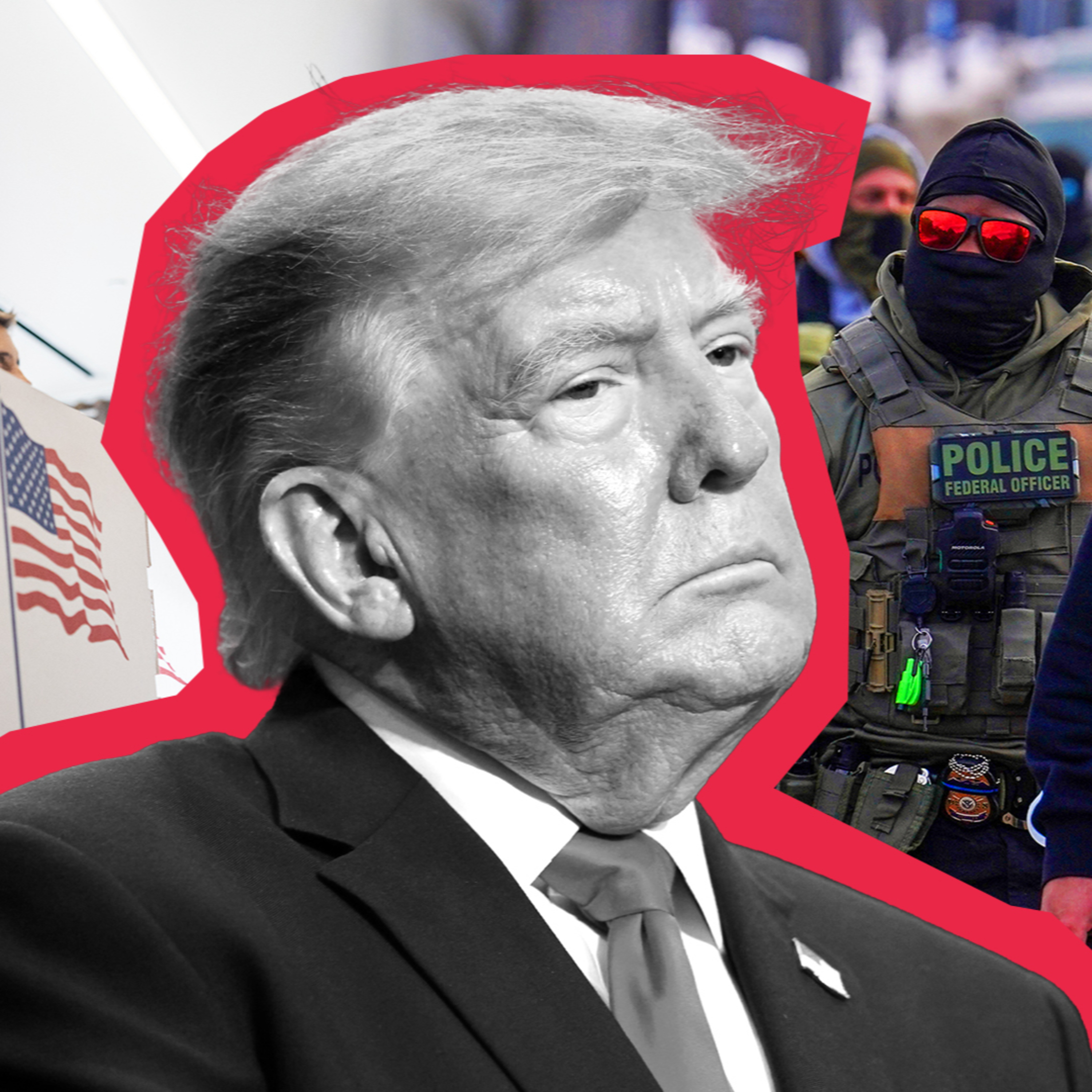
Whether the upcoming US midterms will be free and fair, focusing on (1) Trump’s pattern of questioning elections, (2) claims that ICE raids and threats of ICE at polling places could intimidate voters, and (3) how campaign finance rules and “dark money” via super PACs weaken enforcement by a weakened Federal Election Commission.
Ellen Weintraub, former Federal Election Commission commissioner and chair (multiple terms) who says Trump illegally sacked her; now a senior fellow at End Citizens United.
No evidence of substantial voter fraud affecting outcomes; FEC is effectively defunct with only two commissioners, so investigations/penalties are unlikely; super PAC spending (often from a few wealthy donors) distorts politics; dark money reduces transparency; threats of ICE at polls would be illegal but intended to intimidate.
Elon Musk funding super PACs (hundreds of millions) and USAID being undermined; Alaska lawsuit seeking to block certification; “craziest lawsuit” language; voting early/by-mail/dropbox advice.
Written by AI. May contain mistakes.
Discussion on Trump's history of denying election results and potential voter intimidation tactics.
“This is the craziest lawsuit we've ever seen.”
Ellen Weintraub discusses the state of the Federal Election Commission and worries about free and fair midterms.
“This week, I'm focused on the issue of whether those midterms will be free and fair.”
Ellen explains the impact of Trump's rhetoric on public trust in the electoral process.
“How worried should we be about these midterms?”
Discussion on the overwhelming influence of money in American elections, particularly super PACs.
“There's no evidence that any more than an infinitesimal number of non-citizens have ever voted in U.S.”
Exploration of the Supreme Court's Citizens United decision and its effects on political funding.
“Well, when you're that rich, you can afford to do it again.”
Ellen discusses the issue of undisclosed funding sources and the implications for democracy.
“time on the campaign trail you basically spend speaking to fundraisers to try and get the money.”
Analysis of Elon Musk's financial contributions and motivations in relation to government contracts and political candidates.
“But just before we do, you obviously mentioned Elon Musk.”
Explore how Elon Musk's wealth influences his political contributions, particularly in Texas.
“And let's remember that a good portion of Elon Musk's fortune derives from government spending, from government contracts that his companies get.”
Discuss the impact of super PACs on electoral campaigns and their legal implications.
“Paxton, had been having a very hard time raising money.”
Analyze the limitations and challenges facing the Federal Election Commission in ensuring electoral integrity.
“That creates an environment where the risk takers, the ones who are most likely to push the envelope, are going to feel even more emboldened to try to get away with.”
Examine Trump's unprecedented actions regarding election security and potential voter intimidation.
“And we're talking about over 60 complaints that were filed when I was there.”
Discuss the implications of ICE potentially being sent to polling stations and its effects on voter turnout.
“individuals who have voted usually out of ignorance, voted when they shouldn't have voted?”
Explore the legal protections in place to safeguard elections from federal interference.
“I mean, you started off quite optimistic, but you must be worried about certain states going along with what he wants.”
Explore how financial influences and potential interference could impact election results.
“But I do think that there is potential for mischief should control of the Senate come down to one last seat and it's the Alaska seat.”

Get the gist, explore an idea or ask about something said.
 Claude
On TrumpWorld, what are the key points of this episode?
Searching your listeningAutomatic transcript. May contain errors.
0:00This is the craziest lawsuit we've ever seen. It is not reasonable to go into court in advance of the election and say, you can't certify the election unless our favorite candidate wins. That's just nuts. Donald Trump, the president, has a history of denying election results. We can almost certainly rely on the fact that he will question the results. He is, frankly, kind of a sore loser. The ICE raids that we're seeing across the country have targeted plenty of people who are legal and who would be allowed to vote. The whole point of it is to intimidate voters. Don't let them scare you out of your legal right to vote.
0:39Hello and welcome to Trump World. I'm Anoushka Rastana in Washington, D.C. And Matt is not with me this week. He is covering the Israeli elections, although soon after that he will hot foot it from Israel here to the U.S. so that we can be talking all about the midterms. This week, I'm focused on the issue of whether those midterms will be free and fair. And I'm talking to Ellen Weintraub, who was at the Federal Election Commission for two decades, including as its chair before Donald Trump sacked her last year as chair, something that she says is illegal. Now that same body, the body that is supposed to police campaign finance, has been gutted and is basically defunct.
1:24And with the midterms now just days away, it is unable to police how campaign finance is spent. Investigations remain paused, fines unissued and its backlog continues to balloon. So how worried should we be about the US electoral system? How vulnerable is it to big money? And will these midterms be free and fair? Have a listen to my conversation with Ellen Weintraub. Ellen, thank you for joining me. So let's start broad. How worried should we be about these midterms? Do you think they're going to be free and fair? I do. I think so because people are worried and a lot of good preparations have taken place.
2:09The United States relies on thousands of people at the local level who are staffing their polling places, who are counting the ballots, who are taking care to make sure that their neighbor's votes are accurately and fairly counted. A lot of these people have been doing this for years. Some of them are newer, but have been well trained. And I think that people can rely on the people in their community who are doing the administration and counting to fairly administer the election. But we do have a situation, don't we, in which it's not conspiracy to say that Donald Trump, the president, has a history of denying election results and seems to be putting in place some things to start to question what's coming.
3:00Well, I think we can almost certainly rely on the fact that he will question the results. That is who he is. He is, frankly, kind of a sore loser. And polling indicates that his party is not going to do well in this election. And I think that one of the most damaging things that he has actually done is to foment this myth that there is rampant voter fraud out there. Every time this has come before a court of law where you have to actually come up with proof, you can't just spew wild conspiracy theories, the cases have gone down because there is no proof. There is no evidence of any kind of substantial voter fraud taking place in American elections.
3:44There's no evidence that any more than an infinitesimal number of non-citizens have ever voted in U.S. elections out of billions of voters over the years. None of this has ever affected the outcome of an election. But unfortunately, there are people out there led by the president who have been fomenting this myth. and now we have millions of people in this country who do not trust the results of their own election and that I think is a very sad state of affairs for our democracy. And what does it actually mean? Can it affect how those people behave both on election day and beyond? Well there may be people who won't turn out because they don't think their vote will count.
4:30I think that would be very unfortunate. I personally am hoping for a massive turnout for a huge number of voters and for decisive results. The best thing from the standpoint of election administration is when you get decisive results with clear outcomes. It's very hard. You can spew whatever fantasies you want, but when there are substantial margins of victory, it is really hard to overcome that and to undermine those results. When the results are very narrow, then I think that's when the conspiracy theories really take root. And I think that would be unfortunate, but we'll deal with it when and if it happens.
5:15And I'm going to come back to some of those points and in particular things that the president has done in the past. But you've obviously spent, you know, two decades focused very heavily at the FEC on the issue of money in elections. And for all you're saying, you believe it's going to be free and fair on the day next week. I mean, in a way, is it ever free and fair when the elections have this much money going into them? I mean, how much money is there in American elections in these midterms? I don't have the latest numbers that we won't know until after the last reports are filed at the end of the year, or as of the end of the year.
5:57They're filed in January, actually. But we are definitely looking at billions of dollars, and we are particularly looking at a race where a lot of the money being spent is being spent through super PACs, which are funded by a small number of extremely wealthy individuals. The most obvious example is Elon Musk, who has himself spent hundreds of millions of dollars on this election. After saying after the last one where he spent hundreds of millions of dollars that he wasn't going to do it again. Well, when you're that rich, you can afford to do it again. You can spend hundreds of millions of dollars in every election and still not even feel it.
6:37And I think that is an unfortunate state of affairs that has been given to us by our Supreme Court rulings, which insist that there is no limit on that one could place on how much any person can spend in politics. I think this defies the common sense of the American people. Overwhelming majorities of Americans dislike this system. They want to change this system. And it's very unfortunate. Now, will it ultimately make a difference this year? It may not. And I suspect that some people will say after the election, well, look, all the people who complain about the billionaires and how much money they spend, and in fact, some of the candidates that those billionaires were supporting lost anyway.
7:23And that can certainly happen and may well happen this year. But that doesn't mean that it's not a problem, that there are very wealthy individuals who buy access, who reputedly are creating a favorable environment for pardons of crimes of members of their families, for putting themselves in a position of high government influence, for getting government contracts. I think a lot of people think that there's a lot of favoritism that is going on as a result of these massive campaign donations and that's again not a good thing for people who are hoping to have a government that they can believe in where decisions are made on the merits and not based on who wrote the biggest campaign check and look it's been the case for many years that there's way more money in US politics than there ever has been in UK politics politics.
8:17I actually remember when I was 26 years old in 2006, before he was actually running for president, I had this amazing opportunity to meet and question Barack Obama about various things. And one of the things I remember him telling me, and it really like stayed with me, was how much time on the campaign trail you basically spend speaking to fundraisers to try and get the money. Is it worth just explaining quickly why it is? Because British viewers to this might not necessarily understand that while you do have limits, don't you, on the amount that can be directly spent, these super PACs are basically able to operate without anything like the scrutiny that direct campaigns have.
8:59Yes, the Supreme Court has held for many years that there's an inherent risk of corruption in unlimited contributions going directly to candidate campaign accounts. And therefore, there are contribution limits on the accounts that the candidates personally control and get to direct the spending on. These super PACs arose in the wake of a 2010 decision of the Supreme Court, which I think everybody all over the world has heard of. It's the Citizens United decision. I remember getting questions about it within weeks of it being handed down by people from very far off places that I happened to be talking to, and I was astonished at how far that information had spread and how quickly.
9:44I think it's been very damaging. What it means is that the super PACs that are, and the super PACs were created actually in the wake of a subsequent decision by a lower court, but it is a result of the Citizens United decision. And what the court seems to think is that these independent spending groups could be set up that would be free of corruption because the money would not be going directly to the candidates. But it just defies common sense to say that you can't give more than$3 ,500 directly to a candidate account because of the fear of corruption, but you could give$350 million to a super PAC that's doing nothing but supporting that candidate.
10:32And the candidate knows very well where that money is coming from, and that that has no potential for corruption. I don't think anybody believes that. They don't buy it. But that is what the Supreme Court has said. And, and unfortunately, even the premise of that has been eroded, because the premise of the of the opinion was that these independent spending groups would be in fact, independent of the candidates, and the barriers between the candidates and these PACs have really eroded to the point where the president himself has said out loud, he has a tendency to say the quiet part out loud, and he has said out loud that he controls the money in the super PAC that is supporting his political operation.
11:18That's not the way it's supposed to work. The other premise of these super PACs being set up is that they were supposed to be transparent. Everybody was supposed to know where the money was coming from. And while we certainly do know about some of the biggest donors, we don't know everything. There have been estimates that probably upwards of a billion dollars, perhaps much more in this election, will come from other organizations, will be fed to these super PACs from other organizations that don't disclose their donors. And that's what creates the dark money effect in our country, where people really don't know where all this money is coming from.
11:58And therefore, you don't know whether it is legally sourced. Did some of this money come perhaps from foreign sources, Well, we don't know because we don't know where it's coming from and what deals may have been made to obtain this money. What outcomes are going to happen in government policies because of this money? Well, it's very hard to trace if you don't know where the money is coming from. And in a minute, I want to talk about the lack of the watchdog that you used to chair and the impact that that's having. But just before we do, you obviously mentioned Elon Musk. What do we know about his motives for plowing in this amount of money?
12:35Well, you know, I haven't talked to Elon Musk, so I can't claim to know what's in his head, but he is a major government contractor. He's obviously somebody who has an interest in what the government does and where it puts its money. And he seems to have strong feelings about other government agencies, some of which investigate his businesses and others where he just seems to not like what they do. He famously went on video with his chainsaw talking about how he was going to feed USAID, a humanitarian organization that was doing really wonderful work around the world. he won and faded into the wood chipper and effectively did.
13:21There are entire government agencies that have been either dismembered or completely undermined. Not to mention the staff people that have lost their jobs, many dedicated public servants who lost their jobs. And now the roles that they used to fulfill are empty. So to be clear, if we connect the dots, the world's richest man wanted to raise USAID to the ground. He plowed huge amounts of money into supporting Donald Trump's campaign. And then the president, surprise, surprise, gave him the keys to that exact job. Yes. And let's remember that a good portion of Elon Musk's fortune derives from government spending, from government contracts that his companies get.
14:10So he has a direct interest at stake there. And we theoretically have laws on the books against government contractors making political contributions, but they don't seem to be working very well. And again, we'll come back to the FEC in one minute. But the other thing that Elon Musk seems obsessed about is the issue of trans rights. And kind of as a result of that, it feels like he really, really, really dislikes the Democratic Senate candidate in Texas, James Tallarico, because of things he said in the past when it comes to trans rights. And he is plowing money into that race via the means that he's allowed to do it.
14:52Like, how does that money actually work on the ground? How will that be spent? How can that distort the election? Well, in that election in particular, one candidate has raised a lot of money in direct contributions, and that is Mr. Tallarico. His opponent, Mr. Paxton, had been having a very hard time raising money. He has kind of a checkered past and was not raising a lot of money. And most of his political operation is being funded by this outside super PAC that is funded by Elon Musk. Elon Musk is basically running the campaign. And these outside groups can run the ground game. They can do the get out vote operation.
15:39They can run advertising. Like I said, they're not supposed to be doing all this in coordination with the candidate. Although as to the get out the vote operation, the FEC, the agency that I used to lead, unfortunately, has issued some very bad decisions that actually make things that really shouldn't be legal in terms of working together with the campaigns and the super PACs on the get out the vote operation in particular. But basically, the super PAC can pretty much run the whole campaign. I mean, so much of what you've just said should in theory be illegal. You know, Donald Trump basically admitting that he controls a super PAC.
16:23Government contractors being able to plough money into campaigns. Elon Musk, the world's richest man, effectively running the campaign for the Attorney General, Ken Paxton, running for Senate in Texas. When you were at the FEC, when it had teeth, when there were enough commissioners there to make decisions, what would it have done about any of this? Well, there's a difference between having a quorum and having teeth. Okay, so even when the commission had a full complement of six commissioners, they're supposed to have six commissioners, no more than three from any one political party. It takes four votes to initiate any investigation or approve any penalty.
17:05So if three commissioners, and it's evenly divided, If three commissioners on one side of the table decide that they are not going to vote to initiate an investigation, then the commission cannot initiate that investigation. So even with a full complement of commissioners, a lot of people think, and I am one of them, that over the last at least 10 years, the agency has really not been operating in the way that it ought to in terms of enforcing the law that the American people deserve to have enforced to prevent corruption in our elections. So that's one problem. Even at full strength, it wasn't doing the job that it should have done.
17:48And as I said, sometimes even with the four vote requirement, affirmatively issued decisions that I thought were just wrong. But now how many commissioners are there? Now there are only two commissioners. So no decision can be made. No decision can be made whatsoever. There can be no investigation. There can be no penalties. Now, there's a five-year statute of limitations. So should the agency regain its quorum, it will be able to, down the road long after the election, perhaps address some of the violations that may take place during this election. But I think that to the degree that there is literally no cop on the beat, where they know that any penalty may be coming years down the road, if at all, that does not create a good environment for encouraging compliance.
18:41That creates an environment where the risk takers, the ones who are most likely to push the envelope, are going to feel even more emboldened to try to get away with. Rather, in creative interpretations of the law, in order to spend more money and get more, try to try to win the election, which, of course, is the bottom line for everybody. Everybody wants to win the election. If the FEC was fully functioning right now, what could the penalties look like for some of this? Well, I mean, it depends on the violation. It usually is related to how much money was spent. So if millions of dollars are spent illegally, there is going to be a higher penalty than if hundreds of dollars are spent illegally.
19:25Some of the smaller matters that don't involve a lot of money and don't appear to be very consequential may just get dismissed out of hand. And that's not necessarily bad when that happens. But the FEC, when it was most effective, did adopt some penalties that were in the millions of dollars. But financial penalties, not the threat of jail time? No, the FEC is a civil enforcement agency. It does have the ability to refer to the Department of Justice matters that they think are involved criminal, knowing and willful violations of the law, query whether this Department of Justice can be trusted, frankly, to fairly go after criminal violations.
20:16And why do you think Donald Trump pushed you out? um i was not surprised uh i had been um very vocal uh trying to refute his claims of voter fraud in the previous election which were as i said completely unfounded um i um i had also been vocal about the fact that in the dozens of cases that were filed against donald trump or one of his political organizations at the FEC, there were never four votes to even open investigation against any of them. And we're talking about over 60 complaints that were filed when I was there. And we never pursued a single one of them. And I pointed that out. And that was not popular in certain quarters.
21:03And now we have a Supreme Court decision in the last year, the slaughter decision, which further empowers the president to fire officials that he doesn't like. And I think that that will make it less likely in the future that people in my former position will feel confident enough, strong enough to issue statements that criticize people in power for fear that they're going to lose their jobs. And now let me just ask you a little bit about election security. I mean, you've mentioned voter fraud. We've got a situation in which the president is offering a million dollars. I mean, just let that sink in.
21:43A million dollars for voter fraud tips that lead to a prosecution. I mean, how unprecedented is that and what impact do you think that could have? Well, it's obviously unprecedented. I think that they only get the money if there is a conviction. and that may mean that nobody ever gets the money because they have filed so many lawsuits trying to claim voter fraud. And again, I think we're talking about over 60 lawsuits from the last election and none of them went anywhere. They were all dismissed because when you go into a court of law, you still got to come up with the goods. You've got to come up with evidence.
22:23So I don't think anybody's going to collect that million dollars. I think what that's going to mean is there will be a lot of tips, a lot of crazy conspiracy theories will end up in this government tip line. But I don't think they're going to lead to anything. Because as I said, there really is no evidence of any kind of voter fraud that would affect the outcome of an election. Have there been individuals who have voted usually out of ignorance, voted when they shouldn't have voted? Yes, a handful here and there, but enough to swing an election? No, that hasn't happened. There's a lot of unprecedented activity.
23:02The president also had the Justice Department sue the state of Alaska, telling them they can't certify the results of the election if the Republican loses. That's just nuts. There is no election law expert in the country who has said, oh, that looks like an interesting, soundly reasoned lawsuit. No, they're all saying this is crazy. This is the craziest lawsuit we've ever seen. The president has tried to get the voter roll data, which is maintained by the states and localities. It is not a federal function to maintain a national voter list in the United States. And I think in years gone by, I used to wonder whether that might be a good idea.
23:46But now I'm actually very glad that it's a decentralized function. He's because the Constitution clearly gives this role to the states. And the president has no role in the running of an election. Not not that doesn't mean he won't try. But there's no legal basis for it. No. And we've seen some really brave individuals, including Republicans, for example, in Utah, who are resisting the pressure to take action on this. No question about it. But there are also a lot of Republicans who might be open to do what the president wants them to do because he's still quite popular with their base. I mean, you started off quite optimistic, but you must be worried about certain states going along with what he wants.
24:28Or, for example, you know, a decision to send ICE officers to polling stations, which might scare away people from going to vote. Now, they will say, well, if you're illegal, you're not allowed to vote anyway. But as we've reported here, you know, the ICE raids that we're seeing across the country have targeted plenty of people who are legal and who would be allowed to vote legally? I think that all the talk of ICE agents at the polls, which would be, let's be clear, completely illegal. There are laws against having troops at the polling places. And there are laws of longstanding. And it's never really been a problem before.
25:06That would again be an unprecedented situation. Should these agents show up at the polls, I am quite sure that there are lawyers standing by to run into court to get injunctions to force them to back off. I'm not concerned about that. But I think the point of it, the point of threatening to do that, and there's been some back and forth from different people in the administration, some people say they will go, other people say they won't go, others say they might go. But I think the whole point of it is to intimidate voters. It's to make people think whether they're they actually show up or not, just the threat that they might show up.
25:47The point is to intimidate voters. And I would suggest that for people who are at all concerned about that, don't let them scare you out of your legal right to vote. Vote early, vote, vote by mail, vote, put your ballot in a dropbox. That's what I did. I have already voted. I put my ballot in a dropbox because I don't entirely trust the mails. And it can take a while. So I think there are other alternatives. Most states have some kind of early voting period. And if you're worried about what's going to happen on election day, just get your vote in early. Yeah, although we have seen in Florida, for example, people genuinely really scared to leave their homes, people who have legal status but might live in mixed homes or are simply worried because, you know, they think that they're going to be profiled.
26:39But of course, as you say, there are alternatives. Just to play devil's advocate on Alaska for a moment. I mean, this is going to be an incredibly tight Senate race potentially, and it's going to come down to states like Alaska. The sitting Republican senator there, Dan S. Sullivan, is obviously running and in comes another guy with the same name, Daniel J. Sullivan, somebody who the Republicans say has donated to the Democrats and they believe it is dirty tricks. I mean, is it reasonable for them to raise an objection on that particular point? It is not reasonable to go into court in advance of the election and say, you can't certify the election unless our favorite candidate wins.
27:23That's just nuts. There's no basis for that. And ironically, Alaska, because it has ranked choice voting, if people are confused, which they shouldn't be, because the Alaska Supreme Court has already looked into this. And the incumbent is identified on the ballot as the incumbent senator. So it really shouldn't be hard to figure out who's who. But it is an unusual situation. if people are confused, they can rank both of those candidates. And then in the rank choice voting system, the incumbent senator will probably end up winning if that is the case. If there are not enough votes for anybody named Dan Sullivan to overcome the votes for the candidate who is not named Dan Sullivan, Mary Valdola, then they're going to lose.
28:13But I do think that there is potential for mischief should control of the Senate come down to one last seat and it's the Alaska seat. And Alaska always takes a while to get their voting results in. I think that could create the potential for mischief for the administration to try and come up with some kind of crazy way of interfering with the election. But there are legal restrictions in place and lawyers are on standby. I can assure you that there are lawyers throughout the country who have been gaming out every conceivable scenario to make sure that nothing illegal takes place and that all legal votes are, in fact, counted.
29:01And let me just finally ask you, if you follow the money in politics, you can probably see what the parties are thinking, what they're worried about. the Republicans have spent an enormous amount of money trying to fight for Senate seats in places that seem quite unusual if you look at history, like Kansas, like even Mississippi. Do you think inevitably the sheer amount of money that they're putting into it will affect some of those results that seats that might have swung away from them will be saved by the amount of money that's being poured in? There is really no way of saying what causes the outcome.
29:41I'm sure that the amount of money that is being spent will influence some votes. There are people who will receive information that they might not otherwise have seen because of the amount of money being spent. That information may or may not be good information. I would advise all voters to try and get their information about the candidates from neutral, reliable, trusted sources and not just believe what you happen to see on the internet, because there's all sorts of information being floated around on the internet by influencers. Some of these influencers are being paid in order to put these messages out.
30:17There are undoubtedly foreign influence operations that are operating on the internet, not hacking into voting databases, but trying to influence people's opinions on social media. So I think people need to be wary of what information they're consuming and sharing and try and get their information from reliable sources. But ultimately, at the end of the day, we don't count money, we count votes. And money can be very influential. And I do believe there is too much money, particularly too much money coming from a very small number of people who have particular interests that may not reflect the interests of the population at large.
31:00But at the end of the day, it is votes that count. And I would encourage everyone who is legally able to do so to get out there and get their votes counted. If you're doing it by mail, please try and do that very soon because the mail can take a mile to get delivered. Ellen Weintraub, former three times chair and commissioner at the FEC and now a senior fellow at End Citizens United. Thank you very much for joining me. Thank you. That was Ellen Weintraub, who was chair of the Federal Electoral Commission. She was actually chair of it four separate times before Donald Trump sacked her. I hope you enjoyed our conversation.
31:44Matt will be back for the next episode. And as you might expect, we will be looking hard at the midterms and next week analyzing all those results. See you then.
32:00Thank you.
Will the US Midterms be free and fair?
Voters will head to the polls on November 3rd, in elections which look set to be difficult for Donald Trump and the Republican Party.
But is Trump preparing to cast doubt on the vote before we even know the results?
In this episode of TrumpWorld, former Federal Election Commission (FEC) Chair, Ellen Weintraub joins Anushka Asthana to discuss the unprecedented breakdown of America's chief campaign finance watchdog following her controversial removal by Donald Trump.
They also discuss the enormous amounts of money funding election campaigns from donors such as Elon Musk, the possibility of voter intimidation by ICE agents, as well as advice on what you should do if someone tries to stop you from voting.