
 Ask ChatGPT

In short
Markets surge to record highs amid hopes for an Iran-related oil/energy resolution; debate whether AI is a bubble vs a value-creating ecosystem; speculative trading frenzy exemplified by Allbirds’ “New Bird AI” pivot; broader question of who captures AI value (models vs compute).
Guests
Katie Martin, FT markets columnist/host (London). Robert Armstrong, Unhedged newsletter writer (New York), focuses on big tech and market behavior.
Key claims
Stock rally is driven by forward-looking expectations that oil disruption won’t worsen; speculative “AI-naming” events can create self-perpetuating momentum without real business fundamentals. AI value may be commoditized like compute/utility, hurting shareholders unless models are differentiated and proprietary.
Notable examples
Allbirds stock up ~600% after pivot to “AI compute infrastructure”/GPU-as-a-service; Starbucks “beta app in ChatGPT” drink recommendation (iced brown sugar oat milk shaken espresso); analogy to airlines vs software; Dario Amodei (Anthropic) predicting data centers like “countries full of geniuses.”
Written by AI. May contain mistakes.
Chapters
0:32
Market Overview: Current Sentiments
Discussion on the current state of the market, focusing on rising stock prices and oil prices.
“It looks like investors are really popping those happy pills.”
1:48
Optimism Amidst Uncertainty
Exploring the reasons behind the rapid recovery of the S&P 500 and market optimism despite geopolitical tensions.
“I mean, the way I was thinking about this is like a week or two ago, you could say grouchily, the S &P 500 hasn't gone anywhere since October.”
3:48
Allbirds Transformation: From Sneakers to AI
Analysis of Allbirds' shift from footwear to AI, and market reactions to this pivot.
“But the market persists in believing that this piece of water is so important to global commerce that one way or the other, people will figure it out and get this thing open.”
5:46
Speculative Trading Trends
Discussion on the speculative trading behaviors in the market and the absurdity of trends surrounding AI.
“This explains why the trend came crashing to an end.”
11:00
Valuation of AI: Critical Questions
Examining the potential value of AI and the competitive landscape for capturing that value.
“Somebody and then, you know, it's self-perpetuating momentum.”
14:04
AI Models and Market Dynamics
Explore the competitive structure of AI and its implications for investment returns.
“Or is it like the airlines that have created an immense amount of value and we got all of it?”
15:39
The Future of AI and Economic Impact
Discuss the potential transformative power of AI and the economic repercussions for investors.
“If there's anyone in the audience who's smart enough to answer this question, please write us at unhedged at FT.com.”
18:36
Shifts in Global Focus
Reflect on the transition from war-related topics back to AI discussions and its significance.
“Do you know one thing that I do take some comfort in is like the past six weeks or so, it's been war, war, war, war, war, oil, oil, oil.”
19:35
Long Short: Vermouth and Kebab
Hosts share humorous takes on current events and food, including a quirky renaming proposal.
“Okie doke, it is time for Long Short, that part of the show where we go long a thing we love or short a thing we hate.”

Ask about this episode
Get the gist, explore an idea or ask about something said.
 Claude
On Unhedged, what are the key points of this episode?
Searching your listeningTranscript
Automatic transcript. May contain errors.
0:00Katie Martin: From globalization to innovation, sustainability to market volatility, there's always more than one side to a story. Explore different perspectives on today's most important business and economic issues with the Flipside podcast from Barclays Investment Bank. Hear two research analysts in a lively debate and get insights from every angle to further inform your view. Listen to the Flipside on your favorite platform.
0:32Pushkin.
0:35Rob Armstrong: It looks like investors are really popping those happy pills. The Iran situation is the Iran situation. It's still bad. There's not a lot of ships moving around over there. Oil is still 50 % more expensive than it was at the start of the year. So in general, it's not great. But, like, whatever. Stocks have not just recovered. In the US, they've zoomed up to new record highs. And there's some classic overexcited silly stuff going on too. Today on the show, euphoria and joy across the land. This is Unhedged, the markets and finance podcast from the Financial Times. I'm Pushkin. I'm Katie Martin, a markets columnist here at FT Towers in London, where spring is in full swing.
1:23Rob Armstrong: Lovely stuff. And I'm joined down the line by the big man, Mr. Robert Armstrong, off of the Unhedged newsletter in New York City, where he's been thinking big thoughts about big tech. Rob, are you feeling the vibes? The vibes are good. Are you feeling good?
1:40Katie Martin: I feel good. I feel exuberant. I am irrationally exuberant right now.
1:47Rob Armstrong: Record highs in stocks, baby.
1:49Katie Martin: Yeah, it's true. And it happened so quickly. I mean, the way I was thinking about this is like a week or two ago, you could say grouchily, the S &P 500 hasn't gone anywhere since October. And you'd be right. And then the S &P was like, watch this.
2:07Rob Armstrong: Hold my beer. Yeah.
2:10Katie Martin: And now we have an S &P 500 that starts with a seven, which is something of a moment. We've never had it starting with a seven before.
2:20Rob Armstrong: Seven thousand and something. And the S &P, boys and girls.
2:23Katie Martin: And I don't really know, to be honest. You know, the market hit a low at, you know, 6 ,300 on the 27th of March. So what was that? That was, you know, three weeks ago, two weeks ago. What changed between now and then that took you from 6 ,300 to 7 ,000? I don't rightly know.
2:45Rob Armstrong: Well, I think the thing that does make sense is, as you and I and regular listeners to this show will know, markets are forward looking things, right? So they dropped in anticipation of an energy crunch. So before the oil actually started drying up, markets like dumped. And now they're jumping in anticipation of a resolution. So, yes, I know there is no lasting resolution to this conflict in Iran yet. But if you're feeling pretty bullish about the world, feeling pretty positive in general, then the direction of travel is towards things getting better rather than things getting worse. And that's enough.
3:24Rob Armstrong: That's like fine.
3:25Katie Martin: Let me add to that. We've had a sustained period of oil at$100 or more than$100. And it hasn't been a disaster. So it's like, OK, we can live like this, the world is saying. You're right. You know what I mean? This is a bearable equilibrium. Now, that can, of course, be wrong. Oil nerds keep telling us if the blockade of the blockade stays in place for a long time, that it's not going to be a linear increase in oil prices, that oil prices will move in spiky ways suddenly and kind of geometrically rather than arithmetically.
4:08Rob Armstrong: Yeah, it will be scary and horrible.
4:11Katie Martin: But the market persists in believing that this piece of water is so important to global commerce that one way or the other, people will figure it out and get this thing open. They'll figure it out. That is the market's assumption.
4:25Rob Armstrong: So the market is saying, look, a few things can go wrong. Yeah, one of them is that the oil price just hockey sticks, goes to like$200 a barrel and stays there. another is that central banks have a bit of a kind of brain freeze and jack up interest rates really hard to deal with inflation risks which i think everyone agrees would be a bad idea and it's something that they're certainly suggesting they're not going to do just yet and the third thing is that like the the u.s economy falls into a recession which nobody thinks is terribly likely they are things nonetheless that could happen but they haven't happened yet so vibes are good which is why you get really, really stupid things happening in markets.
5:06Rob Armstrong: Now, here's a stupid thing. Rob, you quite often have incorrect views about footwear. However, please tell us about a company called Allbirds, which I'm not familiar with.
5:22Katie Martin: So Allbirds made some kind of hippie sneaker made out of wool or hemp or something like that. I don't know. It's a shoe. They were quite a hit for a while, and then it all went wrong and the stock collapsed.
5:36Rob Armstrong: So have you ever worn these trainers? Do you approve of them stylistically?
5:40Katie Martin: I have never worn them. I've heard our colleague Robin Wigglesworth likes an Allbird.
5:45Rob Armstrong: Oh, they must be dreadful then. Okay.
5:49Katie Martin: This explains why the trend came crashing to an end.
5:54Rob Armstrong: If you know Robin Wigglesworth, you'll know what I'm talking about.
5:56Katie Martin: Everything Robin wears is doomed to die. We shouldn't be. He's going to get his own podcast soon, which we should talk about at some point. So he'll have his revenge on us for saying this. That's fine. In any case, that all goes terribly wrong. The stock crashes. A few weeks ago, I mean, they haven't even, you know, reported any financials since the third quarter of last year when they were burning cash at a historic rate.
6:21Rob Armstrong: Yeah, and the stock is down like 99 % or was down 99 % from when it listed.
6:27Katie Martin: And then they sold all the assets. They're like, we're doing an asset sale. We sell the brand to somebody else. We're selling the inventories. I should know, but I don't know what's happening today. They have long-term liabilities, lease commitments, long-term debt or whatever. So it's like this shell with some liabilities in it. The assets and a few of the short-term liabilities have been sold off. It's this shell. And then, drumroll please.
6:51Rob Armstrong: Well, then let me tell you the statement they put out yesterday. They said, we are pivoting, and I quote, to AI compute infrastructure with a long-term vision to become a fully integrated GPU as a service and AI native cloud solutions provider. What manner of nonsense is this?
7:13Katie Martin: They did fill up the whole bullshit bingo playing card in like one sentence there. They win the prize at the church raffle after that.
7:24Rob Armstrong: Yeah, they're changing the name to New Bird AI. Now, you, Robert Armstrong, hear this and I, Katie Martin, hear this and think this sounds ridiculous. However, the stock market goes, hooray, AI sounds fantastic. So the stock closed 600 % higher on Wednesday as a result of this, whatever this is.
7:47Katie Martin: Do we have the market cap in front of us of this monstrosity? It's 100 million plus, I think. And the point is, you know, as of a couple of days ago, this was a corporate shell with negative value, as far as I can tell. In other words, it had some liabilities and basically no assets. Yeah.
8:06Rob Armstrong: Selling trainers that not even Robin Wigglesworth buys anymore.
8:11Katie Martin: And basically, you know, if you read down in that announcement you just quoted the ridiculous part from, they're like, we have$50 million of financing to start being a GPU as a service AI dingbat machine. Right. So now it's like just a big box full of these liabilities and it's worth$100 million now. So what's going on here, Katie? Give me a hypothesis.
8:37Rob Armstrong: I'll tell you what's going on here. We have seen this movie before. So when you have like stupid, speculative, nonsense frenzies about nothing, people like companies that are basically like have basically failed or have shrunk dramatically for whatever reason, stick a word on the end of their name and hey, presto, their stock goes up 600 % in the day. So for a little while, people were just like randomly adding the word blockchain to their company name or randomly adding the word crypto to their company name. And just because the world is stupid, that is enough to send the shares up very dramatically in the very short term.
9:15Katie Martin: So Katie, Katie, Katie, Katie, I just don't think we live in that world anymore. Right. Despite what the what the S &P 500 has done. It's not been tech that has been leading the S &P 500 higher, really. I mean, tech has been okay and it's had a recovery, but we're not in like bonkers, everything AI is magic time anymore.
9:38Rob Armstrong: Well, allow me to tell you another AI thing then in that case. I read here from the Starbucks website. meet the beta Starbucks app in chat GPT, a new way to discover your next favorite drink. So if you can't, if you literally cannot decide what to drink in a Starbucks, which is a situation I can't really empathize with on any level, you can ask AI. And the example that it comes up with from a query saying, what should I try today? Is an iced brown sugar oat milk shaken espresso. I mean, is this what this technology is for?
10:16Katie Martin: It's artificial stupidity, Katie. Here's a thesis, though. I don't think anyone who is bidding up the stock of Allbird AI blockchain wingnut, whatever it's called now.
10:33Rob Armstrong: Oat milk shake and espresso. Oat milk shake and espresso.
10:36Katie Martin: I don't think anyone involved is like, oh, hooray, they're going to make loads of money doing AI now. Maybe they will. Maybe they will. I think this is a completely self-contained game among speculative traders where it's like this, you know, they make this announcement and people are like, oh, this is a funny thing to trade or like this will get a little bounce. Somebody and then, you know, it's self-perpetuating momentum. And then it's like a fun game of chicken among speculative traders where they chase the momentum up and it's like who's going to get out first and whatever. I just cannot believe, despite the existence of an AI tool that helps you pick your coffee, which suggests that terrible things about humanity, I just don't believe anyone is this dumb.
11:27Katie Martin: I don't believe there is one single person, one single trader in the entire world who is buying this story. I don't believe it.
11:33Rob Armstrong: I'm old enough to remember when markets were very serious and very serious things happen there all the time. And now there's just like a whole window of like regulated financial markets that's opened up to this sort of just bullshit. And it's annoying.
11:47Katie Martin: But I think it's it's the bullshit has become self-aware is the argument that I'm making to you, Katie, that no one actually buys the story. Right. It's a trading event. You know, the markets are exuberant. People have high risk appetites. there is a community of people somewhere out there that wants to have fun trading this little wave, but they don't think that Allbirds AI is going to like be competing with open AI and Anthropic anytime soon.
12:17Rob Armstrong: Let's move on from frivolous nonsense to something more serious, which is the thing that you were writing about in the Unhedged newsletter today, which is about like, and it is quite an important question isn't it what is ai worth so there's a lot of there's a there's a handful of stocks that are out there that are like super important to the ai ecosystem and they're holding up a lot of sky in financial markets holding up a like a large portion of the value of like us stock markets and global stock markets and part of the idea behind that is that these companies are going to be able to charge good money for this AI.
12:57Rob Armstrong: But we don't know that that's a thing, right?
13:00Katie Martin: Let me reframe your question slightly, Katie. I would say the question is, there is consensus that AI is going to be very valuable indeed. It is going to be worth a lot. The question is, who captures the value? So the example you might give is airlines. airlines are incredible companies in terms of generating value for the world like we get to go to france whenever we want right we can fly to japan it's like it's world-changing industry but we've all captured the value the companies as businesses stink right you know because of the competitive situation. Like the problem is that -
13:46Rob Armstrong: Airline PRs, please email robert.armstrong.
13:49Katie Martin: But like the problem with airlines is like any dingbat with a few hundred millions of dollars can start an airline, right? And that means -
13:57Rob Armstrong: Knock yourself out, Rob. Yeah.
13:59Katie Martin: All I need is, I mean, you know, this is like the oldest joke in finance, but you know, how do you make a million dollars in the airline business? You start with$2 million, You know, the question is, is the competitive structure of AI more like, I don't know, the software industry, which has been brilliantly profitable and created a lot of value and captured a lot of it for itself? Or is it like the airlines that have created an immense amount of value and we got all of it? Right. That question boils down to is a brilliant AI model. A different from the next AI model down the block. And part B is, can you keep them proprietary?
14:44Katie Martin: Once somebody has found out a brilliant one, can somebody else copy it really easily? Right. And so if everybody's AI model is the same, all it is is a matter of computing power. And these companies, like the big Mag 7 companies, Google, Microsoft, Amazon, then the private ones, OpenAI and Anthropik, all they're going to have done is built really big computers. Really big places where there's metal and there's GPUs and there's cables and whatever. And that's a business, right? Selling computer power is a business, but it's going to be a business with modest returns, right? It's going to be like running a utility.
15:28Katie Martin: And like the money that's going in to this business right now does not expect utility like returns. So that is the question. Are AI models differentiated and can they be kept proprietary? If there's anyone in the audience who's smart enough to answer this question, please write us at unhedged at FT.com. I, unfortunately, am not smart enough to answer this question, only smart enough to raise it.
16:03Rob Armstrong: because yeah you know as you were writing in your in your newsletter if this stuff is actually a commodity right and it's like water or worse it's like air then there's like a whole heap of money that's been thrown at the wrong thing that is a problem for financial markets right again it
16:22Katie Martin: depends what you mean by wrong thing i don't i never know how you pronounce this guy's name and I'm going to mangle it. But Dario Amadei, am I saying his name correctly?
16:33Rob Armstrong: I believe so.
16:35Katie Martin: He's the chief executive of Anthropic, and he's a very interesting guy. I think it's Anthropic.
16:40Rob Armstrong: I think that's the thing you're producing, Ron.
16:41Katie Martin: It's amazing they let me come on a podcast. Yes. In any case, he has this thing. He thinks in three or four years, a data center, his term, is going to be like a country full of geniuses. like this guy really believes like there's not going to be disease anymore we're gonna we're like cancer is gone you know because we're going to have the data centers are going to be so much smarter than us the ai models are going to be so much smarter than us they're going to be like curing cancer uh nuclear nuclear fusion energy uh teleportation everything right and if that happens the economy is going to get a lot bigger, right?
17:24Katie Martin: Things are going to be good.
17:25Rob Armstrong: So we're going to somehow leap from telling otherwise normal people to drink iced brown sugar, oat milk, shaken espresso to curing cancer. Right. I mean, okay.
17:37Katie Martin: So all I'm saying is if artificial intelligence allows us to make incredible scientific progress, that is going to be very good and valuable. And we will be glad that Google and Microsoft and OpenAI and Oracle and everybody else invested billions in these data centers. However, who will not be glad about that is the shareholders in the companies that did the investing. Because if it's commoditized, their returns will be terrible. And we'll all be glad that these things were built. But, you know, the investors won't be rich. There's plenty of examples exactly like this in the history of capitalism.
18:17Katie Martin: So basically everyone who invested in the opening round of railroads went bust. And it was the second round investors who made the big money, who like built businesses on the rubble. Right. And it's great for the world that those railroads got built. It was just terrible for investors.
18:37Rob Armstrong: Do you know one thing that I do take some comfort in is like the past six weeks or so, it's been war, war, war, war, war, oil, oil, oil. You know, the only thing we've been able to think about is Iran. And now it's like, oh, we're back to talking about whether AI is a bubble. Nature is healing.
18:54Katie Martin: Yeah. It is so much nicer. It's much nicer.
18:59Rob Armstrong: And to be clear, the war could definitely get worse. And then we'll flip back to talking about that. But in the meantime, we're going to be back in just one second with Longshore.
19:35Rob Armstrong: Okie doke, it is time for Long Short, that part of the show where we go long a thing we love or short a thing we hate. Rob, what are you saying?
19:43Katie Martin: Katie, I am long the Strait of Vermouth. I don't know if you heard this yesterday, but our Treasury Secretary, Scott Bessent, was talking about the war and its economic implications. And he misspoke talking about the crucial waterway and called it the Strait of Vermouth. and what I'm advocating here today is that we actually change the name to the Strait of Vermouth. Remember, earlier in this presidency, we changed the name of the Gulf of Mexico to the Gulf of America. This is correct. Why can't we change the Strait to the Strait of Vermouth and like put huge olives in it and like pump gin through it as well?
20:23Rob Armstrong: He must have been thinking about martini time. I'm here for it.
20:26Katie Martin: I would be too if I had his job. I'm never going to call it anything else ever again, by the way, on this show, everywhere else.
20:33Rob Armstrong: He also mused out loud about what the hit to global GDP would be if London was hit by a nuclear rocket, which I think is strange.
20:42Katie Martin: I think he was trying to imply that it would be bad in his defense.
20:45Rob Armstrong: Yeah. It's a strange thing to say out loud, isn't it? Anyway, I am long kebabs. There are new rules in the UK banning ads for junk food online and on times on TV when kids are awake. So apparently the regulator is already banning online promotions for pastries, but it has allowed ads for kebabs because they are not less healthy.
21:10Katie Martin: I do love a kebab.
21:12Rob Armstrong: Yeah. I do. So long kebabs and vermouth. It's a winning combination. Hopefully it will get you all through the weekend. Listeners, we will be back in your ears on Tuesday. So listen up then. Unhedged is produced by Jake Harper and edited by Brian Erstad. Our executive producer is Jacob Goldstein. We had additional help from Topher Forehead. Cheryl Brumley is the FT's Global Head of Audio. Special thanks to Laura Clark, Alistair Mackey, Greta Cohn and Natalie Sadler. FT Premium subscribers can get the Unhedged newsletter for free. And a 30-day free trial is available to everyone else. Just go to ft.com slash unhedged offer.
21:52Rob Armstrong: I'm Katie Martin. Thanks for listening.
22:11Katie Martin: Hang on, I think I've got pretty decent taste in shoes.
From the publisher
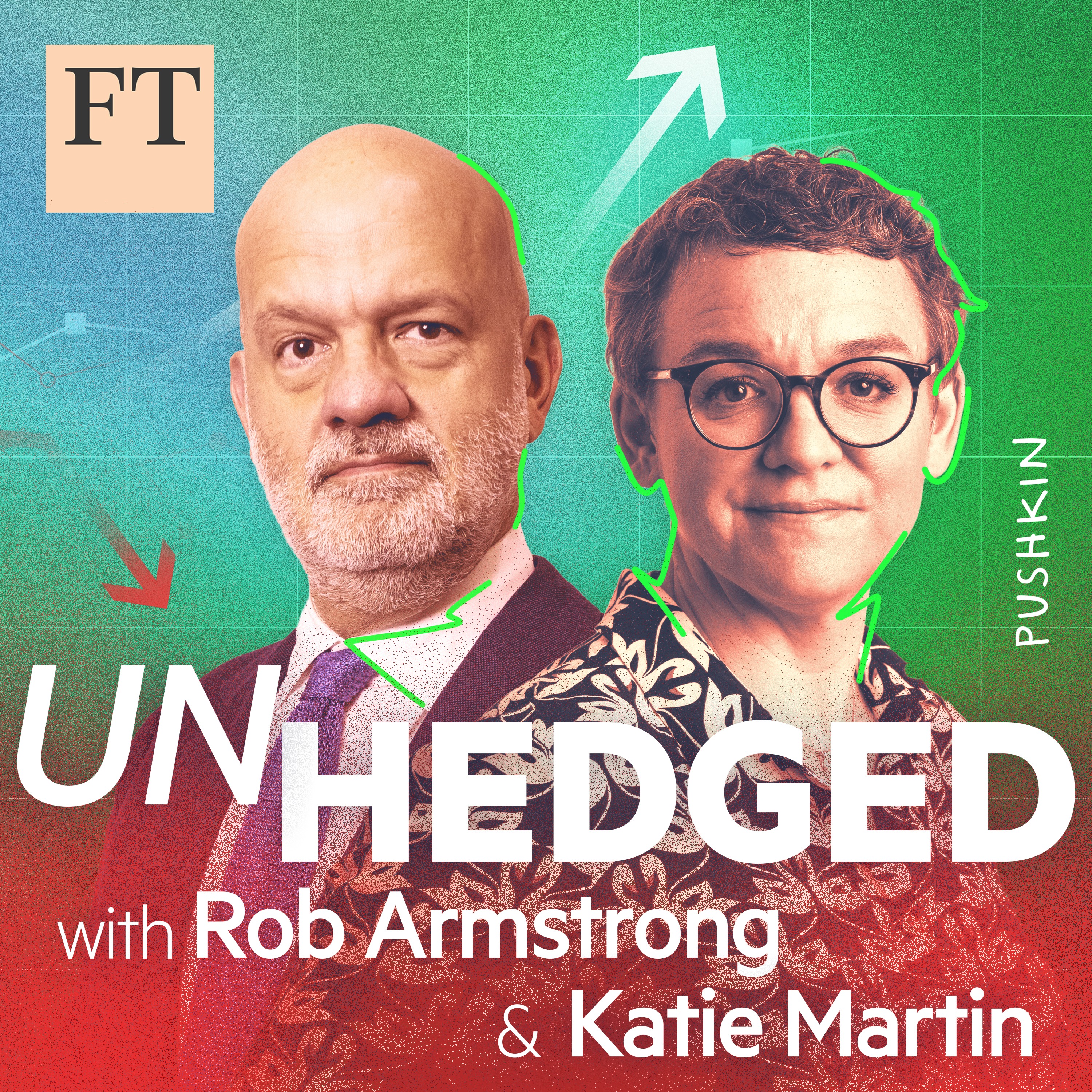
After a nervous couple of months, markets suddenly roared to life this week, with the S&P 500 reaching a new high. Struggling shoe company Allbirds led the charge with a pivot to AI and saw its stock leap 774 per cent. Today on the show, Katie Martin and Rob Armstrong try to figure out why investors are so excited. Also they go long kebabs and the Strait of Vermouth.
For a free 30-day trial to the Unhedged newsletter go to: https://www.ft.com/unhedgedoffer.
You can email Robert Armstrong and Katie Martin at [email protected].
Read a transcript of this episode on FT.com
Hosted on Acast. See acast.com/privacy for more information.
More from Unhedged
All episodesWe use cookies.They keep VO running smoothly and help us improve it. Privacy policy