
 Ask ChatGPT

In short
The episode asks what’s really happening in efforts to broker a deal between the US (under Trump) and Iran amid ongoing war and threats.
Key claims
Trump has repeatedly said a deal is “two to three days away” about 40 times, but no deal has materialized; a ceasefire extension since April 8 is being negotiated, led by Pakistan with Qatar increasing its role; reopening the Strait of Hormuz is the immediate goal to ease energy prices and enable later nuclear talks.
Notable examples
Trump’s Truth Social threats after a Qatari team reportedly made progress; escalatory strikes involving an Apache helicopter; attacks in Jordan, Kuwait, and Bahrain; Israel/Iran strikes.
Guests
Katie Martin (FT markets columnist) and Andrew England (FT Middle East editor).
Written by AI. May contain mistakes.
Chapters
1:20
Trump's Deal-Making History
Discussion on Trump's love for negotiations and current tensions with Iran.
“The thing about that Donald Trump is the guy sure loves doing a deal.”
2:20
Current State of US-Iran Relations
Analysis of the ongoing conflict and efforts for a ceasefire and negotiations.
“I have not recovered and I finished exactly in the middle of my age group.”
4:12
Challenges in Negotiation
Exploration of challenges in reaching a deal, including distrust and hostilities.
“For Trump, the key thing is it would reopen the Strait of Hormuz, which has obviously pushed energy prices up, pushed prices at the U.S.”
6:06
Escalation of Military Actions
Details on the cycle of military responses and threats between the US and Iran.
“And this is a funny sort of negotiation where you're trying to forge a peace deal but simultaneously threatening a land invasion.”
7:20
Negotiation Efforts and Breakthroughs
Updates on the role of mediators and the progress in ongoing negotiations.
“So it attacks US bases in the region, in Jordan, in Kuwait, in Bahrain.”
8:08
The Complex Landscape of US-Iran Talks
Discussion on the complexity and uncertainty surrounding any potential agreements.
“I was told that they came out and they made good progress.”
10:00
Implications of a Short-Term Deal
Examination of potential outcomes of a short-term deal between the US and Iran.
“You know, you've made very vivid, Andrew, the challenges of getting even a short term agreement, extending the ceasefire, opening the strait and kicking off nuclear negotiations.”
13:20
Proposed Solutions and Future Outlook
Discussion on potential solutions for a temporary deal and its implications.
“Just to go back to your original question.”
14:01
Iran's Potential Deal with the US
Discussion on the feasibility of a temporary deal between the US and Iran amidst ongoing tensions.
“Or the regional proxies that Iran supports.”
20:30
Trump's Spin on Economic Issues
Discussion about how Trump might navigate and spin the narrative around the Iran deal and economic issues.
“It doesn't mean necessarily that Iran's going to give up its entire nuclear capacity.”
Show all 11 chapters
22:36
Longshot Segment
Hosts discuss personal experiences and opinions in a light-hearted manner.
“that part of the show where we go long a thing we love or short a thing we hate.”

Ask about this episode
Get the gist, explore an idea or ask about something said.
 Claude
On Unhedged, what are the key points of this episode?
Searching your listeningTranscript
Automatic transcript. May contain errors.
0:00Katie Martin: Today's markets move fast. Get the insights you need in 10 minutes with the Barclays Brief, a new podcast from Barclays Investment Bank. Through sharp dialogue and scenario based analysis, our leading experts analyze key market themes each week. So whether you're managing a portfolio or leading a business, the Barclays Brief podcast can help you make smarter decisions today. Stay sharp, stay briefed. Find Barclays Brief wherever you get your podcasts. Unhedged listeners, the inaugural FT Weekend Festival in New York City is quickly approaching. Join John Lithgow, Orna Goralnik, Jancis Robinson, and most importantly, myself, Rob Armstrong, and my partner, Katie Martin, presenting a live version of this podcast, including taking your questions.
0:54Katie Martin: All this and more on Saturday, June 20th at Spring Studios or online as the FT Weekend comes to life for one unforgettable day. Register now and as a podcast listener, save 10 % using our code FT Podcast. Don't miss out.
1:19Pushkin.
1:22Rob Armstrong: The thing about that Donald Trump is the guy sure loves doing a deal. He certainly loves talking about doing a deal. Since his war against Iran started, he has stated that a deal to end it is just around the corner, about 40 times, 4-0. And do we have a deal? We do not. We supposedly have had a ceasefire for weeks. And for what it's worth, markets have kind of moved on. But the latest is that the two sides are still tearing strips out of each other to say nothing of the role of Israel. Today on the show, seriously now, what is actually going on? This is Unhedged, the markets and finance podcast from the Financial Times and Pushkin.
2:05Rob Armstrong: I'm Katie Martin, a markets columnist at FT Towers back in London, where summer has officially been cancelled. And I'm joined by professional triathlete, the sporting specimen that is Mr. Robert Armstrong in New York. Rob, say hello.
2:21Katie Martin: Hello. I think you exaggerate slightly. I have not recovered and I finished exactly in the middle of my age group.
2:29Rob Armstrong: In the triathlon, were there any walruses? Because I think I may have mentioned before that a walrus can run faster than a man and swim faster than a man. So you've really got to nail the cycling section.
2:41Katie Martin: If there had been a walrus, it would have been way in front of me, so I never would have seen it.
2:48Rob Armstrong: Apart from the cycling bit. We digress. But also, we have been trying to get him on the show for ages, and he keeps saying no and claiming to be busy. But with me in the studio today in London, we have Andrew England, the FT's Middle East editor and generally a good egg. Andrew England, you have been a busy man, have you not? It's been a little bit busy. Yes.
3:12Rob Armstrong: He's got a thousand-yard stare going on. Yes. Mr. Andrew England, I put it to you that in March you wrote that Trump says there was a deal. On April 12th, you wrote the two sides had failed to reach a deal. On May 8th, you wrote that Trump had said the ceasefire was holding. On May 24th, you said a deal to reopen Hormuz was largely negotiated. You get the idea. It just goes on and on and round and round. I feel like I'm going nuts. You must be like losing your mind here. It's been a bit crazy, but I never said it was a straight road. There are mediation efforts going on and there have been consistently going on.
3:52Led by Pakistan, Qatar's taking a bigger role now. And so about two weeks ago, they actually did feel that they were on the brink. They had fought, because basically you're talking about one page, a one page document. And this is not a final deal, and that's one thing to remember. This is essentially an extension of the ceasefire, which has been in place since April the 8th. For Trump, the key thing is it would reopen the Strait of Hormuz, which has obviously pushed energy prices up, pushed prices at the U.S. petrol pump up, ahead of the midterms. So that's a key thing for him, and he's wanted that essentially reopened as part of the original ceasefire on April the 8th.
4:29So he's increasingly frustrated. So it would do that, and it would also lay the framework for nuclear negotiations. there wouldn't be any significant commitment by Iran on the nuclear fire. So essentially it's a temporary deal to move to another phase, get a more durable ceasefire, give Trump a win in terms of reopening the strait, ease the global energy crisis, and depending on how the next stage of negotiations go, there will be some economic dividend for Iran. So they have been moving closer to it, but then you're dealing with these two parties that have decades of hostility and distrust. to overcome.
5:04That's been exacerbated by the US and Israel striking Iran twice in the last year whilst it was holding nuclear talks with the Trump administration. So there's just no trust. And don't forget, at the beginning of this war, they killed the Supreme Leader and many of his top officials. And the dead Supreme Leader was the father of the current Supreme leaders. So you can see that you've got two unpredictable, hostile leaderships, and you're trying to bring them together and get them to agree on a deal. And then there's just the kind of the political courage for either side to sign off on something, because they're both going to want to claim victory.
5:45They both believe they have the upper hand. So even just getting this preliminary agreement over the line is a huge, huge task.
5:53Rob Armstrong: It's been such a marathon. And so the The oil price has fallen back down, right? The Brent oil price benchmark is about$87 a barrel. Like a couple of weeks ago, we were talking about$120 or something. So it's come right down. Even while, like just before I came down here to record this, Trump was posting on Truth Social that he's going to, in capital letters, hit Iran very hard tonight and is talking about taking over Haag Island and oil infrastructure and and and and. And this is a funny sort of negotiation where you're trying to forge a peace deal but simultaneously threatening a land invasion.
6:28It is, and this is President Trump of the United States. He's not your normal president. I think we've all come to terms with that now, and he's a man who likes to deliver his own type of bluster and rhetoric. And at the beginning of the week, you said 40 times, he said we're two to three days away from signing this agreement. And then on Tuesday, he announced that the US military informed him that Iran had shot down an Apache helicopter. Right. So clearly he wasn't happy about that. And again, he's got to speak to his base and the Hawks. As soon as the helicopter shot down, he says, I have to respond.
7:09So he responds. So the US military fires, strikes Iran. Iran then has to respond because it doesn't want to be seen to be caving to US pressure. So it attacks US bases in the region, in Jordan, in Kuwait, in Bahrain. Because the Iranians respond, then the Americans respond again. And so then the Iranians respond again. So the pattern was repeated overnight on Wednesday, Thursday. And so you're in this escalatory cycle all the time. There are still negotiations going on. So Wednesday, a Qatari team was in Tehran to try and finalize this deal that Trump said was close to being finalized. they would only have gone if they had American assurances that one, Tehran was about to get bombed and two, the US was still serious about a deal.
8:01And so they were there. Now, I was told this morning that they came out. So this morning being Thursday, I was told that they came out and they made good progress. They had breakthroughs. And then Trump issues his true social post saying, we're going to bomb them again and we're going to take over Clark Island, which is where 90 % of Iran's oil is uploaded in the near future. So now I'm wondering, okay, so is there progress? Was there progress? I trust my contacts and so there was progress. But once Trump makes these threats, how does Iran respond? Because again, neither wants to be seen to be caving to the other's pressure.
8:40And the last thing Iran will want to do is being seen to capitulate. And this is the thing that Trump hasn't understood from the very beginning. If you remember before the war started, there were nuclear negotiations and Steve Wyckoff, his envoy, said the president surprised that Iran hasn't capitulated to all this military pressure. And that just shows a fundamental lack of understanding of the enemy, of the party they're dealing with.
9:04Rob Armstrong: They may as well be speaking like Martian. Exactly. I mean, since the Islamic Revolution in 79, this ideological foundation is hostility to the US and the West. Yeah. And after they've been bombed, they were bombed by the Americans and the Israelis in June last year. The last thing they're going to want to do is be seen to be capitulating to military pressure. To the regime in Tehran, that's a graver threat to them than war. So let's turn to the token American on the podcast, Mr. Robert Armstrong, triathlete. from where you're sitting out in New York, is there a similar thing for Trump, do you think, in terms of not wanting to lose face?
9:48Rob Armstrong: Like, what is he actually trying to get out of this?
9:51Katie Martin: I haven't the slightest idea at this point. And I want to kick that. I want to kick that question to Andrew. And I would frame it like this. You know, you've made very vivid, Andrew, the challenges of getting even a short term agreement, extending the ceasefire, opening the strait and kicking off nuclear negotiations. What I'm interested in is supposing we cross that hurdle. Where are we? What is a long-term stable status quo that the two sides can agree on? I ask this because it looks to me like, for example, the nuclear issue is a red line for both sides. And those two red lines are in different places.
10:42Katie Martin: So if we get the short term agreement, have we actually achieved anything, Andrew? No. I mean, what makes this administration so different? I mean, you speak to people and you say it doesn't matter who you speak to around the president. it's only what the president's thinking that matters. You don't have that institutional kind of system. So that makes everything much trickier. I mean, I think everybody thinks he wants a deal. He wants to get out. So he got into this war. He said it would take four to five weeks. On the back of the Maduro kidnapping in Venezuela, which was a clean success, Benjamin Netanyahu, the Israeli prime minister, presented him a war scenario where there were going to be great outcomes, regime change, destroy the missile capacity, etc., etc., etc.
11:31So he got sucked into this war. Hawks, Netanyahu, thought it would be easy and then quickly understood, actually, they're not about to collapse. They've closed the Strait of Hormuz. Oh, dear, we didn't expect that. They're hitting energy facilities in the Gulf. Oh, dear, we didn't expect that. They've triggered a global energy crisis. Our allies in the Arab world are getting battered and they're not stopping. So that's where we got to the April, the April ceasefire. Now, the question is, how does he get out? We're still claiming a win, still claiming a victory. And knowing Trump, he would paint anything as a victory, right?
12:07The short term deal, in theory, could allow him to do that in the way he spins it. So there will be a commitment by Iran to say we're never going to develop nuclear weapons. And the one constant in Trump's war goals, and they were totally incoherent, was I'm stopping Iran developing a nuclear weapon. Now, Iran has always said that it's not developing a nuclear weapon. There was a fatwa by the Supreme Leader in 2003. But if they're actually doing that, they're fools, right?
12:30Katie Martin: If I was the Iranian leadership, acquiring a nuclear weapon would be without question the most important long-term goal I could possibly have. Certainly, there are those in Iran who would say that after the June war last year. I think, because you've got to remember that Iran wants to get something out of this as well, right? So, Iran has taken significant blows. Its economy is in deep crisis. You know, inflation is up around 60%, 70%, 80%. They're going to have to do a lot of reconstruction. Steel plants have been hit. Petrochemical plants have been hit. Their oil exports have been stymied. They can't trade through the UAE as they would.
13:11So, you know, they do need an economic dividend. And their challenges will come when the war stops in terms of dealing with domestic pressure. So there's a reason for Iran to want this to stop as well. Just to go back to your original question. this is the great uncertainty. So if you get to this short-term ceasefire, does Trump just claim a victory? The Iranians are notorious for dragging out negotiations, playing the long game. Trump always wants a quick deal. So will he claim a victory and then will his detention drift somewhere else? And then you kind of have these protracted nuclear talks that don't really deliver and the region remains not at war, but it remains in a kind of a volatile, festering, simmering state.
13:52because in this short-term deal, it doesn't even talk about the missiles which they've used to attack Israel and the Gulf states. You know, that's not even being addressed. Or the regional proxies that Iran supports. So there's a lot of things that are being left until the last minute. It's a bit like the Gaza deal. So that was launched with much fanfare in October last year, and it's never got out of phase one. Yeah, all to peace.
14:19Katie Martin: Andrew, just sitting here in my comfortable chair in New York, it seems to me that an avenue that ought to be open is some kind of slightly nonsense deal that gets us through to the end of the Trump administration. In other words, a deal something like this. Iran says we will forego all nuclear development. Both sides know they don't really mean that, but that's okay. They agree to open the Strait of Hormuz. There is some economic dividend to Iran that is not talked about very much. And the president gets to loudly claim victory. And we have now kicked the ball at least until President Trump is wherever ex-presidents go.
15:16Right.
15:16Katie Martin: The next president can deal with it.
15:18Rob Armstrong: Yeah.
15:19Katie Martin: Is that is it realistic that the kind of muddle through option I just described? The context here being the oil market continues to be quite comfortable with this whole situation, as Katie mentioned before. And I don't think the oil market is made up of fools and Panglossian morons. I think they have some story about why we can muddle through. Do you think that's a realistic expectation I just laid out? Yeah, I think you've got a job going as a mediator.
15:56I think there's a couple of things just to start. One, you know, oil prices are still far higher than they were at the beginning of the war. And I think one of the scary things is that what we're seeing today is almost being normalized. So you've had, you know, for the last 48 hours, you've had strikes between Iran and America, the US. And no one's jumping up and down about it. That's kind of scary. And then before that, you had strikes between Israel and Iran, which, again, hadn't happened, direct strikes before 2024. So that's part of the issue. And I don't think that's a positive thing.
16:30Rob Armstrong: But even now, you know, still like energy people, I've got a note in front of me right here from Jeff Curry at Carlisle saying about the abundance illusion, right? We're just chewing through all of these energy reserves that we've got all over the world. Those energy reserves are designed to be reserves. They're designed to provide a little bit of kind of security in emergencies. They're not designed to be drawn down for weeks and weeks and months and months at a time. So there remains this danger that we just get to the point where the reserves are too depleted and we still get that shoot higher in oil prices to$140,$150 a barrel.
17:05Rob Armstrong: Absolutely. And there's also the question of just even if the war stops today, how long will it take to get everything back online? You know, if you've had wells in Iraq that have been moth-bought, how much damage has been done? How long will it take to get back on? But you have just described,
17:18Katie Martin: Andrew, the reasons why both sides would like a break of a couple of years. Iran to lick its economic wounds, maybe replenish its missile supplies. The US to take the political pressure off that is emanating from gasoline prices. There does seem to be some overlap in motivations here and they can put whatever rhetorical flourishes on it they like, but they get to that overlap and we at least get the straight open and stop the kinetic part of the war and we go to a kind of cold. No, but what you're saying, I mean, I was being slightly facetious, but you're exactly right. And this is what the mediators are trying to do.
18:03Now, what they've done by doing the deal they're trying to negotiate is to get the straight open first, which is the crucial thing for global energy for obvious reasons, you push the nuclear negotiations back to the second phase. And then whilst the strait is being reopened, you have the nuclear negotiations. But the key first step is reopen the Strait of Hormuz, get the oil and gas flowing, the helium, the urea, fertilizers, etc., and you lift the U.S. blockade. Now, in the second phase, what you would see is then where you get to the nuclear nitty-gritty, which is kind of, this is what they've been discussing, things that you've been talking about, a moratorium on uranium enrichment.
18:45Now, Trump wants their stockpile diluted. You know, the Iranians probably agree to that. They agreed to it with Obama in 2015, the JCPOA. A key question is what happens to the stockpile of highly enriched uranium? That's a big stumbling block because the Americans want it offshore. Will the Iranians allow that to happen? Then there's a question about what happens to the enrichment of facilities, whether they're dismantled or not, as the Americans want. So these are the kind of technical details, if you like, they've got to fresh out. Those negotiations are always going to take longer, and that's part of the reason you push them back, but you get the straight open.
19:19And Iran, everybody knows Iran will only do a nuclear deal if there is some kind of financial incentive. And like you say, it's how you dress it up. Is it sanctions relief? Is it a waiver on oil exports? Is it unfreezing some of the frozen assets which they've got around the world? You know, some people have estimated up to 100 billion, which is essentially their oil money, which they can't access in various central banks. So, yes, there are. And this is what the media is hoping for. The media is hoping that you get this initial extension done, you get the strait reopened, that calls tensions.
19:53It reduces the risk of hostilities in the Strait of Hormuz or around the Strait of Hormuz, where you've got two competing blockades, the Iranian and the US one. And that provides a better environment for nuclear talks. Now, they've been having nuclear talks with the Trump administration since Trump came back in. So a lot of this stuff they've already been discussing anyway.
20:12Rob Armstrong: But it sounds like really the best plan that we have to hope for at the moment is that there is no plan and that everyone can just pretend that there is a plan for long enough to get the straight open and that we just keep doing this dance and going round and round in circles. Yeah, but I mean, I think... Is that a best case scenario? No, I think, no, not the best case. And the best case scenario is they get this preliminary deal, the strait opens, and then they get some kind of nuclear agreement, which reduces tensions. It doesn't mean necessarily that Iran's going to give up its entire nuclear capacity.
20:44They've got research and development know-how, which you can never reverse, right? But as they did in the 2015 deal, you know, they agreed to reduce the level of enrichment drastically to levels that are insignificant. They had caps on their stockpile. The rest was taken offshore. And in return, they got the sanctions relief. So they complied with that deal until Trump pulled out of it in 2018. And that pushed them way back from being able to have the capacity to develop a nuclear weapon. So you could see kind of a deal like that 2.0. Now, the question is, how do you frame it? What kind of economic dividend does Iran get?
21:22It's much harder to give Iran sanctions relief today than it was in 2015 after everything that's gone on, both internally and externally.
21:30Rob Armstrong: And how do we make it look like everybody's a winner? This is the big kind of conundrum. Listeners, if you think you know, then unhedged at ft.com. Let us know. You might do Andrew a favour. We are going to have to leave it there. Can I just say one thing? Yeah, you can. The good thing with Trump is he can spin anything. I mean, yesterday he was asked about inflation. He said, I love inflation. Yeah. Yeah. So, I mean, you know, there's hope. There's hope. There's hope and there's spin. That's all we've got to go on at the moment. We are going to be back in just one second with Longshot.
22:10Katie Martin: From globalisation to innovation, sustainability to market volatility, there's always more than one side to a story. Explore different perspectives on today's most important business and economic issues with the Flipside podcast from Barclays Investment Bank. Hear two research analysts in a lively debate and get insights from every angle to further inform your view. Listen to the Flipside on your favourite platform.
22:35Rob Armstrong: Okie doke, it is time for Long Short, that part of the show where we go long a thing we love or short a thing we hate. Andrew England, Middle East editor, what do you say? Well, now you've said to go long, a thing you love, I'm going to have to go for the English 40. Ah, beautiful scenes. It's coming home. Is it coming home? Inshallah.
22:59Katie Martin: Nobody but you two thinks it's coming home. I've read a little bit of the sports writers on this topic.
23:05Rob Armstrong: I doubt it's coming home, but we live in hope. I am long. Our listeners, I've been away a little bit, But on the show the other day, Rob and Dara discussed what to call this thing, which may or may not be real, where people are selling Bitcoin to buy SpaceX. I am calling this the BS trade. Make it happen, people. But one listener got in touch to say we should call it. Are you ready for this? The Great Brotation.
23:34Katie Martin: That's pretty good. It's pretty good.
23:36Rob Armstrong: Round of applause. Well done. We have a winner. You are hired.
23:42Katie Martin: but we had a flood of other suggestions too it was great some of them were rubbish i'll be honest some of them were great though i thought i liked bait trade bitcoin ai trade is good anyway what do i have i am very short sand which you might like you might associate with the beach uh about a third of the run in this triathlon i did extremely slowly was on a beach and let me tell you, I will never run on a beach again. I may never walk on a beach again. I may never go to the beach again as a result of the experience of trying to go fast on sand at my age.
24:20Rob Armstrong: Is that scene in one of the Rocky movies where they're running around in very short shorts on the sand? Yes.
24:26Katie Martin: What I was doing did not look anything like that, let me just tell you.
24:31Rob Armstrong: It's a mental image I'm nonetheless going to take with me. You may need therapy. Andrew England, Thank you so much for sharing your wisdom about what on earth is going on in the Middle East. I'm still not sure I'm any the wiser, but you've tried your best. Listeners, we are going to be back in your ears on Tuesday. So listen up then. Unhedged is produced by Jake Harper and edited by Brian Erstad. Our executive producer is Jacob Goldstein. We had additional help from Topher Forehead. Special thanks to Laura Clark, Greta Cohn and Natalie Sadler. FT Premium subscribers can get the Unhedged newsletter for free and a 30-day free trial is available to everyone else.
25:14Rob Armstrong: Just go to ft.com slash unhedged offer. I'm Katie Martin. Thanks for listening.
25:36We'll be right back.
From the publisher
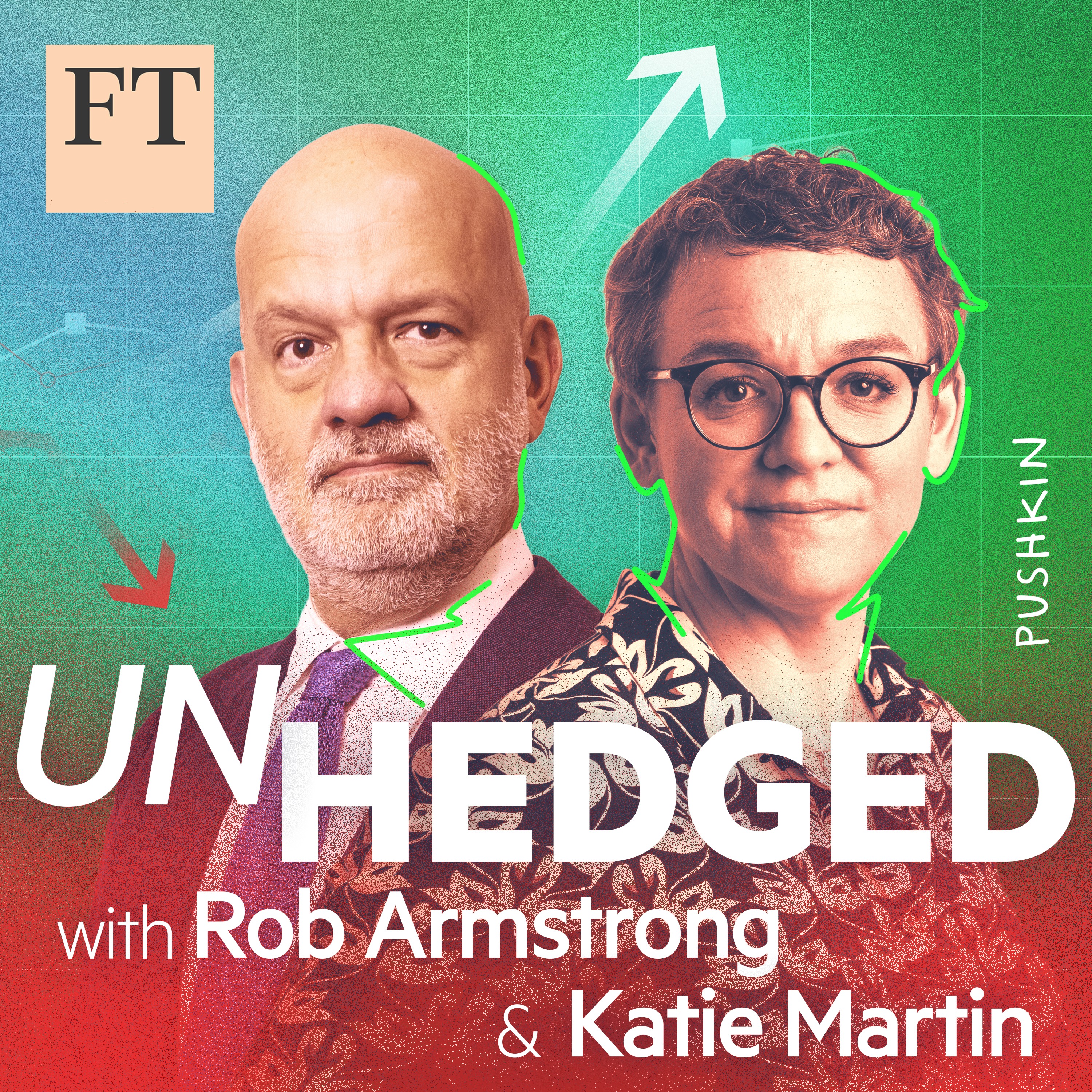
Right now the only thing flowing through the Strait of Hormuz is a caravan of broken promises and fake cease fires. Today on the show, Middle East editor Andrew England joins Katie Martin and Rob Armstrong to discuss US President Donald Trump’s inability to end his own war and what it means for markets. Also they go long English football and long the Great Brotation.
For a free 30-day trial to the Unhedged newsletter go to: https://www.ft.com/unhedgedoffer.
You can email Robert Armstrong and Katie Martin at [email protected].
Hosted on Acast. See acast.com/privacy for more information.
More from Unhedged
All episodesWe use cookies.They keep VO running smoothly and help us improve it. Privacy policy