
 Ask ChatGPT


 Up First from NPR
18 Oct 2026 · 38m · 11 chapters
Israelis’ national election after Oct. 7, 2023, and whether polarization, war, and security failures will drive a leadership change. The episode contrasts Netanyahu’s far-right coalition and war strategy with challenger Gadi Eisenkot’s promise of an official investigation into Oct. 7 failures and a tougher stance on West Bank settler violence.
NPR correspondent in Israel Daniel Estrin interviews Israelis and reports from the country. Featured Israelis include Oshri Karuchi (Netanyahu supporter), Shula Romano-Horing (Israeli lawyer who flew from Kansas City to vote), Yochai Ben Chaim (renewable energy worker in California), Kati and Meir Zohar (parents of Nova victim Bar), Amos Harrell (Haaretz defense analyst), Sufyan Abu Zaydah (Palestinian negotiator), Anat Saragusti (former Gaza journalist), Ari Shuali (retired senior intelligence official), Lior (34-year-old reservist sniper commander, PTSD), Anat Ben-Ari (high school theater teacher), Micha Goodman (author/advisor).
Oct. 7 warnings were allegedly ignored; Netanyahu denies. Netanyahu allegedly prolonged Gaza war to avoid inquiry; hostage deal took until Oct. 2025. Many Israelis endorse “no mercy” toward Gaza; West Bank settler violence is escalating. Tens of thousands of expats are expected to return to vote because Israel lacks absentee voting. Eisenkot says he’ll investigate security failures and curb settler violence, but won’t quickly withdraw troops from Gaza/Lebanon.
Written by AI. May contain mistakes.
Discussion on the significance of the upcoming Israeli elections and the political landscape.
“Benjamin Netanyahu is the longest serving prime minister in the country's history.”
NPR's Daniel Estrin shares insights from Israelis regarding their feelings about the elections and the implications of October 7th.
“I'm joined by NPR's correspondent in Israel, Daniel Estrin.”
Analysis of the events leading to the October 7th attack and the failures in security warnings.
“And overall, what I've learned over the course of many very raw, very blunt conversations with Israelis is that really one date casts a shadow over Israel's elections.”
Learn about the public relations battle and protests following the October 7th attacks.
“Then Hamas and other militant groups stormed across the Gaza border and attacked army bases.”
Explore the personal stories of families impacted by the October 7th attack at a memorial site.
“But other Israelis are focused on what came after.”
Hear about the cultural sentiments and military responses in Israel after October 7th.
“There's a song of vengeance that came out a month after October 7th and topped the charts in Israel.”
Understand how media censorship and recent violence in the West Bank affect perceptions of the conflict.
“This is the third time in five years that Israel has bombed Gaza in response to Hamas rocket fire.”
Learn about the increasing violence by Israeli settlers towards Palestinians post-October 7th and the reactions from Israeli officials.
“Since the October 7th attacks, Israeli settlers have become increasingly violent toward Palestinians and have seized even more land in the West Bank with the support of Netanyahu's government and the military.”
Explore how Netanyahu's handling of conflicts has affected public sentiment and calls for change among Israelis.
“Netanyahu has downplayed settler violence in the West Bank, and his allies are campaigning on a pledge to expel Palestinians.”
Delve into Gadi Eisenkot's campaign strategies, including his call for a national investigation and stance on military presence.
“Gadi Eisenkot is Netanyahu's leading opponent.”
Understand the contrasting visions for Israel's future as articulated by different politicians and the public's reaction to these ideas.
“And on the biggest question of all, how to solve Israel's conflict with the Palestinians?”

Get the gist, explore an idea or ask about something said.
 Claude
On Up First from NPR, what are the key points of this episode?
Searching your listeningAutomatic transcript. May contain errors.
0:01I'm Ayesha Roscoe, and this is a Sunday story from Up First. Next week, Israelis will vote in national elections. It's the first vote since Hamas attacked Israel three years ago, on October 7th, and since Israel retaliated with war in Gaza. The devastation in Gaza has prompted international outrage toward Israel. But what many people in the U.S. may not realize is just how hardened and polarized Israelis themselves have become. It's a huge deal. This is about, this election is about the existence of Israel. For me, it's like coming to save the country, to put Israel back what it should be. Benjamin Netanyahu is the longest serving prime minister in the country's history.
0:52Now he's campaigning for a seventh term. He's one of the world's most controversial and consequential leaders, heading a far-right, ultra-nationalist, religious coalition. He's launched attacks throughout the region, from Gaza to Iran, and he says his job isn't done yet. We will continue to win because we have no other choice. He faces a challenger in the former chief of staff of the Israeli military. Number one, Gadi Eisenkot. Gadi Eisenkot leads Israel's more moderate center-right opposition, and he's offering Israelis something many have asked for and Netanyahu has blocked, A formal investigation into the security failures that led to the October 7th attacks.
1:51Today on The Sunday Story, NPR's correspondent in Israel, Daniel Estrin, talks to Israelis about how they see their conflict with the Palestinians and explains why many think these upcoming elections are the most important in their country's history. I think you really need to hear directly from Israelis to understand what matters to them. Because their vote will shape the future of the Middle East, including the lives of Palestinians and millions of others across the entire region.
2:26Stay with us.
2:38Stay tuned for the following announcements and messages from our sponsors.
3:08Daniel Estrin: when you subscribe at prolonlife.com slash NPR. This message comes from AT &T. Right now at AT &T, you can get the new iPhone 18 Pro for$0 with eligible trade-in. It has the ultimate pro camera system and a big leap in battery life, so you can turn this deal into a long-lasting connection. Connecting changes everything. Requires trade-in of$230 or more and eligible plan. Terms and restrictions apply. Subject to change. Visit an AT &T store for details. This message comes from NPR sponsor A24, presenting You Can See Everything. 34 days before she's set to begin her prison sentence, Theranos founder Elizabeth Holmes invites Nathan Fielder and a camera crew to move in with her family and document their every move.
3:53Daniel Estrin: This jaw-dropping, once-in-a-generation theatrical event demands to be seen on the big screen. You Can See Everything, now playing in theaters. We're back with the Sunday story. I'm joined by NPR's correspondent in Israel, Daniel Estrin. Daniel, thank you for being here. You're welcome. So, Daniel, the way the last three years have gone, I would imagine there are a lot of emotions heading into this election. There are. I have covered Israel for 20 years, and I have never seen an election like this. The Israelis I've been speaking with basically say that what's at stake is their country's very survival.
4:33Wow. I mean, that's really intense. Yes. And let me tell you about one moment I witnessed that really illustrated this to me.
4:46A couple of weeks ago, I saw protesters chanting outside a Netanyahu rally in Tel Aviv. And there was this one protester who was yelling at Netanyahu's supporters. She was saying, how dare you support Netanyahu after he failed to prevent the Hamas attacks October 7th? And as I'm standing there with my microphone recording this, one man comes up to me. His name's Oshri Karuchi. And he says he supports Netanyahu because of what happened after October 7th. The way Israel went after enemies, not just in Gaza, but across the region. And even convinced the U.S. to bomb Iranian nuclear sites.
5:30He says, that lady protesting and me, We wouldn't be standing here if Iran had launched a nuclear weapon at us. So Israelis are really thinking about matters of life and death. Yes, that is what this moment means for many Israelis. October 7th was the deadliest attack on Jews since the Holocaust. And many Jewish Israelis actually talk about it as a second Holocaust. You know, Jews are the majority of Israel's citizens. Palestinians in the occupied territories don't get a vote. And as election day nears, many Israelis are asking themselves, should Netanyahu be voted out because he presided over that dark day, October 7th?
6:15Or should he be re-elected so he can continue his wars to reshape the Middle East, as he's done since October 7th? Israelis have heard what the world says about what their country has done to Palestinians. They've seen the global backlash that's only getting stronger. Some Israelis say, forget what the world thinks. Others say, if their country doesn't change course, they'll pack up and leave. That is why the stakes of these elections feel so high.
6:45And you know, Aisha, because Israelis feel this moment is so important, we are expecting tens of thousands of Israelis who live abroad to actually come back for Election Day. So tens of thousands of people are going to get on planes and fly back to Israel from all over the world just to vote? Those are the estimates, yeah. Israel doesn't do absentee voting. You have to physically be in the country on voting day. And the other day I had coffee with an Israeli lawyer who flew in early just to vote. She came all the way from Kansas City, Missouri. Her name is Shula Romano-Horing. You know, I bought a megaphone in the street.
7:25You bought a megaphone here in Israel? Yes. And what are you doing with it? What are you going to be saying in the megaphone this year? I say go and vote this time. If you don't vote, the existence of Israel is at stake here. If I came all the way to America, you could go downstairs and vote. You know, because we almost could have been destroyed on October 7th. And that's the most important. This is why I'm voting for Netanyahu to make Israel so secure and so safe. And if Netanyahu is not re-elected, what happens? Wow, I think it will be the scariest thing I ever heard. But there are many other expat Israelis who say the scariest thing would be if Netanyahu is re-elected.
8:08Like this one guy, Yochai Ben Chaim. The actions of this government cause Israelis in general and Jews in general to be tagged as, you know, mass killers, as warmongers. He spoke on Zoom from California. He has a job there in renewable energy. And this government is led by extremists that do not represent who we are. And we need to change it. You know, the moment elections were announced, a few hours later, I already had my tickets to Israel. Within hours of Israeli elections announced, you had already bought a ticket to fly back. Yeah. We plan to leave here on a Sunday afternoon. We get to Israel Monday noon, the day before the elections.
8:49and we leave back to Los Angeles Tuesday night. So just come, cast out that out and leave. He said the total journey cost him just under$4 ,000, but he said it was worth it. For me, it's like coming to save the country to put Israel back where it should be.
9:13I mean, these are pretty powerful statements. They are. And overall, what I've learned over the course of many very raw, very blunt conversations with Israelis is that really one date casts a shadow over Israel's elections.
9:33That date is October 7th, 2023, when Hamas attacked. It is a day of violence and fear in Israel. Nearly 1 ,200 people were killed, around 250 taken hostage. Unprecedented in its scale, in the words of NPR's Daniel Estrin and Israel. The deadliest day in Israel's history. Today, as the elections near, Israelis are asking, didn't anyone see this attack coming? New reporting suggests some people did. Let's go back to the early months of 2023.
10:12Israel is in the midst of civil unrest. Benjamin Netanyahu and his far-right government are trying to weaken the powers of the courts to give themselves more unchecked power. Israelis pour into the streets to protest. Israel's president says the country's current crisis is a powder keg. As the protests continued, I reported that Netanyahu's security chiefs were afraid of where all this turmoil could lead. Well, now leadership security officials are meeting today. Reportedly, they met and said that there is an immediate threat that Israel's regional enemies could attack at this moment when the country is weak and divided.
10:53What we know now, according to new reporting by NPR and other outlets, is that behind the scenes, Israel received direct warnings that Hamas was planning something big.
11:07This is Palestinian negotiator Sufyan Abu Zaydah. He told me Israel and Hamas had been holding secret talks for more than a year leading up to October 7th. They both had demands. Israel wanted Hamas to release some Israeli hostages they'd held for many years. Hamas wanted Israel to free Palestinian prisoners and help ease Gaza's longtime humanitarian crisis. When the negotiations stalled, Abu Zaydah says the leader of Hamas and Gaza dictated a message for him to deliver to the Israeli leadership.
11:44Do you have the exact words there of the message that you could read in Arabic?
11:55The message was, by the end of September, we will put cards on the table. There will be an earthquake in the negotiations, and the Israelis should prepare to empty their prisons. Abu Zaydah didn't know what kind of earthquake. the Hamas leader meant, but he says he relayed the message to Israeli intelligence right away. It was mid-September, weeks before October 7th. How do you feel now after all of this? Very frustrated. Why? Your message was not taken seriously? Because all what happened on 7th of October is needless. All the death and destruction in Israel and in Gaza, the death of his sister and dozens of his relatives ever since.
12:40All that could have been avoided, he says, if the warning had been heeded. Benjamin Netanyahu has denied he was warned. I spoke with Amos Harrell, an Israeli defense analyst for the Israeli newspaper Haaretz. He wrote a book tracing the missing warnings and miscalculations that failed to prevent the October 7th attack. He points to a failed strategy Netanyahu had employed going back years, allowing Qatar to send financial aid to Gaza to keep a lid on simmering unrest there. Hundreds of millions of dollars were sent to Gaza, literally suitcases stuffed with cash, even as Israeli intelligence officials warned that Hamas was diverting some of the cash to its military wing.
13:25It was clear that some of the money was actually used by Hamas to dig tunnels to pay its gunmen, And yet he ignored the whole issue. He assumed that Israel had the upper hand. And this, of course, ended in a terrible failure on October 7th.
13:48This is the first air raid siren I recorded in Tel Aviv on October 7th, 2023. It was 6.30 in the morning. Hamas had begun to fire rockets at southern Israel, Tel Aviv, and Jerusalem. Then Hamas and other militant groups stormed across the Gaza border and attacked army bases. They entered residential communities. They filmed themselves going door to door, room to room. They killed elderly women and children. They gunned down young people at an all-night music rave. And they took hostages back to Gaza. That same morning, Netanyahu declared war on Gaza.
14:28But he also began fighting another battle over the October 7th attacks, a public relations battle. Who was responsible for the security failure? Netanyahu as the leader of the country or his security chiefs? Again, Amos Haral. Very, very soon, within days, his PR people were trying to shape the public narrative about events and trying to shift the blame towards the professionals, towards the heads of Shin Bet, the internal security agency, and the heads of the top brass of the IDF. But he never admitted any kind of responsibility. For much of the war, Israeli protesters flooded the streets, demanding that Netanyahu strike a deal with Hamas to release Israeli hostages.
15:18But Netanyahu said he was aiming for total defeat of Hamas. It would take two years of fighting before a hostage deal was reached in October 2025, making this Israel's longest ever war. Today, former officials who worked with Netanyahu are coming forward and questioning what took so long. Did Netanyahu prolong the war to delay the reckoning about October 7? I'm absolutely convinced that this is what happened. For political reasons, he felt that if this would move on too fast, then there will be more of a significant public demand for a national commission of inquiry. A National Commission of Inquiry.
16:05Like the 9-11 Commission in the U.S. investigating the September 11th attacks. There's a huge demand for something like that in Israel. An official investigation into the October 7th security failure. Netanyahu has refused to allow one. But Israelis want answers.
16:28Today, many Israelis go to one main memorial site to grapple with what happened. We're at the site of the Nova Music Festival, the deadliest attack of October 7th, where more than 400 people were killed. it's not some big official memorial with a building and a visitor center and a and a statue and a unified feeling this is this is handmade this is a dusty field with a sea of rickety plaques with pictures of young people smiling and their families writing descriptions of who they were and what they loved about them. Here I find Kati and Meir Zohar. They lost their 23-year-old daughter, Bar, on October 7th.
17:25You guys probably don't remember, but I met you in the hospital on October 7th. No, we don't remember nothing. All I remember is the horror. They later learned that their daughter had been killed at the music festival. So this is Bar. They show me her photo on a memorial sign, a screen grab from a cell phone video where you see Bar laid out being treated by a paramedic. And he gave her morphium. So she was very relaxed when she died. This is like two minutes before she took her last breath. Kati and Meir Zohar help build this memorial with other families. The Israeli government didn't contribute any money.
18:12Nothing. Not Shekel. Nothing. No member of parliament called you to say we participate in your... The Israel government, nothing. Benjamin Netanyahu? No. Nothing. He didn't call you? No. No. No. What do you feel about that? Anger. Of course. Anger. We are angry.
18:41She says Netanyahu, as the head of the country, bears the responsibility for what happened to her daughter and to Israel that day. Israel is about to face elections. Yeah. What do these elections mean to you? It's a hope that something will change. What kind of change are you looking for? I hope that someone will come and take his place and be the one who's trying to keep this country together. Like Kati and Meir, many in Israel want these elections to be a reckoning over Israel's failure on October 7th. But other Israelis are focused on what came after.
19:28I'll be right back.
19:39Daniel Estrin: Stay tuned for the following announcements and messages from our sponsors. This message comes from Prolon. Want to look and feel your best this fall? Prolon's 5-Day Fasting Mimicking Diet is a clinically developed nutrition program with the goal of promoting fat loss while protecting lean body mass. Developed at USC's Longevity Institute, it aims to assist the body in entering a fasting-like state that helps reset metabolism, target visceral fat, and support healthy metabolic markers. Get 15 % off plus a bonus gift when you subscribe at prolonlife.com slash NPR. This message comes from AT &T. Right now at AT &T, you can get the new iPhone 18 Pro for$0 with eligible trade-in.
20:22Daniel Estrin: It has the ultimate pro camera system and a big leap in battery life, so you can turn this deal into a long-lasting connection. Connecting changes everything. Requires trade-in of$230 or more and eligible plan. Terms and restrictions apply. Subject to change, visit an AT &T store for details. Support for NPR and the following message come from Washington Wise. Washington Wise, from Charles Schwab, takes a nonpartisan look at policy developments and how they may affect the market and investing. Listen at schwab.com slash Washington Wise. This is the Sunday Story. I'm Daniel Estrin. There's a song of vengeance that came out a month after October 7th and topped the charts in Israel.
21:04It's called Charbu Darbu, Total War.
21:14It's a battle cry for young Israelis to join the war in Gaza. Let me read some of the lyrics. Who do you think you are, coming and shouting, Free Palestine, you sons of Amalek? That's the biblical enemy of the ancient Israelites. We brought the whole army on you, and I swear there will be no forgiveness. It was a nation in a state of shock. Israeli defense analyst Amos Haral. I think the general line of thinking, not only among decision makers, not only among ministers of the government, but also among commanders in the field, was that something biblical has happened to us and that something biblical needed to happen in return.
21:55What did happen in return was an Israeli military onslaught that was exponential in its proportions. More than 74 ,000 Palestinians killed by Israeli attacks. Most of Gaza destroyed. Today, Israel is fighting back charges of genocide. Prime Minister Netanyahu faces an international arrest warrant for alleged war crimes in Gaza. And all the Israeli soldiers who have fought in the war now risk arrest in some countries. Like Lior, a friend of a friend of mine. I'm proud of what I did, and I know what I did. I was the commander to my soldier. I gave order, so I don't mind to be in front of a judge.
22:36I will go and get arrested. I don't mind. Lior is among the nearly 300 ,000 young Israeli military veterans who were ordered to leave their civilian lives, their work, their partners, and serve as reservist soldiers after October 7th. They are the ones who have fought in Israel's latest wars and have been forever changed by them. His generation is the one that will shape Israel's future. When you're inside Gaza, your life is under danger 24-7. There is shooting, there is bombing, sometimes you hear about Hezbollah and Hamas, what they are doing. So your body, your mind is under survival tension 24-7.
23:20Lior asked that we just use his first name to protect his family overseas from harassment because of the nature of his role in these wars. He commanded an Israeli sniper unit in Gaza and Lebanon. He's 34 years old and has served over 500 days in uniform. And today he's among the nearly 19 ,000 Israeli soldiers who have been newly diagnosed with post-traumatic stress disorder or related illnesses. He says it touches every part of his life. He imagines snipers on the streets. He randomly breaks into tears riding the train. He struggles in his sex life. He and his fiancée are now broken up. All of this after his time in Gaza and Lebanon.
24:04There's one memory that comes to him often. When he gave an order to shoot and kill a man he described as a Hamas terrorist as the man stood next to his child. Lior said the man crossed a line where he shouldn't be. And unfortunately, yeah, the kid saw his father dying in front of him. You don't regret any decisions you made to open fire? No, none. None. Even at the cost of civilians being killed? Yeah. And to be honest, in my opinion, I don't have any mercy of people in Gaza. I know what's going on there. I know of the poverty. I know about the lack of water, electricity. I don't have any mercy on them.
24:54Why not? Because when you see things on your own eyes and you remember what happened on the 7th of October, I'm not forgiving for that. Is there anybody innocent in Gaza? You know, my Jewish identity is saying that I'm sure there is. But first thing, I don't see it that way. That's what I told you about the kid. I know that if he have the chance, he will kill me. Even a five-year-old? Even five years old.
25:32No mercy for people in Gaza. That's the prevalent view of most Israelis I meet. No matter their age, no matter whether or not they served in uniform or support Netanyahu. There are no innocent people in Gaza. Or I don't have room in my heart for the suffering of Palestinians in Gaza. These are not phrases that are whispered. This is everyday conversation. So is, kill all the Arabs. Everyone in Gaza should leave. What Israel did in Gaza wasn't enough. These are phrases Israelis have told me just over the last few weeks. And if you turn on primetime TV news in Israel, you hear journalists saying similar things like, there are no uninvolved civilians in Gaza.
26:19That's a reporter early last year speaking on Channel 12, the leading nightly news network. Israeli media censorship of the Palestinian perspective in Gaza began 20 years ago, after Hamas took an Israeli soldier captive in Gaza. Israel responded by practically sealing Gaza shut to Israeli journalists and to all Israelis. There were years and years of Hamas rocket fire and Israeli retaliation. Israeli jets are again today hitting targets associated with Hamas inside Gaza. This is the third time in five years that Israel has bombed Gaza in response to Hamas rocket fire. And many Israelis are skeptical things can change this time around.
27:02During the last few years of active war in Gaza, most Israeli media chose not to show what Palestinian journalists were reporting day after day. The tens of thousands of men, women and children killed. the forced displacement, the starvation, the misery of trying to survive. Even a year into a declared ceasefire, Israel continues airstrikes regularly, killing both militants and civilians. I spoke about this with Anat Saragusti, an Israeli journalist who used to cover Gaza. The majority of the Israeli journalists didn't do one story, you know. Not even one story was done on Gaza, try to see whether, you know, what the Palestinian journalists are claiming is true.
27:50They were afraid of the pushback by the audience if they dare say something about Gaza. But there is one place where even some war-hardened Israelis say anti-Palestinian sentiment has gone too far. And that is the occupied West Bank. We are now entering the West Bank. We just now entered the West Bank. Since the October 7th attacks, Israeli settlers have become increasingly violent toward Palestinians and have seized even more land in the West Bank with the support of Netanyahu's government and the military. I joined an SUV convoy going there with a group of retired Israeli security officials a few weeks ago.
28:36They wanted to see for themselves how things have changed in the last three years.
28:44We arrived at a small village, Umm al-Kher. It's on a hilltop surrounded by an expanse of empty desert. Palestinian activist Eid Hatlin took us inside a Palestinian family's home. We looked out a window into their backyard and saw Israeli settlers in a trailer home. And there's all this barbed wire around here? They put it here. Settlers? Yes. He says the settlers have blocked the family's outdoor bathroom, and the Israeli army has blocked the path to their sheep. I approached one of the Israelis in our group, Ari Shuali, a former senior Israeli intelligence official. What is your reaction to seeing this?
29:22I think it's idiotic. I think it's shaitanical. I think it's non-human in no other respect. Satanical. This is not the way you'd expect a veteran of the Israeli establishment to speak. He's taking lots of pictures. This is nasty. This is evil. I don't believe that we, as a people, became such kind of unhuman behaviors. I'm an Israeli, I'm a proud Israeli, and I'm ashamed to be an Israeli at the same time. It's one reason why some Israelis like him want to vote Netanyahu out.
30:12Netanyahu has downplayed settler violence in the West Bank, and his allies are campaigning on a pledge to expel Palestinians. They call it encouraging immigration. Netanyahu, meanwhile, is campaigning on what he's done to fight back against external threats, with the wars in Gaza, Lebanon, and Iran as examples of how he's making Israel safer. On that darkest of days, our enemies expected us to collapse. Well, we didn't collapse. Instead, we rose and fought like lions. In speech after speech, he has promised to change the face of the Middle East, and he's commended Israelis for carrying out his plans.
30:59For the past three years, our heroic soldiers have fought day in and day out in a seven-front war. Israel has killed the leaders of Hamas, Hezbollah, and Iran. It has sent soldiers to capture new territory in the West Bank, Gaza, Lebanon, and Syria. It's fought Houthis in Yemen and militias in Iraq. Everywhere Netanyahu goes, he talks about the fight. They all ganged up on us to wipe us off the face of the earth. They failed. The problem is that all of these fronts remain open. Amos Harrell, the military affairs columnist, says Netanyahu prolonged the war in Gaza and now is using the same strategy across the Middle East.
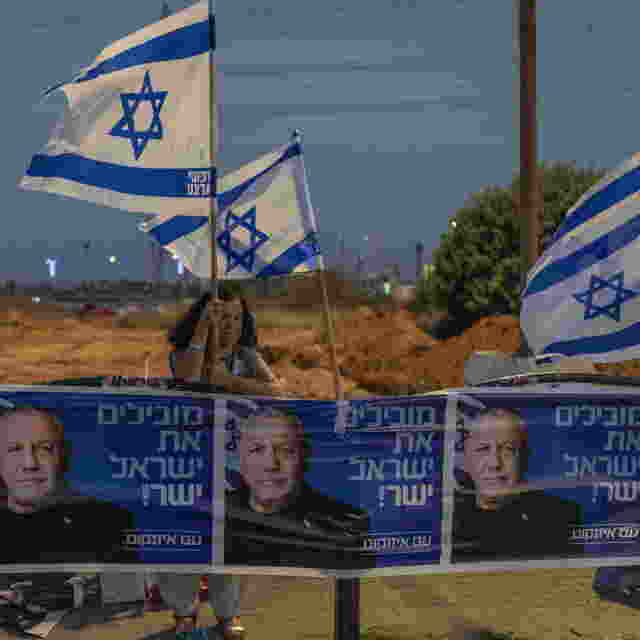
31:50We're entangled in endless wars, and this was done on purpose. So it's not a bug, it's a feature. The whole idea is for Israel to keep fighting because endless wars serve Netanyahu to maintain a sort of a constant state of emergency. Many Israelis believe the only way to break this cycle is to elect a new leader. Number one, Gadi Eisenkot. Gadi Eisenkot is Netanyahu's leading opponent. At a stump speech a few weeks ago, I watched him take the stage. He's a short man with cropped white hair, wearing all black. The event is in Kiriat Gat, a city near the Gaza border. Historically, it's a conservative Netanyahu stronghold.
32:39This crowd knows Eisenkot as the former military chief of staff appointed by Netanyahu a decade ago. He came back into the public spotlight days after October 7th, when he joined Netanyahu's war cabinet. Very soon, the nation saw Eisenkot crying over his son's casket.
33:03His son was a soldier killed in Gaza. The very next day, his nephew was killed fighting in Gaza. Eisenkot tells this crowd that after the first three months of war, he thought things were going in the wrong direction.
33:19I saw a deep dysfunction in the decision-making process, he says. I saw that political and personal considerations were put above everything else. He means Netanyahu. He's pledging to voters the first thing he'll do as prime minister is to do the thing Netanyahu has refused to do, to launch an official national investigation into the security failure of October 7th.
33:54In the crowd, I met Yair Amar. He told me he always used to vote for Bibi, Benjamin Netanyahu. But he says Netanyahu is responsible for all the Israelis killed on October 7th. And Eisenkot? He says he's straight, like a straight shooter down to earth. He's everything Netanyahu isn't, says Amos Harrell, the Israeli columnist. Many Israelis wish for a saner future, for somebody who perhaps is not as charismatic and doesn't look the part of an American senator, but is one of us and is seen as somebody who sacrificed a lot. The race is very, very tight. Most polls show Eisenkot's camp ahead of Netanyahu's camp.
34:43But those same polls show that neither Netanyahu nor Eisenkot have a clear path to victory. The election could tip based on a small amount of votes. Or it could end in a stalemate and force a repeat election next spring. If that were to happen, Netanyahu would stay in power, without a new mandate from the public, but with full authority to make fateful decisions like going to war. And if Netanyahu loses the election, What would change under a prime minister, Eisenkot? Apart from his promise of an official investigation into October 7th, he's spoken of cracking down on settler expansion and violence against Palestinians in the West Bank.
35:24He talks about reaching diplomatic agreements in all the wars Netanyahu has kept open. But there's one thing he's made clear. He would not withdraw troops from Lebanon and Gaza anytime soon.
35:42Truth be told, Eizenkot told the crowd, it will take a lot of time. He said the Israeli military presence in both places is necessary until Hamas and Hezbollah's military forces are dismantled. And on the biggest question of all, how to solve Israel's conflict with the Palestinians?
36:04Eizenkot boasted to the crowd that he never said the solution was two states for two peoples, meaning creating a Palestinian state alongside Israel. That is the vision that the U.S. and the majority of the world has advocated for decades. Eisenkot thinks Israel should preserve possibilities for a solution in the future. After October 7th, Israelis do not want to discuss a Palestinian state. It's not something that the Israeli public can swallow at this time. More and more people suspect that the Arabs, the Palestinians are out to kill us and that the world is out to get us. And there's less support for any kind of concessions because people keep bringing up October 7th.
36:49And this is important to understand. This is not a race of conservatives versus liberals, right versus left. Eisenkot is leading a group of politicians who are largely right-wing. Not the far right of Netanyahu's camp, but right-wing, focused on boosting Israel's military for whatever dangers are to come, and recruiting religious ultra-Orthodox Jews to the military, trying to tell Israelis, it's okay not to vote for Netanyahu. I'll make sure Israel stays strong. I'm trusting on the military level. But is it enough? High school theater teacher Anat Ben-Ari came to hear Eisenkot speak, and she's almost nervous, voicing an unpopular opinion out loud.
37:36She thinks he shouldn't shy away from peace agreements. The only way to end war, all the history says that, is by agreements. It's by people talking to people, even enemies. Mostly enemies. And I think we should also pay the price for peace. In order for less people to die here and not always live on our swords. But this idea, should Israel continue to live on the sword, it gets to the heart of things. As much as this theater teacher would like to let go of the sword so fewer will die, the soldier, Lior, wants to hold on to it. I think the enemy will always become. There will always be an enemy, so I think we will always be in a war.
38:20We always live on our sword. Live on our sword. Live on our sword, and it will always be. The problem is that you have two reputations you need to protect, but you can't. This is Israeli author Micha Goodman. He's written about the Israeli-Palestinian conflict, and in the past, he's been an unofficial advisor to top Israeli politicians. Now, in the Middle East, you want to have a certain kind of reputation. You want to be seen as unpredictable, a little bit crazy. Like, don't mess with us, okay? We have, there's this term in Hebrew, ba 'al abayit yishtagea. The boss went crazy. Yeah. And then in the West, we want to be seen as a Norwegian, nice, sweet country playing by the rules, predictable.
39:07Israelis want to be feared and to be loved. After October 7th, the Middle East didn't fear us. Israel had to restore fear. But everything we did to restore fear eroded the love.
39:20Ultimately, Goodman says, there's a zero-sum game. between love and fear. And so this is what Israeli voters now face, the precarious balance between the world's love and their neighbor's fear, between holding tight to the sword or loosening one's grip. Whoever wins the elections will be leading an Israeli people who are both wary and weary from war, a people who have drawn drastically different lessons from what's happened here these last few years and pose radically different visions of what saving their country means, whether that's an Israel that can start repairing its relations with the world or an Israel that still hasn't finished the fight.
40:07That was NPR's international correspondent Daniel Estrin reporting from Israel. This episode was produced by Reni Svernofsky. It was edited by Jenny Schmidt, engineering by Jimmy Keely, and fact-checking by Will Chase. Additional reporting by Michael Levitt and Etai Stern. Producing by Andrew Mambo and editing by Carrie Kahn, James Heider, and Nishant Dahiya. Didi Skanky is NPR's chief international editor. Liana Simstrom is the Sunday Story's senior supervising producer. Our executive producer is Irene Noguchi. Up First will be back tomorrow with all the news you need to start your week. Until then, have a great rest of your weekend.
41:19and more. Try it free for 14 days at go.gle slash workspace with Gemini. Support for NPR and the following message come from Washington Wise. Policy decisions in Washington can influence markets and your portfolio, but which developments matter most? Listen to Washington Wise, an original podcast from Charles Schwab. Host Mike Townsend, Charles Schwab's Managing Director for Legislative and Regulatory Affairs, takes a nonpartisan look at the latest news from Washington and how it may affect the economy and investing. Download the latest episode and follow at schwab.com slash Washington wise or wherever you listen.
