
In short
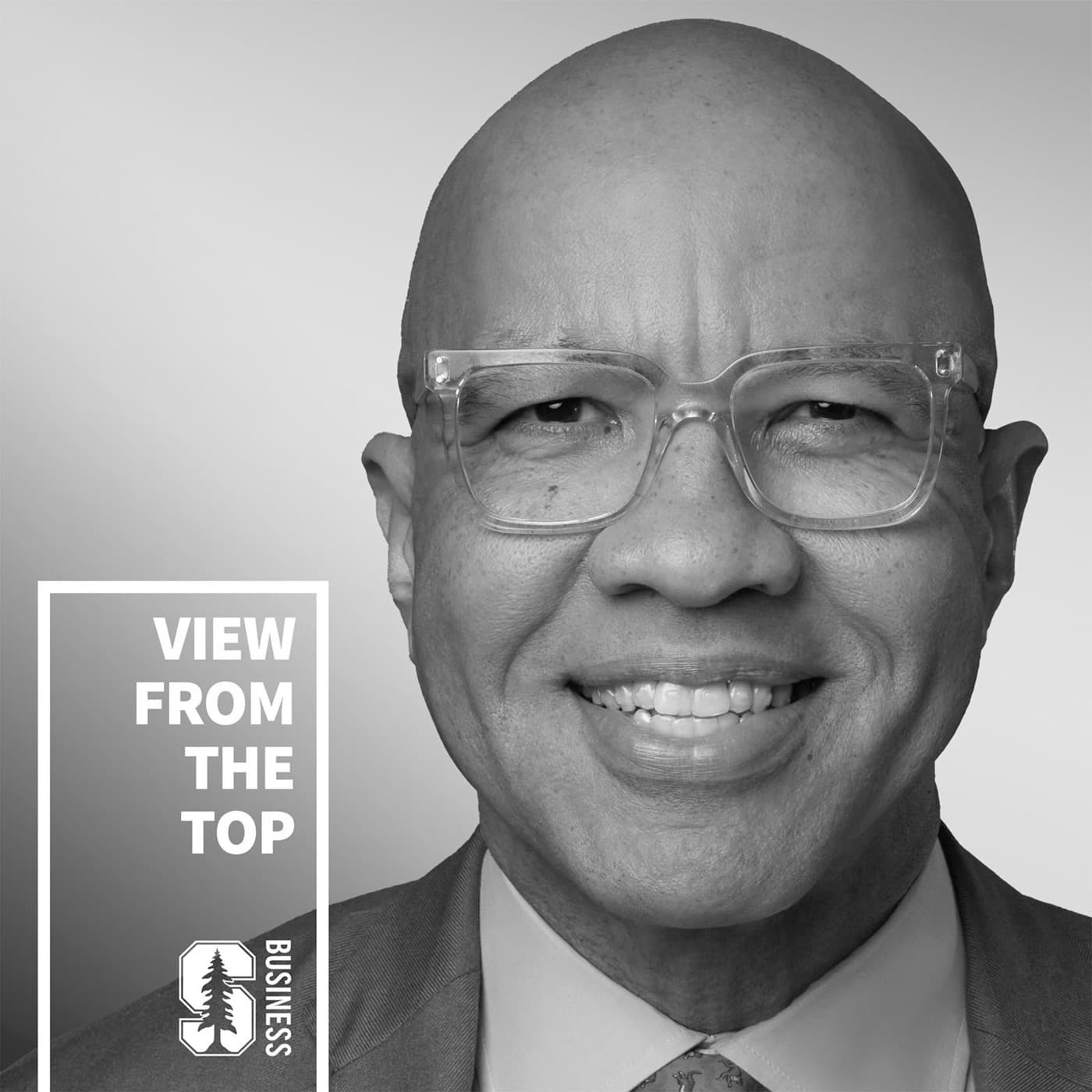
Podcast Episode Summary: S8E3 - Darren Walker on Finding Clarity and Purpose
Podcast Title: Stanford GSB: View From The Top Episode Title: S8E3: Darren Walker on Finding Clarity and Purpose Hosts: Kailash Sundaram, MBA ’25, and Michael McDowell, Producer
---
Episode Overview
In this episode, Darren Walker, president of the Ford Foundation, discusses his journey through inequality, philanthropy, and the importance of clarity and purpose in leadership. Walker shares his personal experiences growing up in Texas and emphasizes the significance of fostering dreams in young people from all backgrounds. The conversation covers his insights on philanthropy, the importance of character over credentials, and actionable advice for career pivots.
---
Key Themes
- Background and Rise to Leadership
- Walker recounts his upbringing:
- Grew up in Ames, Texas, raised by a single mother.
- Experienced poverty but felt supported by his country.
- Early influences included:
- His mother, who encouraged his ambitions.
- Teachers who provided guidance, including Mrs. Majors, who taught him to manage his emotions in the face of racism.
- Importance of Clarity and Purpose
- Walker emphasizes the need for a clear vision, mission, and strategy in life and philanthropy.
- Discusses the dangers of letting financial obligations (golden handcuffs) dictate career choices.
- Advocates for making career pivots early before the constraints tighten.
- Philanthropy and Inequality
- Walker’s commitment to fighting inequality stems from his desire for all children to dream and succeed.
- Discusses the rising wealth disparity and its implications for democracy:
- The need for an economic system that provides shared prosperity.
- Importance of questioning systemic structures that perpetuate inequality.
- Character Over Credentials
- Walker believes that character and the ability to inspire are more crucial for leadership than academic credentials.
- Reflects on his own unexpected rise to leadership positions in foundations despite not being the traditional candidate.
- Navigating Challenges in Philanthropy
- Walker responds to criticisms of philanthropy, arguing it should complement—not replace—government actions.
- Discusses the necessity of strategic grantmaking focused on long-term objectives, particularly in addressing social justice and economic rights.
- Hope for Future Generations
- Walker encourages the younger generation to learn from the past and strive for justice and fairness in society.
- Emphasizes the urgent need for collective action to correct systemic injustices.
---
Key Insights and Takeaways
- Dreams Matter: Walker believes that every child should feel they have the potential to succeed, regardless of their background.
- Adapting to Change: Emphasizes the importance of clarity in personal and professional life to navigate changes effectively.
- Philanthropy’s Role: While philanthropy is vital, it cannot replace the need for systemic change in addressing inequality.
- Legacy and Leadership: Walker prefers to focus on impacting people rather than leaving a personal legacy, highlighting the importance of humility in leadership.
---
Conclusion
Darren Walker's conversation offers profound insights into leadership, the challenges of philanthropy, and the importance of nurturing dreams in the next generation. His personal journey serves as an inspiring reminder of the power of purpose and clarity in achieving meaningful change. Walker's commitment to equality and social justice is a clarion call for the younger generation to engage actively in creating a fairer society.
---
Listeners can find more episodes of View From The Top on the Stanford GSB website.
Written by AI. May contain mistakes. Listen to the episode to check what was said.
Transcript
Automatic transcript. May contain errors.0:09Welcome to View From The Top, the podcast. I'm Kailash Sundaram, an MBA student of the class of 2025. And I'm Michael McDowell, a producer at Stanford Graduate School of Business. Kailash, talk about the conversation we're going to hear today. We're going to be hearing from Darren Walker, president of the Ford Foundation. Darren's story is just absolutely incredible. Darren grew up with a single mother in Texas, and he rose to become president of one of the largest philanthropic foundations in the world. I think Darren's story really resonated with our students living the American dream, switching careers from being a lawyer and investment banker to going into the world of philanthropy and finding purpose and impact in his life.
0:52It's going to be a real treat to listen to. I really like that. And just to preview one thing he said was America wants you to succeed. Yeah. I thought that was so powerful because I think often you worry that that mobility escalator is gone. America's forgotten about the poor, about those who are being left behind. And to hear the president of Ford Foundation that does this work every day of trying to lift up people, of trying to fight inequality, say this country was behind you, that was powerful. And to hear that from someone who had lived the American dream themselves, it made me feel like it's still possible here.
1:28Absolutely. What's a moment in this conversation you're particularly excited for our audience to hear? I think I'm excited for the audience to hear about the advice that he got as a little kid, because that piece of advice really carried with him throughout his life. And you can tell that it set him on the path that he's on now. The second thing that I want everyone to hear is I asked Darren, what's one thing that would surprise us that most people don't know about you? That was a great question. And Darren shares a really poignant part of himself with us. And it was a really vulnerable, tender moment spoke to a lot of people in the audience who've experienced this.
2:10And I hope you certainly get to hear that and carry that with you through your life. That's great. Kyla, should we play the tape? Let's play the tape. Darren, thank you so much for being here today. Welcome to Stanford. I'm delighted to be in Palo Alto at Stanford and not in Manhattan today. I can only tell you as a New Yorker, we often, when people abandon us and come out here, we lament that and say, how could they leave New York, the most exciting, interesting place in the world to live, and then you come here. And you completely get it. You completely get it. This place is magical. Well, we have so much to talk about today, from your incredible life story to your time in leadership, but I want to start with where your story begins.
3:05Tell us about your upbringing and how it shaped you. Well, I grew up in a country that believed that poor little boys who lived in shotgun and houses on dirt roads in rural places like Ames, Texas, could dream. I had permission to dream, and so I had dreams. Some of those dreams took me away because I was in the first class of Head Start, and my love of words and language began then, And I would dream because there were occasions when my grandmother, who was a maid for a wealthy family in Houston, we would go in to the city and I'd go to their house and help her with her work. but I would always in their mudroom find shelter magazines and books and programs from the Houston Ballet and the Alley Theater and I would pilfer them away because they were throwing them away and bring them home with me and I would sit and just just go through the pages of these places and spaces that were so far away from that little dirt road in Ames, Texas but it allowed my imagination to expand and to be taken out of the situation I was in which would be probably called challenge.
4:44I always felt even though most people when they look at the material circumstances of my childhood would use the word poverty or or deprived in some economic way, I always felt that my country was cheering me on. I always felt that America wanted me to succeed. And I always knew I was going to be a success. I didn't know that I was going to be president of the Ford Foundation because I didn't know what a foundation was. But I had enough support from my mother, who was a single mother of four kids. I never knew my father. And although she couldn't discern, well, you should go to this college or major in that discipline, she encouraged me and she knew that I was a different boy.
5:58She knew that I was not like most of the other boys. And she completely embraced that. So I never, my lovely, wonderful, departed partner of 26 years always spoke about how difficult it was to not feel that who you were as a child could be fully embraced and the burden of that as an adult I had the opposite my mother knew that I was a strange child and yet she completely allowed me to flourish and and that helped and then along the way I just had people who were my champions I had I never the thought of the cost of an education being a barrier for me was never a question I was lucky to have scholarships and but I never thought about oh my goodness this I'll have too much debt to go to that school.
7:14And I went to public schools. I'm proud to say I have never had a day of private education in my life. And I think in a democracy, that's a good thing, when you have leaders who can say that. And so I've been a very lucky man. I've been very blessed. I was born at a time when I could dream. And the thing and the reason I'm so singularly focused on inequality today is because I want little boys and girls, wherever they are, if they're living in housing projects in the Bronx and they're black or brown or they're living in rural towns that have been ravaged by opioids, I want them to be able to dream and to feel, as I did, that America wants you to succeed.
8:14Your country is enabling you to be a success and to get on the mobility escalator. And so that mobility escalator that propelled me forward has stopped for far too many Americans. And I think the fact that it has impacted our politics. And it has profound, I would say, existential implications and consequences for our democracy. It is so powerful to hear you talk about the power of the American dream and the support that you had around you that helped you thrive and excel. But I also want to acknowledge that you've spoken about your experiences with racism and discrimination early in your childhood and into your career.
9:19How and if you're open to sharing, how did you deal with and make sense of those experiences? Well, I think anyone who is different in whatever context where you are a minority can relate to what it feels like to be excluded or to be marginalized based on some marker. For me, racism was real because in the 1960s, growing up in a small town in Texas, it was just a way of life. And I think for a lot of people, and it's so interesting because when I look at my mother's generation, it was an accepted cultural norm that you find in other parts of the world that, well, this is the way it is. And so for my generation, the belief is a more hopeful one in this regard.
10:36I think hate is a scourge that many people feel is necessary. I mean, I say this as a historic, the kind of arc of history, whether it's anti-Semitism or racism or classism. And I reject that idea. And I think those of us who do reject it have to be willing to speak up to reject it. And for me, I never let race or racism, and I say this often to young people and people today, you know, throw me off my game. I think one of the things that people who are racist, just focusing on race, hope to do is to throw you off your game. and you really have to have clarity about your North Star and not be so consumed by that the moment right so so when I was a when when I was a boy in this little town I was in the third or fourth grade and this guy friend, whatever, called me a sissy.
12:11I slugged him. We were on the floor fighting and Mrs. Majors came and she pulled me off and she said go into my classroom now. And I go into her classroom and I'm crying, I am a mess, and she says, Darren you have to understand. Now again, Mrs. Majors would be probably fired today, but she wasn't great. She said, little Negro boys who cannot control themselves, bad things happen to them. Now, today, in this context, she was exhibiting love and care for me. because she was helping me understand that in order for me to be a success, I had to control my anger and my rage. Mrs. Majors is on my shoulders every day.
13:16And so when you ask how I, over the years, have coped with, have thought about this, and when you talk to other successful people of color, certainly I can talk other successful blacks, that ability to cope with the moment in which you experience a racist interaction with someone, and the ability to not go there, because it's so easy to, because for many it happens so often, that's key to your success because it's Mrs. Majors was right. The little Negro boys who simply might act out were put into the special education class. They were more likely to not graduate. And when you look at the prisons across this country today, those little boys are the primary occupants.
14:28And so Mrs. Majors did me a great favor. She really loved me, and I owe her. In the face of adversity, you thrived, becoming a corporate lawyer and then an investment banker. But not necessarily something you'd expect from someone who would go into philanthropy. What drove those early career choices? Well, one of the things that happens when you grow up poor is as an adult, you pledge to never be poor again. And so I was envious of my friends in law school who said, oh, I'm going to go and do this public interest law fellowship. And I'm going to go to the ACLU. I was very clear I was going to make money and clarity and purpose is so critical in life but when you have goals that are short medium long term so I knew that I would have responsibilities that many of my classmates did not And so for me, going to Wall Street was a platform to create some wealth.
15:55That's all. And the psychic satisfaction that I did not experience was in some ways satiated during bonus season.
16:18And I reached a point where I said, I'm done. I mean, I did 10 years. And a lot of things converged. It was the early 90s. I started, I mean, I had a life downtown in Manhattan. But if those of you who know New York in the 90s, I mean, I was really drawn to Harlem. Most people in New York in the 80s and 90s were not drawn to Harlem, which is hard to say, hard today to imagine that there was a time when people did not want to live in Harlem. But when I moved to New York, a lot of people did not want to live in Harlem. And so I met this amazing minister at the Abyssinian Baptist Church, Calvin Butts, and everything sort of converged.
17:10And I said, oh, great, I'm just going to come volunteer and hang out with you. And that's what I did. And the vision, which was a real regeneration of particularly central Harlem, although there were half a million people in Harlem, there was no supermarket. It was a food desert. In terms of health care, I mean, you could just go down the indicators of community well-being. And so we set about addressing that. and I spent eight years there and it was amazing. He did over a thousand units of housing, the first supermarket in Harlem in 50 years. I mean, there were so many things that I got to be a part of and it was great and that transition allowed me, again, clarity and purpose.
18:02When I left Wall Street, there were no regrets. I did what I sought and started out to do and when I was able to transition to running a nonprofit in Harlem I actually thought that I would want to do that kind of work I mean that specific work I thought well you know I wanted to work in a black neighborhood I was drawn to Harlem because the Harlem Renaissance and I loved Sorin Arston and James Baldwin and all these sort of sons and daughters of Harlem and so I had this romanticized idea of, of course, when I moved to Harlem in the 1990s. I mean, you know, there was not a lot of romanticism in the rats running around in my apartment and all that.
18:49It was a very different time than it is today. I mean, of course, when you go to Harlem now and, I mean, where do you start? The H &M? To Ralph Lauren? I mean, where do you start? I mean with what populates you know 125th Street as opposed to when I lived there and and just to get a quart of milk you had to go to this bodega and hope that it hadn't expired. Well it's a really interesting decision you made to leave the corporate world, give away bonus season and Wall Street because I think for a lot of us business school students we sometimes have the perspective I'm going to go into a field like invest in banking, make a boatload of money, and then give it all away.
19:33What do you say to those of us with that perspective? Good for you. I mean, my, I say,
19:45for just have clarity about what it is, and I didn't know when I started where I would end up, and I still don't know where I will end up because I'll be leaving Ford at the end of the year. But if you want, if literally you really want to make money, if you want to pay off your student loans, if you, like, that's a goal. Set that goal. And the challenge is, and this is what I found in friends who later on in their careers would call me after really the sort of golden handcuffs are tightly around your wrists to say oh I don't like being a partner at the law firm oh I'm tired of IPOs and chasing clients or all right well you're you're 45 50 years old I mean you spent 20 years you can't just pivot and say well because now I think I I want to be like you.
20:55I think I want to go and be in a foundation. Well, you can't pivot. You've been at Goldman for 20 years doing this kind of work. And you're not a billionaire. I mean, so it's not like, you know, you're just going to sit and not work and give away money. I mean, if you're that, I mean, this is the more normal thing where you people just have become accustomed to a lifestyle. I mean, in a place like New York, it is a place where you can have a household income of a million dollars and not feel particularly rich. I mean, if you have a nice apartment, you want a house in the Hamptons, I mean, like a million dollars a year is not going to get you that in New York.
21:45and so people get the handcuffs and the lifestyle and then you've got kids and then you've got private school education and then you've got and all of a sudden and you're really not happy doing that work anymore but you're locked into a lifestyle and so I think figuring out earlier because the longer you stay in that example the harder it is to extricate yourself into, you know, and pivot. Now, if you're an investor and you want to go and do impact investing, sure, that's not. But the kinds of big pivots, certainly that I did, are possible because I think I got out at the right time. I think that's a great call for us to each find our clarity and what we'd like to do.
22:46So you take that clarity, a passion for social impact, and you go to Rockefeller, where you spend quite a bit of time before you move on to the Ford Foundation. And three years in, you're asked to lead the organization. What did that mean to you? Well, I think I've never been foundation material, or certainly not. No, I mean, when I interviewed at Rockefeller, I remember I went back for so many interviews. And I would remember I'd take the A-train back to Harlem and think, well, what just happened? Are they going to hire me or not? And I just kept getting called back, but never an offer. And then I got an offer.
23:30And a few months in, a person who was a director, one of the directors, I was hired as director of the U.S. program, but the director of the Africa program. We were talking and he said, you know, a lot of people during the interview process liked you, but they just didn't think you were Rockefeller material. And the reason for that was because I'm an Ed Rockefeller at the time. I wasn't an academic. I'd never published anything in a journal. I didn't go to private school. I mean, they were right. I mean, by that criteria, I was not. I didn't, you know, the other four directors all had PhDs. One was a Rhodes Scholar.
24:18I mean, they were, you know. Now, two years later, I was promoted to vice president, and I was their boss. And so what happened? And so that to me is the lesson. And part of the lesson is there was a time when, and I can say this because it's true, there was a time when the smartest man in the room was presumed to be a leader. but just because he's a world scholar he's the first professor in the Department of Economics to blow or whatever he's the youngest partner at what we now know and certainly from research but anecdotally is those people are usually not leaders and they usually are not equipped I I should say they are often not equipped with what it takes to lead, inspire, energize, mobilize, manage, create followership, innovate, et cetera, et cetera, that is needed to lead in the complex world we live in.
25:45And so that's what happened to me at Rockefeller. And that's what happened at Ford. I have never been the smartest man in the room. And that has never left me feeling inadequate or not up to the task. because at every opportunity when given a chance to lead I've been able to do that and so things accrete reputation accretes your own personal brand and how people experience you you hope accretes but to lead today you have to have some sense of humility, of empathy for others, an ability to put yourself in their shoes. Now that doesn't mean that every leader today possesses that, but I do think to be the kind of leader who is respected and hopefully admired, not because of of your title, because that's the other thing about you can, there are many people with president behind their name or founder behind their name.
27:22It doesn't mean that they're respected, that they're admired, that they have a followership that comes not because of their title, but because they inspire, because people want to be in the room with them and are willing to follow them because they respect them. And so I try my best and I don't always succeed in being that kind of a leader. I want to touch on that point about humility but before I get there at the Ford Foundation you chose to make the mission about addressing one core issue, inequality. And I think we can all agree in this room how important that is to give everyone hope, to level the playing field, to make sure that everyone has a fair shot.
28:18Yet since 2020 the world's five richest men have gotten twice as wealthy, while five billion people across the world have gotten poorer. What's not working? Well first I think it's important to not demonize wealthy people. My quest to engage in questions of inequality is not about demonizing people who are successful. We need people to be innovative, to be innovators, to be entrepreneurs, to make the potential of capitalism and our economic system to generate wealth. We need that and that's I begin having said that for a democracy I'm not talking about other forms of government or other countries for this country with the history of a nation where the mobility escalator our ideas of opportunity hope are the lodestar of our cultural zeitgeist to not have an economic system and a form of capitalism that does not produce shared prosperity is a potential crisis.
30:16And so the question is not about, well, there's five people and now they're richer. The question for me is, how do we have a system where people do what we have always done in this country? and little boys like me get to grow up like work hard, have a fair level playing field, have a culture and an economic system that allows people to dream, that is a function of government and public policy choices that are made that is a function of what we prioritize in our larger collective ambition for us as a country and so for me I think we've got to question the systems and structures that are designed to generate these outcomes because if if we believe in the values of this country of opportunity of hope inequality is the enemy of hope because hope is the oxygen of democracy and when you have a society where there is hope and opportunity the air is full and when you have a society where hope where inequality is growing that hope is asphyxiated and the air becomes toxic because the citizenry believe that the systems, the institutions, the economy are all stacked against them and they become angry and anxious and resentful and all of that is bad for a democracy we'll be back after this
33:12So some people, in tackling these issues, argue that instead of philanthropy, corporations and individuals should just pay higher taxes. And you've got folks on the other side who say that, well, the private sector is a more transformative place for change. How do you respond to those who maybe don't see a place for philanthropy in society? Well, first of all, I think it's a false binary. and philanthropy can never make up for the consequences of inequality what I'm talking about the problems that we have to solve in the world today philanthropy can't make up for that and the private sector has an incredibly important role to do in solving the world's problems.
34:06And there is much to be unleashed in the private sector. It is not simply about saying to wealthier people, pay your taxes, or pay higher taxes, or let's just tax them. Actually, I do think there's a question about whether our tax system is fair. and I have lived with privilege and I have lived without privilege and there is a big difference. To live in a world of privilege, when I was an associate I just joined the law firm and you know when you join the firm and they give you orientation they give you all of your materials and there's one to open your banking and so there's a letter and a please go to a 55 Wall Street to this I'm so old it was first city National Bank and and take this so you know I'm I just go walk in and I'm standing in line and this lady sees and I said oh and she I show her this and she said oh sir you're in the wrong line and she takes me up these stairs to this place and there was a sign and it said private bank we go inside and I sit down with a banker with a person and they began to tell me the suite of opportunities and the private bank well the my mother lived on a precipice every I mean the idea of even writing a check and like at bouncing like was a reality, like that was just a cloud over our household.
35:56And to sit with someone and to say, well, in the private bank, basically we'll let your checks bounce. I mean, you put some money in this account and we will. I just thought a bank was a bank. I didn't understand that there was another whole bank for people like me. and thus began my journey, where you come to just see that for people with privilege and money, there's just another line. There's just another whole line. And because I had been in that other line, and now I'm in the other line, and I see how different it is. And I see how, you know, just how you just invest. And we've had, if you have, have you been lucky enough to own assets, you know, in the last decade or even since 2020?
37:04If you've owned securities, if you've owned real estate in New York or the Hamptons, or just think about the things in my world or my milieu, we just had to like sit there like we didn't have to do I mean we worked and worked hard and we whatever but like you just would like just open your bank statement and your Morgan Stanley private bank account statement once a quarter and it's amazing and at the same time so many people so many people in this country feel you know like my cousin who I used to babysit for who lives in rural Louisiana and his dream has been to have a double wide manufactured home and I'm helping him finance it but the journey to get there, the journey to get him there, work hard, play by the rules, do all the things you're supposed to do.
38:07And all he wants is his double wide mobile home. And then people complain in my world that their Range Rover was delivered late and they're really mad about it. As you think about tackling this issue of fixing those two lines or bringing them together, you're faced with difficult decisions every day about where to give money. Is it fighting homelessness in America or is it tackling starvation in war-torn regions? How do you decide who deserves a grant and who doesn't? Well, you first have to start with a clear vision, mission, and strategy that allows you to have some rigor around what you invest in that correlates with some objective you have longer term.
39:09And so at the foundation, our work has significantly been around issues of social justice and inequality. and so for that reason our work has been focused on economic rights and justice issues and so an example would be I in terms of strategy and grant making I believe that a critical link to the mobility escalator is ownership we should be an ownership society we have become less of an ownership society because of the choices that have been made and so and so we make grants to organizations working on employees having ownership and equity yeah and so there are models for that from ESOP to employee stock ownership programs to a program we have with with KKR working in their domestic portfolio with ownership and many of their manufacturing portfolio companies because if people have equity they have more of a commitment they are better workers they are more productive my grandfather had a third grade education.
40:33He was a shoeshine boy, which is what they called him in the 50s, and the porter in an oil company in Texas. But every employee participated in the profit-sharing plan, even the porter. When he retired, his Social Security check and his stock in the company allowed him to live with dignity for the rest of his life. Those programs don't exist anymore. Why? Well because we made choices to do away with those programs. So we in that economic justice program make grants to organizations working on that kind of initiative. In our work on reproductive rights and justice. We are unapologetically as a foundation pro-choice and believe that a woman has a right to determine bodily autonomy and the right to an abortion.
41:39That there are many organizations who are working towards that objective. We fund those organizations. And so we make through those strategic choices then cascading down a set of choices among organizations we believe are most likely to help contribute to that progress towards those goals. As you speak to a room of young people I'm reminded of your quote that you find hope in young people. As you pass the baton, it's on our generation to take up the mantle. What is your call to action for our generation? Well, first I say I apologize because we should be passing a better world to you. And so learn from the lessons of the people whose shoulders you stand on.
42:56And when it comes to issues of injustice, of fairness, of opportunity, help correct the things that you think are wrong and need fixing, of which there is a lot. I certainly hope that each of us will take that away and figure out what we can fix and move towards that. This is your last year at the helm of the Ford Foundation. And so before we open it up to Q &A, I find it particularly fitting that a theme for the year is leaving your mark. So Mr. Darren Walker, how would you like to be remembered? Well, I would like to be remembered as someone who was less concerned about leaving a mark than impacting people.
44:00And what I mean by that is by being an example that you can certainly not be what might be presumed, that you can be a complex person, right? And your complexities and being sort of multidimensional and complicated are all seen as values and virtues towards your leadership. And so, you know, I'm not big on legacy. talk. When I was the board chair called, we did it all hands on, sort of in a room like this at the Ford Foundation and we were on stage like this and he said, we have bittersweet news. Darren has told the trustees that he's going to leave next year and he went on to say and it's going to be so hard to fill his shoes and then during the Q &A, the staff went, oh it's going to be so hard to fill your shoes and finally I just took the microphone and said, I am taking my shoes with me.
Read the full transcript
45:13It is not about my shoes. My shoes are leaving the building. The board, you need to find the next pair of shoes or pumps that need to be in this seat. But, you know, I'm just not, I get really uncomfortable. I mean, we just, you know, they literally are planning my going away party. and they and I was like are you kidding me like they're gonna be two speakers the board chair and me it's going to be an eight-minute program I am not letting speaking on behalf of the women's rights movement but speaking on behalf of the speaking on behalf oh my gosh that's a dreadful experience that I had go through all the time but I mean it's fine but it's just it's so not and I get it oh yeah yeah yeah but like yeah like get on get out of the way let other people come along and you know my one of my mentors was this amazing man named Vernon Jordan and Vernon used to say to me work until you can't and live in the future.
46:30And that was such great. So I don't look back and, oh, yes, you know, there are times, and I do, I mean, you know, but look to the future. Be excited. Get busy. Well, if I can say so myself, Darren, you leave behind a tremendous legacy and you choose to fill. We'll now open it up to audience Q &A. If you could just raise your hand, our mic runners and VFTTT team will come to you. Please just state your name and your year before asking a question. Thanks for joining us.
47:12I'm Sarah. I'm an MBA one. And I've been thinking a lot about Bloomberg's decision to cover the US commitment to the Paris Agreement. And I'm curious how you think the role of philanthropy is changing now, in the next four years, and then beyond. Well, as a full disclosure, I'm on Mike's board of the company of Bloomberg LP, and I'm a huge admirer of his, obviously. And I think this isn't his first rodeo on the issue of Paris and the U.S.'s withdrawal. And so he's got a playbook. And that playbook was successful, I think, in the first administration of this president. And I think he's going to deploy it.
48:07I do think in that example, Mike is putting a tremendous amount of his personal wealth towards ensuring participation and the resources. And so in that example, it is an example where the financial resources of a philanthropist, because it's a window and it can't solve the problem, but the challenge that of America and American institutions participating and having the resources to do that will be spoken to. I think the question of the leadership of us as a country represented in the world, no philanthropy can make up for that. But I think Mike is an example, and there are others who can step in when there is a bottleneck, when there is a time-limited challenge, and with a tremendous amount of resources, make a huge difference.
49:29Thank you. I'm June. I'm an MBA1 here. While doing international developments, how do you handle unpredictable or even hostile reactions from foreign governments, especially last summer when President Ruto made unreasonable accusations of Ford Foundation, the tension escalated, and then you two met in New York, I think in September, and suddenly the president was like praising Ford Foundation. What did you do?
50:02I think when, first of all, when you are an American-based institution, one of the things that, and you've been in a place like East Africa, or many parts of the world we are in, you experience the growing agency that countries that we used to call developing countries rightly feel. So there was a time when American institutions, including the Ford Foundation, had a pretty colonial mindset in our development work in these countries. and they rightly won't tolerate that any longer and I think that's a good thing having said that you also can be a pinata for authoritarians and people who when things in their own country are not going well, are looking for someone or some institution, some country to blame.
51:23And I think President Arutu was in a very difficult situation. And I admire him. And I think he and I just needed to sit down. and have a conversation about our shared interests. And you have to also understand that for a lot of leaders on the continent, sitting down with a black person from America representing an American institution as its CEO is a new experience. Of course we have President Obama as the ultimate black CEO, but for a lot of these leaders there is something that allows you to have a shared experience that you can speak to. All right we'll take one last question. Hello Hi my name is Grace Pan.
52:37I was wondering if you could provide us with an update on the mission investments portfolio. I know that the Ford Foundation is famous for placing a 1 billion dollar bet on mission on impact investing expecting financial returns as opposed to grant making. So I'm wondering how has the performance of the fund changed your view on impact investing? Well, thank you. That's a great question. And it has affirmed my view, because when I proposed the idea, there was some skepticism among the trustees, understandably, because they operated from a perspective of, we should have the endowment generate as much return as we can and then you'll have more money to give away.
53:30Of course you know sidebar when I asked for when we first reorganized the foundation around inequality and some of the issues that I spoke to I wanted an audit of the portfolio, the endowment portfolio, and this is when you hold the mirror up to yourself, you know, when sometimes it's easy. We foundations are great at pontificating from our glass houses and we literally have a glass house at the fourth foundation. About what? And then you hold a mirror up and you find that not only are you the largest grant maker in ending private prisons and the prison industrial complex you also find that you're an investor in it that's news that is a part of the journey of this idea from generosity to justice dr.
54:36King said about philanthropy the following, philanthropy is commendable but it should not allow the philanthropist to overlook the economic injustice which makes philanthropy necessary. So that's what he was talking about. You are happily investing in improving the public health of people in this community and you're investing in one of the largest contributors to asthma rates. So the mission investment portfolio has affordable housing, financial services for the poor as two primary objectives and asset classes. It's done very well. So surprise, surprise, affordable housing, you can make money in America.
55:34Now, it's true, the IRR does not look like luxury housing. But we have a different strategy to have both an attractive adjusted rate of return and social impact. And so the portfolio, which is now the original billion, well over half invested, has done very well. And we published, and I think it may be in our website, an evaluation. I think when we were maybe at the 350 or 400 mark. but I'm very encouraged and hopeful that we will continue to experience success and that it will grow. Thank you. Thank you. So, Darren, we have a tradition here, a view from the top, where we like to wrap up every interview with a set of rapid-fire questions.
56:35Okay. So I'm going to throw out a question, and you're going to tell me whatever comes to mind. Are you ready? Are you sure that's a good idea? We'll see. We'll see. Okay. Are you ready? Absolutely. What's the most important piece of advice you ever received? Mrs. Major's advice that I've told you about. It's the best advice ever. What's one thing most people don't know about you?
57:11Most people would be surprised to know that I have moments of real sadness, partly because of this isn't a rapid-fire answer but because when my partner of 26 years died six years ago a lot of things in my life became dark and and there is something that happens and if you have ever lost a spouse, a child. There is a part of you no matter how light-filled you are where there is this darkness that you can never seem to get rid of. Thank you for being willing to share that with us. You're also the president of the National Gallery of Art in addition to being president of the Ford Foundation. What is your favorite piece of artwork?
58:16Oh my goodness, my favorite piece of art. That's a really hard question. I can only answer it with one. Only one. Oh no. My favorite piece of art. Oh, because there's so many. So I would say mayonnaise Olympia. Mayonnaise Olympia, because it's the foundational picture of modern art. and because it was so shocking when it was shown in Paris of this courtesan lounging naked and looking into the eyes of Manet unapologetically and being handed a beautiful bouquet of flowers from from her client, our next caller. It's a really amazing picture. And what's the first thing you're doing when you retire?
59:23The first thing I'm doing is to hopefully take a little time off, hopefully. Yeah. So I'll do my version of I'm going to Disney World. Well, Darren, I can't wait for you to go to Disney World. It's been an absolute honor to have you here at View from the Top. Thank you so much. Thank you.
1:00:01What do you think Darren Walker's Disney World is? Actual Disney World? Oh, I think Darren loves the actual Disney World. Darren loves art, so art's probably his Disney World, but I'm sure if we took him to Disney World, he'd have the time of his life. And then kind of digging into some of the really profound things he shared, just have clarity. What does clarity mean to you? Clarity means a sense of purpose and a conviction around what you're going to do. I think we often set a purpose for our lives and then sort of judge it from the perspective of others. We sort of get in our head about where we're headed.
1:00:35And Darren's whole thing is just have something you're focused on, go chase it. And once you're there, decide if that's where you want to be or not. And for Darren, that clarity actually, funny enough, was making money. And I think for all of us, especially as business school students, sometimes we're blessed with a lot of choices and we forget that deep down, maybe there's something driving us. And Darren's whole thought is listen to that voice and believe it. Don't look to others for external validation. Don't judge your own thoughts and chase that voice inside of you. One of your very sharp questions was, how do you decide who deserves a grant and who doesn't?
1:01:14What did Walker's response reveal to you in terms of how he makes those calls? Oh, it's the toughest job in the world. Yeah. I certainly don't know if I envy the position he's in. What stood out to me was this point that just because you don't get a grant doesn't mean your work isn't important. But Darren's making choices around how the world's going to look in 10, 15 years and how the investments can line up in a way that meets the world, not where it is today, but where it's going to be. So two things revealed. One is just because he can't back your project doesn't mean that's not important.
1:01:47And two is when you're thinking about what you're building, don't just think about how it works for today, but think about how it's going to be there for the next 10, 15, 20 years. That's really interesting. And I think something that was so powerful was a moment he shared that was deeply personal. And it really seemed to affect the audience. Can you talk a little bit about that? I asked Darren if there was something about him that might surprise us. And I thought Darren might say something like, oh, I love to play poker. I've been to six to seven continents or something like that. And instead, he takes a moment, he pauses, and he talks about the passing of his partner and the grief that came along with that.
1:02:32And really this part of him that feels extremely dark and how he sort of deals with both kind of, to us, the audience, putting on this face of happiness. He exudes joy and warmth and charisma. But on the inside, there's actually a part of him that really hurts, that faces extreme sadness. Yeah, and it's this duality that a lot of us struggle with sometimes which is walking out into the world Showing this side of us that's so sunny and happy but at the same time on the inside. There's some hurt. There's some pain I think he spoke to every one of us that has to do that every day Well, that was really well said.
1:03:07Thank you Last question. Is there anything you want to talk about that we haven't addressed? One thing i'd love to note about darren I didn't get a chance to ask this question the story that stuck with me in preparing for the interview, which was that a couple of years ago, President Obama wanted to speak with Darren and his assistant came and told him that story and was really excited. And Darren responded saying, the president doesn't want to speak with me. He wants to speak with the president of the Ford Foundation. And that to me spoke to Darren's extreme humility. He realized it's not about him.
1:03:40It's about the fact that he's in this role and he has an incredible responsibility and a privilege and he never forgets that. So I hope the audience remembers that that humility is something that is so special to Darren Walker. One of the last questions I asked him was about his legacy he's leaving behind. He's like, I'm not big on legacy. He talks about the fact that he doesn't actually have - His shoes are leaving the building. Exactly, exactly. And I think, you know, he was being a little self-facing there. I think he's going to leave a huge, huge legacy to sort of follow and choose to fill.
1:04:11But there's something to be said about humility and grace and realizing that all of us have a purpose in this world, but we can't let it feel like that we are bigger than others. And no one is better or worse than anyone. And Darren sort of embodies that. He never let that role get to his head. He always took it as a privilege and a responsibility to be president of the Ford Foundation.
1:04:41You've been listening to View From The Top, the podcast. a production of Stanford Graduate School of Business. This interview was conducted by me, Kailash Sundaram, of the MBA class of 2025. Michael McDowell is our managing producer and Michael Rowley edited and makes this episode. Special thanks to Liz Walker. You can find more episodes of You From the Top on our website, gsb.stanford.edu slash business dash podcasts. Don't forget to rate and subscribe and follow us on social media at Stanford GSB. and see you next time on View from the Top.
From the publisher
For more than a decade, Darren Walker has led the Ford Foundation — and has been singularly focused on inequality. Why?
“Because I want little boys and girls, wherever they are, if they're living in housing projects in the Bronx and they're Black or brown or they're living in rural towns that have been ravaged by opioids, I want them to be able to dream, and to feel as I did, that America wants you to succeed,” he says.
On this episode of View From The Top: The Podcast, Walker joins Kailash Sundaram, MBA ’25, to discuss his approach to grantmaking, why character trumps credentials, and what philanthropy can do — and what it can’t.
From actionable insights — “start with a clear vision, mission, and strategy” — to the how of making big career pivots before the golden handcuffs tighten, Walker shares what he’s learned about identifying your purpose, leading without losing yourself, and carrying humility into every room you enter.
See Privacy Policy at https://art19.com/privacy and California Privacy Notice at https://art19.com/privacy#do-not-sell-my-info.


