
In short
Podcast Summary: Wild Hearts - Episode with Andrea Quinn
Episode Overview
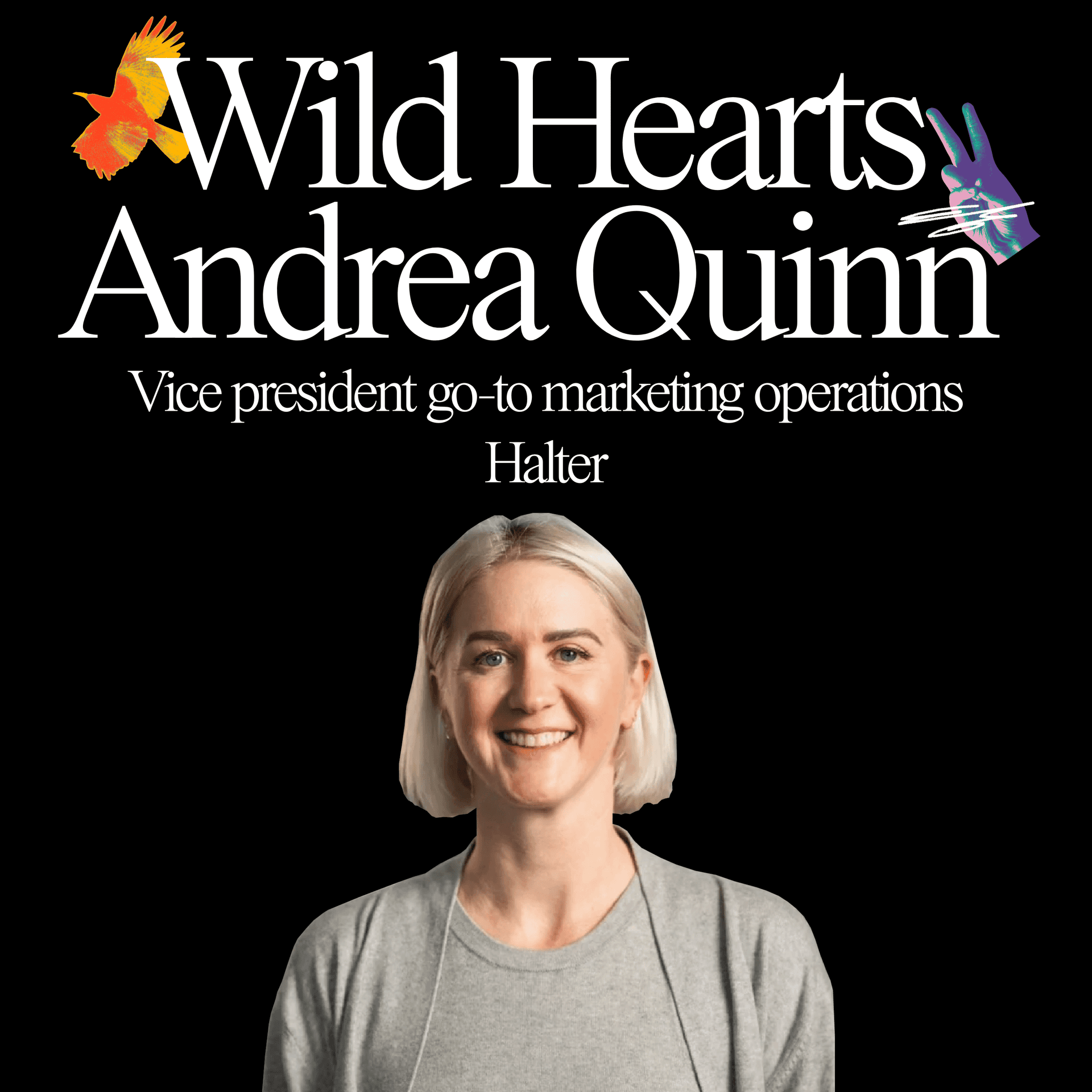
- Title: Andrea Quinn: The operator behind a unicorn's growth engine
- Description: Andrea Quinn, VP of Go-To-Market Operations at Halter, shares insights on transitioning from fashion merchandising to a tech role, scaling startup operations, and the impact of effective processes in achieving growth.
Key Themes and Insights Career Transition
- From Fashion to Tech:
- Andrea transitioned from a successful career in fashion merchandising to tech, highlighting that you don’t need to be a founder to influence the future.
- She worked at H&M and later Vend, applying retail sales strategies to B2B enterprise software.
- Realization of Transferable Skills:
- Andrea discovered that her experience in retail—particularly understanding customer behavior, sales motions, and operational frameworks—applied well to tech.
Revenue Operations (RevOps)
- Understanding RevOps:
- RevOps is essential in scaling startups, focusing on aligning sales and operational strategies to drive revenue.
- Andrea demystifies the concept and explains its importance in fast-growing companies like Halter.
- Commercial Equation Framework:
- Andrea introduced the "Commercial Equation," a strategic framework to optimize sales processes.
- The framework includes metrics like visitor footfall, conversion rates, average price, and basket size, forming a triangle model that helps set targets and evaluate performance.
Practical Applications in Startups
- Building a Sales Funnel:
- Andrea emphasizes the importance of designing a clear and effective sales funnel.
- She outlines the phases of the funnel: Marketing Qualified Lead (MQL), Sales Qualified Lead (SQL), booked meetings, and closed sales, advocating for clarity in definitions across the company.
- Leveraging Technology:
- Use of tools like Salesforce to manage data and track sales processes is crucial.
- Andrea stresses the need for systems that support operational requirements without overburdening staff with administrative tasks.
AI and Future Opportunities
- AI in Sales Processes:
- Andrea discusses the potential of AI for lead qualification, enhancing customer engagement, and improving sales coaching.
- She shares examples of AI applications that can streamline operations and scale training efforts.
Personal Insights and Advice
- Advice to Aspiring Tech Operators:
- Andrea encourages individuals from non-tech backgrounds to pursue careers in tech, emphasizing passion for the mission and curiosity.
- She believes diverse experiences can enrich the operational landscape of tech companies.
- Importance of Cultural Fit:
- When hiring, Andrea values candidates who resonate with the company’s mission and demonstrate a willingness to learn and adapt.
Conclusion
- Halter's Mission:
- Halter aims to enhance the sustainability and productivity of farming through innovative technology.
- Andrea's approach embodies the belief that significant contributions can come from operators, not just founders.
Key Takeaways
- Career Flexibility: Transitioning between industries can yield valuable insights and skills.
- Operational Excellence: A strong operational framework and a well-defined sales funnel are critical to scaling a startup.
- Embrace AI: Leverage AI to enhance efficiency and improve sales processes.
- Cultural Fit: Hire for passion and curiosity, not just technical skills.
This episode serves as a guide for operators and founders alike, reminding them that impactful contributions often come from collaborative efforts and the execution of well-thought-out strategies.
Written by AI. May contain mistakes. Listen to the episode to check what was said.
Transcript
Automatic transcript. May contain errors.0:00Why tech, I suppose, if you'd sort of started off your career thinking, oh that's not me, I'm not an engineer. The mission, you know, how do we make half of the world's habitable landmass more sustainable and productive? I'm like, that's just something that gets me out of bed every day. You're walking into a new startup that's never had RevOps before. What data are you asking to look at and what are you looking for? What I first wanted to understand was what's the current sales motion? What's the current go-to-market motion? What exists today? What doesn't? How do we talk to customers? When we win, why do we win?
0:34when we lose, why do we lose? So to that level of detail, kind of like... Oh, 100%. Hi, everyone. I'm Sam Wong, one of the Blackbird Partners, and welcome to another episode of Wild Hearts, where we uncover the bold moves and the unlikely paths behind extraordinary founders and operators. Today's guest is Andrea Quinn, who's VP of go-to-market operations at Halter, New Zealand's latest unicorn, and one of its fastest ever growing and most remarkable companies. Holter helps farmers manage their herds and their land better with smart colors and software. Andrea's journey to tech isn't your typical one.
1:17She started in fashion retail, working at H &M, and took the framework she learned about how to drive in-store retail sales to the world of B2B enterprise software at Vend and now to Holter. And in this conversation, we demystify RevOps, Revenue Operations. We'll learn about how the lessons from fashion retail translate surprisingly well into the world of tech and startups. We also dive into what it really means to do RevOps at a fast-growing startup, how to know when your systems aren't working, and what Andre has learned about scaling both companies and careers across industries. This is a story about reinvention, operational excellence and finding patterns between worlds.
2:07Dre, as I affectionately call her, is one of the most incredible operators I've been able to witness up close in the last few years. So let's get into it.
2:19So thanks so much for giving up your time. I'm really excited to do this one in particular because infamy of your kind of like reputation is sort of spreading throughout the portfolio and network. So hopefully this can be like very high leverage use of your time. You can kind of like download a bunch of insights and all the rest of it and not have a call with every single person who wants to have a call with you. And so there are sort of two areas I really want to dig in. One is kind of like career pivots because I think it's a your career is like a really cool example. did you ever imagine you would have a career in tech sort of when you were finishing high school and going into university or tertiary education?
2:58No, no. I think there's kind of a misconception or there certainly was, I don't know, back when I was coming out of high school in 2004 it was, which was kind of like tech was for engineers. And I was like, broad term, don't know what it is, not my thing like it was it was very very foreign and I even think back then obviously I'm now in the world of revenue operations but revenue operations wasn't even a function like it wasn't even a profession back then I think back to what little I knew particularly back at school around what opportunity could look like and I would say that across any industry yeah so and And short answer to your question, no, absolutely not.
3:41So step us through the kind of like career arc. So you started off in fashion in garment construction, if I have that right, and then went into merchandise. Yeah. So when I was studying, I was in retail, fashion retail. and then the opportunity came up for me to step into a worker in position uh in a merchandise assistant role which was basics of garment construction and then making sure that you were getting the right things as in garments to the right place as in stores at the right time and so yeah that was kind of my first foray into I guess uh you'd call it like a corporate job yeah and one of the least corporate environments I um which was pretty special that's where I I started to kind of cut my teeth into the retail and fashion world.
4:28I was there for about three to four years and ultimately ended up managing production and then making sure, yeah, stock levels across stores were correct, movements, all that great stuff. And in that time, I worked with factories in China for garment production and then making sure production schedules were delivering as they needed to, etc. And you had to do that in order to make sure that the garments ended up in the stores at the right time. Is that sort of the connection there? Yeah, yeah. So what would happen is our buyers, we were a pretty small team, but the team that would go out and buy would do that seasonally.
5:02So they'd bring back a collection, they'd pull together what the collection would look like. And then ultimately, I was part of the team that then went, okay, well, when do we want the specific line to be delivered in store? When is it perfectly timed? And the thing I love about the purity of retail and then particularly for me, fashion, which is something I'm pretty passionate about, is that when you stood back and thought about what a collection looked like, it was like, when you walked into a store, what did you want the store to look like? What was the right mix? What was the right mix of the fundamentals, like tops versus bottoms?
5:35When did you time things seasonally? How many do you produce of each of those separates? How do you want the color to look? How do you want the palette to look in store? it yeah it came down to like what what you ultimately wanted is your end result to for a customer to walk in and just be like yeah okay what am I going to buy what is it today what's going to compel me to come in and spend my money here and then reverse engineering that basically be like okay well here we are today with this on a piece of paper how are we going to get it to a produced produced garment sitting in store ready for someone to purchase so how does all of that experience of like, I've never really understood what the word merchandising really meant, but the way you just explained it, I'm like, oh, it's optimizing, you know, product assortment and all the rest of it to maximize sales and profitability.
6:25Is that kind of a fair sort of characterization? Yeah. Yeah. Talk about how all of those, you know, learning skills, et cetera, translate into how you should think about a software business and maybe even take a step in your first tech job was, if I'm not wrong, at Vend, which is a sort of B2B software company. How in the first place even thought, oh, what I do here, it could really apply over here. When I think back to my pathway into particularly the role that I initially stepped into at Vend, which was revenue operations manager. Where I'd really found my niche was, and this applied to a couple of roles I'd had, and the most recent one before I went to Vend was when I was at H &M.
7:15And the niche that I found was, I guess, kind of like what we just talked about with, you know, starting with where you want to be, like having that picture in your mind, and then reverse engineering, well, okay, well, how are we going to get there? So for me, that kind of, if this makes sense, It's those same fundamental, those carry over, right? What I mean by that is like at H &M, it was my first kind of step into being part of a massive company. I mean, at that point, I'm not sure what it is now, but it was the second largest fashion organization in the world. Wow. I worked for 12 months with H &M over in Australia, looking after Melbourne across to Perth and below, looking after the stores there in a controlling role.
8:01and what that meant was effectively as the controller I owned the very top right the way through to the very bottom of the operating P &L for my area and the way that our teams worked is we were a core team of four we had a leader of that area so a sales leader and then we had a controller a HR person and a visual merchandiser and we worked as a team of four so my role that I played in that was how do I paint the picture of using data and using kind of those operational what's going well, what's not, what should we, like how do we understand like if sales aren't performing in a particular area, how do I translate the data into actually telling that story and allowing us to understand where and how to dig into that problem.
8:52And so a lot of it was like standing up basic frameworks of reporting to just be like every Monday, every day I step in and I can look at the same data sets, but see movements to go, okay, something's increased, decreased and start to ask. Kind of the most important part of the role was to be able to ask the question why, like ask the right questions. How do you know what data to start to collect? So this is the bit that has carried me through my career. And this is the bit that's not scarily familiar in each of the different industries I've worked in, but like, yeah I guess like a really beautiful repeatable model effectively it all comes down to the fundamentals of a funnel so at H &M we had something called the commercial equation okay and the commercial equation um used to be presented to me as uh when I would work with actually our merchandising team to kind of be like hey uh this time last year we were selling pants way better than we are this year.
9:53What's going wrong, as an example? And so we'd kind of like understand or analyze like what was going on in the store to be influencing or impacting those kind of data points and the results. And so the way the commercial equation worked was it boiled down to the fundamental inputs of how you would get to your result. So in retail, to me, this is like super basic. So you start with, think about like we're building up to a triangle. You start with your visitor footfall in store. So you go, okay, well, how many people am I going to get it through the door? And then you go, well, how many of those people are actually going to purchase something with me today?
10:32What's my conversion rate to transaction? And so ultimately with those two things, you would get to, okay, well, number of people through the door, number of transactions, right? Okay, right. We've got one of our key anchors. Then off to the side, we would go, okay, well, what's the average price per piece that we're holding in store today? So if it was indexed to summer, it would be a cheaper price because it was typically more t-shirts and light garments. If it was winter, your garments would typically be priced more expensive, think knitwear, pants. And we would go, right, average price per piece.
11:04What's the average basket size of how many pieces people were putting in a shopping cart? And then what was your basket value? And so then you had transactions that we were going to make and basket value, bingo, bango, that would give us the revenue that we were going to make. And the beauty of that simplicity of the triangle was that we used that to set our targets to even sometimes the most granular level of by hour. So we could use that framework to go, okay, on an annual basis, we're going to expect our visitor footfall to increase by 10%. Why? Okay, well, marketing are going to run these initiatives here and here and here, and we anticipate it's going to drive X amount more traffic through the door.
11:50Great. So instantly, you are also creating a metric that a really fundamental part of the organization could attach themselves to and could talk to how they were going to influence that result. And then when it came to converting that footfall into actually a purchasing customer, you could then go, okay, well, how well are the mannequins dressed to be able to attract people into the store? How well stocked is the store? Do we have the right sizes out available? Like, again, just coming back to those really basics to go, well, all the things that might influence whether someone gets to check out kind of thing.
12:25Yeah. And then the visual merchandisers would be able to be like, great, we're going to make sure our mannequins are dressed beautifully and the garments that they're dressed in are instantly available within the area of that mannequin sitting. So you're pumping up that conversion rate. And so just setting the basics of the commercial triangle was a really basic way to actually build up your roadmap to your revenue. And then it was also a really useful tool to then articulate to the business what that roadmap was and then how each person could then attach their own strategy or plan to it to go, okay, how am I going to influence that result?
13:06And it gave them something really tangible to go, okay, well, you know, if you're marketing, you're going to really hone in on visitor footfall traffic and am I increasing year on year, month on month, et cetera. And the beauty of the model, as I mentioned before, you could set that on an annual basis, then broken down to monthly, weekly. For us, as I mentioned, in some cases, it was hourly. And yeah, it sets, it effectively in very black and white text sets the framework for the organization to be like what are we going to do what's success at each of these points and then allows you to measure yourself against those in a very data-driven way yeah amazing I love that commercial equation and then when did you maybe cotton on to the idea that you could do that outside of the fashion retail world?
13:55Maybe that's question one. And question two, like, why tech, I suppose, if you'd sort of started off your career thinking, oh, that's not me, I'm not an engineer? I don't know if I deliberately chose tech. So I've had the opportunity to work for New Zealand companies, New Zealand scale-ups, and there's a certain type of person that's attracted to that business. And to me, they are just phenomenal humans. So I'm enormously attracted to the people that particularly in the New Zealand scale of space and one thing that I found really special though was working with H &M I joined a multinational company or an international company and I got to learn that actually you could work with phenomenal humans right across the world and be part of something that like I say this often to people but it was one of the most values driven organizations I've ever worked for and it proved to me that you can actually still hold on to that when you are this kind of behemoth of an organization yeah but I've got to the point where I was kind of like I was really missing that kind of Kiwi ingenuity I don't know that the that that just spark yeah yeah I don't know I've been following Vend for a while I loved the story I'd been in retail and so there was I was in retail and so there was the connection there to go okay well they're they're in retail they're cloud-based point of sale um I come from this world I get what this software does yeah yeah I get what software does and also after um in previous roles being through upgrades and point-of-sale technology I was like man I know what a difference it makes to have a good version of this and a bad version of this and so they looked I don't know like you could take your dog to work it was a bunch of like cool fun smart people and I don't know when I went for my first interview there the people I met I was like wow it just feels like coming home so it wasn't an active shift into tech itself but I really loved that it was solving a problem that I had felt on the front line and that's kind of where I applied for the revenue operations role more to kind of go hey it feels like this is a job where they're looking to go hey we've got some hard problems and looking for someone who likes solving hard problems and so it didn't mean that I needed to be an engineer or you know like it wasn't like a highly specialist skill set they were looking for but I was like wow this could be my entry into a really great company yeah so I kind of went in a little bit blind I'd say was there a revenue ops person at Vand before you or were you the first no there was um there was a team of us actually I think a team of about four oh wow okay yeah four or five and so the way we were structured is, and I kind of carved this spot for myself, which I can walk through a little bit more shortly because it answers the question of how did you bring like the concept of like the commercial equation over into tech.
16:55But the way that we were built out was effectively revenue operations you could think of as kind of two key pillars. The first was go-to-market planning, insights, really thinking through the what's our targets, how are we going to get there, are we on track, off track why and supporting leaders to be able to to drive really efficient and profitable revenue and then the other side of our team was the tooling and tech stack strategy to go okay now how do we unlock a lot of that optimization using like really good quality workflows really nice tooling that effectively helps our what I call our internal customers so our sales teams our customer facing teams up to win so we're a super tight team but we kind of owned those domains so it was yeah that that's kind of what that looks like I guess the kind of question of like how did I figure out I could translate what I'd learned from like my time at H &M over I kind of want to understand and I probably use the term quite a lot but I want to understand the roadmap of how we're going to get somewhere I won't quite rest until I'm like I want to know every single step we're going to take what time we're going to take it like what direction we're heading in I won't kind of rest until I know that that's like clear as black and white on a sheet of paper I think it was probably on like my day three where the team and I won't remember the metrics quite perfectly and I'll make them up anyway but I think I was sitting there and we'd just crossed over into a new month and the team were like so we did 20 better than we did last year in terms of the results for the previous month but we missed target by 40 % and I was kind of like oh okay why and there was nothing behind the why like there were there were kind of no answers behind the why I was kind of like well I'm yet to learn this industry but like if if it were me thinking about that from a retail perspective I'd be like well was put traffic down did we not convert at a particular point in the day like where did it break like what did we assume what didn't go to plan and then and then what fell over and then what do we need to do fix it and that's when I started to burrow down to be like okay well where did our target come from like how did we build to get there and that's when I slowly started to unpick that I was like cool I think sometimes and I remember doing this really early in my career you can kind of go okay well how do you build a target we're just going to take last month's and aim for another 20 percent or last year's and like just ratchet it up by 40 percent whereas I was kind of like hey I think there's a more kind of first principled approach to how we can actually figure out what that target should be and how we kind of get there so we had a beautiful funnel that mapped out like a lead starts here at a marketing qualified lead stage these things need to happen for it to get to a sales assigned lead stage from there um we're in sdr and a style um two-step sales motion so then it was like cool and sdr books a meeting how well do those meetings actually convert to held meetings like that conversion rate and then of those then with the a how many of those convert from a held meeting to closed and the steps within that but we hadn't actually used then then taken that beautiful funnel and gone so what's going on with it but what's the story that the funnel is telling us and so using that commercial triangle framework I basically took the funnel and translated it into well leads is basically just foot full through a store like it's visitors to your website or it's outbound leads that your reps are generating and so I translated it through from a world that I knew to to understanding what the sales process was like um within our BDE and and AE function and yeah basically stood up what I what I called um now the bottom up which is yeah bottom up commercial equation it yeah use the two yeah hand in hand but that's kind of where I was like I had this kind of light bulb moment little thing like light bulb moment where I was like you can carry this approach over from from any industry to go right what's the roadmap what's the pathway to get to where we're going and so yeah so with that I think it was within the first few weeks took the funnel um translated it over to this commercial equation first got the actuals like how have we been performing then in the last six months if I look at what that reality looks like what is what is the funnel telling us yeah and then from there picked out some pretty basic insights which was like hey we're doing a great job here and not a great job here and how do we turn some of that around and yeah so that's what that translation kind of looked like I love that and that's how you know the H &M experience you know really well equipped you to kind of like break a you know a problem or a target into its composite parts you know first doing that at VEND and you don't have to share obviously the the confidential details but I'm wondering what's what some of the you know insights were both obvious and then non-obvious ones that took a little bit longer to kind of figure out because you know there probably are a bunch of startup founders and operators gonna who are gonna listen to this and think like um what do we not know and hopefully they'll you know apply the funnel slash commercial equation yeah any sync picks we can give them on what they might experience i suppose in terms of surprising more often than not what will probably surprise you is it's the most simple stuff that is the biggest thing you can implement and the biggest thing you can make change with.
22:33Like, so the first thing I'd say is make sure your funnel kind of finds that Goldilocks moment. You don't want too, too much detail so that you get lost, so that you just drown in data. But there's like a real sweet spot to go. Others might disagree, but in my opinion, you can do better than just MQL, SQL and close one. So marketing qualified lead, sales qualified lead and close one. I'm like, your data can do more for you to allow you to ask better questions. So, but really relating that back to going like, what's your sales motion and how does your funnel best serve you to tell you the story of how that's going?
23:08So the one thing I'd say is like, spend the time, invest the time in building a really good quality funnel that's fit for your organization. The other thing then I'd say around that is like really quickly, you're going to be able to identify the parts that you can go, oh, okay, like, is my conversion rate trending at around, I don't know, 29%. If it is, you're probably actually not doing too bad. From your SQL to close one, so sales qualified lead to close one, like, you're probably actually doing okay thereabouts. But then I'd be like, well, if you're not getting the results you need, like, let's kind of go further up the funnel.
23:45And I think it's that kind of comparison of conversion rates and absolutes where you can kind of really quickly go, well, actually, is my funnel in a pretty good shape? And now I just need to ramp the volume. Like now we just need to grow. In some instances, that's been the answer. It's like, yeah, okay, we can optimize and increase this, you know, the close rates by another three points or do something like that. But to be honest, when you run the reality of like, okay, so do that, run the scenario. Does it get you to the number that you want to be it? Maybe not. If that's the case, then, you know, make sure you've got the analysis behind, like, if you tip more in, if you're an inbound centric organization, if you tip more spend in, is that spend efficient?
24:29If yes, then, like, go for it. Take the brakes off a little bit. The inverse is true as well. Like, I've seen other cases where the top of funnel is just beyond full. Like, it's if you release that amount of leads out to your sales team, you are going to drown it. and that's when you get to have some fun with your marketing team to go okay well what's the right handover point how do you use nurture to warm those leads up before you're handing them out to your sales teams um with all of the ai technology around these days like there are some fun stuff you can do in that space what are the funnest things or the things you're most excited to experiment with at halter so specifically in the ai space well i guess maybe what did you have top of mind when you were saying there are lots of fun AI things that you can play around with?
25:15I think AI will serve different organizations in very different ways. I think if you are a very heavy inbound centric organization, yeah, when I think about, and this comes with the caveat of do what's right for your sales model, but like, and for your customers as well. If I think about the ability to, like, we're running some testing at the moment on how do we pre-qualify leads through texting with ranchers, because maybe that's a slightly better way in order to collect some really high value information that then allows us to go, right, should we be warming this customer up more, nurturing them, or should we be looking to get this person through to a salesperson straight away?
25:58And within that, how do you craft that text conversation so that it's authentic and that's so that you don't break that trust with that customer right from their first interaction with you which is a really hard hard balance to find particularly in an industry like ours which is relationship based yeah on a separate note what I'm really excited to play with uh given that we are typically we're more of an outbound driven driven organization yeah our sales process is one of the things that we are most proud of so the team have something is similar to the challenger model. And I think one thing when we think about how do we help ensure that we hold on to the quality of the funnel that we have as we scale, one of those key pieces there is sales coaching and making sure that we are delivering that same sales experience right through as we bring on new leaders, new salespeople, expand into new markets.
26:58And I think there's a really interesting question there on we've got some phenomenal people in the organization that are delivering beautiful training and development with our current team. You know, it's that classic thing of how do I bottle that? Yeah, yeah. How do you scale that? Yeah, that's what I really want to crack to go. Well, OK, so through AI, how do we do that? Like we've got something that we're really proud of and that we know is working. how do we get that out to to support our scale so yeah don't have all the answers but yeah I've heard that like at least a couple of times across the portfolio we have at least one other company that is like recording their AEs you know calls turning those into transcripts using AI to analyze when they're sort of there's an objection that's actually not being very well handled yeah So grading the kind of objection handling and then like producing training, like training materials and then kind of distributing it out so that like there's, and it's a recursive thing.
28:02And I just thought that was like such a cool, you know, sort of singular example that doesn't really require more than probably what you're already paying for in terms of like your sales stack, you know, chat GPT subscription. And but makes such a huge difference, right? If you can move your conversion, you know, even a couple of percent, it's, you know, an incredible, incredible investment in the go to market funnel. Yeah. And if you can take kind of best in class examples and whatever you can do to risk, like to mitigate the risk of dilution as effectively you scale, which is a pretty tough one to solve.
28:44And I know even just thinking about it, like, yes, sales, like there's a lot that can be unleashed in sales. But Christian, our launch lead in the US, he's actually using it for training new launch representatives that are coming on board. So they're the ones that obviously get new customers up and running with Holter. So yeah, there's just cool stuff that's happening in the space. And to be honest, it's something that I don't even think we're scratching the surface off. So exciting times ahead. I would love to talk about your past joining Holter. And again, like sort of like why did it appeal?
29:20And maybe if you want to give like just sort of one or two sentences on what Holter is for those who are listening and don't know about the company? I'll start with what Halter is first, and then I can kind of talk about my journey to where we are today. So the way Halter works, we're a virtual fencing and herding company. Think of us in basic terms. We produce a collar that sits on a cow. It's solar powered, and it connects to an app that sits on your phone. And using that technology, the way that infrastructure works is we install towers on farms and the collar communicates with the tower and communicates obviously back with your phone to allow you to set virtual fence lines and then allow you through your phone to also actively shift or shift animals.
30:08And in some cases, like nuances with product, but bring them back to the cow shed and then obviously, yeah, allow you to basically have, yeah, boundaryless farming, which is pretty exciting. farming or ranching. So yeah, we're a New Zealand scale up, although we are active in the Australian and US markets. But yeah, that's kind of us in a nutshell. And so always wanted to work in a farming company or talk about why Holter and why did you decide to join? Yeah, so it kind of comes back to I had the privilege of working in New Zealand scale ups before and as I say the the talent that I don't know that that Kiwi scale-ups attract is just I don't know it just feels to me like I'm home whenever I'm working with the kind of talent that we have and I was really passionate to to come back to a Kiwi Kiwi company um when I was at Vend we were acquired by Lightspeed and so I'd worked for Lightspeed obviously based in Montreal for around two and a half years by the end of my time.
31:15And that's a very big sort of listed software company, right? Yeah, yeah, it is. I think at the time we were about two and a half thousand people. I was leading a team of about like 80. Yeah, but I was really passionate about stepping back into a Kiwi company. And I come from a rural background. My mum and dad are still back in Hawke's Bay. They run a very small herd of Highland cattle, miniature Highland cattle. nice no they they definitely don't have halter but so I'd grown up rurally and yeah it's again in the same way that working in scale-ups feels like home working in agriculture um and farming feels like home to me as well so it was it was very it was very homely it was very familiar and yeah and when I think about I don't know like I I couldn't work as many hours of the day in a day as as I can if I'm doing something that I love and I believe in um and for us the mission um you know how do we make half of the world's habitable land mass more sustainable and productive I'm like that's just that's just something that gets me out of bed every day so um I was really excited at the opportunity to bring my experience and help uh help just jump straight on in and be like look I'm I think I can make a contribution here I really think that that we can do something really special to help accelerate the go-to-market motion because the product is just something that's yeah just so phenomenal.
32:48So you were the first RevOps hire ever at Halter. Yeah. And so talk about sort of the experience of you're walking into a new startup that's never had RevOps before. What data are you asking to look at and what are you looking for are you just trying to start to build out that funnel that you know from your vend experience and then presumably light speed as well yeah so probably harking back to my other like my previous experience the first thing that I did was don't assume what exists and what doesn't so I came in pretty open-minded to just be like you know particularly in the first week to two weeks I'm just going to be like the ratio of two ears to one mouth in terms of listening to hearing like sorry listening to speaking so I really just got in to be like right what's current state I know like what right can look like in terms of what it's looked like in other organizations so let's just figure out to that what what today looks like what's there what's not what's kind of there like yeah so so just kind of got the lay of the land um and I think the first thing that I was keen to just figure out is is again I knew that this concept of like commercial equation and quality funnels like that's ultimately the foundation that sets you up for success I was like cool where are we at and so largely it was like yeah the the kind of checklist of like what exists what doesn't and that allows you or that allowed me to then be like great where where am I starting then like our little law how much exists in each particular pocket to be able to be like yeah where are we at today so and then okay so you start to sort of build a picture of what's there and then how do you start to kind of diagnose what you know might be going on and then also how do you prioritize what you'll do first and then second and so on what I first wanted to understand was what's the current sales motion what's the current go-to-market motion what exists today what doesn't how do we talk to customers what when we win why do we win um When we lose, why do we lose?
35:01But to that level of detail kind of like. A hundred percent. And then I think just by asking those questions, you naturally start to go, okay, well, when I stepped into Halter, we did have Salesforce stood up and I'm an advocate for Salesforce. But yeah, I was kind of like, so Salesforce exists. So these are the basic questions I've got. Let's go and chat to a bunch of people to try and find the answers. But then also relating that back to effectively Salesforce is our go-to-market engine with collating all of that information and data, like what's coming back into that engine versus what is and why.
35:40And so really quickly, I diagnosed that there were a lot of things living in people's heads. There were a lot of people running their sales funnels and leads lists on G-sheets and operating outside of any kind of formal ecosystem. But there was a lot of beautiful information that was sitting in those brains and sheets. So I was kind of like, okay, well, the basics aren't serving people very well here, which is great. Like that's easy to fix. Yeah, so for me, I was kind of like, where does the funnel start? How do we define elite? Where does it come into the system? Like what's the fundamental process behind if someone comes onto a website and they fill out a form, where does that form go?
36:27How do we capture the forms being filled out? What system does that come through? So I'm also painting the picture of what that current ecosystem or that tool stack looks like, or we're kind of enabling you to diagnose where those gaps were. So yeah, just kind of piecing together the whole, I don't know, when you get a puzzle out of the box and you first separate out like what are the borders and then what are the pieces in the middle and what are the colors that all look the same. So effectively just starting to build that picture out. And so it was like, cool, what lives in people's minds? What's the tooling not doing for people that it should be?
37:02And then from there being like, right, for us to even understand or know where to start, for us at Holster, we were like, we need a funnel that serves us better. So we need to completely rebuild that. So it was actually a tooling issue, like the tooling or the software was like the best place to start in that case. it was twofold it was um let's design the funnel to understand the story because we didn't have like we had different definitions floating around the organization around what a marketing qualified lead was or sales qualified lead or even like even even close one it was kind of like this person thinks a close one is is this milestone and another person it's saying is that right the way through to okay so at what point do we invoice what's that invoicing experience looking like so let's chase it all the way through to the most important piece which is revenue so it was like okay well right now we can't get a clear picture of what funnel story is because the data is just it's not serving us well so we really took a step back and we're like right we believe our sales process is right for us now let's match up and build a funnel that that tells the story of how well that sales process is going for us so that started with what's our definition of an mql What's our definition of each of the different steps of the funnel?
38:26What are the things that we know are those big chunky milestones that allow us to be able to unpack and go, if something's not getting from here to here, we've now got the ability to really drill down and diagnose kind of what's going on. And so that's literally just like we did it on a whiteboard and we fired up a G-sheet and we aligned on definitions. And then we came to the tooling part, which was, okay, now we're going to make sure that the tooling is doing the lifting on making sure that the funnel is moving and capturing information like it should do, which is everything from we need to date stamp the minute that a lead enters this point.
Read the full transcript
39:07And so the minute that it's assigned out to a salesperson, I want to know how long it is until the first activity is made on a salesperson actively reaching out to that lead. cool so let's make sure that our systems are doing what they need to to capture that information and then from there you've got all the data points to allow you to build out reporting that allows you to then ultimately tell that story and then yeah be able to shape and understand what the funnel is telling you um so yeah really getting the tooling in the systems to do that work. And through that as well, being ruthless about what you want your people to be doing and what you don't want your people to be doing.
39:50So finding that balance of like really good quality automation, that means that your people aren't getting lost in admin. But then when it comes to the important stuff, like to me, Salesforce pipeline hygiene, like it is a rep's responsibility to go, what's the latest close date on this lead? if it's a stale opportunity, I want that rep to be jumping in and adjusting those close dates themselves. That's where you kind of go, automation exists for good of removing admin from people so they can concentrate on the important stuff, like knowing exactly the health and the status of their pipeline and updating that as they need to.
40:28So yeah, to wind it back to your question, where do you know where to start? You can't begin to fix the right thing if you don't know exactly what's going on. And so the first thing was to be like, well, let's build the framework so we kind of know what's going on. And that's where funnel design and then making sure the funnel operationally was working like it needed to in the CRM was like kind of first cap offering for us. Yeah. And you know how at the beginning you sort of said you can get too lost in the detail when you build your funnel. You know, you can go too far too quickly. Have you sort of had a process of like getting it to version one in order to sort of get diagnosed, okay, this is what we need to do as a priority.
41:12Have you sort of layered in more into the funnel over time? So I'm happy to talk this to the specifics. We've got effectively a four-step funnel, so we can catch it even further above this, but we see when a marketing lead comes in and we call it a marketing qualified lead, we then understand our then next milestone is a sales assigned lead then we understand when it's booked in which is a sales booked lead then we understand when that meeting is actually well that first meetings happen sales qualified lead for us and then we go through to close one and we set that from day one and we're still very happy with those as our key milestones and then within that we have sub stages where we go okay well let's think about right at the top with a sales assigned lead we track down to okay this lead has been shifted into this and it's the rep is it's ready to contact the next sub stage is attempting to contact so maybe the rep has made like x number of calls they can't get through and the final one is we've got them on the phone and we're qualifying them and then either you disqualify or move them through to that next stage and so because I was working with team members that had been in the business for a while and I had had a bit of experience with building funnels prior to this, we were pretty fortunate that we landed on a really reasonable first cut.
42:38But I would say it comes from like years of kind of figuring out and playing with stuff in other companies. But what I would say is like, if you set kind of a core good quality framework from the outset, you've got the ability to drill down and kind of set those kind of sub-steps or more in the weeds details as you learn more. But yeah, if you're not careful, you'll risk just going far too deep. So it's kind of in the weeds question, but you know how you sort of said the definitions of MQL and SQL were a little all over the place prior to Dre's tenure. Do you try and go back retrospectively and fix that?
43:22Or how do you look at your sort of year-on-year or historicals knowing that some of that's probably not super reliable? I think you've got to be pragmatic in your approach. I say to my team, we're very used to this. I'm a person that likes a clean house. And I use that analogy right throughout the organization. Like I don't have a second drawdown junk drawer in my kitchen. Like everything has trays. And I kind of, I use that same analogy here. I'm like, everything needs to be clean. But even then, like with historic data updates and things like that, if it's the difference that's going to make the difference sure go for it um but i would often say if you're at a if you're scaling at a pace that's like you know you're you're 2x and 3x whatever it is like last year is interesting but your targets should be built again i would say from really first principled way on like well where are we going what do we want to where do we want to be and building your targets that way to be like, okay, well, how much are we investing into the funnel?
44:24How well is that going to convert? How efficient are our salespeople going to be? Because your cost structures and everything will look so, so different if you're fast scaling to last year. It's like, fine, interesting, but like more focus on where you're heading. So yeah, I would be like, if it's genuinely going to make a difference, like sure, invest the time and do your best. Don't sweat the small stuff. But for the most part, like, yeah, Depending on what phase you're at, my advice would be like more focus on kind of where you're going and focus on the quality of builds of targets. And, you know, within three months, you're going to build up enough data to understand like some good stuff anyway.
45:00I want to kind of pivot again to talk about sort of kind of almost go back to the beginning. And I guess if you could give, you know, what sort of advice you would give your 18-year-old self or someone today, what advice would you give someone from outside tech who might be curious about making a jump into the industry? Just do it. Like I would say like, I don't know, what served me really well is targeting and finding companies that I've wanted to work for, that stand for something that I can get behind and be passionate about. And if you find that, you find your home and you do your best work.
45:41Tech is a very special industry to be a part of. I think I work with some of the most intelligent people I've ever met in my life. And it's just, yeah, it's just so humbling and it's just such a privilege. But also what I would say is to my 18-year-old self is you also bring something to the table. Sometimes it's coming at something in a, I don't know, as a generalist, you have a different perspective, that actually means that the seat that you have at the table is a well-held seat. You bring a different perspective, you ask different questions. And I think that that adds power to a company. So yeah, that's the advice that I'd say to anybody.
46:30And maybe flipping it around the other way, what's the biggest thing that you wish startups or tech company recruiters looked for when they're hiring talent from outside of central casting? This is something I've been chatting to my team about quite a bit. I love the idea of taking a risk on talent. And what I mean by that is like, yeah, something that serves me really well is, I don't know, if I see somebody that's moved industry. For me, it's I've run dispatch, like I've run warehouses before. I've you know at my time at once it actually we um I used to be in the warehouse picking stuff out when we were a bit low on team members and you know fighting for okay we've just has these goods come in and we decided to sell it wasn't this but we decided to sell garden furniture and I actually need a pallet location and we don't even have the space for that like somebody who's worked with physical things that I don't know you've had to problem solve with and being like in the weeds and and yeah but being in the moment and having to solve niggly problems i think that those are the kind of people that i don't know they're curious they'll figure it out they'll um just get amongst it and just have like really pragmatic common sense solutions and approaches to stuff and i think that you can't replace that like yeah you can have someone who's enormously intelligent but you know isn't curious to to kind of get to like I don't know that level of problem solving and like curious people as I say people who have been open to changing industry and have thrown themselves in the deep end and learned something new um I love hearing stories about people um shifting from hometowns and just breaking out of comfort zones and yeah to me those are the kind of qualities that I look for and and people that are joining our team it served me and I know a lot of others like really well.
48:32So I'm not quite sure how the halter hiring process works but if there were cover letters involved or cover emails involved sounds like they should definitely highlight the risks they've taken themselves their you know propensity to learn new things give examples what else could help someone stand out to you if you were hiring? Firstly actually putting the time into a cub letter is a great thing. I would say like I've been quite surprised at the amount of times that I've just had like really one-pager raw CVs come through with very little understanding of kind of why this role. So the one thing I'd say is like we're passionate about just hiring like great people who are really passionate about our mission, who are just curious and who are smart.
49:22And so, yeah, understanding the why. Why Halter? Why would you be a great addition to this team? Why would you be part of our secret sauce that makes us who we are? Telling a bit about your story and making it human. Yeah, that would be my advice. Love that. I feel like that's a really good place to wrap up unless there was something you were just dying to get out there. No, all good. I think I tried to make sure I covered off like we got to the level of depths and and definitely got the commercial equation which I love and I feel like yeah I could write a blog post on it and just get you to proofread it and and and just share that around in the portfolio um from now on yeah because that's just such an amazing framework and like I can't remember if I told you this like I I started my startup career in retail as well so I was in retail like all through uni and then my first startup job was an e-commerce at surfstitch.com and I moved to France and I opened up the whole business over there so I also was in a warehouse picking and packing our first orders and yeah yeah and I just think it's such a your point around the physic you know that's such a good grounding even today I sort of still reference it yeah I don't know it's just like the kind of people that have sat there and been like I've been cold in a warehouse in the middle of winter trying to fight for packed faces picking something out that's the wrong thing and then being like well how do we solve it because this is annoying yeah or like our most popular item is on like the top shelf of like the furthest part of the warehouse and like you know in e-commerce a huge cost is like the people running we're not amazon like running around picking and 100 awesome hey thank you so much I know you're busy so I'll let you go.
51:07Thanks again. Bye. Lovely. Okay. Bye.
51:15Thank you so much for joining us for another episode of Wild Hearts. If you want to learn more from other ambitious people building, designing and creating the world that we all want to live in, then please hit the subscribe and follow button. It would mean the world to us, the founders, the operators, and the investors who join us on Wild Hearts. This podcast is a labor of love from the Blackbird team and Day One. The show is produced by Camilla Herring and Melia Rayner at Blackbird. Our marketing genius is Eva Telemachus, and our editors are from Day One, Annie Jones and Sanjay Chabaria. Thank you all so much for listening.
51:55We'll see you next week.
From the publisher
You don't have to be the founder to build the future.
When Andrea Quinn made the leap from fashion merchandising to tech, she didn't start a company. She joined one. Today, she's VP of Go-To-Market Operations at Halter, New Zealand's newest unicorn, which just raised $155 million at a $1.55 billion valuation.
Not every path into building the future looks like a founder origin story. Some of the most crucial work happens when you join the right company at the right moment and help turn ambition into execution. Andrea's doing exactly that - scaling the GTM motion as Halter accelerates across Australia and the United States.In this episode, Blackbird Partner Sam Wong sits down with Andrea to explore how operators translate skills across industries and build the engines that power billion-dollar companies. From her Commercial Equation framework to practical AI applications in sales, Andrea breaks down what it actually takes to scale a startup from the inside.
This episode is for: founders building GTM, operators inheriting messy funnels, and anyone wondering if they need to start a company to build the future.
Because the answer is no. Sometimes the most valuable thing you can do is join the rocket ship and help build the engine.