
In short
Wild Hearts Podcast Episode Summary
Episode Title
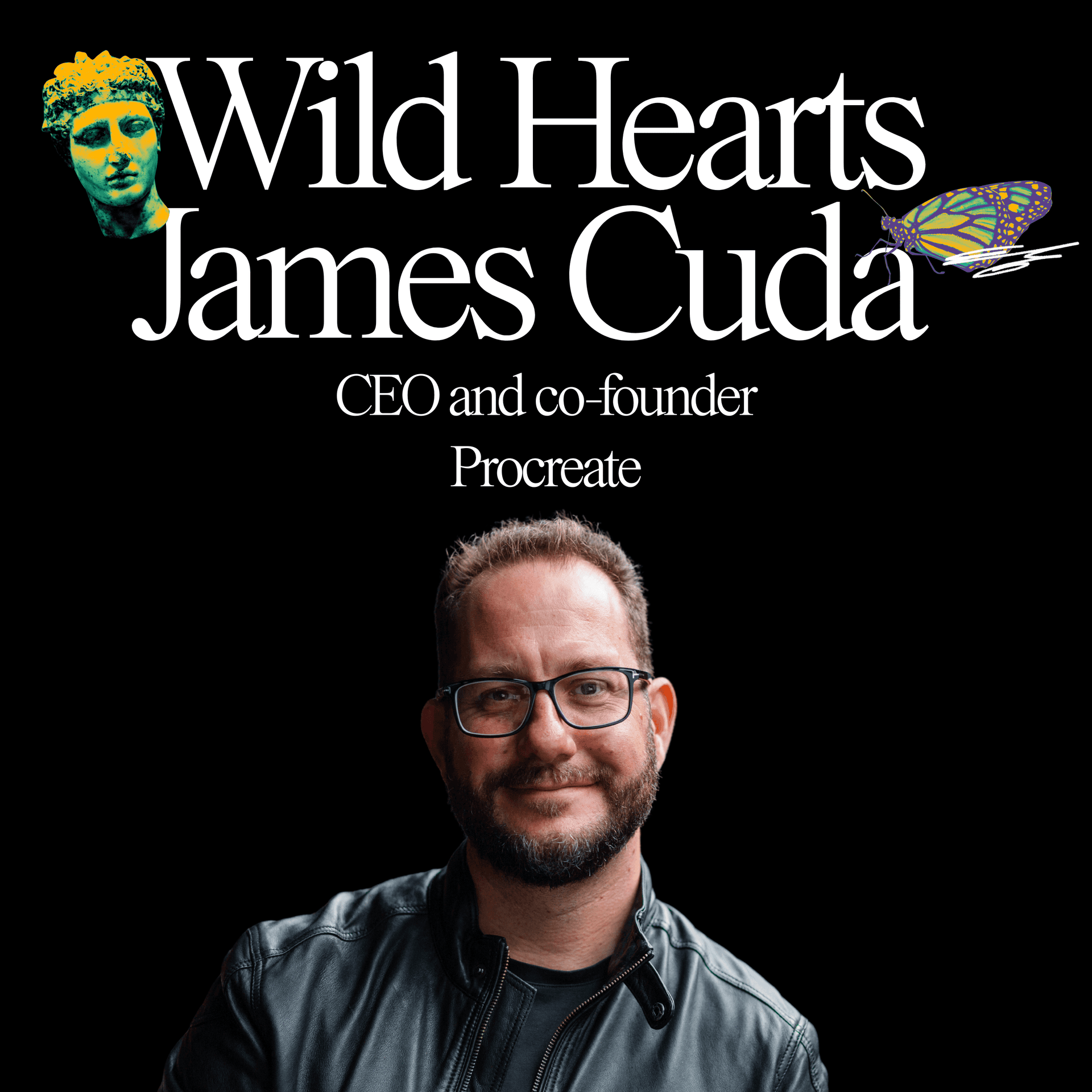
Brushstrokes, Flow State, and Freedom: The Procreate Story
Host
Mason Yates
Guest
James Cuda, Co-founder and CEO of Procreate
Episode Overview In this episode, James Cuda, co-founder of Procreate, shares the journey of creating one of the world’s leading creative apps. He discusses the philosophy behind Procreate, the importance of maintaining simplicity, and the challenges of scaling while preserving the essence of creativity.
Key Themes and Insights
- The Essence of Brushstrokes
- Foundation of Procreate: The app's core philosophy revolves around the simplicity and quality of brushstrokes.
- Technical Achievements: Over a decade, the team has focused on achieving real-time brush responsiveness, even on the original iPad.
- Product Philosophy
- Simplicity and Permanence: James emphasizes the need for permanence in design to help users develop muscle memory.
- Art of Subtraction: As new features are added, there’s an ongoing tension to keep the product intuitive and user-friendly by removing unnecessary complexities.
- Maintaining Flow State: The design process aims to keep users in a flow state, crucial for creativity, by ensuring that tool interactions feel seamless.
- Staying Independent
- Avoiding Venture Capital: Procreate has never taken VC funding to maintain creative freedom and agency. This decision is rooted in a belief that creative control should not be compromised for financial gain.
- Values of Freedom and Creativity: The company prioritizes creative freedom over commercial pressures, which influences its product development and overall direction.
- Listening to Users
- User-Centric Development: James discusses the importance of listening to user feedback without losing the essence of Procreate.
- Adapting Archetypes: The user base has evolved from amateur artists to professionals across various fields, including architects and animators.
- Generative AI and Ethics
- Cautious Approach to AI: James expresses his strong stance against generative AI due to ethical concerns, particularly regarding data rights and consent from artists.
- Potential as a Gateway: While he sees the potential for AI to ignite creativity, he warns against the reliance on it without addressing the ethical implications of data usage.
- Creating a Collaborative Culture
- Internal Flow State: The Procreate team fosters a collaborative atmosphere through "jam sessions" that encourage creativity without established rules.
- Physical Connections: Emphasizing the importance of real-world interactions, the team organizes events to connect artists and users, reinforcing a sense of community.
- Advice for Artists
- Listening to the Inner Voice: James advises artists to trust their intuition and listen to their inner voice, which represents a synthesis of their experiences and knowledge.
Important Time Stamps
- 00:00 – Intro
- 02:05 – Focus on brushstrokes
- 05:10 – The art of subtraction
- 07:50 – Philosophy of permanence
- 09:36 – Product evolution from version 1 to 5
- 15:01 – Balancing user feedback with core values
- 23:31 – Stance on generative AI and ethical concerns
- 39:06 – Reasons for staying independent from VC
- 46:39 – Advice for artists: listen to the little voice
Conclusion This episode of Wild Hearts offers a deep dive into the principles guiding Procreate's creation and growth. James Cuda's insights highlight the intersection of art, technology, and ethics, underscoring the importance of maintaining a creative soul in a rapidly evolving industry. The conversation encourages artists and entrepreneurs alike to prioritize their core values and foster a community-driven approach to creativity.
Written by AI. May contain mistakes. Listen to the episode to check what was said.
Transcript
Automatic transcript. May contain errors.0:00We value our creative freedom more than anything else. It's the highest value that we have and our own agency to make whatever we want, how we want to make it. That creative freedom, man, it's intoxicating. When you know you get up in the morning, you go, I don't know what the fuck we're going to make today. It's going to be fun. Everyone's got ideas, but how do you actually take that idea to market? It starts out with something that ignites the room. So an idea that, holy shit, wouldn't it be cool if? One of the product principles or philosophies that you hold really true. Permanence is one of my pet ones at the moment, especially with the release of iOS 26.
0:33Not to throw shade on those guys. They're doing a great job. Most fascinating product features is the brushstroke. I mean, Procreate is brushstrokes. Every company has a fingerprint. James Kuda is the co-founder and CEO of Procreate, the iPad's award-winning creative app for over a decade. It's the tool of choice for everyone from a tattoo artist to Pixar animators. And when James talks, you don't hear strategy. you hear an artist obsessed with his own canvas. Milliseconds shaved off brush strokes so they feel alive. Three years inventing a gesture for a straight line because breaking an artist's flow even once was unthinkable.
1:16And a philosophy of permanence that kept artists' muscle memory intact while rejecting hype-driven AI that would ultimately cheapen the craft. As James said, if you really love what you've made, chances are people are probably gonna like it as well. After listening to this episode, you'll learn how a world-class founder talks about the details that make products love, flow, subtraction, values strong enough to say no, and the creative freedom that comes from knowing who you are and who you serve. This is Wild Hearts. I'm your host, Mason Yates, and let's dive in with James Buter. in 2011 you launched procreate i think one of the most fascinating product features is the brushstroke do you remember what like v1 felt like oh yeah dude i mean procreate is brushstrokes yeah and it's core it's just brushstrokes we started out with this idea of like how do we make it fast which just seems like a weird sort of you know tech goal but it was like in the real world, we live in a three-dimensional framework.
2:20So things have persistence and we understand causality. And when you're interacting with anything, this new device, or it was new at the time, the iPad, we had to make sure that when you touch it, it's got to keep up. Very small goal in the sense of like, oh, it's a mandatory. It has to keep up with the artist, but holy shit, was that difficult back in the day to try and - So you managed to build it in real time, even in 2011. Exactly. Wow. I didn't personally do it. Never was. Lloyd should take credit for that part. He was obsessed, dude. He was absolutely obsessed. Just an animal. Yeah. Yeah.
2:54We started out with like, I think it was polygons and particles. We did a bunch of R &D. And then we settled on a simple tiling engine that just pumped the tiles as fast as we could. And again, Lloyd really was obsessed, like, you know, eking out millisecond after millisecond after millisecond to the point where on an iPad 1, we were painting at 60 frames a second, sort of outclassing most of the other desktop products. But it was just that obsession. Did you need to get into contact with Apple in order to get access to what sounds like a GPU level? Again, Lloyd, credit to Lloyd. He's never been taught.
3:33He's never gone to school. He doesn't understand how to program. And I think that was the freeing component because he approached it from an interesting perspective. Instead of doing things the correct way, he did things through intuition. So no, he didn't get in contact with Apple. That was just brute force. And it took, what, 18 months? 18 months. So he obviously moves. Yeah, he's fast as fuck, boy.
4:00But what a dynamic duo. And is the first stroke as good as the last stroke if you've been a user for a decade? It's interesting. You know, we put a lot of attention into making sure that every stroke, you know, every single stroke, no matter what brush you've made. And we've got this whole like crazy engine where you can customize the dual textures of brushes. You've got the stamp and you've got the texture itself and they kind of interplay and they can move and dance in different ways. And again, it's just that obsession because at every release, things will probably slow down. As we add more complexity and weight to the product, things will inevitably slow down.
4:35But again, credit to Lloyd, who would just sit there maniacally figuring out, eking back every second to make sure that the start, the first and the last stroke were completely the same experience. Hectic work. It's hectic work to scale that. There's something to be said about true creativity comes in, like A, in a stillness, but being able to like constantly simplify and reduce. It sounds like just then you were talking to like each release, there's more product weight that gets added. You share a bit more with how you keep reducing and simplifying and what keeps you at your core. Yeah, it's tough because customers want stuff.
5:13Yeah. So we want to try and make sure we're answering the customers, but that inevitably leads to more and more weight to the product. So version one was a very simple product and we could release super fast. But as we add certain features and complexity to the product, different languages and et cetera, et cetera, it starts to slow down. It takes a mindset of removing, not adding. And that's a real tension, you know? So we add a new feature. But as we approach looking at how we integrate that feature, we look at it from more of a holistic sort of picture rather than like let's just jam this feature in here and just get it in and put a button on it and off we go.
5:47It's kind of like every feature's got to have a place. Yeah. And it's got to feel connected to the others because we're all about flow state. And by that I mean, you know, both internally and externally. You know, we want our customers to get into that flow state. where time and space sort of bend around you and you're just making this thing. And to do that, you've got to be so careful when you're adding because it's so easy to add stuff, but it's really hard to keep the same power and functionality whilst removing. It's kind of like a dance, you know? It's never finished. You're just sort of moving and ebbing and flowing.
6:23Can you share a few examples? Yeah, I mean, and one example is people wanted us to add a ruler to Procreate. And so we thought, okay, well, how are we going to approach this? Do we just get a skeuomorphic kind of thing on the screen and you can move it around or whatever? That's going to add a lot of weight to the product. What we really want is someone to stay in flow state, right? So if they're drawing away, I just want to draw a fucking straight line. This is not a, we're not talking about right sides here. We're just like, how do I just draw a straight line? And so we devised a mechanism just using a gesture.
6:55So there's no weight to the product as far as assets, et cetera, with UI. It's a simple gesture. So if I draw and hold, we recognize that as a shape. And so, you know, we'll just draw a straight line. That complexity to get an interface that was very light from a product, very intuitive from a customer's point of view, took us three years to get to market because it just wasn't reliable. You know, we had to do some shape detection and stuff. So for three years, we were mucking around with crazy math trying to get it to work. But when we got it to work, the product remains very light, very flexible, but we've added that power to the product.
7:28in an intuitive way that keeps people in flow state too, right? So if they're drawing away and they're like, I just want to draw a straight line, there's no disconnect like file, menu, shapes or whatever. It's just, I'm just going to draw a straight line and off I go again and keep them in that flow state. So there's kind of a few things we have to constantly juggle in order to get to market. You mentioned flow state both internally and in the product. What about product principles or philosophies that you hold really true? And permanence is one of my pet ones at the moment, especially with the release of iOS 26.
8:03Not to throw shade on those guys. They're doing a great job.
8:08But if you look at some of the stuff that iOS 26 introduces with this new liquid glass design, one of my pet hates is where permanence is ignored because permanence helps us get into flow state. And so again, we're in this three-dimensional framework. That is reality. So we understand everything through this framework. Things don't pop in and out of existence. A Makita drill doesn't suddenly turn into a firearm or something, right? So you know that things are permanent. When you have that permanence, then you can start building up muscle memory. So I know that button there, and it becomes almost automatic, but the results become profoundly satisfying.
8:46All of these actions become automatic. But to do that, we have to create a physical framework within Procreate so that things are permanently there. We don't have like a button that when you tap it, it turns into something else or a completely unrelated function. But yeah, permanence can't be understated. It's like that's how we understand reality. So why shouldn't software be the same? So it's one of our real big driving things of trying to create products that allow for muscle memory, which helps customers get into that flow state. That's how we understand reality. Yeah. You know, we understand through, you know, growth and decay and motion.
9:23That's how we understand reality. And if we can synthesize that into our products, I believe they – or we believe they become much easier to use because you're leaning on this framework that already exists. If everything orbits around the brushstroke, how much has your product actually changed in a decade? That's a very good question, Mason. That's a really good question. You know, if you look at like Porsche. Yeah. I mean, they've changed, but, you know, they kind of kept the same kind of soul. That's kind of been our guiding light too. Like people want Procreate to do everything, but again, it's that tension.
9:56We want to make sure that if you look at version one, for instance, to version five, it almost looks the same. It almost looks identical. But again, it's that very deep philosophy of keeping things permanent. We don't want to just like new update and everything's different again. We really want to try and keep people in that mindset of developing flow. So even when we're adding stuff, we sort of pour over every pixel of how does it fit in though? How does it sort of add to the experience? And how does it make the customer feel? And it's a difficult thing to do because, again, they look very similar, version 1 to version 5.
10:30But, man, it's a different app. I mean, version 1 was a piece of shit. I mean, I'm throwing shade on ourselves here. But it's like a really small canvas. It didn't have selection. It was a core. Yeah. It was a really beautiful core product. And we built around that over time without sacrificing that brushstroke as the centerpiece of the experience. Yeah. Like it was really shit, but like the core was magic. Yeah. So have you heard of the Polaroid thing? The amazing piece of shit? I don't think they actually said that, but I'm just going to butcher their words with something to that effect. Yeah, that's okay.
11:05So, you know, photography back in the day. Story of everyone's life, isn't it? So the original Polaroid was developed out of this necessity of like, when I take a shot, I got to go back and get it developed and it takes days and all that. The Polaroid cats were like, wouldn't it be awesome if you could just smash a button and out the photo comes? That was revolutionary back then. Today, we take it for granted. But the idea was, and again, I butchered their words. Someone's going to look this up and it's completely different, but Essence was an amazing piece of shit. So yes, it didn't have all of the power of like, you know, multi-glass lenses and all that kind of stuff.
11:43But it had a magic. You could press a button and you could get your photograph. That was the kind of beauty. And I think we made an amazing piece of shit with Dreams. You know, it had a really beautiful core and it was a first step forward and we built around that. And it's the same with Dreams. When we built our animation product, it's got a beautiful core. But we're only at version one for that. And there's lots of things to add whilst keeping that core experience of what makes it amazing. Like the Porsche, it probably attracts a certain archetype. Yeah. With Procreate, have the type of people that have been flocking to the product evolved?
12:18Has that archetype evolved or is it the same artist that comes back? It's a good question, man. Because like, you know, Procreate's really big in the tattoo scene. Yeah, right. And I never expected that to be an archetype. Yeah. Blowing up on Instagram as well or TikTok. Yeah. I don't like TikTok either. We wanted to make a product where very selfishly we could use. And I can draw a little bit, but I'm not that great. But our idea was, well, if we made it for ourselves, then surely amateurs. And amateur is such a loaded word these days. Like I use it to rag on my mates, amateur. But amateur, the Latin word actually means to do it for the love of it.
13:01You know, and that was the kind of market they were looking at, you know, people that just want to make stuff just because they love it. And that archetype of an amateur was completely blown away as Procreate started growing out. It was like now architects are using it. We've got, you know, 3Ds become a thing. And it's kind of appealed to so many different disciplines now that it's the accessible nature of Procreate has sort of lent itself to being just broadly used in so many different areas of different industries. Both commercially and sort of privately, you know, it's this really interesting mix.
13:35It kind of appeals to everyone, which was not what we intended to do. It started out selfish and became altruistic. Selfishly, it was like, well, we want to love it. We want to use this. But I think that's kind of the beauty that we've recognized over the years is like when you make something, you sort of give it out to the world. If you really love what you've made, chances are people are probably going to like it as well. What sort of artist were you before? A shit one. An amateur. Oh, dude, I had this dream of like, you know, I used to, as a young man, I was into oil painting and watercolors and I used to read all the books, Rembrandt and all that kind of stuff.
14:11And my goal was to be one of the masters. I know it sounds very juvenile, but that was as a young - It's an ambitious goal. It's a young, well, the time had moved on. That was cool. Like in the 1800s. But in the 80s, that was just, I don't know why I was drawn to that. And at some point I realized like, man, I have to be dead in order to be successful or very, very old and very, very quirky and have some sort of point of difference in the art industry. And so I kind of swapped and changed and sort of went into design, but to bring it back, what sort of artist was I? Not a very good one. I guess like the part of the question there is if I was to look at like each of the releases from one to five, did you ever get caught out by like, oh my gosh, tattoo artists are now using it, architects are now using it.
14:55That just adds noise to the focus of the beauty of a brush stroke. I'm curious if that ever caught you out because it's not what you intended. It did catch us out, but in this really interesting way. So I'll give you an example. We were at Mattel. And so Mattel were adopting Procreate and we did a bit of a talk to the team. And afterward, the debrief, they were coming up to me going, hey, we really want to draw a circle. And it was like, oh yeah, we hadn't really thought about that. It was all about free brush strokes. and, you know, we didn't want to, yeah, we didn't want to, like, put shapes and text and stuff in there.
15:28We just wanted it to be a drawing experience. So it did add this kind of conflict of how do we fit that in? And to the earlier conversation about, you know, a gestural input to make a shape, that was the answer. It actually started with Mattel going, I mean, I get it. They work for Hot Wheels. They want to draw it. They want to draw a circle. But that input, you know, when we look at it and developed it in our own value-led way, then the output was something that was accessible for many people. So it does add weight and it does add this complexity to it. But when we can listen to what's the kernel of the problem, you know, what's the real kernel, not what's the solution?
16:05Because if we just listened to the solution, we'd just be Adobe Photoshop, you know. But if we can listen to the - Oh, God. Yeah.
16:14I get it. Like those guys, you know, they've got some such smart people there. But when you've got – talk about weight and complexity. I mean, they've got 30 years of weight and complexity. So I feel for it, man. It's like you want to change one thing, you're probably going to get a revolt. People outside with pitchforks and torches, you know, so I get it. That product needs a GLP one. 100%. 100%. But those guys were so clever. Oh, yeah. Like John Nolan. Oh, my God. What was clever? What stands out? Well, if you even look at the HSP color picker that we all use today, I stole it and sort of put it in Procreate as version one.
16:49That was just done by a couple of brothers who were just trying to solve a problem through intuition. In that respect, man, I just tip of the hat to the early Adobe. They were kind of like Procreate. They were riffing on ideas, trying to figure out problems, doing it in unique ways. And they set the standard. And then it became so popular that it's become corporatized to the point where they don't have that soul anymore. now they're sort of digging a moat around their product and trying to just protect what they've made. But the innovation is, it's not there anymore. But the people at Adobe, they're still incredibly bright people that get attracted to that company.
17:24And I get it. I totally get it. I want to go back to the idea of like keeping everyone in the company in flow and how you, like it's a beautiful idea to be intentional about. And I'm just curious how you are intentional about it. Well, to be honest, man, it hasn't been easy and we haven't scaled at 100%, we're still figuring this out. Yeah. Because when you're small, flow state comes naturally. Yeah. You know, you're just sitting there jamming away with a couple of buds making something. Flow state happens very intrinsically to the process. When you get to a certain number of people, flow state becomes identified as a weakness because it's not commercialized, not standardized.
18:05Because flow state comes from, you know, you've got your head, you've got your heart, and you've got your gut. And flow state comes from all three, but a lot of it comes from your gut, how you're approaching something. And it's not very easily standardized. You can't really quantify it. You can't put a lot of metrics around it. Like, man, I felt good making that thing. It's not something you can really quantify. So there's always a propensity to look at flow state and creativity as a danger because it's unpredictable by nature. You know, I mean, I'm still a businessman. I like having predictability.
18:39But in this instance, predictability is something that is not necessary. But when you scale, it's often identified as a weakness. So as we've scaled, we definitely went through that process of sort of re-evaluating how flow state and creativity works in a company. And we've come sort of full circle all the way back now, sort of writing the rules down, the recipes behind how things can be made in a flow state at a scalable stage. And it's not easy because, again, when you go into the void, you know, you go into the void of the unknown. You don't know how long things are going to take. You don't know what's going to come out of it at the end of it.
19:17But when you can really focus in on what gets people into flow state, generally what they come back with is super interesting. We just have to accept that it's not easily quantifiable. It's not really easy to standardize, but you can kind of put a bubble around it. You know, if you've got a pipeline of production, you can put a bubble around that and protect that process and sort of double down on the unknown, which is difficult, especially, again, when you're scaling a business, you know, you really want to standardize and sort of get efficiency through as much of the company as possible. But in this instance, what we've realized is that there's a danger in just looking at things through the lens of efficiency.
19:54To really get people into flow state, you have to accept some unpredictable patterns that emerge from that. What's an example of balancing the gut, heart, and brain? Yeah. I'm curious in particular, and I want you to finish that thought, but what does a product milestone or production or sprint look like inside here? It's very, very collaborative. It's very, very – and I don't mean that from just a poster on the wall thing. Yeah. And a good idea can come from anywhere. But an idea isn't enough. Everyone's got ideas, but how do you actually take that idea to market? It starts out with something that ignites the room.
20:34So an idea that, holy shit, wouldn't it be cool if? There's no answer to how to make that. We're just looking at the output. Wouldn't it be cool if the customer could do this? Or wouldn't it be cool if we could do this? From there, it goes into what we term a jam session. So jam session is we just sit around. There's no rules. There's no wrong or right. Very creative kind of agency style, right? You just kind of get together and just like jam on an idea. When that what if, sorry to clarify, does that jamming session, is that just full of optimism? Or is there like the bull bear? No, it's a mandatory, man.
21:04It's a mandatory. You can't come in and bring the vibe down. It's like, what about every edge case in the world? Like, no, no, no, no. Well, we'll figure that out. You've got to have that optimism when you come into a jam session of like, we'll figure it out. Because it's kind of, you try to create that, take that vision and sort of start making it tangible. It's almost like focusing a lens. You know, it's kind of blurry. You see something. Yeah. But then you sort of tighten the lens and, oh, there's something there. And when you get really bright people in a room and give them that permission to imagine and dream without constraint, that's what a Procreate Jam session is like.
21:38But we have to get brought down to reality at some point because as we're imagining, wouldn't it be cool? Wouldn't it be cool? Then a jam session stops when we, again, when the room is ignited, we're all super excited. then we splinter off and we start close mode so we know okay there's the vision that's where we got to go but how the fuck do we actually make that now that's the time to think about edge cases and and technological restraint and and all of the technical requirements that make it kind of necessary to bring into reality and then what we'll do is once we we've got something we come back together and we'll share either prototypes or designs and start feeling it out and that sparks another jam session.
22:18Wouldn't it be cool if, and what if, what if, what if, what if, what if? And that will just cycle over and over. So the design and engineering team will just cycle through that process of prototypes and designs and lots of whiteboards until we get a build that we fall in love with. That's the one we're looking for of like, holy shit, that's it. Then we've got to actually make it in production-ready code. And production-ready designs. Yeah. And do you need unanimous holy shit from the people in the jam room? We'd hope to get that. I mean, you're never going to get 100%, right? Sometimes there's always an outlier of like, oh, I'm not sure, but I'll go with the group because we've got a really great team that does trust in the group.
22:58That's a rarity. Yeah. I would say nine times out of 10, when we get that holy shit moment, everyone's just so G'd up to make it a thing that we can't help but splinter off and start trying to make it a thing. Because that excitement, talk about flow state for internal, that's part of how we get into flow state. Because once we splinter off and we're making the thing, that's our flow state. You've got the why. Yeah. And you've got the goalposts. We know what we're doing. Now time and space will warp as we start trying to just make it, you know, will it into reality.
Read the full transcript
23:32And last year you said, I fucking hate generative AI. Yeah, I feel strongly about that one. No change in view?
23:42No change in view in the sense that emotionally I have a response to it. Logically, you know, AI is here to stay. It's going to make a profound difference for our species, no doubt about that. But there is the emotional side to me that I still struggle with because where to start with that one? It's like, does it rob an artist's creativity or does it amplify? I don't think it robs artist's creativity. I actually think it might even bring people into creativity. Yeah. You know, if they're just jamming away on a keyboard with some prompts, that feeling of making something, even if it's through prompts, if they get the little dopamine hit of like, oh, I made that.
24:23At some point, they're probably going to go, but I want to do more now. And they're probably going to want to start transitioning to I'm going to write poetry or I'm going to paint a picture or whatever. So in a way, it's kind of like a gateway drug or something. I don't know. I don't see that as really the issue. I think the interesting part is the Valley had magic. When I was young and then starting a company, I really admired the Valley for that. But anytime they get up on stage, it's like, holy shit, wow, that's going to be a profound change. And it was. But I think in this instance, I wonder if they're sort of drunk on their own hubris of I can change the world and I can do anything, bring in this new tech in without really thinking about some of the consequences.
25:05And so, for instance, the one that I have an emotional response to is the data. If you were to remove, it's like, look at this magic box. I can type and this magic happens. It can do all these magical things. But if you were to remove all human-made data from it, it's in a note box. It does nothing. It's just a statistics machine. It can't actually function without human data. And so if you look at that from a lens of, you know, we're pretty close to the creative industry. So we hear a lot of the stories. But from my perspective, the emotional component comes from the data use. So an analogy would be like, hey, check out this new car.
25:48We can go anywhere with this. Just put this little bit of magic water in the car. You can go anywhere you want. You can do anything. It's going to change humanity. Yes. Yes, it will. And then if someone was asked, where do you get the water from? Don't worry about that. It's magic. Just put it in the car and off we go.
26:05and it's like at some point you know artists in the creative industry they're providing that data uh without consent and that's going that's some of the magic water that's going into the car and i think if they if artists were responsible for refining the oil then surely they have a say in this new economy and i think they will at some point because at the moment the valley is just kind of like, don't worry about it. It's all magic. For me, that's not sustainable because it's not magic. It's all data driven. AI has always been about the training sets. Yeah. And so if you look at the training sets from a creative point of view, specifically around generative AI, artists are sitting there really beating the drum of, hey, we're not consenting to this.
26:49Can you not use our data? And yet the valley is kind of going, look at this magic. This morning I woke up and was like, Grok has imagined a pod racing scene. I'm like, I didn't imagine shit. It looks like a really bad version of the movie. Yeah. But it just looks like a really bad rendition of the movie. Had there not been a movie, had there not been any content, the box can't produce anything. And so that conversation of how does the creative industry participate in this new economy is a discussion I think that has to happen and will happen, but we're not at that stage yet because I think the stage is still in that hubris of the valley of it's all magic.
27:25But I think time's moved on. This isn't magic like the other technologies, like use the analogy of the iPhone. That shit was mental. It's like, I got the whole internet in my pocket now. I'm old enough to remember when I had to go to a desk and dial up for that stuff. Do you know what I mean? It's like, that was magic. There is a certain magic to ML, but the data, there has to be a conversation around that data. I mean, I use ChatGPT and Grok for web searching. It's way better than Google. It's got its flaws. Sometimes it bullshits to you and you've got to sort of double check stuff, but it's way faster.
28:00And I think that's a super interesting direction. But again, where is he getting that data? Have people who are providing to this new economy consented to it? That's the emotional response. Because when I see artists who are putting their heart and soul, they've trained for years and years. And then someone can use an example, an artist, Sam Jung, who's an amazing artist. The data sets have just eaten all of his work and now people are just prompting, make it like this with Sam Jung. and he's sitting there going, hey, guys, come on. Yeah. Come on. Deft in broad daylight. Yeah, totally. And it's like we need to have the conversation where the people who are refining the energy source get a say in the economy.
28:41And like I said, I think it will happen, but we're not at that stage yet. Do you have any ideas on how it could work? Yeah, I mean, if it was consent-based. So you could even have an economy where my job now is to just make training data because I get paid really well. There's nothing wrong with that. If you've got a training set data that is completely consensual, great. The artist is getting paid. The company who's profiting from that gets paid. The customer gets a really wonderful experience. That's cool. But there's another side to that. What if you could send to training on yourself? So I'll give you an example.
29:11This is complete pie in the sky stuff, man. But in Procreate, we thought about with dreams, wouldn't it be cool if you could draw your key pose to your characters, some sort of pose? And then 30 seconds later, it's at a different pose. But in betweening those frames, drawing every single frame is a very tedious, laborious task. Wouldn't it be cool if you could just, with a magic button, just inter between those frames? It's plausible, but based on what data? If, for instance, just using our product as an example, if you could agree that maybe Procreate will train on me, it's not going to share the data, it doesn't go into a bucket, it doesn't go to anyone.
29:53It's just for me, I get my own little Terminator in Procreate. That's really interesting. That's super interesting because what that's doing is sort of leveling up and speeding up that creative flow. And so that's an interesting way to do it. I think there's so many different ways you could cut up this new economy to try and do it with ethics. But at the moment, I don't think we're – I think people are just so excited by this shit. And they're just – like every gold rush in the valley, they're just trampling over each other to try and get there. But this one, I think, has a broad implication that perhaps we're not thinking through just yet.
30:26I've seen products like that. I can't wait to be able to train on my own. And if I could train on yours because you let me use it, maybe I'll pay you. Right. And what's wrong with that? If everyone's getting paid and everything - You're saying thank you. Yeah. For the great work you've done. Yeah. I'm using it every day. Totally, yeah. I'd be so down to pay for that. Yeah. And I think if you look at stock photography, for instance, or stock audio, There are people out there who just sit there with headphones jamming away on a keyboard and they're selling their stock. So why can't we have that arrangement for creatives who are selling their artwork to the training models?
31:01I think it'd be cool. But what we can't have is having the whole creative industry in the whole world not having a say in the economy. It's got to change. It's got to change. I see that there will be an opportunity here. Do you remember back in the day with Kazar or Morpheus or LimeWire, any of the peer-to-peer sharing services? There was an economy there. It just hadn't happened yet. People were stealing the shit out of stuff. And remember, Metallica made a big deal of it, and it was very topical. But what happened was Apple, iTunes, started selling stuff for 99 cents, and it just kick-started the whole.
31:38And here we are now with streaming music. I've got every album in my pocket. So there is a story here. We're not there yet at the moment where people are just stealing shit. But I think something interesting will happen out of this. And again, as long as the artists are getting paid and they're contributing in a meaningful, consensual way, the future is bright. The other thing about a predictive engine is that everything just reverts to the main, which is just like if I put a number into ChateWPT right now and just give me a random number between 1 and 10, it'll give me the same number if I start a new show, which is 7.
32:11because that's the data it's been trained on, which is like completely opposite from hopefully what an artist is trying to do in the creative process of finding novelty and creating something fresh and new and something that intersects with their own ideas. Totally. Has that sort of like creative process, do we want to bring AI into the product, come about? Yeah. I know you've sort of rejected it, but I'm just curious, has that evolved? We definitely consider it. I mean, holy shit, when Mid Journey hit the scene, And I was, to be honest, I was smitten with it. I was like, holy shit, check this out.
32:43And in my opinion, I was like, maybe this is something new that we could get on board with. I wasn't sure where we were going to go, but I just, I was smitten with the idea of I can just punch in some words and I get some cool stuff back. And at some point we reached out to Mid Journey, David Holtz, and had a meeting. And it was really interesting because we were sort of back and forwarding about our two different perspectives on creativity. And there was something in the middle there that I was really, really interested in. But without throwing too much shade on David, but he seemed very concerned with the data and where our data was coming from and what we were doing with the data.
33:17And at the end of that conversation, I sort of left that a little perplexed that the conversation wasn't about creativity and making stuff and, you know, really sort of giving people superpowers. It was how do we get Procreate's data? And that was really concerning. So that sort of started the train moving in a little bit of a different direction. We then sort of considered it for different aspects, like, you know, wouldn't it be cool if you saw an artwork and you could press a button and it generated the brush that looked similar to that being used? And there was all sorts of interesting stuff we were thinking about.
33:47But at the end of the day, where we landed was, it's just a tool in our developer toolbox. Everyone's getting so hyped for this new hammer. It's like, let's just bash the shit out of anything that looks like a nail. And it's like, yeah, but what do we actually need to do with it? Can we solve these things with an ARG? Can we solve these things with a different experience? And we sort of landed on the place that right now there's nothing apart from that interp idea that we had. I kind of like that idea. There's not much in there from our point of view that we need to reach down and grab that tool for.
34:17That's not to say that in the future we will. There's a big plausibility we'll reach into it, but it has to be done with ethical data. I think unless that data set problem has a solution, I think we've made that sort of value-led choice to step back and say that we don't want to participate in this unless we feel good about it and we're not creating harm, you know. It's a hot topic, man. It's such a hot topic. I could go for that. I could speak to you about it for an hour. I can speak about it for an hour. I know. And I think what I love is that I love how opinionated you are on the product experience, the Italian in you.
35:00Or the German. Or the German. True that. Highly disagreeable. Pardon me. I'm highly disagreeable, but not for the sake of being disagreeable. But open as well. Yeah. Open first, then disagreeable. Yeah. Like you've taken in the ideas. Yeah. Then you've gone back to like, what are we the best in the world at? It's about the artist. And also, we try and use the word a lot internally about authentic and authenticity. We're trying to really live that. We want our brand to be as real as possible because at the end of the day, I think corporations and businesses change so drastically, especially in the last 10 years.
35:35Like ads, people don't give a shit about big mission statements. No one cares about. They care more about this sort of the person to person. That's why we're seeing a rise of the influencer because people are searching for that meaning. They want connection. with real people. And I think we recognize that and we're trying to make sure that we're on that curve of making sure that we're being open and honest and real, showing our flaws and our wins at the same time to just try and give the customer a perspective that we're people just like you and we're trying to be real and we're not trying to sell you on something.
36:08We're not trying to screw you on something. We're trying to legitimately put something back into the world that makes them a little bit better or a little bit happier? And especially like now when the promise of the internet was to share all this knowledge and make us all smarter. I don't think it's made us smarter. I think it's definitely leveled us up. There's much more we can do. But has it actually brought us closer together? You know, has it really brought us closer together? There's an argument there that we're probably more further apart now than ever. And with that, when you've got the corporations and sort of enterprise still, they haven't quite figured out that people just don't give a shit about a corporate slogan or this new tech or whatever they care about connection and they care about people and i think that's why we're we're trying to be as real as possible throughout our journey how do you let artists like there's just this i can't escape this idea of like the the product is tactile in function like the form totally so you feel like your whole body feels the connection the joy and And the connection of it.
37:09Like you mentioned that you were super collaborative internally. How do you let other artists be creative and collaborative and connect with others as an extension from the product? It's interesting because we try and do it as organically as possible. We've got a team that sort of flies all around the world to events and bits and pieces where we can try and bring people together. There's a selfish and altruistic side of that. We want to get feedback on our product, but we also try and bring people together for no commercial reason other than connection. So a lot of the time, once an event's over, we'll try and chuck a party or get people together.
37:43Because that, again, is not looking at it through the commercial lens of trying to figure out how do we get cross collaboration or tools that collaborate over time. What we're actually trying to do is bring people together in physical sense. And there's something to be said for that in a world and a time where we're more separated than ever. Our brand's trying to bring people in physical space together. Like even internally, our culture book is all about working together, working in person. In the age of remote working, we've got some remote workers, but the majority of the team works together because humans, when we get together, there's that serendipitous nature of doing what we're doing right now, man.
38:21It's like we're jamming, we're talking. It's the highest bandwidth we have. It's the highest bandwidth. And when we reduce it down, 90 % of human communication is body language. So when we reduce that down to just simple text, it's the lowest bandwidth we can possibly have to get meaning, to get communication. And so we're all about trying to connect people together physically and sort of jam together physically. And at these artist events, we'll often, you know, let's all go for a walk, guys. We're going to do some plein air painting or whatever. And we'll all just sit there and that's real human connection.
38:55To me and I think to a lot of us here, those connections are far more valuable than any kind of tech we could possibly develop just bringing people together to connect you've been very either disciplined or defiant or disagreeable in maybe all of the above not not deciding i i'm curious to i mean i think the learning from this is that it is like the the starting point is disagreeableness but uh it's like strong opinions held loosely, but staying in Tasmania, not taking on AI, some of the opinions you've shared on how the team works, not taking, I don't know if I said this already, not taking on venture capital and never wanting to take on venture capital.
39:38Maybe we can just hang on venture capital for a piece. What are the hot takes? Was it born out of necessity or was it born out of a deliberate decision? Probably born out of selfishness, if I'm honest, Mason. There's a reason why that we've sort of swum in the opposite direction to a lot of other startups. We value our creative freedom more than anything else. Internally, it's the highest value that we have. And our own agency to make whatever we want, how we want to make it, that creative freedom, oh man, it's intoxicating. When you know you get up in the morning, you go, I don't know what the fuck we're going to make today.
40:17It's going to be fun. It's up to us then to have that commercial reality come in of making sure that we're meeting market demands, we're doing our competitive analysis and all the other stuff. But at the core, what we're really, really focused into is our very own selfish, creative freedom. And because that for us is our kind of guiding star, there's no price that we can sort of sacrifice that for. We've entertained the idea of getting some venture capital and we've talked to yourselves and a bunch of other firms. But to us, it always comes back to, but can we really have the freedom? Because that's what the money's for, from my perspective, is like we've been lucky enough to have a good, strong, healthy revenue.
40:59The revenue itself isn't to buy a car or to buy something from our perspective. It buys our freedom, our complete and utter creative freedom. And I suppose our concern is that if we were to sacrifice that or dilute it, are the products going to be better? Are we going to feel better? And that's the question mark that sort of always kept us along the lines of, well, we're going to do it our way because we value our freedom above anything else. Well, ultimately, it's complete alignment. Yeah. You haven't found it yet. Not yet. We've come close, man. I mean, we've had some really good discussions in Palo Alto with some friends up there, which has been really fun.
41:37They're really fun. But again, it's like, I suppose we see ourselves as artists as well. Yeah. And if anything compromises our ability to make the canvas that we want to make, we're going to selfishly choose that. But who knows, man? It's good for no one either. You want to build the most powerful experience for an artist. Yeah. You need to be an artist and have that artistry internally. Totally. And if something toxic comes in the way of that, then yeah. VCs, I think we don't see them as toxic. We do see them as just different alignment. It's a different one. Maybe I misword it. More like if you're in flow, you don't need a distraction.
42:17Good call, man. Yeah. A hundred percent. I don't need that J-I pop-up bubble that gives me a summary of like - Time and space is warping and we're having fun. Yeah. Yeah, yeah, yeah. But again, who knows? Like our roadmap is so ambitious. I mean, it's weird. Like after the J-I statement where I said those colorful words and it sort of got a bit of attention, we got just people like, please, can you bring this stuff to desktop? can you bring it to Android? Can you do this? Can you do that? Because all of our competitors are sort of rushing in this direction of generative AI. And we didn't mean to put ourselves at a commercial advantage here.
42:52There was no point of difference we were looking at strategically on paper. It naturally manifested after we just sort of made our statement like, oh, look, this is how we feel. And we started getting a lot of enterprise businesses and small to medium businesses sort of hitting us up going, can you please just do this and we'll drop said product that we use and we'll use this because we're concerned about our data. And so we're getting kind of hammered at the moment with this demand. And we're trying to now react to that demand because we're like, holy shit, we didn't see ourselves as this kind of beacon, but we want to answer that.
43:23We really want to answer that because these kind of moments in time, they come past and they go again. If we don't answer it, someone else will. They'll fulfill it. It's the beauty of the market. Someone else will fulfill that. So at the moment, we kind of got this renewed spirit behind us of like it's a bit more than us now. We've got all this demand to bring our stuff to bigger platforms and more products and we can. And so we're now got this renewed outlook that's super motivated. I mean, holy shit, I go to bed thinking about this and I wake up thinking about it. It's cool. It's beautiful. Yeah, a lot of fun, a lot of fun, a lot of demand, a lot of opportunity.
43:57But again, doing it our way is the difficult part. How do you think about simplicity with that abundance of optionality. Yeah. What a tension. Gosh, what a jump between the iPad to a desktop. So yeah, how do you think about that? Like it's not in the focus in the camera lens that you were describing, but like even just the ideas that you would lean on. Well, I think it's interesting. It's like DreamWorks, when we showed them Procreate Dreams. Yeah. Oh, they were like, this is cool, man, but I ain't making a movie like this over a couch. And I was like, yeah. Ah, fair point. Because it's not a, what we realized is it's not a, they're not mutually exclusive.
44:39Yeah. Artists just want to make stuff. Whether it's at the desk, at the beach, they don't really care. You know, it's not really what goes into their mind. They see an opportunity of like, can I have my desk set up where ergonomically I've got a larger screen, my back's not getting destroyed and I can work for long hours. But then I can just jump on the couch by the fire or something, continue making the movie. That customer flow, if we sort of look at that, that's super exciting. There's a tension there. But that's super exciting in the sense of what Procreate could give to the artists in the sense that perhaps they do just approach their desk.
45:14We've got a CloudSync file type that we're bringing to market. How cool would it be just to draw your movie and you're doing your timings, et cetera, and turn it off to walk away and grab your pad? I see what they want. And I get it. I totally get it. It's not an if or an else. The challenging part to us is, well, if we jump to a desktop, there's a lot of heritage. A lot of things don't transpire. Like you can't just grab the iPad and just blow it up. Desktops have been around for 30 years. Very, very different input methods. And if we were to do that, what we don't want to do is just sort of follow the trend of just blowing an iPad up and throwing it on there.
45:53If Procreate is going to make a desktop app, we want it to be the best Mac experience, like better than first party. We want it to be the best, almost like we've always been Mac developers. But that's a challenge. It's a real challenge because our mindset isn't in that direction. It's always been on this magic piece of glass that can kind of transform itself into whatever we need. Whereas on the desktop, it's very different workflows. Very, very different. Yeah. Massive. But I can totally imagine someone leaning over a couch and creating that next movie. Well, there's people doing it. Yeah. Just maybe not at Disney yet.
46:29Totally. If you have any advice for the artists out there, whether they're founders or artists themselves, what would you hope that they can think about? I'd turn that around and say the best advice I could offer is listen to the little voice. as artists, we have this high amount of intuition generally. And it's so easy to suppress that tiny little voice that sort of tells you what you should be doing or what could be great or what the right answer is. And we often suppress that with logic and data. But the advice I'd give out would be always listen to that little voice because that's just some total of all of your knowledge being accessed in an instant.
47:09There's something there. There's something very truthful and emotional about listening to that little voice inside. It's not easy to do. It's so easy just to kind of rationalize your way through commercial decisions or product decisions. But I find the strongest sort of superpower we have as artists is that little voice. I have to ask a follow-up. Yeah. How do you bring, so you listen to it, you can hear it. Yeah. It's starting to bubble. The weight, it's building. What questions would you ask yourself to start putting words to the feeling? The first thing you've got to do is be honest. That's tricky, man.
47:46That's so hard. It's weird. It's like, you know, you make a call. Is this my ego or is this true? Right, right. Yeah, like you're making a call and the little voice starts chiming in. You're like, shut the fuck up. I know what I'm doing. And you keep going down that path and it gets louder and louder. The first thing you have to do is just really be reflective and be completely transparent with your own person. And that's not easy. It's not a path for everyone because no one really likes admitting that they're wrong. That's just a human condition. But if you could push past that and really like be really honest with yourself, then that little voice becomes so powerful.
48:22Thank you for joining me on Wild Hearts. That was beautiful. Cool. Thanks for having me, man. So good.
48:31Thank you so much for joining us for another episode of Wild Hearts. If you want to learn more from the most ambitious people working at the front line, designing, creating the future, please hit subscribe or follow. Please share it around. It would mean the world to us, as you know. Frankly, the show would be impossible without the help of Camilla Herring, Amelia Rayner at Blackbird, and our editors, Annie Jones and Sanjay Chabaria at day one. Thank you all for listening. And if you're a wild heart with a wild idea, please get in touch. I'd love to hear from you.
From the publisher
Procreate co-founder James Cuda has spent more than a decade obsessing over one thing: the brushstroke. From hacking the iPad 1 to run at 60fps, to turning a side project into the world’s leading creative app, James has built Procreate on a radical philosophy: simplicity, permanence, and creative freedom above all else.
In this episode of Wild Hearts, James joins Mason to share why the company never took VC money, how “flow state” shapes everything from product design to team culture, and what it really takes to scale without losing soul. They also dive deep into generative AI, ethical data, and why Procreate’s biggest unfair advantage may simply be staying small and Tasmanian.
James also reflects on the tension between addition and reduction, the power of jam sessions, and why listening to the “little voice” is the artist’s greatest superpower.
Time Stamps
00:00 – Intro
02:05 – Why brushstrokes were the starting point
05:10 – The art of subtraction: keeping flow while adding features
07:50 – Permanence as a product philosophy
09:36 – From “an amazing piece of shit” to a world-class creative tool
12:11 – How Procreate’s archetype grew from amateurs to architects
15:01 – Listening to users without losing the soul
17:31 – Scaling creativity and protecting flow inside the team
19:51 – Jam sessions, “holy shit” moments, and making ideas real
23:31 – James’ strong stance on generative AI and ethical data
34:51 – Authenticity over slogans: building trust with artists
37:21 – Bringing artists together, online and offline
39:06 – Staying independent: why Procreate never took VC
44:01 – Simplicity vs. optionality in future workflows
46:39 – The advice James gives every artist: listen to the little voice
48:26 – Outro