
In short
Wild Hearts Podcast Episode Summary
Podcast Episode Details
- Podcast Title: Wild Hearts
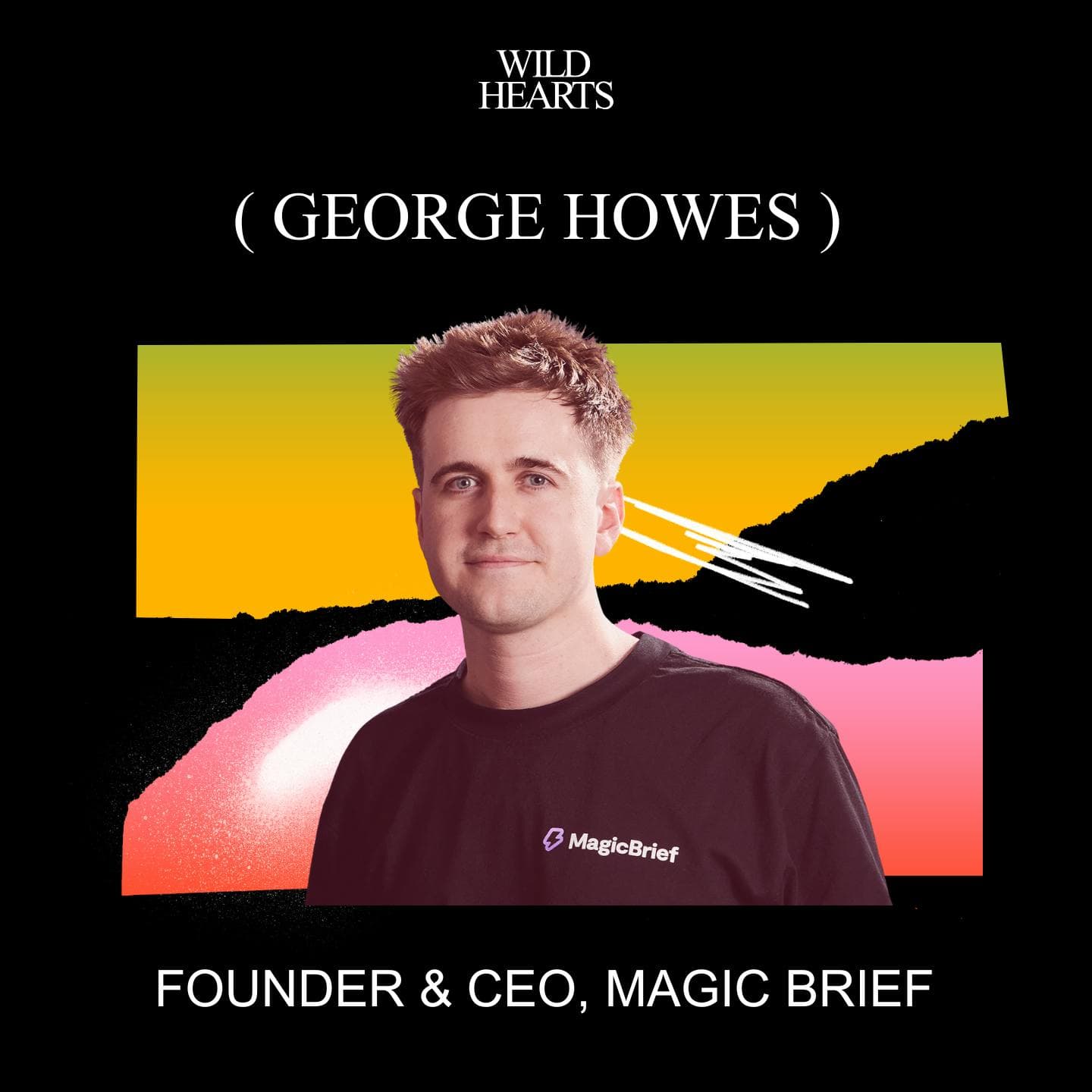
- Episode Title: The intersection of marketing, product, and creativity with George Howes from Magic Brief
- Episode Description: This episode features George Howes, the founder of Magic Brief. It discusses the challenges of creativity in the digital space, the importance of feedback loops, and how AI can enhance, rather than replace, creativity.
Key Themes and Takeaways
- Creative Challenges in the Digital Age
- The internet is filled with mediocre content ("slop"), and the ability to create has democratized content production.
- The need for real taste, curation, and innovation in creativity remains significant despite the ease of content creation.
- Magic Brief’s Mission
- Magic Brief aims to establish a new kind of marketing machine that centers on creative intelligence rather than just analytics.
- Focus on creating a perfect feedback loop that integrates customer insights, ad performance, and creative execution.
- 15 Principles of High-Performing Teams
- George shares his experience from Eucalyptus and outlines 15 principles that define high-performing marketing teams:
- Tight feedback loop between media buyers and creatives.
- Culture of testing over subjective decision-making.
- Shared responsibility for metrics across the team.
- Ability to generate novel concepts quickly.
- Deep understanding of audience interests.
- Rapid creative iteration based on insights.
- Regularly updated messaging matrix.
- Understanding past performance drivers.
- Best practices for different channels.
- Ability to iterate based on success drivers.
- Movement up and down in messaging depth.
- Following cultural trends.
- Clean, repeatable processes for creativity.
- Discovering competitive insights.
- Culture that encourages taking risks.
- Marketing and Product Integration
- Marketing and product development should work closely together, emphasizing a culture of feedback and rapid iteration.
- The importance of understanding what has worked in the past to inform future marketing strategies.
- Role of AI in Creative Strategy
- AI should enhance the creative process by providing insights and recommendations rather than replacing human creativity.
- Magic Brief uses AI to analyze performance data, providing actionable insights that creatives can utilize.
- Future of Marketing
- George predicts that marketing teams will evolve to resemble performance marketing teams at Eucalyptus, with creative and data analysis integrated.
- Emphasizing a holistic understanding of audience needs instead of viewing marketing channels in isolation.
- Company Growth and Development
- George discusses the growth journey of Magic Brief over the past year, including:
- Expanding the team and developing new products.
- Adapting the go-to-market strategy to focus on valuable, engaged customers.
- Enhancing the product's onboarding experience to deliver immediate value to users.
- Challenges with Self-Service Models
- Early success in self-service onboarding led to rapid growth, but the need for deeper customer engagement necessitated a shift towards a more guided sales approach.
- The importance of providing a structured onboarding experience that quickly demonstrates product value.
Conclusion
- The conversation emphasizes the future direction of marketing through a blend of creativity, data, and AI.
- George Howes is committed to empowering creative professionals by providing them with the tools necessary to thrive in a rapidly evolving digital landscape.
Call to Action Listeners are encouraged to subscribe to the podcast for more insights from founders and operators who are making significant changes in their respective industries.
---
This summary captures the essence of the episode while highlighting the critical discussions and insights shared by George Howes.
Written by AI. May contain mistakes. Listen to the episode to check what was said.
Transcript
Automatic transcript. May contain errors.0:01The role for the creative right now and the future going forwards is really around taste and curation and genuine good novel ideas and ways of thinking about things. and it's been interesting even being on on twitter over the past like week or so with the launch of open air's new model and you see like hundreds of people posting like things that they made whether it's landing pages ads or whatever and saying like it's so over it's over for creative people and first of all you look at the stuff that they're posting these are bad ads and they're bad landing pages but you just managed to make them in seconds so i think the world is going to be filled with a lot more kind of slop in terms of just like now that anyone can make anything Welcome back to Wild Hearts.
0:42I'm your host, Mason Yates, from the investment team at Blackbird Ventures. When George Howes left Eucalyptus, Australia's fastest growing health deck startup, he wasn't chasing another unicorn. He was chasing a feeling. The feeling of a team that moved like a single organism. The feeling of making thousands of ads a month with every team member wired into the same pulse. What's working and why? The feeling of a perfect feedback loop, from customer insight to add performance to creative execution. That feeling became Magic Brief. In a world where creative is now free and the internet is drowning in slop, George is building a new kind of marketing machine.
1:21One where taste matters, insight matters, and feedback becomes the superpower. Where AI doesn't replace creatives, it unlocks them. Magic Brief isn't an analytics tool. It's not an AI copywriter is something deeper it's a new system of record for creative intelligence in this episode george shares why most smart tech fails and how magic brief avoids the trap how he built a product that mirrors the 15 principles of eucalyptus's marketing team why the most creative people in the world need feedback not freedom what it really takes to build fast and make it feel like magic. This episode is a masterclass in marketing for anyone building at the edge of AI, creativity, and product velocity.
2:06Let's get into it. I would love it if you could summarize the last 12 months. Last 12 months have been nuts. Even the last couple of weeks, we've had such a surge in demand. I think part of it is coming off the back of OpenAI's new model. And you're just seeing marketing teams around the world going, how can we make the most of this? This is breakthrough technology. Now it's virtually free to produce creative or statics at least. And the most important thing that everyone is trying to get to, and we're doing a good job of right now is, well, what is the thing? What's the ad that we should make next?
2:40And we've spent the last two years essentially building for this with what we call creative intelligence. So it's like looking at the wider landscape, looking at your own ad account, your own marketing channels, even the comments that people are leaving on your ads, building off that and then going, this is the ad that you should make next. So we feel like we've really got into an interesting spot and there's a lot of momentum in the market around it. I'd say it's also been interesting for us because we've had this huge surge in demos where anyone on the team who's not an engineer, anyone who can use Google Meets is on Google Meets doing demos.
3:12So it really is just getting the product out as quickly as we can. And then there's questions like, well, should we move back to self-serve should we let anyone adopt the product right now because there's the demand for it but i think from what we've seen the customers that we on board right now and the kind of quality of the conversations that we can have and show them these novel insights off the back of their own accounts in a single onboarding call like that's really made a lot of sense so it's that balance but there is a temptation to go okay let's let's let everyone in and it's a hard thing to kind of balance between particularly starting out and and having the company here in sydney australia with so much of our market pool coming from the US and Europe, where you go, even though we've built an early muscle and building a product that people can adopt and see the value and wire asleep, it is that cool to have the best experience and the best showcase of the product.
4:03Being able to sit with someone on the call really does make sense. So a lot of the time and energy over the last few months has just been building this go-to-market muscle in the Northern Hemisphere, and we're hiring for that right now, as well as handling all of the demo calls that we possibly can. So it's been, yeah, last 12 months have been crazy. We've doubled the size of the team. We've built a whole set of new products and have some real flagship brands and agencies on the product today. So they've been crazy, but they've been good, good crazy. How would you describe the product at the moment?
4:35The product has two main pillars to it. The first is what we call creative research so that's getting a view on the wider landscape in terms of what's working in your market what are the messaging the themes that the creators the formats that are driving results and then the other part of the product which we're really doubling down on and we're seeing a lot of traction with is what we refer to as creative analytics so that is establishing this feedback loop with inside your own team where you can have essentially the surface that sits on top of the ad accounts and the actual data and then the decisions about what gets made and coming from eucalyptus that was one of the things that i really took away from there where part of the reason that we could build such an impactful marketing muscle inside the business was everyone at any one point in time had an understanding of what worked what was selling product who they were selling it to and really understanding those motivations and drivers within any of the ad accounts or the channels.
5:32So Magic Brief and a lot of the core tooling that we've built is just enabling exactly that. Like how can you have any person in the team at any point in time know this is the ad that I need to make because I've got the underlying data and I understand kind of, well, this is how we should develop that or this is how we should iterate on that ad. I'll read out from the investment memo our thesis on magic briefs business remains unchanged and this is just sentence one over the next 10 years all marketing teams will look like eucalyptus and performance marketing internal teams of creatives and engineers producing and buying ads they can immediately test and iterate on I'm sort of realizing as I read it's probably your words will simply be called marketing those teams will need a tool that enables them to collaborate on creating ads, brief their production teams, track ad performance, and compare that performance to their competitors.
6:27The output of these teams is more revenue for the company. Magic Brief can be the tool that helps marketing teams drive that extra revenue. Does that resonate? That was written at the end of 2023. Does that remain true today? A hundred percent. It's more true than ever. When I left Eucalyptus, I remember this. I wrote a list of 15 traits because people would always ask the question like what was different about eucalyptus in the way that you did marketing like how did the function and the business scale so quickly and there were these 15 principles these 15 traits that i wrote down that i believe to be the underlying traits that that drove the performance of such an incredible marketing machine and an incredible team at eucalyptus and i was looking back at that list a few days ago and it really has become and that was written years ago now the checklist that magic brief has been built off you look at the traits and then the features that we have in the product now and the alignment is so close in the sense that that's a point of friction that's something that a team does really well that's a trait that really makes like a marketing function stand out and those same features are almost mapped one-to-one so i feel it's more true than it's ever been like most marketing teams will look like eucalyptus or these kind of powerhouse teams around the world where they develop an ability, kind of almost closer to the discipline of product or engineering, where you're running an iteration cycle, you're testing, you're learning, you're doubling down on the winners versus traditional marketing, which was my background working at large agencies like Widen Kennedy and Colenso BBDO, where we would spend months, sometimes years working on an ad versus like Eucalyptus, where for each brand, we were putting out thousands and thousands of ads every month so it's like a change in and mindset and a change in the way that you build a process or you build a team but yeah every good team will end up looking like the kind of discipline that was built at eucalyptus and many of these standout teams around the world right now so it's an exciting time and i i feel that it's it's almost weird right that you've got performance marketing and then you have traditional brand marketing or whatever you want to call it shouldn't all marketing be able to perform and it's weird to even view them it's totally it's weird to view them as these kind of two different entities or formats or channels i think maybe a lot of that was driven by back in the day digital advertising would have more been like the web banners like dynamic product ads or it's like the last time that you see the picture of the handbag before you buy it and people treated it as kind of like the conversion layer kind of like the quick wins versus what marketing has become today on digital channels, where it's like short form vertical video, a crazy level of storytelling, or just being able to interact with an audience.
9:16And then how can you look at that and say, well, that isn't a place where you can build a brand. And that's just a place where you can show kind of discount codes and get a kind of conversion. And I think that mindset, if you can adopt that of, well, how do we tell the right message to the right people on the channels that they live in and the places that they sit and show them the things that they care about and kind of double down on that. That is how you build like an amazing marketing function versus we can only do these things on said brand or we can only do these things on said channel because those are the rules.
9:48Like the world changes fast enough that it really should be like, well, how can we reach the people that care about us and how can we give them something that they care about and kind of meet halfway and end up with a conversion and a product that they love but at the same time still show the reason that this that this company was built or this company was started through that kind of same channel so it's an interesting time in marketing and i think a lot of people would benefit from going well let's just think more holistically about the people that are buying our product and the way that we can reach them because you look at the types of relationships that creators or content creators have with their audiences that have been built purely through platforms like tiktok where it's just short form vertical video and you go, well, if they can build a relationship like that or where people will wait like hours and hours just to have a glimpse of them or go to some kind of event that they put on or their product will sell out straight away.
10:42Well, why can't that same channel, that same platform, that same way of making work build a more traditional brand in the way that people think about it? So I think that's kind of an interesting misconception that has plagued marketing for too long where you have to look at these things as these kind of like absolutes and you kind of have to look at them as the these two purely independent channels in their own right and i think that was part of the benefit as well when when you talk about that feedback loop or refer to marketing as building a muscle or building a machine a lot of that comes from well how can we have a repeatable way of understanding what's working sharing that with a team and graduating that to different channels and whether you're making a tv ad whether you're doing a billboard whether you're making a hundred more facebook ads those learnings are still relevant and they still drive those same results so having that mindset of a real feedback culture and a real like empowering everyone to kind of test and learn and there's no there's no right there's no wrong like you're better to test and learn than you are to think oh maybe that doesn't suit the brand or that's kind of off the tone of voice that we would have normally put out or whatever it may be so i think it's a bit of a mindset shift but it's an interesting one now george i'd be insane not to ask you can you please pull up the 15 principles and walk us through what you wrote many minutes ago but still remain to be true let me find them 15 traits here we go one a tight feedback loop between media buyers and creatives so a real shared understanding of like between the person who's running the ad reading the data seeing what's working on platform and the people and the team themselves who are making the ads like i i would say that is the most important one and a lot of them kind of build off the back of that number two a culture that encourages testing rather than making slow subjective decisions number three metrics being the whole team's responsibility not just the media buyer for the ability to quickly generate novel concept concepts based on previous winners five a deep understanding of your audience and what your audience actually cares about.
12:45Six, a process that enables rapid creation or reworking of creative based on new learnings. Seven, shared and regularly updated messaging matrix across your products and audiences. Eight, a shared understanding of what has driven past performance in the account. Nine, a shared understanding of the best practices for a particular channel or medium. Ten, being able to understand what is actually driving success and iterate from that. Eleven, the ability to go up and down, not just sideways. So being able to dig deeper into insights or messaging rather than just creating a set of replicas. 12, the ability to follow the eye of the cultural storm, which is something that my boss said to me a long time ago when I was working at Widen Kennedy, like just being able to stay on the pulse and kind of move with the speed of culture.
13:3213, a clean and repeatable process for each section of the creative process. 14, the ability to discover and act on competitive formats, concepts, or insights. And then 15, a culture that enables the team to consistently take bets, which can have outsized returns. I feel like that describes your product. A hundred percent. It really does. And like the roadmap for it, there should be like a, on the website, like these sort of - Yeah. Those are the traits that, and the thing is like teams that understand those traits, they're the best customers of the Magic Reef product. Cause like, that's how we want to work.
14:07They see the product and that's been built for our team. So there really is kind of alignment with this new way of working and performance advertising. And it's amazing to see kind of that alignment with everything that we've built just fit so perfectly with kind of teams around the world. It was interesting to hear the number of times that you said shared understanding and how, in particular, to use your words, creative intelligence comes into the game. if you could explain a bit more about how the product has been set up to capture the advantages of open ai's for our image generation model and and the models to come off the back of that that would be really helpful framing so we can sort of draw a line between the shared understanding and then how you get to catch the the upside i'd say like one thing that is interesting and when I look at so much of the martech that exists today people try and solve the wrong problem like they try and get to this like one shot solution where it just ends up with this final output and the output is worse than what most good marketers could have created but they didn't really give them a kind of service where they could actually get involved with the process and make that ad better they tried to just get like to an absolute end result and part of that is through like the quantity of output.
15:29Well, I can give you 500 ads right now and I can generate them in seconds, but having 500 fairly average ads doesn't really do anything for a business because you've got to pay to test all those ads. So you're in no better place than you were really. You've just had that kind of huge output given to you. The best place to be in as well, here's 10 ads. And I feel pretty strongly that five of these are going to become these like exceptional outliers in your ad account that are going to drive the performance of your business. So it starts there in terms of when you work backwards, if we're not giving someone the final output and we want to have a way where someone can impact the creative process and end up with an amazing piece of work that really drives an ad account or their entire business off the back of it, how do you let someone interface with that?
16:13And the first thing is you have to let people understand, well, what are the traits that have worked? Is it that particular a creator? Is it the way that they said something? Is it the thing that they said? Is it the way that we showed the product? Is it the kind of pain point that they build on? And you look at that and you go, okay, there was something there. Let's turn that into a brief. Okay, let's create three videos that are iterations of things that we've seen where those traits were true and create a new script. And you go through a creative process and that can be guided, right? Like you can have, even inside Magic Brief, we have AI recommendations now.
16:49So we'll look at the ads that are in your account and go, there's real opportunity here. If you create an iteration of these three ads, you should change the hook of this ad. You should change the call to action. You should replace this content creator. Like we give you kind of these shapeable answers that you can then go on and create the ad. And you can still do that in a way where every step of the process, you can agree or disagree with what we're saying. It's like getting feedback from a human. Like you can choose to ignore certain parts of what someone said to you. It doesn't necessarily have to end up in the straight output.
17:20So it's having this kind of shapeable surface where you can show someone what you're thinking, show them the underlying metrics, give some kind of hint of where to go next, and then help them kind of form that process. And a lot of teams, like I'd say the biggest weakness in marketing teams where they're not performing as strongly as they could is they don't have that kind of, they don't have the feedback loop built. Like they're not looking at what worked last week and they're putting out the assets that they make this week based on those learnings. And whether that's kind of like a disjointed internal process, whether they're using an agency that doesn't really understand the true kind of USPs or the drivers of what works for their business.
18:01And there's that separation or that lag, or there's kind of that gray zone between what works and what is getting made. But if you can enable that, that is the thing that really drives a huge amount of performance. And that was a tricky thing for us because it was tempting with all of the data that we have inside the platform you have to try and stop yourself building another just analytics platform where you're just like we've got all these metrics we can show them in interesting ways we can graph them out and kind of build another google analytics or whatever it may be so we've been focused on building a platform where like the work itself is front and center and the metrics sit alongside the work for example, we will show a grid of all of the ads in your account.
18:44We'll label which parts of the ads are working, which pieces you should change. We'll have the recommendations that you can pull out of those, but we really focus it on, well, let's focus on the work itself. And then second to that, the underlying drives of what is working and the metrics that accompany them, even wrapping things together. So we have these wizard scores inside the product, which shows you how well an ad is doing at stopping someone's attention in the feed, how well it does at holding someone's attention how well it does at driving them to the landing page or the product page and then how well it does at getting them to convert and with inside that there's a ton of different metrics that we're referencing but we just break it down into these scores so you don't need to be a media buyer or like an analyst like you can just look at the grid see what's working and what's not and double down on that and i think examples like those that is how you build the feedback loop.
19:36And that is what I wanted when I was at Eucalyptus. Like surely there's a better way than going into Facebook ads manager, which is largely just a table of data that looks like a spreadsheet. Like surely there's a better way to infer repeatedly with a large team of people, what is working, what we should double down on. And we used to do these, these creative whip sessions at Eucalyptus and we'd do them like once a week on a Friday and we'd sit in a meeting room and we'd have like a presentation where we'd have screenshots of the ads that were working and reasons why we thought that they were working.
20:07But by the time most of the people had left the meeting room, you'd forgotten what the insights or the drivers were and then came back to work on Monday and you made the ads. And I just kept thinking, there's got to be a better way of having the creative team who are producing the work that's driving the company forwards. We've got to have a way where at any point in time, anyone on the team knows for any of the brands and any of the products, these are the things that are driving these products forwards and this is what we should double down on. So that is why I guess I have this kind of like obsession or use the word feedback loop a lot.
20:39Cause that's really like building that, that cycle where it's test and learn, test and learn, but you can't test and learn if you can't understand what's worked and you can't show the people who are making the ads that on a regular basis and that easy to understand way. You've given me sort of a eureka moment. What really resonated with me is, Oh, like, what do we call ourselves? Like we're not an analytics company, company, not just a marketing tool. Who are we? What do we call ourselves? Have you had a eureka moment where, oh, this is the category we're creating. We're sitting at both sides of capturing context, analysis, cultural, et cetera, et cetera.
21:17And then the other side, we're telling you how it is so that you can then sit in the middle and be that manager that does the task better. Yeah. I mean, it's a great point, right? We found it hard for a long time to name ourselves in terms of what are the category that we sit in like what's the name of product if you were to search it's not like we're kind of like a crm or we're not a analytics platform and the kind of pure sense so it's like it's hard to to explain to someone kind of like well what is the thing that we're building and i think it's kind of a bit abstract but creative intelligence is the closest thing that we've got to where it's helping people make good decisions about what to make in their marketing function based on a large set of data.
21:59Part of that being their own ad account and their own performance data. And then also the larger kind of landscape of what people are testing with inside their larger industry. So it's a hard one to land on because it's not like we're going into a category where it's like we're a product management tool or a CRM. We run like a lifecycle marketing product. Like it really is kind of becoming a new way of thinking about marketing, a new way of working in marketing and therefore maybe a new category in terms of the product that we're making right now. Definitely. I've just seen a lot of companies in a similar wedge and I do like creative intelligence, but I'm excited to see how this plays out even further.
22:37What do you think the role is for, let's go with creatives in the backdrop of OpenAI's model release. I'm curious if you have any thoughts on how their role changes. I'd say what I feel to be like the strongest kind of role for the creative right now and the future going forwards is really around like taste and curation and like genuine good novel ideas and kind of ways of thinking about things. And it's been interesting even being on Twitter over the past like week or so with the launch of Open Hour's new model. And you see like hundreds of people posting things that they made, whether that's landing pages, ads or whatever, and saying it's so over, it's over for creative people.
23:21And first of all, you look at the stuff that they're posting. These are bad ads and they're bad landing pages, but you've just managed to make them in seconds. So I think the world is going to be filled with a lot more kind of slop in terms of just like now that anyone can make anything. If you look at the rate of photos that are getting taken right now because everyone has an iPhone and you go, well, a big portion of the Western world has had professional grade cameras in their pockets for the last five years. A lot of people are still terrible at taking photos. And not that that matters, but there's always going to be a place for people that really understand and excel and think, I want to take this seriously as a craft.
23:58And I want to get good at understanding the principles of how to take a good photo. I feel like that's going to be the same in every creative discipline where someone just goes, okay, I've now have a new set of tools where I can do something better than I could yesterday. And I'm going to double down on that. I even saw someone post on Twitter that they're going to generate their wedding photos. so they don't have to pay a wedding photographer. And it's like, you're missing the point there. This isn't what it was made to do in the sense that there's some things in life where you do things because you want to capture that moment or you want to have a genuine kind of real piece of creativity, not sweet, I'm just going to upload pictures of me and my wife and that's going to be the wedding photo.
24:38So it's interesting to see the reaction when you have changes like this in the world where some people go, okay, I can just shortcut. I don't really care that much about the quality of the end result, but I can get there quickly and I can get there for free. And then there's other people that go, this is a new set of tools or I can make something that wouldn't have been possible two weeks ago. But I can really have an impact and get to a piece of creative or whatever endeavor it is and be like, I'm proud of this work. And it's been enabled by the changes in technology. So I think it's almost like picking what side you're on to a certain degree and how you want to use it.
25:13do you just want to output slop and the world is filled with things that kind of are pretty mundane and different repetitions of versions of things that have already been made or do you want to create a kind of new style a new piece of work a new way of thinking about things a new like funny novel idea that really can kind of change your business or the way that someone thinks about you or the world so i think it's it's never been a better time to be a creative and even though there's a lot of fear mongering where people say oh this is the end of certain roles this is the end of certain skill sets i think like like anything there'll be people that take this and really do run with it and end up with incredible results and incredible outcomes and it's just if you can position your company your creative team yourself in a way where you can really kind of ride on this wave and get to better outcomes like those would be the people that are rewarded and And those would be the people that kind of keep creativity and culture moving along in a way that is interesting.
26:11If we look back at the prior year, can you describe just how your product has changed with or in tandem to updates that the foundational model companies have made? Just so we can all get a sense of just the advantage of sitting on top of that at the application layer. Good question. one of the most important things that we focused on is like how to understand a piece of creative like how can you look at an ad and infer the same understanding that a human would have ever looked at it like how does this ad make me feel who appeared in it what was the ad about what were the specific traits like the kind of tone that they used when was the product mentioned like you've got a whole bunch of these things that you inherently just understand if you watch something as a human, but we had to come up with this pipeline for understanding ads at a crazy scale because we've got like millions and millions of ads inside the platform and billions of dollars in spend.
27:12So we have to process these ads and understand these kind of underlying traits. And that is something that is becoming kind of easier and cheaper to do with the new models that come out. So having that kind of core understanding of what makes an ad and what makes an ad work, that has been something that's kind of been an incredible uplift that we've managed to kind of sit on top of and build around. And a lot of what we do now as a company and the product that we're building is, well, if we have this amazing understanding of millions of ads inside the platform and billions of dollars in spend, how do we actually build on this to the point where you're noticing these patterns, these similarities, these kind of drivers across industries where it's like, hey, within the certain product type, everyone's talking about this.
28:00A few people have mentioned this, but the people that have mentioned that are really seeing results. And you start to see these kind of like sweet spots within industries or markets or product types where you can double down. But that all comes from being able to look at such a wealth of data and context and kind of pre-existing references. And we can do that because of the underlying tech even things like transcription the fact that you can now transcribe things for next to nothing and look at the underlying transcripts of an ad and what you can infer from that if you wanted to pull away the same insights and the same learnings you'd have to watch thousands of ads and make annotations about these were the things that were mentioned these are the things that would be said these are the same themes so we just released a couple of days ago a new part of the product where we use ai to add these tags and you can see the tags that are being added to your own ads and your own account.
28:53And then in a matter of seconds, you can start just building these comparisons. So I can see out of every one that we've ever used in an ad, these are the age groups, like these are the concepts, these are the formats, these are the things that actually win and drive results. And we even see it with people going, okay, out of all of our content creators, who are the ones that are driving results out of all of the agency partners, which are the one where the spend's going behind them. So you can see in a new way, like a breakdown that just wouldn't have been possible if we couldn't understand ads and we couldn't kind of draw these correlations or tag these traits using the underlying models.
29:28You mentioned off camera around one of the self-serve learnings. I wanted to just replay part of that conversation. So what did you learn about self-serve last year? I think self-serve is an amazing way to have just a very low barrier to entry to the product where anyone at any point in time, any level of intent can sign up and experience the product. And that is great for certain businesses at certain times. And that was like us where in the early days when the product was less mature and we were kind of focusing entirely on the development of the product, we didn't want there to be a barrier or we didn't want there to be a distraction for the business on thinking like, well, how do we go to market?
30:12How do we build a sales team and a go to market motion in that sense, where we could just focus on the product. And that works because we brought thousands of people into the product. And so many of them are still our best customers today in terms of the way that they use the product. And they use it as this kind of like daily driver. And it's part of the way that they make marketing. And that's been one of the most exciting things, seeing someone leave an agency or a brand, move to another brand or agency. And within the first a week buy Magic Reef again at their new workplace because it's just this is the way that I want to do marketing and I can't imagine working without the tool.
30:47So I think self-serve opens up to a lot of opportunities like that where you can have people just experience the product at any point in time, any level of intent, but then you do get to a point and I think that's a point that we've got to particularly over the last six months where the value that you can give particularly to kind larger marketing teams with larger budgets you want to make sure they're really understanding that value and it's worth having that call and taking someone through the products and just kind of explaining not only why you made it but like how other teams are using it the value that they're getting out of it and i think if you stick to purely self-serve you kind of miss those opportunities to have these like amazing teams come in and get their interactions and see their kind see their reactions to the product and then build on that.
31:37So it's kind of getting that balance right. But for us, we've started to see so much traction in the US and Europe in terms of just a real pull for the product that we've built. That has been a driver of, oh, let's set up a go-to-market function and really kind of center ourselves there. But I think the underlying muscle of building for self-serve and PLG, you carry that through forever because it's just a way of thinking about the product where people can understand the value. People can onboard other team members that weren't part of the demo and they can still understand the value of the product.
Read the full transcript
32:12So I think there's a lot of principles that come from thinking about self-serve that apply even in a world where you're doing sales because it's just a way of thinking about a product and making it really accessible and easy to understand the value. And a way that I've thought about self-serve that I carry through today is, and this is another example of why product and marketing are actually a lot closer than a lot of people kind of give them credit for is people overestimate the attention span of the average person. And when someone lands in your product, you have to earn the next 10 seconds.
32:45Like I've always thought about it in this way where someone lands and if they don't see value in that first 10 seconds, you're not going to have another 10 seconds. And then the rest is kind of pointless, right? If you can't win them over. And it's the same as an ad. If you don't have a good hook and you don't have a good thumb stop, nothing else matters because they don't watch the rest of the ad they scroll past it and it's the same with products if you can show that value early and you can show real value you're going to keep having them around for the kind of the subsequent minutes and then become months then become years like and it's just a way of thinking about well how can you tell a story how can you show someone like real novel value that they get out of your product and have them do that in a way where it just flows on they can become a customer for life that loves the product.
33:32So much of the value is, to bring a break to your principles, is in that shared understanding. And I can see how that would then impact the onboarding flow. So maybe if you could share an update on what's the onboarding flow look like now and some lessons that came with those changes. Yeah, the kind of biggest change that we've made to the way that people onboard to the product is we try and do everything that we can to show the user like a novel insight about their own ad account in the first session. And that started with making the tooling kind of more accessible where we would make it easier.
34:11This is one person? Yeah, this is one person. Whether they're the first person from a team, whether they're like a small business where they've just opened their first Shopify store and they're looking to kind of double down and start on advertising, scaling their business there or whether this is. And is this a free version when they can see this inside? This is for anyone, anyone who joins the product. So people will either experience this for the first time if they've come, if they've been invited by someone else to the product or after they've had a sales demonstration of the product, then they will still hit the products.
34:40They'll connect their own ad accounts and kind of move on from there. But we got to the point where it's like, how can we show someone as quickly as possible a novel insight where they just go, well, I wouldn't have seen that. And I hadn't seen that without Magic Brief. So I can now make decisions about my business and my ad account and the things that I make. And those decisions are going to be better because of what I can now see in this platform. And at first it was like, well, let's make it easier for them to connect an ad account. Let's make it more obvious that there's value in doing so.
35:06But now the point that we're at is, well, things where someone would have had to create a new style of report, or they would have had to set up like a comparison filter or whatever it may be. How can we just look at the interesting data in the account and pull out these learnings. So we do that now where we have these AI generated recommendations, where we will look at the ads in your account that are spending, but they have poor performance on a particular part of the ad. So we will say, for example, this ad is doing a good job of capturing someone's attention. It's doing a good job of holding their attention and driving them to the landing page, but the conversion is not there.
35:43And we think the reason the conversion is not there is because in the ad, you're talking about a sale and a discount code that isn't mentioned anywhere on the website. So that's the cause of drop-off. And I think as soon as someone sees a recommendation like, wow, that would have come from like someone working in creative strategy, whether that was an agency partner or someone in a team, that's a real unique learning that we could build on. And that's a good point that you flagged. That is when it's, okay, let's use this product and let's really get seriously involved. So we're looking at more and more ways of how we can do that.
36:16And we've got to the point now, we call it the Magnificent Seven, where it's just like magnificent seven in the sense that like how can we give the best possible seven days that someone's in their trial where every single day you're like wow i just i can't lose access to this when the trial runs out so it's like that balance and even if someone has had a sales demonstration it's still valid right because like you come off the back of the call you're still going into the the kind of inertia of well i'm going to have to change my workflow i'm going to have to pick up a new tool I'm going to have to get my team across this.
36:48I might have to migrate things if I've already got a certain setup somewhere else. So you still have to fight for every day in terms of showing real value of why a decision should be made and someone should get on board. So the way that we thought about self-serve early on has dictated a lot of the decisions that we've made around even the way that we go to market now, that it does still involve more of a higher touch interaction with with a customer. And does that mean that the consequent types of customers that you'll take demo calls with has changed? Yeah, definitely. I mean, there's probably a point in the future where we will go full circle and we'll open up self-serve again.
37:32And the learnings that someone could deem, like whether to my point before, it's like they've just opened a Shopify account and they are selling something for the first time and they need to learn how to run an ad account. and what creative to make. There's definitely a world where we can support that at real scale. I think for us right now, it's how do we double down on the type of customer that we can really build an interesting product for, for where they're at, what they're spending, the size of their team, what their workflow looks like. For us, because we build based on ad spend, that kind of number of where we start, like we do demos with teams that spend at least 50 ,000 USD a month on advertising and that's kind of our basic rule of there's enough spend there where performance marketing is a required muscle inside their business and they kind of they're running a team or they're running that function in a way where the tooling is a fit and that's the other point where it's like magic brief makes so much sense for those teams or it's just well like where we're scaling we're looking for learnings we're trying to figure out how we can get ahead and win market share, but we're looking for kind of answers and we're looking at ways of working more efficiently.
38:44And with everything that we're seeing in AI right now as well, teams are like, how can we make sure that we're sitting in the forefront of this? Like, how can we make sure that we're taking these new models, these new ways of working, these new ways of understanding performance and getting them inside our business as quickly as we can? Because if we don't, someone else will and particularly in commerce like there's no reoccurring ARR like you fight every day like you go back in and you win over customers and it really is kind of like how can we make sure that we're well suited and well placed inside that battle how do you stand above the noise perhaps if we move up the funnel what does your marketing look like yeah our marketing It's an interesting one with Martech because there's a lot of Martech out there.
39:33And I think it gets kind of a bad reputation for some of the things that kind of exist. Don't you mean creative intelligence? Yeah. I'm kidding. I'm kidding. It's tongue in cheek. The umbrella category of Martech, it's ironically because it's being sold by marketers. They're over-promising things that just can't be delivered. So people have these wild expectations of what is possible. or I'm not going to need a marketing team anymore. I'm just going to have this platform that punches out creatives and that's it. They get uploaded and the rest is history. So people get let down by the products that have existed.
40:07And I think in a time certainly where the models were nowhere near they are now, that was just like, it really wasn't moonshot in terms of what people were selling and what they were trying to get away with. I also think a lot of Martech is built by people that have never made a good ad, which sounds weird, but they come from background where they just look for a solution where they're focusing on the wrong thing like how can we just one shot get to an output have minimal interaction with anyone who would be working the creative process and it's like trying to solve a problem with the wrong solution where it's just you end up with a lot of ads that don't really perform and don't really make an impact so I think when it comes to our own marketing the way that we we get around them the thing that we're trying to push is like showing that we have a real understanding appreciation of the creative process of how good ads are made showing that like we understand different parts of like the way that teams are formed the pain points and challenges they have right now things like even like ads manager and how overwhelming it is for a lot of people when they open that like dashboard and there's just like that table of data and talking to people not in a way where it's this is just going to be a single solution you turn this button on and your your entire marketing function now runs in a different way than it did yesterday and you don't even need people working on the team like that's that's not the right way to sell to these people because they've seen it too many times and they know that that kind of thing isn't true but showing these people we've built a set of tools because we really understand how you work and we can have a meaningful impact on the way that you work through like this feature, this new workflow process, this use of AI here, and like really showing those and being more realistic about what the solutions are that we've built.
41:52And I think if you can do that, that's how you earn the trust of a marketer or someone in a leadership executive position running a brand or an agency where it's like these people understand real problems that we're having inside our business and they're working on real solutions and they're not selling us these crazy pipe dreams where they don't make sense or they're just over promising things that we've seen a hundred times before. So I guess it comes down to doing marketing that's like more realistic, more honest, and also just represents the real challenges that people have in the marketing space.
42:26But we have done a lot of our scaling so far through performance channels. Like Facebook has been a big impact for us in terms of how we've grown the business and we're actually using Facebook what people say oh Facebook doesn't work for b2b it's a consumer channel and I think at the end of the day Facebook has the most amazing targeting in the world right like meta as a platform people think that they're using the microphone on the phone to listen to them like the targeting is that good but it's just they've got 20 20 years of purchasing behavior from like billions of people right like you get to these outcomes right like i know you are going to buy trainers on this day because you ran that same marathon last year and it's that is the point of sophistication where they they'll even show an ad to someone that you know because they they know that you'll tell that person about the thing that you've been showing like it's an amazing sophistication of targeting and i think like when it goes back to the point of that should primarily be for selling to consumers for selling to businesses or enterprise customers at the end of the day like everyone's a human most people are using instagram or facebook or one of these channels and if you can target the right person with the right message doesn't really matter the frame of mind they're in whether they're sitting on their couch on sunday watching tv scrolling instagram or whether they're in a business setting where they've scrolled past the linkedin ad you're still you're delivering a message to a person and if the message is good and the format you delivered it and hits them the right place at the right time like that's that's how you do good marketing and it's people overcomplicate it but at the end of the day it's can kind of get that simple if you do it well how did you arrive at the insight that you needed to shift your go-to-market the question behind the question is that's a hard one to uncover and i'm just curious about that journey on what didn't work out and that evolution i mean the thing is it was working from the point of view that we're growing quickly we're bringing on customers from all over the world.
44:25And I think it was, it was just an interesting way that the, that we were scaling, right? Cause it didn't feel like we could focus on the meaningful kind of like customers and conversations and interactions that were really guiding the bits in the product that were working because we were just like, we were being overwhelmed with like thousands of people onboarding the product, giving feedback, posting things that didn't work, like stress testing different parts of the product that maybe we hadn't spent that much time on versus going, let's focus on a go-to-market that's a real fit with the type of teams that we want to build with at the forefront and let's find out how we number one find those people how we sell to them but then how we build the perfect product for them and that was kind of one of the main driving points in that change of go-to-market where we went let's have an interaction so that they have a line of comms like one of the big things of having a sales call with someone is you actually get to set up that line of comms.
45:21So for all of the teams that we've onboarded over the last couple of months, we've been making Slack channels where every team is in Slack. They can message us whenever, they can give feedback on the products, they can give kind of insights into what's working and what's not, things that they want to exist in a marketing stack or ways of working that aren't currently supported, not only, not just with Magic Brief, but in the entire market. And I think going to market in a way where you can optimize for that, that is a really kind of strong thing. And it felt weird to do at the time because we were turning away customers that we could have had.
45:53But that was a necessary piece of focus to go, let's work with a set of customers that are really going to understand what we're building and what we're kind of driving towards and get that alignment, get that line of comms of that team and really, really double down on that. So that was kind of the key driver and why we changed from pure self-serve to then going product-led sales and having those kind of conversations and those interactions. You've touched on it a little bit. So don't worry about repeating covered ground. But I think there's more that we can touch on as it relates to like measuring the Magnificent Seven.
46:32And beyond the Magnificent Seven, like how do you measure customer love where, oh gosh, they are really loving it? What metrics do you look at? The main metric that we use to define like a power user in the product is someone that uses the product three out of seven days. So that shows that there's like habitual workflow usage where their creative process is reliant on the magic brief product where they're coming back to pull out insights. They're looking at competitor references. They're writing briefs, like they're generating scripts. They're pulling out our recommendations and showing them to their teams or their clients.
47:03That has been the kind of key driver of what we define to be like, this is a power team and this is someone who is really in love with the product in a way that we can build on. And do you measure the rate at which accounts expand? Have you been seeing that there's typically one team that jumps in and then, oh, you know what, now we've got a few other teams. I'd love to understand what that cross team dynamic looks like a little bit more. Yeah, the team dynamics are an interesting piece. And that changed our thinking around the way that we priced because we started to see, and particularly in the age of AI, right, where people are working in like, amazingly efficient ways.
47:45You have these teams of eight to 10 people in cases that are controlling like 50 to$100 million in spend for a business. And you go, we're enabling these teams or we're part of the function that's enabling these teams to work as efficiently as they are. it doesn't make sense to bill on a per seat basis and then we we moved our pricing model to attach it to ad spend which has been a perfect fit because as the business grows we grow alongside them and the more insights that they can deem more ads that they run more spend that goes into those ads it really is a perfect alignment versus trying to kind of capture value through the amount of people that are working within the marketing function so that's been an interesting way that we've kind of like, I guess, adapted to the team dynamics that we've seen where you can have these super lean teams that still have crazy kind of outputs or ad accounts or brands that they're running and kind of rebuild for that.
48:40The way that you've described marketing or performance marketing, I should say, one can only imagine that you take a similar approach to your product teams and product velocity. I'd love it if you could share three key learnings on the speed at which you move. Hint, hint, I already know that you launch a lot and ship quickly. So yeah, let's start there. I'd say like the learnings of how we've been able to ship as quickly as we have. This sounds like an obvious one when you say it out loud, but hire people that genuinely like building things. If someone loves to build and they build in their own time, they've got side projects like you see like this person genuinely gets energy out of building something those are the best people to have in your team because it's like they're already motivated to to get to a point of creation so the fact that you can drive that forwards by giving them kind of like a line of sight on what is worth making but also show them that people are getting behind the thing they're making that is just a crazy compounding win of having those types of people inside the company And I'd say the team that we have is just incredible in that sense where everyone loves to build.
49:49Everyone in the entire company is involved with the product. Like Charles, I head of operations, he's working on the underlying logic for those wizard scores. Maddie is taking customer feedback that she's got from a webinar and applying that to the product in terms of how we evolve it. Like it really is like the whole team is impacting the product that we ship every day. I'd say the next piece is this sounds funny but there's the product that you ship with product velocity and then there's how you show the world the product that you've built and and have that kind of external view that there is momentum and that you are shipping quickly and that's something that Dan my co-friend and I have spoken a lot about is like how can we break down the things that we're building into these like launchable chunks where we can say hey here's the dashboard but then the next week we're shipping new modules for the dashboard or a new way of doing recommendations and it has this really kind of like outward facing view of there's a lot being done here and a lot being built and this is a company and a product worth getting behind because I can trust that they're going to keep like building whatever they can to put us and our company and our brand or our agency in the best position possible and then I would also say and this goes back to my favorite like theme of the feedback loop like keeping a tight feedback loop on what is getting built like the perfect version of it is is like in the in the very early days with like dan and i and i think at the time you maybe had one or two engineers in the company like i'd talk to a customer they would explain the challenge that they were having either with their workflow or something that they were doing inside magic brief i'd work on the figma file and then that would get built out and the engineering team would go straight off that figma file and then we'd show that to the customer and that is the tightest loop possible right and even though So yeah, that's maybe harder to scale as the company grows, even at Snapchat, Evan still has.
51:39I think when the company was about 5 ,000 team members, he had 10 designers that would work under him and he knew at any point in time what was happening inside the product, the full kind of edge to edge of the app so that he could make changes like anyone on that team could shape the product in a way that it was meaningful and they understood how people were interacting with it. So I think there's examples of how even at like much larger orgs, you can still keep that feedback loop tight. And then I'd say the last piece is just like not overthinking or overengineering certain solutions. I remember I used to paint with my grandma when I was a kid.
52:15And I remember her saying to me, like part of being an artist is you have to know when to stop. Like you have to know when the painting's finished. And I think that's the same with product where you look at ways that products have kind of evolved. And it's like, this is just so overwhelming. And it goes back to the point around like the attention span of humans when they enter a product or a new experience for the first time. Like you have to make sure you're not overwhelming someone and really thinking like, was there a point where I could have stopped and it could have solved the problem that it needed to.
52:45But without all of these kind of bells and whistles that may be added certain things for certain people or certain teams, but they've confused a ton of people. So it really comes down to like, where do you draw the line and when do you put something into production and into the app and into users' hands? And maybe on that, how are you prioritizing like from a framework perspective, like what to build next? Staying close to our key customers, staying close to the people who are those power users that are using their products as their daily driver, looking at like, where are the points of friction?
53:18like what is annoying you about the current product what's a way that you want to work that's not supported right now and how can we build into that but we're also looking at how can we have the power and the models that are coming out now and the way that teams are working and the underlying ways that they manage campaigns or projects or creative endeavors and how can we have those hit at the right time so what are going to be the kind of key strengths of the models that are coming out over the next couple of months and how can we best place the teams that are using magic brief to really capture the value of those.
53:48And I think image generation from open AI has been a good example of that. Like now that we can get to a point where you can accurately render product images and text on screen, like how do we then test and learn and give the headlines, give the prompts? Like that is an interesting thing about magic brief because magic brief started as briefing humans, right. But now the same brief that you could give to a human could become a prompt for a model. So it's, it's that same underlying insight that you're building on, but then how do you shape it in a way that whether it goes to a human, a model, wherever that goes to kind of follow its creative process and end up being produced and going out into the world, how do you set that up well?
54:28So a lot of the features that we're looking at now is like, how can we turn things into relevant recommendations? How can we pull out insights in a way that just would have been very hard to find before? How can we look at these huge sets of context, but then shape that in a way that ends up with an ad that's far better than the team could have ever made, just trying to look at the back of a spreadsheet and whatever it may be. So like combination of the mix in terms of how we're thinking about product. But yeah, there's a lot on the roadmap at the moment, even the next couple of weeks. When this podcast goes live, the product will look like completely different in terms of the stuff that we're shipping.
55:03So it's been hard to keep the landing page and the product videos up to date. Like we're moving the product along that fast. I think we had a customer say to us like a couple of weeks ago, it's scary how fast the product moves. So it definitely is one of those things that we're proud about. That's so good. So good. And let's make some predictions or bets when I next have you on George in a year or so, what will the world look like for MagicBrief? I'd say we will be closer to a point where we have this kind of full turnkey workflow coverage where we're integrating more with either external vendors, other models, and we're sending these insights through, getting to the point where we test and learn off the back of half of the ads in your account are maybe generated and you've had an impact on shaping them.
55:51The other half are being cut and edited and produced by humans, and there'll be more of that mix between the two. I'd also say there's more that we're kind of working on right now where we're just looking at what does the perfect workflow look like if we pull out insights if we send you through slack like here's five ads that we've generated off the back of the learnings off the back of concepts that you wrote two weeks ago and we've pulled out kind of where we see the opportunity to kind of build on winners we send those into a slack channel you reply with an emoji thumbs up and those get sent straight to the ad account.
56:26Like how do you really build for this kind of perfect workflow where someone uses a product and they're just like, this is a way of doing marketing that is just like the way that I want to work. And I really do feel like I can make the most of not only the AI models and what is happening in those advancements, but how can I make the most of my own skillset and my own understanding of the brand and the product that I'm selling? And how can I make the most of everything that I've learned about the customer conversations that I've had or the way that customers are interacting with our product. And I think there's a lot there and that is really where we'll continue to double down on and focus as a company is like, how can we make that perfect feedback loop for every team in the world that is running marketing?
57:07Yeah, it's hard to define as kind of a single kind of outcome or part of the product or feature or go to market motion, but just like, how do we close that feedback loop in a beautiful way where There's just a way of working that's not possible today, but it relies on what's come before it. It relies on some magic. Yeah, some real magic. I have to ask, why are you building Magic Brief? Usually the prediction is the last question, but I want to ask at the heart of Magic Brief, why are you building this company? I'd say I saw and hired some amazing creative people at Eucalyptus, and I worked with some amazing creative people throughout my career working in marketing.
57:47And I was always kind of frustrated that the idea of there's got to be this kind of unicorn marketer where in the modern world, someone has to be able to understand the ad account. They have to be able to kind of like go through a pivot table and a spreadsheet and compare the forms of certain things or whatever it may be. And like, how can you really let creative people focus on what they do best and how can you bring them where they're truly empowered to make the best work of their lives off the back of a new understanding? And I think that is like a point of privilege with what is happening in the world right now, where you really can enable creative people to use the tooling that is coming out to build things that wouldn't have been possible, let alone a year, like months ago even.
58:31And I think that's an exciting piece, right? Where you've got these maybe smaller teams even with limited budgets, and now they can make ads that they just wouldn't have had the resource or capability to make if it wasn't for what exists today. so I'd say what what it comes down to in terms of why we're building is just like how do we we genuinely empower creative people and marketing teams to make the best work that they ever made and really drive the business forwards and building the product that I wish had existed when I was working and marketing myself and and I feel like we've done a great job so far still early two years in but we've really gone a long way with our incredible team in terms of putting an answer out for that question of what should we make and where should we go next as a business you hear george thank you so much for your time thank you amazing to chat
59:22thank you so much for joining us on this latest episode of wild hearts if you want to learn from other ambitious people that are building designing and creating the world that we want to live in then please hit the follow or subscribe button. It would mean the world to us here on the Wild Hearts team. We have an insane producer, Melia Rayner, an incredible editor, Annie Jones from Welcome to Day One. And our marketing and content support is provided by Jonathan Blakely. And we couldn't do it without them. If you're searching for investment, please, my DMs are open. Find me on LinkedIn. I'd love to help.
59:58And so with that, we'll see you next week, Wild Hearts.
1:00:04Thank you.
From the publisher
The internet is drowning in ‘slop’- and George Howes has a fix.
The former creative lead at Eucalyptus believes the solution to this ‘creative problem’ starts with a feedback loopand ends with a new kind of intelligence.
After leading one of Australia’s fastest-growing startups through a wave of performance marketing breakthroughs, George walked away to build something better. That “something” became Magic Brief: a tool that captures creative intelligence, not just analytics.
In this episode of Wild Hearts, George takes us inside the machine. From his 15 principles of high-performing teams to how AI can (and should) unlock—not replace—creativity, this is a wide-ranging conversation going deep on marketing and product.
In this episode, we cover:
📈 The 15 traits of high-performing creative teams
🧠 Why feedback loops—not freedom—unlock the best work
🤖 How AI can enhance creative strategy without replacing it
🎨 Why taste still matters in a world of AI-generated content
George Howes gives a masterclass in the intersection of AI, creative strategy, and product velocity. If you're in marketing, this is one you’ll want to play twice.