
In short
Podcast Notes: Wild Hearts - Episode: Why Australia’s Defence Needs Tech Founders
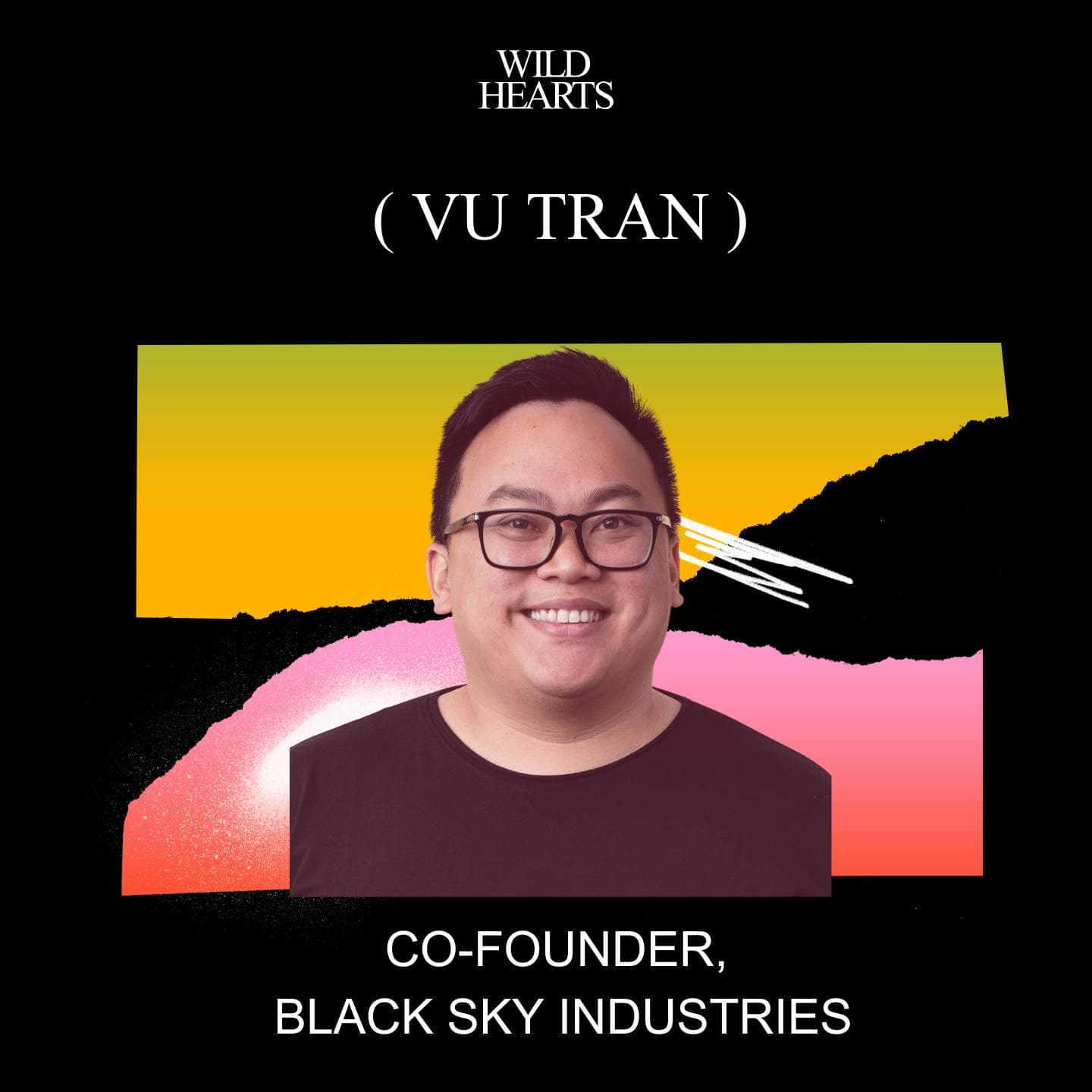
Episode Overview In this episode, host Mason Yates interviews Vu Tran, co-founder of Black Sky Industries and former co-founder of Go1, who transitioned from building a billion-dollar edtech company to manufacturing missiles. Vu discusses his motivations, the vulnerabilities in Australia’s defense sector, and the necessity for a startup mentality in defense technology.
---
Key Themes and Discussions
- Personal Motivations
- Vu’s shift to defense is deeply personal; he worries about the future his children may face.
- The emotional toll of working as a GP influences his worldview, tying personal responsibility to national security.
- Black Sky Industries
- Black Sky is Australia's first scalable missile and solid rocket motor manufacturer.
- The company aims to address the vulnerability of Australia's military reliance on foreign suppliers by producing its own defense technology.
- Defence Philosophy: The Echidna Approach
- Vu proposes that Australia should adopt a defense strategy akin to that of an echidna—small, underestimated, and defensive in nature.
- The emphasis is on self-reliance and deterrence rather than aggressive military posturing.
- Challenges in the Defense Sector
- There’s a prevalent reluctance to engage with “the pointy stuff” (weapons manufacturing).
- Australia traditionally relies on foreign defense suppliers, creating a vulnerability in national security.
- The current U.S. military industrial complex is seen as inefficient, with a need for faster and cheaper solutions.
- Market Opportunities
- Vu indicates that defense tech could be the next trillion-dollar market opportunity.
- The podcast discusses the importance of inviting more tech entrepreneurs to engage in the defense space.
---
Key Takeaways
- Emotional Engagement: Founders are often driven by personal motivations—Vu's shift to defense was influenced by his role as a father and his fears for his children's future.
- Vulnerability in Defense: Australia’s current defense strategy is overly reliant on foreign suppliers, necessitating an urgent call for self-sufficiency.
- Potential for Innovation: There’s an opportunity to innovate in defense tech, with a call to action for tech entrepreneurs to engage in this sector, shifting from conventional, slow-moving military contracting to agile startup models.
- Cultural Shift in Defense Perception: There appears to be a growing acceptance of defense industry roles among younger generations, demonstrated by political support across varying parties.
---
Insights from Vu Tran
On Transitioning from Tech to Defense
- Vu articulates the learning curve he has experienced moving from SaaS to defense, emphasizing the need for a different mindset—one that prioritizes scalability from the outset.
Building a Culture of Innovation
- The importance of not just building technology but fostering a culture that supports continuous learning and innovation within the defense sector.
Sales and Communication Skills
- Vu ties together the importance of narrative and trust in both medicine and sales, emphasizing that understanding and communicating needs is key in both sectors.
---
Conclusion This episode of Wild Hearts provides a compelling look at the intersection of personal responsibility, national security, and innovation in defense technology. Vu Tran’s journey illustrates the potential for tech founders to dramatically impact Australia’s defense capabilities, challenging the status quo and advocating for a more self-reliant and innovative future.
---
Note: For further insights and discussions, consider checking out the full episode and engaging with the topics presented.
Written by AI. May contain mistakes. Listen to the episode to check what was said.
Transcript
Automatic transcript. May contain errors.0:00There is a more than 0 % chance that there is a world where my kids will have to grow up in a time where they will become adults or fighting age they may have to pick up a gun not because they want to join the army. or serve the country, but because they have to. What are the lessons from Go1 have you taken and brought into Black Sky intentionally? I think I'm a pretty good leader, but I'm a terrible manager. And maybe I'm not a terrible manager. Megan said, I hate managing. It's probably a better way to put it. Usually that makes the best managers. Yeah, I hate managing. I just generally hate managing for a bunch of reasons.
0:30But one reason is just I hate being responsible. Wow. Now, we were talking to the UK Ministry of Defense when we said, oh, look, we operate the largest private launch range in the world. They said, 3 million acres. Is that right? That's about half the size of Wales. And we said, yep, that's about right. Wow. That is just mind-boggling scale. I could probably teach you in two weeks how to fully integrate our build from scratch with three Allen keys and screwdriver. Build one of our missiles in four hours. Wow. Welcome back to Wild Hearts. I'm your host, Mason Yates, from the investment team at Blackbird Ventures.
1:04Get this quote, I'm in defense not because I want to, but because I feel like I have to. Vu Tran still sees patients every week as a GP. He built Go One into a billion dollar business. Now he's building missiles. Let that sit. Because when Vu looks at the world his kids might grow up in, he sees a future that might ask them to pick up a gun. Not by choice, but by necessity. So he left SAS to build Black Sky Industries. Australia's first company making scalable, solid rocket motors and guided weapons Not to start wars, but to make Australia an echidna Small, underestimated and far too prickly to buy it This is just a taster for what's to come at Sunrise, Blackbird's love letter to founders An incredible festival with the best investors, operators and founders coming together To build a creative nation we want to live in If you don't have your tickets yet, head on over The link is in the description and let's dive right into this episode.
2:06Why are you juggling so many hats? I'll be honest, man. I really enjoy it. I love it. Like general practice is one of those things that you'll never see me give up. I really love it. I could not do it full-time. Full-time general practice is a nightmare because no one ever comes to a doctor and says life is great, right? They come in and they go, they've got a problem. I don't know if you remember, in the early 2000s, there was a show called Thank God You're here where there's like an sketch show and the community opens the door and they don't know what's what's coming through that door and that is generally what general practice is like except to the fact that it could be anything from someone needs a prescription to domestic violence and mental health issues right like it's a pretty damn big spectrum and cancer and a whole bunch of stuff in between so it's really tolling if you were to do general practice five days a week Like I take my hat off to anyone else who does it.
2:58But I really enjoy it because I've had these patients for almost 10 years. You know, it sounds a bit wanky, but it's incredibly grounding. Like despite all the shit that I get to do, you know, I get to sort of see my regular patients who I've known for 10 years. They don't know what I do. Where's your GP? I need to go. Yeah. So when I go and chat to them, you know, like I get to just remind myself that my life's pretty fucking great, right? Like I've had a pretty damn good life. Like, if you want to catch me at my absolute worst, when I think the world sucks, it's at like 9 o 'clock on a Thursday night.
3:30And then if you want to catch me at my absolute best, it's probably at 10 o 'clock on a Thursday night or on a Friday morning where I'm like, holy cows, I have so much perspective. Like, I think it was last Sunday. Yeah, it was last Sunday because I'd just come back from the Oz Fitness Expo down in Melbourne, which is a completely different school. Wow. And got back to Brisbane at like 10 o 'clock. Then I rolled out of bed at 7 o 'clock, and saw my patients and I just remember being wrecked and being like, and I had two patients, one who was like under the age of 40, but I had to tell him he had cancer.
4:02And I was like, you know, in the afternoon when I finished up, I was like, man, fuck life, life is shit. Like, why am I telling a young, like he was a dad like me, he's got young kids and you know, tell the guy he's got cancer, right? Like, man, life sucks. And then I kind of have to kind of slap myself in the face and be like, A, I'm not the one who's being told they have cancer, right? As that is. And B, like I'm going home to my kids and I've got to like, I get to do all this really cool shit. So from my perspective, it's just one of those sort of reality checks, which I have always found incredibly useful.
4:34Wow. That is a seriously interesting perspective, especially in the context of why you decided to start Black Sky. Like you have this like almost daily reminder of life and death. Well, but also just like a connection to, you know, when we live in tech, we live in a real fucking privileged bubble. That's why I'll say. Like I'm a general practitioner in a, where are you in Sydney or where are you based? Sydney. So I'm a general practitioner in Logan, which is the equivalent of the Western suburbs of Sydney, right? Very low socioeconomic, working class, very, very multicultural. And so for me, it's like, you know, it's where I grew up.
5:16It's the people that I know. But the other side that it comes back to is that, like, you're reminded of just what normal people have to experience outside of the white-collar tech sort of world. Like, people don't know what I do, but they have conversations with me and they go, man, this Trump stuff is going to be worrisome because, like, what happens if the U.S. doesn't come to our rescue? Now, this is what patients are saying to me, not knowing that I do black scarring. Wow. To their GP. Because GPs are trusted advisors. You know what I mean? Like you trust your healthcare, not just your healthcare, but the healthcare of your family members.
5:48So, you know, it's such an amazing insight that you get, right, which is super useful. But ultimately, like, I love it. I really, really do enjoy it. If I wasn't worried about all this, you know, I'll call it World War III occurring, if I wasn't worried about global conflict, I'd be doing health tech. You know, that's where I'd be spending all my time because I think that's the area that I can make the biggest impact at SCAM. You said you're in defense not because you want to, but because you feel like you have to. I feel like that's the perfect segue to ask you, when did this moment become a passing concern to a moral obligation?
6:26I'll zoom right out to the macro and bring it into the micro for you if that's okay. I'd love that. I'm the child of Vietnamese refugees, right? So my mum and dad flowed Vietnam, post-Vietnam War with their three kids, my three siblings. I'm the youngest in my family by 10, 12 and 14 years. So I've got an incredibly privileged life. I was born here in Australia. I grew up as a kid in the 90s, post-Berlin War, pre-September 11. It was the most awesome time in my eyes to grow up as a kid in Australia, right? So the opportunity to not worry about what the world was going to turn out like as a kid, You don't really think about it.
7:01And in fact, my parents didn't really think about it because everything was better than what they grew up in. So coming to Australia was a godsend for them. The challenge I think about is that six years ago, I had my first child. I have my daughter, my six-year-old daughter now. And then three years ago, I had my son. So I've got two kids, a six-year-old and a three-year-old now. And I mentioned to you before, I grew up in the 90s and the age gap between me and my daughter is 30 years. What 2025 is to her is what 1995 is to me. My biggest concern is what does that next 20 years look like for her?
7:33And, you know, do you have kids, mate? Do you have kids? No, no kids. One of six. Yeah. If and when, you know, you or anyone else decides to have kids, your whole perspective really does change because you think about what's the world they're going to grow up in. And I think that there is a more than 0 % chance that there is a world where my kids will have to grow up in a time where they will, as they become adults or fighting age, they may have to pick up a gun, not because they want to, not because they want to join the army or serve the country, but because they have to. You know, we're about to go down to Sunrise at the end of this month and, you know, attend this great conference and, you know, bring together all these amazing people and get to talk to them all.
8:09I can almost guarantee you that five years ago in Kiev and Ukraine, we had a very similar conference to Sunrise, bringing together founders and capital allocators and great thinkers. And today, those same people who attended that conference in Ukraine five years ago, they're either dead, holding a gun, or have had to flee their country. Now, I sound really, you know, extreme saying that, but if you think about all the events that have occurred over the last few years, that statement, unfortunately, has become sort of scarier and more real every single time. So don't get me wrong. I'm an optimist in that I don't think World War III will occur, but I'm also a realist in going there's a chance that it may occur, right?
8:49And the challenge I run into, when I built GoOne with my match from high school, so I got to build a great company and go one. We built it to that sort of multi-hundred million dollar revenue company from Logan, from here in Queensland, in the online learning space. Education is something we're incredibly passionate about as founders between the four of us. We've got to build something that makes a difference and really chose corporate learning as that area to focus on, the missing piece of the puzzle that no one focuses on when it comes to education. And Bill's a really great company. And for me, my role has always been on the customer side, on the growth side of the business.
9:23But there was a point there where I sat there and thought to myself, I'm truly worried about where the world's going. And if I look back and the world does go to shit, if I can say that, and I've just sat there optimizing an opt to win funnel in a SaaS business by an extra half or two or 3%, which potentially results in tens or hundreds of millions of dollars of revenue. I just wouldn't be happy with myself. So it was about trying to go, well, it's one thing to be worried about it. The question is, what are you going to do about it? And so for me, you know, you get all these signals that keep happening.
9:55So I'm just saying there's not just one thing. There's multiple different things. But these signals occur. And I still remember there was a dinner where I just sat down with my co-founders. And I just said to them, guys, like, I love this business. We've built it. You know, if you look at the newspapers, GoOne started in 2015 when we went through YCOM, Andrew. So this year marks 10 years since we went through YC. But Andrew and I started our first business together, what eventually became GoOne, when we were in grade 11. We're 16 years old, right? I'm 36 years old now, so I've been doing this for 20 years, right?
10:24So we've spent our entire adult lives building Go One. You know, there was a certain point there where I looked at it and I'd go, this is a business that will thrive and survive and do incredibly well with or without me. And the one thing I came to learn to myself from the Go One journey was that I freaking love the early stage. The flip side of it, the one thing I'm not made for is corporate. Right. And so for me, you know, as Go One became a bigger, badder, awesome company, I also realized that what I love is like being at the coalface. You know, to use a military term, I'm not used to being in general.
10:54Give me a gun and send me to the coalface, right? So I said to my co-founders, I said, look, there's a shot cloth on how long I'm in this business for. More importantly, you know, there's some stuff that I think that's really personally important to me that I didn't need to pursue. And that was in the defense space. And I've got a really good mate, Blake Nicolich, who started Black Sky Aerospace, who about three years ago was thinking about focusing more on defense. And I said to him, mate, if I leave Go One, let's double down and let's go for this. So he, his mate Carl and myself. So Blake's an ex-army pilot.
11:25He's worked with explosives for over 20 years. Carl's been in manufacturing for a long time based in Victoria and logistics. And he's an ex-tanky, so an ex-tanky artilleryman. And so me, I'm the only one not from defense. So, you know, three of us got together and sort of the rest is history. We decided, you know, we're really going to go from aerospace and building rockets. So really the area of defense, no one else wants to touch. which is the technical term they'll call it is lethality and explosive ordinance but really it's missiles right that's that's what it is so to go from rockets to aerospace to missiles with extreme lethality so you know i don't know if this is a compliment or not but i remember steve baxter saying that our company is the most lethal company in australia which i don't know necessarily think is a good or a bad thing but it's more so to point out you know my eyes i think it's a bad thing because it means that a company that's essentially three years old in its current form, you know, has no one else doing this in our space in our country, which if you think is a population of almost 30 million people and a defense budget of 60 billion plus dollars, we don't make anything that actually is pointy.
12:29You know, there's the euphemism I use for it. Hysterious help. So that's a very sort of high level answer as to sort of how I got into this position. But to be honest with you, it wasn't one thing. it was several things that kind of added up and added up. And I'm a firm believer, like, the world gives you a whole bunch of signals, and those signals just got stronger and stronger and stronger and stronger to the point where it's like, all right, either do it now or I don't. Yeah, I totally agree. This was just before the war in Ukraine. And then when the war happened in Ukraine, it was kind of like, holy shit, that's a really strong signal.
13:05You're like, okay, yeah, this is war, this is interesting. Like, I remember having a chat to my co-founders when Trump was in power the first time. And this is not whether or not you're pro-Trump or anti-Cump. This is just, you know, Trump's first term. When Trump had a trade war with China. Right. Do you remember who the collateral damage was when Trump had a trade war with China? Henfolds wine and WA rock lobsters. Yeah, that's right. Yeah, in 2020. 2017, 2018, whatever it was, 2020. like all i'm trying to come back to is that when two great powers go to war or face off against each other they're not necessarily taking pot shots at each other they're potentially trying to inflict damage on their allies trying to make an example of their allies and the asia pacific the biggest ally the u.s has is us is australia you know so in my eyes you know one of one of things that i always think about is just again what world are my kids going to grow up in and you know what am i going to do to do something about it you know get off my ass and do something that it's just sitting there optimizing a SaaS sales funnel.
14:04No offense to anyone who works in SaaS, but I think if you think you've got the ability to do it, then you should at least give it a go. One of the things I'm really passionate about is I want to bring great founders into defense tech. The reason why I'm keen to do this podcast with you and talk on stage and do all these different things with anyone who will give me an audience to do it with is trying to how do we bring more founders into defense tech? Because pretty much the table I want to give them is the water's wall, you know, come on in. That is such a beautiful summary. Oh my God, what a life you've lived.
14:38Hopefully there's a lot more to it. Yeah. Yeah. I mean, it's still early days. You're in the early innings. I was thinking what I'd like to do is basically thread some of what you've just said and frame it into sort of three parts around like, what do most people get wrong about defense. What is like, how did you arrive at missiles or lethality to use your word? And you mentioned go on and I'd love to spend a bit of time like learning about the principles that you've taken into Black Sky and what's been deleted. So starting from the top, one thing that stood out to me was like from A, the conversations that you're having as a GP to B, the like world news of trade wars in Ukraine and how that emotionally impacted you.
15:25At the same time, what is Australia's defense capability like? Obviously, it feels like we're right off the back of the US. And I guess I'm curious, what are we all getting wrong about it? Where do you want to start, man? What do you want to start with it? Let's start at the level of consciousness for Aussie citizens. So I think there's probably two or three things that I can kind of unpack for you, first of all. There's the perception and the reality, right? I think that perception has changed a lot over time when the way people view defense, the way people view defense companies. And the reason why I say that to you is I'll start off very simply.
16:07The first thing people think about when it comes to defense companies is they think of the defense military industrial complex, right? And I think people rightfully are suspicious of the defense military industrial conflict. Because when they think about those companies, they're not thinking about Australian companies. They're thinking about US companies. And the reason why I say that is let's break it back down for you first. Australia spends$55 billion a year on defense. It's going to go up to about$65 billion in the next year or two, right? So let's call it$60 billion. dollars. Now, that$60 billion is, if you stack up Australia globally, when it comes to global spend on defense, we are ranked about seventh or eighth in the world when it comes to our military spending, which is insane because our military has about 40 or 50 ,000 personnel.
16:59Now, we spend more money than most of the rest of the world on defense, bar half a dozen countries. Yet, We only have one company in the top 100 companies by revenue in the world when it comes to defense industry. Wow. So we have one company in the top 100. Think about every other industry we participate in and we spend money on as an economy. We have one company in the top 100 globally when it comes to revenue, yet we spend more money than most of the rest of the world. Now, what does that tell you? That tells me that we spend our money overseas. We spend our money buying from foreign primes.
17:35So the term that we use when we talk about large military companies, manufacturing and priming companies that get these big contracts, they're called primes. So Boeing, Lockheed Martin, Raytheon, Airbus, these companies are all large US primes. Well, Airbus is French, but these large US primes. So one of the things it comes back to is that during the 90s, what happened was you had a consolidation of defense companies post the fall of the Berlin War. So as a result of that, you have this massive proliferation of defense companies post-World War II start to consolidate as defense budgets got smaller.
18:14And that's what we call the peace dividend post-World War II and then post the fall of the USSR. So as a result of that, you have all these massive companies, all these small companies, sorry, all consolidate into this handful of really big companies. And I'll send you this really great diagram from a company called Andrel where they show that consolidation. Nice. Now, the problem with that consolidation is you end up with, I wouldn't say a monopoly, but you end up with less competition. Now, governments will continue to spend money on defense, yet less competition. And most of the contracts will run off what's called a cost plus model.
18:47Now, I come from a SaaS world, right, where we build a great product. They're rated on their merits and the customer will buy them according to how they need to use them. And we pay for the R &D. The VCs, the companies themselves pay for the R &D. We bring the product to the customer and the customer chooses what they want to buy. On a cost plus model, what happens is they get awarded these multi-hundred million dollar or billion dollar contracts. And on a cost plus model, it's just the markup, which means whatever it costs to build the thing, plus our 10 or 15 percent or whatever the number is.
19:14Now, the challenge you run into with that model is that what's the incentive to do it cheaper? What's the incentive to do it faster? What's the incentive to innovate when it comes to doing it? And the reason why these guys love selling half-billion-dollar airplanes is because I can mark up everything from the nuts and bolts to the glass that we use on the airplane. Now, the challenge that it comes back to is that the value to the taxpayer is incredibly, terribly low. So that's the first step there. That's the challenge. I like to describe the military-industrial complex as it was or as it is, is really good at making money during peacetime.
19:50But during times of escalating risk of conflict, like we've had in the last few years and that you're going to have over the next few years, what we need is cheaper, faster, and more stuff, right? Now, the one bit of technology that has evolved significantly in the last five years when it comes to war, especially in Ukraine, but in other regions as well, is drones. So you have a whole bunch of these large, slow-moving companies that are used to selling half-billion-dollar pieces of equipment to now a world of drone warfare, where there might only be a few grand per piece of equipment. so if you had a company that's used to selling something for 500 million dollars with a 10 % profit per item to suddenly having to make money from thousand dollar items with a 50 % profit they're just not geared up for that world so part of it is that there is an opportunity here where there's almost this sort of you know they use this term a lot when they talk about ai there is this phase shift in technology which the large incumbent primes are having their large incumbent sort of military industrial complex, they're having their Kodak moment where the smaller companies like us and a whole bunch of other companies have the opportunity to punch through and make a difference and be able to do something.
20:55But the second part of it is that you have more of these founders who are coming through, who are coming from the tech scene. So Parmalahi, who's the founder of Andrel, was also the founder of Oculus. He's the modern-day Tony Stark for Iron Man. Think of what you will of his politics, but at the end of the day, The guy founded Oculus when he was 19, sold it for a few billion bucks to Facebook, and then founded Andruil, which I think is about to raise a few billion dollars at a$24 billion valuation after getting a$14 billion valuation this time last year. So what Andruil is to defense tech is what I think Salesforce was to SaaS.
21:35right? Salesforce managed to convince enterprise customers to buy from startups and cloud-based technology providers, right? Rather than buying from IBM and Oracle. What I think Andrew will do is start to convince governments to start buying from startups and small defense tech companies, because we can move faster. We can operate in a field of emerging technology. Now, your question is, what is the average punter's view on the street of defense, right? Or defense industry, defense tech, I think it's shifted. So I think, you know, when I graduated high school, everyone wanted to be an engineer.
22:10Everyone was in Queensland, want to go work in the mining industry or work for a defense company. And then it became really uncool to work in the mining industry or for a defense company. And I think it's become more acceptable to work in defense now as the world has changed and as the risk of conflict has increased, right? So what do I mean by that? Well, both sides of politics have in Australia, when we're about to head to an election, have policies and views that are very much supportive of defense industry in Australia and us building more stuff here. But more importantly, the Greens have just released the policy around the fact that they want to see more weapons and more defense products being built in Australia as well.
22:50So regardless of what your politics is, whether you vote red, blue or green or anywhere in between, there is a consensus across politics. And I view politics as just a reflection of what the community are thinking most of the time, that defense is an incredibly important focus for us as a country, and that making things on shore when it comes to defending the country is incredibly important. And that policy was released by the Greens, I think, going about two weeks ago. And I bring that up because I'm just trying to point out that regardless of what your flavor of politics is, every single side is doing this as something incredibly important.
23:24And when push comes to shove, no matter where you stand, I think everyone will sit there and go, we value the way of life that we have today. Yeah, we've got a whole bunch of problems that we need to fix, but push comes to shove. The way of life we have right now and the quality of life we have is much better than where you would get it in most other places. So I think the view on the street is actually reflected by the policy you're seeing put forward by all the major parties, especially coming into an election. They wouldn't be putting it forward unless they thought it's popular. And then the second part that I would come back to is I think about my interactions with my patients in general practice.
24:00My patients do not know what I do, right? Very few, if any, of them know what I do. And the one thing about being a general practitioner is you get to be a trusted advisor. You get to hear firsthand what people are talking about. You get to do the first two minutes of small talk before you get into what their problem is and what you're seeing before today. It's, Kev, how are you doing today, buddy? What's been happening? Oh, man, you see what was in the news yesterday. Do you see what's going on here? We need this sorted out, yada, yada, yada. So that is my first two minutes of banter. Not me initiating it, but my patients initiate it for me because some of these patients I've had for over 10 years, almost 10 years, sorry.
24:34So one of the things it comes back to for me is I hear firsthand from my patients. Then volunteering, the things they're worried about is, you know, if you eat more recently, you know, Trump becoming more nationalistic when it comes to the US, which they're entitled to do, has had repercussions where I've got patients down in Logan saying, what does that mean for us when it comes to the US coming to our defense? if the proverbial hits the fans you know what are they going to do and that's that's literally a question i've had patients raise with me where again they don't know what i'm involved in defense but they genuinely are you know the average puncher on the street i guarantee you is thinking more about sovereignty for australia than you probably think they are what you've shared there is kind of like the collision of or dovetailing of i guess the impetus to buy and having a stronger a reason to sell.
25:22What's the aim of this to buy? All of the upstream top-down multi-variable factors, and then the opportunity at hand that Black Sky has. Are you going to say something? Can I put it to you this way? The debate that is often had right now across countries all across the world is what percentage of GDP should we spend on defense? Is it 2%, 4%, is it 6 %? I want to call bullshit on that question and say, as Australia it's the wrong question to ask. the question we should be asking is what percentage of GDP should defense industry be contributed right we should look at it of going we have so many allies that would benefit from us creating an industry where we could provide these goods to and I'm not just talking about weapons I'm talking about all the different things defense material needed right and we should be thinking not should we spend two or three percent of GDP on defense it should be going how do we make sure defense industry actually forms two to three percent of our GDP.
Read the full transcript
26:20Think about the job creation, the technology creation, the industry creation, the benefit that is created for us in doing so. But the other great thing is if we create an awesome defense industry in Australia, it makes us incredibly spiky or prickly when it comes to anyone who wants to attack us, right? In fact, the way that we describe that strategy is what's called the echidna or the porcupine strategy, right? People call it Occupy Mind Strategy. We'll adapt it for Australia. We'll call it the Echidna Strategy. If you think about the Echidna and you think about what it looks like and it's covered in all those spines, it doesn't have all those spines to go out there and kill something, right?
26:56I've never heard these. This is sick, yeah. Those spines aren't there to go out and kill something, right? Yeah. Those spines are there to make sure that when something looks at it and says, I wonder if I want to have a bite out of that animal, it says, fuck no, I don't want to touch that thing. Look at all those spines, right? But the challenge we have, for lack of a term, we're pretty spineless right now. We're actually reliant on our allies to protect us and primarily the US, right? So think we're in a world where the geopolitics is changing, where the US is becoming much more nationalistic and they're saying, we've got to look after ourselves and we can't necessarily be the police force of the world.
27:32That's one thing. On the other side of it, we're sitting here going, well, we're reliant on the US for everything, not just to defend us, but all the stuff that we need, we buy from the US as well, right? So if COVID taught us nothing, we need to be more self-reliant on a whole bunch of fronts. As a GP, I didn't have enough bloody rubber gloves and masks during COVID. You know how scary that was? I still remember back to 2020. It was March 2020. I'm watching the news. Doctors are dying in Italy. Doctors are dying in New York City. I don't know if you remember, they were like cold room vans with people's bodies.
28:07Doctors were dying in hospital. And I stepped back from Go1 and I was in general practice all my time during that time because I needed just all the doctors out there. And I remember going, fuck, we don't even have enough masks, right? And that's crazy. Like, that's a pandemic. What happens when there's someone who wants to blockade us, right, and wants to stop us from receiving goods? And I sound very paranoid in doing so, but it's just how do we make sure we're prepared? But the other thing I'd kind of just wind it all back for you is we're talking about the porcupine or the echidna and having all those spikes, right?
28:39And how those spikes are for defense, not offense. They call our defense department the defense department for a reason. One of the really important things it comes back to is, this is just to illustrate it to you. About four weeks ago, five weeks ago, I like to describe it as we had some foreign ships go missing and decide to do a full circle of the country, right? a Chinese missile cruiser and a few other boats and probably some submarines underneath it that we're not publicly aware about decided to do a lap of Australia go down the east coast I think 150 nautical miles of Sydney so they're closer to you than I am to you right now they were doing live fire exercises off our east coast which is well within their light legal to do so and they decided to do a lap of the country go down past Tassie past South Australia and past our naval submarine yards in WA and head back north home, right?
29:29Now, that lap, they might have just been doing that for a bit of sightseeing or whale watching. If you want to read it the other way around, it was also sent a very strong signal that we can reach you anywhere. And we can also, if that's what we can do with two or three ships, what can we do with the whole fleet to actually blockade anything coming into Sydney, Melbourne, Brisbane, any of our ports, Newcastle, whatever it might be. That's the very hawkish way to view it. The other way to view it, and this is a cold hard fact, is that one missile cruiser, that one missile cruiser, right? Sorry, am I getting you paranoid?
30:00Am I getting you paranoid? So I'll share this with you, which they didn't talk about on the news. And I know this because it was just out of defense problems. That one missile cruiser. So on board a ship, you have what's called a cell, which fires a missile out of it. I think a bit like a pod that shoots a missile. That missile cruiser, I think, I'm going to use round numbers here, had about 120 missile cells on it, right? Now, imagine this. take every single boat in the Australian Navy, add up every single missile cell of every single boat combined. And I think we might have maybe a dozen more missile cells than that one Chinese boat.
30:36Wow. If you take out the boats that are currently in dry dock, I believe the number is that that one Chinese ship had more missile cells than every single active Australian Navy ship combined. Wow. That is just mind boggling scale. So your question around why missiles? Yes. Well, that was going to be my segue in like all of this context. Tell me more about the wedge unique. First of all, think about going, okay, well, okay. Defense is a problem. What is the biggest, baddest problem? What is the problem that twofold? One is such a massive vulnerability for us as a country, but two, no one wants to touch.
31:16And the answer is lethality. You can't have a defense force without weapons yet the irony of it is no one wants to touch it right and i have this debate all the time i'll talk to some vc funds who invest in defense and as far as i'm aware steve baxter who's got beaten zone is the only vc fund that will actually invest in lethality there's a lot of funds who will invest in defense tech but he's the only fund to invest in lethality and full disclosure i'm steve is not an investor in black sky but i'm an lp in in in beaten zone because I believe in what he's doing. So just kind of want to put it out there just in case anyone pulls that up.
31:54But the answer is because no one's investing in this space, right? No one's investing their time, energy, or effort or money into lethality. Now, it is one of the most important things when it comes to a defense force and no one's investing in it. So I'm going to break this down to a few things. So one, why is no one investing in it? Because they don't want to touch the pointy stuff. It's scary. So for me, every single hour I have that I'm not spending with my family is an opportunity cost of spending time with them, right? So if I'm going to pursue something, you know, personally, the way that I view it, especially post my life and go on, which I'm happy to talk about in the tick, but it's got to be worth it.
32:30Like it's got to be something that moves the needle, right? It can't just be cute or cool. It's got to be something that I genuinely feel will make a difference. You know, so let's go chase the hardest problem, the problem no one else wants to touch, which is lethality, which is building weapons. And why missiles? Well, Blake has been building rockets for a very long time. And those rockets are used for aerospace to put things up into, not orbit, but what we call suborbital launch, up to 100Ks up in the air. Mate, the difference between a rocket and a missile is we aim that rocket at something, put a warhead in it, and suddenly it becomes a missile.
33:07Right? So the thing for us is there is a very fine line between rocketry and missiles. That's the first thing I'll say. So the most important thing we focus on in Black Sky is, yes, we can build the full kit and caboodle, the full missile, but the area that is our secret source and thing that is most important that we do is something called solid rocket motors, okay? Now, I'm just going to give you a 101 on solid rocket motors because I'm not a rocket scientist, but I'll give you the sort of background on it. A solid rocket motor is the oldest type of rocket motor that exists. So when you see rockets that were launched in around early World War, late World War II and pretty much almost any missile and rocket that was launched in the last sort of 70 years bar the last say 20.
33:49Most of them use what's called solid rocket propellant. So the old shuttles that would go up into space use solid rocket propellant. The missiles that you see being used across the world mostly a solid rocket propellant. Only in the last few decades have people started using liquid propellants. So that's what SpaceX will use. That's what Rocket Lab will use. Gilmore's, who's a Blackbird company up here in Queensland, they'll use what's called a hybrid rocket motor, but they'll use liquids as well. So liquids are awesome for things like reusables, when you want to be able to throw them, all those sorts of things.
34:20But they're terrible for storage, right? So, you know, and they're highly volatile. So the great thing about solid rocket motors and why they've used them in defense for a very long time is because they're highly stable once you cure them and mate them, and you can transport them super easily, right? So that's the reason why defense will always use most of the time. solid rocket motors with the exception of what we call cruise missiles or certain types of cruise missiles. So that's the sort of the role of solid rocket motors. But I'll say to you, remember I spoke to you before about the consolidation of defense industry?
34:54In the US and across the allied world, there are literally two major players of solid rocket motors, Aerojet Rocketdyne and Norfolk Grone. And both of them have a backlog of solid rocket motors in the tens of billions of dollars. Wow. Not hundreds of millions, not billions, tens of billions of dollars. And they are years away from being unclear. The second part of it is they're both American and it's virtual duopoly, right? So the ability to come into that space is incredibly important. The second thing I'd say to you is that to illustrate the importance of solid rocket motors, and again, interpret this however you wish, they actually had to stop the war in Ukraine and Russia in early 2023 because they ran out of rocket motors.
35:36That's not a good thing. I'm not talking about enabling war, but I'm just talking about how critical rocket motors are to the supply chain. And so for us, this is an expertise that Blake has spent over a decade building up. And unfortunately, and as much as I came in with my hat from tech going, sure, man, surely anyone would just get together and mix this stuff. But there are Venn diagrams of just circles on circles on circles on circles, which really helped me understand the fact that you've got to really thread the needle to know how to make these things. You've got to have the infrastructure to be able to do it, the experience to be able to do it, and probably at least four to five different levels of expertise to be able to thread them in your own, make these things.
36:11And the thing is, we're really fortunate in that not only did we figure out how to do it, and we'd be doing it for a long time in the civilian aerospace world, we figured out how to do it at scale. And that's super important as well. So you've got people who dabble with it, but being able to transition from being able to do it at a hobby sort of level, doing it at scale, is very, very different. and sort of the thing that I love coming from the SaaS space is I get to ask all the stupid questions. But the one thing that we know from dealing in SaaS is that unless your product can scale, it's a shitty services company.
36:43And so ultimately, you know, my job in Black Sky is to ask the question, how do we make 10, 20, 30, 50 ,000, 100 ,000 of these? And how do we scale it? And if it can't scale it, let's kill it. And so, you know, this is kind of where the, you know, traditional tech startup, SaaS startup sort of mindset is super useful in this space, which is why I mentioned at the start of our conversation, I'm super keen to see founders come into this space, but in particular, second and third time founders, because there's a whole mentality we can bring to this space that I think can be quite transformative. I don't think we need the change, but I really do think that we can be catalytic when it comes to bringing it about.
37:23The product is super clear. You said that you've proven that you can scale it. Now, my brain goes back to start small, show that you can build a prototype and progressively build up. What did you learn? How have you been able to prove that? I'd love for you to unpack that statement. We have proven scale. So let's go back to looking at the constraints first, right? So if I look at this typically, how about this? What if I said to you that there was a TAM that is growing by a trillion dollars every five years? It's going to grow by another trillion dollars. There's super low competition and the cost of capital is incredibly high because no one will lend them to the space.
38:02You'd sit there and go, fuck yeah, what a great market to go and chase. Right? Like, what do I mean by the cost of capital is high? Well, if you literally Google the words Bank Australia and missiles, put that into Bank Australia missiles into Google right now, open up the first link that opens up, and you'll see a term that says something along the lines of, at Bank Australia, we have never and will never lend to companies that create bombs, boards, and missiles, and so they're like 82 % of that customs. Yeah, I'm reading it now. And that sort of statement actually exists with almost every bank in Australia.
38:37Why us? That is so interesting to then have that at the top. Yeah. So the thing that you've got to think about is that for a traditional small business to go and get access to capital and growth capital, borrowing money is not an option. The banks won't give you a credit card, let alone give you a loan to build your business, even if you've got great unit economics. That's the first part. So the opportunities for private capital would come into this space and buy low, right, on low multiples, on really good businesses, in a growing TAM that's going to add a trillion dollars of TAM over the next few years is huge.
39:10That's just the pure capitalistic side of it, right? But I guess what I'm trying to say is, let's start at the top and work our way down. The market is there and it is growing. And you don't even need to have alpha. You just need to ride the beta. You just need to ride the wave and build a good enough product to get into defense and get some traction. So that's the first part. The second part that it comes back to is going, well, we'll put aside the scale and let's talk about getting the MVP and getting your product and getting it tested and proven. I think what a lot of companies don't think about is they think so much about the technology.
39:43They don't think about everything that goes around the technology. How do you prove it? How do you iterate on it? How do you actually keep improving the product and get to a point where you can show the customer it working? That it's not theoretical, that it's actually practical, right? That for me is where Black Sky has been very fortunate. We operate three test ranges at the moment, probably put a fourth online very soon. Where our guys are out there testing rocket motors on a weekly basis. Because of Blake's experience in rocketry and what Black Sky Aerospace was before we became Black Sky Industries, we actually operate our own launch ranges, our own test ranges, and we have, on one of our ranges, we have the ability to fly, sunrise to sunset, seven days a week.
40:25Out at Fagaminda, which is a little bit wet right now because they're getting a bit of flooding, we have a launch range that is 3 million acres. Wow. Now, we were talking to the UK Ministry of Defence when we said, oh, look, we operate the largest private launch range in the world. They said, 3 million acres, is that right? That's about half the size of Wales. We said, yep, that's about right. And so UK Ministry of Defense, they were saying, well, we said to them, how many people do you have in Wales? And I said, oh, they said about two and a half million people in Wales. I said, cool. They said, how many do you have in Thagaminda?
40:54We said, five. I said, wait, you've got five million people in Thagaminda? I said, no, no, no, five people. Right. And that blew their minds because they don't have that scale of land to test things on. Right. So again, if I talk about Australia's unique positioning to do a lot of this stuff, our ability to test some of this stuff, the space we have, to be able to play around with these things is huge. And it's a natural advantage we have that others don't have. And at Black Sky, when you talk about sort of scaling proof of concept, MVP, minimum viable product, and then moving to what we call low rate initial production or LRIP is the term they use in defense, low rate initial production.
41:34we were able to have the infrastructure to be able to do that without waiting on someone else to be able to help us test it so the waiting time right now for warmora which is the defense range down in south australia i believe is around about two years man your startup's going to die if you have to wait two years to test your product 100 now i need to be very very clear with anyone who's listening to this who does have a product that needs to be tested on a range because we get asked all the time because of the nature of what we do it's really difficult for us to allow third parties to use our ranges because I get asked about this every single week, which is why one of the things I'm encouraging the Queensland government to do is to build Queensland ranges that the government helps operate or gets a contract to operate that allows defense startups to be able to use, right?
42:18But just sort of fast forward to the point I'm trying to make is that the step to get to scale is first of all being to approve your product and not enough defense companies think about how they're going to approve their product. That's the first one. The second step is actually to find a customer as you would in any sort of circumstance with a startup, who is actually willing to tell you what they need and to be able to be that first customer for you, right? And the thing we're lobbying with defense every single time I'm talking to them is to say, we don't want you to be our biggest customer.
42:46You should be our biggest customer. What we need to do is be our best customer, right? Because the first question that when you go to an allied nation, you say, we want to sell you our sludge, which is what our solar rocket propellant initially is. And they turn around and go, who else is using you? You need to be able to say your home country is using you, right? It's a really important thing. So from my perspective, it is that ability, first of all, to be able to show you can test and prove your product beyond the theoretical. It's about to show it working in real time. Then it's to be able to find, as you would in any other business, an initial customer who wants your product and you find that useful.
43:23And the third step is every step along the way in what you're doing. Scale is not step three. Scale exists from step zero. So one, I think of scale as a platform. I don't think of it as a step. That's probably a better way to look at it, right? It's the foundation in which you execute everything. So when you're initially choosing what TAM to pursue, you're looking at the size of the market and going, is there a big enough TAM there to scale into a market? Right. Master TAM, sweet. Then as you're building out the product and choosing what product to sell into that market, you need to make sure that it's the product that can scale, right?
43:59If you're making custom-made Bentleys, where the world wants a whole bunch of Toyota Corollas, Like, man, you shouldn't be doing that. You should be thinking going, you don't want to be going after a custom-made Bentley where the world's saying, I want Corollas. You got to figure out from the start, you're making a Toyota Corolla. So therefore, every single decision you make in terms of the investment of time, in terms of your design process, in terms of the materials you use, in terms of the application it has, is based on how do I get a thousand, 10 ,000, 100 ,000, a million of these into service.
44:30And so I think scale is a mindset. It's not a step. I don't think it's build the MVP, then get it in service and then scale it. I think you've got to have scale in mind right from the start, from determining the business case as to whether the TAM is big enough, through to how you design and build things, through the materials you decide to use, right? Right. The example I would give you is that, and I don't think I'm breaching any confidentiality by saying this, but the way we've designed some of our systems is that I could probably teach you in two weeks how to fully integrate our build from scratch with three Allen keys and screwdriver, build one of our missiles in four hours.
45:09Wow. Now, what does that mean? Well, I'll tell you what that means. It means that we've designed it in a way that you don't need to be an aerospace engineer to be able to assemble this. That's step one. because if shit hits the fan, it's not about aerospace engineers building these. It's about how mom and dad's coming to the factory and helping us build these. That's the first. Number two is we've chosen materials that we can source from here in Australia because again, if shit hits the fan and we need to build 50 ,000 of these, we need to make sure that we have chosen materials that allow us to scale.
45:40And number three is that we need to make sure that the application and the usage of these is that we're not building something I mean, we've got five or 10 of them in the storage shed. We got 50 to 100 ,000 of them in a storage shed if we need to, right? Which means that not only should we be able to source those materials in Australia, but they need to be in sufficient volume that we could actually, you know, the Prime Minister comes to us tomorrow and says, Vu, Blake, Carl, here's the keys to the country. And we have a pathway to be able to make a shitload of stuff very, very quickly. Now, that is not a mindset that your typical defense technology founder in a startup will think about, right?
46:21But I guarantee you, if you've come from the SaaS world, that's what you think about, right? You're not building this product. If you realize that you're building a SaaS product and that the team is only going to be 15 people, right? And those people are going to pay$200 a month. So really, your team is going to be 15 times$2 ,500 a year. That's not much of a business to go and pursue. you could be really surprised how many defense founders build some amazing cute awesome pretty tech but it isn't applicable to the real world again it's a custom made handmade bentley it's the swiss watch right where what people are wanting a toyota corollas and casios right and that that is the thing for me is that and and to go back to that discussion i had with you before about major primes or the US military industrial complex.
47:11They are so good at building Swiss watches. But when the whole world needs a whole bunch of Casios, that's just not what they're geared up for. They're not geared up to produce them. They're not geared up to sell them. They're not geared up to market them and that sort of thing. And so that's why I'm trying to say, and I'm a broken record on it, but I really want to find great founders who have built businesses and understand scale in different industries. I say, come find a problem in defense and help us fix that, help us solve that. And at the same time, build an awesome industry, build an awesome business, build your next exit.
47:42But also at the same time, again, like me, make sure your kids aren't in a situation where they're having to defend their country. What are the lessons from Go One have you taken and brought into Black Sky intentionally? So to any founder who has, and if I think about my sort of journey in Go One, and I said to you, I spent my entire adult life up until that stage, you know, first 15, 20 years of my life building Go One, like adult life building Go One. with my mates. There's so much stuff you learn. The most important stuff you learn is what not to do. But I want to think about some of the things that I think about.
48:15I'll break it into two areas, the learnings, but also some of the mindset that I've learned, right? I urge anyone who has stepped down from business, sold their business, exit a day business, to restart a business as soon as you can, because you will find it so invigorating, at least most of the time, because there are a whole bunch of things that you'll be able to not realize you've learned that you'll actually be able to look like. So the first thing I'll share with you from a mindset point of view is that, man, how much you don't sweat the small stuff, right? So there's so many things that, you know, your fellow co-founders in a new business will freak out about if they haven't found a business before.
48:50And you kind of sit there and go, yeah, it's a problem, but it's not a big deal. You know, we've been through a lot worse and go on, right? So from a mindset point of view, I think you really learn not to sweat the small stuff. I think very much intertwined with that is you learn to value your time a lot more. So as a result of not sweating the small stuff, you also value your time and you go, this is a good use of my time, this is a bad use of my time. You also learn what you're good at and what you're bad at. And for me, early on as a founder, I used to think, man, there's so much stuff I'm bad at and I need to work on it, right?
49:21Like I think I'm a pretty good leader, but I'm a terrible manager. And Megan, I'm not a terrible manager. Megan said, I hate managing. It's probably a better way to put it, right? Usually that makes the best managers. Yeah. I hate managing. I just generally hate managing for a bunch of reasons. But one reason is just I hate being responsible for other people's outcomes. I like helping people achieve outcomes, but I hate being responsible for it. So perhaps that's just my maturity and not yet being more mature managing it. And I fully acknowledge it. But I used to think to myself, I've got all these weaknesses and I need to spend so much time working on them and trying to get better at all these weaknesses.
49:55And what I've come to realize is, fuck it. Like, I should be doubling down on my strengths. not trying to patch up my weaknesses, right? I should be taking the things that I think I'm really good at. So it might be things like communicating, motivating a team, communicating with customers, thinking strategically, looking at scale, thinking about how we break down processes into actually achievable outcomes. There's a whole bunch of things that I think I'm uniquely good at that I bring to the table. And instead of just focusing on all the stuff I'm shit at and trying to get better at that, I've realized, like, actually, this is what I bring to the table in Black Sky.
50:28I need to then surround myself with a team who's good at all the other shit. And so what Black Sky gets out of me is what I'm good at, not necessarily what I'm mediocre at, if that makes sense. And so that's a really big mindset learning that I wish I knew early on in my journey in Go One. That's the first part. In terms of practical things that I bring out, you know, I mentioned all those things just then, but I'll give you one really good example. In Go One, we sold to HR. So I dealt a lot with HR. and I think anyone who's scaling a business knows particularly if you're on a leadership level particularly for founder is there is a certain point in your business where you go from being a CEO an executive a founder what it is to an HR manager that's it every single founder who may be listening or who talks to you will know that most of their time at some stage in growth is chewed up by Hedger right and one of the concepts I always wanted to do and Blake what Blake was very much sort of helping pioneer this in my thinking as well, was I always wanted to divorce HR from people.
51:26I know that sounds crazy, but just let me run with this for a tick. Isn't it crazy that the same people, the same area that's responsible for your onboarding, compliance training, payroll, and disciplinary actions is also responsible for your personal growth, personal development, mental health, and your development as a human. Like judge, jury, and executioner and everything in between, right? So what we did in Vice Guy was we've got an amazing ex-Navy captain. He's worked across three militaries, including the Australian Navy. He's one of the best personal people that you'll meet. He headed up innovation for Navy in Australia.
52:03He's retired. And we said we put him in the role of what we call the MIG. So internally, we call him the MIG. And MIG stands for mentor in chief, right? That's what his role is. Now, his role in the MIG is to help you develop as a person, not as an engineer, because he can't help you become a better mechanical engineer. But his job is to be able to help you become a better human, to be able to progress through the stages and mature as a human through life, because a lot of our team is incredibly young. But he has nothing to do with improving your performance directly as an engineer, right? He's got nothing to do with your performance reviews in terms of as an engineer.
52:44He's got nothing to do with trying to help you upskill in dealing with certain new techniques or understanding new areas of engineering. His pure thing is to be able to help you develop as a person and as a professional, right? And by having you fully divorced from HR, HR we have completely, and again, our team's only made up with 30 people. So why don't I say HR is one person, right? But those roles are fully divorced. And in fact, the MIC answers directly into the CEO. And what that allows us to be able to do is to be able to very strongly, not just improve culture, but ensure that culture is something that is actually focused on throughout the organization without it just being another burden on HR.
53:21And the second part of it that it comes back to is it allows us to be able to get feedback directly to Blake as the CEO from the coalface without going through a HR filter. Now, the complexities that that brings in, a lot of people who may be listening, who have experienced it, will know that actually having that barrier between the coalface and CEO and having HR in between, no matter how well-meaning or however they are, can be a real challenge. And so that restructuring has been really important for us. What are the results that we see from that over the last 12 months? Well, one is that we've found people, or we call self-select to leave Black Sky.
53:56So instead of me saying to you, you're underperforming, you need to leave. Part of Steve's role as our Mick is Steve helps people understand whether or not they're the right fit for Black Sky. well before their performance wanes, well before they get to the point where, you know, that we're having to tell them to leave or they're, you know, or they're leaving in the half. So one example, it's that ability to help people understand on a regular basis and to reassess, am I doing the right job? Am I working in the right industry? Am I working for the right company? Am I working in the right role?
54:30Right. And helping them understand that on a regular basis and having a role that's focused on helping them do that. Also means that there's a bit of a safety net to catch them if they're falling and gives them opportunity to work out whether we're at the right business for them. The important company teams and whatever you want to call it. That for me is transformation. That's really something that I wish that I could have done back in the day at Go One, but it's something we're doing by exploring, something that I see as truly beneficial and I'm not even the CEO. So that's one example. That's a beautiful example.
55:00And I have to ask this question. I'm not sure if you have the time, but you were responsible for customers at GoOne as one part. And with defense, you sort of outlined like the antithesis of a good customer. Like what is a good customer? Someone who is easy to reach, immediately sees the magic, like quickly signs up and says thank you over and over again. And I'm curious, what have you learned from GoOne to accelerate the transition from being a bad customer to a good customer. I'll break it down for you. I love sales. Yeah. I don't mean sales in the form of just getting a deal done, right? One thing you'll learn from me is I'm going to go off in tangents, but I'll hopefully bring it back for you, right?
55:44The best doctors know how to sell. Now, sales has a really bad connotation with it, but if you kind of hear me out in the definition of what selling is, selling is communication and being able to tell a story and be able to engage with someone as you do on the podcast here. So good doctors sell. And what do I mean by that? One of the best sales I can make in the next few months is in general practice when I have a patient come in and see me and they're sick. They're sick as a dog. Runny nose, cough, sore throat, and they're terrible. What they're likely experiencing is a viral infection where antibiotics, no matter how much I give it to them, they're going to not do anything.
56:19They'll probably give them the trots or may even build antibiotic resistance over time. The patient just wants frigging antibiotics so they can get better because that's what's in their mindset, right? As an author, I've got a choice of either giving it to them, giving it to them and just being like, here you go, bugger off. Two, not giving it to them and making them feel crap about it. Or three, taking the time to explain to them, giving them an understanding of what's happening, what they actually need to do to get better, which is rest, take their foot off the gas and give their body a chance to recover.
56:48And have them walk out of that room after five to 10 minutes. Again, it's a short consultation. After five to 10 minutes and understand that they'll be perfectly capable of getting better than themselves, feel happy with the service I've given them, and not need a single medication outside of some Pamela or Neurofen to make them feel better. That, for me, is a say-it, right? I'm walking out, understanding where I'm coming from, and buying in to my professional opinion as to why I think they're me, right? We've all met good doctors and bad doctors, but I can guarantee your perception of a bad doctor isn't based on their medical knowledge or their skill, but it was actually based on how they communicated to you as a person.
57:27So true. How they make you feel and the trust they earn from you. That same skill set I think is highly applicable to selling, whether that be to selling a piece of software in learning management or through to selling yourself, right? And why do I say that? Narrative is incredibly important. Understanding the customer is incredibly important. Understanding your product and service and what you're selling is incredibly important. knowing how to sell is actually not that important in comparison. You know, the analogy that I would give you is if you wouldn't, if I want to go out and buy a car right now, right?
58:01What's more important to me? A slick salesperson who knows how to communicate and earn my trust or someone who understands my needs and understands the product they're selling incredibly well. And I'll say to you as the buyer, I want the latter. I want someone who understands me and understands the product they're selling really well, no matter how good a slick salesperson and they understand all the tools and tactics, right? So ultimately, for me, what it comes back to is that whether you're selling into defense, you're selling to SaaS and the enterprise, the SMB world, or the mid-market world, your ability to tell a story, understand the customer, and understand the product you're selling are two of the, or three of the most important things there.
58:40Tell a story, understand the customer, understand yourself, what you're selling. Those tools are applicable whether or not I'm trying to get someone to convince someone they don't need antibiotics, convince someone to buy software, or convince someone to buy a guided weapon, right? They just have different sales cycles, is the way I describe it to people, and a higher touch. But the parallels between doing an enterprise sale and trying to do a tender or trying to sell a guided weapon, they just have different restrictions, right? That's really good, right? But ultimately, the way to engage and tell a story is the same.
59:11It also means that trying to sell something to someone that they don't need, something that they don't need to someone, is also true. If you're trying to sell something to a patient that they don't need or they don't think they need, then you're going to fail. If you're trying to sell something to an SMB, to a mid-market customer, an enterprise customer in SaaS that they don't need, you're going to fail. And if you're going to sell something to defense that they don't think they need, you're going to fail. So the rules are pretty simple. It just comes down to communication, understanding yourself and understanding the customer that you're selling to.
59:42And I think it's very, very basic. Everything else just comes down to technicalities. and what are the rules around contracting and all that sort of crap, which again, they're logistics, right? They're logistics. They're not a skill set. They're logistics. It's like, okay, cool. You and I want a date. Now, what are the logistics of figuring that out? You want to buy a hard product? What are the logistics of figuring that out? But those logistics don't come into play until I've won my heart and mind as to I'm the right person for you. I've got right product for you. And most importantly, I'll be able to fulfill those requirements and make you look like a legend as opposed to having this fall over and you be left holding the bag in front of your superiors.
1:00:24Now that is applicable to SaaS and that is applicable to selling defense. You have my heart and mind. That was honestly an honor. Thank you so much for coming on and I'm pumped to see you at sunrise. No worries, man. I'm really looking forward to it as well.
1:00:41Thank you so much for joining us on this latest episode of Wild Hearts. If you want to learn from other ambitious people that are building, designing, and creating the world that we want to live in, then please hit the follow or subscribe button. It would mean the world to us here on the Wild Hearts team. We have an insane producer, Melia Reiner, an incredible editor, Annie Jones, from Welcome from the day one. And our marketing and content support is provided by Jonathan Blakely. And we couldn't do it without them. If you're searching for investment, please, my DMs are open. Find me on LinkedIn.
1:01:15I'd love to help. And so with that, we'll see you next week, Wild Hearts.
From the publisher
What motivates a founder to shift from building a billion-dollar edtech unicorn to manufacturing missiles? And what happens when your career becomes a response to something deeply personal — the kind of world your kids might grow up in?
Vu Tran is a doctor, a co-founder of Go1, and now the co-founder of Black Sky Industries — Australia’s first scalable missile and solid rocket motor manufacturer. In this episode, Vu opens up about the moral tipping point that drove him into defence, the vulnerability he sees in Australia’s current military setup, and why he believes our future depends on becoming, in his words, “an echidna — small, underestimated, and far too prickly to bite.”
This is a conversation about personal mission, national security, and the power of bringing startup speed to one of the slowest-moving industries on the planet.
In this conversation, we cover:
🏥 The emotional toll and grounding power of Vu’s continued work as a doctor in Logan
🚀 How Black Sky Industries is tackling lethality and building solid rocket motors at scale
🛡️ What Vu means by “making Australia an echidna” — a defence philosophy grounded in self-reliance and deterrence
💣 Why no one wants to touch “the pointy stuff” — and why Vu’s choosing to anyway
🌍 How Australia’s current reliance on foreign defence suppliers makes us vulnerable — and what needs to change
💡 Lessons Vu took from scaling Go1 into a unicorn — and what he’s left behind at Black Sky
📈 Why defence tech is the next trillion-dollar market opportunity — and why Vu wants more founders to enter the space.
This episode is a raw and revealing look at how one founder is turning personal responsibility into national-scale impact — and why Australia needs more entrepreneurs willing to tackle the hardest problems.