
 Y Combinator Startup Podcast
24 Nov 2026 · 16m

 Add vo to ChatGPT or Claude to ask about everything you hear
vo listened to this episode to put together the overview and transcript, so there may be the odd mistake.
Boom Supersonic’s founder and team describe building a jet engine core from scratch after Rolls-Royce abruptly backed out, and how that same engine design is being repurposed to power AI data centers.
no off-the-shelf engine can meet their needs; selling “superpower turbines” first lets Boom fund the Overture supersonic airliner; vertical integration and software-driven design speed up iteration; turbines can be tested via long 24/7 operation, reducing rare-failure risk.
XB1 broke the sound barrier; Rolls-Royce exit in Sept 2022 triggered a “stage four cancer” crisis; turbine blades require exotic single-crystal alloys; Boom’s “superfactory” in South Denver vertically integrates production; Blade Runner tool enables rapid blade design.
Sam Altman (day-one Boom investor) is mentioned; no other named guests appear.
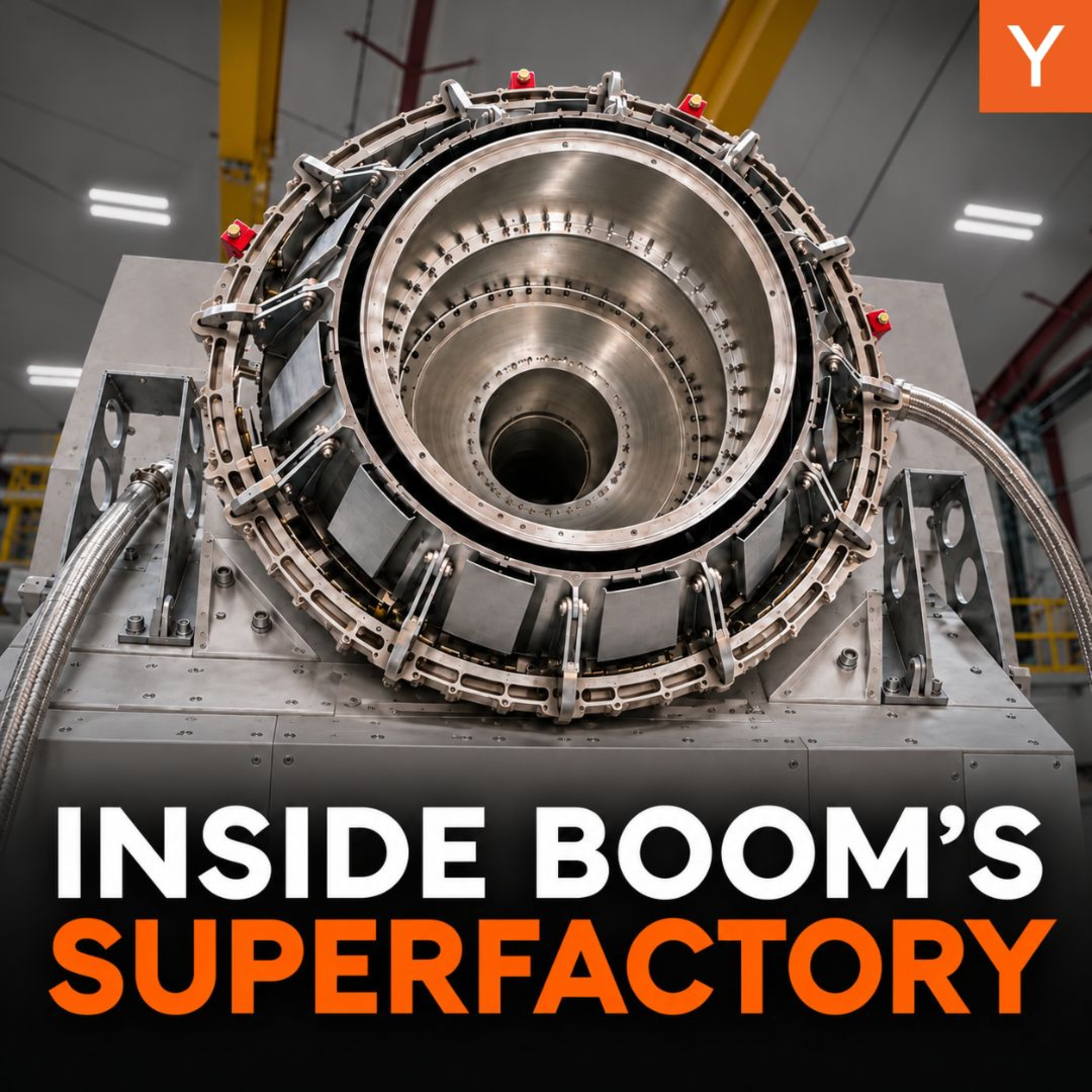
0:00This is the first full-scale jet engine core ever built by a startup, and on November 21st, it fired up for the first time. It's from Boom Supersonic, the company working to bring back supersonic passenger travel over two decades after the Concorde was shuttered for good. Last year, their XB1 became the first independently developed jet to break the sound barrier. There we are. XB1 is supersonic, faster than the speed of sound. Now they have their sights set on Overture, their 60-80 seat commercial supersonic jet. But to make it work, they need an engine you can't buy. So they're building one from scratch.
0:38And here's the twist. This engine's first job isn't related to flying at all. AI data centers can't get enough power, so they're building their own power plants. And they use gas turbines, which are basically jet engines bolted to a generator. And Boone's engine turns out to be the perfect fit. So I sent two texts. And one was to Sam Altman, who had been a day one boom investor. And I was basically, hey, I keep reading about this power shortage thing. Is that real? If I had a 40 megawatt class Nat gas turbine, would that be of relevance to AI? And Sam is like, yes, please, as many as you can make.
1:11So Boom's first engines won't go on a plane. They'll be used as turbines in data centers. I went behind the scenes of their brand new superpower super factory to find out how they're building an engine that will power both the AI boom and the return of supersonic flight.
1:37What was the plan for how you were going to get an engine? If I go back to the moment of founding, I did some research on what if engines were available, and I knew that there was no off-the-shelf engine that could just do the job. I had the thought that it would not make sense to outsource that, that we should probably just do the engine together with the airplane. For that reason, the first employee was actually an engine designer out of Pratt & Whitney. And so literally we hired this guy, came to work in my basement in Colorado, and it was like, okay, dude, go figure out how to make a jet engine.
2:06And he walks in and he's like, guys, we don't have to do the engine program. We can just team up with Rolls-Royce, mod one of their engines. This will save us billions of dollars. It seemed like a reasonable plan. Boeing and Airbus don't build their own engines, and Rolls-Royce built Concord's engine back in the day. When you say you're building an airplane, the first question anybody in the domain asks is, what's the engine? And if you don't have an answer, you're seen as not credible. And like, oh, it's gonna be a Rolls-Royce engine. Like, oh, that's a reason to believe in boom. But in September, 2022, Rolls-Royce abruptly walked away.
2:37And so what do they do? They run to the press and they break up with us without giving us so much as a warning. I was out to dinner with a supplier. my phone starts blowing up. Boom goes from like this insane momentum. And then all of a sudden crash. And we've rolled out XB1. We've signed up United. We signed up American. And overnight, I could not raise another dollar. I could not have another customer conversation. I could not have another supplier conversation. The roles breakup was like the startup equivalent of a stage four cancer diagnosis. Meaning if we don't do something, this will definitely kill us.
3:10So you kind of get to decide, do you hang it up or are you going to fight it? So I went through all the stages of grief, in my heart of hearts, I kind of knew, fuck it, we should have just done this ourselves. But nobody really believed it. My own team didn't believe it. The industry certainly didn't believe it. With characteristic speed, Boom put together a crash program to build its own engine. They announced it in December 2022.
3:36Then, in 2025, Blake stumbled onto an idea that changed Boom's trajectory. The engine he was building for Overture could also power data centers. We just broken the sound barrier on XB1. I'm scrolling Twitter, like the best of us, and I'm reading what we all now know to be front page news, which is the grid interconnect queue is five to 10 years long. You can't get enough power to power data centers, or frankly, anything. Now the turbines are sold out. And if you go to GE and you order a power turbine, you can't get it for five years. So I sent two texts. And one was to Sam Altman, who had been a day one boom investor.
4:12I was basically, hey, I keep reading about this power shortage thing. Is that real? If I had a 40 megawatt class Nat gas turbine, would that be of relevance to AI? And Sam is like, yes, please, as many as you can make. Call this person on my team. And I was like, huh, OK, market demand checks out. The core of the engine and most of the not core of the engine, you could basically take the fan off the front, put a generator on the back. and instead of making 40 ,000 pounds of thrust at Mach 1.7, you could make 42 megawatts of clean electricity running on natural gas, and you'd have some incredible advantages versus every other power turbine.
4:47The brilliance of selling turbines first is that instead of raising billions from investors to build Overture, Boom can pay for the plane with the profits from the turbine business. This is a very profitable multi-billion dollar business if we only make two turbines a month. The day we ship the first one of these, the company flips cash flow positive. So the turbine makes more than all the money that we need to develop the jet. And starting on the ground makes building a safe engine easier. Normally you test an engine for like 5 ,000 hours, so you find the problems that are like one in 5 ,000.
5:18But you don't find the one in 10 ,000, one in 100 ,000, one in a million. And now we'd be able to go to the FAA and to the public and to our customers and say, this is actually the most tested new jet engine ever. It doesn't have 5 ,000 hours, it has a million. because it's been running 24-7 for years, powering your tokens. When Rolls-Royce pulled out, it seemed like a huge setback. But looking back, Blake sees it very differently. The worst bad thing that ever happened to Boom with the Rolls-Royce breakup ended up leading to probably the thing that saved the company and made the airliner actually practical, which is the ability to have an earlier revenue product and earlier access to real-world engine test data at scale.
5:58To support the AI data center build-out, the U.S. needs to add around 100 gigawatts of new generating capacity in the next 10 years. That's about$300 billion worth of superpower turbines. Our plan was to make one gigawatt of turbines in a year. We have one prospective customer, which that one customer wants to deploy 1.6 gigawatts of turbines every 30 days. The moment this thing is proven in the field, there is firm customer demand as far as the eye can see. So why can't the companies that already make turbines just make more of them? There's something like$1 to$2 trillion in market cap of industrial companies that were founded more than a century ago that have not had to innovate or compete in a long time.
6:42Customers are clamoring for more power. They say, great, my prices have tripled. My margins are through the roof. My stock price is up. My stock options are in the money. Why should I make a capital investment that Wall Street might punish me for? So they put their feet up and they don't do much. Blake traces this decay in America's industrial power back to the 1970s. 1973, we banned supersonic flight. The same year, we stopped the rapid exponential increase in electricity per capita. There's this chart that goes all the way back to 1882 when Edison flipped the switch on the first electric grid.
7:17In the out years, it was about 6 % annual compounded growth in electricity per capita. And this enables our modern lifestyle. And that same year we stopped advancing in flight, we stopped advancing in power generation. And since 2000, we've actually done this. The slope is now negative in power production per capita. GE's gas turbines are sold out through 2030. The biggest bottleneck is a single part, the blades inside the engine that sit in the hottest gas. To not melt, they have to be made of exotic alloys and manufactured with specialized techniques. Boom ran into this the moment it started buying parts for its own engine.
7:55For the first iteration, we were going to 3D print our turbine blades. And the quote from the supply chain was like 18 months of lead time and$1.3 million for one ship set of blades. The first question I said is like, OK, so like this printer, what is the printer, the printer that makes these blades? What does it cost and how long does it take to get one? Well, the answer was like$1.1 million and like two weeks. And I was like, this is dumb. Like for the price of like a ship set of blades, we can just buy the printer, print them ourselves that it's going to be faster and cheaper. Like, what are we doing here?
8:27So we just did that. So Boom is doing this thing that to me seems obvious, but is regarded as like a massive breakthrough that nobody thought of, which is we're putting every production process in one building under one roof so we can go from raw materials to completed advanced products quickly without suppliers. That building is the nearly 200 ,000 square foot supersonic superfactory in South Denver. So the vision for the superpower superfactory is we go from raw materials to completed turbines under one roof with essentially every process vertically integrated. By weight, we expect to make 85 % of every superpower in-house ourselves.
9:09The superfactory just came online. And as I walked around, machines were busily humming, cranking out metal parts. What you're seeing here is a factory that's under construction. And even as it's under construction, we've already activated the first machines. But when we signed the lease in January, none of this stuff was here. So it was a big, empty box. And the first thing we had to do is to literally lay the foundation. And this is the raw material for the first superpower customer units. So we have everything here from stainless steel castings to nickel super alloy forging. And then we'll be the cut down to the final part to fit the turbine.
9:52So you're looking here at metal that will make your tokens. Making almost everything yourself sounds like the slow, expensive way to build an engine. Building XB1, Blake learned it's the other way around. Vertical integration, bringing everything in-house. Can you talk about why that makes sense and why Boom is so unusual in doing it this way? We believed, wrongly in fact, that we could not afford to vertically integrate. We thought we didn't have the capital to go buy the production equipment to stand up with the in-house capability. So we thought we had to outsource. We thought we had to rent other people's equipment.
10:24This is actually the expensive and slow way to do it. We were lucky we survived the outsourcing. And Boom has learned that the best way to make parts in-house is to put the people who make them right next to the people who design them. When we were building Sprint Corps, we found that like some parts were hard to reach and ensoul and we kind of wanted a wrench of a certain shape that is not a wrench that you can just buy. And so what did we do? One guy cadded up a drawing for it. We sent it to our machine shop. The machine shop worked overnight and the next morning we had the exact perfect wrench for that assembly.
10:56And that is something that can happen like, you know, in a few hours that would be somewhere between weeks and just flat out impossible. The parts that go in this engine have to survive in extreme environments. So think spinning at 10 ,000 RPM at 3 ,000 degrees Fahrenheit and doing that continuously for three years without breaking. That is the environment that turbine lives in. And to do that requires the highest performance materials invented by mankind. The hardest of the hardwoods are single crystal. and this is a this is a thing that according to the internet only three companies in the world can do and it's the sort of thing that if i described to you you might think it was flat out impossible the turbine blades the most advanced turbine blades are one crystal one perfect grid of atoms just like a diamond except they're much larger than a diamond and uh and so there is uh a lot of industrial secret sauce locked up in kind of the big three engine makers about how do you actually produce single crystal parts boom is building its own single crystal foundry here in the building next door and our goal is not just to do single crystal but to do the world's most advanced all digital single crystal where literally you can design a blade on monday cast it in the afternoon and uh by tuesday you've got a cast a new cast part ready to test before boom Blake was a software engineer, and Boom builds its own software to run almost everything.
12:27And a thing we discovered 10 years ago was that most hardware engineering is actually software engineering. And so we did this thing where we put a software engineer on every hardware team, and we said, automate what your teammates are doing. Now the cost of software development has collapsed. Now every person at Boom, down to the receptionist, is a coder in the AI-enabled sense of that. The fastest anybody's ever done a whole engine iteration is three months, six months is more typical. We built a tool called Blade Runner where an engineer can drag a slider. We have our own CAD kernel, the geometry updates in real time.
13:03We have our own GPU cluster, the aerodynamic simulation runs in real time. So one engineer looking at a screen can drag a slider and see how it impacts the aerodynamics and structural behavior of that blade. So one engineer in real time can do what used to take a team of 100 six months. And we're just getting started. The XB-1 plane was built by just 50 people. And Blake has long believed in the power of astonishingly small teams. Who is the team that's working on superpower? The whole company today is 165 people, about 40 in manufacturing, about 125 in engineering and everything else. and I'm a big believer in small elite teams will do things the big guys can't or won't do.
13:48We put a bold thing out there internally, which is outside of manufacturing, boom, we'll never be larger than 250. We're going to do the power turbine and the supersonic airliner with a team of no more than 250. On November 21st, their team successfully fired up the engine core for the very first time. The next step is to begin shipping turbines in mid-2027. This takes me back to two years ago, when XB-1 sat on the runway about to make its historic flight breaking the sound barrier. I think we've got better than 50 % odds that we all get to fly supersonic on our airplane. That did not used to be the case.
14:21But whatever happens, should we screw it all up and it all is for naught, this is a piece of aviation history. And supersonic flight would not be legal had it not been for what a team of 50 people did in the Mojave Desert. There are not that many things that you get to do as a founder that you're pretty confident will remember 100 years later. But I think this is one of them. There we are. XB1 is supersonic, faster than the speed of sound. We've got confirmation from the control room that she is supersonic. There is nothing so human as flying because it is the thing that we do not have the biology to do, but we have the brains to do.
15:01And I think that's why people get so excited by flight. I think it's why they get so excited by landing on the moon. It is a denial of this notion that we're bound by our biology and just the most incredible, poignant, visceral, concrete expression of human ingenuity. Getting here has meant years of setbacks and deciding to keep going. The difficult thing you overcome and don't give up on becomes the most epic thing later. It becomes legendary, and the pain that we endure on the way is the thing that we're actually proud of later.
On November 21, 2026, Boom Supersonic (YC W16) fired their prototype engine core for the first time.
They're developing a shared core for two products: Superpower, a natural-gas turbine for AI data centers, and Symphony, the engine intended for the Overture supersonic airliner. The turbine business could help fund Overture while giving Symphony years of real-world operating data before it ever flies.
In this episode of Hard Tech, Boom founder and CEO Blake Scholl shows YC's Jared Friedman around their new Superpower Superfactory in Colorado and explains how they’re building a jet engine from scratch.
On the factory floor, we explore in-house manufacturing, the challenge of making turbine blades survive extreme heat, and the custom software Boom uses to design and iterate on engine parts.
Scan the code with your iPhone camera
Listen in the app.