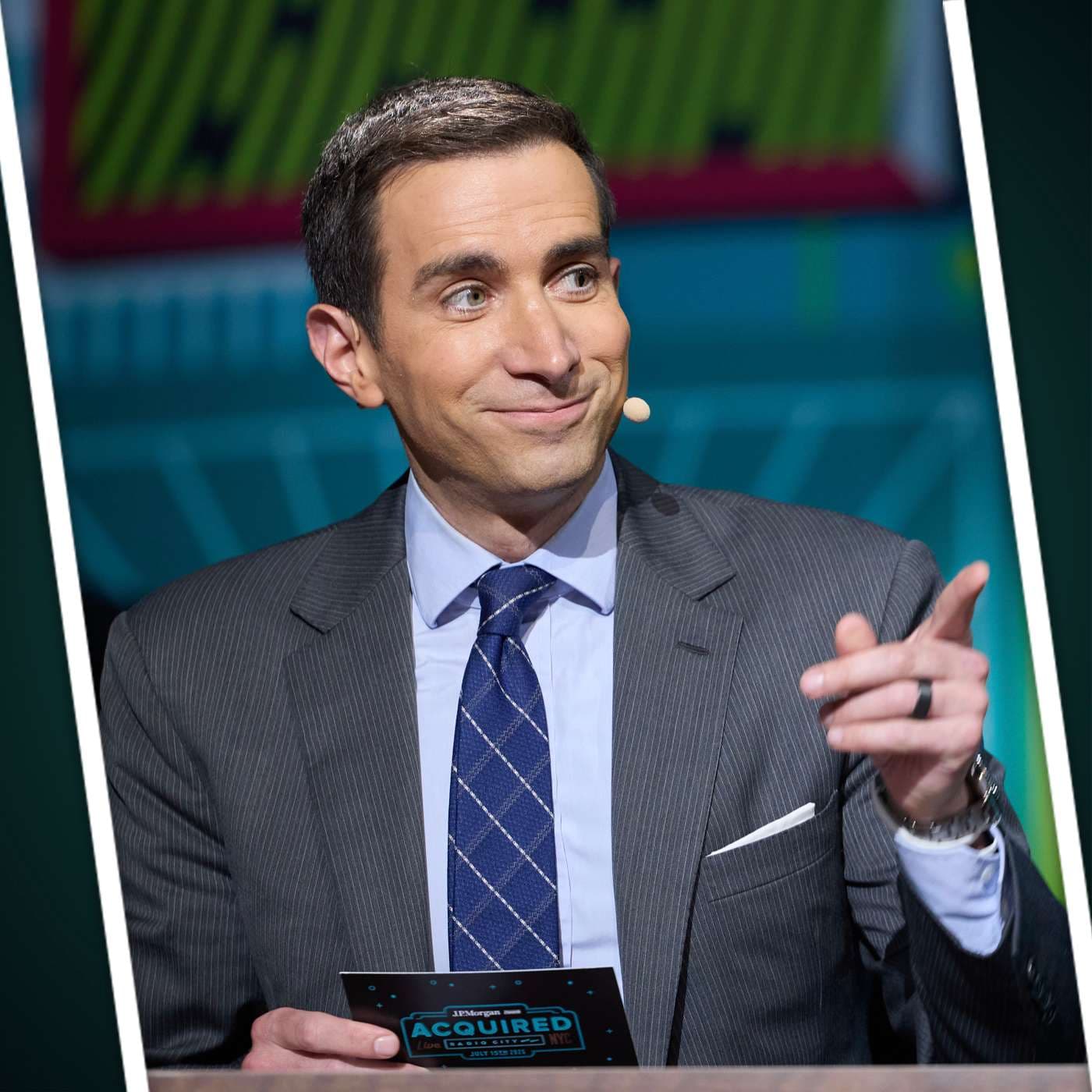

In short
Podcast Episode Summary: The Insane Productivity of Andrew Ross Sorkin
Podcast Details
- Title: ACQ2 by Acquired
- Episode Title: The Insane Productivity of Andrew Ross Sorkin
- Hosts: Ben and David
- Guest: Andrew Ross Sorkin
- Description: Discussion of Sorkin's multifaceted career, insights on productivity, and his journey in media.
---
Episode Overview In this episode, Ben and David converse with Andrew Ross Sorkin, a prominent journalist, author, and television personality. Sorkin shares insights into how he manages his numerous roles, including:
- Founder and writer of DealBook, a business newsletter for the New York Times.
- Host of Squawk Box on CNBC every morning.
- Organizer of the DealBook Summit, a major annual business event.
- Co-creator of the TV show Billions.
- Author of notable books including "Too Big to Fail" and "1929."
Key Topics Discussed
Andrew's Daily Routine
- Morning Ritual: Sorkin begins his day around 4:30 AM, utilizing the early hours for email checks and finalizing the DealBook newsletter.
- Squawk Box Hosting: His duties on Squawk Box run from 6 AM to 9 AM, often overlapping with his responsibilities for DealBook.
- Productivity Strategy: Sorkin emphasizes the interconnectedness of his work, noting that each role informs the other.
Journey to DealBook
- Early Career: Sorkin’s path began as a teenage freelancer at the New York Times, leading to his eventual founding of DealBook in 2001.
- Innovative Newsletter: He pioneered the concept of a daily email newsletter well before others like Substack emerged, aiming to provide insights for professionals in finance and policy.
The DealBook Summit
- Inception: The summit started in 2011 as a way to bring the stories and people featured in DealBook to life, facilitating direct conversations with influential figures in a live setting.
- Format and Structure: Sorkin shares the careful curation of speakers and attendees to foster meaningful exchanges.
Interview Techniques
- Preparation Process: Sorkin spends significant time preparing for interviews, often dedicating 15-30 hours per conversation.
- Engagement Techniques: He discusses strategies to create a comfortable atmosphere for interviewees, emphasizing the importance of understanding their background and motivations.
Insights on Journalism
- Balance of Objectivity and Subjectivity: Sorkin believes that understanding the motivations of sources is crucial for delivering nuanced storytelling.
- Taking Things Personally: Contrary to advice against it, Sorkin argues that taking things personally is essential for producing impactful work.
Business Model of DealBook and the Summit
- Advertising Driven: The newsletter and summit primarily rely on sponsorship and advertising rather than subscriptions, aiming to reach influential audiences.
Personal Reflections
- Taking Risks: Sorkin reflects on his career leaps, such as writing his books and venturing into television, noting the challenges and self-doubt he faced.
- Human Experience in Journalism: He believes in understanding the human side of business and policy, aiming to narrate stories that resonate on a personal level.
---
Key Takeaways
- Insane Productivity: Andrew Ross Sorkin exemplifies how to maintain high productivity levels across multiple demanding roles through careful time management and prioritization.
- Innovative Media Practices: His approach to journalism, particularly with the DealBook newsletter, showcases the evolution of media and the importance of adaptability.
- Interviewing as an Art: Sorkin’s techniques in engaging interviewees reveal the balance between preparation and spontaneity, fostering genuine dialogue.
- Personal Investment in Work: Taking work personally can lead to deeper connections and more impactful storytelling, essential for journalists and creators alike.
---
Links Mentioned
- [Andrew’s new book 1929](https://www.amazon.com/1929-Inside-Greatest-History-Shattered/dp/0593296966)
- [DealBook Newsletter](https://www.nytimes.com/section/business/dealbook)
- [DealBook Summit](https://www.nytimes.com/events/dealbook)
- [Squawk Box](https://www.cnbc.com/squawk-box-us/)
Sponsors
- [Shopify](https://bit.ly/ShopifyACQ25)
---
This episode highlights Andrew Ross Sorkin's impressive productivity and offers valuable insights into the evolving landscape of journalism, the business world, and effective communication strategies.
Written by AI. May contain mistakes. Listen to the episode to check what was said.
Transcript
Automatic transcript. May contain errors.0:00Hello, Acquired listeners. we are coming to you today with a very fun acq2 interview with our buddy andrew ross sorkin yep we got to know andrew over the summer for our radio city show where he had a delightful cameo with us and he's got a new book 1929 and he's doing a book tour and we said hey do you want to come on acq2 given you're doing the book tour and rather than just talking about the book why don't we talk about how the heck do you do all of this that you do like we're dying just making one show you know you do like four things every day so there's the new york times deal book the daily newsletter there's the deal book summit which happens every december there's of course that he co-created the show billions he is every single morning from 6 a.m to 9 a.m eastern on CNBC doing Squawk Box.
0:54He's written Too Big to Fail and 1929. Two major books. Yeah, this was a very fun conversation. So today's conversation is a little bit, how does he do it all? But also, we realize Andrew's never actually told this story before of how it all came to be. How did he start a business daily email newsletter in 2001. I mean, this is over a decade before Stratechery, I don't know, 15 years before the era of Substack, doing it inside, now the biggest newspaper in the US, I think in the world. And now every December doing Dealbook Summit, which to me is kind of the flagship canonical business interview forum in the world.
1:41I mean, that's more than that, business technology politics. So listeners, this conversation was especially interested to David and I for navel gazing reasons, but we think Andrew's story is just fascinating. It really illustrates the shift in the media landscape. And I am just so interested in how he maintains the quality bar that he does across such a wide, wide set of activities. So please enjoy our conversation on the insane productivity of Andrew Ross Sorkin. Andrew, you're wearing something different than you are wearing on Squawk Box this morning. How does that work? Yeah. What's your wardrobe change throughout the day look like?
2:16So I did that for you, to be honest with you. Really? Yes. Usually I'm in a suit basically all day. I kind of sleep in a suit with a tie. And then I thought to myself, we're doing this podcast. There might be video. These guys are probably going to wear like sweaters or look cool. And I'm going to look like some like old man in a suit. I'll put a sweater on. So that's what's going on here. Okay. So Andrew, I've always thought of you as a New York Times reporter. I've thought of you as the founder of Dealbook. You also do Squawk Box. How do you think about that, especially since that's over by what, 9 a.m.?
2:54It is over by 9 a.m., but it's a full three hours, which oftentimes feels like a lot longer than that. Not in the moment. I think we have a ball in the moment. But for me, it's the way I I begin my day and all the things that I try to do, you know, in many ways, I'm doing DealBook, oftentimes finishing it up even before Squawk Box starts and then doing Squawk Box and then going back to DealBook and going to other projects. And they all sort of inform each other in interesting ways. about 15 years ago, I want to say. In 2011, I used to be a guest on Squawk Box often, and they called me up and they said, hey, would you want to be the host of the show?
3:37And I thought, that's crazy. I can't read a teleprompter. I've never done this before. This is insane. Was one of the other hosts retiring? Or like, how did this? A couple of things that happened, actually. I don't know if you remember, a legendary journalist named Mark Haynes, who was the original host of Squawk Box and then was on a show called Squawk on the Street, passed away. And they were going to reshape Squawk on the Street. And Carl Cantoneo, who was one of the three hosts of Squawk Box, was going to move to that show. And so they were looking for somebody to put in his chair. And I thought, you know, I love my job at the Times.
4:14I'd been there since I was 18 years old. And they were willing to have me do the show in the morning and also allow me to continue doing a lot of the other work that I enjoy doing, I could have the best of both worlds. This would be great. And as long as I could be awake at that hour. Now, I was always up early. So the up early was not the hard part, though I don't think I was up early with makeup on and lights. I was always up early because I was publishing Dealbook, our newsletter, which typically was going out between 7 and 8 o 'clock in the morning. So I always did have to get up early. But I was often in my pajamas.
4:48as I wasn't, you know, interviewing people. And if you need that time to publish DealBook, now you don't have that time. Yes and no. So a couple of things. The DealBook team has grown, so that actually was a huge benefit. And also, I end up spending usually about an hour in the morning before Squawk Box starts sort of making last tweaks and things to the DealBook newsletter. And that's actually one of the great ways that I sort of read in, as they say in the TV business, to learn about everything that's going on, sort of as I'm doing my last licks at the newsletter to make sure everything's in order.
5:28What time are you getting up? What time is your day starting? Right, this is 5 to 6 a.m. now that you're doing the last minute tweaks, 5 to 6 a.m. Eastern. So my day usually begins around 4.30 in the morning. That's usually when I wake up-ish, I'd say. I lie in bed with my phone under the covers, like looking at email, text that came in overnight, slacks oftentimes around DealBook and things like that. And then I'm oftentimes writing, if you read DealBook at the top, it says, good morning, Andrew here. I'm writing that in the morning, every morning. That's because I need to see where we are in terms of like what we're going to really, you know, lean into for the top of the newsletter.
6:07Oftentimes trying to change the subject line or other things like that as we try to get more readers. Yeah. It's very clear whenever I open it up that that is a lead. That is a hook. This is a pitch to me of the rest of this newsletter is interesting. Here's why. Read on. That's the goal. So if that's working for you, that knock on the wood. That's great. So are you sending that from the news desk at CNBC? No. So the button is being pressed actually in Europe by two of my colleagues, Michael Dillamer said, who's actually been with me and DealBook for about 20 years now. and Bernard Warner, who work overnight.
6:46He lives in Italy, actually. And they're working with a copy editor doing some of the last minute changes. And then usually we're doing a little bit of slacking back and forth in the morning before things go out. They're later in the day. They've had their coffee when they're hitting the button. They've had their coffee. They've been fixing, adding, sometimes completely rewriting and changing the mess that we've made out of New York overnight. How do you think about the content of the newsletter? Are those stories created in service of creating a cohesive newsletter, or are you trying to create a newsletter out of the most interesting business stories of yesterday?
7:25Combination of both. So I think for the purpose of the newsletter, we're thinking about how can we make the reader armed and dangerous before their nine o 'clock meeting or their breakfast in the morning or wherever they're headed off to. Dealbook actually transformed itself over the last, and we're coming up on 25 years of doing this. In the beginning, it was really for the world of dealmakers. It was M &A bankers and lawyers and accountants and people in that ecosystem. And then increasingly CEOs started to read it and board members and strategic dev groups and then regulators and politicians started to read it.
8:04And so I think we sort of shifted our focus, especially after the financial crisis of 2008, to really sort of try to capture the intersection of business and policy and really connect the dots between lots of different storylines. And so every morning I think we're trying to find, you know, as much scoopy original stories, but also be able to try to take a story that's in the news and spin it forward if we can. Hmm. We're sort of starting in medias res here. Let's go back to the beginning. Let's go back to the start of DealBook, the newsletter, before there was a summit. I don't think people realize how early you were to the email game.
8:47Or to the Times. I mean, you made the quip earlier in our conversation about you started at, you know, when you were 18 at the time. You literally started at age 18, right, at the New York Times. That's not a joke. All right, let's go there. How'd that happen. Okay. So backstory is I'm 15 years old. I got to go back three years. All I wanted to do is be in media, not necessarily as a journalist. Actually, the business side of media was more interesting to me. And I was selling ads for the school newspaper and then ultimately created my own magazine in my high school in Scarsdale, New York called the Sports Page Magazine.
9:21And the purpose of the magazine was as much about sports journalism as much as it was about selling ads and trying to capture a particular audience, in this case, high school-aged boys, which were harder to get to than high school-aged girls at the time. The magazines would be distributed across the country, inside high schools, advertisers would pay, kids would write the articles about professional sports as if they were writing Sports Illustrated. So we did it, and about a year into this project, New York Times wrote a little article about this little endeavor. My mother used to drive me down to New York City to different advertising agencies because I'd have to go sell my ads.
10:00And they were cheap. I mean, cheap on a relative basis, like$900,$1 ,200 for a full-page ad, blah, blah, blah. Yeah, but for you as a high school student, this is amazing. Huge. Anyway, it succeeded and failed by the time I was about 18 years old. It succeeded in that we had gotten all these high schools to agree to take it. Some schools were getting it. Some schools weren't. And I'll be honest, we made a whole bunch of rookie errors that a great business leader would not have. We used to send mail by Federal Express, for example, because we thought that that would make it look like we were really professional.
10:40Meanwhile, your mail bells are. Which was a great mistake. And then we had hired a printer, actually the same printing company that was printing Wired magazine at the time. and we were supposed to drop ship. We were moving from black and white to full color and we totally just misestimated what the cost was going to ultimately be. And that was the end of that. But it was one of the great educations of my life. And as a result, it helped me, I think, get my little foot in the door of the New York Times when I was 18 years old. I used to read a guy named Stuart Elliott who was the advertising columnist at the New York Times.
11:17He, I mean, he was like a god to me. I mean, most people, you know, read the front page of the paper, the sports section. I would go to like page C6 to read what Stuart had to say. So I could go down to these meetings with the advertising agencies and pretend like I knew what I was talking about. And all I wanted to do was work for this guy. And I was trying to find all these different ways to get into the times and get to him. And I used to go home during high school and call him on the telephone to try to try to get a gig. And then finally he took me out to lunch and somehow convinced him to let me stay.
11:49And then there was a guy named Glenn Cramon who was running the business section. And he let me stay. And so I used to come every day with a visitor pass. There's a union at the time, so they didn't really like this whole idea. So they didn't really know about it, actually. I just would come every day and I'd stand and I'd Xerox and staple. I had no intention of putting two words together, let alone a sentence. This is 1995. And happily, an editor who had no idea how old I was, I was wearing a suit with a tie back then. And she thought I was like a real person. And she assigned me a story to write.
12:20And that's how it all started. No way. Like a mistaken identity thing is how you wrote your first piece at the Times. I think she thought I was like a young, maybe news clerk graduate from college. She overheard me talking about this thing called the internet back in 1995. And she thought, oh, he may, he seems to know what's going on. Do you remember the piece? Oh, absolutely. It was the silliest piece, but it was, I mean, I love it so much. It was, you're going to laugh. It was a piece about the noise that modems make. Back when we used to, we actually used to write the word modem, comma, a device that transmits data over a phone line.
12:58And all these adults. Well, now you need that again. Nobody knows what it is. Nobody even knows. My kids don't know what a modem is. And she wanted to understand what that noise was, that weird little high-pitched noise. And I was trying to explain to her that the noise was they were mating. The two modems were talking to each other. And that was the first article out of the gate. So did you start full-time? No, sorry. I went to Cornell. I was going to be like a camp counselor that summer. And then they asked me to stay for the rest of the summer. Then I went off to Cornell. And then at Cornell, I would continue writing for the paper, freelance stories and things.
13:37And then my junior year, I went off to London School Economics for part of the year and ended up writing a lot in the afternoons because school, as you might imagine, was like over in London at like 2, 3 in the afternoon, which was like 9 or 10 in the morning. So I would often be writing articles almost every day, little articles, but it was just a great sort of education for me. I want to go to the beginning of DealBook. I am still astonished at how early this was in email. I mean, you look at when did Substack start? 2016, 17? I think 2016, 17. Yeah. Ben Thompson started writing 2011, 2012. I think it was 2013.
14:17Yeah. I had no idea that DealBook predated all of this. That was a really remarkable period. So, yeah, it's 2001. I had lived in London after I went to Cornell. I'd been covering mergers and acquisitions, trying to break his stories and be as competitive as we could be. I get back to New York. I'm supposed to cover M &A. I'm thinking, OK, this is going to be easy pickings. I thought it was hard in London because it's the New York Times. It wasn't the local paper. And I started to meet bankers and lawyers and people in that whole netherworld. And they'd say, Sorkin, you seem like a nice kid. But, you know, we get the times at home.
14:55And I read the front page, sometimes the sports section. And then I leave it with my wife. And I take the Wall Street Journal with me on the train. And that was like dagger to the heart. It was like dagger to the heart. I was like, oh, my God. How am I going to make this work? And I thought, well, you know what? I spend an inordinate amount of time racing around the Internet trying to find little bits and nuggets of things. And everybody else is doing the same thing. And if I could put that in a report every day and then effectively almost bypass the physical paper and go straight to their inbox, since they seem to be claiming that they're leaving the paper at home, maybe this is the answer.
15:35And there have been a history of newsletters on Wall Street, but they were faxes, right? Yeah. Yeah. I mean, you could get all sorts of, you know, analyst reports back then. People would fax the analyst reports for the most part. A lot of stuff was going by fax. In fact, when we first started DealBook, if I remember correctly, there was a number of subscribers who had their, you know, assistants back then. They called them secretaries call and say, could you fax us DealBook? That was like a regular thing. Could you please fax us DealBook? And I remember always being like, well, but there are links in it.
16:06And if you click on the links, you can read the whole story. And they didn't really get that. So that was the sort of original conceit. And inside the Times, I will say there was sort of support but sort of marginal because I think most people didn't understand what we were trying to do. And the other piece was part of the conceit was we were going to link you oftentimes to our competitors. So we were going to provide links to the Wall Street Journal or the Financial Times. Or oftentimes back then there were a lot of local papers that were doing actually incredible business coverage. So, you know, when Lucent was buying Alcatel or rather I should say Alcatel was buying Lucent, you know, we would translate parts of Le Monde.
16:51We would send you to the Trenton, you know, Times, give you what they were saying about a deal or what the local issue was in Dallas. If there was some, you know, something going on in the oil patch or something like that. So we were linking people all over the place and into SEC filings and other things like that. But I think as a newsroom, there was a little bit of discomfort, let's just say, about that whole concept for a while. There must have also been a ad sales and business model question too, right? Well, in the beginning, so a couple of things. I was really trying to launch this thing in the ashes of what was, this was the dot-com bust had just happened.
17:32It wasn't that we were still in the boom. The bust had happened. And there were real concerns just about the economics of everything. The New York Times actually had what was going to be a tracking stock for its dot-com business. And that looked like it was starting to go off the table, if you will, given what was happening in the marketplace. In any event, their view, I think, if I got to go back and look, I was actually trying to find some of these old notes. I think they thought that the TAM, to put that in a mod, I don't think we ever used the phrase TAM back then, was 30 ,000 subscribers for free.
18:10And what is it today, if you're willing to share? We're over a million. We're over a million subscribers. This sounds very like Ben and my own journey. In the early days, we used to be like, oh, there can't be more than 10 ,000. There's 10, 20 ,000 people who will listen to this. Who would listen to this, yeah. So, you know, and I had this thought that we get the whole thing paid for by advertising. I was not looking to, you know, charge for it. Really, the whole goal was to get the brand of The New York Times out in front of this audience more than anything else. And I told them that we were going to make money on day one.
18:46I said we would not do this unless we made money on day one. And we did. Our original advertiser was Brooks Brothers. He was our first advertiser. Awesome. Brooks Brothers is still in business, but only by a hair, I think. I mean, I think they've gone in and out of business a couple of times. Were you doing the ad sales? I was not doing the ad sales. So the good news about The New York Times at that point, and it continues to be the case, but there really is a church and state wall between the two. We also had a currency exchange, if I remember, was another advertiser that was one of the early ones.
19:24But anyway, within a couple of months, it felt like the thing had sort of caught fire. And all of a sudden there were people who were sending me emails saying, you know, how do I subscribe? I'd like to subscribe. We'd get, as I said, the phone calls from different CEOs saying, can you fax it to my boss or whatever it is. And we were off to the races. Was there a cool dynamic where people who you were covering would subscribe and then would reply to the email? Oh, yeah. I mean, that was actually – I mean, even to this day, that's the coolest part about it, which is just the audience is so crazy.
19:58Crazy, I mean, in some of the names that get it every day that oftentimes they would reply – I mean, people used to send us – they still do. I get PDFs of decks about a deal that's going to be coming within two days or ahead of time. Someone's leaking us something or people are replying to this saying, you know, I'm involved in this transaction. And by the way, you didn't get this right. I want to tell you what actually really happened. What a great reporting channel, just the replies. Yeah, no, the replies are a huge sense, just that immediate feedback that you get. And that actually was a huge sort of plus, I think.
20:31It's funny, now I think that is so common and normal. But back then, 25 years ago, there was no feedback loop in that way. This really was one of the first because, you know, we didn't have Twitter or X or any of these other social media platforms didn't exist back then. So this was sort of like an original way to do that. All right. I got to ask, what is the meta game here? What's going on when you do get a reply that said, actually, I'm involved in this deal. You're not getting this right. Here's the real thing. Obviously, there's an incentive at play to share that with you. How does that enter into how you decide to absorb information when you get it?
21:10So my view is that every source has some motivation for why they're talking to you. And oftentimes, if not all the time, it is self-motivated, meaning like there is something that they believe benefits to them. I think it's important to understand what their motivation is. But ultimately, as long as I can confirm the information, typically from two, three, four different sources, or I can get documentation of the issue, I try not to worry too much about what their ultimate incentives are. because some of the best sources have completely terrible and ulterior motives. I can't tell you how many times I've had people who want to screw somebody else over, even people that you thought were their friends, people in offices that literally were next to each other, and somebody's ratting out the other.
22:14I had situations where I've talked to board members. I remember 11-member board, 10 people want to do a deal. One of them thinks the deal is a terrible idea, thinks if the deal is somehow in the public domain that they're even considering it, the public shareholders will, you know, freak out, rebel, and that will turn on the company. I've had the opposite happen. I've had CEOs who thought that their board was against them, but was convinced that if the public markets understood that they were contemplating this, they would cheer and the board would actually be sort of put into a corner the opposite way to do a deal.
22:54We just finished recording our Coca-Cola episode. I don't know if you remember this. The CEO of Coca-Cola struck and announced a deal to buy Quaker Oats. I worked on it that night. I remember that night. I remember that night like it was yesterday. Yeah, and Quaker Oats owned Gatorade, which is the reason to do it. The press releases were ready. The two CEOs did a joint announcement, and then the Coca-Cola board killed it after the announcement. Unbelievable. And then Pepsi ended up buying Quaker Oats and Gatorade, and it's been a home run Grand Slam for them. David, I love that you're telling Andrew this.
23:29I'm pretty sure Andrew knows. No, but it's a great story. And it's an example of just how these things happen where, you know, from the outside, it all looks, you know, very organized. Oftentimes you see a big announcement and there's a press release. But behind the scenes, invariably, there is a lot of different egos and personalities that have their own sort of plans, if you will. And as a reporter, that's where most of the stories come from. Sometimes very senior people, sometimes junior people. By the way, junior people who hate their boss or people who love their boss, it's up and down. I think people have this view that, you know, maybe you talk just to the most senior people.
24:12That's typically not the case. Oftentimes, a great story starts at a very junior level. Oftentimes, a great story starts with what I call the jilted somebody. So there could be an auction for something. Someone's now lost the auction. Now they're jilted, the jilted lover. and now if they have any incentive in life, they have no skin in the game except maybe to upset the situation or maybe there's a banker or a lawyer or an accountant or somebody else who thinks they've spent the last 10 years sending Christmas cards to some CEO thinking that this is their client, taking them on some annual conference or ski trip or something and then all of a sudden finds out that Goldman Sachs got the business and not them.
24:56Well, now they have no skin in the game And so they may be more inclined to say, hey, Sorkin, you should look into this. By the way, it's very rare that someone just calls you up and tells you this stuff. But I think if you're sort of like in the in the flow, calling around, talking about different things, sometimes it just comes up in conversation where, you know, people are maybe willing to say it's like one of those they're having a bad day. You might be talking about something else and you might say, well, what else is going on? And they might say, well, you know, I got to tell you, I just got totally screwed on this situation.
25:28You should check out this other thing because that's, you know, and that's how a lot of stories like this start. You get a beat like that. You say, you know, you need to confirm it with two, three, four other sources. How do you decide who to then call next? Well, then I start to think through, okay, who in my sort of network that I've tried to develop relations with might know about this before going to the tippy top. I always think if you go straight to the top, you will probably not succeed. I know X. Can you confirm or deny? Yeah, that doesn't really work. You sort of need to get enough information, usually at lower levels, to know where the meetings are happening, when they're planning on announcing, what's the price.
Read the full transcript
26:13If it's a stock-for-stock deal, what's the ratio? Is there a collar to the ratio? I mean, I would say you want to get 80 % to 90 % of the way there before asking the company for comment, if you will. And I will say that if you get to 90 % of the way there, oftentimes it behooves the company in some ways to tell you what's actually happening at that point. Yeah, they'd rather have a hand in shaping the narrative versus not. Typically. Yeah. You know, most companies do want a hand in at least to tell you what's going on. And look, my view is it makes the story stronger. I want to know what what folks think.
26:53I want to know what folks think in a positive story. I definitely want to know what folks think in a negative story. And, you know, I think it makes it a better story to include whatever the other side of the story is. Yep. OK, so we could talk about this forever. And I'm interested in part because David and I don't think about ourselves as journalists. And yet we have a lot of the same – what we do rhymes as sort of this business historians even though we're not really – We're just doing it about the past. But it's similar. Different people remember things very differently. As you know, you're a historian too.
27:32Well, it's very interesting to try to think back. I mean I just finished this 1929 book. Which is fantastic by the way. I'm in the middle of it for anyone who hasn't read it yet or listened. And it's great, by the way, that I love that you narrate it, too, in the audio book. You guys are in the audio books. I'd never done anything like that before. But what I was going to say is stories about today, you can go obviously talk to people who are involved in them and they can give you their perspective in the moment. Stories 100 years ago, you know, you're dependent on letters and diaries and memos and notes and all this archival material, which you guys have unearthed a whole number of times when you guys have been working on projects around companies that have lengthy histories.
28:10I always try to put myself in the shoes of the people who are living. And I found myself trying to put myself in the shoes of the people who were not living back then. What would they be thinking? Why would they be thinking it? How would that relate to somebody who's alive today? I don't know if you guys ever think about that, but. We definitely try to, modernize is the wrong word, but like make these characters real. real, you know, talk about them, reenact conversations like in the way that people would naturally have them today, as opposed to, you know, you read a history book and it sounds very stilted.
28:45I'm trying to think of an example of maybe like Standard Oil. It really is like incredible drama, right? And like ruthless stuff that's happening. And there's a way to talk about that in the language they were using at the time that might be a little less accessible today. And there's a way to talk about it of like, you're not gonna believe what Henry Flagler did next. Like, what an animal, that guy, you know? All right, listeners. Now is a great time to thank one of our favorite companies, Shopify. Yes, and this is really fun because we have been friends and fans of Shopify for years. We just had Toby on ACQ2 to talk about everything going on in AI and everything that has happened at Shopify in the six years now since we covered the company on Acquired.
29:28It's been a pretty insane transformation for them. Yeah. So back at their IPO, Shopify was the go-to platform for entrepreneurs and small businesses to get online. What's happened since is that is still true. And Shopify has also become the world's leading commerce platform for enterprises of any size, period. Yeah, so what's so cool about the company is how they've managed to scale without losing their soul. Even though companies like Everlane and Vori and even older established companies like Mattel are doing billions of revenue on Shopify, the company's mission is still the same as the day Toby founded it, to create a world where more entrepreneurs exist.
30:08Oh, yeah. Ben, you got to tell everyone your favorite enterprise brand that is on Shopify. Oh, I'm saving that for next episode. I have a whole thing planned for episode two of this season. Okay, okay, great. Anyway, the reason enterprises are now also using Shopify is simple, because businesses of all sizes just sell more with Shopify. they built this incredible ecosystem where you can sell everywhere. Obviously your own site, that's always been true. But now with Shopify, you can easily sell on Instagram, YouTube, TikTok, Roblox, Roku, ChatGPT, Perplexity, anywhere. Plus with ShopPay, their accelerated checkout, you get amazing conversion and it has a built-in user base of 200 million people who have their payment information already stored with it.
30:55Shopify is the ultimate example of not doing what doesn't make your beer taste better. Even if you're a huge brand, you're not going to build a better e-commerce platform for your product. But that is what Toby and Shopify's entire purpose is. So you should use them. Yes. So whether you're just getting started or already at huge scale, head on over to Shopify.com slash acquired. That's S-H-O-P-I-F-Y dot com slash acquired. And just tell them that Ben and David sent you. Well, Andrew, I was going to ask you, how many years was it of the newsletter before starting the DealBook Summit? So we started the summit in 2011, in fact.
31:35So we'd basically been doing it 10 years, 10 years in. And really the summit was just the idea of, can we bring the pages of DealBook to life, right? Could we actually take all of these characters who we were writing about every day, who oftentimes were replying to us on the email and put them on a stage and talk to them in a really human way so that people could and the public could sort of see them and see the way they think about the big issues of the day? I always love conversations about ultimately why people think what they think. I care about the information they're imparting, but I feel like especially when you think about people of great influence and power and all of that, even if you disagree with them, understanding why they think what they think I think has huge value just to our collective understanding.
32:27I've thought that watching the last few years of Dealbook Summit interviews, I mean, whether it's Elon or Sundar or Jeff Bezos, it's not like they're sitting there breaking news. It's not an act of reporting to do the summit, but you really do get inside the psyche. You get a much richer texture of why they're doing what they're doing from an hour-long interview. A lot of them go between a half hour and an hour. And in terms of the reporting, you're right. It's not, you know, oftentimes news of the moment, though sometimes they do make news in that moment that make headlines. Alex Cooper dropped her energy drink.
33:04She did. She did. But to me, ultimately, it's it's reporting that ends up explaining what they did in the past and oftentimes gets used later in what they do in the future. So sometimes you'll see little nuggets, little quotes, little other things that end up in the newspaper six months later after they've announced something else that they're doing or something happens. And those quotes are used as a way to explain them. You know, it's funny. I haven't had a chance to read today's deal book yet, but I'm very curious in the story that you helped report around Jeff Bezos' new venture that I saw just a headline of this morning.
33:44Does that call back at all to your interview with him where he's talking about all the heavy industry that they want to move off Earth and what's going to be necessary to accomplish all of that? Yes, and yes, and because he made a particular point of leaning in to AI. And I remember being a little surprised about sort of his interest in artificial intelligence and how he clearly wanted to talk more and more about artificial intelligence. And I remember thinking to myself, well, you know, Amazon doesn't have its own large language model right now. You know, arguably it's behind. I mean, I think a lot of people thought that at the time.
34:25And here's a guy who says he's focused on space. So why is he all of a sudden talking about AI and talking about how he thinks AI is like fire? I remember him saying he thinks it's, you know, it's that important. So last night when I learned about this, I thought, oh, okay, this all makes a little bit more sense now. And he's going to become the co-CEO of the company, which to me is remarkable because he hasn't been – he was not the CEO of Blue Origin. He was the founder, but he had hired someone to be the CEO. And the last time he'd been the CEO of a company obviously was Amazon. So the idea that this is what he's effectively doubling down on and where he's going to focus his own personal energy I think is pretty interesting.
35:08When you were starting the summit back in 2011, did you think about it as like, we have this amazing readership and engagement of people replying and like, let's bring it to life. Let's make something really amazing around this. Or did you think about it as like, hey, there are a bunch of these business summits out there to varying degrees of great. And maybe there's an opportunity for us to become the premier version of this. I think it was a combination of both of those things. And the truth was back then, there weren't nearly as many conferences either. The biggest at the time was probably what was the Wall Street Journal D conference, which ultimately turned into Recode.
35:56And that was focused really on tech more than anything. I think we thought the opportunity was the sort of confluence of, you know, finance and Wall Street, tech and policy out of Washington. So our first deal book, Jamie Dimon, I think, was the opening speaker, Lloyd Blankfein, Mark Andreessen, Eric Schmidt, Dick Costolo, who was running Twitter at the time. Those were some of like the big leaders back then who we had. And then I think, you know, the second year, Ken Griffin and Dan Loeb, Priype Barara, who was at that point running the Southern District of New York. So that was really the backstory of what we were trying to do.
36:43And we thought there was an opportunity to elevate all of this, but I don't think we knew where it could all go. To me, this is the flagship set of interviews for the year. I mean, each interview that you do is on par with the one big interview that David and I would do for the year. We will maybe do two. And you do eight of them back to back in one day. How do you prep for that? What does this process look like? I would say each interview usually takes me anywhere between 15 and maybe 30 hours of prep, typically. First of all, I keep a little notes app in my phone for all sorts of people. Some of the people who make it to the stage, some people who are sort of my wish list that for whatever reason don't happen.
37:32But I keep little notes throughout the year of little quotes, of little articles, little notes and things about them so that I can sort of go back to that later on. I end up spending a lot of time talking to other people who know different individuals about them. sometimes it's as much about knowing certain facts as it is about like their disposition and sort of what's really driving them or motivating them just trying to understand them some of these people I've known myself for many years some of them I've never met my life before I do try to talk to them if I have never met them before prior like on a zoom or something or maybe try to meet them oftentimes they do have teams you know PR teams and other people who who reach out And so I do like to sort of understand them if I can so that it's not totally cold for the first time.
38:27I never share questions with anybody as a policy and as a rule as a journalist. We do often talk about themes like thematically, you know, probably want to like touch a couple of things just because you also want to get them thinking a little bit, you know, in that moment ahead of time so that they're not coming to all of this completely cold. I don't know if you ever interviewed somebody where they had no clue why you're planning to talk to them. You know, the closest was Barry Diller at Radio City. But he's so great. You know, we kept trying to reach out like, hey, do you want to chat? Do you want to prep?
38:58We can send you stuff. And he's like, no, no, no. We did ultimately do a quick call from our dressing room when we were in rehearsal. Right. But it's just even that, by the way. Like I often think that the most important time of an interview, oddly enough, and it's actually hard in the context of deal book because I'm on stage most of the time and I'm only sort of coming off for a minute or two in between sets sometimes, is in those two minutes prior. You know, on TV when we're doing squawk, I often think that the most important time is while the commercial break is happening and someone's sitting in the chair because people come in, they're a little anxious, a little nervous, and trying to get them to settle and trying to get them to be the best they can be I think is almost more important than what ultimately I end up asking them on the stage.
39:46Like, however you can sort of meet them where they are before it begins, I think is a huge thing that I try to do. That's so true. Chase Center, Mark. Ben made our conversation with Mark Zuckerberg at Chase Center. It was all in the wings beforehand. Andrew, I'm sure you have this every time in the wings. No, and it's like, how do you meet that other person where they are? And everybody comes to it totally differently. There's some people who come, you know, either with great energy. There are other people who come completely scared out of their mind. You can learn a lot by shaking a hand, by the way.
40:22You get a sweaty, sweaty hand, you know what's about to happen.
40:28So our Squawk Box experience, we felt very, I mean, look, David and I are business historians and we've watched so much tape of Squawk Box and walking onto the set almost felt like this weird like Disneyland experience like whoa this is what it looks like in real life and so there's a little bit of this heightened energy for me walking in you guys did a great job of making us feel very at ease we had another tv appearance where we walked in and the host just stared down at his his ipad the whole time and like literally ignored us one foot away and it was complete night and day experience well thank you for that we we always say we we think we should start a streaming show during the commercial breaks because we what happens during the commercial breaks is oftentimes as fun if not crazier than what happens and we're all on it's like very rare where we're just looking down an ipad sometimes i i will empathize or sympathize with whatever that person was that your experience is with because there have been times where i've some like news is breaking or something's happening and you feel like you have this like 90 seconds between commercial and you have to like study the thing so you know what's going on i don't know if that was your circumstance this was not that but i could see that being a very valid reason to i've had i've had that and i felt bad about it because i there have been a couple of times where i've like stared straight at the screen and not really looked up and i probably should have and and maybe the person next to me was like what is going on here and i've been like in my own thoughts you guys in squawk box like you put a lot of thought and effort into the guest experience.
42:01Like you had a car pick us up. You know, we were greeted in the in the waiting room. It's very nice there. We're offered something to drink. We're escorted in. We all say hi. Like it's just. Oh, you don't have to do your own makeup. Yeah. You don't have to do your own makeup. Like this is night and day versus the rest of the industry. We want it to be fun. And I think actually one of the reasons people keep coming back and want to come on the show is like for the most part, I think people have a ball doing it. Even by the way, when we have disagreements or debates or whatever it is, the experience is a fun experience.
42:34Well, I can tell you, I mean, as guests, it felt like you really valued our time and experience. It didn't feel like we were the commodity filler for, you know, that 10-minute segment. It was like— But that's the thing. There is no commodity filler. I mean, honestly, you know, whether you're Barry Diller or Jamie Dimon or, you know, an analyst who's studying a stock, I think we all think that each of these component parts over the course of the three hours has huge value to the broadcast. Okay. So going back to PrEP. Okay. Give us the lineup for DealBook this year. It's about to happen. We're recording this.
43:10I think we're going to release it right after the videos come out. So we've got everybody from Secretary Besant, which I imagine is going to be a conversation about obviously our economy, what's going on in Washington, tariffs. We've got an interview You're coming up with David Ellison, who, of course, is in the middle of having just bought Paramount, trying to buy Time Warner Discovery, and whatever you think the rest of the chessboard looks like. You know, obviously, his father at Oracle is involved with all sorts of AI efforts. They're getting involved with TikTok. I'm going to be talking to Erica Kirk, the widow of Charlie Kirk, which I'm really looking forward to.
43:51I actually knew Charlie. You know, I remember watching her at the funeral. I think her words and the way she talked about wanting to forgive the killer of her husband I thought was unbelievable. And, you know, she's now going to be running Turning Point, which is hugely influential in the conservative Republican movement. So I think trying to understand the way she's thinking about that could be really, really interesting. Mary Barra, probably the most influential, powerful female CEO in America, runs General Motors. She's in the middle of it all. I mean, talk about manufacturing in America and the whole tariff story.
44:30Dario Modi, who runs Anthropoc. I think he's one of the most personally interesting people in artificial intelligence. And he's been willing to speak out and say things that I think a lot of others have not. He has some very provocative views about the implications of AI, even what some of the things like NVIDIA and others and the political class is doing. President Trump has made some comments about him. So I'm very curious. He's also had a large hand in every single one of the major foundational AI players. Google, OpenAI, Anthropic, all have his fingerprints on them. All have his fingerprints.
45:07So I think spending some time with him, I think, is going to be really interesting. Alex Karp, who's the co-founder with Peter Thiel of Palantir, runs Palantir. And I think that's been considered one of the hottest stocks, clearly, but also one of the most interesting stories and companies in the country. We're going to do a conversation with what I call the young OG and the old OG of finance. So we're going to put Brian Armstrong and Larry Fink together. Are you doing every one of the interviews you mentioned so far? I do all of the interviews. So every interview on the stage I do, we started doing that maybe in the third year of the conference.
45:45Okay, so keep going. And then we've got arguably the most influential, powerful influencer in the world, Jimmy Donaldson, better known as Mr. Beast. So my children want to come to DealBook this year for that very reason. And then we're going to have a conversation with Gavin Newsom. Of course, the governor of California, who's probably been the most outspoken and vociferous politician when it comes to being on the other side of the Trump administration. Okay. You're doing all this in one day. It sounds insane. Oh, and Halle Berry. Halle Berry. Halle Berry. Halle Berry. How could you forget Halle Berry?
46:27How could you forget Halle Berry? Can't forget Halle Berry. So, yeah. So I'm going to do this. I'm usually on stage from, call it, 9 in the morning to 6 or 6.30 p.m. And it's an all-day marathon. It's like sprinting a marathon. I assume you're going to take the day off from Squawk Box. I take the morning off. I usually go on for like five minutes in the morning and sort of tease what's going on all day. But you go on Squawk Box before all day. This is insane. I'm just thinking about just the amount of prep. And like, I mean, truly, the CPU of my brain is redlining going into a Zuckerberg interview or a Balmer interview or a Jensen interview where like my job and David's job.
47:07David's job is more of the story. My job is more of the reflection and the analysis is to make sure that we leave that interview with did we give the listener important takeaways? Like, do they have something where they're like, whoa, I learned something new I didn't know before. I understand this at a deeper level. And it takes everything I have to do that. And I really do feel the deal book interviews are of that caliber where you get to indulge in this person's psyche for that period of time. What are your tips and tricks? For me, I have to absorb all of the information in advance. I need to almost like know it at a visceral level so that it's not about notes or anything else.
47:51It's like you know it. because there often isn't a lot of time even between interviews to sort of recalibrate and rethink sort of, okay, I've got to start this new one. So it really is for me about sort of feeling it, if you will, and having read so much and having spent so much time thinking about the different ways it could go. And I do think a little bit, the sort of analogy I often use is, I try to plot out in my mind and on paper actually what the flight path is, knowing that the weather's going to change. But, you know, I know that I'm starting at JFK. I know I'm ending at LAX. And I know I'm probably going to land at O 'Hare, maybe Atlanta, Denver, and, you know, Dallas.
48:37We may not pay ATC along the way. So who knows what detours are going to happen. But I also know the weather's going to change. And so, you know, my ambition to get to O 'Hare first might get upended pretty quickly, and we might have to divert to Atlanta first. and then how am I going to pivot back if I want to go back there? So I think that for me it's sort of like having a little bit of a path but then listening. To me, and you guys do this so brilliantly, I think the whole trick is to listen because there's going to be so much new information that's going to come up that's going to surprise you, but then if you're prepped, that new information is going to inspire you to then maybe drop some other piece that you had read about or thought about before in that moment.
49:26And if you can get the subject to sort of smile and be like, wait, you knew that or you were able to connect that dot, then the whole rest of the interview is going to be much more interesting because suddenly they're a fan. I remember interviewing Bill Gates as many, many years ago. and I'll tell you what the tell was. It wasn't a smile. It was he slouched in the chair. At one point in the conversation, it was as if he had turned the chair into a hammock and he was just lying there. And I thought, okay, we're here now. We can do this. I just feel like I'm never as smart or as maniacal or as empire building or as any of these people, but I can be better researched about their journey than just about anyone out there.
50:16And so if you can get that like game recognized game moment where they're like, oh, you really did a lot of work on this. I just feel like that's where a lot of the beauty comes from after that. Well, I think that a lot of people have an enormous amount of mutual respect for you guys because they see it. They see the work and the work is so evident when they listen to you because the embedded both in questions when you're doing interviews or obviously embedded in the storytelling that you do is all of this information, which can only be acquired by demonstrable research that frankly can't be done by AI.
50:52That's a great point. You're bringing your whole body of work to the interview and your subjects have that experience too. Hopefully. Yeah. I mean, that's what you want. Yeah. All right. Let's talk logistics and then I want to talk about the business. So at CNBC, you have a producer team. We got to interface with some great people who helped us prep, who prepped you. There's teleprompters. There's notes. What does the producer side of Dealbook Summit look like? So the producer side of Dealbook is we do have a fantastic events team that's doing a lot of sort of the organizational work just because there's obviously hundreds of people in the audience.
51:34There's all the participants who are on the main stage. We also have a series of these things called task forces and groundbreakers. There's a lot of sort of moving pieces. For the interviews that I do, most of the notes I'm creating myself, I do have a producer who helps me with some things, some early research as I'm sort of gathering to put things together. But that's really the extent of the setup. It's not like there's some huge apparatus that's building notes or questions. I often, by the way, do lean on – there's some great, great beat reporters at The Times who obviously live and breathe particular topics and CEOs and businesses.
52:20and I'll reach out to them and say, you know, what are the five questions you think absolutely need to be asked? Or are there particular places that you think I can go or different ways to get there? Because sometimes it's about knowing where the speed bump is for the other person and then figuring out a way how to get to the same place without them feeling that bump. I know exactly what you're talking about. There's an area of sensitivity for a person that is adjacent to a topic that's really interesting. And how do you get to that really interesting topic without making the whole thing awkward and depriving the audience of a good interview?
53:01You know, and I want the other person to hit the ball back. Like I always say, you know, here we are talking about airplanes. It's also a little bit like a tennis rally. You want the ball to go back and forth. So even if I hit the ball into the corner of the court and, yeah, we're seeing the person run to go get the ball, I'm still rooting for them to hit the ball back. Like I do want them to hit the ball back. And so it's a question of, you know, how do you place the ball there so that they can hit it back in many ways and that you're going to get a really revealing, interesting answer as a result.
53:35And sometimes it's complicated because I do feel, again, I'm curious how you guys think about it in the context of, you know, I'm a journalist. You guys say you're not journalists. And sometimes there's questions or issues that are really difficult that I want to and feel like I want the interviewee to grapple with. and how do you get them to grapple with it in a way where they don't necessarily either feel defensive or they don't feel they're being attacked or what have you, but that you're actually learning about the way they think about that particular issue. I find, by the way, one technique that does work is sometimes I'll find a quote that somebody else has written or said that's critical either about the company or the person or some issue or raises an issue.
54:24And I'll read the quote aloud. And by doing that, two things are happening. One is it's not me saying this. It's not here I am accusing you of something. There's this thing. It's in the public domain. The public is thinking about this. So it's also we're all everybody's thinking about this. how do you think about it? And the other reason why I find it's actually very effective is typically the other person has thought about it a lot. Even if it's somewhat triggering or painful, it's that they've read the quote. They've grappled with that quote oftentimes for weeks on end because they're either annoyed by it or they think there's another.
55:04And so it's not an impossible question to answer. David's over there chuckling because I have tried to steal a very specific phrase from you, which is you depersonalize it. You bring something up and it's not Andrew saying it. It's there's this quote. When you hear that, you would say what? You would say what? Yeah, yeah, yeah. I just love it. You literally call it the Andrew Ross circuit in phrasing. my wife is going to laugh when she listens to this part of the podcast why tell us because i use that with a lot of things i could imagine if you are your you know your spouse that would be extremely annoying what would you say how do you think about that yeah no i have a whole i have a whole bunch of friends who always sort of mock little phrases.
55:59How do you guys think about the set and setting for these? Like, you have a whole set of choices that you could make about number of attendees, who those attendees are, the stage design, you know, like, it's very sparse, but you could be more intricate. I'm sure these are all intentional choices. So I think the audience is as important as who's on the stage. And I often say that a lot of people in the audience could clearly be on the stage. And one of the reasons that I think people who are on the stage want to be on the stage and oftentimes want to win over the people in the audience is because they are peers in many ways.
56:32I think we try to have a good mix between sort of business leaders, the political class, the sort of academic universe, the sort of journalist, public intellectual culture kind of group, so that there's sort of a really interesting mix in the room. And I think we've every year tried to elevate that. I love the Appel Room at Jazz at Lincoln Center. I think it's just one of the most beautiful rooms in New York City. It overlooks Columbus Circle. It has natural light. There's something super intimate about it. You can put close to 400 or 500 people in that room. It doesn't feel like that. So I think there's something very special about that.
57:23And then the truth is we just use a sort of massive LED screen behind us because you can almost paint whatever you want on it at any moment. And that's the set. And yet it mostly has this one particular graphics package that is heavily identifiable, has been this way for a decade or more. And I feel like I can spot a photo from the DealBook Summit a mile away. That's just like a branding. Because then those pictures get used repeatedly throughout the year. And I think now people look at that background and they just know, oh, that happened at DealBook. I was actually at a gala dinner in that room a couple months ago.
58:05And it was like the most bizarre thing. I'm like, you know, it's a totally different setup. There are all these round gala tables there. There's, you know, like a, and it's like, this feels very familiar, you know, but an entirely different context. For a certain business, political, technology segment of the world, it's almost like that room is typecast. That room can't have another role in the world. For our crowd, yes. Yeah. Okay. So this is Acquired. What we do is we analyze businesses. What is the business of DealBook and the DealBook Summit? How does it play a role? So look, I think the business of DealBook is the newsletter franchise, which we publish six days a week to effectively over a million of what I think of as some of the most influential people in the world, both business leaders, policy people, culture leaders, and it's just a spectacular audience.
59:03It's driven by advertising. It is not a paid, separate paid subscription. Is it a Dealbook-specific advertising team or part of the Times All Up advertising? It's part of the Times, but there are people who are more focused on selling advertising and sponsorship related to DealBook. But clearly across the board, there's people in the advertising department that work on that. And then the event itself is really, as I said, a manifestation of the newsletter. And that unto itself also has a huge sponsorship component. A lot of the sponsors who are involved in that are involved in the newsletter and other parts of the Times and things like that.
59:45So that is the business. So 100 % sponsor supported, no direct monetization of the entire thing. There's no subscription model for the newsletter. For me, the truth is, we've always wanted, if we could, to punch above our weight in terms of reaching the most influential people in the world. That was really our goal more than anything else. It was about outreach. And we found that we can make the economics of the business work pretty well under this scenario. And does that apply to Summit too? Like, can you buy a ticket to Summit or you don't buy tickets, it's only sponsorships? Our readers can apply effectively to buy a ticket for the event.
1:00:34And so we do maintain a group of tickets that are available for readers and the public who want to participate. But you're still curating the room. But we're still curating the room. And we're also super intent on making the event as public and available as possible to the public. So, you know, within 24 hours of the event, you know, all of the interviews are available for free, not just on NY Times, but on YouTube and other platforms. I was thinking about what David and I have done. And people will often describe us as founders or entrepreneurs or talk about taking the leap, leaving venture capital to take the leap to do this.
1:01:19I really don't feel we ever took a leap. I feel we are the sort of least risk tolerant founders I've ever met. This all happens slowly, accidentally, and with almost no risk. And other than our time, I'm curious for you, Andrew, what to you has been a leap? When have you really put yourself out there? When have you bet on yourself versus, you know, it was actually a pretty conservative choice and it just happened to work out well. I think for me probably the biggest leaps were writing too big to fail. I think that was a leap for me. I remember when I first got the advance for the book, I thought – I remember telling my wife, we're going to have to give the money back.
1:02:00Like I wasn't sure I could write a book. I didn't know if it would work. I just thought there's just no way that I'm going to be able to do this. So I think writing that book was a leap. I think actually writing 1929 was a leap. You might not think it was a leap, but for me it was a huge leap because I had never actually really written about history and people that weren't alive. And I was super scared the whole time. And really the first couple of years I wasn't even sure I was going to really write the book. I didn't know what I was doing. I think my kids thought I was wasting an extraordinary amount of time.
1:02:32I think one of the leaps when I co-created Billions, I wrote that with Brian Koppelman and Dave Levine, and we did that all on spec. That original pilot script was a total leap. Like, we had no idea whether we were going to get anyone to buy that thing. On spec means you do all the work to write it. You didn't have a studio giving you a development deal. You know, you didn't have a development deal or something in advance. It was literally you were writing and hoping that somebody would buy the work, would buy the project once you had it all on paper. So I think those things were probably a leap.
1:03:07To me, maybe even going on TV was a leap. I didn't know whether that would work or not. That could have failed pretty miserably. Still could, right? Seems unlikely at this point. Well, actually, I thought this was the direction you were going to go because I was going to ask. It seems like a risk to become a celebrity. Before you were a journalist, your face wasn't everywhere. Now you're Andrew Ross Sorkin. Did TV do that? So it's a little complicated for me to answer this only because I was going on TV to talk about my articles for a very long time. So, you know, back in 2002, 2003 and 2004, I was going on the Today Show back when Katie Kirk and Matt Lauer were the hosts and back with Charlie Rose.
1:03:53And I remember during the Martha Stewart trial, sitting at the desk there with Katie. And so for a long time, I felt like there were times I would get on the subway and someone would say, oh, I just saw you on such and such or this thing or that thing. So it's probably elevated today to some degree. I think there's more people who saw me on the subway now. I don't think I ever really thought about that part. I don't think I've ever really thought about that part it's maybe to my own detriment because I don't realize I think a lot of people if we were to go out to dinner I don't really realize that there are people who know who you are I find it weird and so I don't even really think about it or acknowledge it until I sort of have to I guess I used to have people come up to me on the street and I'd be with my kids and my kids would always say Dad, is that a friend of yours?
1:04:47How do you know that person? and I'd be like, I don't know. I think maybe they watch the show in the morning. I'm not sure. Well, hopefully you have the same version of this that we have, which is our audience are like super smart, super curious, super wonderful people who we're always happy to talk to. Totally. I mean, I find it so exciting when people come up to you and they want to give you a high five or they say they see you on the show or this or that. And while we're on the topic of TV, I do want to ask you about Billions. I loved billions, especially I think the first few seasons are the some of the best television that has ever been created that succession.
1:05:24I mean, I'm, I'm a sucker for that genre. But God, Bobby Axelrod is such an amazing character. How did you work that into your life? And what was your level of involvement in billions? How did you work it into everything else you were doing? And did you think in any way that it was a risk? Yeah, you might start getting some replies from your sources being like, you ripped me off for this character. Or that affects your brand as someone who covers the truth, not who makes up these fantastical worlds. So I had been a co-producer of Too Big to Fail. We'd made a movie of Too Big to Fail for HBO. Paul Giamatti, who ends up in Billions, obviously, is Chuck Rhodes, was Ben Bernanke in Too Big to Fail.
1:06:12I loved that whole process of being on set and working on that film. I thought I learned more. I thought the people at HBO were amazing. Everything about that was such an extraordinary experience. And so I was thinking to myself, you know, is there some other kind of project I could do that's in the television world? And at the time, you know, I had not really seen a show that put the world of hedge funds on its feet. And I thought that could be a really exciting genre and world. The truth is actually when I first went to L.A. to visit with my agent, he told me this was a terrible idea because people hate people on Wall Street.
1:06:55They just look at computer screens all day. It's going to be boring, blah, blah, blah, blah, blah. And back then I was just really thinking more about maybe a character that's kind of like Bobby Axelrod and sort of like around a family, a hedge fund and their family. And then I remember coming home and my wife was watching a rerun of Law & Order on USA Network. And I said to her, you know, what kind of shows work? Legal shows work. People love a great procedural. Why is that? They just like eat these shows up. And then I thought, okay, what happens if you could set these two worlds against each other and maybe you'd fall in love with the hedge fund guy and maybe – and I, by the way, covered a lot of white-collar crime too where sometimes the prosecutors who you thought were doing things in the name of rights, weren't always doing things right.
1:07:41So I thought that was sort of like a unique way to approach the issue. I don't think I was so worried about the fictional nature of it. And my role was really in helping sort of put the whole thing on its feet. And then, of course, I met Brian and David, and they were the showrunners of the program, and they really took the whole thing and ran and were really great. I mean, if you love the show over all those seasons, give them the credit. Was it strange casting yourself? strange casting myself. There is a character that seems to rhyme with what you do. I didn't think he really was me. I never thought about it that way.
1:08:18No, I never really did. I know who you're talking about, but for whatever reason, I never thought he was pretending to be me. Okay, so we got Dealbook, CNBC, The Summit, The Books, Billions. How do you think about the business that you are running? Like, what is the business of Andrew Ross Sarkin? There is a media empire. I don't know if it's an empire. I think of it more as I'm a journalist. I'm writing and reporting on and talking about what's happening in real time in this fascinating universe of sort of business meets policy, both in terms of what I do on television, what I do at The New York Times.
1:09:02And then are there things I can do that layer on top of those things? And they're all interrelated, really, whether it be, you know, a fictional TV show or a book project or something else. It's just another way of telling the story and reaching more people and reaching them in different ways. I love when someone comes up to me on the street and tells me about a story that they read that I wrote in the New York Times like a decade ago that somehow meant something to them. But I also love the idea that somebody could watch Too Big to Fail on HBO, you know, on the streaming service now. You go back and watch it.
1:09:48And they're like, I've watched it 10 times and it gave me, you know, I remember this and this and this and this. or someone who reads 1929 and learns about these different characters and people. I think I'm just sort of trying to take this lens that I have on the world, which is typically the lens of people and characters and trying to understand what incentivizes people and motivates people to do things and trying to apply that to all sorts of things. You know, an economist might look at the world of 1929 or 2008 or a lot of things that are going on in our world and talk about in the context of economic cycles and systems and all sorts of things like that.
1:10:23And I don't really think about it like that. I think that people make decisions, some good decisions, some bad decisions that lead to economic cycles and systems and all sorts of other things. And if you can understand the people and why they do what they do, and you can really feel them, it'll change your outlook on everything and make it a lot more understandable. We get to meet amazing folks like you in the media world. And the people who are the very best, the most respected, produce the great work across different mediums, basically have the same answer as you of like, no, I'm not thinking about this strategically of like, oh, my agent said I should add a podcast.
1:11:02And so that'll amplify it. It's like, no, no, no, no. I'm doing like, there's a, there's a thing that I'm trying to do. I'm trying to get to some aspect of the human experience and I can paint in some different campuses doing that, but I'm always doing the same thing. What are some recommended best practices that you disagree with? What are some things that is canonical wisdom, like David threw out. Oh, yeah. Oh, you should have a podcast that'll amplify what you're doing. Well, so you guys probably think I do a lot of things. I think you do a tremendous amount of things, and I'm trying to figure out what the trade-offs are.
1:11:34There seems to be no trade-off anywhere. Well, no. What I was going to say is I feel like I do a lot of things, and then I say no to a lot, a lot, a lot of things, and that I can't do anything well unless I spend an extraordinary amount of time on each of the things. So, you know, people have said, oh, should you do a podcast or something like that? And I'm like, how would I do a podcast? That takes an extraordinary amount of time. Could you do more deal book summits, you know, around the world or something? And I'm like, well, how are you? So what I'm trying to do is it took me eight years to write that book, 1929.
1:12:10So I feel like in my own way, each thing takes a sort of remarkable amount of focus for me to do it well. People say all the time you should not take things personally. You hear that a lot? Like don't take it personally. I think you have to take everything personally. I think that the people that I know who are the most successful people in the world take everything personally. And it's because they care. They care so deeply. And I know that for me, I take it all personally. And it hurts sometimes to take it that personally. But I think that it's the only way. If you're not taking it personally, I don't know what you're doing.
1:13:01I've already tried to think of like what a common criticism of Andrew Ross Sorkin could be. What do you hear? So, you know, within the journalistic world, there are people who think that you shouldn't know your sources or not know your sources. But some people would say, you know your sources too well. You're too close to your sources. So I'd say within the world of journalism, you know, one critique is you're too close to your sources. You know, my view is that the only way to tell the sort of truly human nuanced story of the way they think is to know them. You have to know them somehow. And I think you can do that and still be objective.
1:13:44You know, there's lots of times and it's complicated for me. There are lots of times where I have to write stories that are negative or critical or where I even myself just fundamentally disagree with the other person on a particular issue. And I think or I like to think that the people that I report on. Respect that and actually respect it more. One man's view. But I've had conversations with people who you've reported on where they have said that to me of like, yeah, man, I hate that. But like I, you know, I understand it. You know, like if they were talking about a piece on them by somebody else, I'd be like, oh, that, you know, SOB or whatever.
1:14:27But like with you, it's like they respect you. They don't understand. Yeah, yeah, yeah. You know, I think a great journalist in a way is a Fairweather fan. And what that means, though, is if they do something right, you should say attaboy. And if they do something wrong, you should explain why it's wrong. Now, if you're just doing one or the other, that's where I think journalists get into trouble. That's a great framework. On the take everything personally, when you said, what are you doing? It sort of gets at, what is the purpose of all this? Is it to do great work? Like on your tombstone, do you want to die?
1:15:06And it says he did great work. Is it he lived a great life? Like he had a lot of fun. He spent time with his family. He did the things he enjoyed. Or he made the world better. Whether the like don't take it personally advice kind of really depends on which of those things you think this is all for. And if the goal is do great work, you have to take everything personally. Yeah. I hope I'm trying to do a little bit of each of those things. but I think one of them clearly is doing great work. Hopefully one of them is having a lot of fun doing that great work. And if I can leave the world a little bit better off at the end of the day, even better.
1:15:42So, and I think it'd be very hard to accomplish any of those things if you didn't take it personally. Yeah. Well, Andrew, I just want to thank you so much for having this conversation with us. We said we would love to have you on right when 1929 came out. And I realized I kind of had no unique angle to talk about 1929 because I was woefully behind on reading the pre-advanced copy. So hopefully, listeners, you learned something from this because this was our attempt to say, Andrew's so interesting. We loved having you at Radio City. We love getting to spend time with you this summer. What could we do together that would feel timely, cool, unique, and this is what we came up with?
1:16:20Well, this has been a ball for me. And you guys know I've been listening to you for a very, very long time. And I think it's remarkable what you've created. And And it's just such a privilege to now know you and to call you friends. So thank you. Thanks, Andrew. Likewise. Thank you.
From the publisher
Andrew Ross Sorkin does the work of about five people. He founded and writes the DealBook newsletter for the New York Times. He hosts Squawk Box on CNBC every morning at 6am. He runs the DealBook Summit, which has become the premier annual interview event across business, policy, and technology. He co-created the TV show Billions. He wrote the definitive account of the 2008 financial crisis, "Too Big to Fail", and now he's written "1929," a 600-page epic about the greatest crash in Wall Street history. So how does he actually do all of this?
Today we sit down with Andrew to answer exactly that questions. We dive into his philosophy on interviewing, his start as a teenage freelancer at the New York Times, how he built DealBook from a daily column into a media empire, and his actual daily routine that somehow fits all of this into 24 hours!
Links:
Sponsors:

