
In short
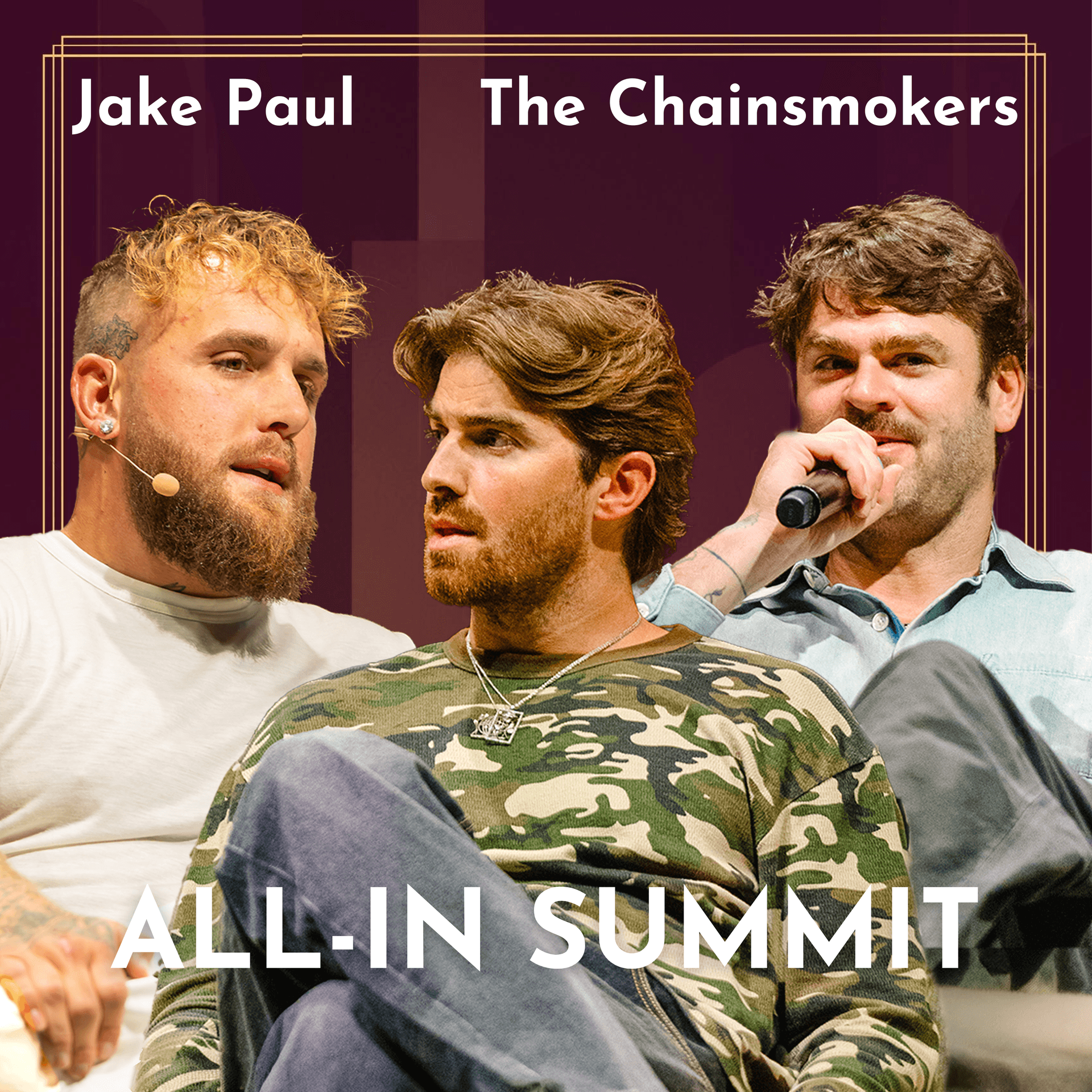
Jake Paul and The Chainsmokers discuss turning attention into business value, the attention economy’s risks, and how fame intersects with investing and venture. They cover Jake’s path from Vine to boxing, his venture/angel investing thesis, and UFC/MMA pay and fighter-first claims. The Chainsmokers discuss their music evolution, nostalgia in pop culture, and how they built a venture investing approach.
Guests (backgrounds)
Jake Paul is a social media creator turned entrepreneur/boxer/philanthropist; he says he started angel investing at 18 and invests in companies including OpenAI, Cognition, and SpaceX. Drew Taggart and Alex Pall are The Chainsmokers, a long-running DJ/producer duo with a Las Vegas residency at Wynn and multiple platinum records.
Key claims
Attention is “currency,” but inauthentic hot takes can degrade content and journalism. UFC underpays fighters (~15% of revenue) and fails to stage big fights; Jake’s MVP claims to compete by improving fighter economics and merging with PFL. Jake’s “anti-fund”/venture approach targets attention-driven awareness and founder value-add.
Notable examples
Vine’s “top 20 Viners” demanding payment; Jake’s early boxing knockout and Tyson/Mike Tyson-viewership reference; The Chainsmokers’ early Hype Machine remix strategy; their investing in startups like Uber (series G mentioned) and a liquidity event via Underdog Fantasy.
Written by AI. May contain mistakes. Listen to the episode to check what was said.
Chapters
Tap a time to open that second in VOJake Paul's Journey in Social Media
0:46 to 2:41
Jake Paul shares his early experiences and motivations in the social media landscape.
“Jake, let's actually start where I think Nick and Clavicular ended, which is in this weird way, all of you guys have grown up in this social media generation, and you're maybe be at the tail end of it.”
Vine's Impact and Transition to Other Platforms
2:41 to 4:28
Jake discusses the demise of Vine and the transition to other platforms like YouTube and Snapchat.
“What did you love about it when you first started?”
The Evolution of Streaming and Content Creation
4:28 to 5:25
Exploring the changes in streaming content and its sociological effects on youth.
“And within a couple of months, the vine died out.”
From Content Creator to Successful Businessman
5:25 to 6:45
Discussion on Jake's transition from content creator to an entrepreneur and angel investor.
“not good streaming content out there and people doing things for clickbait for views just to generate attention.”
Jake Paul's Boxing Journey and Business Strategy
6:45 to 10:31
Jake shares his motivation for boxing and the business strategies behind his success.
“The evolution of content creator tends to be you go from content creator, you're doing sponsorships, maybe you start to roll your own products.”
The Future of MMA and UFC Comparisons
10:31 to 12:31
Analyzing the UFC's business model and the potential for new competition in MMA.
“Why is there an opportunity to rebuild MMA?”
The Attention Economy and Its Implications
12:31 to 13:24
Jake discusses the implications of the attention economy in business and media.
“Jake, what's the downside of an attention economy?”
Investing in the Attention Economy
13:24 to 14:03
Exploring how Jake utilizes his platform for investing and marketing.
“A lot of times there's these crazy hot takes that people are coming up with because they know that it's going to garner a lot of views and make them money.”
Jake Paul's Ambitious Ventures
14:03 to 18:08
Explore how Jake Paul is expanding his brand and vision for the future.
“But also my years of experience in marketing and branding behind the scenes, we help with a lot of that, specifically with OpenAI Sora.”
Jake Paul's Vision for Politics
18:08 to 19:10
Discuss Jake Paul's potential political ambitions and his philanthropic efforts.
“He didn't have that social media native audience where he's making content.”
Show all 23 chapters
The Chainsmokers: From Music to Business
19:10 to 21:08
The Chainsmokers share their transition from music to venture capital.
“If you don't envision your success, you'll never achieve it.”
Evolution of The Chainsmokers' Music
21:08 to 24:15
Explore the creative journey of The Chainsmokers and their approach to new music.
“We've been at the Wynn in Vegas for eight years.”
The Business of Music Today
24:15 to 28:00
The Chainsmokers discuss the challenges and opportunities in the modern music industry.
“And I mean, now there are 300 ,000 songs being uploaded to Spotify every day.”
The Future of Music & Artist Independence
28:00 to 29:20
Exploring how new artists might navigate the evolving music industry landscape.
“And I think we're like on the precipice of that.”
Transitioning from Music to Venture Capital
29:20 to 31:10
The Chainsmokers discuss their journey from music artists to venture capitalists.
“We'll have a whole band and we'll do an arena tour.”
Building a Unique Venture Firm
31:10 to 34:50
How the Chainsmokers structured their venture firm and the importance of partnership.
“And then also like, I mean, I love creative people.”
Insights on Success in Venture Capital
34:50 to 37:10
The importance of hard work and consistent results in venture capital.
“You guys are just extraordinary entrepreneurs to actually make a business work in the music industry is one of the most difficult things you could ever do.”
Advice for Hollywood Stars Entering Venture
37:10 to 40:10
Advice for celebrities looking to enter the venture capital space based on experience.
“I mean, everyone kind of wants to get in it in some way.”
Lessons from Investment Failures
40:10 to 42:00
Reflections on past investment mistakes and the learning process involved.
“And I think that's like one of the, I mean, we're still relatively, it's been seven, 12 years since our first check and seven years since we started the fund.”
Lessons from Robinhood: Mistakes and Insights
42:00 to 44:32
Learn about the significant mistakes and insights regarding investments in Robinhood and the mindset required for successful ventures.
“And, you know, then we're going to be on the hook for it.”
Investment Strategies and Doubling Down
44:32 to 48:01
Explore how investors approach doubling down on investments and the importance of understanding market signals.
“When you look at the great investors of an asset class, it is usually the case that they have no priors in that asset class.”
The Evolution of Unicorns and Market Behavior
48:01 to 50:57
Discuss the changing definition of unicorns in the venture space and the implications of bubble market behaviors.
“But one is they force you to find the one in the portfolio and say, great, we're going to put 25 percent of the capital.”
Closing Thoughts on Fame and Hard Work
50:57 to 52:47
Reflect on the journey from fame to creating lasting success through hard work and dedication.
“And I mean, that's I think that understanding that is really important, going back to like the secondary sort of question and when you get out.”
Transcript
Automatic transcript. May contain errors.0:01Jake Paul has got to be the dumbest, cockiest, stupidest, most egotistical person in the social media sphere. Mr. President, what an honor. That's what makes him so damn successful. The world has shifted to attention being one of the most valuable currencies. He is the multi-talented superstar who bridged the cap between social media and professional boxing. He is a boxer, a content creator, an entrepreneur, a philanthropist. I have two main goals, definitely becoming world champion. And I want to exit a company for$1 billion. I never was like social media is the new wave. I was the wave. Please welcome Jake Paul.
0:58What's up, man? What's up?
1:00Jason Calacanis:How you doing? Good. Hey, don't fall asleep. When I say all, you say in. All. In. All. In. Let's go. Come on, guys. We're at the summit. Get that energy up. Jake, let's actually start where I think Nick and Clavicular ended, which is in this weird way, all of you guys have grown up in this social media generation, and you're maybe be at the tail end of it. You're almost 30 now. Talk to us about your journey, because your journey started very similar to a lot of these guys, which is you're there, you started Vine at the time, so it wasn't even really TikTok and YouTube. And then this success begets success.
1:42Jason Calacanis:And then just walk us through what that does to you as an individual trying to find your way in the world? Yeah, it's a good question. You know, I don't remember a time where like I wasn't already getting followers and people following me and coming up to me since I was super young. And I think for me personally, I was doing it before it was cool and because it was a passion. I think a lot of people now are trying to become influencers and trying to figure it out and seeing if they can go viral and create a team and build businesses around them because it's the cool thing to do and it seems like the best thing to do.
2:25But I think the people that authentically are actually entertaining and have a take and are filling a niche in the entertainment space and specifically on social media are the ones that succeed. I was doing it because I love doing it. and I was good at doing that. What did you love about it when you first started? I loved creating. I loved having a story and an idea in my mind and seeing it come to life and to be able to put it out there into the world and to make people laugh, to change their lives, to maybe make their day a little bit better. People go through hard times and all these things on a daily basis.
3:05So if I could inspire someone in my messages every single day in my vlogs, I would say, make sure you're working hard make sure you're smiling make sure you're chasing your dreams and i think those simple reminders on a daily basis are why i was able to grow a really big audience does the
3:21Jason Calacanis:pressure change your approach to the business as you started to become more and more successful there's millions of people and then in this weird way the platform underneath you goes away and so how did that change when you're like oh my god i have to restart all over again this business that i'd invested so much time in isn't there anymore this is vine specifically yeah i wasn't too worried about it. So it's actually a funny story and it's a good lesson for business owners, but we told the top 20 Viners told Vine, hey, you have to start paying us. Otherwise we're going to stop posting on here because they weren't paying us.
3:56And we knew we were getting ripped off. We were bringing in all of the content, all of the views, all of the fans. And we were like, hey, we need a million dollars. They went back to Twitter and they were like, hey, they want a million dollars. They came back and were like, yeah, we could pay you the million dollars. A million each or a million amongst them. Exactly. So they said, we'll pay you a million. How do you guys want to divide it between you? 20. And we were like, no, we need a million dollars each per year. And they said, no, we all stopped posting on the platform, transitioned to posting on Facebook, YouTube, and Snapchat.
4:28And within a couple of months, the vine died out.
4:31Jason Calacanis:Tell us about the evolution now of streaming and popularity and attention how has it changed from when you started this 15 years ago and what do you think happens to society and these generations of young men and women who now really aspire to be famous and have you know the things that you've built which we'll talk about in a second but what what happens like sociologically to these people yeah you know it's a weird world to grow up in and i i don't think we have the answer to that of how the iPad kid generation grows up and they're able to access so many more things than we ever even were able to do.
5:10I still was in an era where I had to go knock on the door of my friend's house to go hang out with them. And so I got the technology, but also the analog real life. And so I have that balance, but I don't know what it looks like. I think there's a lot of not good streaming content out there and people doing things for clickbait for views just to generate attention. And I used to do that when I was a kid because I wanted to make it and I wanted to build a business and I wanted to build a following. And so I call it the YouTuber disease that people can fall into a lot of times where they're just saying absurd things to generate more press and clicks on a daily basis.
5:58Jason Calacanis:Should YouTube take more responsibility in filtering some of this stuff and actually having more of a, maybe a moral view on what the spectrum of things is that they should support? Well, I think they're just one platform. And I think the problem is, and it's very similar to the AI race that's happening between the United States, Russia, China, is if YouTube stops it, then their viewership and people going to their platform go down and then Twitch, Kik, Twitter, Instagram, TikTok, whatever platform is still going up. So if they don't come together to solve the problem, then I don't think the problem will be solved.
6:39Jason Calacanis:You've had to evolve from making content and you've started to be, I mean, a very successful businessman. The evolution of content creator tends to be you go from content creator, you're doing sponsorships, maybe you start to roll your own products. And then ideally, if there's cash flow, then you can start to actually own assets. Give us your version of that, how it happened for you. Yeah. So I'm an entrepreneur at heart. And so even before I blew up on YouTube, I went to SF in the Valley and fell in love with startups and seeing all of these big companies. I got to go to Google, Twitter, Uber.
7:17I saw people in hacker houses building all of these insane apps. And that's when I started angel investing. And I started my own startup at the time, which was a social media label. And so I always saw vision in people and the potential in people. And so I'd find talent, sign them to my company, Team 10, and help them blow up. And I created 20 or more people with millions and millions of followers and revolutionized like the content house and that was my first startup that I did and so I've always been in the business of startups investing and being in the valley since I was a young kid one of the
7:59Jason Calacanis:things that happened at one point is you had a you started boxing and you had this incredible moment with Mike Tyson I think it was 108 million people watch 138 138 million people watch on Netflix and where did boxing come and why did you feel like you had to put your body at risk I guess maybe and was it because it was you were passionate about the sport or was it that you felt like that was an unexploited way in which you could continue to build awareness and attention yeah so it started off because these two brothers from the UK were talking to me and my brother and we were like yo let's just glove up and settle this.
8:42And I actually, we signed a contract to fight them in like three months it was. And I was like, I'm not going to lose. And I went to a professional boxing gym the next day and it was very grueling, but I grew up as an athlete in Ohio and just started training. And within that three month period, got to be pretty good, went into Manchester to fight them enemy territory and got a knockout and that was one of the greatest feelings in my life it felt very accomplished and it was very fun and I don't know if it's like a little sadistic but it was like cool getting punched in the face and beating someone up and from that moment on It was the biggest pay-per-view in amateur boxing ever.
9:33And I saw the numbers. I loved it. And I wanted to double down and become a professional boxer. And I took it very seriously. Moved out of Los Angeles to go and train in a secluded area in Puerto Rico where there's less distractions. and knew that I could take over the sport of boxing and saw the vision because most boxers build their record up. They fight easy fighters. Then all of a sudden, the first time you hear about a boxer is when they're 20 and 0. But I had this built-in audience of 100 million followers that followed along through every fight and that I could also grow and build fighters underneath me, similar to my original startup, Team 10, where it was influencers.
10:17So I just replicated that model. And now we have 400 fighters boxing MMA under MVP. And we're going after Dana White, Sufa Boxing and the UFC.
10:30Jason Calacanis:Tell us about that. Where is UFC failing? Why is there an opportunity to rebuild MMA? Yeah, so first and foremost is they don't put fighters first. So they pay their fighters roughly 15 % of their total revenue, which in other professional sports leagues, it's 50%, 5-0. And so the fighters are pissed. They want to leave. They want to go box. They want to go find and make money somewhere else. Sean O'Malley got paid$600 ,000 on the White House card. And so because of that, the big fights aren't happening. They're not willing to pay for the big fights, and people don't want to risk it. they're not putting on the fights that fans want to see they're having trouble creating so very classic your margin my opportunity kind of an opportunity where exactly you attract the talent because you're just willing to give them a very significant part of the gate and the ref share and all of that stuff exactly and letting them have sponsorships and and not shelving them there's a lot of drama between the fighters and a lot of them want to move into boxing as as well and so in every industry there's a coke and a pepsi and a nike and adidas and never before has it been possible to compete with the ufc until my company came into the fold and we just merged with pfl and it's it's going to be a very exciting next couple of years how uh and when did you start angel investing because you're an investor in open ai cognition spacex i mean it's an incredible portfolio how did that start so i started angel investing when i was 18 years old after i went to the valley, made a ton of mistakes, and then formalized a fund.
12:08Jeff is your partner. Yeah, Jeff Wu. Jeff Wu. And so we believe that we're in the attention economy and that capital is a commodity. And I think this is part of Elon buying Twitter. When you make a new account on Twitter, the first suggested follow is Elon pumping all of his companies through that. Very smart, obviously. But bringing attention to a company and to a cap table is something that we've found to be extremely valuable and something that founders need and want.
12:41Jason Calacanis:Jake, what's the downside of an attention economy? Like, what is the downside when popularity is how things first get arbitrated? Yeah, no, I think the problem is if people forget to build great things and are focused on just building something to gain attention and to have eyeballs and to make it seem like they're doing something big, that's where there can be downside. And I think the inauthenticity that can come with trying to gain views is a massive problem I see in journalism, in reporting, and in people making content online. A lot of times there's these crazy hot takes that people are coming up with because they know that it's going to garner a lot of views and make them money.
13:39At the end of the day, they're using that attention to try and make money. I think money runs the world. So in an attention economy, the inauthenticity will come through and it's not a good thing.
13:52Jason Calacanis:So your attention mechanism, meaning the followers you have, the reach that you have, is a differentiator when you're investing in these businesses at some level. Because for some of these businesses, you can help them cut through the noise and generate a level of awareness that they wouldn't otherwise get. Correct. But also my years of experience in marketing and branding behind the scenes, we help with a lot of that, specifically with OpenAI Sora. I actually was the one that told them like, hey, this could be a good idea for you to launch a social media app. and was involved in the whole process of building out the app.
14:33Really? With them. Oh, wow. Yeah, and then granted them my NIL to, you know, people can make videos with it. Name interest likeness. Yes.
14:44Jason Calacanis:You just raised$100 million for that fund. You call it the anti-fund. So is this, you're going to compete more aggressively with the traditional VCs or do you want to be sort of a compliment? How do you see this evolving? No, like that's what I hate about this. like celebrity VC thing. That's, it's, it's just annoying. Like if a lawyer is an investor, they don't call them a lawyer investor. So that like, I'm a celebrity, but they call me a celebrity investor. It's like, no, compare me to the Sequoias of the world, our DPI and IRR, and let's see who does better over the next five years. Those are the people I want to compete with.
15:18We're super ambitious and that's the ambition set and where we want to go. Thank you. I'm ruthless out here.
15:31Jason Calacanis:Multi-stage, multi-sector, or how are you sort of evaluating? Yeah, we have a barbell approach. So we already deployed that fund. We were raising and deploying at the same time. So we're on to fund four now and we have a barbell approach. First check-in, helping founders build their company from the ground floor identifying talent or going in growth stage and in companies that have the proven track record best founders in the world with the sams of the world palmers of the world etc and so we diversify on both sides there's um there's a natural evolution as you age which is the things that you did before stop working or they just need to stop obviously like you know boxing you're not going to be able to do forever, but you've been very creative in getting to the next lily pad.
16:20Jason Calacanis:So just as we wrap, tell us how do you see the next 10 or 15 years? Give us the sense of media, fame, attention, business opportunities. How are you organizing Jake Paul Industries? Yeah, look, I think it's a flywheel that feeds itself. When I'm fighting, it brings attention to all of my other businesses. And when I'm investing, it's growing my business brand, but it's something that I'm super passionate about that I'll do forever. When I'm making content, it also helps me grow my following to funnel things into fighting. Then I can also push my businesses, help more people. I have a foundation that we've opened up 40 gyms for kids to go on boxing for free with sending kids to boxing events and tournaments, sponsoring them.
17:10So it's this whole flywheel and ecosystem that kind of feeds the whole empire and completely grows it.
17:20Jason Calacanis:As we wrap, where's 40-year-old Jake Paul? Where do you see him? I think politics.
17:27Jason Calacanis:That's a great answer. Why? I believe that it's one of the best ways to make change in the world. I've already done so much and accomplished so much. and where I get the most satisfaction is out of helping people and where I'm doing that right now is in women's boxing and with young boxers and giving them a pedestal and the biggest paydays of their career. We've completely revolutionized women's boxing and basically made it the WNBA and before they were underpaid, underserved and barely on any fight cards. So I get the most satisfaction actually out of doing that and then you know the appreciation I see from them and I think the next step of that for me is helping the world I believe the best way to do that is some form of politics and actually being ground floor making change and I believe that the future people in office will have a natural built-in following that they can talk to I think I've been saying that for five years, and then recently Spencer Pratt comes along and is the first example of someone who is...
18:39Or Trump was probably the first, yeah. But even him, he's not like a... He didn't have that social media native audience where he's making content. He was a traditional celebrity, and I think even the Nick Shirleys of the world. I think Nick should be in office doing something at some point. But these are the future leaders of the next generation will have that built-in following and be able to capture the vote. Jake Paul, thank you very, very much. Bravo.
19:12Jason Calacanis:Thanks, brother. Yeah, that was great. Who are you performing for? There's nobody here. You have to envision it, man. You have to manifest your destiny. If you don't envision your success, you'll never achieve it.
19:27Their music has gone platinum 25 times. These are the Chainsmokers that are to my right, Alex and Drew. They are one of the biggest DJ groups in the world. You shared a quote when you started Mantis. You know it's the end of the days for VCs when the Chainsmokers start doing this. Music to venture capital, whole different game. Are you legally allowed to say invest in Mantis? tech investing you just get a fun seat view of the future it's the most stimulating show you could watch please welcome drew taggart and alex paul
20:14what's up my guy good to see you great to see you brother what's up brother how you doing good to
20:18Jason Calacanis:Good to see you, man. What's up, bro? Good to see you. Man, last time I saw you guys, me and Friedberg were in the pit. 1 a.m., we're dancing our asses off. You guys threw down. We were impressed. I didn't expect you guys to stay. I mean, I'm there to the sunrise. When you guys stop playing, I got another 20 minutes. I'm good. Friedberg was high as a kite. He was, somebody gave him a pill in Ibiza. He just popped this little thing, and he was dancing like a fool. I'm kidding. I'm kidding. I like the pre-party. Pre-parties are more my scene. Oh, that was the other great part. You go and you're VIP for Chainsmokers.
20:54They have a suite and you go in and there's like 50 guys. And then all these famous people are there. And then they walk you through the tunnel with the Chainsmokers. Boom. And then there's 10 ,000 people in Vegas losing their minds. How long have you been doing that? What do they call it? The residency. The residency. We've been at the Wynn in Vegas for eight years. We've been in Vegas for 10 years and I think we are going to be, we're going to die there. As long as we stay relevant. I wouldn't be buried at EBC personally. I like the beach club better. The win is your LP. That's your anchor LP in your funding.
21:30Exactly. Exactly. Can you guys talk about your evolution in making music?
21:36Jason Calacanis:How did you find each other? How did you guys first figure out the genre of music that was going to work? and then you know this first little burst of success what what did it feel like like what were you what were you thinking would happen probably not this but just yeah um well we met through uh kind of a I guess it's a friend of a friend um and weirdly we didn't know each other at all before Alex had started the chain smokers with a different guy and they had a falling out and he was like okay we put all this work into it you know we're djing all these shows around New York City. This is like 2011, 12.
22:15And then I went to school at Syracuse and was just finishing up around that time. Alex was like, I want to find, you know, a chance to focus with two people. I need another person. And I was just making music at school and we got introduced and weirdly, you know, didn't realize at the time the biggest decision of our life basically met and said, you seem cool. Let's start a band. And here we are 14 years later, still best friends. And we've done a bunch of, had a lot of success in music, luckily. And we're so like-minded in so many other areas, which is the luckiest thing that's ever happened to me.
Read the full transcript
22:49Jason Calacanis:Is it hard to make new music and feel like you're pushing new ground when maybe a lot of people want to hear the classics, so to speak, or they have you kind of like in a certain vein of how your music should sound? We were just talking about that earlier, actually. and you know I think there's one side of the equation is like you know there's a sound that we created that people you know have become come accustomed to hearing from us that we love making and then you see that like one twitter troll that's like you guys make the same song over and over again and then suddenly you're like I'll show you and you sort of you know get away from it a little bit I don't think that one twitter troll is responsible for the genesis of our music but I think we like to challenge ourselves and I think more than anything we just follow our creativity and wherever it goes and we don't have a label on specifically what type of music we think we make but I also think ironically right now there's this big yearning for nostalgia just generally and we find ourselves in this interesting position where there was this big trend in January around 2016 which was a pretty special year for us in our career and you know now we're you know in 2026 coming to the end of it sort of wondering like where do we find that balance between you know what makes our music exciting for us to make and perform but also tap into that I don't know like that special feeling that why why do you think there is this need for nostalgia I mean it's funny you say this because like I listen to the I look at the Spotify playlist of my children who are in their you know teenage years and it's so much throwback stuff they're listening to Elton John they're they're going all the way back and I thought how why is that happening um I mean it's hard to say exactly it's probably different from different segments of people but um I think everyone remembers the past you know more favorably than the present and they want to existentially exist in uh in in a time that they can kind of color and with their own memories and you know I don't know there's like a simplicity we just say like maybe the music was just better back then yeah i think they're well yeah i mean um tell us about the business of music and then we'll talk about the business of business sure um because you guys have done an incredible job of transcending but just you you need a nut you know you need to start your first something the first thing has to work and you have to make it into a real business and you did that explain the business of your business before you do you want to say i'm going to be too negative about the music business i can be positive yeah okay do it i'll start i'll be Yeah, I mean, and the music business is an extremely competitive landscape.
25:31And I mean, now there are 300 ,000 songs being uploaded to Spotify every day. Wow. And this content. 300 ,000 a day. That's right. Wow. Yeah. And so, I mean, when we started in 2012, it wasn't like that. It was pre-streaming. And, you know, I think if we started over today, I have no idea how we would do it. But in 2012, you know, as we were kind of cutting our teeth in dance music and as producers and songwriters, we started doing remixes. We loved indie electronic music. There was this chart called Hype Machine, which was the first viral chart of the Internet. This is way before streaming. And basically how you were charted on this, the algorithm was basically how many times a certain amount of blogs posted about you.
26:19And then that's how you entered the chart. and then how many likes you got on that chart. So what we would do is we'd go to all these artists because we loved all the music that was being posted on this chart and we'd beg them to do remixes. And then Alex went in the back end of Hype Machine and he found every kid that wrote for every blog that they pulled music from. And we'd make this remix of a song they were already posting about and then he would write them these hilarious emails, like super personalized, gave them about where they went to school because what he realized is all these kids are, college kids that want to be closer to artists and you know all these labels that are sending these blanket boring promotional emails it was uninspiring so like they were really receptive to you know Alex's messages and we went from in the first year of our career pretty much being completely obscure to having we now have like 30 number ones on that site because we were remixing the right thing and he was but I think within the first year of our career Alex had developed like the most powerful promotional platform, probably more than any other label at the time.
27:25Jason Calacanis:I mean, it's like content marketing. It's like you guys. I mean, that was just like our hustle at the time. Like that's not applicable now. Maybe it's TikTok. Maybe it's, I don't know if we had to start from that point, but that was kind of our first thing as we were, you know, what we did, what we were learning to be, you know, good producers and songwriters, find our artistic identity. Yeah. Like it feels a bit broken too, when I think about what the music model is right now. And I think there's a lot of parallels between what happens in venture and what happens on the label side of deals. You know, there's more channels for distribution than ever and to create your own audience and goes directly to your fans and create your own community.
28:01And I'm honestly like very interested to see who will be that like first brand new artist that sort of rejects all the typical, you know, customary things that like an artist does like signing with a label and, you know, signing away your next five albums and things like this. And I think we're like on the precipice of that. But I do think there's this sort of like vicious cycle that happens in music where, you know, it's so hard to break through. And when you finally do break through, you're in this position where, A, you're probably being offered your first couple million dollars that you've ever made in your life for something, you know, that you've poured your heart and soul into.
28:34And then you also think about all the people you've admired over the course of your lives. And they all generally sign with labels, too. And so is this like the moment where you decide to like truly bet on yourself and go direct in every sense of the word? or do you sort of like take the slightly safer route, but in the process sort of sell a part of yourself and future self to sort of the label model? And there's a lot of value that labels still provide, I think in different capacities, but I think it's like a completely new world out there right now. I don't think anyone really has a clue what's gonna happen, particularly with like AI and music and streaming and YouTube and all these other platforms and people's attention is getting shorter and shorter.
29:15and you know it's it's a kind of crazy time right now very exciting but also just vastly different than the period of you know music we started but on this years ago on this music side of your lives you guys do a lot of live performance is that where most of the income is then generated is that really the business today is live performance versus digital and once you've kind of broken through there and you've got an audience doesn't that kind of just keep feeding itself it is for us I mean it depends on what type of touring you do I I mean, we have songs that we go and perform sometimes. We'll have a whole band and we'll do an arena tour.
29:47And there's crazy overhead. And luckily for us, like we came up in dance music. We were DJs before we were anything. And that's a big part of, I guess, our touring business. And there's vastly better economics there. So for us, that is the case. Can we talk then about the transition to investing, how you got into it, and how this part of your lives helped you kind of make that transition? Yeah, I mean, Drew kind of touched on it. I mean, I think we've always had a really positive relationship generally with technology. I think we leveraged it in very clever ways throughout our career, like the growth hacking Drew was talking about.
30:22Our friend James created this conference technology called Tilt that we used for touring data. And this is like pre-cloud, pre-sort of all this backend data that was available to us right now. and so I think that like established sort of a positive relationship and honestly like our foray into venture was about as cliche as it gets like we were you know lucky to be a successful artist we had this you know distribution and marketing platform via the chain smokers and thus we were sort of like catnip for consumer brands and you know I think you know that was an interesting exciting time for us to start investing but I think what really struck us and resonated was like the relationship with founders and the ability to like add value back into the businesses and I think that's what caught us off guard.
31:07Instead of kind of treating it like this like passive revenue opportunity, we wanted to be hands-on and like sort of take matters into our own hands. And then also like, I mean, I love creative people. I think it's so amazing to have this, you know, career in music, but there's something inspiring about working with an entrepreneur that's like putting it all on the line, sort of going 24-7 towards this like pretty, you know, big goal. And I won't lie, like more water companies is not what the world needs. and we were meeting great founders like Brian Chesky and Drew Houston and Michael Seibel and the Khan brothers and you sort of got to ask yourself, you're like, where do we want to be spending our time and money?
31:45Most of this stuff probably won't work out. At least let's invest in things that we think are truly interesting, could actually have a positive impact on the world. I remember personally, I invested in the series G of Uber or something, the final round and I thought it was the smartest, coolest thing I ever done. I've made like 25 bucks on that investment to date. But that to me was the sort of thing that we wanted to be a part of in the future. And I think that led us down a path to institutionalizing our access, becoming really great partners to companies in cybersecurity, AI, infra, deep tech, and taking it incredibly seriously.
32:25How did you learn to assess your selection process? So, you know, these things are coming in. You've not seen a cybersecurity company before, I'm assuming, the first time you saw one. You know, how do you start to make these choices? Yeah, I mean, I think, like, on some levels, that was the big question. It was like, we definitely have an interest here. I think, like, the most important piece was, like, we're going to show up and we're going to be good partners. Like, I'm not going to do the traditional, like, you know, song and dance to get what we want and then sort of disappear into the fray.
32:50But I also agree, like, we weren't super clear on, like, what does a cybersecurity company need? But I think what was interesting is after speaking with a ton of founders that we've been lucky enough to build relationships with, it felt like the things that were keeping them up at night and challenging them as they built their business in the modern present day were a lot of the things that we had a lot of experience with. And sort of what I mean by that is we make music almost the same way we did 15 years ago. But everything else around that business has completely changed in terms of how we distribute it, create community, sell it, tour it, and all these things.
33:23And I think building a company, obviously, you still care about, you know, revenue, net dollar retention, customer acquisition costs, COGS, all those things. But the inputs by which you create them is different. And it felt like there was an opportunity to build sort of a differentiated type of firm that isn't necessarily supposed to be a substitute for a craft or Sequoia or whoever's out there, but be like a collaborative partner. And sort of like, for lack of a better term, like understand our role in the ecosystem.
33:47Jason Calacanis:Can you unpack then what does the firm look like then? I mean, we're, you know, me, Jeff, Drew Milan founded it. We have, you know, a few great partners in like Ingrove. We, you know, specialize in or focus at least across cyber, AI, infra, deep tech and health tech. And we invest in series A stage companies. We don't take lead positions. We like being the sixth man of the year on these teams. It's sort of like I think of ourselves as like Robert Horry. Like Robert Horry is a ton of championship rings, you know, and you could be really successful and you don't have to be, you know, Shaquille O 'Neal.
34:20on every team. And I think we've learned a lot by working with great firms. And we've also learned a lot by working with great founders. And that's sort of getting back to your question is the kind of the whole point, which is like, beginning to build that muscle, that pattern recognition on what greatness looks like, what are these firms doing to support these founders. And then I think we all over exaggerate like what everyone is actually doing for these companies. And I was surprised by like, you know, I get an email saying like, hey, do is there any way you can get me in, you know, on the phone with this person?
34:48And it was like, actually, yes, we played their company party three days ago. That's no problem. And so we've been like extraordinarily helpful when it comes to like go to market relationships, brand, you know, sort of the brand building side of things, which I think is, you know, become really important nowadays when you talk about like the defensibility, indefensibility that AI is created around tech, you really need to like suck the oxygen. I mean, this is a critical point. You guys are just extraordinary entrepreneurs to actually make a business work in the music industry is one of the most difficult things you could ever do.
35:22It's a magnitude more difficult than making software. And so you have, I think, a lot of credibility there. And go to market and being able to support people in networking, and then also knowing when to get out of the way. The great founders very rarely need help. And when they do, something like networking or something like understanding the business model, you are actually very well connected to do it. And deal flow is the hardest part of being a venture capitalist. We are blessed with this podcast, you know, gives us the ability to get a lot of deal flow. And you're blessed with the fact that, hey, you guys are very well respected in your field.
35:59And, you know, a lot of the people who are founders have probably come to see you play and might have jammed out to your music. And I think it's absolutely valid. And, you know, for people to kind of goof on it or whatever, you're doing the work. It's very easy to goof on venture capitalists, but it's hard work. I love being the underdog. Like that's the best position. It's the best position. And I think like I wouldn't bet against us. And I don't think anyone that has it's worked out with, but like keep letting us, keep underestimating us. I'm happy to be in that position. But like, we love the hard work.
36:30We love showing up. That's always been in our DNA. You know, for us, it's, it's, this is an incredible opportunity. I mean, I studied art history at NYU. you. Like, all of this is unbelievable to me, to be in this position doing any of this stuff. So we don't take it for granted, but like, it's, you know, these things are people's life work and, you know, life's dreams. And, you know, to be able to go, you know, play shows all over the world for our fans and see the experience that what our music means to people. I mean, it's the most fulfilling thing I can imagine doing with our lives. You know, as tech has gotten bigger and bigger, I mean, I've noticed that there's a tremendous curiosity from people in Hollywood.
37:08I mean, not just music business, but acting or the agencies. I mean, everyone kind of wants to get in it in some way. You guys have invested in like a ton of unicorns. I mean, you have a phenomenal track record of the companies you've gotten into. It's very impressive. I'm curious, like what advice would you give someone in Hollywood who maybe has like huge stardom, you know, is very well known and they're like, who could get allocations and deal just based on their name, but they have no idea how to do it. What would your advice to them be? I mean, I would ask them if they paid off their mortgage first.
37:40And if they've done all of that stuff, I'd say like venture is probably the last frontier to begin investing in, in my opinion, because it is long duration, illiquid assets generally. I mean, venture is also just extremely hard. I mean, you're talking about, you know. Extremely hard. We were looking at some chart yesterday in our chat, just like the, you know, top 5 % generate 90 % of returns. Like you have to just be in the best companies. And so when you're, it's, it's brutal out here to have success in two things, whether it's sports, Hollywood, music, um, and then venture, like you just, you got to approach it the same way.
38:19Like you have, we dedicate all of our time to these two things. Like we work 24 seven, we are heavy in the streets. We've seen a lot of people that have asked us, you know, you know, we want to get into the venture game and you know it's very rare that those usually when we meet with them we meet with their teams and they don't show up for the call and uh i don't think people realize like how much work it is like does your fame help raise personally every deal we've had to get in because there's a lot of noise basically you have to sift through that to find i don't think people want to do that like i really i think the idea of venture is super exciting but what it takes is grind extremely hard.
38:58Does your fame help, hurt, or neutral? I think both. I mean, to be honest, I mean, I think there's obviously opportunities to connect with people that probably would, I mean, I'm on LinkedIn all the time leveraging my name and getting in touch with people that I want to speak with. But then there's obviously the fundraising side where you're speaking to a principal at an institution and they're just like, listen, I like what you're doing, but I'm not about to invest in the Chainsmokers Fund because you'll be the first thing that will pointed out to me if something goes wrong. And I understand that.
39:29And I think you need to be empathetic to that point. And I think, you know, we just are always been results driven guys. So it's like, all good. I'll be back next fund with numbers that will make you regret this decision. And we'll try this again.
39:40Jason Calacanis:I think you're saying something incredibly powerful. It is so, I think like if I learned anything in that chapter of my life as an investor, the ability to generate consistent DPI cuts through all the noise because they could have issues with you or not, people have had issues with me and not, but what's undeniable are returns and the ability to convert whatever asset you have, attention, fame, track record, technical experience, whatever, into results really does speak for itself. Because that's the one thing I think investors have a very good tendency to do is they have an extremely short memory for everything other than returns.
40:15And I think that's like one of the, I mean, we're still relatively, it's been seven, 12 years since our first check and seven years since we started the fund. And And, you know, I still feel like the new kid on the block. And I feel like, you know, what's challenging right now, and I'm sure you guys have discussed ad nauseum up here, is just like there is so much liquidity going into everything right now that, you know, it's not just about riding in a company that you know is going to get marked up just by virtue of the people involved. And I think that, like, that's the hard part, but also, like, the responsibility of being a good manager, which is, like, really investing in, like, ideas, founders, businesses that feel real and tangible versus sort of like the hypey side of venture, which is, you know, very relevant.
40:57And you could honestly go out here and invest in a, you know, there's a ton of companies where you're like, I know this is just going to get marked up, but I just don't see the vision long-term for where this company heads. And I think that's the challenge as someone that like, yes, I love those results, those, that TVBI always looks great, but like, you know, really betting on a bigger vision idea. Like, I mean, obviously Airbnb at the time, Uber, when you did Jason, like that was a non-obvious decision. To your point, I introduced 21 angel investors to Travis and 19 said no. Three said yes. Me, Simon, Bannister and first round capital.
41:37Jason Calacanis:Why do you think they said no and you guys said no? I can tell you the reasons. They said, well, this is a dirty business in the real world. We don't want to be involved in it. We invest in software companies. If he will just sell the software, a very famous venture capitalist told me, if you can convince Travis to just sell the software to the cab companies, we'll back it. But we don't want to be in that dirty real world business because somebody is going to get hit by an Uber and die. And, you know, then we're going to be on the hook for it. It's just, it's too complicated. It's too dirty. And Robinhood was the same thing.
42:07I mean, they looked at Robinhood and they laughed at that company. And we were in that company before they left. I remember when that company was raising its seed series A, it was a total joke. People were like, this is the dumb thing.
42:16Jason Calacanis:It's not a, it was a huge mistake. I'll tell you what I made wrong in Robin Hood. It was purely my own ego. They had a sign-up list of like some number of millions of people. And one of our principals was really adamant that we invest in this business. And what I couldn't get over was my own previous experience at Facebook and how I had helped architect its growth mechanism. And it violated too many priors for me. and I just couldn't get around it. And when you look at that, that's a billion dollar mistake, which is horrible. By the way, I really resonate with that. We don't invest in any music apps or anything related.
42:54It's almost too close. Because I have a very hard time sort of not being a pessimist about these opportunities. And I think you have to, I don't want to call it blind optimism, but sort of pragmatic. Any investment you've made where you've lost money, you never invest in that space again. It's so common. Or if you've had success. Yes, it's just too close. But like, oh, we're going to get rid of the manager. And you're like, what? No chance. I'm like, you know, these things you experience. The one thing that will cut through all of that biases is just understanding how capable this person is, you know, and how difficult and driven they are.
43:29And that is at the core. When I met Vlad and his partner and they said, we're going to get millennials to invest and we're going to do it because they're going to invest for free. All I thought to myself is these guys are extraordinary. They're so smart and they're quants and now they're going to build this app. Right. What if it works? And that is the hard question is to just pause for a second and say, if this does work, what does the world look like? And now we're over 10 years in Robinhood. I've never sold a share. In fact, I bought a lot of shares when it was$9 a share in the public market again.
44:01You've still not sold? Still haven't sold a single share. I mean, I've sold a lot of Uber over the years because it was 99 % of my net worth at one point and it was no choice but to do that. but I still hold a lot. And Robinhood is a very special company because now you have two generations of people on it. And Vlad keeps launching the next vertical, the next vertical, the next vertical, until he's not running that company and he doesn't have the product vision and execution. Those things can't be faked. Execution cannot be faked.
44:32Jason Calacanis:Here's an interesting observation. Not sure if it's true or not. When you look at the great investors of an asset class, it is usually the case that they have no priors in that asset class. You know, Mike Moritz was a journalist, right? John Doerr was, you know, Intel chip sales. And look at the wood that they chopped in the internet. No priors. If you look at this next current generation of people coming up that are like super investors. So there is something to be said for being far away. But having that curiosity and the ability to network and the ability to think critically about a problem, I think that's a very good thing to do.
45:05How are you guys now thinking about, you know, when I pick venture funds to be in, I have these like four Ds, like deal flow. You guys got that. Decision making, you're very sharp, obviously, and you're very astute in terms of your own careers. But then there becomes a doubling down and when to double down an investment and then when to distribute, when to sell shares in it. You're actually at that point now, if you're in year 10, how do you think about doubling down on an investment or not? And then how are you thinking about distribution selling too early, which is actually how you're successful in this business in some cases?
45:37It's a really good question. And, you know, we're coming up on our seventh year. We actually just had one of our first proper liquidity events with a fun one company. Shout out to Underdog Fantasy. What company? Underdog Fantasy. Oh, okay. So, it's IG International, which was a great outcome. How great is that day to send your LP to? Amazing feeling. Amazing feeling. And I think, like, partially, you know, we think about this a lot because, in my mind, it's like we've made 75 % of the business model. But, like, we really need to get, you know, the cash back to our investors. Otherwise, none of this really matters at the end of the day.
46:09But I do think a lot about the profile of the people, and especially early on in Funds 1 and Funds 2, who invested with us. And they're not here really generally to play it safe with us. So I think we have a little bit of more liberty to ride out the winners. But I think that's exactly that. It's like you have to really be involved in these companies. I mean, Dandy and Fund 1, which is an amazing company that continues to double every single year, just started international expansion. you're just like I'm riding this thing to the wheels fall off but I think like in the context of where you know AI is today and all the capital flowing into it and then all the you know external conversations around it I mean I wake up every day and I'm like you could probably build a business model about getting into super serious competitive series A's adding value and just getting out of the series B or C and just that is like your guaranteed rule that's not what we're doing but I think you know it's important to pay attention to those signals and I actually think Like there's a few companies in our portfolio that I won't name where I'm like, it's interesting to watch the demand before around and then the price gets set.
47:14And then the feeling around that company at that new price. And then either the demand sort of builds again or it kind of stays where it is. And it's very interesting to pay attention to the sort of signal supply and demand feeling. Obviously, the secondary market setter emails every day and these like, you know, secondary market opportunities to get liquidity. but I think that's where you need to spend a lot of time on the underwriting and try to really understand the potential of these businesses. On the follow-on piece, it's all about concentrating in your winners. I think that's a skill that takes time to learn and experience to have the balls to know what that is.
47:50I want to credit Brian Singerman to lecturing me for two hours once about the importance of follow-on. You can architect it into your fund.
48:00Jason Calacanis:You know, I mean, founders fund, I think what's what's brilliant about them on many dimensions. But one is they force you to find the one in the portfolio and say, great, we're going to put 25 percent of the capital. Every fund. Every fund. You've got to find one, which, to your point, is incredibly scary. If you're forced to sit there and you have to underwrite a deal, your deal, the other partner's deal and cut everything else. Yeah. I mean, it's like literally scary. It's like saying, like, I'm going to go live at this founder. So I'm actually going to become an employee of this company for the next three months and, you know, figure out a way to have, you know, the leverage to convince them to basically put that size of check in, which isn't like something we've traditionally had a lot of, you know, experience doing in the past.
48:42But it's I think like when I look back, like the signals were always there, like I always knew the ones that we should have been doing that with. it's just I think we're just taking the steps I think one at a time to get comfortable to a place where you have the guts and sort of understand the intangible signals around these things that make it Have you thought about doing like a growth fund? Because some people do that where they'll have the sidecar where they'll be able to put a ton of capital in versus concentrating the main fund Yeah, I mean we debate this all the time we're growing into the idea of a growth fund I mean, the other option that is very elegant is SPVs, and I can trade notes with you on it, but it's worked pretty elegantly for us.
49:26And one of the things that's starting to happen, which you're going to experience shortly, is if you do the job right, you'll curate a bunch of LPs. We have a bunch of family offices who want to do late stage. So they're very interested in the Zipline deal, the Vast deal, the Adams deal that we did. And then I have early stage investors. We had a company that broke out, Go.ai, and we had early-stage investors who invested sub -$10 million who wanted some liquidity and there was some litiquity. We were modest sellers. And then we had so many late-stage funds that wanted to buy it. We were also buying at the latest round at$500 million,$600 million.
50:02Sequoia is having this happen now, and so is Founders Fund. They are investing in companies, whether it's Stripe or SpaceX, et cetera, and they're also selling at the same time. And because companies are staying long for so long, you can actually build both of those parts of the business into one. And I think that's where venture is going is you could have a very nice late stage business with just your top 10 people. I'm blown away by the size and scale of these companies now. I mean, saying the word billion, even like 12 years ago or 10 years ago was like the thing you had said where you're like, you know, will you lick the pavement and I'll give you like a billion dollars.
50:37You know, it was like such a rational number. And now it's a billion in revenue. Like I think being a unicorn now really should be redefined, not on the valuation, on the revenue. I consider unicorns a billion in revenue. I don't care about the paper value anymore. I want to see, and we have one company that's just hit 700 million in revenue. I'm like, okay, 300 million more to go, you'll be a unicorn. Yeah. And I mean, that's I think that understanding that is really important, going back to like the secondary sort of question and when you get out. Because, I mean, you know, at the end of the day, it's just another you're just passing bags around sometimes in these instances.
51:09And, you know, these double, triple tranche deals that are happening right now, which I honestly completely understand from the Sequoia benchmark index client perspective, because I don't feel like their cost of capital is the same necessarily as everyone else's. but like the guy piling on that second tranche is paying a significant markup, sometimes two or three X with the company is initially valued at for absolutely no change in underlying performance. That's bubble. That's bubble market behavior, by the way, when you see that, that's when you take a little,
51:38Jason Calacanis:as we, uh, as we wrap, maybe final question. Do you guys still perform? Still perform every now and then for you guys? Yeah. Well, yeah, we'll make an exception. Yeah. What are you guys doing tonight? You guys, any plans tonight? We'll come by. Do you guys have a thumb drive? If Friedberg can tell us where we're going. I think I've texted you like, I got tequila for you. It'll be great. We'll share a bottle of tequila before. I haven't tried you guys' tequila yet. Friedberg is going to break it down tonight on the dance floor. So watch out, everybody. It's really impressive what you guys have done.
52:08Jason Calacanis:Yeah. Thank you for having us. Well done, gentlemen. It's the same pattern over and over again, meaning you have some attention and fame, you develop some mastery, and then you've got to translate it into something. But I think I'll leave it on this note. Great to see people translate. Celebrities are so good at being like, oh, this is shiny and I'm excited by this. But after three months, that shininess wears off and all you're stuck with is the actual hard work that goes into making anything successful. And I think that's always been our difference, which is like - Put in the work. We don't actually care about the first three months.
52:35Put in the work. Do the work.
52:37Jason Calacanis:You're an overnight 15 year success. Here we go. All right, thank you guys. Give it up for the chain. Smoker. Boom, that's awesome. Yeah, we'll see you in a couple hours. That's great, yeah, very good.
From the publisher
(0:00) Jake Paul joins the Chamath!
(6:41) Turning an audience into businesses, the boxing playbook & coming for the UFC
(11:54) Attention as capital, investing without the celebrity label & why politics is next
(20:46) Drew Taggart & Alex Pall join the Besties!
(30:35) From artists to investors: picking deals, playing the sixth man & what fame buys
(37:33) Advice for famous investors, whether fame helps or hurts & the non-obvious bets
(46:10) Riding winners, getting cash back to investors & spotting bubble behavior
Thanks to our partners for making this possible!
IREN is a vertically integrated AI Cloud platform, delivering data centers, compute and software for AI training and inference. https://iren.com/
Oracle connects the data, applications, and infrastructure that turn AI into business outcomes—with the flexibility, choice, and control to optimize as AI evolves. http://oracle.com/ai
EY helps tech innovators scale from startup to exit to megacap. You build the future. We'll handle the rest. http://www.ey.com
Meta believes the future is for everyone. We're focused on giving every person the tools to reach their full potential and making sure the benefits of technology are distributed to all. http://www.meta.com
Keel Infrastructure owns the power, land, and connectivity that HPC and AI run on - backed by secured energy assets and established grid interconnections across North America. https://keelinfra.com/
Airwallex - Agentic Global Business Accounts. Open local accounts in 70+ countries to accept payments, earn yield, pay globally, and manage spend. http://airwallex.com
PayPal has been revolutionizing commerce globally for more than 25 years. Creating innovative experiences that make moving money, selling, and shopping simple, personalized, and secure, PayPal empowers consumers and businesses in approximately 200 markets to join and thrive in the global economy. For more information, visit https://www.paypal.com
Google for Startups connects founders with the right people, products, and best practices to help startups build faster and go further. https://startup.google.com/
Explore ideas, industries, and technologies worth understanding with Chamath every week on Learn with Me: https://research.socialcapital.com/allin
Follow the besties:
https://x.com/chamath
https://x.com/Jason
https://x.com/DavidSacks
https://x.com/friedberg
Follow on X:
https://x.com/theallinpod
Follow on Instagram:
https://www.instagram.com/theallinpod
Follow on TikTok:
https://www.tiktok.com/@allin
Follow on LinkedIn:
https://www.linkedin.com/company/allinpod
Intro Music Credit:
https://rb.gy/tppkzl
https://x.com/yung_spielburg
#allin #tech #news