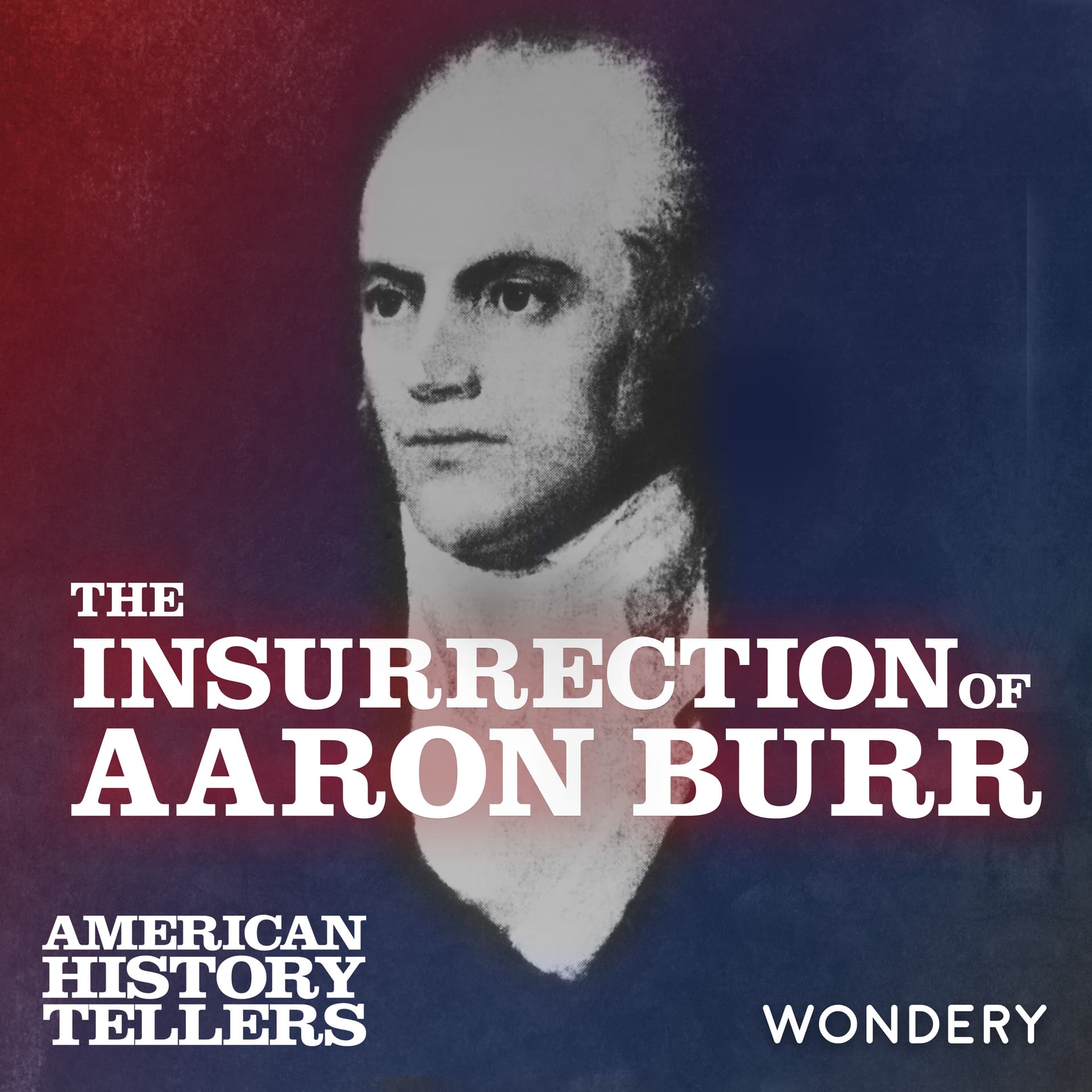

In short
Episode 1 of “The Insurrection of Aaron Burr” (American History Tellers) covers Aaron Burr’s rivalry with Alexander Hamilton, the July 11, 1804 duel at Weehawken, and how Hamilton’s death led to Burr’s political collapse and later treason charges. It also traces Burr’s rise: Revolutionary War service, legal career, election politics, the 1800 Electoral College tie, and his alienation from Jefferson after being dropped from the 1804 ticket.
Guests
No episode guests are mentioned; it’s a narrative history episode hosted/produced by Lindsey Graham.
Key claims
Burr’s duel was driven by long-running insults to his honor and reputation; Hamilton’s shot allegedly went high while Burr hit him in the abdomen; public outrage and a coroner’s murder charge pushed Burr into exile and conspiracy. Burr later offered help to Britain to separate the western U.S.
Notable examples
Burr’s secret 1804 meeting with General James Wilkinson; Hamilton’s Albany dinner remarks; the 36th House ballot that gave Jefferson the presidency; Hamilton’s last words (“I am a dead man”).
Written by AI. May contain mistakes. Listen to the episode to check what was said.
Chapters
Tap a time to open that second in VOThe Duel with Hamilton
0:22 to 3:36
Explore the dramatic events leading up to the duel between Aaron Burr and Alexander Hamilton.
“It was August 1807 when Aaron Burr stood trial for treason in Richmond, Virginia.”
Burr's Political Rise
3:36 to 14:00
Discover Aaron Burr's early life and political career leading up to the insurrection.
“Police in Irvine, California are investigating the double murder of a young couple in the parking lot of their apartment complex.”
Political Maneuvering in 1801
14:00 to 14:36
Explore the dynamics of the 1801 election and Burr's unexpected ambitions.
“The Constitution requires that the House of Representatives breaks the tie.”
The Confrontation with Burr
14:36 to 16:52
Experience a tense dialogue between a congressman and Aaron Burr regarding the presidency.
“For the past month, you've been embroiled in trying to get your candidate, Thomas Jefferson, elected president.”
Hamilton's Dilemma
16:52 to 18:08
Learn about Hamilton's reluctance to support either presidential candidate and his views on Burr.
“You're infuriated that his obstinance could clear the way for the Federalists to hand him the presidency.”
Tied Votes and Political Fallout
18:08 to 18:48
Discover how the House voted on the presidency and the implications for Burr and Jefferson.
“principled option, declaring, there is no doubt but that upon every virtuous and prudent calculation, Jefferson is to be preferred.”
Burr's Rising Ambitions
18:48 to 20:04
Analyze Burr's ambitions after being elected vice president amidst party tensions.
“his new vice president could not be trusted.”
The Louisiana Purchase and Political Impacts
20:12 to 22:45
Examine the implications of the Louisiana Purchase and Burr's political maneuvers.
“On March 4, 1801, Aaron Burr was sworn in as America's third vice president.”
Burr's Political Downfall
22:45 to 24:50
Trace Burr's decline in political standing and the implications of his actions.
“In February, a Republican caucus dropped him from the ticket, nominating New York Governor George Clinton as Jefferson's running mate instead.”
The Duel Between Burr and Hamilton
24:50 to 28:00
Delve into the tensions leading up to the duel between Aaron Burr and Alexander Hamilton.
“He was humiliated and brimming with resentment.”
Show all 14 chapters
The Origins of the Burr-Hamilton Rivalry
28:00 to 30:45
Explore the escalating tensions between Aaron Burr and Alexander Hamilton leading up to their duel.
“For Burr, 13 years of festering resentment was the fuel.”
The Fateful Duel
30:46 to 35:08
Detail the events and emotions surrounding the duel between Burr and Hamilton.
“A week after Burr sent his first letter, he began demanding that Hamilton answer to every statement he had ever made about Burr in public or in private.”
Aftermath of the Duel
35:09 to 39:39
Understand the consequences of Hamilton's death for Burr and the political landscape.
“The doctor rushed to Hamilton's side as the wounded man gasped, I am a dead man.”
Burr's Unfolding Conspiracy
39:40 to 41:08
Investigate Burr's plans and aspirations following the duel and Hamilton's death.
“Burr and his second, Van Ness, both noted that Hamilton put on his glasses and appeared to take careful aim.”
Transcript
Automatic transcript. May contain errors.0:00American History Tellers:Audible subscribers can binge new seasons of American History Tellers early and ad-free right now. Join Audible in the Audible app or by subscribing on Apple Podcasts. We're hard at work to bring you fascinating new seasons that include criminals, gunfighters, and pilgrims. But in the meantime, we're revisiting a fan favorite, our series on the insurrection of Aaron Burr. It was August 1807 when Aaron Burr stood trial for treason in Richmond, Virginia. From the heights of power to the depths of conspiracy, here is the story of how a vice president became a notorious traitor.
0:44American History Tellers:Imagine it's just after dawn on July 11, 1804. You're sitting across from your close friend, Vice President Aaron Burr, in a boat on the Hudson River. Four oarsmen are rowing you from Manhattan to Weehawken, New Jersey, where Burr is scheduled to duel his bitter political rival, Alexander Hamilton. You are serving as his second. And as you look over your shoulder, you follow his gaze to the imposing rock face of the palisades ahead. You sure you want to go through with this? You can turn back. Burr lifts his chin. I've been insulted. I must defend my honor if I'm going to maintain people's respect.
1:20American History Tellers:That's the only way I'll have a chance of ever holding elected office again. Or perhaps I could undertake some last-minute negotiations. There's still time to resolve this before weapons are drawn. No, you spent weeks trying to settle this matter. The time for negotiations is over. You're risking everything. I'm over a few words spoken at a dinner party. Now, you know perfectly well that this is not about one insult. I have evidence that Hamilton has injured my reputation on countless occasions. and refuses to own up to it or apologize. As far as I'm concerned, this duel is completely justified.
1:55American History Tellers:Burr smooths a wrinkle in his black silk coat. You're amazed by how calm and determined he is. Still, you know that duels rarely end in death. The point of them is not to demonstrate marksmanship or deadly intent. Burr and Hamilton are making a dramatic public stand to prove that they are men of courage, principle, and honor. But you can't seriously intend to kill the man, right? So what will you do? Aim for his leg? I have a plan, and everything will work out as I intend. Well, I hope it does. I have my doubts. This duel will change everything. Look what Hamilton's done in my career. I have nothing to lose, I tell you.
2:33American History Tellers:Everything to gain. Nothing to lose? What about your life? I mean, it's unlikely, but your daughter has already lost one parent. This could make her an orphan. No, I won't come to that. You turn around to see the cliffs now looming above you. There's no reversing this now. Burr's smoldering anger toward Hamilton has never been so intense. But as you approach the shore, you're overcome by a nagging feeling of dread that one of these two men may not leave New Jersey alive.
3:07Being a serious business owner takes hard work, patience, and a drive to keep moving forward. so it's important to find a serious business card that goes the extra mile. With the VentureX Business Card from Capital One, you earn unlimited double miles on every purchase. And with big purchasing power, you can spend more and earn more. This is your sign to take your business to the next level. The Capital One VentureX Business Card. What's in your wallet? Terms apply. See CapitalOne.com for details. Police in Irvine, California are investigating the double murder of a young couple in the parking lot of their apartment complex.
3:45A double homicide grabs the public's attention by the throat. We have identified Christopher Dorner as a suspect in this double homicide. A former cop and still on the loose. Considered armed and extremely dangerous. And scariest of all, he left something behind. A particular interest is a multi-page manifesto. This manifesto on Facebook is 11 pages long. Trace, this manifesto from this suspect who's targeting cops, it's stunning. Listen to the show The New Yorker calls one of the best podcasts of the summer. Dan Taberski's Manifesto.
4:20American History Tellers:And I tell you, this manifesto, it scares the hell out of me. Listen to Dan Taberski's Manifesto wherever you get your podcasts or binge the entire series right now, only with Audible.
4:42American History Tellers:From Wondery, I'm Lindsey Graham, and this is American History Tellers. Our history, your story.
5:03American History Tellers:On our show, we take you to the events, the times, and the people that shaped America and Americans. our values, our struggles, and our dreams. We'll put you in the shoes of everyday people as history was being made, and we'll show you how the events of the times affected them, their families, and affects you now. On July 11, 1804, Vice President Aaron Burr and former Treasury Secretary Alexander Hamilton faced each other on the dueling grounds of Weehawken, New Jersey. Their duel was the culmination of a long and bitter rivalry, and its outcome ended Hamilton's life and Burr's career in politics.
5:39American History Tellers:Aaron Burr was a Revolutionary War hero, a celebrated lawyer, and the sitting vice president. But after he killed Hamilton, he became a pariah and a fugitive. Desperate to regain power, Burr cast his eyes on what was then America's western frontier, the newly acquired Louisiana Territory. There, he traveled down the Ohio and Mississippi Rivers, hatching a plot that drew support from politicians, planters, army officers, and foreign diplomats. Two centuries later, many of the details of Burr's conspiracy remained shrouded in mystery. But the plot ended in the most sensational legal spectacle in the young nation's history, as Burr became the highest-ranking American official ever to be charged with treason.
6:23American History Tellers:Just 30 years after the founding of the republic, questions persisted over whether America's experiment in self-government would survive the threats of foreign influence and domestic upheaval. Aaron Burr's ambition and intrigue, and the trial that followed, ultimately tested the bonds of union and the nation's commitment to the principles of its founding. This is Episode 1 in our four-part series on the insurrection of Aaron Burr, an affair of honor.
6:54American History Tellers:Aaron Burr was born on February 6, 1756, in Newark, New Jersey, to one of America's most distinguished families. His father was the president of Princeton University, and his grandfather was one of New England's most esteemed preachers, famous for his fire-and-brimstone sermons. Burr was destined for a life of privilege, but his childhood was marred by loss. His mother, father, and three of his grandparents all died from sudden illnesses before his second birthday. He and his older sister were placed in the care of an uncle. When Burr was just thirteen, he entered Princeton himself. As he grew older, he spent much of his time there charming women in local taverns.
7:35American History Tellers:He was charismatic, intelligent, and handsome, with piercing hazel eyes. Though small in stature, he still cut an elegant figure in impeccably tailored clothes. After graduating with a degree in theology, Burr moved to Connecticut to study law. But in the spring of 1775, he heard the news that British and American troops had skirmished at Lexington and Concord. These were the first clashes of the Revolutionary War. Burr was 19 years old, and he immediately left his studies to enlist in the Continental Army. Burr fought heroically in the American invasion of Quebec, then served briefly on George Washington's staff.
8:13American History Tellers:In 1777, the then 21-year-old Burr became one of the Army's youngest lieutenant colonels, assuming command of 300 soldiers. He endured the famously brutal winter at Valley Forge, defending an isolated pass with a small unit of men. Bad health led him to resign from the Army in 1779 and resume his studies. Three years later, when he was 26 years old, he married Theodosia Barto-Pravost, who was 10 years his senior and the widow of a British Army officer. The couple moved to New York, where Burr passed the bar. They soon had a daughter, also named Theodosia. By then, it was the early 1780s, and Burr had become a successful lawyer in New York, where he often found himself in court alongside a fellow war veteran, Alexander Hamilton.
9:01American History Tellers:Hamilton had risen from humble origins to become George Washington's aide-de-camp, and in many ways had a promising young career like Burr did. The two men were on friendly terms, and they occasionally worked together as co-counsels. Burr was polished and terse, carefully choosing each word he uttered in court, while Hamilton dazzled judges and juries with speeches that could last two or three hours. But their paths soon diverged. While Hamilton participated in the Constitutional Convention, Burr stayed back in New York, avoiding the contentious political debates to focus on his law practice. But in 1784, he entered state politics, serving a one-year term in the New York State Assembly.
9:40American History Tellers:Five years later, in 1789, he was appointed as the New York State Attorney General. That same year, Hamilton joined President Washington's cabinet as America's first Treasury Secretary. Two years later, in 1791, Burr decided to enter the national political arena himself by challenging Philip Schuyler for his seat in the U.S. Senate. Schuyler was Hamilton's powerful father-in-law. The stakes were high. Hamilton desperately needed Schuyler's votes to carry out his economic plans for the new nation. But Burr was a skilled politician and shrewdly avoided controversial issues, using his natural charisma to charm voters and raised money by promising favors to wealthy supporters.
10:23American History Tellers:When the votes were counted, Burr won the election. But his defeat of Schuyler ignited a feud with Hamilton, who wrote, I fear Burr is unprincipled. He is for or against nothing but as it suits his interest and ambition. I feel a religious duty to oppose his career. In an era when high-minded officials like Hamilton viewed public service as a solemn duty, Burr stood apart for relishing the game of politics. Burr arrived in the Senate just as the first American political party started to emerge. Hamilton was becoming the leader of the Federalists, who supported a strong national government. Secretary of State Thomas Jefferson led the Republicans, who favored a weaker national government, fearing that a strong central authority would threaten states' rights and individual freedoms.
11:10American History Tellers:These two clashing ideologies came to define the contentious politics of the early republic. And during his time in the Senate, Burr became most closely aligned with the Republicans. But he worked with both parties, which meant that neither side completely trusted him. More inclined to listen than talk, he kept his opinions close to his chest. He wrote letters and cipher, and often avoided writing his thoughts down altogether. His secretive nature made many of his fellow politicians suspicious. But the impression that Burr was holding something back was also part of his appeal. One man who met him said, There is no human more reserved, mysterious, and inscrutable.
11:49American History Tellers:Burr made people want to know more, and he took his mysterious charm on the campaign trail. In 1796, Burr made a failed bid for the vice presidency. He ran as a Republican, though he maintained alliances within the Federalist Party. Despite his loss, other Republicans recognized his ability to marshal votes in the North. The new vice president, Thomas Jefferson, wrote to Burr noting his esteem for the younger man. But Burr did not just lose the vice presidency. He also failed to win re-election in the Senate. After this string of defeats at the national level, he returned to New York, where he was re-elected there to the State Assembly in 1798.
12:27American History Tellers:He became a major player in state politics, and in April 1800, New York held an election with national implications. Incumbent President John Adams was facing a challenge from Republican leader Thomas Jefferson, but without New York's 12 electoral votes, Jefferson had no clear path to the presidency. Republicans needed a strong showing in local New York elections to ensure that they had the power to choose the state's presidential electors and hand Jefferson the victory. To manage these New York state assembly races, Republicans looked to Burr, their most prominent northern leader. But to win, Burr would have to outmaneuver the political wile of Alexander Hamilton, who led the Federalists' efforts in the state.
13:10American History Tellers:In the end, Burr won, and his success solidified his reputation as a masterful politician, an important Republican asset in the North, and the party's nomination for vice president. But as the election of 1800 got underway that fall, it exposed a major flaw in America's electoral system. The Constitution mandated that presidential electors each cast two votes for president. But under that system, there was no way to distinguish between votes for president and vice president. It was simply the candidate who received the most votes that became president and the runner-up who became vice president.
13:46American History Tellers:Under these rules, in December 1800, the election ended in a stunning result. Jefferson tied with his running mate. Both he and Burr received 73 electoral votes. Adams came in third with 65 votes. The Constitution requires that the House of Representatives breaks the tie. So lining up behind Jefferson were loyal Republican congressmen. Meanwhile, many Federalists who hated Jefferson began throwing their support behind Burr, considering him the lesser of two evils. This didn't worry many Republicans because they expected Burr to stand down and announce that he would not accept the presidency or compete against the leader of his party.
14:27American History Tellers:But they would soon discover that their rising star had different plans.
14:35American History Tellers:Imagine it's early January, 1801, and you're at home in Philadelphia. For the past month, you've been embroiled in trying to get your candidate, Thomas Jefferson, elected president. The astounding tie in the Electoral College has caused some confusion. You are hoping tonight to settle the affair by inviting Aaron Burr to your home and pressuring him to step aside. When he arrives, you politely usher him into your parlor with a quick bow. Mr. Burr, thank you for making the time. Please take a seat. You gesture toward a sofa, and Burr sits down. You take a seat in a chair facing him. Now, I've invited you here on behalf of my colleagues.
15:15American History Tellers:The fact of the matter is, it's time you bow out of this race. Our party chose Jefferson, not you. The public favors Jefferson, too. He served far longer at the national level, and if I can be frank, sir, he has a more impressive record of achievements. Burr's lip curls. Well, how could I possibly respond to such flattering praise? Oh, be serious, sir. Time is running out. If the House doesn't come to a decision by Inauguration Day, This country will be left without a chief executive. Your fellow Republicans are counting on you to be loyal. How can you accuse me of disloyalty? Need I remind you that I am the reason our party won New York?
15:51American History Tellers:Yes, which we are all grateful for. But now it's time to stand down. I will do no such thing. If the House elects me as president, I will accept their choice and serve my country. Mr. Burr, you are playing a dangerous game. You must know you're risking political suicide by challenging Jefferson. Your safest option is to accept the vice presidency. You're still a young man. You have plenty of time to reach the presidency. Well, be that as it may, I will not declare myself unworthy of the presidency when it's simply not true. No one is saying you're unworthy of the presidency, sir. We are asking you to recognize that Jefferson is more worthy.
16:26American History Tellers:So if the House does choose you, will you make a pledge to resign after the fact? To allow Jefferson to take office? Burr abruptly stands and looks down at you with disgust. Oh, you insult me. I will take the office of president if I am deemed worthy of it and elected by the House. If you'll excuse me, I must be going. Good day, Congressman. You watch Burr walk out, shocked by his audacity and his betrayal of the party. You're infuriated that his obstinance could clear the way for the Federalists to hand him the presidency.
17:01American History Tellers:In late December 1800, Burr made it clear that while it had not been his intention to seek the presidency, he would not reject it if the House chose him over Jefferson. He told a Republican congressman he was offended by the assumption that he should resign if elected president, calling the suggestion unnecessary, unreasonable, and impertinent. Confounding the Republicans was the fact that most Federalists in the House had decided to support Burr. But this was too much for Federalist leader Alexander Hamilton. He did not want to support Burr, but was also reluctant to support Jefferson, with whom he had repeatedly clashed over policy matters in President Washington's cabinet.
17:39American History Tellers:But Hamilton saw Burr as little more than a selfish, untrustworthy opportunist. He wrote, Burr is bankrupt beyond redemption. His public principles have no other aim than his own aggrandizement. If he can, he will certainly disturb our institutions to secure himself permanent power and with it wealth. So in the end, Hamilton bucked his party, lobbying Federalist congressmen to support Jefferson over Burr. As much as Hamilton despised Jefferson, he saw him as the more principled option, declaring, there is no doubt but that upon every virtuous and prudent calculation, Jefferson is to be preferred.
18:15American History Tellers:He is by far not so dangerous a man, and he has pretensions to character. But Hamilton had his work cut out for him. On February 11th, the House took a vote, and once again Jefferson and Burr tied. The vote remained deadlocked for another five days. Finally, on the 36th ballot, enough Federalist congressmen abstained to hand the victory to Jefferson. Burr would be his vice president and at long last, the election was over. But Republicans were made very angry with Burr for refusing to step aside. And Jefferson was left feeling his new vice president could not be trusted. Burr's political fortunes were fading fast, But he was still as ambitious as ever, and he would do whatever it took to salvage his career and climb higher.
19:06American History Tellers:During World War II, New York communist Julius Rosenberg began spying for the Soviet Union. Soon he was persuading other Americans to betray their country as well. But when his wife's brother joined the Manhattan Project, Julius targeted him as a valuable new recruit and inadvertently set the stage for the ultimate betrayal. Hi, I'm Lindsey Graham, host of Audible's original show, American Scandal. We bring to life some of the biggest controversies in U.S. history. Presidential lies, environmental disasters, corporate fraud. In our latest series, two young New Yorkers meet and fall in love. Julius and Ethel Rosenberg's commitment to each other is matched only by their commitment to communism.
19:45American History Tellers:And the couple risks everything to help the Soviet Union develop an atomic bomb. But when they're uncovered, they have to make an impossible choice about where their loyalty truly lies. Follow American Scandal wherever you get your podcasts. Audible subscribers can listen to all episodes of American Scandal The Rosenbergs ad-free right now. Join Audible today by downloading the Audible app.
20:12American History Tellers:On March 4, 1801, Aaron Burr was sworn in as America's third vice president. He had completed a meteoric rise to the second-highest office in the land. But for Burr, there was no victory in claiming second place. Republican Party leaders resented him, believing he had conspired to steal the presidency. President Jefferson froze him out. And suddenly finding himself alone and powerless, Burr spent most of his vice presidency at his home in New York. He returned to Washington for just a few months a year to fulfill his sole vice presidential duty, presiding over the Senate. Hamilton described the new animosity between Burr and Jefferson, declaring, There is a schism absolutely incurable, because founded in the breasts of both is the rivalship of an insatiable and unprincipled ambition.
21:01American History Tellers:As president, Jefferson had a lax governing style and a preference for avoiding conflict. He believed in small government, declaring, I am for a government rigorously frugal and simple. But his most notable presidential accomplishment was the Louisiana Purchase. In 1803, the French Emperor Napoleon desperately needed new funds for his war with Britain. He offered to sell Jefferson more than 800 ,000 square acres of land between the Mississippi River and the Rocky Mountains for$15 million, roughly four cents an acre. Jefferson worried that he lacked the constitutional authority to acquire the new territory.
21:39American History Tellers:But in the end, his desire to expand the nation's borders won out. In December 1803, the deal was finalized. And overnight, the Louisiana Purchase doubled the size of the United States and gave America the Mississippi River and the Port of New Orleans. Many Americans celebrated the news, and the popularity of Jefferson and the Republicans soared. And that was good news for the Republican Party and Thomas Jefferson. In January 1804, the next presidential election was looming, and with it, the party's decision for a candidate for vice president. Seeking to hold the office, Aaron Burr met with Jefferson.
22:15American History Tellers:He defended his conduct in the previous race and asked for a mark of favor that would demonstrate Jefferson's confidence in him as a running mate for a second term. But Jefferson refused, declaring he considered it his duty to be merely passive and take no part in the selection of his running mate. But in his personal papers, Jefferson noted the real reason, that from his earliest dealings with Burr, his conduct very soon inspired me with distrust. Burr's fears for his political future were well-founded. In February, a Republican caucus dropped him from the ticket, nominating New York Governor George Clinton as Jefferson's running mate instead.
22:53American History Tellers:So Burr changed course, deciding to fight for Clinton's old job. That spring, Burr entered the New York governor's race. And since his relationship with the Republican Party had frayed, Burr ran as an independent and began courting Federalists for their votes. Many New England Federalists resented the Louisiana Purchase, fearing that it would enlarge the power of the agricultural South. Some extremists believed the only option was to secede from the Union, and a group of secessionists approached Burr for his support. In typical fashion, Burr kept them guessing about his true beliefs. But these secessionists decided to back his candidacy anyway, hoping he would reward them with his support once he was in power.
23:34American History Tellers:So Burr appeared to be getting the Federalist support he needed to win the race. But one Federalist was determined to stand in his way again, Alexander Hamilton. In the 13 years since their rivalry began, Hamilton's hatred toward Burr had only grown stronger. Hamilton had dedicated his career to shaping the young nation, with a long record of accomplishments as Treasury Secretary. He viewed politics as a profession built on honor and principle. But in Burr, he saw a cynical politician with no real values or policy achievements. So in the spring of 1804, Hamilton went on the attack. After he got wind of Burr's meeting with the secessionists, he accused Burr of plotting to destroy the Union.
24:17American History Tellers:He warned a fellow Federalist that if Burr reached the governor's mansion, a dismemberment of the Union is likely to be one of the first fruits of his elevation. Others sought to undermine Burr as well. Some of the most bruising attacks came from the influential Republican newspaper, The American Citizen, which published a list of 20 prostitutes who named Burr as their favorite customer. On May 1st, Burr lost the race for governor by a wide margin. He would continue as the lame-duck vice president for another year. But his chances of higher office had all but disappeared. He was humiliated and brimming with resentment.
Read the full transcript
24:57American History Tellers:While Burr was stewing over his loss in late May of 1804, he received a letter from an old friend from the Revolutionary War, General James Wilkinson. In the letter, Wilkinson asked to meet in secret at Burr's New York mansion. Wilkinson was the general-in-chief of the entire U.S. Army. He was also the country's most prominent Westerner, having lived in Kentucky for 20 years. He arrived at Burr's New York mansion fresh from New Orleans, where he had personally accepted the Louisiana Territory from the French on Jefferson's behalf. Wilkinson and Burr met for several days, poring over recent maps of Spanish lands in the West.
25:34American History Tellers:What they discussed is unknown, and the two men formed an odd pair. While Burr was reserved and polished, Wilkinson was loud, brash, and known for excessive drinking. He sported garish uniforms of his own design and rode a horse with gold spurs and stirrups and a leopard-hide saddlecloth. But despite their differences, Burr and Wilkinson were both ambitious men who shared frustrations with the Jefferson administration. Jefferson had made Burr a political outcast. He also reduced the size of the army and slashed its budget, actions that Wilkinson bitterly resented. In one furious letter to Burr, Wilkinson called lawmakers in Washington a set of prating puppies and coxcombs.
26:17American History Tellers:Wilkinson felt no deep loyalty to the federal government. Back in the late 1780s, he had begun selling American secrets to the Spanish, having sworn an oath of allegiance to the Spanish king, and even made vague promises that he would encourage Kentucky to separate from the Union and become a Spanish protectorate. Nearly two decades later, Wilkinson was still a paid spy for the Spanish crown, known as Secret Agent No. 13. So it was clear both Wilkinson and Burr craved power, and both men were consumed by anger that sprang from wounded pride. Huddling together far into the night, this pair reached an understanding.
26:55American History Tellers:It would not be the last time they would hold covert talks.
27:02American History Tellers:Licking his wounds after his defeat in the governor's race in New York, Burr suspected that Alexander Hamilton had played a major role in his loss. In June 1804, Burr got proof. He received a copy of a newspaper article stating that Hamilton called Burr a dangerous man and one who ought not to be trusted with the reins of government. The article went on to describe an Albany dinner party prior to the election in which Hamilton had voiced a still more despicable opinion of Burr. For Burr, this insult printed in a newspaper was the final straw. To defend his good name and redeem his political reputation, he was prepared to challenge Hamilton to a duel.
27:43American History Tellers:Duels were known as affairs of honor, and despite being illegal, they were governed by elaborate sets of rules. According to formal dueling code, a person could present a challenge after receiving a public insult to their honor. If the challenge could not be settled through apologies or negotiations, it would be settled with pistols. For Burr, 13 years of festering resentment was the fuel. Hamilton's dinner party remarks were the spark. On June 18th, Burr wrote to Hamilton, demanding he confirm or deny the report that he had uttered a despicable opinion of Burr. But Hamilton refused. Letters flew back and forth between the two men.
28:22American History Tellers:Burr would not back down until he was satisfied that he had defended his honor.
28:29American History Tellers:Imagine it's June 25th, 1804, in New York City. You're a lawyer and a close friend of Alexander Hamilton. For the past week, you've been acting as a go-between between him and Aaron Burr. You've met several times with Burr's friend William P. Van Ness in the hopes of negotiating a truce between these two bitter political rivals. Today, you're sitting with Hamilton in his upper Manhattan office, desperate to find a solution. All right, Alexander, tell me what you said at the Albany dinner. Hamilton leans back in his chair, a weary look on his face. I'm afraid my recollections are hazy. I remember I spoke of Burr's politics, but I am certain I made no reference to his character or conduct.
29:10American History Tellers:Well, it sounds like Burr won't rest until he knows exactly what the alleged despicable opinion is, or until you deny you said it. The man's spoiling for a fight. You nod in agreement as you unfold the latest letter from Burr's friend Van Ness. And that's not all. According to this, Burr doesn't just want an explanation for the Albany slur. He's now requesting that you offer a full disavowal of all previous attacks on his character. He is making impossible demands. How can he ask me to deny all I've ever said about him? I couldn't possibly do that without lying. And then he could use my words against me in a future election.
29:44American History Tellers:I think he's raising the stakes. And I don't think he's going to stop. Even if it means taking it to the dueling grounds. Hamilton rises and stares out the window. His two young sons are chasing their sister in the garden. I am opposed to dueling. How could I not be after what happened to Philip? You nod sadly, thinking about Hamilton's eldest son, who died three years ago in a duel. You could do what Burr wants and apologize. It would put an end to this. Hamilton looks at you in alarm. And who's my honor and political standing? No. Write back to Van Ness. Tell him I was prepared to discuss this fairly, but now that Burr is asking for general disavowal, I see nothing but hostility on his part.
30:27American History Tellers:Taking a fresh sheet of paper from Hamilton's desk, you begin composing a letter to Van Ness. And much to your dismay, it's becoming increasingly clear that this rivalry between Burr and Hamilton will only end in violent confrontation.
30:45American History Tellers:In late June, discussions between Burr and Hamilton continued to escalate. A week after Burr sent his first letter, he began demanding that Hamilton answer to every statement he had ever made about Burr in public or in private. Hamilton knew it was an impossible request. He saw it as a calculated attempt to antagonize him. So he had his friend Nathaniel Pendleton write to Van Ness, accusing Burr of predetermined hostility. On June 27th, Van Ness sent a response. He declared that Burr was determined to vindicate his honor, a formal challenge to a duel. Hamilton desperately wanted to avoid a duel, but he felt he had no choice if he wanted to protect his honor and political standing.
31:27American History Tellers:Most duels were resolved long before pistols were drawn, and even when opponents went through with a duel, it rarely resulted in anyone's death. It was common for duelists to deliberately fire into the air rather than take aim at one another. The mere act of showing up was enough for a man to prove his courage and recoup his honor. So now Hamilton and Burr would fight for their honor on the dueling ground. Burr demanded retribution for Hamilton's insults, and he was ready to make a dramatic public stand to restore his name. For both the vice president and the former treasury secretary, failure to appear at the duel would mean nothing less than political suicide.
32:16American History Tellers:At 5 o 'clock in the morning on July 11, 1804, Aaron Burr climbed into a boat on the Hudson River with his friend William Van Ness. The pair set off for New Jersey, where Burr was scheduled to duel with Alexander Hamilton later that morning. Both Burr and Hamilton kept the duel a secret from their families. Burr wrote his 21-year-old daughter Theodosia, directing her to burn various letters in the event of his death. He also addressed his finances. Though Burr was a successful lawyer, he lived beyond his means. He told Theodosia that he hoped that his assets would be sufficient to cover his many debts.
32:53American History Tellers:He concluded his letter by declaring, You have completely satisfied all that my heart and affections had hoped or even wished. For his part, Hamilton left a letter to Eliza, his wife of twenty-five years and the mother of his seven children. In it, he wrote, If it had been possible for me to have avoided the duel, My love for you and my precious children would have been alone decisive, but it was not possible, without sacrifices which would have rendered me unworthy of your esteem. As Burr rode across the Hudson from New York to New Jersey with Van Ness, he was calm. Morning sunlight glowed down on the shore as they arrived in Weehawken.
33:30American History Tellers:The location was chosen because the penalties for dueling were less harsh in New Jersey than they were in New York. And once they came ashore, the pair climbed up the small wooded area set into the side of the rock palisades, roughly 20 feet above the water. There they began clearing debris from the ground. Hamilton and his second, Nathaniel Pendleton, arrived 30 minutes later, carrying two pistols in a small leather case. A doctor remained in their boat, ready to treat any wounds. The mood was somber and formal, as Burr and Hamilton exchanged greetings. Van Ness and Pendleton loaded the pistols and measured the distance that would separate the duelists, a full ten paces.
34:10American History Tellers:Burr and Hamilton then each chose their weapons and took their positions. At last, Burr and Hamilton faced each other, both desperate to recoup their standing and ready to settle their rivalry once and for all. Pendleton called out, present, the signal to fire. Hamilton asked for a moment's pause so he could put on his glasses. Then Burr and Hamilton settled into a duelist stance. They leveled their pistols at each other, and two shots rang out in quick succession. Hamilton's shot went high into the air. Burr's hit Hamilton in the abdomen. Hamilton cried out in pain and fell to the ground. Van Ness and Pendleton disagreed over whether Hamilton deliberately fired into the air to avoid harming Burr.
34:53American History Tellers:Whatever his intention, Burr stood unhurt while Hamilton lay on the ground, breathless and ashen-faced. As the smoke cleared, Burr took a step forward toward Hamilton, a flash of regret on his face. but he knew it was dangerous to linger. He quickly turned and fled the site. The doctor rushed to Hamilton's side as the wounded man gasped, I am a dead man. This is a mortal wound. Hamilton lost consciousness and was rowed back to Manhattan. He lingered in pain for another 31 hours with his wife and seven children by his side. At 2 p.m. on July 12th, Hamilton took his last breath. He was 47 years old.
35:34American History Tellers:Americans were shocked and outraged by the death of Alexander Hamilton at the hands of the vice president. A Charleston newspaper wrote that in place of a heart, Burr had only cinders raked from the fires of hell. The Republican paper, The American Citizen, described Hamilton as a victim to a wicked system of deadly hostility planned by Mr. Burr. Across the nation, people were shocked and mourning. Hamilton's funeral was a grand, solemn affair that brought New York City to a standstill. Amid outcry over Hamilton's death, the New York coroner's jury began a formal investigation. Burr wrote to his son-in-law, describing how the reaction to the duel has driven me into a sort of exile and may terminate in an actual and permanent ostracism.
36:17American History Tellers:Burr decided to flee town, declaring that he wanted to let public opinion take its proper course. But Burr showed little remorse for his actions, even in the face of public scrutiny and a potential murder charge.
36:33American History Tellers:Imagine it's late at night on July 24th, 1804, and you're at home in Philadelphia. It's been just two weeks since your friend Aaron Burr killed Alexander Hamilton in a duel. Burr has since fled Manhattan, and you've been up all night waiting for him to arrive here, where you've promised to keep him safe. When you hear a knock, you walk past your servant to answer the door yourself. You find Burr on your doorstep, looking weary. Oh, come in, come in. How was the journey? Long and hot. Your servant takes Burr's bag as you usher him into the sitting room. Please, take a seat. And pour us two brandies, please.
37:12American History Tellers:I'd prefer a glass of claret. Oh, of course. Your favorite. Burr nods gratefully as you hand him the glass of red wine and sit down beside him. Your eyes flicker in the direction of the newspaper on the table. The page is open to an editorial about the duel. Well, it appears you're still the talk of the town. Tell me, was it truly necessary to challenge Hamilton like that? You know, he was my friend, too. Burr crosses his arms over his chest. It is well known that Hamilton had long indulged himself in attacks on my character. I could no longer stay silent and retain my self-respect. Did you know that Hamilton put on his glasses before he aimed his pistol?
37:51American History Tellers:He clearly intended to make a fatal shot. I've heard. But I've also read that he pledged not to shoot you. At least, that's what his second Pendleton says. He did fire his weapon into the air, did he not? Doesn't matter now. And my conscience is clear. You take a sip of wine, surprised at Burr's defiant posture. Was it really wise to leave town? Oh, what choice did I have? The coroner's jury is filled with my enemies. I'm expecting the worst. So what will you do now? Perhaps you should defend your actions in court. I mean, you're the best lawyer in New York. No, I have other plans. starting with some important business to attend to here in Philadelphia.
38:27American History Tellers:Oh, and what might that be? All will be revealed in due course. You raise your eyebrows, hoping for more details. But Burr stays silent. Well, you're welcome to stay here as long as you need to, but you must consider that fleeing will do little to salvage your reputation. I'll take care of my reputation, thank you. I always have. People who say this is the end of my career will soon eat their words. You narrow your gaze as Burr downs the rest of his wine. It seems unlikely to you that Burr can wriggle his way out of this predicament, much less stage a political comeback. But you know if there's anyone with the ambition and fearlessness to make it happen.
39:06American History Tellers:It's Aaron Burr.
39:11American History Tellers:In late July, Burr traveled to Philadelphia, where he stayed in the home of a friend. He was on the run, a decision that would prove to be wise. On August 2nd, the New York coroner's jury charged him with murder. Its report declared that Burr had killed Hamilton willfully, feloniously, and with malice aforethought. Burr insisted the charges were politically motivated, and that his duel with Hamilton was justified. He also maintained that he had only shot Hamilton in self-defense, after Hamilton gave every indication that he intended to shoot Burr first. Burr and his second, Van Ness, both noted that Hamilton put on his glasses and appeared to take careful aim.
39:50American History Tellers:But Hamilton and Burr's intentions in the duel remain unclear. It seems unlikely that either man went to the dueling grounds planning to murder the other. When Burr issued his challenge, his main intent was apparently to prove to the world that he was a gentleman, prepared to nobly and courageously defend his honor. He believed the duel would revive his career, but instead, because of Hamilton's death, it had destroyed it. Burr was left a man on the run, deeply in debt, and shunned from both political parties. Despite still being the sitting vice president, the public now saw him as little more than a murderer.
40:26American History Tellers:But Burr vowed to rise again. He was already plotting his return to power. In early August, he sent a friend to visit Britain's ambassador to the United States, Anthony Mary. Mary later sent a dispatch to London describing the meeting. He reported that Burr had offered to lend his assistance to His Majesty's government to effect a separation of the western part of the United States. It was an extraordinary proposition. The sitting vice president of the United States of America had offered his services to a foreign power for no lesser purpose than to break the Union apart. Burr had embarked down a path of betrayal, and there was no telling where his conspiracy would end.
41:08American History Tellers:From Wondery, this is episode one of our four-part series, The Insurrection of Aaron Burr for American History Tellers. On the next episode, after stepping down from the vice presidency, Burr journeys south on the Mississippi River, collecting allies and funds to support mysterious plans for rebellion and conquest. American History Tellers is only possible because of listeners like you. So thank you. And don't miss an episode. Be sure to follow American History Tellers on Audible or wherever you get your podcasts. Audible subscribers can binge new seasons of American History Tellers early and ad-free right now.
41:46American History Tellers:Join Audible in the Audible app or by subscribing on Apple Podcasts. And to find out more about me, including my other podcasts, my live show, the history tours I'm arranging, and all sorts of other things, go to HistoryIsHuman.com. That's HistoryIsHuman.com. American History Tellers is hosted, edited, and produced by me, Lindsey Graham, for Airship. Audio editing by Molly Bach. Sound design by Derek Behrens. Music by Lindsey Graham. This episode is written by Ellie Stanton. Edited by Dorian Marina. Produced by Alita Rozanski. Our managing producer is Matt Gant. Senior managing producer is Tonja Thigpen.
42:24American History Tellers:And our senior producer is Andy Herman. Executive producers are Jenny Lauer-Beckman and Marsha Louis for Wondery.
From the publisher
In July 1804, Aaron Burr faced political rival Alexander Hamilton on the cliffs of Weehawken, New Jersey, in a legendary duel that would change Burr’s life forever.
As a young man, Burr had distinguished himself as a patriot, lawyer and politician. But as his political star rose, he made many enemies. He challenged Thomas Jefferson, in the tumultuous Election of 1800, but his greatest rival was Jefferson’s Treasury Secretary, Hamilton.
After he shot and killed Hamilton, Burr’s career was in shambles. But soon, he would hatch an audacious conspiracy to return to power – by forging his own empire.
Be the first to know about Wondery’s newest podcasts, curated recommendations, and more! Sign up now at https://wondery.fm/wonderynewsletter
Listen to American History Tellers on the Wondery App or wherever you get your podcasts. Experience all episodes ad-free and be the first to binge the newest season. Unlock exclusive early access by joining Wondery+ in the Wondery App, Apple Podcasts or Spotify. Start your free trial today by visiting wondery.com/links/american-history-tellers/ now.
See Privacy Policy at https://art19.com/privacy and California Privacy Notice at https://art19.com/privacy#do-not-sell-my-info.
