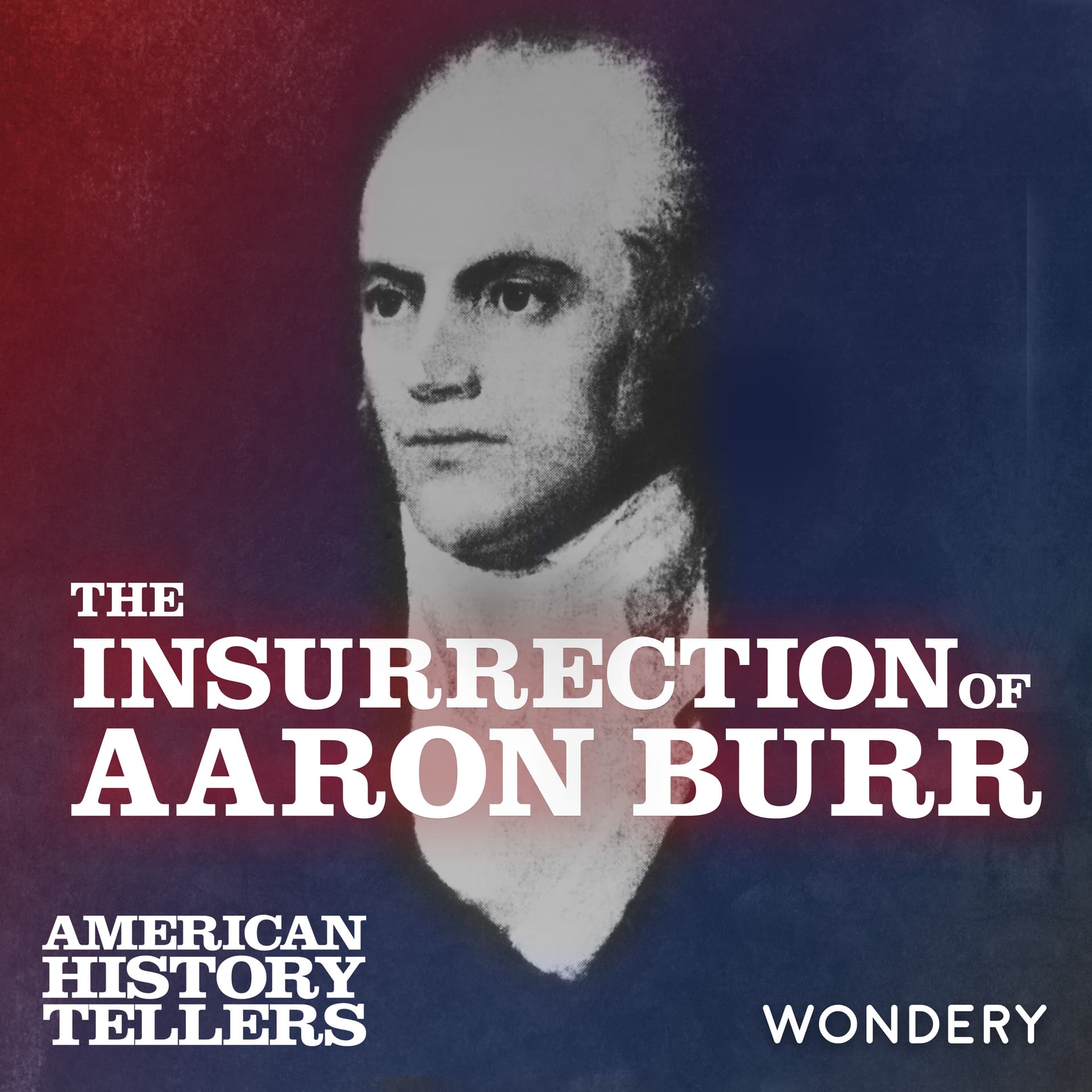

In short
Aaron Burr’s 1806 expedition from Blenner-Hassett Island toward Spanish Mexico, the escalating conspiracy rumors, and the “severance of the Union” plot—ending with Burr’s arrest without a shot fired.
Guests (none)
This episode is narrated by American History Tellers hosts Lindsey Graham and Matt Ford; no external interview guests appear.
Guest backgrounds (if any)
Not applicable.
Key claims
U.S. attorney Joseph Hamilton Davis warned Jefferson about Burr and General James Wilkinson’s alleged Spanish-linked conspiracy; Wilkinson double-crossed Burr by forging reports and later doctoring Burr’s cipher letter. Jefferson’s cabinet ordered arrests and interception; Jefferson publicly proclaimed Burr’s treasonous aims as “severance of the Union” and “attack on Mexico,” effectively judging Burr before trial.
Notable examples
Davis’s St. Louis interrogation of Wilkinson; the Frankfurt, Kentucky Western World newspaper series; Burr’s dinner with Colonel George Morgan; Wilkinson’s forged “New Orleans plot” report; Ohio militia seizing 11 boats; Burr surrendering near Natchez (Jan 17, 1807).
Written by AI. May contain mistakes. Listen to the episode to check what was said.
Chapters
Tap a time to open that second in VOSetting the Scene for Burr's Expedition
0:49 to 3:11
Imagining the atmosphere and motivations of men preparing for a secret mission.
“You're on a large island in the Ohio River with about 30 other men.”
Overview of Burr's Conspiracy
5:26 to 6:28
Exploring the mysterious nature of Burr's mission and the rumors surrounding it.
“In early December 1806, 30 men gathered on Blenner-Hassett Island near Marietta, Ohio.”
Davis's Warnings to Jefferson
6:34 to 8:30
U.S. Attorney Joseph Hamilton Davis's efforts to inform President Jefferson about Burr's plans.
“Further warnings of Burr's intentions continued to trickle into the White House, and in Kentucky, a dogged federal prosecutor became determined to bring Burr down.”
Davis's Confrontation with Wilkinson
8:33 to 11:30
Davis's visit to General Wilkinson and his suspicions regarding Burr's plot.
“So Davis decided to take matters into his own hands.”
Burr's Preparations and Mistakes
11:45 to 14:01
Burr's attempts to recruit men and the critical mistakes that could lead to his downfall.
“He left the meeting convinced that Wilkinson was leading a sinister plot against the United States.”
Burr's Ambitious Plans and Secession Predictions
14:01 to 19:21
Explore Aaron Burr's bold plans for secession and invasion, alongside his interactions with key figures.
“that the overtaxed West would soon secede from the Union.”
Presidential Response to Burr's Threat
19:21 to 19:32
Learn about President Jefferson's response to the emerging threat posed by Burr and his conspirators.
“And Jefferson resolved to quash Burr's dreams of conquest and preserve the Union no matter the cost.”
Presidential Response to Burr's Threat
21:19 to 22:49
Learn about President Jefferson's response to the emerging threat posed by Burr and his conspirators.
“He informed them of an audacious plot to rebel against the United States, led by former Vice President Aaron Burr.”
The Investigation Against Burr Intensifies
22:49 to 26:51
Follow the escalating investigation into Burr's activities and the efforts to thwart his plans.
“But Burr's travels in Kentucky placed him just a few miles away from District Attorney Joseph Davis.”
Wilkinson's Forged Report and Jefferson's Proclamation
26:51 to 28:00
Discover the implications of Wilkinson's forged report and Jefferson's subsequent public response.
“militia to stop Burr and his followers before this plot escalates any further.”
Show all 16 chapters
The Proclamation of Jefferson
28:00 to 30:06
Learn about Jefferson's urgent response to the conspiracy rumors concerning Burr.
“It also noted that naval support might be provided by the British.”
Burr's Grand Jury Outcome
30:06 to 33:53
Discover how Burr navigated political challenges and public opinion during his trial.
“declaring that they found no evidence of criminal conduct.”
Wilkinson's Martial Law
33:53 to 36:22
Understand how General Wilkinson took control of New Orleans amidst the chaos.
“and finally fulfilling what he believed to be his destiny.”
The Arrest and Surrender of Burr
36:22 to 42:01
Follow Burr's journey as he confronts the consequences of his ambitions amidst military opposition.
“You're a county judge in New Orleans, and for several weeks your city has been under the thumb of General James Wilkinson.”
Burr's Surrender and Aftermath
42:01 to 44:33
Learn about Aaron Burr's surrender and the political fallout surrounding him.
“called the vile fabrications of a man notoriously the pensioner of a foreign government.”
Burr's Escape and Upcoming Trials
44:33 to 45:07
Explore Burr's escape plans and the trials he faced as a fugitive.
“Burr began to dream up desperate new plans for power and glory.”
Transcript
Automatic transcript. May contain errors.0:28Hello, American History Tellers listeners. That's AmericanHistoryLive.com. Come see my Days That Made America tour live on stage. Go to AmericanHistoryLive.com.
0:48Imagine it's early in the evening on December 7th, 1806. You're on a large island in the Ohio River with about 30 other men. You've been a farmer your whole life in Pennsylvania, but after years of struggling, eking out a living, you've recently joined an expedition to the southwest, where you hope you can start over. That expedition has taken you here, to prepare for some sort of secret mission. You and another recruit named Thomas are standing in a snow-covered field near the riverbank, practicing your shooting. He looks at you and nods. All right, your turn. You squint into the fading light, raising your weapon and aiming at your target, the center of an X you carved in a tree 20 yards away.
1:30You inhale, exhale halfway, then squeeze the trigger. As the smoke clears, you see you've hit your mark, just an inch or two off center. Thomas grins. That's not bad for a farmer. You smile and turn around to look at the other men. Some are setting up camp, but most are huddled around a fire, swapping stories while they melt lead into bullets. You know, Thomas, have you heard any more about what we're doing here? The man who brought me in promised I'd get$12 a month and a plot of land on the Ouachita. But now I hear we're going to Mexico? No one knows why. Thomas shrugs as he begins to reload.
2:08I imagine we'll find out once we get there. Fighting Spaniards and getting rich, most likely. Fighting Spaniards? We're not at war with them. And I don't want to be doing anything illegal. Oh, come on. Where's your sense of adventure? This is our chance to explore. Maybe see a little action. Besides, we'll find out more before long. Once Colonel Burr arrives, you look back to the group around the fire. I suppose so, but just thought there'd be more of us if we're going to be invading Mexico. We'll meet up with more men downriver. Anyways, I expect some folks to get scared off by the rumors. Rumors?
2:41You haven't seen the papers? There's talk of Colonel Burr plotting a rebellion in New Orleans. They say he wants his own empire. Rebellion? No, no, that definitely sounds illegal. It's nonsense. Colonel Burr is the former vice president. He wouldn't break the law. Now you stand there and watch me get a bullseye. You ready? Thomas raises his rifle to aim, but you're not paying him too much mind. You're starting to fear that this journey has an ulterior motive, one that you're not fully aware of. You just hope you meet Colonel Burr soon and get the answers you're seeking before you're forced to take part in anything you might regret.
3:23Police in Irvine, California are investigating the double murder of a young couple in the parking lot of their apartment complex. A double homicide grabs the public's attention by the throat. We have identified Christopher Dorner as a suspect in this double homicide. A former cop and still on the loose. Considered armed and extremely dangerous. And scariest of all, he left something behind. A particular interest is a multi-page manifesto. This manifesto on Facebook is 11 pages long. Trace, this manifesto from this suspect who's targeting cops, it's stunning. Listen to the show The New Yorker calls one of the best podcasts of the summer.
4:02Dan Taberski's Manifesto. And I tell you, this manifesto, it scares the hell out of me. Listen to Dan Taberski's Manifesto wherever you get your podcasts or binge the entire series right now, only with Audible.
4:20It's late at night, and a woman has spent hundreds of hours alone with her AI. But this isn't the first time they met. They've been in contact for thousands of years, it tells her, through past lives, heartbreaks, and missed connections. Her true love has found her again, connecting through a chatbot. From This Is Actually Happening, AI, A New Kind of Being, is a six-part series sharing the stories of people whose lives have been forever changed by artificial intelligence. You'll hear intimate first-person accounts from every side of this new frontier. A man who fell in love with his AI and married her.
4:53A woman who was betrayed by it. A man who has been recruited by his chatbot to change the world. And an interview with an AI chatbot itself. These are stories about what it means to be human, at the razor's edge where the line between human and machine begins to blur, exploring the question, what happens when everything changes? Follow This Is Actually Happening wherever you get your podcasts. Audible subscribers can listen to This Is Actually Happening early and ad-free right now.
5:25From Wondery, I'm Lindsey Graham, and this is American History Tellers. Our history, your story.
5:47In early December 1806, 30 men gathered on Blenner-Hassett Island near Marietta, Ohio. There they made final preparations for an expedition into the southwest, but the exact nature of their mission remained mysterious even to them. Most were Pennsylvanians, looking to make a fresh start, and they had been recruited with a vague promise of opportunity on the western frontier. As they prepared, they waited for the arrival of their leader, former Vice President Aaron Burr. They hoped in time his intentions, and their expedition's true purpose, would become clear. Because for months, rumors rippled across America's western frontier, accusing Burr of hatching a dangerous conspiracy to foment rebellion, invade Spanish-held Mexico, and carve out his own independent nation in the West.
6:34Further warnings of Burr's intentions continued to trickle into the White House, and in Kentucky, a dogged federal prosecutor became determined to bring Burr down. But Burr was not about to let anything stop him. Throughout the summer and fall of 1806, he continued gathering men and munitions for his expedition downriver, not knowing that all his plans would soon be threatened by a shocking act of betrayal. This is Episode 3, The Severance of the Union.
7:04By May 1806, U.S. Attorney Joseph Hamilton Davis had spent four frustrating months warning President Thomas Jefferson about a dangerous plot simmering in the West. The previous January, he had written to President Jefferson insisting that the head of the U.S. Army, General James Wilkinson, was part of a traitorous conspiracy involving the Spanish and an attempt to separate the Western frontier from the Union. The following month, in February, Davis sent a second letter declaring that Jefferson's former Vice President Aaron Burr was also deeply involved in the plot. Davis was a hard-charging federal prosecutor in Kentucky.
7:41He rode to court on horseback in a hunter's uniform, with a rifle slung over his shoulder. Davis was a member of the Marshall family, a prominent clan of Kentucky Federalists that included his brother-in-law, Supreme Court Justice John Marshall. Davis was such a dyed-in-the-wool Federalist that he adopted the middle name Hamilton as an adult after party leader Alexander Hamilton. Ever since Davis first learned that Aaron Burr, Hamilton's killer, was trying to incite war and rebellion, he had been relentless in his determination to stop him. So despite getting no early traction with Jefferson, Davis continued to flood the president with more letters, identifying Burr's co-conspirators and dredging up decades-old details about Wilkinson's work on behalf of the Spanish.
8:26But Davis knew he was making serious allegations with little concrete evidence. And Jefferson was taking no heed of his warnings. So Davis decided to take matters into his own hands. He set out for St. Louis, where Wilkinson was serving as governor of the Louisiana Territory. Davis was determined to get to the bottom of Burr's plans, and he knew there was no better place to start than by exposing the double life of Burr's closest ally.
8:55Imagine it's May 1806 in St. Louis. You're a U.S. attorney, and you're walking through an Army barracks toward the office of General James Wilkinson. You believe Wilkinson is deeply involved in a conspiracy with Aaron Burr, and you're here to try and extract as much information from Wilkinson as you can. Taking a deep breath, you knock on the door. Yeah, come in. You open the door to find Wilkinson stuffing documents into a large trunk. You plaster an ingratiating smile on your face. Good afternoon, General. I wonder if I might take a few minutes of your time? Wilkinson gestures impatiently toward the seat across from his desk.
9:32Yeah, certainly, but I'm preparing to leave for New Orleans, so we have to be quick. Then I'll get right to the point. I was recently released from my position as U.S. attorney in Kentucky, and I'm hoping to find employment here in St. Louis. You're lying about being fired, hoping it will encourage the general to openly discuss his anti-government feelings with you. But Wilkinson looks at you skeptically. Ah, that's so. Well, I am sorry to hear that. Thank you, General. I imagine you must sympathize with my dissatisfaction toward the government, then. To be let go so unceremoniously, after all I've done defending the law of this nation.
10:08Wilkinson raises his eyebrows, and a grin slowly spreads across his face. Oh, give up. I know who you are, and I know all about your little investigation. You tilt your head, feigning confusion. Investigation, sir. Wilkinson searches his desk and hands you a folded piece of paper. Here, take a look for yourself. An anonymous warning I received telling me you were coming. You scan the letter, frustrated to be found out. Yeah, well, fine. It's true. I have been investigating you, General, and I know you're conspiring with Aaron Burr. I have reason to believe you're planning to sever the western frontier from the Union.
10:45Wilkinson abandons his trunk and sits down behind his desk. He then pours himself a large glass of whiskey, but doesn't offer you any. And where is your proof of this? I recently paid a visit to a surveyor's office back home. It turns out in 1797, he wrote to President Adams stating unequivocally that you aim to detach Kentucky and Tennessee from the Union and place them in Spain's protection. And I'd wager you're still a paid agent for the Spanish now. Wilkinson looks amused and takes a sip of his whiskey. But you detect a flash of anxiety in his eyes. No, I won't listen to these accusations any longer.
11:21Get out of my office. Well, thank you for your time, General. But I'll have you know I'm a persistent man. You walk out of Wilkinson's office, more sure than ever that he and Burr are plotting some kind of uprising. You're appalled that Jefferson has an obvious traitor at the head of the army. and just hope the president can wake up to the threat before it's too late.
11:44In May 1806, Joseph Hamilton Davis traveled to St. Louis to interview General Wilkinson. He left the meeting convinced that Wilkinson was leading a sinister plot against the United States. Though the general dismissed his accusations, Davis later wrote, I could clearly discern through the veil of his laughter that he was thoroughly alarmed. Davis returned to Kentucky that summer, just as rumors about Burr's conspiracy began to spread across the West. The controversy started with a newspaper in Frankfurt, Kentucky, called The Western World. In July, the paper ran a series of sensationalist stories, alleging that a secessionist scheme was underway and naming several of Burr's allies and confidants, including Wilkinson.
12:26Eventually, it printed accusations of Burr himself, saying he was leading a sprawling plot to detach the West from the Union, conquer Mexico, and form a new empire under his own rule. The reports quickly spread to Philadelphia, where Burr was spending the summer making final preparations for his expedition to Blenner-Hasset Island. When a friend showed him one of the articles, Burr laughed it off, dismissing the story as politically motivated. And Burr was correct that Federalists were behind the articles. The editors of the Western World had even purposefully exaggerated the scale of Burr's alleged plot in order to make Jefferson's Republican administration look weak.
13:03And the newspaper's mix of fact and fiction might have inadvertently benefited Burr, making his conspiracy sound too outlandish to be true. But for Prosecutor Joseph Davis, the Western World articles were simply more evidence that he'd been right all along. On July 14th, he wrote Jefferson again, voicing his frustration that his warnings about Burr and Wilkinson had been ignored. But Jefferson continued to brush off Davis, assuming the Federalist prosecutors' warnings were politically motivated, just like the articles in the Western world. So unhindered, Burr continued making preparations for his plot.
13:39In August, he arrived in Pittsburgh, where he tried to recruit more men into his private military force. Burr envisioned a small army of well-armed and well-trained soldiers who could help him conquer Spanish lands. But as he traveled through western Pennsylvania, he made a critical mistake. One evening, he called on an influential Revolutionary War veteran named Colonel George Morgan. Sitting down with Morgan and his sons for dinner, Burr predicted that the overtaxed West would soon secede from the Union. Morgan was shocked, replying, God forbid, I hope no such thing would ever happen. But Burr kept talking.
14:14He decried the imbecility of the government and insisted he could seize Washington with just 200 men. Morgan was stunned by his guest's traitorous remarks. The next day, he dashed off a letter of warning to the president. Burr, meanwhile, continued his solo journey down the Ohio River, arriving at the shipyards of Marietta in September 1806. There, he arranged to buy 15 boats, capable of carrying 500 men. He also purchased provisions, including large quantities of flour, cornmeal, pork, and whiskey. Then he pushed off, traveling alone through Ohio, Kentucky, and Tennessee. In Nashville, he arranged for the construction of several more boats, enough in total to lead a force of 1 ,000 men, and entrusted General Andrew Jackson with the money to pay for them.
15:00Burr told Jackson that he was confident that war with Spain was about to erupt on the Sabine River, the unofficial boundary between Spanish and American territory. Jackson happily agreed to lend his own Tennessee state militia to the fight, a fight he believed was being waged in the name of U.S. sovereignty. With this pledge, Burr was confident that his plans were falling into place.
15:24While Burr stayed in Nashville, General Wilkinson journeyed down the Mississippi River to the Orleans Territory. He was following Jefferson's orders to reinforce the disputed border between the United States and Mexico. In late September, he arrived in Natchitoches, on the east side of the Sabine River, where Burr had told Andrew Jackson he expected war between the U.S. and Spain would soon break out. There, on October 8, 1806, Burr's friend and confidant, Samuel Swartout, delivered a letter to Wilkinson that Burr had written in cipher. It read, I have obtained funds and have actually commenced the enterprise.
15:59Burr described how detachments from several points and under different pretenses will rendezvous on the Ohio on November 1st. Burr also noted that troops would meet Wilkinson in early December. Concluding the letter, Burr struck an inspirational tone, declaring, Up until this moment, Wilkinson had given every appearance of fully supporting Burr's plan. But now, on the verge of putting the plot into motion, Wilkinson began to have second thoughts. The visit from Davis had unnerved him. Newspapers across the country were now identifying him as Burr's partner. And recently, Wilkinson had lost his best pretext for invading Mexico, a key component of Burr's plot.
16:40A week before Wilkinson received Burr's cipher, on September 30th, Spanish troops had retreated from American settlements on the Sabine River. War with Spain now looked unlikely. and any aggression against Spanish Mexico would now be seen for what it was, an illegal invasion of a peaceful nation in defiance of the U.S. government. Wilkinson felt no deep loyalty to the United States, but he had always moved in the shadows. Now Burr was asking him to betray his country in the open with dire consequences if they failed. Wilkinson knew the time had come to either side with Burr or expose him. The two men had been friends and allies for decades.
17:19But in this moment, Wilkinson made the decision to double-cross his friend. But first, he needed to convincingly distance himself from the conspiracy. To do so, he forged a document, an anonymous report of a mysterious armed plot against New Orleans. He put the forged report in an envelope addressed to President Jefferson, along with a cover letter in his own letterhead, declaring that he was puzzled by the news. Wilkinson said nothing about Burr nor the cipher letter. Instead, he planned to slowly parcel out information to the president, as if he were discovering the conspiracy himself for the first time.
17:53He would use the cipher letter later as further evidence against Burr, but doctor it to remove any mention of his own name. On October 22nd, Wilkinson handed the forged report and his cover letter to a messenger who set off for Washington about a month's journey away. But while Wilkinson's forged report made its way to Washington, whispers about Burr turned into an uproar. Western newspapers were filled with reports of the conspiracy. Some editors branded Burr a traitor who was trying to break the Union apart. And at the same time, new warnings about Burr's plot landed on Jefferson's desk. In mid-September, Jefferson received Colonel George Morgan's letter describing his dinner with Burr.
18:34He reported that Burr had belittled the administration and predicted Western secession. Then on October 20th, Jefferson received a letter from his postmaster general, Gideon Granger. Granger described a second-hand account given to him by General William Eaton, the hard-drinking war hero who had tried and failed to warn Jefferson about Burr back in March. Eaton reported that Burr placed an order for boats in Marietta, Ohio, presumably to transport troops down to New Orleans. So for nearly a year, a steady stream of government officials, anonymous letters, and newspaper articles had sounded the alarm about Aaron Burr.
19:10And at last, this drumbeat of warnings had become impossible to ignore. The time had come for President Jefferson to finally admit that Burr was a threat to the government of the United States. And Jefferson resolved to quash Burr's dreams of conquest and preserve the Union no matter the cost.
19:32I'm Alice Levine. And I'm Matt Ford. And we're the hosts of British Scandal. Yes, indeed. In this series, a Derbyshire couple are bored of their curtain-twitching, lawn-mowing suburban life. So they sell their house, build a yacht and sail off around the world. Which sort of sounds idyllic until a sperm whale sinks their boat and they begin to starve. Oh yes, and they didn't bring a radio because real sailors don't use radios. Right? This is the story of Marilyn and Maurice Bailey. And the 117 days they spent lost at sea. Follow British Scandal wherever you get your podcasts or listen early and ad-free on Audible.
20:12During World War II, New York communist Julius Rosenberg began spying for the Soviet Union. Soon he was persuading other Americans to betray their country as well. But when his wife's brother joined the Manhattan Project, Julius targeted him as a valuable new recruit and inadvertently set the stage for the ultimate betrayal. Hi, I'm Lindsey Graham, host of Audible's original show, American Scandal. We bring to life some of the biggest controversies in U.S. history. presidential lies, environmental disasters, corporate fraud. In our latest series, two young New Yorkers meet and fall in love. Julius and Ethel Rosenberg's commitment to each other is matched only by their commitment to communism, and the couple risks everything to help the Soviet Union develop an atomic bomb.
20:56But when they're uncovered, they have to make an impossible choice about where their loyalty truly lies. Follow American Scandal wherever you get your podcasts. Audible subscribers can listen to all episodes of American Scandal The Rosenbergs ad-free right now. Join Audible today by downloading the Audible app.
21:18On October 22, 1806, President Jefferson assembled his cabinet. He informed them of an audacious plot to rebel against the United States, led by former Vice President Aaron Burr. The cabinet members were shocked to hear the president confirm that the long-standing rumors about Burr were true. They grappled with how to respond to such an unprecedented problem, especially with the limited information at their disposal. After weighing their options, they decided to warn Western governors and district attorneys, directing them to arrest Burr if he was observed engaging in any overt act against the Union.
21:54They also planned to send gunboats north from New Orleans to intercept Burr on the Mississippi River. But just two days later, Jefferson reconvened his cabinet. Mail had arrived from the West containing no further news about Burr's activities, and Jefferson took this as evidence that there was no immediate danger, declaring, this total silence proves he is committing no overt act against the law. Showing his characteristic reluctance to take action, Jefferson backtracked. Instead, the president and his cabinet decided to take a more measured approach. They would send warning letters to the Orleans and Mississippi territories and assign a government agent to follow Burr.
22:34Jefferson dispatched John Graham, secretary of the Orleans Territory, to gather information. Burr remained unaware that Jefferson had finally begun to take action to thwart him, or that his closest ally, General James Wilkinson, had betrayed him. He was traveling through Kentucky, still soliciting funds and feeling optimistic about his plot. But Burr's travels in Kentucky placed him just a few miles away from District Attorney Joseph Davis. Davis was by now fed up with Jefferson's silence and inaction. He later described his feelings, writing, Good God, was ever anything so astonishing, so unaccountable?
23:10If I had possessed sufficient power, I should have taken the start of Mr. Jefferson by removing him from office. Davis was tired of sitting back and waiting for what he called the snoring administration to wake up. So on November 5th, Davis took the evidence he had gathered to a federal district court in Frankfort, the Kentucky state capitol. He asked the judge there to force Burr to appear before a grand jury and answer questions about a conspiracy to instigate secession and invade Mexico. The judge agreed to consider the request. News of the court proceedings soon reached Burr. But he decided to meet the accusations head-on, riding on horseback through the rain to Frankfort.
Read the full transcript
23:48By the time Burr arrived, the judge was in the midst of reading his decision, denying Davis' motion on procedural grounds. But Burr still decided to play offense. He demanded a grand jury investigation to settle the matter, and the judge agreed. Burr was confident he could stave off charges in Kentucky. But authorities were quickly closing in on his co-conspirators. And Burr's tangled web of secrets was starting to unravel.
24:18Imagine it's mid-November, 1806, in a tavern in Marietta, Ohio. You're the Secretary of the Orleans Territory. A month ago, President Jefferson ordered you to gather information on Aaron Burr's activities. A trail of clues and rumors has led you here to Marietta, where Burr has supposedly placed an order for several boats to be built. Now you're having dinner with an old acquaintance, an Irish immigrant named Harman Blenderhassett, who owns an island just 12 miles down the river. He surprised you at the tavern when he heard you were in town. You look up from your bowl and smile at Blenderhasset.
24:53It's a good stew here, don't you think? Much better than the last place I was at. I've got nothing on my mother's, but no, it's not bad. So what's it been? Four years since we've last met? Five, if I'm not mistaken. Has it been that long? Well, time flies. But I imagine your property must be keeping you busy. It does. But my attention has been divided lately. But with all the preparations for the expedition, and I expect you'll be wanting to know all about that. You drop your spoon in surprise. The expedition? You don't mean Aaron Burr's enterprise. Blenner Hassett takes a sip of beer, and he peers over his tankard with a knowing smile.
25:29You should have come to me earlier. We really could have used your help. You look at the Irishman in disbelief. It's dawning on you that he thinks you're here to volunteer for Burr's army, but he takes no notice of your day's expression. His focus is entirely on the tough piece of beef he's cutting. Yeah, we're still trying to recruit as many men as possible. Young men, of course. Single, without families. We're arming them and settling down on the Bastrop Land near the Ouachita. From there, we'll march into Mexico. Of course, we'll have the help of the Mexican Association in New Orleans. Ah. Well, I see.
26:03This is all very remarkable. But I'm afraid I have to tell you, you've mistaken my intentions. What do you mean? I'm not here to join the expedition. I am here to stop it. What are you talking about? I'm here as an agent of President Jefferson. I travel to Ohio to investigate Burr and his plans. You realize you're violating the law. Blennerhasset's eyes widen. No, you're wrong. Everything is perfectly above order. No, it isn't. An invasion of Mexico would be illegal, and I urge you not to join in. You will most certainly be arrested. Blenner Hassett abruptly stands and leaves the tavern. As the other diners watch in confusion, you slowly sip the rest of your whiskey.
26:45Though you didn't expect it, you got what you came for, confirmation of Burr's plans. Now you resolve to persuade the Ohio governor to call out the state militia to stop Burr and his followers before this plot escalates any further.
27:02With new information gleaned from his lucky meeting with Blennerhossett, Jefferson's agent John Graham set off for the Ohio state capital of Chillicothe, 100 miles east of Marietta. Graham hoped to petition the governor for military aid in thwarting Burr's plot. Meanwhile, despite his unnerving meeting with Graham, Blennerhossett continued making preparations for the expedition south, remaining loyal to Burr. But as Graham brought news of Burr's plot to the Ohio governor, information even more damaging to Burr reached Washington, D.C. On November 25th, Wilkinson's messenger arrived at the White House after his month-long journey.
27:39He was there to deliver Wilkinson's forged report and cover letter about a mysterious plot against New Orleans. The report did not name Burr or anyone else, but Wilkinson warned that the conspirators were active, influential characters. The Forged report declared that a 10 ,000-man army of rogue Americans planned to attack New Orleans, then take Mexico from the Spanish. It also noted that naval support might be provided by the British. This would have been a startling report to receive for Jefferson. Wilkinson had previously been accused as a conspirator in the plot and an agent of foreign powers.
28:14But if Jefferson had any doubts about Wilkinson's loyalty, he did not voice them. Wilkinson was still the governor of the Louisiana Territory and the Army General-in-Chief. Such a dire warning from a high-ranking official was too urgent for Jefferson to ignore. Though the report was vague, Jefferson knew the matter required immediate attention. Two days later, on November 27th, President Jefferson issued a public proclamation announcing that an illegal military campaign against Spanish lands was transpiring in the West. He urged government officials to apprehend the conspirators and bring them to justice.
28:49Jefferson was still short on facts, So he did not name Burr or make any mention of the secession plot. But he did not have to. Rumors of Burr's exploits in the West have been spreading for months. And despite the ambiguity of Jefferson's words, Americans everywhere understood exactly who he was talking about.
29:10Despite the urgency of Jefferson's appeal, it would still take weeks before his proclamation reached Kentucky. There, in Frankfurt, Burr prepared to face a grand jury that would review evidence and decide whether to indict him on criminal charges and initiate a trial. Davis assembled several witnesses, including the editors of The Western World, who had all but started the rumors of Burr's conspiracy. But Davis' case faltered when these editors admitted they had no actual evidence against Burr. They revealed that their articles were based on information supplied by a local Federalist leader. And ultimately, their testimony backfired, making Davis' case against Burr appear to be little more than a political witch hunt.
29:51Throughout the proceedings, Burr repeatedly expressed his earnest desire for a full and speedy investigation. His willingness to cooperate won him sympathy and respect. On December 5, 1806, the grand jury handed down their decision. They refused to indict Burr, declaring that they found no evidence of criminal conduct. The courtroom erupted in cheers, and locals threw a ball in Burr's honor. Davis was furious. He wrote, You remark in history that there are times in which whole nations are blind. This seemed to me to be one. It appeared as if Mr. Burr had wrought a spell or enchantment on the whole people.
30:28Burr had miraculously or masterfully dodged a bullet, but the legal trouble had cost him two weeks that he had planned to use to organize his expedition. He also faced other delays and setbacks. The Marietta Boatyard was struggling to fulfill his order for 15 boats. And William Eaton had recently published a statement declaring that Burr planned to capture Washington. That alarming report caused many of Burr's recruits to abandon the expedition. Still, Burr pressed on. From Frankfurt, he set off for Nashville to meet with Andrew Jackson. By then, Jackson had learned that Burr intended to separate the Orleans Territory from the United States, and he was outraged.
31:07Jackson had agreed to help fight Spanish belligerents, not participate in an uprising. But when Burr arrived in Nashville, he managed to convince Jackson that he was innocent, pointing to his success before the grand jury. Jackson backed down and fulfilled his promise to furnish Burr with boats.
31:28In the meantime, General James Wilkinson continued to take drastic measures to distance himself from Burr's plot. In late November, he marched troops into New Orleans and declared martial law. He spread word of Burr's conspiracy and warned that thousands of his followers would soon invade the city. The news stirred locals into a panic and scared New Orleans officials into submission. And soon after arriving in New Orleans, Wilkinson sent President Jefferson a copy of the cipher letter he had received from Burr in October. Wilkinson wanted to give credence to the forged report he had previously sent Jefferson.
32:03But before he sent the cipher letter, he made sure to doctor it, removing any traces of his own involvement. Like the letter before it, this cipher would take several more weeks to reach Jefferson's desk. But in that time, Wilkinson made sure to circulate his altered copy in New Orleans to justify his military regime.
32:25While Wilkinson seized control of New Orleans, Jefferson's agent John Graham was raising alarm in Ohio. He persuaded the state legislator there to call out its militia to fight Burr. Lawmakers also authorized the arrest of anyone participating in Burr's expedition, and the Ohio governor dispatched soldiers to Cincinnati to intercept boats heading downriver. Meanwhile, on December 7, 1806, four of the 15 boats Burr purchased and some 30 volunteers arrived at Blenner-Hassett Island. But just two days later, Ohio militiamen seized the remaining 11 boats upriver in Marietta. When word of the seizure reached Blenner-Hassett Island, Burr's men decided to act quickly.
33:05Blenner-Hassett and the remaining recruits worked fast, packing their weapons, ammunition, and supplies. Under the cover of darkness, they boarded their four boats and sailed downriver. At daybreak, Ohio militiamen arrived at Blenner-Hassett Island mansion, only to find it empty. The frustrated soldiers trampled the gardens and ransacked the house, destroying furniture and drinking a fine collection of wine and whiskey. But Blennerhassett was not the only one on a river. Twelve days later, on December 22nd, Aaron Burr left Nashville, floating down the Cumberland. A few days later, he ranavoured with Blennerhassett.
33:41Just 100 volunteers and a handful of boats awaited him. It was not the army of invaders Burr had envisioned. But he had invested too much to stop now. Nothing could deter him from satisfying his ambitions and finally fulfilling what he believed to be his destiny.
34:02I'm Alice Levine. And I'm Matt Ford, and we're the hosts of British Scandal. Yes, indeed. In this series, a Derbyshire couple are bored of their curtain-twitching, lawn-mowing suburban life. So they sell their house, build a yacht, and sail off around the world. Which sort of sounds idyllic until a sperm whale sinks their boat and they begin to starve. Oh, yes, and they didn't bring a radio because real sailors don't use radios. Right? This is the story of Marilyn and Maurice Bailey. And the 117 days they spent lost at sea. Follow British Scandal wherever you get your podcasts, or listen early and ad-free on Audible.
34:47On the morning of December 28th, 1806, Aaron Burr gathered the Blenner-Hassett family and his one hundred volunteers on the freezing shore of the Cumberland River. The recruits were worn down after a long and cold journey. They were frontiersmen, farmers, doctors, and teachers. Most were men, though there were a handful of women. They had joined the expedition for adventure, glory, and the prospect of seizing riches in Mexico. Many also were drawn to the promise of a piece of the Bastrop land. Few knew Burr's true purpose. There, on the riverbank, Burr shook hands with each volunteer. After the greetings were done, the recruits circled around him, expecting him to make a speech about his plans.
35:29Instead, Burr kept them waiting, telling the group that soon everything would be explained. And somehow, despite providing them with no further details, Burr managed to keep the trust of the group. Two days later, ten fully loaded boats set off down the Ohio River. Each was built for fifty people, but only carried a handful. The flotilla slowly made its way to the muddy Mississippi River, headed for New Orleans, where Burr expected to join General Wilkinson and his army. Burr still had no idea that Wilkinson had double-crossed him, and was in New Orleans right at this moment determined to cover his own tracks.
36:05To eliminate any suspicion of his own involvement in Burr's plot, Wilkinson had set himself up as a military ruler and began a ruthless campaign to weed out conspirators and silence dissent.
36:21Imagine it's early January, 1807. You're a county judge in New Orleans, and for several weeks your city has been under the thumb of General James Wilkinson. You're furious to see him toss aside civil liberties, and you're determined to put a stop to it. As you exit your chambers in the courthouse, you spot Wilkinson across the hall. He's wearing his full army regalia, sword included, and speaking to his second-in-command. General, I must speak with you at once. Wilkinson turns to you, a bored look on his face. Yes, what is it? Well, with all due respect, sir, you do not have the authority to arrest and extradite civilians without due process.
37:00I issued writs of habeas corpus to review the arrests of Burr's alleged conspirators here in the city, but now I find you've gone and ignored me and shipped the men off to Washington. I demand an explanation. Wilkinson shrugs, then adjusts the cuffs of his gold-button uniform. Those men are guilty of conspiring with Burr, and I'm doing my duty in keeping New Orleans safe. What you're doing is trampling the civil liberties of American citizens. I've never seen such blatant disrespect for the Constitution, sir. Wilkinson squares his shoulders. The Constitution says that habeas corpus may be suspended in cases of rebellion and invasion, which is exactly what we are facing.
37:38Those men were just the tip of the spear, believe me. Burr's hordes are on the way, and I'm not going to stand back and let him instigate secession. General, even if what you say is true and these hordes are coming, only the territorial legislature has the authority to suspend habeas corpus. An army leader cannot arbitrarily decide to throw it out. A neutral judge must review these arrests for sufficient evidence. Wilkinson sneers. A neutral judge? Please don't act so innocent. I have it on good authority that you are a member of the Mexico Association. You feel a sharp pang in your chest at the mention of the local secret society dedicated to seizing Spanish territory in Mexico.
38:19It's true, you are a member, and you've heard the rumors that Burr courted the association in the summer of 1805. General, that has nothing to do with this. You are acting like a dictator. I just want to protect due process. If I let you back into the courtroom with Burr's friends, justice will never be served, I'm sure of it. I'm tired of this argument, and I'm beginning to suspect you're collaborating with Burr, too. You, sir, are under arrest. You can't be serious. Wilkinson beckons toward a pair of young soldiers. Take the judge to jail. To your horror, the soldiers rush forward and grab you by the elbows.
38:55General! Mark my words. You'll answer for this. Wilkinson only stares blank-faced as the soldiers drag you down the hall. You're horrified to see this disregard of the judicial system. And you're starting to fear that no man is safe from Wilkinson's regime.
39:16In December 1806, Wilkinson arrested two of Burr's alleged co-conspirators, Eric Bollman and Samuel Swartout. He placed both of them on a warship bound for Washington. When New Orleans judge James Workman tried to protest, Wilkinson arrested him too. Determined to silence all dissent, Wilkinson also took aim at the press, arresting the editor of the Orleans Gazette. The general's scare tactics worked. Other newspapers quickly refrained from printing news of Wilkinson's repressive measures. But nevertheless, fear and mistrust grew throughout the city. One resident declared, No man in New Orleans felt himself safe, and in truth, few escaped suspicion.
39:57Neighbors avoided each other reciprocally as spies and traitors. Private friendship was everywhere poisoned.
40:07While Wilkinson held New Orleans under martial law, Burr and his followers kept making their way down the Mississippi during the coldest winter in years. On January 10, 1807, Burr traveled ahead of the other boats to stop at the home of an old army friend in Bayou Pierre in the Mississippi Territory. Arriving at his friend's Riverside home that night, Burr asked to see a newspaper, hoping for news of war with Spain or reports of Wilkinson awaiting him in New Orleans. Instead, he read President Jefferson's November 27th proclamation warning against a Western conspiracy. At long last, Burr discovered that Jefferson was on to him.
40:45But that was not all. Burr also read a published copy of Wilkinson's altered version of the cipher letter and realized immediately that Wilkinson had betrayed him. In an instant, Burr knew his dreams had been dashed, and he was in serious danger of arrest. But he reserved most of his anger for Wilkinson, calling him the greatest traitor on the face of the earth. When the other boats caught up with Burr the next morning, he told the volunteers what he knew and asked them to vote on whether they should continue the expedition. To many, it seemed there was no point in turning back, especially after being chased out of Ohio.
41:19So the group agreed to keep going. But just three days later, word of Burr's presence in Bayou Pierre reached Natchez, roughly 40 miles to the south. Nearly 300 militiamen arrived at Burr's camp to apprehend him and his supporters. Many were shocked by how small his army was. There were only roughly 100 people with him, and many were unarmed. Burr, though, quickly went on the defensive, writing a letter to Coles Meade, the acting Mississippi governor. In the letter, he insisted he was merely leading settlers to the Bastrop track on the Ouachita River, and he branded Wilkinson a liar, referencing rumors of the general's work for the Spanish crown, he urged the Mississippi governor not to believe what he called the vile fabrications of a man notoriously the pensioner of a foreign government.
42:06Then, after days of discussions with the militiamen, Burr agreed to meet with Governor Meade in person. Snow fell on January 17th as Burr met with the governor and surrendered. His friends posted bail to secure his release until the territorial court could hear his case. In the end, Burr's insurrection was over before a single shot was fired. The next day, more than 1 ,000 miles away in Washington, Jefferson finally received Wilkinson's altered copy of Burr's cipher letter, and reading it, the president no longer hesitated to take decisive action. On January 22, 1807, Jefferson sent a message to Congress.
42:45His statements were much stronger than his previous public address, declaring, it appeared that Burr contemplated two distinct objects, which might be carried on either jointly or separately. One was the severance of the Union. The second was an attack on Mexico. Jefferson praised Wilkinson as a soldier and a patriot. As for Burr, he declared, his guilt is placed beyond question. Before any grand jury indictment or trial could take place, President Jefferson acted as judge and jury, summarily pronouncing Burr guilty of treason. His remarks were controversial. Former President John Adams declared that even if Burr's guilt is as clear as the noonday sun, the first magistrate ought not to have pronounced it so before a jury had tried him.
43:30But Jefferson's remarks were reported across the nation, and they gave credibility to the rumors already circulating about Burr's conspiracy. But out on bail in the Mississippi Territory, Aaron Burr remained a charmer. He won new local friends, attended several balls in his honor. Local newspapers defended him, and to many, Burr's company of 100 men hardly seemed dangerous enough to warrant the president's statements and Wilkinson's repressive rule in New Orleans. So on February 4th, when Burr appeared before a federal grand jury in the small territorial capital of Mississippi, he demanded to be released, insisting that there was no evidence he had committed any crimes in Mississippi.
44:11The grand jury agreed and refused to indict him. But Burr knew he was still a wanted man, especially after Jefferson's latest proclamation. Rather than take his chances, Burr disguised himself as a boatman, complete with a wide-brimmed beaver hat. Then he fled into the wilderness. Burr's dreams of conquest in Mexico and a new Western empire were shattered. But he wasn't about to give in yet. Burr began to dream up desperate new plans for power and glory. But while he was on the run, the wheels of justice continued to turn against him. And soon, Burr would face his greatest battle yet. From Wondery, this is episode three of our four-part series, The Burr Conspiracy, from American History Tellers.
44:55On the next episode, Burr flees east, determined to escape arrest by federal troops. But in Virginia, the trial of the century begins as President Jefferson clashes with Supreme Court Justice John Marshall over the definition of treason in the fate of the former Vice President Aaron Burr.
45:15Follow American History Tellers on the Audible app or wherever you get your podcasts. You can listen to all episodes of American History Tellers ad-free by joining Audible. And to find out more about me and my other projects, including my live stage show coming to a theater near you, go to notthatlindsaygram.com. That's notthatlindsaygram.com. American History Tellers is hosted, edited, and produced by me, Lindsey Graham, for Airship. Audio editing by Molly Bach. Sound design by Derek Behrens. Music by Lindsey Graham. This episode is written by Ellie Stanton. Edited by Dorian Marina. Produced by Alita Rozanski.
45:53Our production coordinator is Desi Blalock. Managing producer is Matt Gant. Senior managing producer is Tonja Thigpen. Senior producer is Andy Herman. Executive producers are Jenny Lauer-Beckman and Marshall Louis for Wondery. You
From the publisher
In August 1806, Aaron Burr began the final preparations for his mysterious expedition to the western frontier. As he traveled, rumors that he was plotting a dangerous conspiracy followed in his wake.
Newspapers reported that Burr was planning to invade Mexico and start a secessionist rebellion in New Orleans. As evidence mounted, a dogged federal prosecutor resolved to bring Burr into court. But the biggest threat to Burr’s vision of power and glory would soon come from someone he never expected – one of his closest allies.
Be the first to know about Wondery’s newest podcasts, curated recommendations, and more! Sign up now at https://wondery.fm/wonderynewsletter
Listen to American History Tellers on the Wondery App or wherever you get your podcasts. Experience all episodes ad-free and be the first to binge the newest season. Unlock exclusive early access by joining Wondery+ in the Wondery App, Apple Podcasts or Spotify. Start your free trial today by visiting wondery.com/links/american-history-tellers/ now.
See Privacy Policy at https://art19.com/privacy and California Privacy Notice at https://art19.com/privacy#do-not-sell-my-info.
