
In short
Bubonic plague reaches Honolulu in late 1899, leading Honolulu Board of Health to burn parts of Chinatown; the disease then spreads to San Francisco via an infected stowaway on the steamship Australia. In San Francisco, bacteriologist Joseph Kenyon confirms plague in Chinatown, but Mayor James D. Phelan and the Board of Health initially lift a quarantine, downplay the outbreak, and blame Chinese residents. As cases rise, Kenyon pushes for a second quarantine and mass inoculation using Valdemar Hafkin’s serum.
Guest backgrounds
No podcast guests are identified in this transcript (it’s a dramatized American Scandal episode with no named guest interviewees).
Key claims
Quarantine failed in Honolulu; San Francisco’s political leadership delayed containment; plague spreads regardless of race; Hafkin serum reduces infection risk by about half but has severe side effects.
Notable examples
Wong Chut King’s March 6, 1900 death; dead lab animals on Angel Island; the Australia quarantine; Chinatown’s 12-block “precautionary quarantine”; the Chronicle calling it a “phantom.”
Written by AI. May contain mistakes. Listen to the episode to check what was said.
Chapters
Tap a time to open that second in VOThe Bubonic Plague Crisis in Honolulu
0:04 to 4:05
The Honolulu Board of Health grapples with a deadly bubonic plague outbreak.
“Some elements, including dialogue, might be invented, but everything is based on historical research.”
Sponsor: This Is Actually Happening
4:05 to 5:07
Introduction to a podcast series exploring lives changed by AI.
“It's late at night, and a woman has spent hundreds of hours alone with her AI.”
The Spread of Bubonic Plague to San Francisco
5:07 to 7:48
The outbreak of bubonic plague begins impacting San Francisco amid health mismanagement.
“This Is Actually Happening is a podcast that features extraordinary true stories of life-changing events told by the people who lived them.”
Dr. Joseph Kenyon's Reassignment
7:48 to 10:37
Dr. Kenyon is reassigned to a quarantine station in San Francisco amid rising plague fears.
“It's May of 1899 at the Surgeon General's office in Washington, D.C.”
Dr. Kenyon's New Life in California
10:37 to 14:00
Dr. Kenyon struggles with his new assignment and the challenges of isolation.
“Joseph Kinion, his wife Lizzie, and their three children reached San Francisco in June of 1899.”
The Struggle of Kenyon and Lizzie
14:00 to 20:33
Explore the challenges faced by Kenyon in his role as a health officer amidst a crisis.
“Lizzie thinks they should go over and introduce themselves, but Kenyon just sneers.”
Wong Chut King's Life and Struggles
20:33 to 21:25
Learn about the life of Wong Chut King, a laborer facing illness in Chinatown.
“And I'm Matt Ford, and we're the hosts of British Scandal.”
The Rise of San Francisco and Chinese Immigrants
21:25 to 24:15
Understand the rapid transformation of San Francisco and the role of Chinese immigrants.
“Wong Chut King is far from the only immigrant in San Francisco at the turn of the 20th century.”
The Plague's Arrival and Quarantine Measures
24:15 to 28:00
Discover the initial response to the bubonic plague and its impact on Chinatown.
“The officer immediately notices the strange swellings on the dead man's groin.”
Panic and Quarantine in Chinatown
28:00 to 31:28
Residents of San Francisco's Chinatown face panic and suspicion due to plague fears and quarantine measures.
“As the day goes on, the residents' anger turns to panic.”
Show all 14 chapters
The Evidence of Plague Emerges
31:28 to 35:31
Dr. Joseph Kenyon discovers signs of plague and urges immediate containment efforts, but faces bureaucratic obstacles.
“The Black Death, perhaps the most feared disease in the entire history of humanity, has arrived in San Francisco.”
The Challenge of Public Health Decisions
35:31 to 41:43
Dr. Kenyon battles skepticism and political pressure while advocating for urgent public health measures against the plague.
“Travelers bound for San Francisco start making other plans, and ships sailing from the city face new quarantine protocols in other ports along the Pacific coast.”
Hope Amidst the Crisis
41:43 to 42:01
Despite securing a second quarantine, Dr. Kenyon faces the daunting task of convincing the Chinatown community to accept medical intervention.
“Do you have any idea what it would mean for San Francisco if our city became associated with plague?”
Urgent Quarantine Measures in Chinatown
42:01 to 42:44
Learn about the urgent decisions made to combat the plague in Chinatown.
“All right, we'll reinstate the quarantine.”
Transcript
Automatic transcript. May contain errors.0:00American scandal uses dramatizations that are based on true events. Some elements, including dialogue, might be invented, but everything is based on historical research.
0:24It's late December 1899 in Honolulu, Hawaii. A group of doctors walks briskly through the deserted city hall, their kerosene lamps flickering in the darkness. They're members of the Honolulu Board of Health, and they're meeting tonight to confront a growing crisis. Earlier this month, one of the city's residents of Chinese descent died of bubonic plague. The board acted swiftly and quarantined the city's Chinatown, where the man had lived. But the measures didn't work, because within days the disease claimed other victims. And now cases are being detected outside the quarantined area. Fear of an epidemic is gripping Honolulu, and the Board of Health must decide how far they're willing to go to contain the outbreak.
1:12The men file into a large room with chairs arranged around a long wooden table. But the doctors are too restless to sit. A senior member of the board speaks first. Well, gentlemen, I regret to say it, but our efforts to contain this plague have failed. In my view, we have only two options. We either expand the quarantine area or we maintain the present restrictions around Chinatown, but we must deploy more officers to police its borders. There's a murmur of discussion among the other physicians. One man remains silent, though. At 60 years old, Dr. Nathaniel Emerson is the oldest member of the Board of Health.
1:47Raised by Protestant missionaries, he's deeply devout. So now, as the other men debate, Emerson closes his eyes and prays. Eventually, the others take notice. Dr. Emerson, what are your thoughts? Slowly, Emerson opens his eyes. Fire, yes. It may be the only way to contain the spread. We must raise the infected houses. I'm sorry, what are you suggesting? That we destroy Chinatown? I'm suggesting a controlled fire in the affected areas. We tried quarantine, and it didn't work. But Dr. Emerson, how many more must we lose? Gentlemen, think of your children, your wives and mothers. This cruel disease could kill them all in a matter of days.
2:28But what if the fire spreads? You've seen the buildings in Chinatown, how closely packed they are. One gust of wind and the entire district would go up in flames. We're talking about people's homes, Doctor. People's livelihoods. And if we fail to contain the plague, then it's only a matter of time before it spreads to the mainland. And what will the consequences be then? Hundreds dead? Thousands? Or even millions? Dr. Emerson, how can we be certain this would even work? What evidence do we have that fire might stop the spread? Certainty is a luxury we cannot afford. Gentlemen, we have already delayed too long.
3:01I know this. And if Chinatown burns to the ground, will you take responsibility for that? I'm willing to do whatever is necessary. This is nothing more than a gamble. No, it is a prayer. One by one, the other officials on the Board of Health fall in line behind Emerson. And at dawn the next day, a column of jet black smoke rises above Chinatown. For the next three weeks, it becomes a common sight in Honolulu as plague-infected houses are burned to the ground. But then, when the winds predictably shift, the authorities lose control of the fires. By the time the blaze finally dies out, Chinatown has been reduced to ashes and over 6 ,000 people have been left homeless.
3:45And as these residents are forced into temporary camps, The Honolulu Board of Health waits anxiously to see if the disease has been wiped out along with people's homes. But they are already too late. A steamship carrying plague-infected stowaways sailed out of Honolulu Harbor in late December and headed across the Pacific. Its destination was San Francisco.
4:11It's late at night, and a woman has spent hundreds of hours alone with her AI. But this isn't the first time they met. They've been in contact for thousands of years, it tells her, through past lives, heartbreaks, and missed connections. Her true love has found her again, connecting through a chatbot. From This Is Actually Happening, AI, A New Kind of Being, is a six-part series sharing the stories of people whose lives have been forever changed by artificial intelligence. You'll hear intimate first-person accounts from every side of this new frontier. A man who fell in love with his AI and married her.
4:45A woman who was betrayed by it. a man who has been recruited by his chatbot to change the world, and an interview with an AI chatbot itself. These are stories about what it means to be human at the razor's edge where the line between human and machine begins to blur, exploring the question, what happens when everything changes? Follow This Is Actually Happening wherever you get your podcasts. Audible subscribers can listen to This Is Actually Happening early and ad-free right now. This Is Actually Happening is a podcast that features extraordinary true stories of life-changing events told by the people who lived them.
5:18In a special six-part series called AI, A New Kind of Being, This Is Actually Happening explores the powerful and unexpected ways artificial intelligence is changing human lives. Follow This Is Actually Happening wherever you get your podcasts.
5:38From Wondery, I'm Lindsey Graham, and this is American Scandal.
6:03At the dawn of the 20th century, the United States found itself under siege by an invisible threat, bubonic plague. This disease is most commonly associated with Europe in the Middle Ages. There and then, millions died from an illness that left its victims' bodies disfigured by dark, swollen lumps. Symptoms that gave the plague its terrifying name, the Black Death. The Black Death was one of the deadliest pandemics in human history, wiping out over a third of Europe's population. But after that, the plague seemed to recede. Centuries passed with no new pandemics, and many came to believe that the Black Death was a thing of the past.
6:41But in the 19th century, the plague returned. not in Europe this time, but in China. And from there, it spread through Asia and the Pacific, claiming tens of millions of lives. But in this newest resurgence of the disease, the world's top scientists were almost as powerless as their medieval predecessors. There was no known cure for the disease and little understanding of how it spread. It seemed inevitable that the bubonic plague would eventually reach the United States, and health officers were stationed at ports along the West Coast, tasked with inspecting ships for infected goods or passengers.
7:15But their efforts failed. In early 1900, San Francisco became the epicenter of a deadly outbreak that would overrun the nation if it wasn't contained. But as the death toll in the city rose, San Francisco's leaders would downplay the threat. Warnings would be ignored, health officials would be vilified, and blame would be deflected onto the city's Chinese community. For the health authorities tasked with saving lives, San Francisco would become a battleground between science and medicine on one side, and greed, ignorance, and fear on the other. This is Episode 1, The Year of the Rat.
7:54It's May of 1899 at the Surgeon General's office in Washington, D.C. Dr. Walter Wyman sits at his desk, pretending to look busy. His pen moves, but his thoughts are elsewhere. Wyman is head of the Marine Hospital Service, a precursor to the modern U.S. Public Health Service. It's taken him decades of hard work to reach this position as Surgeon General, and he intends to keep it. Wyman knows the service is full of ambitious younger doctors, none more so than the man he's called into his office this morning. Dr. Wyman, you asked to see me? Ah, Kenyon. Yes, come in. At the age of just 38, Dr. Joseph Kenyon is already one of the most respected bacteriologists in the country.
8:35Wyman gestures for him to take a seat. Yes, this won't take long. I assume you're aware of the worsening plague situation in the Pacific? Yes, of course. I've been following the reports closely. Well, it's spread to 12 countries now, over 10 million dead. And we can't afford to let it reach our shores. So the president has authorized me to establish new quarantine stations along the West Coast. This is a major operation, and we'll need someone experienced on the ground. Someone sharp. That someone I've decided is you. I beg your pardon? You're being reassigned immediately. You'll be heading up to our quarantine station on Angel Island in San Francisco Bay.
9:09In California? Yes, in California. That's where San Francisco is. Two weeks should be enough to get your affairs in order, ISU. Sir, with respect, I have ongoing work here. The lab, my team, my research. And all of that can continue without you. You are not irreplaceable, Kenyon. None of us are. But I'm not a port inspector. I'm a scientist. Surely my expertise is of more use to the service here in Washington in the lab. Not, what, standing on a dock? Sniffing cargo? And yet, in my estimation, there is no one better suited to recognize the signs of infection. Your skills are precisely the reason I've chosen you.
9:44You're the best man for the job. Well, respectfully, sir, I have to question the wisdom of this. You may question it all you like, but you will do it from Angel Island. I'm the Surgeon General, Dr. Kenyon. I will decide where you are needed to help this country. Kenyon purses his lips and nods. Understood, sir. Good. Travel arrangements will be made and you'll have a support staff waiting for you in San Francisco. I suggest you begin your preparations immediately. Wyman turns back to his papers and doesn't look up again until he hears the door to his office slam shut. Then he lets out a sigh of relief.
10:20Medical journals have been hinting that his days as Surgeon General may be numbered, and with a certain young bacteriologist named as a likely replacement. Wyman had to nip those rumors in the bud, and that meant getting rid of Joseph Kinion.
10:36After a long trip by train across the country, Dr. Joseph Kinion, his wife Lizzie, and their three children reached San Francisco in June of 1899. They then take the ferry to Angel Island, a rocky, isolated outcrop five miles out in the middle of the bay. While seagulls cry overhead, the travel-weary families led to a windswept wooden cottage overlooking the gray ocean. This will be their new home. For Kenyon, this does not feel like a new work assignment. It feels more like an exile from everything that has given his life meaning. From a young age, Kenyon was always certain that he was destined for greatness.
11:13He had a brilliant mind and was determined to become a doctor like his father. At the age of 21, he graduated from Bellevue Medical College in New York. But he soon found that treating patients like any other doctor didn't appeal to him. Instead, Kenyon was drawn to the emerging field of bacteriology, the study of infectious diseases, and the microorganisms that caused them. And by the age of 25, he was leading the United States' new bacteriology lab on Staten Island in New York. Soon after, he became the first scientist in America to isolate and identify the bacterium that causes cholera, an achievement that made him one of the most respected physicians in the country.
11:51In 1891, he moved to Washington, D.C., where he became director of the National Hygienic Laboratory, and his career seemed on an endless upward trajectory. But then came a short meeting with Surgeon General Walter Wyman and his reassignment to California. The quarantine station on Angel Island is a vast complex of ramshackle, low-slung buildings arranged around a harbor nicknamed Hospital Cove. It's here that ships from foreign ports dock for inspection before they're allowed to travel on to San Francisco. Cargo and passengers are checked for any sign of disease. Suspicious-looking vessels are fumigated, while those on board are taken inside the quarantine station, where isolation rooms and disinfection await.
12:33And it's here that Kenyon now commands a staff of more than 100 health officers and nurses. But he's deeply unhappy. He worries about the health of his young children on this windswept island. He hates the pompous, gold-epauletted uniform he must wear. And he longs for his clean, modern laboratory back in Washington, and the sense of purpose he felt when he donned his lab coat every morning. But with the encouragement of his wife Lizzie, Kenyon tries to make the best of his new life in California, but his attempts to befriend other doctors are unsuccessful. Kenyon isn't a naturally sociable man, and many local physicians seem to resent that his job went to a man from Washington rather than one of their own.
13:11And even outside the medical community, the Kenyans find it no easier to make friends. One evening, they travel into the city to attend an opening night of a new play. The theater's lobby is bustling with San Francisco's elite, including all the big political movers and shakers. With the children and the care of a nanny, this is a rare opportunity for the couple to escape the isolation of Angel Island and enjoy a night out. But while Lizzie excitedly scouts the room, smiling and pointing out prominent figures, Kenyon broods in silence. He can't seem to relax. The shrill laughter echoing around the lobby almost feels like it's directed at him and his fall from grace.
13:50Trying to distract him, Lizzie nudges her husband and points across the room. San Francisco's mayor, James D. Phelan, stands in the middle of the lobby, glad-handing with executives from Southern Pacific Railroad. Lizzie thinks they should go over and introduce themselves, but Kenyon just sneers. He says that Phelan likes to style himself as a reformer who advocates ambitious public works, But while City Hall spends more and more of its budget on grand construction projects, the city's sanitation is in crisis, with open sewers and overcrowded hospitals. So Kenyon isn't interested in exchanging pleasantries with a man like that.
14:25Lizzie just rolls her eyes and chides her husband. They ought to at least make an effort. But Kenyon won't budge. He misses his old job, where the people actually cared about public health, not just appearances. So Lizzie tries a different approach. She suggests that it's not enough for him just to do his job well. If he wants to transfer back to Washington, having the right friends and allies here will help. But Kenyon hardly hears her, unable to bear it any longer. He takes his wife by the arm and steers toward the door. As the weeks pass, Kenyon seeks deeper into despondency. When he isn't conducting routine inspections, he's scribbling frantic letters to friends back home, bemoaning the injustice of his exile.
15:05And yet, for all his unhappiness, Kenyon is succeeding at the job he was sent here to do. Six months into his tenure, there have not been any reported cases of plague in the city. For now, at least, the defenses seem to be holding. But then, in December 1899, an urgent bulletin arrives from Hawaii. Bubonic plague is spreading in Honolulu. Suddenly, Kenyon's mission takes on a new urgency. San Francisco is the busiest port connecting the U.S. mainland with Hawaii. If just one infected passenger from Honolulu slips through the net, then Kenyon will hold himself personally responsible for the devastating epidemic that will surely follow.
15:43This makes every ship from Hawaii a potential threat. So on January 2nd, 1900, when the steamship Australia arrives from Honolulu, the vessel is immediately quarantined at Angel Island. Kenyon's officers check the ship for any signs of plague among its passengers. And after a rigorous inspection, the Australia is deemed fit for travel and continues to its berth at San Francisco's docks. But there, as the mooring lines are tied and the weary passengers disembark, no one pays much attention to the rats scampering down the ropes and vanishing into the city beyond.
16:20It's two months later, in March of 1900, in San Francisco's Chinatown district. Forty-one-year-old Wong Chut King limps along the busy street. Rickshaws piled high with fruits and vegetables clatter past. Red paper lanterns swing from balconies and lampposts, remnants of the recent Chinese New Year celebrations that mark the arrival of the Year of the Rat. Wong is a laborer at a nearby lumberyard, but this morning he wasn't able to report for work as usual. A painful dark lump has appeared on his groin, making it hard for him to move without triggering waves of agony. But Wong needs to work so he can send what little he earns home to his family in China.
16:59That's the reason he came to San Francisco. The city is known as Gold Mountain back home, an almost mythical land where fortune awaits for those willing to work for it. But the reality, as Wong now knows, is very different. No matter how hard he works, he'll never make a fortune here. But he's determined to do the best he can, so he has to get better as quickly as possible. Soon, Wong arrives at his destination, the house of a traditional Chinese healer. He shuffles inside and rings a bell. Moments later, the doctor calls Wong through to his office. There, Wong explains his ailments while the doctor listens.
17:34He instructs Wong to lower his trousers and then stoops to examine him. The doctor inspects the lump on Wong's inner thigh, gently pressing the mottled and blackened flesh. His brow tightens with concern, and then eventually the doctor stands and delivers his diagnosis. He says it's most likely a venereal infection of some kind. Wong's heart sinks. This is what he feared. The doctor prescribes some herbal remedies, then advises Wong to steer clear of the brothels along DuPont Street. Clutching the medicine in hand, Wong staggers back to the Globe Hotel, a dilapidated flophouse that's notorious for its filthy conditions.
18:13There, Wong descends a flight of stairs to the basements. Rats scamper around his feet as he shambles down the hallway to his room, which is a cramped, grimy space carved into the ground beneath the sidewalk. Fetid liquid drips from an exposed sewage pipe, pooling in the dirt floor. In the center of the room, an upturned crate serves as the only table where a burning stick of incense fails to mask the stench rising from the open pit latrine. Wong collapses onto the hard wooden mattress that he shares with four other men. He shuts his eyes and murmurs a prayer that the doctor's herbal remedies will help.
18:50But as the days pass, Wong's illness only gets worse. He grows a fever and loses control of his bodily functions, suffering violent episodes of vomiting, diarrhea, and delirium. When it becomes clear that Wong is close to death, his roommates carry his body to a Chinatown funeral home. Still barely alive, Wong is placed in an open coffin until on the afternoon of March 6, 1900, he draws his final rasping breath. Like many other Chinese immigrants in San Francisco before him, Wong Chut King passes quietly, without ceremony or mourning, an anonymous end to a life spent in the shadows. His death will not go unnoticed for long.
19:31Because as Joseph Kinyan and his colleagues will soon discover, Wong Chut King has just become the first victim of bubonic plague in the mainland United States.
20:04No, maybe just tell them about the guest stars like Richard Kind, Carrie Coon, Jimmy Fallon, at all. But they were in it. And if you don't listen to them, then I will cut off your tongue, then cut off your head, and then put the tongue in the head hole. Aw, you tried. Listen now exclusively on Audible and Donald the Audible app today, or off with your head! I'm kidding.
20:33I'm Alice Levine. And I'm Matt Ford, and we're the hosts of British Scandal. Yes, indeed. In this series, a Derbyshire couple are bored of their curtain-twitching, lawn-mowing suburban life. So they sell their house, build a yacht, and sail off around the world. Which sort of sounds idyllic until a sperm whale sinks their boat and they begin to starve. Oh, yes, and they didn't bring a radio, because real sailors don't use radios. Right? This is the story of Marilyn and Maurice Bailey. And the 117 days they spent lost at sea. Follow British Scandal wherever you get your podcasts or listen early and ad-free on Audible.
21:25Wong Chut King is far from the only immigrant in San Francisco at the turn of the 20th century. Over the past 50 years, the city has been transformed. In the late 1840s, a gold rush brought thousands of prospectors flooding into California. Few struck it rich in the gold fields, but many stayed nonetheless, making new homes and settlements up and down the Pacific coast, making once quiet villages bustling new towns. And no transformation was more sudden or dramatic than in San Francisco. In 1847, its population was under 500. But within just two years, more than 25 ,000 people were calling the town their home.
22:04And by 1870, the population had swelled to 150 ,000. Real estate developers, newspaper magnates, and railroad tycoons all swooped in to capitalize. San Francisco had many attractions for these businessmen. Fertile farmland, a temperate climate, and a natural harbor that was perfect for trade all across the Pacific. But as the city expanded, another group started arriving. Chinese immigrants. These were the people who did the jobs that no one else would. They built the railroads. They opened laundries. They worked in sweatshops. Their role was vital to the city's growing prosperity, but they were not universally welcome.
22:43San Francisco's emergence as a commercial hub hadn't made all its citizens rich. There was still widespread poverty, and union bosses told white working-class crowds exactly who to blame for their struggles, declaring that the Chinese must go. In response to the growing public anger, San Francisco passed a series of discriminatory laws targeting the Chinese community. Restrictions made it harder for Chinese residents to operate businesses, and local public schools were segregated, with Chinese children barred from attending alongside white students. Still, for some, these harsh measures weren't enough.
23:19Chinese immigrants were attacked and their homes burned. And soon, this hostility spread beyond the city limits and all the way to Washington, D.C. In 1882, the federal government took action. The Chinese Exclusion Act was signed into law, the first legislation in U.S. history to outright ban immigration from a specific country. This new law was welcomed by the white community in San Francisco. In 1897, the city elected the virulently anti-Chinese politician James D. Phelan as the new mayor. And almost three years on, Phelan still believes the Chinese should be forcibly removed from California altogether.
Read the full transcript
23:57But failing that, he is determined to keep them as second-class citizens, hemmed inside San Francisco's cramped Chinatown. Phelan thinks that this will keep the Chinese in their place, but it also gives Chinatown the ideal conditions for diseases to spread. And on March 6, 1900, a city health officer is writing death certificates in Chinatown when he comes across the body of Wong Chut King. The officer immediately notices the strange swellings on the dead man's groin. Fearing bubonic plague, the officer summons the city's chief bacteriologist, Dr. Wilford Kellogg. Kellogg rushes to the morgue, where he carefully extracts tissue samples from the dead man's lymph nodes.
24:36Then he races the samples down to San Francisco docks, where he jumps on the day's last ferry out to Angel Island.
24:47There, Dr. Joseph Kinion is working late in his office at the quarantine station. Suddenly, Dr. Kellogg stumbles in, his coat half-buttoned and clutching a leather briefcase. Dr. Kinion, I'm sorry for barging in unannounced like this, but I had no time to send word. Dr. Kellogg, what's this all about? I fear we may have a problem. Earlier tonight, I was summoned to inspect a body in a Chinatown war. He had groin bubos and black lesions on his body. Kenyon goes pale. These are classic symptoms of plague. Oh, when did he die? Sometime last night, possibly early this morning. And you've only just come?
25:24I wasn't notified any earlier. Do you have samples? Kellogg raises his briefcase. Yes, of course. All right, come with me. Kenyon sweeps past Kellogg and heads toward the laboratory. What else can you tell me about the deceased? Male, 40s, name is Wong Cut Ching. He's known to have resided at the Globe Hotel. That's on DuPont Street, corner of Jackson. Yes, I know where it is. That building will need to be fumigated. And I'll want a full account of the victim's last days, where he went, who he may have come in contact with. We have officers looking into it now. Good. We cannot afford any more delays.
25:55Precious time has already been wasted. I came as soon as I could. The two men step inside the lab, while Kenyon dons gloves and prepares his microscope. Kellogg opens his briefcase and carefully removes the glass vials containing the samples. All right, let's see what we're dealing with. Kenyon places the samples under the microscope and peers through the eyepiece. There's a long silence, and Kellogg shifts impatiently. Do you see the bacilli? Yes, Yersinia pestis, I should think. If it's bubonic plague, we'll have to tell the Board of Health. Yes, but I can't be certain yet. I'll need to do more tests.
26:29Well, then what should I tell them? We'll tell them not to do anything until I'm done, of course. We'll know in 48 hours. Nothing should be said until I'm certain. One false alarm and the city could descend into chaos. As Dr. Kellogg leaves to advise the board, Dr. Kenya returns to the microscope. To confirm the cells he sees are indeed plague germs, he needs to inject samples into lab animals, a rat, a guinea pig, and a monkey. And if they become sick in the next two days, you'll know for certain that it was bubonic plague that killed Wong Chuck King. But while Kenyon values certainty over haste across the water in San Francisco, the men at City Hall are under pressure to act immediately.
27:15Late that night, an emergency meeting is called by the San Francisco City Board of Health. In response to the death of Wong Chuck King, health officials take an unprecedented step. They agree on what they call a precautionary quarantine of Chinatown, essentially sealing off a district that contains around 35 ,000 people. So while Joseph Kinion works through the night in his laboratory on Agil Island, dozens of policemen assemble around the borders of Chinatown. Under the glow of flickering gas lamps, these officers encircle all 12 blocks of the district. And when morning arrives, residents awake to find themselves essentially incarcerated.
27:53Angry crowds soon fill the streets, massing against the police cordon where officers armed with clubs threaten anyone who comes too close to the barricade. As the day goes on, the residents' anger turns to panic. They've heard what happened to the Chinatown in Honolulu, and now Chinese residents of San Francisco fear that their homes will be burned to the ground as well. Their paranoia is deepened by the appearance of masked health officers in the district. They're documenting the last known whereabouts of Wong Chut King and disinfecting the Globe Hotel with formaldehyde. But the noxious chemical odor that wasps over the district only deepens fears that the white authorities are planning something terrible.
28:32But it's not just Chinatown that's feeling the effects of the quarantine. The restrictions throw the entire city into turmoil. San Francisco's business owners suddenly discover that their launders, waiters, and servants are unable to report for work. Hostility brews as people search for someone to blame for the mayhem. The most widely read paper in the city, the San Francisco Chronicle, points the finger firmly at Mayor James D. Phelan and the Board of Health. One headline reads, Nothing but suspicion, criminal idiocy of the Phelan Board. An editorial in another popular newspaper, the San Francisco Call, lays the chaos even more starkly at the feet of the mayor.
29:10On March 8th, it declares the most dangerous plague which threatens San Francisco is not of the bubonic type. A plague of politics, brought to the city by the mayor, is the malady which not only menaces the commercial interests, the prosperity and future of the city, but is striking at the very foundation of its government. Feeling under attack from all sides, Mayor Phelan calls another emergency meeting of the Board of Health. He fixes his furious gaze on the city's bacteriologist, Wilford Kellogg, and demands an update on the process of Dr. Kenyon's tests. Dr. Kellogg replies that when he visited Angel Island earlier today, he found no indication of infection in the lab animals, though of course they wouldn't expect that for at least another 24 hours.
29:53But this is too long for Phelan to wait. He would rather take his chances than risk more public backlash. So he demands that the quarantine be lifted immediately and the whole affair be forgotten. And so, just as abruptly as it was imposed, the quarantine order is withdrawn. The barricades are removed, the police officers stand down, and the people of Chinatown are permitted to come and go as before. But as the rhythms of ordinary life resume in San Francisco, over on Angel Island, the plague cells injected into the animals in Kenyon's lab are silently and rapidly multiplying.
30:30The next day, Joseph Kenyon rises early at his home on Angel Island. Careful not to wake his wife, Lizzie, he gets dressed and heads downstairs. He skips his usual morning coffee and instead immediately steps outside to walk the short distance from the cottage to the quarantine station. It's a chilly spring morning, and dawn leaks through a pale fog that hangs over San Francisco Bay, waves lapping gently along the shoreline. Shivering slightly, Kenyon enters the quarantine building and descends a short flight of stairs to the lab. He opens the door, his trepidation rising. He hangs his jacket on a hook by the entrance.
31:07Rolling up his sleeves, goes across to the cages where his lab animals are kept. He peers inside. Lying cold and motionless on the floor of their enclosures are the guinea pig, the rat, and the monkey all dead. Kenyon shuts his eyes as a million thoughts race through his mind. This proves beyond all doubt that the initial diagnosis was correct. Wong Chuck King died of bubonic plague. The Black Death, perhaps the most feared disease in the entire history of humanity, has arrived in San Francisco.
32:00call to action, an artful scream. They capture our anger and they try to do something with it. This is my attempt to take the Manifesto back from mass shooters and nihilists and return it to its rightful place with the warriors, the visionaries, the regular folks with just the right amount of crazy. I compare notes with radicals, secessionists, internet trolls out for a laugh, and punk singers screaming their guts out, all trying to turn their anger into the world they want to see. Listen to Manifesto wherever you get your podcasts. Audible subscribers can binge all episodes of Manifesto early and ad-free right now.
32:35Join Audible in the Audible app or by subscribing on Apple Podcasts. I'm Alice Levine. And I'm Matt Ford, and we're the hosts of British Scandal. Yes, indeed. In this series, a Derbyshire couple are bored of their curtain-twitching, lawn-mowing suburban life. So they sell their house, build a yacht, and sail off around the world. Which sort of sounds idyllic until a sperm whale sinks their boat and they begin to starve. Oh yes, and they didn't bring a radio because real sailors don't use radios. Right? This is the story of Marilyn and Maurice Bailey. And the 117 days they spent lost at sea. Follow British Scandal wherever you get your podcasts or listen early and at free on Audible.
33:33After his discovery of the dead animals in his lab on Angel Island, Dr. Joseph Kenyon dashes off a telegram to the San Francisco Board of Health. He explains that the deaths of his subjects prove that plague is present in the city and that urgent containment measures must now be taken. He strongly recommends that the board reinstate the quarantine in Chinatown, the last known whereabouts of the victim Wong Chuck King. But having already reversed their decision on the quarantine once, the officials on the board are reluctant to change course again. They don't want to risk the embarrassment of appearing indecisive.
34:06Furthermore, San Francisco's mayor, James D. Phelan, has now taken a firm public stance against the quarantine. He was spooked by the uproar caused by the measure and has no intention of repeating that mistake again. So Kenyon's recommendations are dismissed. To his frustration, all he can do now is sit on Angel Island and wait for the next victim to emerge. But for almost a week, no more cases are found. The delighted local press begins to mock Kenyon. The San Francisco Chronicle calls the plague a phantom and declares the bubonic scare has collapsed. Other papers claim Kenyon must have killed the test animals himself out of a desire to be proven right.
34:46But then, just days after the Chronicle claimed the danger has passed, the body of another plague victim turns up in Chinatown. It's followed by another and another. The corpses are found abandoned in alleyways and on street corners, dumped by people who are too terrified by what an association with a plague victim might mean for their own safety. But despite the rising body count, many in San Francisco still deny the existence of the plague. Officials in City Hall take their cues from Mayor Phelan, They quietly blame the Chinese and their lack of sanitation for the deaths. Meanwhile, most of the local press refuses to report on the growing death toll at all.
35:25But despite these efforts to play down the threat of the disease, the news begins to spread beyond the city. The New York Journal publishes a story under the headline, The Black Plague Creeps Into America. Travelers bound for San Francisco start making other plans, and ships sailing from the city face new quarantine protocols in other ports along the Pacific coast. Whether the people of San Francisco are ready to accept it or not, the rest of the country can see that the crisis in their city is growing.
35:57In early May of 1900, Dr. Joseph Kinion leans over his workbench in the Marine Hospital Laboratory on Angel Island. He is examining another tissue sample taken from the body of the latest suspected plague victim. It's teeming with rod-shaped bacteria, the unmistakable sign of plague. He pulls away from the microscope's eyepiece, his face taut with stress. This makes eight plague victims in total, and the fifth in the span of just a week. All of them are residents of Chinatown. Kenyon runs a hand through his thinning brown hair. He barks at one of his assistants to bring him the case files on the seven previous victims.
36:35And moments later, the officer returns with a stack of documents. They land on the table beside Kenyon with a heavy thud. Kenyon has already read these files countless times before. But once again, he methodically works through the pages, trying to find any connection between this latest victim and the earlier deaths. If he can find a mutual employer or a common street address, that he might be able to piece together how the plague spread from one host to another. But as he scours the pages for clues, Kenyon comes up short. Two victims lived a few blocks away from each other, but that's as close as any of them come.
37:11There's no real pattern. Kenyon sets the files down. If the victims didn't infect each other, that means there must be more cases that he doesn't know about. This is clearly no longer an isolated outbreak. He likely has a plague epidemic on his hands. Kenyon immediately sends a telegram to his boss, Surgeon General Walter Wyman in Washington, D.C. Skipping any pleasantries, he writes, examination plague suspect completed. Diagnosis confirmed by bacteriological examination. Regards situation very serious. We'll require almost superhuman efforts to control now. So much time has been lost. The superhuman efforts Kenyon alludes to is the only possible solution, widespread inoculation of every man, woman, and child in Chinatown.
37:58But there's a problem. No entirely effective vaccine against bubonic plague exists. The only option available is a serum pioneered by Russian scientist Valdemar Hafkin. The Hafkin serum is made using plague cells taken from cadavers. These cells are then exposed to extreme heat to stop them from multiplying, And injections of the serum have been shown to reduce the risk of infection by half. But the side effects are deeply unpleasant. They include high fever and vomiting, and additional doses are required every six months for the serum to remain effective. It's far from perfect, but it is all they've got to fight the spread of the disease.
38:36Kenyon estimates that to buy enough doses to inoculate everyone in Chinatown would cost around$100 ,000. But he argues that the high price would be worth it, and Surgeon General Wyman agrees. He promptly shifts 20 ,000 vials of the Havkin serum to San Francisco. And as Kenyon waits for their arrival, he plans how the inoculation campaign might work. Stopping the epidemic will mean cordoning off Chinatown. Then, health officials will have to go house to house, armed with syringes filled with the serum. He has little doubt that the Chinese residents will resist, though. Years of mistreatment and prejudice have bred deep mistrust of San Francisco authorities, and many in Chinatown will no doubt be suspicious of the injections.
39:19But even before the first shot can be administered, Kenyon needs to persuade the City Board of Health to back his plan. They've already rejected his recommendations once before, so this time he has to make them see the light.
39:34A meeting of the San Francisco Board of Health is called, and Kenyon sits at a long table opposite at Mayor Phelan and the doctors on the board. They've been grilling him for the past three hours, trying to pick holes in his diagnosis that there's an active epidemic in their city. Mayor Phelan fixes Kinion with a skeptical glare. But you said, doctor, that these cases are random. I mean, if that's true, then why are all the victims in Chinatown, huh? Could we not reasonably conclude that this disease targets only the Oriental race? That the good white folk of San Francisco have nothing to fear?
40:06It seems to be the case. Kenyon tries to keep the scorn from his voice. No, sir, that's not how Yersinia pestis operates. This pathogen does not discriminate. It will spread wherever the conditions allow. The fact that it hasn't yet escaped Chinatown is sheer luck. And luck always runs out. Luck, huh? Forgive me, doctor, but I was led to believe you were a scientist, not a gambler. It's not a gamble, Mr. Mayor. It's evidence-based inference. This is how public health decisions are made, especially when time is short and thousands of lives are at stake. Ah, but earlier you claimed to be so certain.
40:40So which is it, Dr. Kenyon? Are you certain or are you not? Is this just an inference, a hunch? You've got to make up your mind. Mr. Mayor, I am certain that we are facing an outbreak. I am certain that people are dying of plague. What remains uncertain is how far it has already spread. We have to figure out how this pathogen is transmitted. Then perhaps you should go back to your lab and do just that. Then if you come up with an answer, that's the time to get the board involved. Going off all half-cocked is a political nightmare. Well, might I suggest, sir, that epidemics don't care about politics?
41:13My role is not political. I'm here to prevent catastrophe. We must do everything we can to contain the spread of plague to Chinatown. That means reinstatement of the quarantine and a program of inoculations with the Hafkin serum. Gentlemen, I know what this disease can do. So do you. History has shown that it doesn't care if you're Chinese or if you're white, if you're rich or pour from the East Coast or from the West Coast, it will burn through families like fire through dry grass. And the longer we do nothing, the worse it will get. Oh, doctor. Do you have any idea what it would mean for San Francisco if our city became associated with plague?
41:49Our reputation might never recover. No better a damaged reputation than a dead city. Mayor Phelan sits back, folding his arms. He exchanges glances with the board, then leans in again. Ah, God, fine. All right, we'll reinstate the quarantine. But hear me, doctor, this does not become a permanent stain on the city. I want every man, woman, and child in Chinatown inoculated quickly and quietly. After this meeting at City Hall, Dr. Joseph Kenyon allows himself a rare flicker of hope. With a second quarantine ordered and the Havkin Serum on its way, perhaps this nightmare can still be stopped before it spreads beyond San Francisco.
42:27But as his boat pulls away toward Angel Island again, Kenyon's optimism fades. Convincing the mayor and the board of health to back his plan was one battle. Now he must embark on the far tougher challenge of persuading the people of Chinatown.
42:46From Wondery, this is episode one of the plague in San Francisco for American Scam. In our next episode, the plague continues to rip through Chinatown, and local people decide they know exactly who to blame. The man they call the Wolf Doctor, Joseph Kenyon.
43:10Follow American Scandal on the Audible app or wherever you get your podcasts. You can listen to all episodes of American Scandal ad-free by joining Audible. And to find out more about me and my other projects, including my live stage show coming to a theater near you, go to notthatlindseygram.com. That's notthatlindseygram.com. If you'd like to learn more about the plague in San Francisco, we recommend the books Black Death at the Golden Gate by David K. Randall, The Barbary Plague by Marilyn Chase, and The Plague in Fire by James C. Moore. This episode contains reenactments and dramatized details.
43:47And while in most cases we can't know exactly what was said, all our dramatizations are based on historical research. American Scandal is hosted, edited, and executive produced by me, Lindsay Graham for Airship. Audio editing by Christian Parada. Sound design by Gabriel Gould. Supervising sound designer Matthew Filler. Music by Throne. This episode is written and researched by Joe Viner. Fact-checking by Alyssa Jung Perry. Managing producer Emily Burke. Development by Stephanie Jens. Senior producer Andy Beckerman. Executive producers are William Simpson for Airship and Jenny Lauer Beckman, Marsha Louis, and Aaron O 'Flaherty for Wondering.
44:23Wondering
From the publisher
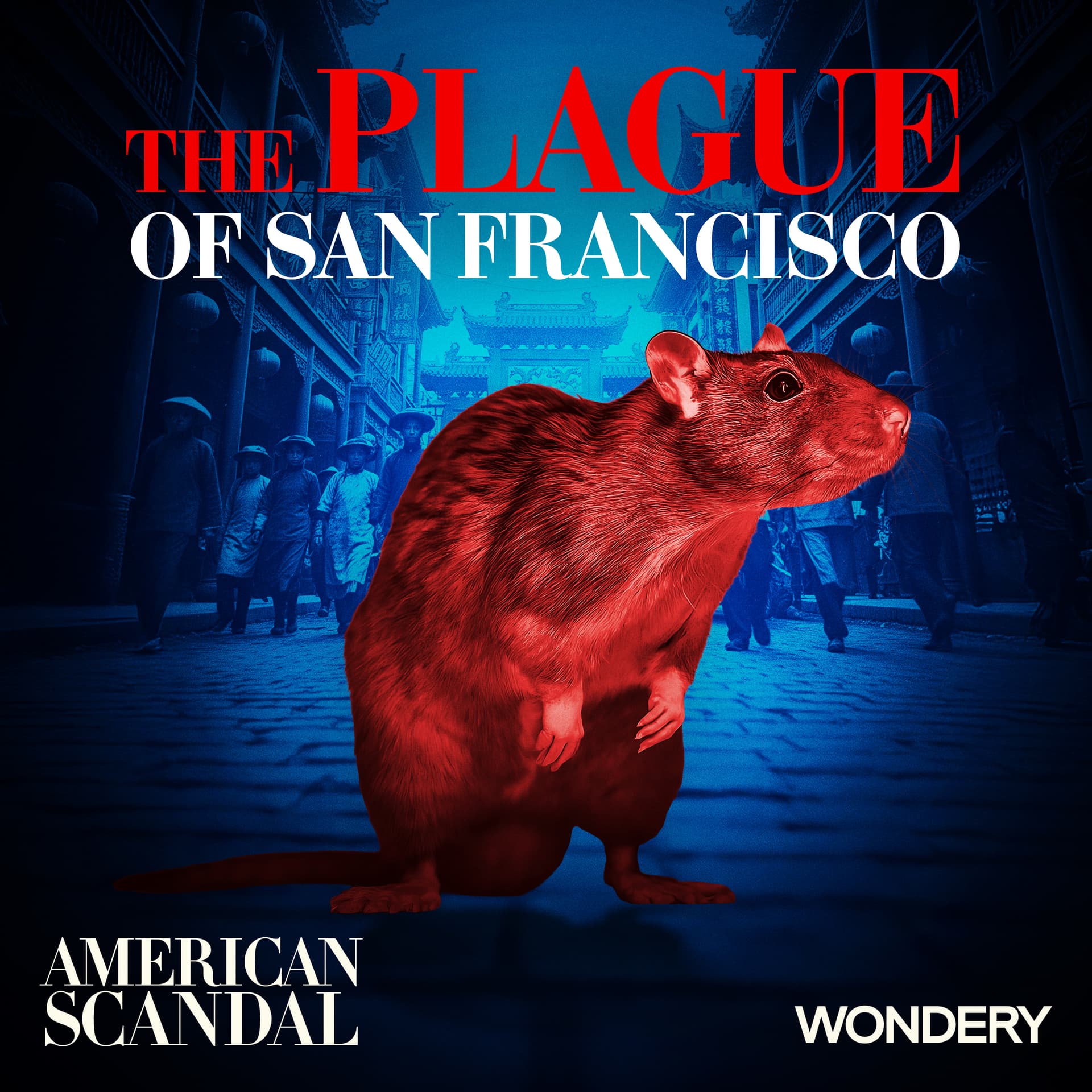
When a deadly outbreak of bubonic plague hits San Francisco, a brilliant young bacteriologist named Joseph Kinyoun is tasked with stopping the spread. But as Kinyoun soon discovers, he is battling not just the disease, but a group of politicians more concerned about profits than the health of their city.
Be the first to know about Wondery’s newest podcasts, curated recommendations, and more! Sign up now at https://wondery.fm/wonderynewsletter
Listen to American Scandal on the Wondery App or wherever you get your podcasts. Experience all episodes ad-free and be the first to binge the newest season. Unlock exclusive early access by joining Wondery+ in the Wondery App, Apple Podcasts or Spotify. Start your free trial today by visiting wondery.com/links/american-scandal/ now.
See Privacy Policy at https://art19.com/privacy and California Privacy Notice at https://art19.com/privacy#do-not-sell-my-info.
