Ask ChatGPT

 Azeem Azhar's Exponential View
22 Oct 2026 · 15m · 9 chapters
The “$110 billion AI economy” (revenues in 12 months to June 2026), how the money flows through the stack, whether it’s real vs internal shuffling, and who pays; plus infrastructure payback, token pricing/“quality-weighted tokens,” open-source model impact, and organizational barriers to AI adoption.
The transcript is a single analyst/host voice (no named guests or guest bios).
Revenue is real (forensic accounting across 1,000+ companies, counted once end-to-end). Of $110B, ~20–25B is big-lab training spend (OpenAI/Anthropic), and ~70–75B comes from profitable “Main Street” firms. Infrastructure revenue currently covers hyperscaler depreciation but lacks healthy margins; sustainability may arrive in 2–3 years. Demand elasticity explains why AI gets cheaper but bills rise; open source enables efficient adoption. Main bottleneck is “congestion” in decision-making systems, not model capability.
West Texas Intermediate/Brent as token-quality analog; Google model cost dropping to ~27 cents then DeepSeek <0.5 cents; CEOs see productivity up but firm-wide impact lagging; 1978 camera vs today’s ubiquitous cameras; Airbnb/Coinbase/Uber using cheaper Chinese models.
Written by AI. May contain mistakes.
Discussion on the authenticity and sources of AI economy revenues.
“Is the money just being handed from one company to another and back to the originating company?”
Exploration of the infrastructure spending and its implications.
“AI infrastructure spend has been enormous.”
Analysis of AI's economic impact and the concept of demand elasticity.
“It's an important milestone, but it's not the signal of long-term sustainability.”
Examining the challenges of integrating AI into existing company structures.
“They're buying more of this intelligence.”
Discussion on how AI intelligence is becoming more accessible and its implications.
“You know, we often obsess about the most powerful models from Anthropic and OpenAI, and we're amazed at what they can do.”
Exploring the competition in AI development and the learning curve effect.
“And what things become more valuable precisely because intelligence is cheap?”
Discussing how current incentives in education may impact AI use and thinking.
“Nothing in history, not oil, not electricity, not computer chips, has become so cheap so quickly.”
Analyzing China's approach to AI amid sanctions and their efficiency advantage.
“If we reward the reasoning, AI could help us think more deeply than ever before.”
Discover how China's AI models are outperforming American counterparts in cost.
“Their models are 10 times cheaper than equivalent American ones.”

Get the gist, explore an idea or ask about something said.
 Claude
On Azeem Azhar's Exponential View, what are the key points of this episode?
Searching your listeningAutomatic transcript. May contain errors.
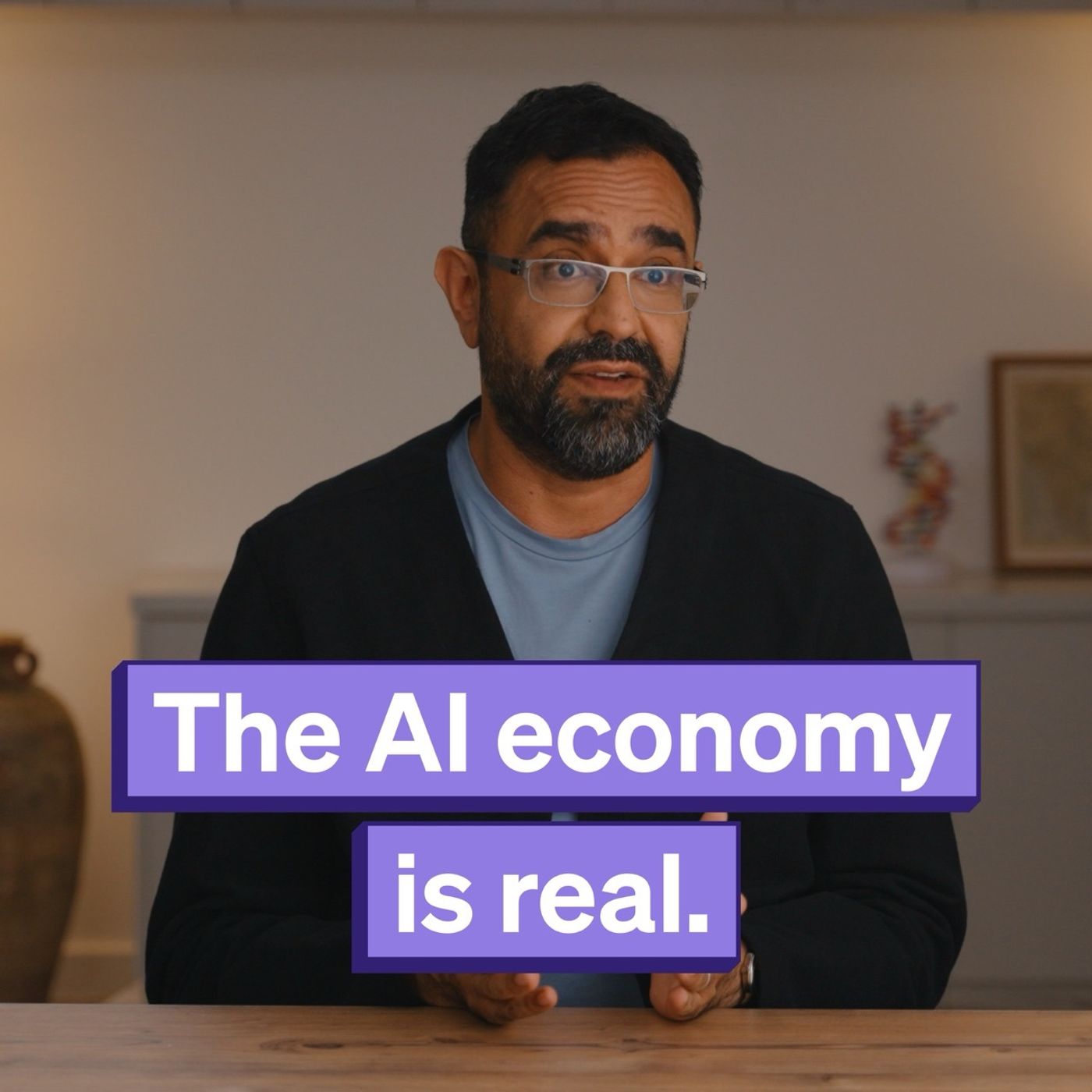
0:00Azeem Azhar: The AI economy is real and it is substantial. In the 12 months to June 2026, it's$110 billion of revenues that flowed into a sector that didn't exist four years ago. It's a big number, but more than that, it's a number we've got to faster than any technology wave we've seen in history. Three times faster than the mobile phone, three times faster than the internet, three times faster than cloud computing. So not only is it a real sector, it's growing very, very quickly indeed. When you say real, what do you actually mean? How do we know the AI economy and its revenues are real? One of the biggest concerns about the AI economy is whether any of it is real at all.
0:46Azeem Azhar: Is the money just being handed from one company to another and back to the originating company? And that's a real concern that sometimes happens during technology waves. So we set out to trace how revenues came in at the top of the system and went all the way through from the application companies to the foundation model companies through to the hyperscalers and the infrastructure companies that actually run the chips that serve the models. And that was a long, painstaking process. We looked at over a thousand companies to try to figure out some of these numbers. We used forensic accounting to deconstruct financial models.
1:23Azeem Azhar: And we spent a lot of time ensuring that if a dollar came in at the top of the system, we only counted it once as it made its way through. So it is real. But of that$110 billion, a large part of that is being spent by companies that are loss-making. So the big AI labs like Anthropic and OpenAI spend tens of billions of dollars a year to train their next models. And if you're a real cynic, you could say, well, that's not real revenue. But in truth, it's in the order of 20 to 25 billion of that 110 billion. Then you might say, well, what portion of that 110 billion is coming from startups funded by venture capital?
2:03Azeem Azhar: I mean, it's one thing if an excitable founder has persuaded a Silicon Valley VC to give them$10 million. It's another thing if a stalwart member of Main Street has decided to put shareholder capital in their accumulated profits, into AI. And even if you take away the money being spent by companies backed by venture capital, it's only a few billion dollars. So at the end of all of that, we're looking at something in the order of 70 to 75 billion dollars coming from main street profitable companies spending on AI like they spend on IT. If you want to see our full report on the state of the AI economy, visit intelligence.exponentialview.co
2:53AI infrastructure spend has been enormous. What has to happen for it to pay off?
2:58Azeem Azhar: The infrastructure story is astonishing. The big hyperscalers and new startups serving AI are undergoing an infrastructure build-out of a scale that we haven't seen since the railway build-out in the United States in the 19th century. The big question is, are they going to make a return from that? And what we identified in our research was that roughly at the end of 2025, the amount of revenue flowing in to Gen.ai was just about covering the depreciation expense on the infrastructure spending that the hyperscalers were doing. Now, let's understand what that number means. What that means is that the cost of building all these huge data centers is just about being met by customer revenues.
3:49Azeem Azhar: That's a good start, but it's not a good business because, of course, you need to more than cover your depreciation costs. You have to cover them with a really healthy margin so that you can pay for all of your other expenses like your staff and your marketing and ultimately show a profit to your shareholders. What we discovered was that we've passed one milestone. It's an important milestone, but it's not the signal of long-term sustainability. And the question is, will we get to that long-term sustainability? At the moment, revenues are growing far faster than the growth of AI infrastructure expense.
4:25Azeem Azhar: So the bet would be that at some point in the next two or three years, we might get to that point. But equally, there's a lot of uncertainty in this market, and it could be the case that we don't. Do you think we should treat tokens as units of intelligence? When you think about the oil industry, we know what West Texas Intermediate is. It's a constant standard for what a barrel of oil is and what the price is. And people across the market can compare one with another. And many markets have that. They have these sort of constant metrics, whether it's the horsepower of a car or the fuel efficiency, measured in exactly the same way.
5:00Azeem Azhar: The challenge in AI is that it's a very, very young industry. It's only a few years old. And we haven't yet figured out a way of putting a value to the intelligence that's produced. So our proposal is that you have a quality weighted token. The token is the thing that ChatGPT or Claude produces, but not all tokens are the same. They get produced by models that are more intelligent and models that are less intelligent. And they can be more useful or less useful. So our initiative is to figure out a quality adjusted token that can start to look like the West Texas Intermediate Standard or the Brent crude standard so that investors, companies, providers can understand what they're producing, what they're selling and what it's worth.
5:47AI keeps getting 10 times cheaper. So why are bills going up?
5:51Azeem Azhar: AI models are on a learning curve. That means every year they get about 10 times cheaper. But it's really odd that our AI bills haven't gone down. In fact, they've gone up virtually universally. So what's going on? Well, that's called elasticity of demand. As the price of tokens comes down, companies are buying more and more of this. They're buying more of this intelligence. And the overall scale of the revenue is going up. Now, my hypothesis is that this elasticity, this behavior will continue for quite a while. Companies in America and around the world have just got started, even as models get more efficient.
6:27Azeem Azhar: They come from China. they go to open source, the declining price of the token will be more than made up for by increasing volumes of token consumption. Revenues are growing fast, but AI still represents a tiny part of the wider economy. How do you reconcile that? AI revenues have grown so quickly, three times faster than the internet, three times faster than mobile, three times faster than the cloud. So it's incredibly rapid. And yet it doesn't really feel that a lot of companies have figured out what they're actually doing. If you look at how much American companies are spending per employee, per month, it's only a few dollars.
7:07Azeem Azhar: The real leaders in using AI, the firms who can prove that they've grown faster because they've invested more heavily in AI, are spending hundreds of dollars, sometimes thousands of dollars, per employee, per month. So that$110 billion revenue number has got lots and lots of room to grow as more and more American firms through Main Street get more confident, get more practice, and get more persuaded that AI is something that will change their business. So it's very much still in the foothills. What's the impact of low-cost open source models? You know, we often obsess about the most powerful models from Anthropic and OpenAI, and we're amazed at what they can do.
7:47Azeem Azhar: But life isn't always about having the most incredible, most powerful system. Sometimes you just need an efficient, cheap version to do the thing you need to do. And what we're learning is that open source is becoming that thing for companies as they start to use AI. And you know what? It makes perfect sense. You don't always need to go off and see the most expert doctor if all you've got is a sore ankle. Just go and see your local physician, go to the pharmacy. And open source plays that role. It plays the role of the efficient, cheap models that will lift most of the workloads that most people use most of the time.
8:24Azeem Azhar: And once in a while, we'll want to find the most powerful models to answer the hardest, hardest questions. What's the biggest problem companies run into with AI? I speak to about 100 CEOs a year, and they've all run into the same problem with AI. Individual productivity is up, but its impact isn't visible across the firm as a whole. I know what's going wrong. A company is not simply the sum of its employees' tasks. It's a system for turning information into decisions and decisions into action. And most of those systems were designed for a world in which intelligence was scarce, expensive, and exclusively human.
9:00Azeem Azhar: That world is disappearing. With AI, developers can write 50 % more code, but they're still waiting in the same review queue. Teams with AI can act immediately, but management won't make a decision for a month. I call that congestion. It's an organisational problem, not a technical one. Your company most likely runs at a rhythm designed for scarce intelligence moving at human speed. So the question isn't, where do I add AI? It's now that intelligence is abundant, what should my company even look like? Which decisions should move from monthly to daily? And what things become more valuable precisely because intelligence is cheap?
9:38Azeem Azhar: The winners will be the companies that redesign themselves around a new economic fact. Intelligence is no longer scarce, but the ability to act on it still is. You say intelligence is no longer scarce. What does that look like in everyday life? In 1978 my family had one camera, just like this one. We took about 24 photos a year. They were expensive and rare. Today cameras are everywhere. We take so many photos and videos, we don't give it a thought. They used to be magical. Now they're ubiquitous. And we use them in ways my parents could never have imagined. With AI, useful intelligence is going to become as ordinary as a photo.
10:17Azeem Azhar: Three years ago, I used ChatGPT to write novelty rap songs for a dollar. Exponential, the curve is going up. Exponential, never gonna stop. Today, I have several AI agents working for me all the time. They build software, they research, they create products. It costs little more than a fancy coffee every day. And honestly, it already feels mundane. As intelligence becomes cheaper, we will use much more of it. But most interestingly, we'll use it in unforeseeable ways. As unforeseeable as a camera in a doorbell was to my parents back in 1978. Which of the frontier labs is ahead at the moment? It doesn't matter who wins the AI race.
10:58Azeem Azhar: OpenAI, Anthropic or DeepSeek could stumble. Another lab could overtake them. But the larger story will continue. We've discovered something remarkable. A way to manufacture intelligence. And once we can make something, we can learn to make it better and more cheaply. We've seen that with solar panels, computer chips and batteries. It's called the learning curve. The more we make, the cheaper it gets. In the summer of 2025, it costs around 27 cents for Google's best model to write a bit of code. Ten months later, DeepSeek could do it for less than half a cent. This is part of a strong trend. Every year, AI models get 10 times better.
11:40Azeem Azhar: And this trend doesn't look like it's slowing down. Nothing in history, not oil, not electricity, not computer chips, has become so cheap so quickly. And here's the really special thing about AI. Oil can't learn how to make more oil. Solar panels don't improve new panels. But AI can learn how to make AI. And that is extraordinary. Do you think AI is really making us stupid? An economics professor allowed students to take their midterm exams at home. Their average score was 96%. That's miles above normal. Suspicious, he asked them to sit their final papers in person. And the class average fell by half.
12:23Azeem Azhar: Only three got anywhere near their original score. And by the way, kudos to those three students. I think the rest of them turned off their brains and got AI to do their thinking. but even then asking whether AI is making us stupid is not the right question. The right question is why do the students want to avoid the hard thinking at all? It's because the incentives in the system don't reward their thinking, they just reward the result. If the goal of study is high test scores, of course we'll all take the easiest route to those good scores. SAT coaching in America is an entire industry built on gaming the score while not teaching anything.
13:02Azeem Azhar: In a world of AI, we must change the incentives so that they reward reasoning. The hard thinking, the late nights, the dead ends, not just the final grade. If we reward only the answer, AI will give us better answers and weaker thinkers. If we reward the reasoning, AI could help us think more deeply than ever before. How far behind are China's AI labs? If you think Chinese AI labs are just plane catch up, you're mistaken. Washington's sanctions have choked the supply of AI chips to Chinese labs. That's actually forced them to develop the most efficient AI models on the planet. American labs do have eight times more computing power than their rivals, but Chinese labs have become much smarter about how they use their limited resources.
13:50Azeem Azhar: In fact, they get five times more intelligence per unit of compute than the Americans do. That's a bit like having a car that can travel five times further on one gallon of gas. I call this China's efficiency moat. Their models are 10 times cheaper than equivalent American ones. And that's already winning them US customers, companies like Airbnb, Coinbase, Uber, and the majority of Silicon Valley startups. That doesn't sound like catch-up to me. One group wants to create the most powerful intelligence at any price. The other is figuring out how to make capable intelligence at a remarkably low cost.
14:28Azeem Azhar: Those are different strategies. And we should not assume that the most expensive strategy is the one that ultimately wins.
14:41Azeem Azhar: To get my analysis every week, just sign up at exponentialview.co.
The AI economy is real, substantial and growing three times faster than the internet, mobile phone or cloud computing. But is it sustainable?
Our forensic analysis from June of this year of 1,000+ companies reveals that over $70 billion in revenue is coming from Main Street enterprise adoption, rather than loss-making labs or VC-funded startups.
However, we’re still in the foothills: even as models get cheaper, corporate bills keep rising; and hyperscalers are only just covering the costs of the data center buildout, with margins still years away. In this Q&A about the state of the AI economy, I discuss:
00:00 The AI economy is real
00:35 Who’s really paying for AI, and how we checked
02:53 Will AI infrastructure spending pay off?
04:36 Creating a “Brent crude” for tokens
05:47 Cheaper models, bigger bills
06:38 What AI leaders spend per employee, and why it matters
07:38 When a cheap open-source model is all you need
08:30 Congestion: the biggest problem CEOs hit with AI
09:49 What life looks like when intelligence is cheap
10:54 Why it doesn’t matter who wins the AI race
12:04 Is AI really making us stupid?
13:24 China’s efficiency moat
Note: this was recorded before our latest tracker update and the annualized run rate has since grown to $229 billion. For an updated measure of the AI economy, see sources below.
📄 Full report: https://intelligence.exponentialview.co/
📈 The latest revenue figure: https://www.investmentbrief.ai/p/ai-investment-brief-monday-3
About Exponential View:
Welcome to Exponential View, where Azeem Azhar examines how exponential technologies such as AI are reshaping the future. Each week, Azeem shares his analysis or speaks with an expert guest to shed light on frontier shifts across technology, business and society.
To keep up with the Exponential transition, subscribe to this channel or the newsletter: https://www.exponentialview.co/
To keep up with our AI economy research, subscribe to https://www.investmentbrief.ai/
Where to find me:
Exponential View newsletter: https://www.exponentialview.co/
Website: https://www.azeemazhar.com/
LinkedIn: https://www.linkedin.com/in/azeem/
Twitter/X: https://x.com/azeem
Production by EPIIPLUS1.
Production and research: Baba Films, Marija Gavrilov.
Hosted by Simplecast, an AdsWizz company. See pcm.adswizz.com for information about our collection and use of personal data for advertising.