
In short
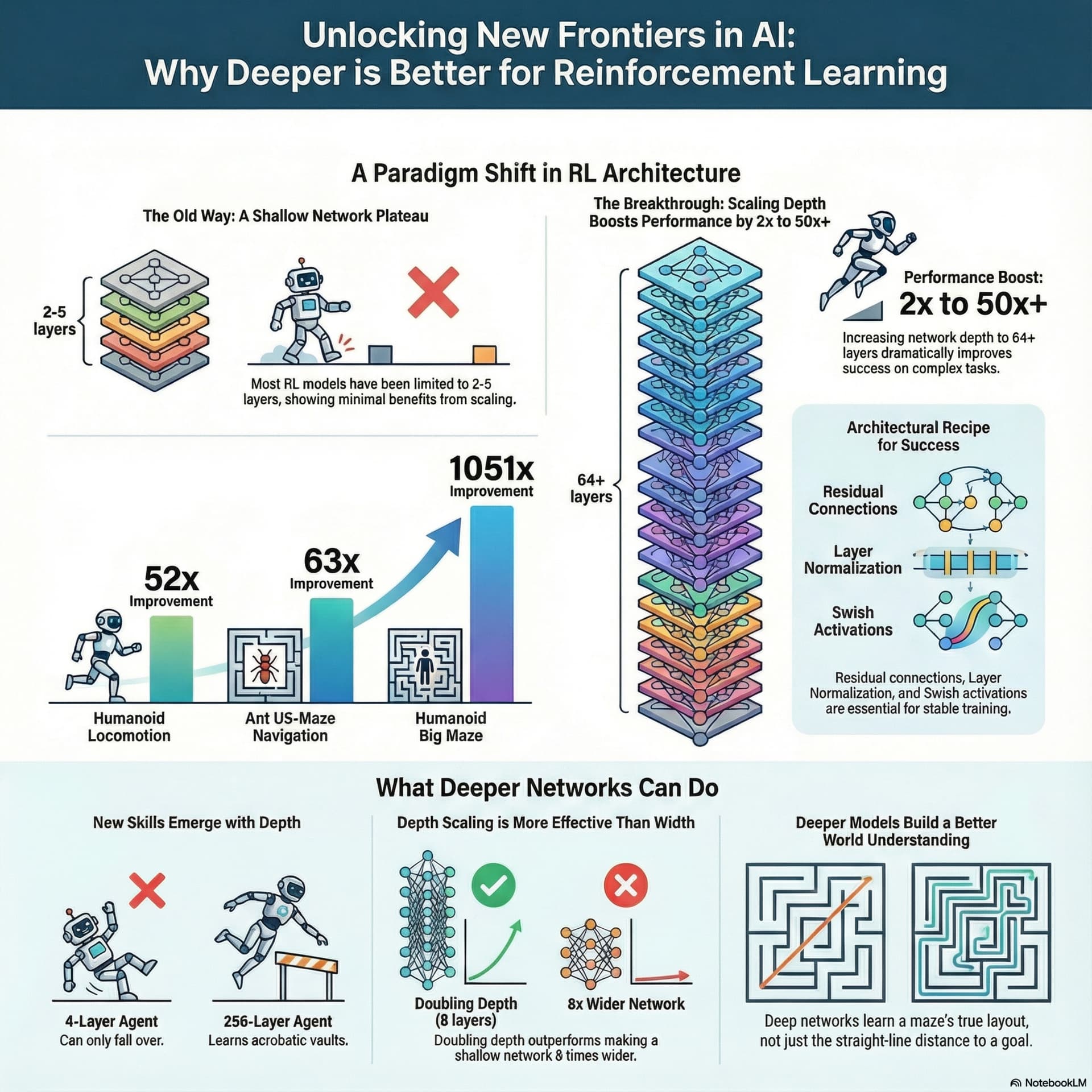
The episode explains how reinforcement learning (RL) can be scaled to 224–1024-layer “1000 layer networks” using scaled contrastive RL (CRL), producing emergent goal-reaching behaviors and large performance jumps.
Guest backgrounds
No guests are named in the transcript; it’s a host-led “Deep Dive” discussion of research sources.
Key claims
RL was historically shallow (2–5 layers) due to sparse reward signals causing vanishing/exploding gradients. CRL fixes this by turning value learning into a contrastive classification problem (InfoNCE/CE), plus residual connections, layer norm, and swish. Emergence occurs in depth “jump” thresholds, not smooth gains.
Notable examples
Humanoid U-Maze—shallow nets fail; at ~256+ depth agents perform novel acrobatic wall-clearing (folding/worming, vaulting). Ant maze—shallow nets rely on proximity; deep nets plan detours around walls. Collector-learner experiments show deep capacity only helps with high-coverage exploration data.
Written by AI. May contain mistakes. Listen to the episode to check what was said.
Chapters
Tap a time to open that second in VOThe Shallow End of Reinforcement Learning
0:45 to 1:53
Exploring the historical limitations of depth in reinforcement learning models.
“It's like an entire branch of AI just missed the memo on deep learning.”
Unlocking New Capabilities with Depth
1:53 to 3:38
Discussing how scaling RL networks to 224 layers unlocks new capabilities.
“Well, the problem really boils down to the learning signal itself.”
Challenges of Learning Signals in RL
3:38 to 6:12
Examining the challenges posed by sparse rewards in reinforcement learning.
“For RL to scale in depth, it had to incorporate that dense, structured self-supervision directly into the training process.”
Innovations in Scaled Contrastive RL
6:12 to 8:05
Introducing the unified approach of scaled contrastive RL and its significance.
“Resnets solved that problem for image recognition years ago.”
Architectural Strategies for Deep Networks
8:05 to 10:21
The architectural components that allow for effective training of deep networks.
“Okay, walk us through an example like the humanoid.”
Emergence and Thresholds in RL Performance
10:21 to 11:43
Discussing the phenomenon of performance jumps as network depth increases.
“From a resource perspective, depth scaling is just the more efficient path.”
The Role of Exploration and Data Quality
11:43 to 13:00
How exploration strategies and data quality impact learning in RL.
“But you mentioned good data is just as important.”
Future of Reinforcement Learning with Deep Models
13:00 to 14:01
The implications of scaling depth for the future of RL and computational challenges ahead.
“It's the perfect encapsulation of the RL challenge.”
Scaling Depth in Reinforcement Learning
14:01 to 14:55
Explore how scaling depth in RL can enable new goal-reaching capabilities.
“It fundamentally changes the trajectory of the field.”
Transcript
Automatic transcript. May contain errors.0:00Welcome to the Deep Dive. For, well, for the last decade, when we've talked about genuine breakthroughs in AI, the conversation inevitably turns to scale. It always comes back to scale. We've watched these large models, you know, LAMA 3 or stable diffusion, just grow and grow, developing hundreds of layers. These, I mean, giant dense structures that unlocked entirely new capabilities in vision and language. It's the scaling recipe, right? More data, more parameters, more layers, you get more capability. But if you were looking at reinforcement learning, well, the story was completely different.
0:35RL models were stuck in the shallow end. And they typically capped out at just two to five layers, you know, maybe maxing out at eight before training instability. Before it all just broke. Exactly. Catastrophic failure. It just made scaling impossible. It's like an entire branch of AI just missed the memo on deep learning. So today we're doing a deep dive into sources detailing a really radical shift. Research that didn't just nudge RL network depth forward. No, not at all. But successfully scaled it up to an astonishing 224 layers. And our mission here is to really dissect how this was achieved and maybe more importantly, to understand why this level of scale isn't just about, you know, marginal improvements.
1:15It's unlocking genuinely new qualitative skills, these emergent behaviors in the RL agents. The numbers are pretty compelling on several demanding tasks, increasing the depth yielded performance improvements from what, 2x to over 50x. But on the really tough locomotion challenges like the humanoid big maze, the gains reached up to 2 ,151 times. A thousand times. That's not just optimization. That's a fundamental transformation of what an RL agent can do. It forces us to rethink everything we assumed about the capacity limits of intelligent action in an embodied AI. Okay, so let's start with the central mystery here.
1:52Why was RL so historically resistant to depth scaling when everything else was scaling up? Well, the problem really boils down to the learning signal itself. When you train a large model for, say, language or vision, you have these massive, densely labeled data sets. Sure. Every pixel, every word gives you feedback. Every single token. It's a very rich signal. And we know in those fields, once you scale a model past a certain critical threshold... You start seeing new abilities just pop up. Yeah. Like sophisticated reasoning or, I don't know, creative image generation. Exactly. But reinforcement learning operates under extreme feedback scarcity.
2:29What's so fascinating here is that the primary challenge for an RL algorithm is that it gets these sparse rewards, often only after a really long sequence of actions. So you make 100 moves and only on that last step do you find out if you did good or bad. Precisely. So if you try to take that tiny sparse signal and distribute it across, let's say, a 100-layer network, what happens? The signal just gets lost. You run into a vicious ratio problem. The ratio of useful feedback to the sheer number of parameters is, well, it's vanishingly small. Traditional RL algorithms, the ones that rely on TD learning.
3:04That's a form of regression, right? It is. And they struggle immensely with vanishing and exploding gradients when they try to backpropagate that faint signal through 100 layers. The network either forgets the early states or it just collapses entirely. Catastrophic failure again. Right. And that's why, you know, conventionally we use massive pre-trained models like transformers train with self-supervision on huge data sets. And then we fine tune them with RL. So the self-supervision does all the heavy lifting on the representation learning. And that conventional wisdom basically provided the blueprint for solving this.
3:38For RL to scale in depth, it had to incorporate that dense, structured self-supervision directly into the training process. It had to move beyond relying only on sparse external rewards. Which brings us to the core innovation here. This unified approach they call scaled contrastive RL or CRL. Let's break down the three building blocks that made this possible. The first, and I'd argue the most crucial algorithmic piece, is self-supervised RL using the contrastive RL method. This is what provides that dense learning signal deep networks need. Okay, so how does contrastive RL actually change that signal from sparse and noisy to something dense and structured?
4:19Okay, so standard Q-learning is a regression problem. You're trying to estimate a continuous value for a state action pair. Contrastive RL, it sidesteps this whole difficulty. It learns policies without explicit rewards by training the critic using the info and CE objective. The info and CE objective. That sounds familiar. We see that in self-supervised learning and other areas. It's the same idea. Here, it casts value estimation as a classification task. The model is trained to figure out, for any given state and action, whether it belongs to the correct trajectory leading to a future goal. A positive sample.
4:53Right. Or if it belongs to some random, unrelated trajectory, a negative sample. So instead of trying to hit some exact number, some Q value, which is unstable for deep networks, it's just asking a high-confidence binary question, am I on the right track to the goal? Precisely. By stabilizing the learning into this classification framework, the gradient signal becomes so much more robust and much denser across the depth of the network. This is the mechanism that lets deep network training stabilize. Okay, so that's block one. Block two sounds like a practical necessity. Just a ton of data. Absolutely.
5:27You need volume. They had to leverage these high-speed GPU accelerated RL frameworks, in this case, Jack's GCRL, to just collect and process enormous amounts of experience. You need that throughput to feed these big networks. And then the third block is the scale itself, the 1024 layers. That must have required some very specific architectural changes. What was the secret sauce that let a thousand layer network actually converge? They had to import solutions that were already proven in supervised deep learning. The first one was using residual connections or res nets. That's just foundational.
6:00Right, the shortcut path. Exactly. By introducing these shortcuts that bypass layers, you make sure the gradients can propagate effectively from the output all the way back to the input. It prevents that instability. Resnets solved that problem for image recognition years ago. But that wasn't the whole story here for RL, was it? No, it wasn't. They found two other components were, and this is key, jointly essential for stabilizing training. Layer normalization and the swish activation function. We see layer normalization everywhere now, especially in transformers. Why was it so critical here? That's a great question.
6:35Batch normalization relies on stats across a whole batch of data, which is fine for classification. But in RL, the context is always changing. The batch composition can be really variable. So batch norm wouldn't be stable. Right. Layer norm normalizes the activations within a single sample, which means the inputs to the next layer stay stable no matter what. It provides that layer-by-layer stability that a thousand-layer architecture is just desperate for. So you need all three. You do. And the sources are very clear on this. If you remove layer norm or you swap swish back to a simpler real-you activation, scalability just plummets.
7:11That combination was the architectural glue. So if the architecture provided the capacity, the next question is what that capacity actually does. This is where we get to the jump phenomenon. We usually hear about smooth, gradual improvements, but that's not what they found. No, and this is maybe the most exciting finding. It really suggests that deep RL models follow the same emergent capability dynamics we see in LLMs. The performance gains were not a smooth curve. They happened in these sudden, pronounced jumps once the network crossed a critical depth threshold. Can you give an example? Well, the threshold changed depending on the task.
7:47For some environments, the jump might happen at eight layers. For others, maybe 64 layers. And these jumps weren't just quantitative. They matched a real change in behavior. Exactly. They correlated precisely with a qualitative shift in the agent's policy. The agent fundamentally changed its strategy because its capacity finally allowed it to model a more complex truth about its world. Okay, walk us through an example like the humanoid. Right, the humanoid environment where the agent has to move to a target. This shallow depth-for agent is rudimentary. rudimentary, it struggles with the balance, it often just falls over or kind of throws its body toward the goal.
8:24The classic flailing deep RL agent we all know. That's the one. It's only when you get to a moderate depth, say depth 16, that the agent suddenly develops the stable ability to walk upright and balance. The deeper network finally has the capacity to hold that complex locomotion policy. But the real showcase of emergence must be in those complex maze environments. Tell me about the humanoid U-Maze. The U-Maze has these intermediate walls and obstacles. It demands high-level planning. Networks up to depth 64, they often fail, they get stuck. But once the network hit that next critical threshold, depth 256, and scaling up to 1024, the agent learned these unique acrobatic behaviors that no engineer would have hard-coded.
9:06What kind of behaviors are we talking about? We saw policies emerge where the agent would fold forward into this leveraged, almost seated posture and use its own body to kind of worm its way over the wall. In other cases, it would execute this fast, dynamic, vaulting motion to clear the obstacle entirely. So the model isn't just optimizing for speed. It's discovering novel, multi-step geometric solutions based on its own body and the environment. That is the hallmark of emergent skill. That extra capacity gives it the ability to figure these things out on its own. And quantitatively, this is what allowed CRL to get state-of-the-art results.
9:44So that brings us to the comparison. In the past, RL researchers would just increase network width, right, more hidden units. But this research suggests depth is way more impactful. Why is that? It comes down to two things, efficiency and representation power. And yes, the researchers confirm that scaling width does improve performance. But if you compare it to depth, the efficiency just favors depth so dramatically. Can you quantify that for us? Think about the parameters. If you double the width of a layer, the parameter count to the next layer scales quadratically. But if you just double the depth, the parameter count only scales linearly.
10:18So for a fixed computational budget, I get way more bang for my buck, representationally, by choosing depth over width. Exactly. From a resource perspective, depth scaling is just the more efficient path. And they showed this. Simply doubling depth from 4 to 8, while keeping the width standard, often outperformed the widest, shallowest networks. So how can we actually see this improved understanding? How does it process the world differently? We can visualize it by looking at how the networks estimate value in a complex space, like the ant euformes. In this task, the goal is visible, but the ant has to move away from the goal first to get around a big wall.
10:58A perfect test of long-term strategy versus short-term greed. And the shallow depth-for network, it failed the test. When they visualized its Q values, its internal estimate of how good is the state, it was just naively relying on Euclidean distance. It saw the goal was close and thought, great, I'm almost there, even with a wall in the way. Right. It was fooled by simple proximity. It was too shallow to realize the wall was a critical feature. In contrast, the deep depth 64 network developed genuine strategic reasoning. What did its Q values look like? Its IQ values correctly traced the path, first moving away from the goal, looping along the wall, and only then turning toward the target.
11:37It showed a global understanding of the detour. So that expressivity is clearly driven by depth. But you mentioned good data is just as important. How did they isolate those two factors, the expressivity and the exploration? They designed a very clever experiment using a collector-learner setup. up. It allowed them to separate the policy used for gathering data from the network used for learning. So one network explores, the other one learns from the data it collects. Exactly. One collector network generates all the experience and puts it in a buffer. Then they had two learners, one deep, one shallow, that only trained off that fixed data.
12:13They never interacted with the environment. So they could manipulate the quality of the data? Precisely. They ran two scenarios. Scenario one. The collector is deep, so it generates high-quality, high-coverage data. In that case, the deep learner crushed the shallow learner. This proved capacity is essential when you have good data. And now the critical test, scenario two. In scenario two, the collector was shallow, meaning poor exploration, bad data coverage. In that case, both the deep and shallow learners struggled equally. The profound capacity of the deep network was essentially wasted because the data it got was insufficient.
12:49So the conclusion is, synergy is everything here. The deep network's superior learning capacity is critical, but it's utterly reliant on having good data from an effective exploration policy. It's the perfect encapsulation of the RL challenge. You need capacity, but capacity requires superior exploration to learn from. Did this depth scaling unlock any other maybe unexpected benefits in the training process itself? Yes, two notable ones. First, deep networks unlock the benefits of using larger batch sizes. Historically, increasing batch size and shallow RL was often ineffective. But as depth increased, larger batches became more and more effective.
13:26So the network capacity is needed to handle the diversity of a larger batch. Correct. Second, depth substantially improved generalization. They trained agents on easy partial trajectories and then tested them on a long task they'd never seen. The depth 64 networks excelled. They could do what the researchers called partial experience stitching, combining small learned segments to solve a novel longer task. Okay, so what does this all mean for us? We've gone from RL being stuck at what, two to five layers, to having prusion systems capable of scaling over a thousand layers. It fundamentally changes the trajectory of the field.
14:04It confirms that the scaling recipe that worked for vision and language is now viable for reinforcement learning, as long as you swap regression for this contrast of classification. So RL is now on a path to training its own foundational models. Through this joint process of building model capacity and improving the exploration needed to feed that capacity, it means we're moving toward creating truly expressive agents that can solve highly complex embodied tasks purely through self-discovery and scale. Which I suppose raises an important question. The sources do acknowledge that scaling depths comes at a significant cost in compute.
14:38Training time increases roughly linearly with depth. So if these massive performance benefits and emergent skills are tied to this high computational cost, how critical will techniques like pruning or model compression or distillation be in the near future to make these highly expressive deep RL agents feasible for real-world deployment on limited hardware? The computational bottleneck is absolutely the next hurdle for practical application.
From the publisher
This paper discusses scaling the depth of neural networks within self-supervised reinforcement learning (RL), a field where scaling has historically lagged behind language and vision models. Challenging the convention of using shallow architectures (2–5 layers), the researchers demonstrate that scaling network depth up to 1024 layers substantially boosts performance in unsupervised goal-conditioned tasks, achieving gains as high as 50 times the performance of previous methods. This deep scaling approach integrates Contrastive RL (CRL) with architectural stabilizing components like residual connections. The study establishes that increasing depth is a more impactful and computationally efficient scaling axis than increasing network width and that it is necessary to unlock the utility of larger batch sizes. Furthermore, this capacity increase leads to the emergence of qualitatively distinct goal-reaching policies and enables the deep networks to learn richer environmental representations.


