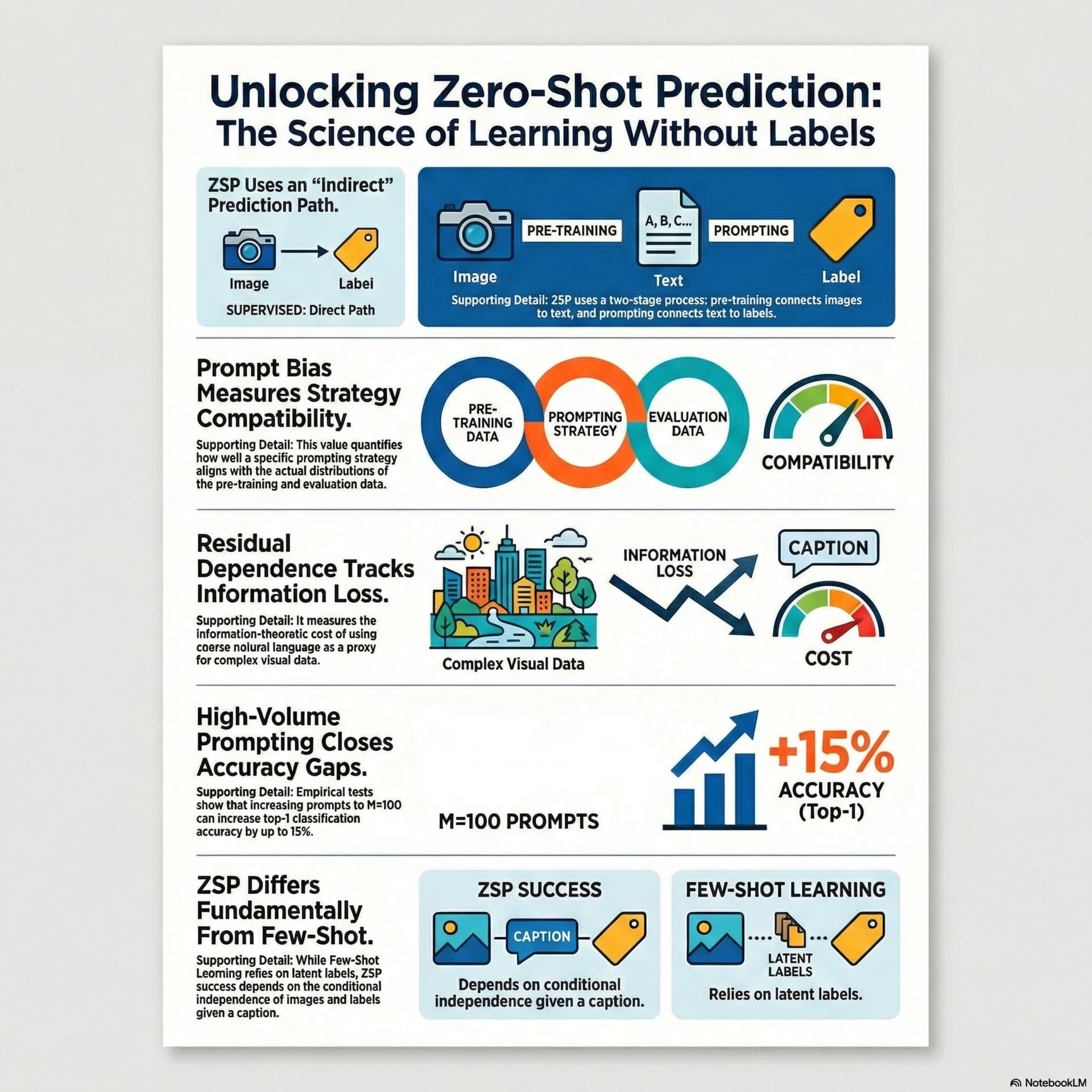

In short
Explains zero-shot prediction (ZSP) for vision-language models (e.g., CLIP) using “indirect prediction path” theory: image-to-text-to-label, and why it works or fails. It frames ZSP as triangulation via captions/prompts rather than direct image-to-label learning, decomposing error into estimation error, residual dependence (information lost in the text bridge), and prompt bias (train/test text mismatch).
Key claims
performance can jump without retraining by improving prompts; residual dependence can create an irreducible ceiling.
Notable examples
ImageNet zero-shot accuracy rising from 11.5% to 76.2% after CLAP; Scottish fold vs vague “cute kitten” caption; unbiased prompting from messy alt-text improves ResNet-50 by ~15%; QPL uses LLM (Llama 3) to generate richer texture descriptions, improving Describable Textures by ~20% top-5.
Guests
None mentioned.
Written by AI. May contain mistakes. Listen to the episode to check what was said.
Chapters
Tap a time to open that second in VOThe Paradigm Shift of CLIP
0:20 to 1:19
Discussing the impact of OpenAI's CLIP on zero-shot classification.
“And just to frame this for everyone, before this moment, if you looked at zero-shot classification on ImageNet, we were like fighting for scraps.”
Understanding Zero-Shot Prediction
1:19 to 2:12
Exploring how zero-shot prediction functions and its underlying mechanism.
“Zero shot prediction, or as I like to call it, the how on earth did it know that phenomenon?”
The Triangle of Zero-Shot Prediction
2:12 to 3:56
Introducing the three components involved in zero-shot prediction.
“I understand there's sort of a triangle of players here.”
Differences Between Few-Shot and Zero-Shot Learning
3:56 to 4:56
Clarifying the distinctions between few-shot learning and zero-shot learning.
“We've talked about few-shot learning before, FSL.”
Challenges in Zero-Shot Prediction
4:56 to 7:33
Identifying the key challenges and errors faced in zero-shot prediction.
“You're teaching it to speak a language that connects vision and text.”
Improving Zero-Shot Performance
7:33 to 11:21
Discussing strategies to improve zero-shot prediction accuracy.
“You literally cannot get there from here because the bridge is missing the planks.”
Limitations of Language in AI
11:21 to 14:13
Exploring the potential limitations of using language for AI vision.
“And speaking of better communication, they took it a step further with large language models.”
Ineffability and Machine Vision
14:13 to 15:02
Explore the limitations of AI in capturing complex visual concepts through language.
“You're touching on the concept of ineffability.”
Transcript
Automatic transcript. May contain errors.0:00Okay, let's unpack this. Because when you look at the timeline of artificial intelligence, specifically computer vision, there are these moments where the ground just shifts beneath your feet. You have the deep learning boom in 2012, which was huge. But then you have 2021. Right. 2021. The entire game just fundamentally changed. Exactly. Open AI releases CLAP. Yeah. And just to frame this for everyone, before this moment, if you looked at zero-shot classification on ImageNet, we were like fighting for scraps. We were sitting at a very humble 11.5%. Which is, let's be honest, statistically, it's barely better than a lucky guess.
0:39It's nothing. Yeah, it's like throwing a dart at a board, blindfolded. Right, and then CLAP drops, and overnight that number explodes to 76.2%. I mean, that is not an incremental improvement. No, it's a face shift. It's a revolution. It wasn't just about the model getting better at recognizing cats versus dogs. It felt like the model suddenly understood everything. It definitely had that feeling. But what really happened was a redefinition of the goal itself. We stopped trying to build models that could generalize to new classes. Like a new type of bird or something. Exactly. And we started building models that could generalize to entirely new tasks.
1:15And that brings us right to the topic of today's deep dive. Zero shot prediction, or as I like to call it, the how on earth did it know that phenomenon? It does feel like magic, doesn't it? It really does. You take an image, you ask the AI to label it with a term it has never, ever been explicitly trained on, and it gets it right. How is that possible? It's the billion-dollar question. And the answer, I guess, unfortunately for the mystics out there, isn't magic. It is a very specific, quantifiable, a mathematical mechanism. It's what the theory calls the indirect prediction path. Indirect path.
1:51Okay, so instead of going straight from A to B, we're taking a detour. That's it, exactly. And the success and, more importantly, the failures of these massive foundation models, it all comes down to the quality of that detour. Today, we're going to peel back the hype and look at the actual math that explains why this works and why it so often fails. I love good failure analysis. So let's set the stage. I understand there's sort of a triangle of players here. They do. To get ZSP, you need to think in three variables. First, you have$6. The input, the image. The photo. Then you have out dollars.
2:22That's the label, the destination. you know, cat, airplane, spaghetti. Okay. Simple enough. Input$6, output dollars. That's just standard machine learning. Yeah. I show a machine, a picture of a cat. I tell this is a cat and it learns that direct connection. That's the traditional highway. But in zero shot, that highway just, it doesn't exist. The model has never seen that direct link. So we can't go straight from$6 to dollars. Nope. You have to go through the third point of the triangle. Zeal, the bridge. And in models like CLIP, this text, captions. Precisely. Zilleries is the natural language description, and this is the indirect part.
2:57The model never sees the labels during pre-training. It only ever sees images, six letters, and their captions zilleries. So it learns that this pattern of pixels corresponds to the words a furry creature wagging its tail. Correct. That's the first leg of the journey, zillerballers. Then later, when we want to classify something, we, the humans, provide the second leg. We connect the text ziller to the label with a prompt. So the model goes image to text, and then we help it get from text to label. Zix's to Z to Zer. That is the indirect path. Think of it this way. The direct method is seeing a face and immediately thinking, that's Bob.
3:35Fast. Efficient. Yeah, but the indirect method is seeing a face you don't recognize, but you have a dossier. You see a tall man with glasses and a beard. That's your description, your zillare. Then you look at your dossier and see Bob. Tall man, glasses, beard. And you connect the dots. Aha, therefore, that must be Bob. You're triangulating. You're matching the description, not the raw visual data. That makes a ton of sense. Yep. I had to push back a little here. Please. We've talked about few-shot learning before, FSL. That's also about learning with less data. Is this really different, or is it just few-shot with zero-shots?
4:07It's a great question, and it's a really common point of confusion, but mathematically, they're fundamentally different beasts. In few-shot learning, you usually assume something called a latent variable model. Okay, hold on. Latent variable model. Break that down for us. Right. So it basically means you assume the label is the parent of the data. You assume there's this platonic ideal of a dog out there somewhere. The concept of dogness. Exactly. And the photos are just messy examples of that concept. FSL is trying to reverse engineer that hidden label from a few examples. So it's trying to guess the category directly.
4:43Right. But in ZSP, we flip the whole thing on its head. We don't assume the label is primary. We assume the text is the anchor. The label is almost an afterthought that we add on later. It's a totally different philosophy. You're not teaching it concepts. You're teaching it to speak a language that connects vision and text. And that's crucial because it explains the flexibility, but also why they make such weird mistakes. Because, and this is the kicker, the model never actually practices the final task it's supposed to perform. Which brings us back to that detour. If we're forcing it to go through text, doesn't that make things, I don't know, messier like a game of telephone?
5:23That is the perfect analogy. And yes, it absolutely makes it messier. The research breaks this down beautifully. The total error why the model gets things wrong is decomposed into three specific villains. Ooh, a rogues gallery. Who are we fighting? Villain number one is, well, he's the boring one, estimation error. Let me guess. Not enough data. Exactly. The cost of a finite sample. If you only see 10 images, your model won't be very good. That's in every machine learning story. We can kind of ignore him. Okay, moving on. Who's villain number two? This is the interesting one. The mastermind. Residual dependence.
5:58Or, as you put it, the lost in translation cost. Residual dependence. That sounds deep. It is the information theoretic cost of using one thing to predict another. It asks a simple but devastating question. Does the text, zero dollar, actually contain all the information needed to predict the label? I see. So if the text leaves something important out, the bridge just collapses. Exactly. Let's use a concrete example. Imagine an image, six dollars of a specific breed of cat, a Scottish fold, you know, with the folded ears. Sure. Very distinctive look. Now imagine the caption Zira that this image was trained on is just, look at my cute kitten.
6:37Okay. It's an accurate caption, but it's vague. Right. It connects the image to the text cute kitten. But now let's say our downstream task, the label deraude is stottish fold. Oh, I see the problem. The image,$6.00, it has the folded ear information. The label needs that information. But the text, the bridge, it just says cute kitten. Precisely. The bridge is broken. The information to make the prediction exists in the image and it's required by the label, but it was lost in translation. That missing info, the stuff that Six Arana shared that is not captured by zero, that is the residual dependence.
7:10It's like a broken arrow in the diagram. It's supposed to connect them, but the text just snipped the wire. It's like trying to describe a specific color over the phone. You can say it's warm and bright, but you can't convey the exact hue. You lose fidelity. Yes. And if that residual dependence is high, your zero shot model will fail. And it doesn't matter how big the model is. Nope. Trillion parameters, thousand years of training. It doesn't matter. You literally cannot get there from here because the bridge is missing the planks. Wow. That's a sobering thought. We are fundamentally limiting the AI's visual understanding to only things that can be easily described in words.
7:46But hold that thought because we have a third villain. We do. Prompt bias. This is the culture shock cuss. Culture shock. Between who? The computer in itself. Sort of. The model was during its chaotic, unsupervised training and the neat, orderly robot we expect it to be during testing. Okay, explain that. Think about the pre-training data. It's the internet. It's messy, chaotic alt text, Reddit comments, file names like dsc005final.jpg. It's learning from garbage, basically. Organic garbage. Messy, organic language. But then when we test the model, what do our prompts look like? A photo of a cat, a photo of a dog, super rigid templates.
8:27Exactly. A photo of a class. We trained the model on street slang, and we're testing it with formal academic language. That mismatch is prompt bias. It's like learning English by watching nothing but reality TV and then being asked to write a legal brief. That is a surprisingly good analogy. The distribution of text during prompting is just fundamentally different from the training distribution, and that bias adds error. So how do we fix it? The research gets into some pretty heavy math here. I saw a radon nicodim derivative, and my eyes glazed over. Don't panic. It sounds like a spell from a fantasy novel, I know.
9:02Right. But the idea is actually kind of beautiful. There are basically two ways to fix this bias. One is the conditional mean approach. That just asks, on average, what text goes with this image? It's safe, but a little boring. And the other? The information density approach. That's where that derivative comes in. Think of it as a ratio, a surprise factor. That's right. How much more likely is this specific text given this image compared to just seeing this text randomly? It's looking for the strength of that unique connection. So it's not just looking for common words. It's looking for words that only seem to show up when this kind of image shows up.
9:38You got it. It's maximizing the signal to noise ratio. Okay. So we have our villains, not enough data, a bad bridge, and speaking the wrong dialect. But this isn't just theory, right? They actually tested this. They did. They moved from the chalkboard to the server room with CLIP and Vireg models to see if these villains actually pop up in the real world. And they started with a simulation. Why not just use real photos? Because in the real world, you can't perfectly measure residual dependence. So they created a synthetic world where they could literally dial it up or down. They rigged the game.
10:11They rigged it to prove a point, and they found that as they made the text a worse and worse bridge, as they increased that residual dependence, the model's accuracy just plummeted. It proved the theory. If the middleman drops the ball, the message doesn't get through. Exactly. But the real-world results were, to me, even more interesting. They tested something called unbiased prompting. Which tackles the prompt-bias villain. Yes. They asked, what if we stop using rigid templates like a photo of A and instead use caption sample directly from the real messy training data? Using language the way people actually use it online.
10:49Yes. Messy. Natural. And the result was huge. For some models, like a standard ResNet 50, using this natural prompting strategy boosted accuracy by nearly 15%. Wait, wait. 15%. In computer vision, people fight tooth and nail for 1 % gain. 15 % is massive. It is massive. And think about what that means. The model was actually smarter than we thought. The limitation wasn't its visual understanding. It was our questions. We were asking in templates and the model speaks internet. That's actually kind of profound. It's not a capacity problem. It's a communication problem. We weren't speaking its native dialect.
11:23Exactly. And speaking of better communication, they took it a step further with large language models. This is the QPL method. QPL? Customize prompts via language models. This sounded really cool. It is. So think about the residual dependence problem again. The prompt, a photo of a texture is a bad bridge. It's too vague. Right. If I'm looking at a braided texture, the word braided doesn't really tell the model what visual features to look for. Not really. It's a concept, not a visual description. So they used an LLM Lama 3 to generate rich, detailed descriptions for the classes. Instead of just the word braided, they had the LLM describe what braided looks like.
12:03Interwoven strands, repeating patterns, shadow depth. They fleshed out the bridge. They added more planks to it. That's it. They reduced the gap between the bridge and the label by packing the bridge with descriptive info. They artificially lowered the residual dependence. And the results. Drastic. On complex data sets, like the Describable Textures data set, these LLM-generated prompts beat the simple templates by nearly 20 % in top-five accuracy. 20%. Just by changing the words. Not retraining the model at all. It just confirms the theory. Make the text description richer. You reduce residual dependence.
12:39You ensure the bridge actually contains the information you need. It really hammers home that prompt engineering isn't just some buzzword. It's literally optimizing the channel capacity of that indirect path. That's a very clean way to put it. It's impedance matching, matching the prompt to the training data and matching the prompt to the visual complexity. So let's bring this all home. What is the big takeaway? Why should anyone listening care about this new theory? The biggest takeaway is about efficiency. For a long time, the assumption was to get better performance, you need a bigger model, more pre-training data.
13:12You need to retrain the whole brain. Which costs millions of dollars and a small country's worth of energy. Right. But this shows we can get massive improvements just by fixing the bridge. We don't need to retrain the model. We need to focus on better prompting. We need to speak the model's language. It's a shift from model-centric improvement to prompt-centric improvement. It is. But it's also a warning. And this is the part that keeps me up at night. Go on. It tells us that this entire approach, zero shot prediction, has a hard ceiling. If your text captions simply cannot capture the visual nuance, if the residual dependence is high, no amount of training data will ever solve it.
13:52That leads me right to my final thought. And it's been nagging me this whole time we've been talking about this indirect path. What's that? If our main way of getting AI to understand images is now through language, if we are forcing every visual concept through this text bottleneck, are we limiting AI's visual understanding to only the things that are easy for us to describe in words? That is the question, isn't it? You're touching on the concept of ineffability. Ineffability. The things that can't be said. There's a residual dependence between the visual world and the linguistic world that might never be zero.
14:24a chaotic street scene, the specific emotion on a person's face. Can you really capture all of that in a caption? Probably not. Not fully. By relying on this method, we are essentially filtering the visual world through the lens of human language. And language, as powerful as it is, is a lossy compression algorithm. So we might be building AIs that can only see what we can say. And that, I think, is a limitation we are only just beginning to understand. And it suggests that to build true machine vision, we might eventually have to abandon the bridge and find a way to let the machine see for itself again.
15:02A fascinating and fully unsettling place to leave it. We've gone from the math of broken bridges to the philosophy of what it means to see. All in a day's work. Thanks for listening to this deep dive into the hidden mechanics of zero-shot prediction. We'll catch you on the next one.
From the publisher
This research paper establishes a formal learning theoretic framework to analyze the performance of zero-shot prediction (ZSP) in multimodal models like CLIP. The authors decompose prediction error into three distinct components: prompt bias, which measures the suitability of a prompting strategy; residual dependence, which quantifies the information lost when using text as a proxy for image features; and estimation error from finite data. By avoiding common but unrealistic assumptions of conditional independence, the study provides theoretical guarantees for how pre-training distributions and prompting methods influence downstream task accuracy. The framework introduces two primary mathematical approaches—conditional mean and information density—to evaluate how indirect predictors compare to direct supervised learners. Finally, the authors validate their theory through empirical simulations and image data experiments, demonstrating that minimizing residual dependence and prompt bias is essential for optimizing zero-shot performance.


