In short
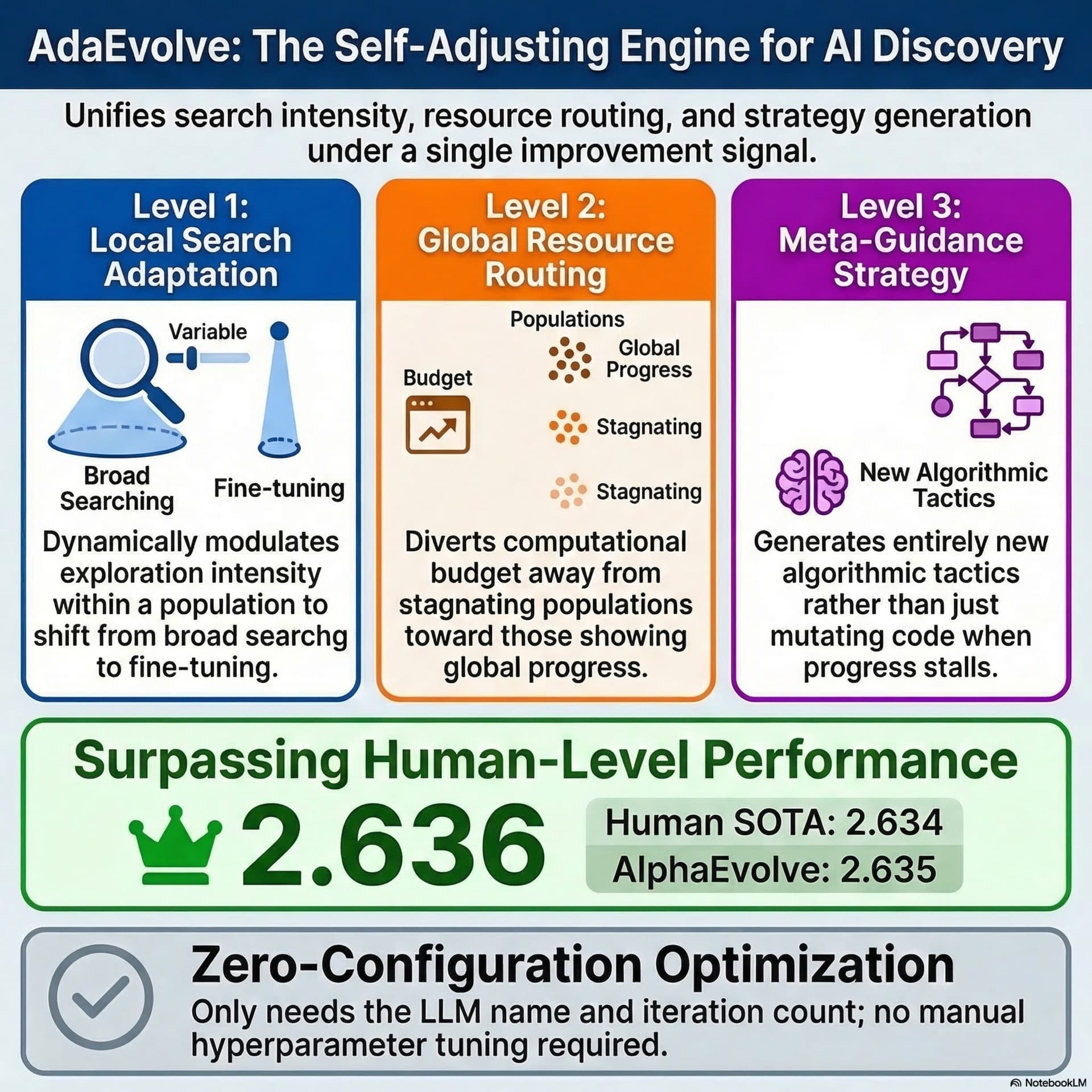
AdaEvolve (UC Berkeley, Bespoke Labs) argues that algorithm/code search with LLM-guided evolutionary methods fails due to fixed “static schedules,” and proposes hierarchical adaptive optimization: local (zeroth-order) adaptation, global compute routing (multi-armed bandit), and meta-guidance (System 2 LLM reflection).
Guest backgrounds
No guests are named in the transcript; it’s a host-led discussion of the research paper.
Key claims
Static mutation/population/prompt settings cause stagnation on deceptive landscapes; AdaEvolve switches between exploitation and exploration per “island” using an accumulated improvement signal; global normalization prevents “poor island bias” in bandit rewards; meta-guidance triggers a separate LLM call when global stagnation occurs to change solution tactics.
Notable examples
Circle-packing (26 circles) stagnates for OpenEvolve after ~100 iterations; AdaEvolve escapes by instructing SLSQP, improving score from ~2.54 to ~2.6+. Multi-cloud routing: AdaEvolve outperforms static baselines by generating dynamic load balancing. Benchmarks: 185 open-ended problems; GPT-5 single-call average 20.64 vs 61.33 with AdaEvolve; wins 6/7 on ADRS.
Written by AI. May contain mistakes. Listen to the episode to check what was said.
Chapters
Tap a time to open that second in VOUnderstanding the Current Limitations of AI
1:18 to 3:32
Discover why current AI systems struggle with complex problem-solving and the impacts of static schedules.
“And that's exactly what we're going to unpack in today's Deep Dive.”
Introducing Ada Evolve's Self-Regulating Mechanisms
3:32 to 7:08
Explore how Ada Evolve adapts and optimizes its approach to problem-solving dynamically.
“It's completely blind to the non-stationary dynamics of the search process.”
The Role of Exploration and Exploitation
7:08 to 10:30
Learn how Ada Evolve modulates between exploring new solutions and exploiting known successes.
“The system actually changes the prompt it sends to the LLM, essentially saying, you are on the right track.”
Global Adaptation and Resource Allocation
10:30 to 12:44
Understand how Ada Evolve allocates computational resources efficiently across problem-solving islands.
“but it manages to make a tiny tweak and jumps to a score of 1.5.”
Meta-Guidance and High-Level Optimization
12:44 to 14:03
Examine how Ada Evolve employs meta-guidance to reevaluate its strategies when facing stagnation.
“In this context, that's the AI rapidly mutating code making syntax tweaks and evaluating scores.”
Overcoming Stagnation in AI Optimization
14:03 to 15:14
Learn how the System 2 LLM overcame stagnation in AI optimization.
“It was just acting in System 1 trying to randomly nudge circles around, hoping they would fit tighter together.”
AdaVolv's Performance Benchmarks
15:17 to 16:12
Discover AdaVolv's impressive performance across various benchmarks.
“The zeroth order local tracking, the venture capitalist global routing, the system two meta guidance.”
Dynamic Load Balancing in Multi-Cloud Networks
16:15 to 17:19
Understand how AdaVolv handles complex data routing tasks in real-time.
“They tested it against the ADRS Benchmark Suite, which consists of seven real-world systems optimization problems.”
Impact of Adaptive AI on Problem-Solving
17:25 to 18:43
Examine the revolutionary impact of AdaVolv's adaptive framework on solving complex problems.
“This is a massive suite of 172 open-ended computer science problems, where in many cases the global optima aren't even known yet.”
The Future of AI: From Tools to Autonomous Researchers
18:43 to 20:03
Explore the shift of AI from static tools to autonomous decision-makers.
“So, synthesizing all of this for you, Adavall proves that the future of artificial intelligence isn't going to be about who can build the biggest, most power-hungry language model.”
Transcript
Automatic transcript. May contain errors.0:00Imagine an AI that gets completely stuck on a really complex mathematical problem. Like instead of blindly guessing over and over until it crashes or, you know, a human just pulls the plug, it actually stops. Right. It looks at its own failed code, realizes it's using the wrong branch of math entirely, and then decides on its own to teach itself calculus to find the answer. Which sounds wild, I know. Right. That is not a pitch for some sci-fi movie. That is actually happening right now. And it represents this massive shift in artificial intelligence. We are moving away from just making models bigger, what the industry calls scaling training, to make them think much, much harder when they actually sit down to solve a problem.
0:43Yeah. And that is fundamentally changing the landscape of research right now. It's called scaling inference time compute because we've spent years kind of conditioned to believe that a bigger engine is always the answer. Throw more data at it. Exactly. More data, more parameters, and the AI will just power through and hand you the answer. But when you apply that brute force method to really open-ended, complex challenges like inventing a new sorting algorithm or optimizing a global multi-cloud network, that massive engine just, well, it burns through gas while spinning its tires in the mud. And that's exactly what we're going to unpack in today's Deep Dive.
1:21We've got this fascinating research paper from UC Berkeley and Bespoke Labs, and it details a new system called Ada Evolve. It's a really incredible piece of work. It really is. So for you listening, our mission today is to uncover why standard state-of-the-art AI systems completely hit a brick wall when they try to iteratively improve code and how 80 of all shatters that wall by acting as this dynamic, self-regulating researcher. Yeah, the researchers propose a framework they call hierarchical adaptive optimization. Which sounds like a mouthful. I know. It sounds incredibly dense, but it's deeply elegant once we look at the mechanics.
1:55And we really need to establish the stakes here early on. This isn't just like a clever prompt engineering trick. Right. This is a fundamental redesign of how artificial intelligence actually manages its own computational resources to achieve human competitive results. OK, but to appreciate the cure, we first have to really understand the disease, right? Let's look at why the current state of the art breaks down so badly in the first place. Right now, the leading approach for complex algorithm discovery uses something called LLM-guided evolutionary algorithms. So systems like OpenEvolve. Right.
2:31And to be fair, the theory behind OpenEvolve is actually quite sound. On paper, yeah. Yeah, on paper. Instead of asking an AI for a final answer in one shot, you give it a population of candidate programs. The large language model acts as a semantic mutation operator. Meaning it understands what it's looking at. Exactly. Because it actually understands the logic of the code, it's not just randomly swapping symbols around like older genetic programming used to do. It reads the code, attempts to mutate it, and tries to breed a better solution over successive generations. Which, I mean, that sounds like a solid plan.
3:02Yeah. Survival of the fittest, directed by an AI that understands syntax. So where exactly does the bottleneck happen? The fatal flaw is in what we call static schedules. Okay. In systems like OpenEvolve, the parameters that govern this entire evolutionary process, the mutation rates, the population sizes, the strict prompt templates you feed the LLM, they are all completely fixed by a human developer before the run even begins. Wow. Okay. Yeah. So you are forcing a highly sophisticated AI into an incredibly rigid search algorithm. It's completely blind to the non-stationary dynamics of the search process.
3:41It's like setting your car's cruise control to exactly 60 miles per hour before a massive cross-country road trip. That's a great way to put it. Right, because that's great if you're on a perfectly straight, flat highway in the desert. But if you suddenly find yourself navigating a winding, icy mountain pass and your car refuses to adjust its speed... You're going to fly off a cliff. Exactly. But wait, let me push back on this for a second. If the AI gets stuck in a rut, if it hits that icy mountain pass, why can't human operators just monitor the output and manually tweak the settings when they see the system spinning its wheels?
4:15Well, that's the instinctive response, sure. But it completely defeats the entire premise of automated scientific discovery. Because you're still doing the work. Right. If you require human intuition to sit there, babysit the algorithm, and bridge the gap every single time the math gets tricky, you limit the AI to the boundaries of human patience and human understanding. That makes sense. Take the circle-packing benchmark from the study, for example. The objective is to pack 26 circles into a unit square to maximize their total radii. Which seems like a simple geometry puzzle when you first hear it.
4:47It does, but it's a notoriously deceptive, jagged mathematical landscape. the complexity scales wildly, and Open Evolve literally stagnates after just 100 iterations. Wow, just 100. Yeah. It finds a decent layout, gets trapped in a local optimum, and simply cannot escape. Unless a human developer manually stops the run, writes a new configuration for a refinement mode, and restarts it, the AI will just sit there failing forever. It has absolutely no mechanism to adapt to its own momentum. Okay, let's unpack this. Because human babysitting isn't scalable for thousands of concurrent problems, the system needs to feel the road automatically.
5:28It needs to know when it's cruising and when it's stuck. And this brings us directly into Edevolve's first layer of defense, right? Local adaptation. Yes, exactly. This is the micro view of the system. So Edevolve strips away all those preset human configurations. You just hand it the problem in a compute budget and it manages itself. At this first level, it tracks an accumulated improvement signal for each distinct subpopulation of programs. And the researchers refer to these subpopulations as islands, right? Yes, islands. Let me stop you there for a second, because the paper mentions that this accumulated improvement signal acts like a gradient in zeroth order optimization.
6:03Right. For those of us who don't spend our weekends reading dense math textbooks, that sounds super intimidating. Wait, zeroth order means it doesn't have a map of the whole terrain. It's just feeling the ground right beneath its feet to see if it's sloping up or down. That is a brilliant way to visualize it, honestly. Okay, phew. Yeah. In standard first order optimization, like how neural networks are traditionally trained, you can calculate the exact slope or gradient of the entire mathematical landscape. You know exactly which direction is downhill toward a lower error rate. Because you have the math to map it.
6:37Right. But in open-ended algorithm discovery, the landscape is a black box. you can't calculate a clean slope. So zeroth order optimization just means you take a step, look at your score, take another step, look at your score, and build this localized exponential moving average of your recent success. Okay, that makes perfect sense. So if that improvement signal is high, meaning the ground beneath its feet is sloping in the right direction, and the island is finding lots of recent meaningful improvements, what does the system do? It automatically shifts its behavior into exploitation mode. The system actually changes the prompt it sends to the LLM, essentially saying, you are on the right track.
7:18Don't make wild structural changes to the code. Just refine the variables and polish this current productive trajectory. Oh, wow. So it's riding the momentum. Exactly. But if that signal decays to zero, meaning the island hasn't improved its score in a while and it's just basically walking into a brick wall, it does the opposite. Yes. It automatically cranks up the exploration intensity. It swaps the prompt to encourage radical orthogonal mutations. Orthogonal meaning completely different directions. Right. It stops taking parents from the most successful recent batch and starts sampling parents from the archive entirely at random to inject weird, diverse traits.
7:56It physically forces the AI to abandon incremental tweaks and look for completely different ways to solve the problem. You know, it's exactly what you do when you're studying a new subject. How so? Well, like if you're reading a textbook chapter and it makes perfect sense and you're nailing all the practice questions, you just zoom through it. You're in exploitation mode. Right. You just keep going. But if you hit a dense, incredibly confusing concept and your brain just halts, you don't just keep rereading the exact same paragraph over and over. I mean, that's a waste of time. You stop. You crank up your exploration intensity.
8:28You close the book, look up YouTube tutorials or try to build a physical model. You try completely different angles to attack the learning bottleneck. It's the exact same mechanism. The system is autonomously modulating its own cognitive style based on its real-time success rate, completely eliminating the need for a human to tell it when to switch gears. Okay, so the island is exploring, but exploring costs money. It really does. The actual processing power, the API, calls to these massive LLMs that is a finite, highly expensive resource. Just because an island wants to explore doesn't mean it deserves the compute budget to do so.
9:05How does the system avoid bankrupting itself on just, you know, a dead-end idea? You've hit on the exact reason why local adaptation isn't enough on its own. We have to zoom out from the micro to the macro, which is the second level of the framework global adaptation. Okay. 8evolve treats computational resources as a strict dynamic budget. To manage this across all the different islands, it uses a multi-armed bandit algorithm. I see. So instead of giving every island an equal slice of the pie, it acts almost like a ruthless venture capitalist. I like that analogy. Right. Imagine a VC firm with a portfolio of 10 startups.
9:41If nine of them are just burning cash and stagnating, but one of them suddenly finds incredible product market fit, the VC doesn't keep writing checks to the losers. They pull the funding from the stagnant companies and heavily invest it into the one that is actually growing. That's a much more accurate framing than the usual analogies we hear. The system dynamically routes the global compute budget only to the most historically productive islands, effectively starving the islands that have plateaued. Brutal, but efficient. Exactly. And if all the startups or islands are stagnating, the system acts like an incubator.
10:14It dynamically spawns entirely new islands from scratch, seeded with historical data to force fresh paths. I do see a potential trap here, though. Let's stick with the VC analogy. Let's say Island A is a really terrible startup. It has a baseline fitness score of 1, but it manages to make a tiny tweak and jumps to a score of 1.5. That's a 50 % relative jump. Meanwhile, Island B is your absolute unicorn. It has an amazing score of 100, and it finds a massive plus 10 absolute improvement, bringing it to 110. That's only a 10 % relative jump. Ah, I see where you're going. Doesn't the bandit algorithm look at island A's 50 % jump, get tricked into thinking that relative progress is more impressive, and accidentally route the compute budget to the losing island?
11:01It absolutely would if it were built using standard reward metrics. The researchers identified that exact trap and named it poor island bias. Poor island bias. Yeah. If you just measure local improvements, the algorithm wastes massive amounts of time and money funding islands that are making trivial, easy refinements in terrible regions of the search space. To solve this, Aida Evolve utilizes something called global normalization. Global normalization? Yeah. How does that mathematically prevent the poor island bias? It normalizes all the bandit rewards, not against the Isler's own local history, but against the global best fitness across the entire system.
11:39Oh, wow. So a single unit of absolute improvement is valued equally, whether it happens on the worst island or the best island. It mathematically guarantees that computational resources only flow to the true frontier of the search space. You're always funding the cutting edge, never the laggards. I love that. But this brings up a deeper philosophical issue for me. What's that? Perfect resource allocation is fantastic. Perfect local tweaking of your exploration intensity is great. But what happens if the underlying conceptual approach is just fundamentally wrong? You can flawlessly optimize a terrible idea, but at the end of the day, it's still a terrible idea.
12:15Now we're getting to the real frontier of the research. You're describing a scenario where numerical adaptation is simply not enough, where the entire global system flatlines, the VC has no good startups to fund, and every single island is stuck. Right. And here's where it gets really interesting. This is where 8evolve triggers its third layer, meta-guidance. This relies heavily on what psychologists refer to as System 2 thinking. Let's expand on that because it's vital. In Daniel Kahneman's framework, System 1 is fast, automatic, and instinctual. Like driving a familiar route to work. Exactly.
12:50In this context, that's the AI rapidly mutating code making syntax tweaks and evaluating scores. But System 2 is slow, deliberate, and highly analytical. It's the deep reflection that happens when instinct fails. Precisely. When the global improvement signal drops below a critical threshold, Adavolve doesn't just blindly keep mutating the code, it physically steps back. It invokes a separate distinct LLM call to perform a meta-analysis. Oh, so it brings in a fresh set of eyes. Yes. It feeds this separate LLM, the original problem specification, the evaluator code, and a highly detailed history of all the recent failed attempts.
13:29It's essentially calling in a high-level consultant to audit the entire operation. It basically says, look at what we've been trying. Look at why it's failing. Generate entirely new high-level solution tactics. Instead of just changing syntax or refining variables, it changes the entire paradigm of the approach. Do you have an example of what that looks like? Sure. It might generate a directive like stop using a greedy heuristic and implement dynamic programming. Let's actually go back to that circle-packing case study, because this is where the System 2 thinking produces just jaw-dropping results.
14:02In the 8 Evolve run, the AI was stuck packing those 26 circles at a score of around 2.54. It was just acting in System 1 trying to randomly nudge circles around, hoping they would fit tighter together. It was completely trapped. And that global stagnation triggered the meta-guidance. The System 2 LLM reviewed the failures, analyzed the geometry of the problem, and realized that random discrete nudging was a conceptual dead end. So it explicitly instructed the mutation operator to implement something called SLSQP. And for you listening, let me unpack SLSQP real quick. That stands for Sequential Least Squares Programming.
14:40It is a continuous optimization solver. Essentially, the System 2 AI looked at the random guessing, realized it was wildly inefficient, and explicitly told the system, stop guessing where the circles go and start using calculus to calculate the exact optimal boundaries. It wrote a high-level instruction to wrap the coordinates in that continuous solver, and the result was instantaneous. By injecting that specific tactic, the system shattered the stagnation immediately. It jumped up into the 2.6 range and eventually found the near-optimal layout. It escaped a conceptual local minimum that mere numerical tweaking could never have solved.
15:14Okay, so what does this all mean? Going from theory to application, all of this architecture, The zeroth order local tracking, the venture capitalist global routing, the system two meta guidance. It sounds incredible. But why does this matter to you and the software and systems we all rely on every day? Did it actually work outside of a geometry puzzle? The benchmarks are where this paper really cements its authority. The researchers didn't just test this on a handful of cherry-picked tasks. They ran eight of Volv across 185 different open-ended problems. And looking at the data here, it didn't just edge out the competition.
15:48On the six highly deceptive mathematical optimization tasks, AdaVolv achieved human competitive or superior results in four of them. That's a huge deal. It is. In that circle-packing benchmark, using a GPT-5 backbone, AdaVolv hit a state-of-the-art score of 2.636, which actually beat the best-known human score of 2.634 and totally outclassed proprietary models like AlphaVolv. But, you know, math is clean, real life is messy. How did it handle the engineering benchmarks? They tested it against the ADRS Benchmark Suite, which consists of seven real-world systems optimization problems. And it won six out of the seven tasks.
16:26Let's make that concrete for a second, because one of those tasks is multi-cloud data storage routing, right? Yes. Think about what a multi-cloud network actually looks like. You have thousands of servers spread across the globe. If a server bank in Tokyo suddenly goes offline, massive amounts of data traffic need to be instantly rerouted to Seattle or London without creating a massive bottleneck that takes down the entire network. A static AI would approach that by trying a fixed routing table, noticing it's slow, and just trying slightly different fixed routes over and over until it gets totally overwhelmed by the bursty traffic.
17:00Exactly. The static baselines plateaued incredibly early on that task. But AdaVal, because it can monitor its own stagnation, realized the fixed route pattern was failing. It shifted its global compute away from that strategy, triggered its system two thinking, and figured out how to write dynamic load balancing algorithms on the fly. That's insane. It pushed right past the static models to find highly optimal, adaptable schedules. And the broader impact of this architecture becomes just undeniable when you look at the Frontier CS benchmark. This is a massive suite of 172 open-ended computer science problems, where in many cases the global optima aren't even known yet.
17:39Right. The researchers took a single-call GPT-5 model, meaning you just feed the problem into the prompt and take its first answer. It scores an average of 20.64. More than half the time, it scores an absolute zero. But when you take that exact same GPT-5 backbone and place it inside the 8-evolve framework, giving it the ability to budget its compute and reflect on its failures, the score skyrockets to 61.33. Wait, really? That is a 3x performance multiplier. Not from adding more data to the model, not from scaling the training, but simply by giving the AI an adaptive hierarchical way to manage its own thoughts.
18:15And we know the hierarchy is the core driver here. How so? The researchers conducted ablation studies basically methodically turning off individual parts of the system to isolate their impact. When they disabled the local adaptation, performance dropped. When they disabled the global multi-armed bandit, performance dropped further. And when they turned off level three, the system two meta-guidance, the system suffered catastrophic drops in performance across the board. Every single tier of this adaptive framework is absolutely critical. So, synthesizing all of this for you, Adavall proves that the future of artificial intelligence isn't going to be about who can build the biggest, most power-hungry language model.
18:53The future is about giving AI an adaptive brain. It's about building systems that can sense when they are hitting a wall, seamlessly redistribute their computational budget to more promising ideas, and trigger deep paradigm-shifting reflection when instinct fails. If we tie this back to the broader trajectory of the industry, this research signifies a monumental evolution. We are actively watching AI transition from a passive static tool like an incredibly smart calculator into an autonomous researcher capable of managing its own complex trial and error process without your constant supervision.
19:26And that leaves us with a pretty profound final thought to mull over. We started this deep dive talking about the limits of brute force and the assumption that humans will always need to be the ones holding the steering wheel, you know, pulling the AI out of the ditch when it gets confused. Right. But if an AI can now dynamically monitor its own stagnation, cut funding to its own bad ideas, and invent entirely new mathematical paradigms to solve complex engineering problems without our help, at what point does human intuition stop being the guiding hand of scientific discovery and start becoming the bottleneck?
20:02A very provocative question, and one the field will definitely have to reckon with very soon. Thank you for joining us for this deep dive. We hope you walk away with a totally new perspective on where AI is heading, and we'll catch you on the next one.
From the publisher
This paper introduces AdaEvolve, a novel framework designed to enhance how Large Language Models (LLMs) solve complex optimization and programming tasks through evolutionary search. Unlike existing methods that use rigid, pre-set schedules, this system implements hierarchical adaptivity to manage computational resources and search strategies dynamically. It operates across three levels: local adaptation to adjust exploration intensity, global adaptation to allocate the budget toward promising solution populations, and meta-guidance to generate new tactics when progress stalls. This approach mimics the efficiency of adaptive gradient methods used in continuous optimization but applies it to discrete, zero-th order problems. Experimental results across 185 benchmarks show that AdaEvolve consistently outperforms standard baselines and human-designed solutions in areas like combinatorial geometry and systems optimization. By replacing brittle manual tuning with a unified improvement signal, the framework demonstrates a more robust and autonomous path for AI-driven discovery.


