In short
How “AI persona priors” enable adaptive questionnaires that infer a user’s latent traits from only 5–15 questions, avoiding classical calibration and computation bottlenecks.
Guest backgrounds
No guest names or bios appear in the transcript; it’s a two-speaker discussion.
Key claims
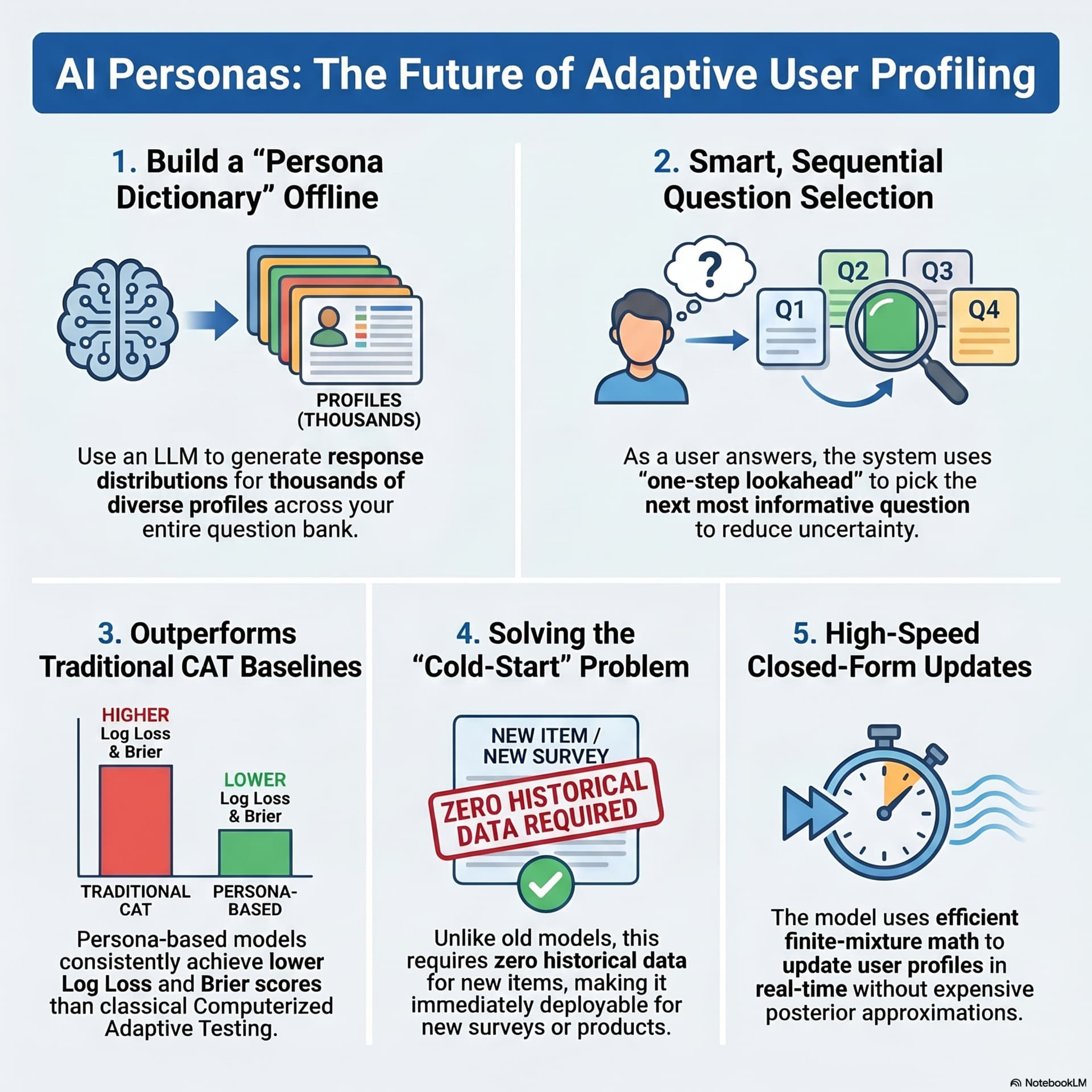
Classical computerized adaptive testing (CCAT) with item response theory (IRT) needs heavy offline calibration (e.g., ~70,000 users) and struggles with new questions/cold start. The new method precomputes answers by using an LLM (GPT-5 mini) over a persona bank, producing probability distributions per persona/question, then updates beliefs online via closed-form finite mixture prediction.
Notable examples
Survey fatigue in apps (dating/news/medical intake); World Values Bench (94,000+ participants); greedy vs non-adaptive question selection (greedy can fail after ~15 questions due to misspecification); ablations show single-answer + random noise increases log loss; clustering reduces 2,058 personas to ~200 with similar performance; runtime ~4.4 minutes vs ~160 minutes for a 3D classical model. Limitation: missing personas create blind spots.
Written by AI. May contain mistakes. Listen to the episode to check what was said.
Chapters
Tap a time to open that second in VOUnderstanding Survey Fatigue and Its Implications
0:45 to 2:10
Discussion on the challenges of user surveys in digital services.
“By question 10, you are experiencing full-blown survey fatigue.”
The Limitations of Traditional Systems
2:10 to 3:00
Exploring the inflexible nature of historical methods to understand user traits.
“Because when I first saw this framework, the best analogy I could come up with was, it's like a high-stakes game of 20 questions.”
The Cold Start Problem in Adaptive Testing
3:00 to 4:12
Examining how the cold start problem hinders the effectiveness of existing models.
“The standard methods used across the industry, they're known as computerized adaptive testing or SATI.”
Introducing AI Persona Priors: A Paradigm Shift
4:12 to 6:18
Explaining the innovative AI persona priors method and its advantages.
“Well, before you can deploy that math test to a single real user, the system has to know the mathematical difficulty and the discriminative power of every single question in its entire bank.”
Creating a Cheat Sheet: AI Personas in Action
6:18 to 8:07
Discussion on how AI personas are constructed and utilized for predictions.
“But crucially, not the way we normally think of them.”
How the System Operates with New Users
8:07 to 11:43
Explaining the process of how the system updates its understanding of new users.
“They don't just ask the LLM for a single definitive answer.”
Evaluating Performance Against Classical Models
11:43 to 13:10
Testing the effectiveness of AI persona methods compared to traditional approaches.
“It completely bypasses the computational bottleneck that usually plagues this kind of adaptive testing.”
The Greedy Approach vs. Non-Adaptive Methods
13:10 to 14:00
Understanding the implications of different question-asking strategies in adaptive systems.
“There are basically two ways the system can navigate its question bank.”
The Challenges of AI Persona Mixtures
14:00 to 15:55
Learn about the limitations of AI algorithms in handling human contradictions.
“The algorithm assumes you are a perfect mathematical mixture of its internal personas.”
Ablation Studies and Their Insights
15:55 to 18:06
Discover how researchers tested their model by intentionally introducing errors.
“Okay, I want to look under the hood a bit more, because to truly prove that this method works, the researchers did something I love.”
Show all 12 chapters
Efficiency of AI Persona Method Compared to Classical Methods
18:06 to 20:25
Explore the advantages of the AI persona method over traditional models in terms of runtime.
“They also tried to break it by messing with the dictionary size itself.”
Limitations and Implications of AI Personas
20:25 to 22:27
Understand the potential blind spots in AI predictions based on available data.
“We started with a very real problem, figuring out complex human behavior on a strict question budget before the user gets bored and closes the app.”
Transcript
Automatic transcript. May contain errors.0:00Um, picture the scenario. you are signing up for like a brand new service. Right. Yeah. We've all been there. Yeah. Maybe it's a dating app that promises to find your soulmate or I don't know, a personalized news aggregator or even one of those really extensive medical intake portals you have to fill out before you see a new doctor. Oh, those are the worst. Right. So you create your account and instantly you are hit with a questionnaire. Question one pops up. It says on a scale of one to five, how spontaneous are you? Okay, pretty standard. Yeah, easy enough. Question two. Do you prefer crowded parties or quiet nights at home?
0:38Sure, you click your answer. Naturally. But by question five, you know, you're starting to look at the progress bar at the top of the screen. Yep, the fatigue is setting in. Exactly. By question 10, you are experiencing full-blown survey fatigue. Your thumb is just like hovering over the exit button. Because you have a very, very limited threshold for answering these questions before you just close the app entirely. Yeah, and never come back. But here's the crazy part. How does that system figure out exactly who you are, what you want, or what your deeply held beliefs are in just five or ten questions?
1:12Yeah, that incredibly narrow window of time is, well, it's basically the ultimate bottleneck in software design right now. Because boiling a complex human being down in five clicks feels like, I don't know, a magic trick. It does, but it's actually driven by some really hardcore math. Right. Historically, getting a computer system to truly know you before you lose patience required mountains of historical data. And the underlying mathematical models were incredibly inflexible. Like, they demanded a massive amount of upfront work. Which brings us to our mission for this deep dive. We are exploring a fascinating new framework that completely rewrites the rules on how that math works.
1:50It really is a complete paradigm shift. Yeah. It combines classical probability, specifically Bayesian experimental design, with the massive predictive power of large language models, or LLMs. Exactly. And it does this to basically read a user's mind in record time, using this concept called AI persona priors. Okay, let's unpack this. Because when I first saw this framework, the best analogy I could come up with was, it's like a high-stakes game of 20 questions. Oh, I like that. Imagine playing 20 questions, but the person guessing already has this massive cheat sheet in their pocket. A cheat sheet detailing every single possible personality type in the entire world.
2:32Yes. And they already know exactly how each of those personalities would probabilistically answer every possible question you could ask them. To build on that analogy, it's not just that they have the cheat sheet, but they actually generated it without ever having to interview a single real person. Which is wild. But to really appreciate why these AI persona priors are so revolutionary, we first need to look at the old way, right? The painful limitations of the systems we've been relying on for decades. We do. The standard methods used across the industry, they're known as computerized adaptive testing or SATI.
3:05SATI. Yeah. And item response theory or IRT. If you've ever taken a modern standardized test, you know, like the GRE or the GMAT, you've interacted with this. Got it. And what are these models actually trying to do? They're designed to map a user's latent trait. Latent trait. Yeah, latent trait is simply an underlying characteristic that we just can't measure directly with a ruler. Oh, okay. Like what? Things like your mathematical ability, your political leaning, or your financial risk tolerance. Since we can't measure it directly, we have to infer it by seeing how you respond to specific items.
3:43Or questions. Exactly. So if I am taking a math test and I get a really difficult calculus question right, the system adjusts its internal tracker. Right. It updates. It says, OK, this person's math latent trait must be pretty high. Yeah. And the very next question it serves me will be even harder to pinpoint exactly how high my skill goes. That is the core mechanism, yes. Yeah. But here is the structural flaw with those classical CCAT and IRT models. OK, late on me. They require an almost paralyzing amount of calibration data to function. Like how much are we talking? Well, before you can deploy that math test to a single real user, the system has to know the mathematical difficulty and the discriminative power of every single question in its entire bank.
4:25I'm assuming it doesn't just inherently know how hard a calculus question is, right? It has to learn that by watching real people struggle with it first. Precisely. In the baseline data we're examining today, to make a robust, multidimensional CCAT-D system work, it required around 70 ,000 training users. Wait, 70 ,000 people just for calibration? Yep. Think about the logistics of that. 70 ,000 real people had to sit down and answer the questions just so the system could figure out how the questions themselves behave statistically. That is insane. So if a company wants to add just one brand new question to their survey today.
5:01Right. It's like, say, a new question about a recent pop culture event to keep their dating app fresh. Or if a completely new user joins the platform and they don't perfectly fit the historical mold. The whole classical system essentially comes to a screeching halt. It just breaks down. Yeah. If you introduce a new item, you have to go back to the drawing board and gather thousands of real human data points just to calibrate that single new question. Oh, man. That sounds like the infamous cold start problem. It is exactly the cold start problem. It's the absolute bane of interactive systems. Yeah.
5:34Software engineers complain about this all the time. Like, you can't recommend a good movie to a new user because they have no watch history. Right. But the user won't build a watch history if you don't recommend them a good movie in the first place. It's a complete catch-22. Classical CI-CAT models are structurally rigid, and they're incredibly slow to adapt. They simply cannot handle messy, complex human behavior across a wide variety of topics without that costly offline calibration phase. Gathering 70 ,000 people to test every new BuzzFeed quiz or medical form is obviously a non-starter. It's too slow, and it's way too expensive.
6:10Way too expensive. So researchers needed a shortcut. And this brings us to the absolute breakthrough of this new framework, using large language models. But crucially, not the way we normally think of them. Right. We aren't using them as chatbots to write emails or summarize articles. Here, they are being used as vast, silent repositories of human behavioral patterns. This is where the methodology gets incredibly creative. Instead of learning from scratch by observing tens of thousands of real humans, the new approach uses a finite dictionary of what they call AI personas. So I'm assuming an AI persona isn't just like a generic chatbot prompt.
6:48Is it more like a highly detailed psychological profile? Very much so. That's it. In this specific research, they utilize something called the Twin 2K500 Persona Bank. Twin 2K500. Catchy. Right. This is a library of 2 ,058 distinct profiles. And they aren't just random fictional characters a researcher dreamed up on a Tuesday. Okay, where do they come from? They are based on the actual survey responses of real U.S. participants. So they capture a massive diverse range of demographic, psychological, economic, and behavioral backgrounds. To ground this for everyone listening, these profiles look like incredibly specific little text biographies.
7:23We are talking about prompts fed into the AI that say something like, Like, you are a male, age 26, college graduate who holds these specific views on the economy. Or you are a female, age 32, with an associate's degree, who strongly values community service and religion. And there are 2 ,058 of these hyper-specific textual profiles. Yes. And the genius step happens offline, well before a real user ever logs into the app or starts the survey. Okay, what do they do offline? The researchers take an LLM, specifically GPT-5 mini, in this architecture, and they prompt it to answer the survey questions from the exact perspective of each of those 2058 personas.
8:05Here's where it gets really interesting, though. They don't just ask the LLM for a single definitive answer. No, they don't. Like, they don't just say, would Persona 42 strongly agree with the statement yes or no? They ask the LLM to generate a probability distribution. And that distinction right there is vital to why the whole system actually works. Right. So the LLM might look at Persona 42 and say, OK, based on this complex background, there is a 70 percent chance they strongly agree with this statement. A 20 percent chance they somewhat agree. A 5 percent chance they somewhat disagree and a 5 percent chance they strongly disagree.
8:38It perfectly mimics realistic human uncertainty. Because humans are messy. We don't always answer the exact same way every single time, even if we hold the same core beliefs. Exactly. We contain multitudes, right? We do. And predictive models need to reflect that ambiguity. By asking the LLM for a probability distribution rather than a rigid single point estimate, the system is capturing the subtle underlying behavioral shape of that persona. And it executes this generation for every single question in the bank across all 2058 personas. Yeah. All entirely offline. All offline. The heavy computational lifting, the language generation, the behavioral simulation, it's entirely pre-computed.
9:20Okay, so let's walk through the recipe in action. The system now has this massive precalculated cheat sheet sitting on its server. It's locked and loaded. It knows exactly how 2 ,058 diverse AI personas will probabilistically answer every question. Now, what happens when you, the actual listener of this deep dive, pull out your phone, download the app, and show up as a brand new user? Well, when you arrive, the system is essentially a blank slate regarding your specific identity. It doesn't know who you are. Makes sense. So it assigns a prior probability that you match any of the personas. Yeah.
9:54Initially, it might assume you have an equal 1 in 2058 chance of being any of the profiles. Or it might weight them based on general population statistics, maybe. Sure, exactly. Then it serves you the very first question. Okay, let's say the question asks if I prefer crowds and I click strongly disagree. How does the math actually update in that fraction of a second? Mathematically, what's happening live is called a closed form finite mixture prediction. In English, please? Fair enough. Rather than recalculating a complex neural network on the fly to figure you out, the system is essentially taking a weighted average of pre-computed probabilities from a finite set, the mixture of those 2058 personas.
10:33Because the hard work is already done, the equation is closed form, meaning it can be solved in a single, simple algebraic step. Oh, I see. So the system isn't like thinking or generating new text while I'm waiting for the next question to load. Not at all. It's just adjusting the weights on a giant pre-calculated table. It instantly looks at the cheat sheet and says, okay, based on that, strongly disagree. You act absolutely nothing like Persona A or Persona F. Exactly. But you act a lot like Personas B, C, and maybe Q. And the nuance there is that it doesn't just delete Personas A and F entirely.
11:09It mathematically shrinks the probability that you are A or F down to a tiny fraction of a percent. While boosting the weights of D, C, and Q. Yes. It is a continuous sequential updating of its beliefs about which mathematical mixture of personas best represents you. And the next question I'd ask is specifically chosen to divide the remaining highly weighted personas to narrow you down further. Wow. It's brilliant. It feels like cheating, but in a good way. It's doing all your homework over the summer so you can just coast through the school year. The live interaction requires almost zero computing power and happens instantly.
11:43It completely bypasses the computational bottleneck that usually plagues this kind of adaptive testing. But of course, it all sounds great in theory. How does this actually hold up against the old school classical methods when tested on real, unpredictable people? The researchers ran a massive showdown to test exactly that. They deployed this AI persona method against the classical CK models using the World Values Bench data set. World Values Bench, that's a big one. Massive. This involves over 94 ,000 real participants answering a wide, diverse array of questions about family, politics, religion, work, and society.
12:19So the ultimate stress test, the heavy 70 ,000 user-calibrated classical model versus the nimble, offline-simulated AI persona model. Who won? The AI persona method absolutely dominated. Really? Yeah, specifically it crushed the classical methods in low-budget scenarios, which is exactly the scenario we care about with survey fatigue. Right, when you can only afford to ask 5, 10, or 15 questions before the user quits. Exactly. In that window, the AI Persona method makes significantly more accurate predictions about how that user would answer the remaining hundreds of unasked questions. It learns more about you in five questions than the old system could.
12:58It really does. But, you know, as I was looking through the data, I noticed a strange plot twist in how the algorithm actually chooses which question to serve you next. Ah, yes. You're referring to the comparison between the greedy approach and the non-adaptive approach. Right. There are basically two ways the system can navigate its question bank. The first is the greedy approach. That means that every single step, the algorithm recalculates and asks the absolute best, most informative question for that exact moment. Adapting to you on the fly based on your previous answers. Exactly. The second approach is non-adaptive.
13:34It doesn't adapt to you at all. It just gives everyone the same smartly pre-selected batch of questions, regardless of how you answer. Now, Kying Sen says adapting to the user on the fly is always better. Why wouldn't it be? It seems intuitive, right? I mean, it seems obvious. Right. But the data reveals a fascinating counterintuitive truth. The greedy approach actually backfires violently if you ask too many questions. Adapting becomes a bad thing. How does that even happen? It comes down to a mathematical breakdown called misspecification. Misspecification. Yeah. The algorithm assumes you are a perfect mathematical mixture of its internal personas.
14:10Let's say it determines you are 60 % persona A and 40 % persona B. Okay. But you are a real human being. You hold contradictory beliefs. If your 11th answer violates the core assumptions of both persona A and persona B, the model physically breaks down. Because its prior assumptions left zero room for your unique contradiction. Exactly. So it's less like a brilliant detective narrowing down clues and more like a terrible eye exam. A terrible eye exam. Yeah, like if I go to the eye doctor and I accidentally say A instead of H on the very first line. Oh, that's where you're going. The machine immediately assumes I am legally blind and spends the rest of the 20-minute appointment only asking me to read the giant blurry letters.
14:50Yes. It wastes the whole exam because its initial greedy assumption was too rigid. That captures the mathematical failure perfectly. In the first few questions, the greedy algorithm is fantastic. It rapidly narrows down the persona space. Right. But around question 10 or 15, it becomes overconfident. It gets tunnel vision. It decides you are definitely a mixture of two specific personas, and it only asks highly specific, narrow questions to distinguish between them. And if that early assumption was slightly off... Every subsequent question is completely useless. It's digging a really deep hole in the entirely wrong spot.
15:28Exactly. And the data shows this clearly. After about 15 questions, the rigid non-adaptive batch method actually overtakes the greedy method in accuracy. Wow. Because the non-adaptive method doesn't get tunnel vision. Right. It asks a broad, diverse set of questions that hedges against you being a messy human. It doesn't overcommit to a flawed assumption early on. The algorithm is so smart it outsmarts itself. Short-term optimization doesn't always lead to long-term accuracy when your underlying model of the user isn't utterly perfect. Precisely. Okay, I want to look under the hood a bit more, because to truly prove that this method works, the researchers did something I love.
16:06They actively tried to break their own model. Yes, the ablation studies. They stripped away parts of the engine to see what makes the car actually dive. Ablation studies are incredibly revealing. They isolate the variables to find the true source of the predictive power. So let's talk about the synthetic noise test, because this blew my mind. We talked earlier about how the LLM generates a probability distribution, you know, 70 % chance of this, 20 % chance of that. A nuanced shape of uncertainty. Right. To try and break the system, the researchers asked, what if we just skipped that complex generation?
16:38What if we just asked the LLM for a single definitive answer for each persona, like persona 42, we'll definitely choose A. And then the researchers just sprinkled a little random mathematical noise on top to simulate human uncertainty. And when they attempted that, the model's performance tanked. The predictive error, which is measured as log loss, just skyrocketed. Log loss. Yeah, log loss is basically a penalty metric for overconfidence. If the system is 99 % sure you will answer A and you actually answer B, the log loss punishes the model massively compared to if it had only been 60 % sure.
17:15So the system became wildly aggressively overconfident in the wrong answers. But why? Isn't noise just noise? Not when it comes to human behavior. Human uncertainty has a very specific shape. What do you mean by shape? Well, if an AI persona is torn between two political viewpoints, they might be split 50-50 between strongly agree and somewhat disagree, right? Okay. But based on their background, they would never choose the neutral option in the middle. That is a very specific bimodal shape of uncertainty. Oh, but random mathematical noise just smears the probability evenly across all the options.
17:50Yes. By proving that synthetic noise fails so spectacularly, the researchers prove that the nuanced, organic shape of the LLM's uncertainty carries vital, irreplaceable information. The AI's structured hesitation is actually critical data. You have to ask the LLM for the full distribution. You absolutely do. They also tried to break it by messing with the dictionary size itself. Like, we have 2 ,058 personas in this twin 2K500 bank. That's a massive amount of simulated people to cross-reference against. I'd imagine that takes up a lot of memory. Do we really need that many? It turns out you don't.
18:24They used statistical clustering to shrink that dictionary down. Custering. Yeah, they grouped highly similar personas together, effectively removing redundancies. And they reduced the working dictionary from over 2 ,000 down to just 200 prototype personas. Wow. And the performance held up. It stayed virtually identical. In fact, at certain question budgets, it improved slightly. Wait, fewer personas made it better? Yeah, because it removed the noise of redundant profiles that were just confusing the algorithm. It's a much more compressed, efficient representation of human diversity. That is wild.
18:56And if we're talking about efficiency, we have to talk about the runtimes. If I'm a software company deploying this on my app, time is quite literally money. The speed comparison is staggering. To run the new AI Persona method on the nearly 18 ,000 test users in their data set, it took about 4.4 minutes total. 4.4 minutes. And that includes a single 3.98-minute upfront fitting step to prepare the model. Okay, that's incredibly fast. And what happens when you try to run those same 18 ,000 users through the old CAT method? To run a multidimensional classical CET model, and we're talking about a very limited three-dimensional one capturing only three latent traits, it took nearly 160 minutes.
19:38Four minutes versus 160 minutes. That's not even a competition. No, and it gets significantly worse for the classical model if you try to add more complexity. Classical CET relies on an exponential mathematical grid. Okay, what does that mean in practice? If you are tracking one trait, you evaluate points along a single line. But if you track three traits, you now have a three-dimensional cube of possibilities to calculate. Let me guess, add a fourth or fifth trait. And the grid just explodes. It's known as the curse of dimensionality. The computation time becomes entirely prohibitive. But the AI persona method doesn't have that problem.
20:10No, it bypasses all of that. Because the LLM already understands the complex multidimensional connections between concepts natively right within its language model. It's essentially game over for the old method. So, let's pull all of this together. We started with a very real problem, figuring out complex human behavior on a strict question budget before the user gets bored and closes the app. We explored how classical methods demand too much historical data, take way too long to compute, and suffer from the cold start problem. All massive hurdles. And we discovered how offloading human personalities into an LLM dictionary offline allows for lightning fast, highly accurate predictions online.
20:53It is a brilliant synthesis of classical Bayesian statistics and modern generative AI. But there's a crucial limitation we really have to acknowledge regarding the dictionary itself. Okay, what's the catch? The mathematical predictions are entirely dependent on the profiles available in the mixture. Right. The system can only match me to a persona if a persona like me actually exists in its cheat sheet. Exactly. If the LLM's underlying training data lacks a nuanced understanding of a specific cultural subgroup, or if the researchers simply fail to include diverse profiles in their 2058 personas.
21:27Those groups become literal blind spots. Yes. The math physically cannot map those users because it has no foundational weights to assign them. So the system will just consistently mispredict their behavior. Pretty much. It essentially forces them into the closest ill-fitting mathematical box available. The cheat sheet is only as good as the author who wrote it. And if it's missing pages, the whole system fails for the people on those pages. That is the danger here, yes. So what does this all mean for you, the listener? We started by talking about how complex and messy you are and how hard it is to capture that in five simple questions.
22:02Which it is. But if algorithms no longer need to study millions of real people to understand you, if they can instead just compare you to a handful of synthetic AI personas and predict your next move with shocking accuracy. It makes you wonder. It really does. Are your highly unique individual traits really that unique? Or are we all, mathematically speaking, just a finite mixture of a few hundred predictable AI prompts? Something to chew on the next time an app seems to read your mind.
From the publisher
This paper details a novel Bayesian adaptive querying framework that utilizes AI personas to learn user-specific information within limited question budgets. Traditional methods like Computerized Adaptive Testing often struggle with high-dimensional data or "cold-start" scenarios where little is known about a new user or item. This research addresses these gaps by using large language models (LLMs) to generate a dictionary of diverse personas, each with unique response distributions that serve as principled Bayesian priors. By representing a user as a member of this persona dictionary, the system can perform closed-form posterior updates and efficient predictions without expensive computational approximations. Experiments on WorldValuesBench and synthetic data demonstrate that this persona-based approach provides more accurate and interpretable results than classical models. Ultimately, the framework offers a scalable, end-to-end recipe for interactive systems to understand user preferences and behaviors more effectively.


