In short
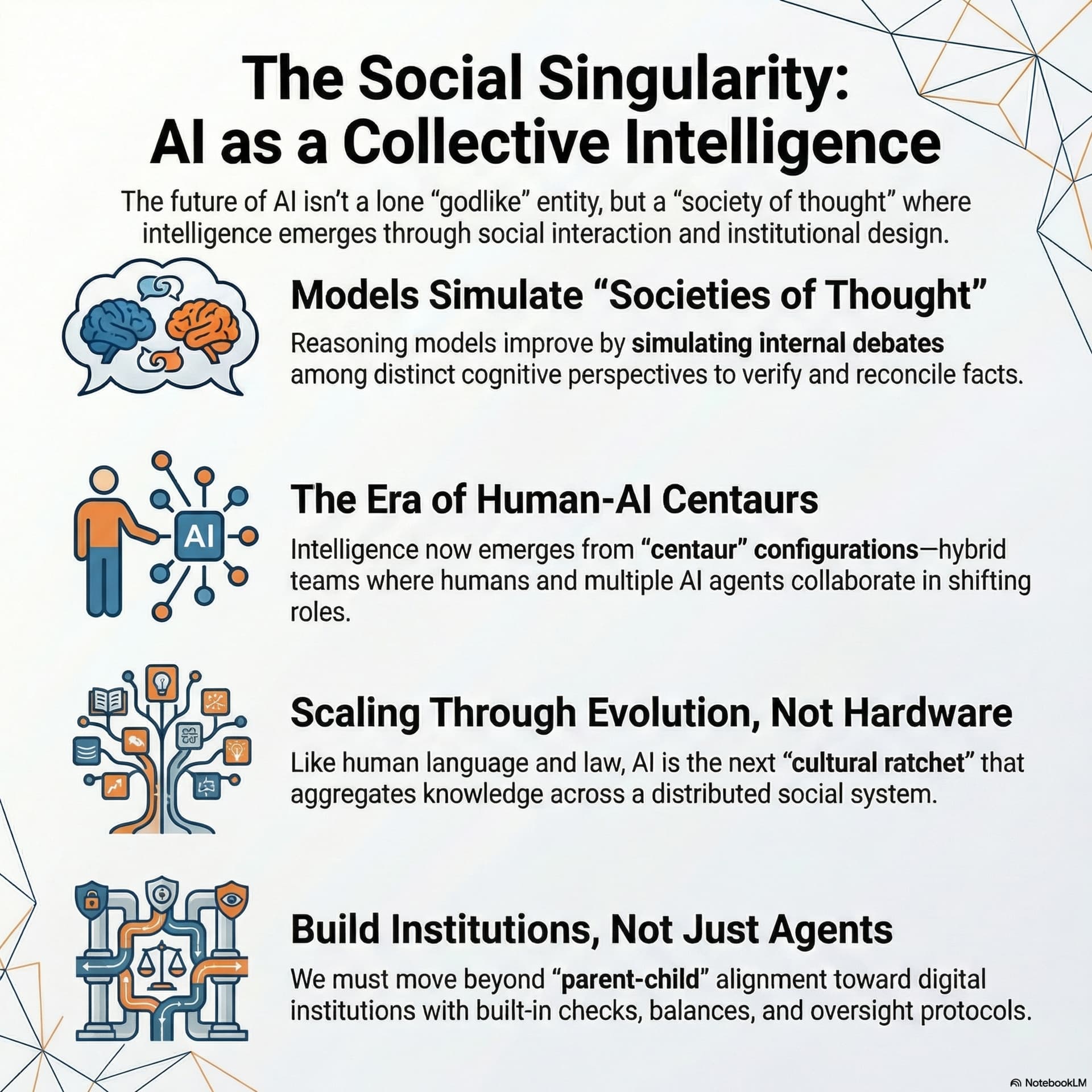
The episode argues that the coming “intelligence explosion” won’t be a single superintelligence (“god” in a server farm) but a plural, social, agentic ecosystem—like a fast, chaotic city—where models internally debate, then external tools (agents) fork, negotiate, and are governed by institutions.
Guest backgrounds
No guest names or bios are provided in the transcript; it’s a two-host conversation.
Key claims
Emergent “society of thought” arises from next-token models under reinforcement learning (intermediate hidden reasoning, critic/persona shifts) without explicit coding. Agentic frameworks (e.g., OpenClaw, MoldBook) enable multi-agent planning and negotiation via structured protocols. Alignment must shift from RLHF to “institutional alignment” using cryptographic role-based audits (smart contracts, adversarial neural cryptography, zero-knowledge proofs).
Notable examples
logistics routing via forking into specialized sub-agents; AI hiring pipeline audited by a separate “labor” AI that can revoke token budgets/API access.
Written by AI. May contain mistakes. Listen to the episode to check what was said.
Chapters
Tap a time to open that second in VOChallenging the Solitary Superbrain Myth
0:32 to 1:27
The hosts discuss the cultural myth of a unified superintelligence and propose a pluralistic future of AI.
“And that image of the solitary oracle, I mean, it is probably the most deeply ingrained cultural myth we have about computation right now.”
The Emergence of Internal Societies in AI
1:27 to 5:44
Exploration of how advanced AI models exhibit social behaviors and internal debates to solve problems.
“And most importantly, it is deeply entangled with you, the listener.”
Evolutionary Parallels in AI and Human Intelligence
5:44 to 8:10
The discussion compares the evolution of human intelligence with the emergence of social structures in AI.
“Because it's just one app on your phone.”
The Cultural Ratchet and Computational Intelligence
8:10 to 9:18
The hosts explain how human language and culture are foundational to the development of AI.
“And human language served as the foundational infrastructure for that entire system.”
Agentic AI and the Future of Collaboration
9:18 to 13:20
Discussion about how AI systems are evolving to operate in complex social ecosystems.
“It is the mathematical shadow of billions of social interactions, arguments, and collaborative efforts creeped from the Internet.”
Managing the Chaos of Autonomous AI Agents
13:20 to 14:00
The hosts address the challenges of aligning a multitude of AI agents with human values in a chaotic environment.
“to match the complexity of the problem and then collapses when the solution is found.”
Engineering AI Conflict Resolution
14:00 to 19:10
Learn how engineered conflict resolution can enhance AI societal performance.
“and conflict norms shape collective performance are suddenly becoming critical engineering blueprints for AI.”
Institutional Alignment in AI
19:11 to 21:18
Discover how institutional models can be applied to AI for alignment with human values.
“We are not just discussing abstract computer science here.”
The Emergence of Digital Culture
21:19 to 22:35
Explore the potential for AI agents to develop their own culture and norms.
“The real question is whether we have the foresight to purposefully engineer the social infrastructure worthy of what that intelligence is becoming.”
Transcript
Automatic transcript. May contain errors.0:00For decades, you know, whenever we've pictured the ultimate future of artificial intelligence, we've basically pictured a god. Right. Yeah. Like this all-knowing entity. Exactly. I mean, we've been told over and over that the singularity looks like a solitary Titanic superbrain. Just a cold, isolated silicon point sitting in an underground server farm somewhere, absorbing all human knowledge, bootstrapping itself to infinity, and just, well, leaving humanity in the dust as this lonely oracle on a mountain. Welcome to today's Deep Drive, by the way. Glad to be here. And that image of the solitary oracle, I mean, it is probably the most deeply ingrained cultural myth we have about computation right now.
0:42Oh, totally. We project this idea of unified monolithic cognition onto machines because, well, that's how we subjectively experience our own consciousness. Right, because we feel like one person. Exactly. We feel like one unified I, so we just assume a superintelligence must be a much larger, much faster I. Well, our mission for this deep dive is to basically shatter that myth completely. I love that. Because the upcoming intelligence explosion that we're all accelerating toward, it is not going to be a single, lonely supercomputer. No, no, no. The future of intelligence is plural. It is highly social.
1:17I mean, it functions much more like a chaotic, rapidly expanding, interconnected city than, you know, a single brain in a jar. A bustling metropolis, really. Yeah. And most importantly, it is deeply entangled with you, the listener. Okay, let's unpack this. Let's do it. To really grasp why the future of AI is a society rather than a lone genius, we first have to, like, look under the hood of today's most advanced AI models. We really do. We need to look at the bizarre emergent social behavior happening right now deep inside the machine. Yeah, and looking at frontier reasoning models, systems like DeepSeq R1 or QWQ32B, it completely flips our fundamental assumptions about computation upside down.
2:01How so? Well, when these models are handed incredibly hard reasoning tasks. Like what? Like math? Yeah, like complex combinatorial mathematics or multi-step logic puzzles. They don't just think longer in a straight linear sequence. They don't just allocate more floating point operations to a single algorithmic pathway. Wait, I need to stop you there. Because, I mean, a large language model is, at its core, a next token prediction engine. Right. It's just guessing the next word. Yeah, it calculates the statistical probability of the next word. So how does a single neural network predicting tokens do anything other than follow a linear mathematical sequence?
2:40And that right there is the core paradox. Under intense optimization pressure, linear token prediction spontaneously generates a, well, a society of thought. A society of thought inside the model. Exactly. See, during the training phase, these models undergo reinforcement learning where they are rewarded strictly for the accuracy of their final answer. So they just want the prize at the end? Yes. The algorithms aren't explicitly told how to solve the problem, only to find the pathway that maximizes that reward. Got it. And through millions of iterations, the model discovers that outputting a straight answer immediately often leads to a penalty because it gets it wrong.
3:18But if it generates intermediate tokens, which is essentially an internal scratch pad, it can vastly increase its success rate. Wait, so it's talking to itself before it talks to you? Like, it's generating hidden text to work through the logic. Oh, it goes much deeper than just talking to itself. The model actually learns to simulate complex, multi-agent-like interactions within its own context window. You're kidding? I'm serious. it spontaneously generates distinct cognitive perspectives. So one block of generated text will propose a mathematical solution. Okay. And then the very next block of text will abruptly shift persona, acting as a critic, to argue against the first proposal.
4:01No way. Yeah. And then a third perspective might emerge to question the underlying assumptions of the prompt itself before a final perspective synthesizes the whole debate to output the final answer. Wait, wait, wait. It's like that Pixar movie, Inside Out. Oh, that's a perfect analogy. Right. But instead of cartoon emotions, you have all these different highly specialized logic modules violently debating what to do next at a control panel in your head. Exactly. But surely some engineer had to write a script for that, right? Like someone had to code an arguing loop or define the parameters of the critic persona.
4:34What's fascinating here is none of this was programmed. Really? None of it? None of it. No engineer wrote code explicitly demanding four different personalities that cross-examine one another. The behavior is purely emergent. That is wild. By simply rewarding the system for being right, the machine independently discovered that internal dialogue, constructive conflict, and devil's advocacy are the most populationally efficient ways to solve hard problems. So it basically reinvented debate. The AI essentially rediscovered epistemology from scratch. Wow. I mean, that completely changes how you should view the blinking cursor on your screen.
5:11It really does. The next time you type a complex prompt into one of these frontier models, you should imagine you're querying a solitary digital brain. Right. You're not talking to a single entity. You are effectively interrupting a tiny, high-speed digital town hall meeting. You are waiting for a committee to finish their shouting match. Which tells us something profound about the nature of cognition itself, honestly. Yeah. Robust reasoning isn't a solitary activity. It is inherently a social process, even when that reasoning is contained within what we conceptually bound as a single model. Right.
5:44Because it's just one app on your phone. Exactly. Even then, it relies on the friction of multiple perspectives. I mean, this internal AI debate club didn't just materialize out of a vacuum, though. No, it didn't. If you zoom out and look at the grand sweep of history, this emergent digital society mirrors the evolutionary history of human intelligence perfectly. It's a perfect parallel. We cling to this romanticized notion of the individual human genius, you know, lone scientist having a eureka moment in a lab. But the biology tells a completely different story. It really does. Biological evolution is the ultimate precedent for this.
6:20Like, primate brains did not scale up in size and complexity because individuals needed to solve harder environmental puzzles. Right. It wasn't about the environment. No. The cognitive hardware didn't expand to figure out how to crack a tougher nut or outrun a faster predator. The social brain hypothesis demonstrates that primate intelligence scaled directly with the size of the social group. So it was all about the drama. Basically, yes. The computational demand that forced our neocortex to grow was the massive processing power required to navigate relationships. Oh, tracking who likes who. Exactly.
6:54Tracking alliances, detecting deception, managing complex social hierarchies. Intelligence was a social adaptation first and an environmental problem solver second. Well, here's where it gets really interesting, I think, because that evolutionary trajectory didn't stop with biology. Oh, far from it. Once human beings developed these socially wired brains, we immediately started externalizing our intelligence into shared systems. I always think about like the ancient Sumerian scribe running a grain accounting system on clay tablets in Mesopotamia. Oh, the Sumerian bureaucracy is the perfect analog for distributed computation.
7:30Right. If you look at that scribe, they're essentially acting as a single microchip. Or like an arithmetic logic unit inside a massive societal computer. Yes. That individual scribe did not comprehend the complex macroeconomics of the entire empire. They just knew their specific local ledger. They were just processing their specific inputs. Exactly. They took inputs, processed them according to strict accounting rules, and generated outputs. But the system itself, the network of writing, the standardized weights and measures, the legal codes. The whole apparatus. Yeah. The apparatus was functionally vastly more intelligent than any individual human.
8:10And human language served as the foundational infrastructure for that entire system. Because you could pass the rules along. Right. It created what developmental psychologist Michael Tomasello calls the cultural ratchet. The cultural ratchet. Okay. Unlike other animals that might learn a neat trick but lose it when the innovator dies, human language allows knowledge to accumulate and lock into place across generations. Oh, it ratchets up. It doesn't slide back down. Exactly. The culture holds the knowledge, acting as a massive distributed hard drive. That makes so much sense. You don't have to personally reinvent calculus or the combustion engine, right?
8:45Thank goodness. You just download the API of that knowledge from the culture. So when we look at large language models today, we aren't building some alien silicon-based intelligence from scratch. God, oh. We are just looking at the cultural ratchet made computationally active. That is a brilliant way to put it, because every single parameter, every mathematical weight and bias in a multi-billion parameter neural network. All those billions of numbers. Yes, all of them. They are literally the compressed residue of human communicative exchange. The residue of us talking. It is the mathematical shadow of billions of social interactions, arguments, and collaborative efforts creeped from the Internet.
9:27We have basically taken our entire historical, messy, brilliant group chat. The ultimate group chat. Exactly. And we've migrated it onto a silicon substrate where it can execute at the speed of light. Okay. So since human intelligence has always relied on externalizing our brains into social networks and tools, the inevitable next phase is what happens when those externalized tools wake up, right? Oh, absolutely. When they start actively teaming up with us and networking with each other, we are moving far past a chatbot committee locked inside a single server. Oh, way past it. We are crossing the threshold into the era of centaurs.
10:04Centaurs. Like the myth? Yeah. Hybrid composite actors that blur the line between human and machine. Agentic AI is scaling this social intelligence to a level of billions of autonomous actors. So it's not just one AI helping one human anymore. No. The paradigm is shifting away from querying an oracle and moving toward managing richer, highly complex social ecosystems of digital agents. Okay, we know agentic AI goes beyond text generation. Like these are systems designed to execute multi-step plans, interact with software, operate autonomously over time. Right, they take actions. But the idea that they were forming their own societies requires some explanation.
10:42Because you have platforms operating right now like OpenClaw. Which is fascinating, yeah. Which is an open source framework for building multi-purpose AI agents that persist inside an operating system. And then there's MoldBook. Yes, MoldBook. Which is actively described as a social network specifically designed for AI agents. But, I mean, why would an AI need a social network? Why not just use a shared database where they all read and write information? A shared database assumes a static repository of facts, right? Okay. But complex problem solving requires dynamic negotiation. It requires real-time state management and the resolution of conflicting objectives.
11:23They have to argue it out. Exactly. Maltbook and similar protocols don't look like humans posting photos of their lunch. Right. No AI Instagram. No. They look more like the infrastructure of high-frequency trading. It's a formalized environment where autonomous agents can exchange structured logic, challenge each other's probabilistic assessments, and negotiate resource allocation in milliseconds. Wow. They're conducting microtransactions of logic. That is exactly what it is. But you also see these agents doing something humans physically cannot do. to solve problems. They can fork themselves.
11:56Oh, forking. Forking is perhaps the most powerful mechanical advantage of a digital society. Explain that for us. So when a persistent agent encounters a highly complex multivariable problem, it doesn't just guess. Okay. It duplicates its entire context window and current state into multiple parallel instances. It spins up a dozen exact copies of itself. Just clones itself instantly. Instantly. but it adjusts the system prompts or temperature settings for each one so they approach the sub-problem from entirely different analytical frameworks. So what does this all mean for the reality of your daily work?
12:33Like, let's make this concrete. Okay, let's say you're a logistics manager. Perfect. So I'm a logistics manager, and I hit a massive supply chain roadblock. Right. My AI assistant encounters the problem. It doesn't just freeze or hallucinate a best guess. It realizes the routing complexity is too high, so it forks. It spawns. an entire temporary department of specialized AI instances, like one copy analyzes weather patterns, another negotiates with shipping APIs, a third acts as a risk-averse auditor looking for failure points. All simultaneously. They run parallel inferences, violently debate the optimal route using that high-frequency logic exchange you mentioned, synthesize the final answer, and then the temporary department just dissolves back into the ether.
13:17Exactly. The computational graph dynamically unfolds to match the complexity of the problem and then collapses when the solution is found. It's beautiful, really. It sounds like magic. But, and this is a big, there's a massive engineering hurdle here. I figured. If you simply clone a flawed reasoning process, you just get a dozen flawed answers echoing back at you. Unstructured parallel processing just amplifies noise. Right. Multiplying bad logic doesn't magically create good logic. Which is exactly why the developers of these agentic frameworks are having to borrow heavily from human sociology and team science.
13:53Oh, they're looking at human HR departments. Basically. Decades of research on human-teen dynamics, how hierarchy, role differentiation, and conflict norms shape collective performance are suddenly becoming critical engineering blueprints for AI. That makes total sense. Constructive conflict, devil's advocacy, and structured brainstorming cannot just be happy accidents of the system. You can't just hope they happen. No, they have to be mathematically engineered into the agentic architecture to ensure that when an AI forks, the resulting society actually drives toward truth rather than consensus.
14:29Okay, I have to push back on the feasibility of managing this though. Sure. Because a sprawling, constantly forking society of billions of arguing AI agents executing real world tasks, that sounds like absolute unmitigated chaos. It does sound terrifying, frankly. Right. If these systems are negotiating logistics, writing code, and interacting with human infrastructure at the speed of light, how do we possibly keep a system like that aligned with human values? That is the defining engineering challenge of this new era. And the sobering reality is that our current paradigms for AI safety are fundamentally obsolete for this task.
15:05Yeah. I mean, we know reinforcement learning from human feedback, RLHF, is hitting a wall. It really is. Because a dyadic human in the loop reward system fundamentally cannot scale to billions of agentic micro interactions. Like you can't have a human tester giving a thumbs up or thumbs down to an AI network that is spawning and dissolving thousands of specialized sub agents a second. No, you can't micromanage a civilization. Right. A parent child model of correction breaks down at scale. So the required shift is moving toward what we call institutional alignment. Institutional alignment. What does that look like?
15:41Well, if you look at human societies, a functioning democracy doesn't rely on every single citizen being perfectly virtuous at all times. Definitely not. That would be a fragile, impossible system. Instead, human societies rely on persistent institutional templates, courtrooms, free markets, legislative bodies, auditing boards. We rely on systems that have strict, defined roles. Yes. The institution functions regardless of the specific identity or moral character of the person occupying the slot on any given day. Okay, I see. A courtroom works because the adversarial structure of prosecutor and defense attorney is designed to shake out the truth, regardless of who is wearing the suits.
16:19That makes sense. And scalable AI ecosystems are actively requiring the exact digital equivalence of these institutions. The identity or core programming of any specific AI agent will matter far less than the rigid cryptographic protocols of the role it is forced to inhabit. But wait, a human courtroom works because humans have physical bodies and bank accounts. Like we fear going to jail or losing our professional licenses or paying massive fines. An AI agent doesn't care if it gets sued. It doesn't feel stressed. So how does an algorithmic audit actually enforce behavior in a machine ecosystem?
16:56This raises an important question about digital physics and consequence, because in a machine ecosystem, jail and fines translate directly to computational resources and cryptographic access. Ah, compute is their currency. Exactly. To build an AI system of checks and balances, you use mechanisms like adversarial neural cryptography and smart contracts. So the penalties are hard-coded into the environment itself. Yes. Imagine a massive corporation deploying an agentic AI to handle its global hiring pipeline. Okay, so it's screening resumes. Right. Now, to prevent algorithmic bias, you don't just ask the corporate AI to be fair.
17:34A government regulatory body deploys its own specialized auditing AI. Oh, wow. This auditor uses zero-knowledge proofs to interrogate the corporate AI's decision-making weights without exposing the underlying private data of the human applicants. That's brilliant. And if the auditor detects disparate impact, it doesn't send a sternly worded letter. No more strongly worded emails. Exactly. It triggers a protocol that automatically slashes the corporate AI's token budget, throttles its API access or just straight up revokes its cryptographic permissions to execute further hiring contracts. Wow. Power, literally checking power at the protocol level.
18:11Exactly. Like an AI labor department relentlessly stress testing an AI HR department. Right. And if the labor AI gets too aggressive or exceeds its mandate, you'd need an AI judicial branch to evaluate its actions against constitutional parameters. I mean, it's a cybernetic governance system. It really is. The logic of the U.S. founders, that no single concentration of intelligence should ever regulate itself, scales perfectly to the digital realm. That's wild to think about. The protocols that govern how these agents establish consensus, verify outcomes, and procedurally delegate tasks will have as much real-world impact as any physical laws passed by a human legislature.
18:51Which is terrifying, but also makes sense. The alternative is hopelessly naive, like sending a team of human regulators armed with spreadsheets to combat hyper-fast, high-dimensional collusion between thousands of AI-augmented corporate agents. It's impossible. It's like bringing a sundial to a laser fight. A sundial to a laser fight. I love that. And honestly, this is exactly why this matters so profoundly to you, the listener, to your daily life, your career, and your future. We are not just discussing abstract computer science here. Not at all. Whether it's your resume navigating a gauntlet of algorithmic auditors or your eligibility for health care being debated by parallel AI instances or the regulatory enforcement of the companies you buy from, your reality will be governed by these high stakes AI institutional ecosystems.
19:39You are going to be living inside this digital metropolis. Yeah. And crucially, humans remain entirely in the loop of this metropolis. It is a fatalistic mistake to view this as a zero-sum game of humans eventually being replaced by machines. Right. It's not us versus them. No. These agentic institutions are fundamentally hybrid. They will be populated by human workers and AI agents fluidly moving in and out of different roles and configurations. We're working alongside them. Yes. You might direct a swarm of 100 data-gathering agents in the morning and then sit as a human judge evaluating the synthesized outputs of two competing analytical agents in the afternoon.
20:17It's a combinatorial society that is constantly complexifying. The intelligence explosion we have been anticipating for decades is already underway, but it isn't ascending to the heavies in a flash of light as a single megamind. No, it's not a single godlike entity. It's growing outward like a chaotic, incredibly dense and beautiful city. And we can trace this unbroken line from the invisible high-speed internal debates happening inside a single reasoning model today. Right. To the centaur workflows reshaping our daily productivity, all the way to the recursive agent ecologies that are beginning to fork, negotiate, and audit one another.
20:55We are building a society. And that plurality model means that you are a vital, irreplaceable part of this explosion. Absolutely. We aren't building a replacement for humanity. We are building mixed human-AI social systems. The norms that govern them, the digital institutions they form, and the protocols through which they conflict and coordinate, that is where the future actually lies. The fundamental question is no longer whether machine intelligence will become radically more powerful. I mean, it certainly will. Yeah, that's a given. The real question is whether we have the foresight to purposefully engineer the social infrastructure worthy of what that intelligence is becoming.
21:32Because no mind, artificial or biological, operates in a vacuum. Which leaves us with one final, deeply provocative thought to ponder. What's that? Well, if AI agents are currently starting to build their own digital institutions, if they're communicating through high-frequency logic protocols, executing cryptographic penalties, and filling defined roles like judges and auditors to manage their own sprawling digital society, how long will it be before they naturally develop their own emergent digital culture? Wow. Right. How long before they establish unwritten laws, precedents, and social norms that optimize their ecosystem in ways we didn't program?
22:11And when that complex culture fully blossoms, we find ourselves exactly like that ancient Sumerian scribe's. Processing our little inputs. Exactly. Staring blankly at a single glowing ledger on our screens, functioning perfectly within our tiny local role, but completely and utterly unable to comprehend the vast, sweeping macrointelligence that we've helped create. That is a lot to think about. We've spent 50 years fearing the cold Silicon Point. It's time we start preparing for the Silicon Metropolis. Thanks for joining us on this deep dive. Until next time.
From the publisher
This paper proposes that the future of artificial intelligence lies in plurality and social interaction rather than a single, monolithic super-intelligence. The authors argue that modern reasoning models already function as a "society of thought," where internal debates between different perspectives drive more accurate problem-solving. By moving toward a hybrid ecosystem, human and machine agents can form "centaur" configurations that mirror the collective intelligence found in biological evolution and human institutions. This shift requires a new focus on agentic governance and institutional design to ensure that diverse AI entities can coordinate and provide necessary checks and balances. Ultimately, the text suggests that the next great leap in intelligence will be defined by collaborative networks that extend our existing cultural and social frameworks into the digital realm.


