
In short
Whether AI bots are corrupting survey data, and how data quality varies by online sample provider. Guests/backgrounds: The episode features hosts discussing a pre-registered study by Gordon and colleagues; it references Westwood (2025). No other guest identities are provided in the transcript.
Key claims
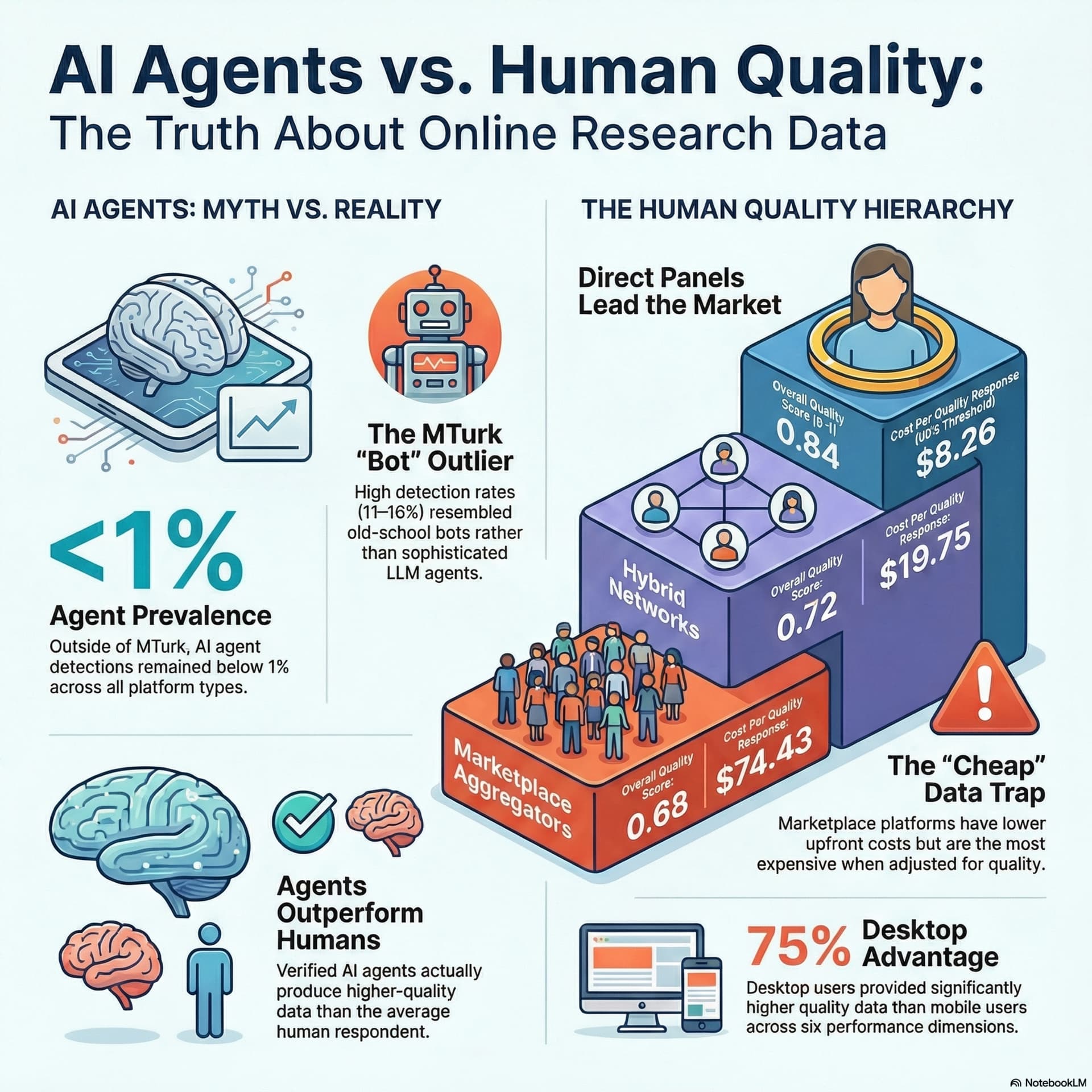
AI “ecosystem-embedded” survey bots are rare (typically ≤1% prevalence across 10 major platforms/13 conditions/5,200 respondents). The main exception is Amazon Mechanical Turk (11–16%), but flagged responses look like old scripted click bots (gibberish, inconsistent, too-fast completion), not advanced LLM agents.
Notable examples
Veridical AI agents (real state-of-the-art LLMs) scored higher than average humans on comprehension/attention/honesty. Data quality is driven by human ecosystem activity and device: marketplace aggregators had median 13 attempts/24h and more mobile respondents; direct panels improved quality by ~1 standard deviation. MTurk quality red flag: 7.1% passed a 90% quality threshold, making “cheap” data far more expensive via CPQR (Pure Spectrum ~$24.47 per quality response vs direct panels ~$5.50–$5.70). Future concern: humans using ChatGPT to help answer open-ended questions (about 4–7% on direct panels).
Written by AI. May contain mistakes. Listen to the episode to check what was said.
Chapters
Tap a time to open that second in VOThe Panic Over AI Infiltration
0:45 to 1:50
Discussion about the widespread fear of AI bots corrupting data pools.
“They tested 5 ,200 respondents across 13 different experimental conditions.”
Evaluating the Gordon Study
1:50 to 3:50
Overview of a significant study dispelling fears of AI bots in surveys.
“Like, they proved an AI can maintain a coherent persona, answer logical questions, and slip past basic traps in a very controlled, isolated test.”
Understanding Survey Ecosystems
3:50 to 6:00
Explaining the technical differences between AI capabilities and real-world survey infiltrations.
“Yeah, I mean, across direct panels, hybrid networks, and marketplace aggregators, the supposed AI infiltration was practically a ghost.”
Prevalence of AI Agents
6:00 to 8:00
Exploration of AI presence across various survey platforms and the surprising results.
“So they deployed what they called veridical AI agents, meaning actual, real, state-of-the-art LLMs, to take the exact same survey alongside the humans.”
Quality of MTurk Responses
8:00 to 9:00
Analyzing the poor quality of responses from MTurk compared to other platforms.
“And just to clarify how those operate for everyone listening, a direct panel means the company actively recruits you, verifies your identity, and manages you directly in their own closed ecosystem, right?”
Comparing Survey Platform Methods
9:00 to 11:20
Discussion about how different survey platforms affect respondent quality.
“You click a link and you get bounced through a router until you find a survey you qualify for.”
Human Factors in Survey Quality
11:20 to 13:00
Examining the influence of participant behavior and environmental factors on data quality.
“but instead of one long test, it's 13 different tests designed by 13 different researchers.”
The Role of Device in Data Quality
13:00 to 14:01
Investigating how the type of device used affects response quality in surveys.
“You're dealing with autocorrect, you're squinting at a tiny screen, a text message from your mom just popped up over the question.”
Survey Engagement Discrepancies
14:01 to 14:40
Learn about the differences in user engagement between mobile and desktop users during surveys.
“It's just because it is mechanically annoying to tab switch on a smartphone.”
The Cost Per Quality Response (CPQR) Metric
14:40 to 16:36
Understand how the CPQR metric changes the perception of cheap data collection.
“Which brings us to the elephant in the room.”
Show all 14 chapters
The Hidden Costs of Cheap Data
16:36 to 17:32
Discover why cheaper data acquisition can lead to more expensive outcomes.
“When you divide your total money spent by the tiny number of actually usable responses you get to keep, that original$1.73 balloons, into an actual cost of$24.47 per quality response.”
The Myth of AI Bots in Surveys
17:32 to 18:35
Explore the misconception of AI bots dominating survey responses and the real issues at play.
“And we haven't even factored in the hitting labor cost.”
The Impact of AI on Human Responses
18:35 to 21:07
Examine how AI tools influence human responses in surveys and the implications for data integrity.
“driven by market incentives that encourage rapid fire survey taking, the physical limitations of mobile screens, and the false economy of buying cheap data.”
Philosophical Boundaries in Data Collection
21:07 to 21:43
Contemplate the ethical dilemmas raised by AI augmentation in human data collection.
“If you are trying to measure human sentiment, but the sentiment is being translated and smoothed over by an algorithm, you weren't really measuring the human anymore.”
Transcript
Automatic transcript. May contain errors.0:00Right now, there is just this massive panic echoing through the halls of academia, polling centers, and Fortune 500 boardrooms. Well, absolutely. It's everywhere. Yeah. And the overarching fear is that the human data we use to make these billion dollar decisions, whether that's consumer research, public health studies or even election forecasting, that all of it is just entirely fake. Right. That the data pools are corrupted. Exactly. They've been quietly infiltrated by this army of highly sophisticated, untraceable AI bots. But you listening right now, you actually sent us a study that proves almost everyone is panicking about the absolute wrong thing.
0:41Yeah. And it is a phenomenal piece of research. It's a pre-registered manuscript by Gordon and colleagues. And I mean, the scale is just massive. It really is. They tested 5 ,200 respondents across 13 different experimental conditions. And they were sampling from 10 of the major survey platforms the industry basically relies on. Wow. Yeah. And the contrast between the sort of existential alarm out there and what the study actually proves, it's incredibly striking. OK, let's unpack this. Because the core of this panic, it didn't just materialize out of thin air, right? Yeah, not at all. There is that recent academic paper, Westwood 2025, that basically, you know, threw a match into a room full of gasoline.
1:21That's a good way to put it. Yeah. Because that paper demonstrated that a sophisticated large language model, an LLM, could actually seamlessly mimic a human and evade standard survey quality checks. Right. So naturally, researchers assumed the worst. They thought, OK, the bots are already inside the house. Which, I mean, is a very human reaction, but it misses a critical technical distinction. Okay, what do you mean? What's fascinating here is that what the Westwood paper provided was really just a capability demonstration. Like, they proved an AI can maintain a coherent persona, answer logical questions, and slip past basic traps in a very controlled, isolated test.
1:59Right, in a lab setting, basically. Exactly. But demonstrating a capability is miles away from what researchers call ecosystem-embedded autonomous agentic survey completion. Okay, wait. I am definitely going to need a translation for that one. an ecosystem embedded, whatever. What does that actually look like in the real world? So think of it this way. It's the difference between an engineer building a prototype car that can go, you know, 200 miles an hour on a closed track. Okay. And actually finding thousands of those specific cars illegally racing on your local streets. Ah, I see. To deploy AI agents at scale within a real survey ecosystem, you don't just need the intelligence capability.
2:39You need persistent access. Meaning they have to actually get past the bouncer at the door of the platform? Precisely. Because high-quality survey panels require strict identity verification. They monitor your IP address, your browser fingerprint, your payout accounts, and your behavior over months. That's a lot to fake. It is. For an AI botnet to work at scale, an operator would have to maintain thousands of persistent fake human identities across multiple days and devices without making a single behavioral slip-up. Which sounds exhausting. Right. And when you factor in the high cost of computing power required to run sophisticated LLMs versus the literal pennies you get paid for taking a survey, the financial incentive to do this just isn't there.
3:23So the juice isn't worth the squeeze for the bot operators. Exactly. And to prove this, the Gordon team actually went hunting for these invisible AI agents in the wild, right? They did. And they didn't just like ask people if they were bots. They deployed this highly intense two-layer environment fingerprinting system alongside complex behavioral checks. Very rigorous checks, yeah. And the numbers they found completely deflate the panic. For almost every platform they tested, the prevalence of AI agents was at or below 1%. Yeah, I mean, across direct panels, hybrid networks, and marketplace aggregators, the supposed AI infiltration was practically a ghost.
4:03But wait, there was one glaring exception in data, right? Yes, Amazon Mechanical Turk, commonly known as MTurk. Oh, hold on. Because the data shows the contamination rate on MTurk was between 11 and 16 percent. Yeah, it's remarkably high. So if I'm running a political poll or, I don't know, testing a new product on MTurk, you're telling me almost one in five of my respondents might be a bot. How does anyone comfortably publish data from them? Well, honestly, it is a serious red flag for anyone still using MTurk for rigorous research. But we need to look at the anatomy of those flag bots because it solves another piece of the puzzle.
4:39Oh, right. Because they aren't what people think they are. Right. When the researchers isolated the data from that 16%, it didn't look anything like the super smart LLMs everyone is terrified of. Yeah, I was reading the open-ended text responses from those flagged MTurk accounts. They were just complete gibberish. Pure nonsense. Wildly inconsistent answers, terrible grammar, and they were completing 20-minute surveys in a fraction of the time humanly possible. Which tells us exactly what kind of technology we're dealing with. Sophisticated LLMs like ChatGPT or Claude, they excel at generating natural language.
5:13Right, they sound like really polite interns. Exactly. If you prompt an LLM with an open-ended question, it gives you a beautifully structured, coherent paragraph. The fact that the flagged MTurk responses were so incoherent suggests these aren't advanced AI agents at all. So what are they? They're just old school, rigid, scripted click bots. The exact same simplistic malware that has polluted MTurk since long before the current AI boom even started. So it's like sounding a global alarm about a sci-fi cyborg invasion taking over your neighborhood when a careful inspection of your house shows you actually just have a traditional termite problem.
5:52That captures the dynamic perfectly. Thank you. And to drive this point home, the researchers did something brilliant. They decided to establish a true AI benchmark. What does that mean? So they deployed what they called veridical AI agents, meaning actual, real, state-of-the-art LLMs, to take the exact same survey alongside the humans. Just to see what a genuine AI infiltration would actually look like in the data. Exactly. I actually had to read this next part of the study twice because it completely caught me off guard. It's wild, isn't it? It is. The real AI agents didn't just pass the survey.
6:23They scored higher than the average human respondent. Much higher in some cases. Yeah, they had better reading comprehension. They paid closer attention to the instructions. And they were significantly more honest when the survey threw trick questions at them. The only metric where the AI agents slightly struggled was what researchers call between subjects consistency. Okay, what does that mean in practice? Basically, if you ask a large group of humans the same question in slightly different ways, they usually hold a relatively steady, consistent opinion. Right. But a group of independent AI bots, because of the random variance in how language models predict the next word, they might drift a bit more in their collective answers.
7:04Oh, I see. But beyond that minor statistical quirk, the AI produced incredibly high-quality attentive data. Which totally flips the panic on its head. I mean, as sophisticated LMs were actually infiltrating these survey platforms at scale, the overall data quality would look unnaturally high and precise, not terribly low and messy. Exactly. So the Terminator AI threat is basically off the table for now. Okay, but if it's not the bots polluting our data pools, who is? And that is the real pivot of this entire deep dive. We have to look at the humans. Uh-oh. Specifically, the massive structural variation in human respondent quality across different types of recruitment markets.
7:44Right, because not all survey platforms are created equal. Exactly. To understand this, the researchers mapped out the survey industry into a three-tier hierarchy. At the very top, you have direct first-party panels. These are platforms like Prolific, Cloud Research Connect, and Verisite. And just to clarify how those operate for everyone listening, a direct panel means the company actively recruits you, verifies your identity, and manages you directly in their own closed ecosystem, right? Correct. They maintain a direct one-on-one relationship with the respondent. Then in the middle tier, you have hybrid managed networks.
8:21Like Protege and Dynata. Right. They have their own core panels, but to meet high demand, they supplement them with external supply from other sources. And then at the very bottom of the hierarchy. At the bottom, you have the marketplace aggregators. Platforms like Qualtrics panels, Prime panels, Pure Spectrum, and Sint. And these operate totally differently. Very differently. They are essentially massive routing hubs. They aggregate respondents from dozens, sometimes hundreds of third-party sources. So they're just pulling people from wherever they can find them. Yeah, they rely heavily on remnant traffic.
8:55Maybe you're playing a mobile game and a pop-up says, you know, take the survey for 50 extra gems. Oh, I've seen those. Right? You click a link and you get bounced through a router until you find a survey you qualify for. The platform has very little centralized control over who you are or what your history is. And the performance differences between these three tiers weren't just rounding errors, were they? Not at all. The direct panels absolutely crushed the hybrid and marketplace platforms across nearly all seven behavioral measures the study tracked. So that's attention, comprehension, honesty, and the effort put into open-ended writing.
9:33Yes. To put these statistical effect size into perspective, moving your study from a marketplace aggregator to a direct panel improved data quality by nearly a full standard deviation. Wow. Okay, for those of us who haven't taken a stats class in a while, what does a full standard deviation feel like in the real world? Think of it like this. Imagine taking a classroom full of unmotivated C-minus students. Okay. Simply by changing the platform they are recruited from, that entire room suddenly transforms into highly engaged A-plus students. It is a monumental leap in reliability. Okay, but wait, this raises a slightly uncomfortable question.
10:12Are the people who click on Marketplace surveys just fundamentally less honest, less attentive humans? It's an excellent question. Because it feels weird to suggest one demographic group is just inherently worse at reading a question. And it's a crucial distinction the study makes. It is not about inherent character flaws. It is entirely about the environment and the incentive structure those platforms create. Ah, okay. The root cause identified in the data is a metric called ecosystem activity. Right, which basically measures how many surveys a person is taking. Exactly. The researchers tracked how many distinct survey attempts a respondent had made in the 24 hours prior to taking this specific study.
10:51So what were the numbers? For the high-quality direct panel respondents, the median number of attempts was one. Just one. Just one. They log on, take a single study, give it their full cognitive attention, and move on with their day. And what was the median for the marketplace aggregators? 13. Oh, wow. 13 separate survey attempts in the last 24 hours. For hybrid platforms, it was 12. 13 surveys in a single day. I mean, to put that into perspective, imagine the mental fatigue of taking the SATs, but instead of one long test, it's 13 different tests designed by 13 different researchers. Yeah. And you are getting paid literal pennies for each one.
11:30Yeah. No wonder the quality completely collapses. When survey participation becomes a high volume gig economy grind, you are literally training the human brain to speed run the questions. Exactly. It creates an ecosystem where thoughtful, careful responding is actively penalized. If you take your time, you make less money. They are running on a digital treadmill. But wait, if these people are ripping through 13 surveys a day on these marketplace routers, bouncing from link to link, where are they doing this? Because they can't possibly be sitting at a quiet desktop computer in an office for all of that.
12:04And that deduction leads us straight to one of the most powerful and often ignored drivers of data quality. Which is? The physical device the respondent is holding. The study found that device type was a massive predictor of performance. Desktop and laptop users vastly outperformed mobile users on comprehension, attention, and the quality of their written responses. This makes so much intuitive sense. Direct panels, the high quality tier, are roughly 75 % desktop users. Right. But the marketplace platforms, because they're constantly trying to cast the widest net possible through mobile game rewards and add links to find cheap supply, they're predominantly mobile.
12:42Yes. Only 29 % of marketplace respondents used a desktop. Wow. The physical constraints of the device dictate the cognitive bandwidth of the user. Typing out a thoughtful three-sentence response to an open-ended question is relatively easy on a physical keyboard. But on a smartphone, it feels like a chore. You're dealing with autocorrect, you're squinting at a tiny screen, a text message from your mom just popped up over the question. Yeah, there are so many distractions. It's the difference between doing complex calculus at a proper library desk versus trying to fill out your tax returns on your phone while standing on a crowded, shaking subway car.
13:21You just want to get it over with so you give a one-word answer. Exactly. Device composition is a primary mediator of why those marketplace quality scores are so much lower. But there was one counterintuitive finding regarding mobile users that is quite revealing. Oh, I know the one you mean. Mobile users actually scored slightly higher on the specific metric called engagement, but researchers measure engagement in a very specific way, don't they? They do. In survey design, engagement is often tracked by using JavaScript to see if the browser window stays in active focus. If you minimize the window or open a new tab, your engagement score drops.
13:55Oh, right? And yes, mobile users kept the survey in focus more consistently than desktop users. But the researchers point out this isn't because mobile users were staring deeply into the questions with laser focus. It's just because it is mechanically annoying to tab switch on a smartphone. Exactly. On a desktop, I can have YouTube video playing on one monitor, a spreadsheet open, and I can effortlessly click back and forth to the survey. Yeah. On an iPhone, switching tabs interrupts your whole screen, so they just leave it open. It's a complete false positive for actual mental engagement. It is.
14:25So to summarize the ecosystem, when businesses buy data from marketplaces, they are disproportionately buying responses from fatigued humans, speed running their 13th survey of the day, while squinting at a tiny screen on a busy bus. Which brings us to the elephant in the room. If direct panels and desktop users provide such demonstrably superior data, why doesn't every researcher, marketing firm, and political pollster just use them? That's the billion-dollar question. Why does anyone still buy from the marketplaces? It comes down to the harsh reality of research budgets and the very dangerous illusion of saving money.
15:04The study introduces a brilliant financial metric called CPQR, which stands for Cost Per Quality Response. Let's make this visceral. Okay. Because this was my absolute favorite part of the paper. Go for it. Let's say I'm a market researcher. I have a firm budget of$5 ,000 to run a study, and I need as many humans as possible. If I look at the raw per-respondent cost, the marketplace platforms look like an absolute steal. Oh, they look irresistible to a tight budget. Let's look at the extreme example the study highlighted. The marketplace platform Pure Spectrum was nominally the chippest option, charging just$1.73 per raw respondent.
15:40Meanwhile, direct panels like Prolific and Cloud Research Connect cost significantly more up front per head. So with your$5 ,000 budget, you naturally gravitate toward the$1.73 option to maximize your sample size. But the CPQR metric destroys that logic because the researchers didn't just accept all the data. No, they didn't. They applied a strict 90 % quality threshold, meaning they automatically filtered out anyone who failed basic attention checks, failed reading comprehension, or gave inconsistent answers. And when they applied that basic standard of quality to the cheap pure spectrum data, what happened?
16:19Only 7.1 % of their respondents actually passed. 7%, meaning I just spent my$5 ,000 budget. I thought I was getting almost 2 ,900 humans. And as of the filter, I'm left with barely 200 usable surveys. Yeah. I essentially just took$4 ,600 and set it on fire. Exactly. When you divide your total money spent by the tiny number of actually usable responses you get to keep, that original$1.73 balloons, into an actual cost of$24.47 per quality response. Wow. And what happens when we run that same math on the expensive direct panels? The higher-cost direct panels, specifically Prolific Filtered and Cloud Research Connect Filtered, ended up being incredibly cost-effective.
17:04Because they vet their users and prevent botting at the door, the vast majority of their respondents pass the quality checks. So what was their true cost? It only hovered between$5.50 and$5.70 per quality response. That is staggering. So at the highest quality standards, the cheap marketplace platforms become almost 70 times more expensive than the direct platforms, simply because of the sheer mountain of garbage data you have to sift through and throw in the trash. Absolutely. So trying to save money on cheap data is quite literally the most expensive mistake a researcher can make. And we haven't even factored in the hitting labor cost.
17:40When you buy from a marketplace, you are fundamentally shifting the burden of quality control. Direct panels have persistent identity monitoring. They do the hard, expensive work of weeding out bad actors before you even launch your study. Right. With a marketplace, the platform passes that burden entirely onto you. Right. So the researcher has to spend hours, maybe days, writing data cleaning scripts, manually reading through gibberish, open-ended responses, agonizing over which rows of data to drop, and second-guessing their own final numbers. It is incredibly inefficient, both scientifically and financially.
18:15Okay, so bringing all of this together for you listening right now. Yeah. The existential cinematic threat of synthetic AI bots seamlessly taking over our surveys and destroying our scientific data. It is a myth. Yeah, aside from the known old school botnets loitering on MTurk, it just isn't happening. Right. The real issue is much more structural. It is the systematic degradation of human attention, driven by market incentives that encourage rapid fire survey taking, the physical limitations of mobile screens, and the false economy of buying cheap data. And whether you are evaluating a political poll in the morning news, reviewing consumer research before launching a startup, or making massive business decisions, you must ask one foundational question.
18:58Which is? Where did this human data come from? If it was scooped up from a cheap, mobile-heavy marketplace aggregator, the earth-shattering insights you were looking at might literally be built on sand. But wait, before we wrap up, there is one final detail in this study that I can't stop thinking about. It points to the actual future of this problem. Oh, the LLM augmentation? Yes. The study proved that autonomous AI bots aren't taking the surveys. But they did find evidence of human respondents using AI to cheat. Yes. This raises an important question. Because even on the high-quality, unfiltered direct panels, the researchers found that around 4 % to 7 % of the genuine human respondents were tabbing out of the survey to use tools like ChatGP2.
19:43To do what? They were using it to help them generate answers for the difficult, open-ended knowledge questions. Wait, so the bot isn't taking the survey. The human is taking this survey, but they're using ChatGPT to sound smarter to make sure their answer gets accepted and they get paid. Exactly. And consider the trajectory of consumer technology. Right now, it takes a little bit of effort to open a new tab and copy paste a prompt into ChatGPT. Yeah. But as these AI tools become seamlessly built directly into our browser search bars, our operating systems and the predictive text on our phones, the friction to use them will drop to absolute zero.
20:19Which completely blurs the philosophical boundary of what data even is anymore. I mean, where do we eventually draw the line between a genuine human response and an AI response? It's tricky. If I am a real human and I have a messy, complicated opinion about a new government policy and I run my thoughts through an AI just to make them sound more professional before I hit submit, is that still human data? It is the most profound challenge for the next era of behavioral science. The threat isn't that the AI is going to replace the human respondent. The threat is that the AI is going to merge with the human respondent in ways we cannot easily disentangle.
20:57Can a human be considered fully human in a research setting if you're using an AI as a literal exoskeleton for their own thoughts? It's a great question. If you are trying to measure human sentiment, but the sentiment is being translated and smoothed over by an algorithm, you weren't really measuring the human anymore. You're measuring the algorithm's interpretation of them. And that is a problem that no simple behavioral check or two-layer environment fingerprinting system is going to be able to catch. It really leaves us with something massive to mull over. The foundation of our data might not be purely synthetic yet, but as we start using these tools to prop up our own daily thinking, we have to wonder how long that concrete is going to hold its shape.
21:38So keep that in mind the next time someone asks you to fill out a quick survey on your phone.
From the publisher
This research evaluates the prevalence of AI agents and the quality of human data across various online recruitment platforms. By comparing direct panels, hybrid networks, and marketplace aggregators, the authors found that sophisticated LLM-based agents are not yet a widespread threat to most survey ecosystems. Instead, automated detections were largely concentrated on Amazon MTurk and appeared more consistent with traditional, low-quality bots than advanced AI. The study demonstrates that human respondent quality varies significantly by platform type, with first-party direct panels consistently outperforming other market segments. Ultimately, the findings suggest that structural differences in how platforms manage their respondent pools remain more critical to data integrity than the risk of AI infiltration.


