In short
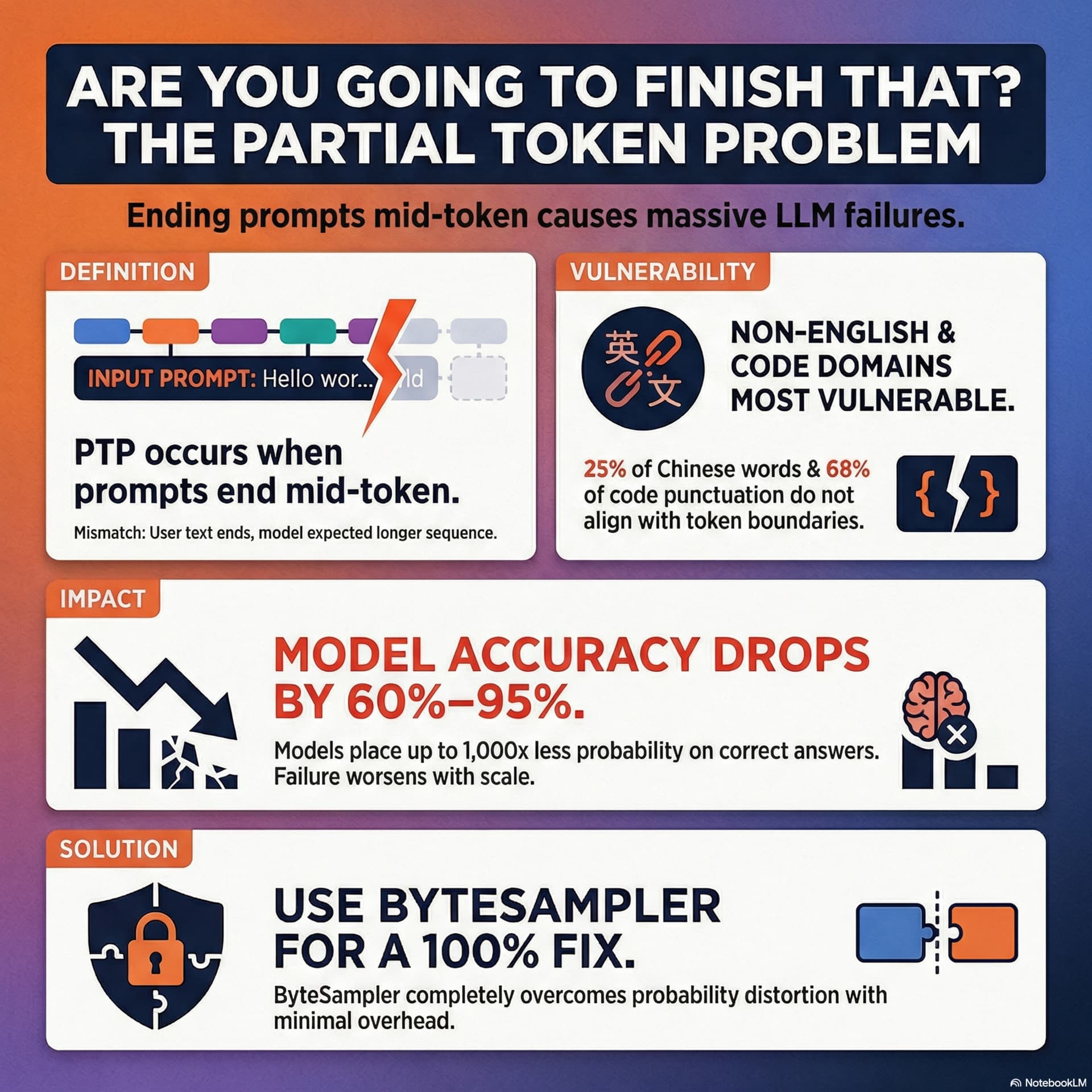
The episode explains the “partial token problem,” where language models tokenize text into chunks and can fail when a user prompt ends mid-token (e.g., pausing after an incomplete word or punctuation sequence). It argues this mismatch is a structural flaw, not an intelligence issue, and that scaling up can worsen it.
Guest backgrounds
No guests are mentioned; it’s a solo “Deep Dive” style discussion.
Key claims
Models don’t read letters; they follow tokenizer “combo meal” units. Partial tokens cause hallucinations, skipped characters, or wrong next tokens. Scaling myth: larger models (up to ~32B parameters) can fail harder due to rigid tokenizer overfitting. Token healing (deleting the last token) is a heuristic patch. ByteSampler (byte-level constrained sampling) is a structural fix.
Notable examples
English “processing” missing final “G” (G probability ~0.002). Chinese: up to ~25% of word boundaries misalign; “is a” characters can merge into one token. German compounds: “eigelb” split into illogical chunks (E + I-G-E-L + B), so pausing after “I” breaks completion. Code: punctuation boundaries in programming can be inside tokens; up to ~68% of punctuation boundaries. Repeat-after-me memory test shows accuracy drops ~60% to >95% with partial tokens; ByteSampler reportedly restores ~100% accuracy.
Written by AI. May contain mistakes. Listen to the episode to check what was said.
Chapters
Tap a time to open that second in VOUnderstanding Tokens and Their Challenges
0:38 to 4:25
Delving into how language models process tokens and the implications of partial inputs.
“Our mission today is to explore the invisible plumbing of artificial intelligence to uncover a massive hidden flaw.”
Real-World Implications of Token Issues
4:25 to 8:02
Examining how the partial token problem affects different languages and coding practices.
“so it knows exactly how to read the board and continue.”
The Scaling Myth in AI Models
8:02 to 11:44
Discussing the misconception that larger models solve the tokenization problem.
“But it doesn't stop with human languages, which brings us to danger zone 3.”
Potential Solutions: Token Healing
11:44 to 14:01
Investigating a proposed fix called token healing and its limitations.
“Don't the massive, state-of-the-art models easily step over this little tokenization pothole?”
Understanding Token Healing and ByteSampler
14:01 to 17:06
Learn how token healing and ByteSampler address the partial token problem in AI.
“When you submit your prompt, the system essentially backs off.”
The Impact of Tokenization on AI Understanding
17:07 to 18:24
Explore the implications of rigid tokenization on AI's grasp of human language.
“The big takeaway here is a profound shift in how we need to understand these systems.”
Rethinking AI Limitations
18:25 to 18:52
Consider the unseen limitations AI faces due to tokenization's impact.
“That is something to mull over the next time you hit enter.”
Transcript
Automatic transcript. May contain errors.0:00Have you ever been typing a prompt into an AI? maybe you're asking it to write an important email or trying to get it to help you debug a complicated block of code. Yeah, exactly. And you just pause for a second to collect your thoughts. You hit enter. And instead of giving you a helpful, coherent response, you watch the AI just spits out absolute incomprehensible gibberish. Or it hallucinates a weird space. Yes. Or it skips a letter completely, acting like it has no idea what you were just talking about. So if you ever experienced that frustrating moment, you're going to want to hear this. It's surprisingly common.
0:36It really is. Welcome to today's Deep Dive. Our mission today is to explore the invisible plumbing of artificial intelligence to uncover a massive hidden flaw. We're looking into a fundamental glitch known as the partial token problem. And this is a problem that gets right to the core of how we interact with these systems because there is this fundamental mismatch between the text you are typing on your keyboard and what the AI is actually reading and comprehending under the hood. Right, because language models don't read individual letters. Exactly. They process chunks of text called tokens. But the way those tokens break down is really where the trouble starts.
1:14You can think of it like ordering food at a fast food drive-thru. Okay, I like this. So you pull up, and instead of ordering individual ingredients, you know, a bun, a patty, some lettuce, you order a preset combo meal. You say, I'll take combo number four. And the kitchen knows exactly what combo number four is. Right. They have it memorized as one complete prepackaged unit. But what we see in the data is that if you pause and accidentally hand the AI half a token, effectively trying to order half of combo number four, the cashier just freezes. It breaks the system. The system literally doesn't have a button for that.
1:51It completely shatters the logic of the entire transaction. Okay, let's unpack this with a really specific concrete example. Let's look at the English word processing. Good example. Imagine you're typing a prompt, and you type the words natural language processing, but you stop right before the final letter G. You haven't hit the G yet. You just pause to think. Right. Now, any human looking at that sequence of letters knows exactly what the next letter is supposed to be. It's a G. It is the most obvious, undeniable continuation in the world. But when we look at the internal data for how a massive state-of-the-art AI model handles this incomplete word, it completely panics.
2:30It really does. The numbers are crazy. They are. If you look at the raw probabilities assigned by the model in that exact scenario, the AI gives the letter G a probability of only 0.002. Wow. Yeah, that is less than a fraction of a single percent. It genuinely belies that the letter G is incredibly unlikely to come next. Which is mind-blowing. Why does it think that? It ties perfectly back to that combo meal concept. During its massive training process, the AI memorized the entire word processing as a single token, a single indivisible puzzle piece. It has never actually seen the sequence of letters P-R-O-C-E-S-S-I-N followed independently by a G.
3:09Because it's always packaged together. Exactly. To the AI's mathematical brain, the context processing directly indicates that G cannot possibly be the correct next step. Because if it were, the system would have just used the single processing token from the very beginning. It literally cannot fathom the sequence of a partial word plus the remaining letter. So it's essentially overthinking itself into a corner. It knows the token for processing, but it views this processing string as some kind of alien anomaly. That's a great way to put it. But for most of our English-speaking listeners, they might be thinking, I use these language models all the time, and I rarely see this happen.
3:48And they'd mostly be right. Yeah, because of one fundamental structural element of the English language is a space bar. What's really fascinating here is that for English speakers, white space is this invisible shield. It's protecting you from triggering this glitch on a constant basis. Because tokens usually start with spaces, right? Right. During the training phase, the system naturally learns to split its tokens based on spaces. So tokens generally have a leading space attached to them in the model's dictionary. Oh, I see. If you end your prompt with a complete word and no trailing space, your prompt perfectly aligns with those invisible token boundaries.
4:24You are handing the AI a perfectly complete puzzle piece, so it knows exactly how to read the board and continue. Because of the space bar, the partial token problem is generally avoided in standard English text. So if spaces save English speakers, I have to imagine languages that don't use spaces to neatly separate every single idea are a complete minefield for this. They really are. What happens when we take away the white space? Because that's where this hidden flaw turns into an everyday nightmare for millions of users. The data highlights three real-world danger zones, where the partial token problem completely derails the user experience.
5:00The first major danger zone involves logographic writing systems, and the most prominent example being Chinese. In Chinese, words are not separated by spaces. The characters just flow continuously from one to the next. So the tokenizer has no spaces to guide it. Exactly. Because there is no white space, the algorithm grouping the text into chunks relies purely on statistical frequency. As a result, it routinely ends up merging characters across natural word boundaries. I can see how that would cause issues. What does that actually look like in practice for a user? Well, let's look at a common character pairing for the phrase is a.
5:38In Chinese, the character means is and the characters a a. Because they appear together so frequently, the tokenizer often combines these into a single token fear. Okay, so they're glued together into one combo meal. Right. Right. Now imagine you are a native Chinese speaker typing a prompt into a model. It is entirely natural to type the word meaning is and then pause for a split second to think about the subject of your sentence. You haven't done anything wrong. You've typed a complete word. You've typed a perfectly complete grammatically correct word. But to the AI, you just ordered half the combo meal.
6:11You stopped your prompt right in the middle of its prepackaged is a token. The model is misaligned and the system breaks. And the data shows this isn't just a rare one-off glitch. The numbers on this are staggering. Up to 25 % of Chinese word boundaries do not line up with the AI's token boundaries. It's a huge issue. Think about the scale of that. One out of every four times a Chinese user finishes a completely natural distinct word, they are unwittingly handing the AI a broken partial token. It creates a massive structural vulnerability for users simply trying to communicate in their native language.
6:48language. And that frequency based chunking leads us right into the second danger zone, highly compounding languages like German. Right. German is famous for building these incredibly long, highly specific words by just smashing smaller distinct words together. They do. And tokenizers slice these massive compound words up in ways that completely ignore natural human grammar. They ignore morphological roots. The tokenizer doesn't have a dictionary. It just looks at what letters sit next to each other most often. Can you give us an example? Sure, take the German word for egg, yolk, eigelb. Linguistically, it comes from I, meaning egg, and gelb, meaning yellow.
7:26Any human speaker inherently understands those two distinct components. Egg and yellow. Makes perfect sense. But the tokenizer slices it up arbitrarily into three completely illogical chunks. The letter E, the letters I-G-E-L, and the letter B. So it just chops it up as E-Igel-B. Yes. That makes zero sense linguistically. So if a German user types I, meaning egg, which is a perfectly valid complete word on its own, and then pauses, they trigger the glitch. Precisely. The AI is sitting there waiting for the rest of the token, but the token it's mathematically expecting is built on arbitrary slices of characters, not the actual foundational blocks of the German language.
8:05But it doesn't stop with human languages, which brings us to danger zone 3. I actually remember writing a simple Python script recently, and I paused to double-check my logic, and the autocomplete just completely lost the plot. Code completion is arguably the most frustrating danger zone of all. For our listeners working in tech, this is huge. In programming, consecutive punctuation marks get glued together into single tokens all the time. It is incredibly common across almost all programming languages. Think about a standard Python function definition def main. To a human programmer, the open parenthesis, the close parenthesis, and the colon are distinct syntactic boundaries.
8:44Right. You might open a parenthesis and stop to think about your argument. But because those three symbols appear together so frequently in the training data, the tokenizer glues the parenthesis and colon together as one single token. So if a developer is typing along and they type def main open parenthesis and then stop, the system completely chokes because they stopped in the middle of a punctuation combo meal. And the misalignment rate here is astronomical. Across different programming languages, up to 68 % of punctuation boundaries fall right in the middle of a token. 68%, that's insane. It means more than half the time a developer pauses after a piece of punctuation, they are unknowingly setting the AI up to fail.
9:25If we connect this to the bigger picture, we have to realize this isn't just a quirky edge case. We aren't talking about users trying to trick the AI by feeding it bizarre adversarial strings of letters. Right, they're just typing normally. These are entirely natural, grammatically correct, everyday prompts. And they are consistently setting these advanced language models up for failure, simply because the humans have no way of knowing where the invisible token boundaries are. And to expose exactly how badly these models break down when they encounter these boundaries, researchers designed this ultimate dead simple test.
10:00It is a basic repeat after me memory task. The setup for the test is incredibly straightforward. You give the model a sentence, for example, Seattle is a city. Then you explicitly ask it to repeat that exact same sentence. Okay. But you give it the first half of the sentence as a starting point. So the prompt looks like this. Repeat this sentence. Seattle is a city. Repeat, Seattle is. and you wait for it to generate the rest. It's a memory test that a toddler could pass. The text is literally right there in the prompt. All the AI has to do is look at the sentence it was just given and output the exact next word.
10:34But the test is designed so that the word, the prompt, stops on, like the Chinese word for is, or the German word for egg, leaves a partial token hanging. And the results of that simple test are astonishing. When hit with a partial token, the model's accuracy just plummets. We see a drop of 60 % to over 95 % in accuracy across the board. The models fail completely at a trivial copy-paste task. The numbers from the Chinese language tests were particularly shocking. When they tested this in Chinese, the probability that the AI assigned to the correct NEXT token dropped by four orders of magnitude.
11:10It's a total collapse. The models just completely lose their grip on reality. They start hallucinating to escape the broken token. They generate extra spaces where there shouldn't be any. They skip characters entirely or they just swap in totally different words that mean roughly the same thing just to avoid having to complete the partial token they were handed. Here's where it gets really interesting. When you hear about an AI struggling with the basic task, the default answer in the tech world is almost always the same. Make the model bigger. Throw more computing power at it. Feed it more data.
11:41Add billions of parameters. So doesn't scaling up fix this? Don't the massive, state-of-the-art models easily step over this little tokenization pothole? This raises an important question, but the answer is a definitive no. This is what we call the scaling myth. The scaling myth? Scaling up does not help at all. In fact, testing on massive models, including those with up to 32 billion parameters like QEN332B or LAME3, shows that larger models often fail harder. I really want to dig into that. Why would throwing 32 billion parameters at a model make it worse at this? Shouldn't a quote-unquote smarter model be able to infer what the user meant?
12:20It's brilliantly counterintuitive. It comes down to a form of overfitting. Larger models are actually vastly better at strictly memorizing the rigid rules of their tokenizer during pre-training. Oh, okay. A smaller model has a slightly fuzzier memory. Its internal representations aren't as sharply defined, so it might be a bit more flexible when it sees a partial sequence. But a 32 billion parameter model has perfectly optimized its loss function to the tokenizer's exact vocabulary. So it's rigid. Extremely. It has perfectly memorized that the concept of processing is always, without exception, represented by one specific token ID.
12:58So when it sees the partial sequence processing, it is far more confident than a smaller model that the next letter cannot possibly be G. Because it knows the rules too well. It has perfectly learned the arbitrary rules of its training data. When you break those rules with a partial token, the massive model is supremely confident that you must be asking for something entirely different. The AI is so advanced and has learned its own internal plumbing so perfectly that it becomes totally blind to obvious human logic. So what does this all mean? How do developers actually fix this? Because you obviously can't just retrain a multi-million dollar model from scratch every time you realize the token boundaries don't match human language.
13:36You're right. Retraining from scratch is far too expensive and computationally heavy. So the focus has to shift to inference time fixes adjustments we can make at the exact moment the model is trying to generate a response. What's the first fix? The first fix the industry tried is something called token healing. You can think of this as the Band-Aid approach. How exactly does the Band-Aid work? It's a heuristic trick. When you submit your prompt, the system essentially backs off. Before it generates anything, it automatically deletes the very last token of your prompt. Okay. Then it lets the model try again to generate the completion, but it applies strict constraints to make sure the newly generated text matches the characters that were just deleted.
14:19It's basically trying to rewind the clock one step to see if it can find a cleaner boundary to start from. Token healing sounds like a neat trick, but isn't it essentially just guessing? How does the model know how far back to delete to actually fix the misalignment? That is exactly the limitation. The verdict on token healing is very mixed. Sometimes it helps significantly, boosting accuracy back up. But it is fundamentally a guess based on heuristics. You never know exactly how far back you need to heal the tokens. Right. Because it could be two tokens back. Exactly. If the partial token spans across multiple boundaries, deleting just one token doesn't solve the problem.
14:57It might heal too much or too little. It's a patch, not a cure. But the data points to a real cure, and this is where the math gets really beautiful. Second fix is an exact mathematical solution called ByteSampler. ByteSampler is a true structural fix. To understand it, we have to look below the level of tokens, down to the raw bytes that make up the text. Down to the code itself. Yes. Instead of just guessing and backing off one token, ByteSampler constructs a massive invisible tree of all possible valid byte sequences that cover the exact text the user typed. I love the visual of this invisible tree.
15:31So instead of forcing the AI to walk down a single predetermined path of clunky token blocks, how does ByteSampler navigate around the boundaries? It maps out every possible way those raw bytes could be grouped together into tokens. The nodes of this tree are bytes, and the branches are valid token continuations from the model's vocabulary. So it sees all the options. It essentially maps out all the overlapping possibilities. It finds paths in this tree from the root all the way to the leaf that match the user's prompt perfectly, without being constrained by wherever the arbitrary token boundary happens to fall at the very end of the text.
16:10Once it maps that path, the model can sample normally. It preserves the exact mathematical probability of the language, bypassing the rigid chunking entirely. What's the final verdict on ByteSampler? Does it completely solve the issue? It works perfectly. When applied to that exact same repeat-after-me task that was completely breaking the models earlier, ByteSimpler pushes performance to a flawless 100 % accuracy. 100 %? Yes. Across Chinese logographs, across German compound words, across code completion with deep punctuation, it completely neutralizes the partial token problem. But constructing a massive mathematical tree of bite sequences sounds incredibly computationally expensive.
16:51Does it slow the whole system down to a crawl? That's the best part of the solution. The processing delay is tiny. On average, constructing that tree and finding the path requires just about one extra forward pass compared to regular sampling. That's practically nothing. It is an incredibly elegant, low overhead solution that restores the model's ability to just read the text for what it is, rather than stumbling over its own puzzle pieces. Okay, let's bring all of this together. The big takeaway here is a profound shift in how we need to understand these systems. Artificial intelligence isn't just learning human language.
17:27It is learning the weird, invisible, entirely arbitrary rules of its tokenizer. It is learning the shape of the puzzle pieces, not just the picture on the puzzle. And when those puzzle pieces don't match the natural flow of human language, whether that's a Chinese sentence, a German compound word, or a line of Python code, the AI's worldview completely shatters. So the next time you are using an AI, maybe you are asking it to translate a document into German, or you're deep in your code editor relying on autocomplete, and the AI suddenly hallucinates a weird space or skips a crucial letter. You don't have to wonder if the machine is fundamentally broken.
18:05You will know exactly what is happening under the hood. You paused. You unknowingly ordered half a combo meal. A partial token tripped it up, and the invisible plumbing couldn't handle the boundary. It really highlights the friction between how humans think fluidly and how machines process information rigidly. It does. And this raises an important question, one that I think we should leave you with today. Go for it. If these incredibly advanced multi-billion parameter language models are so rigidly bound by the invisible shape of their tokens that they completely lose their minds over a half-finished word, What other complex human concepts, emotions, or cultural nuances are they entirely blind to, simply because they don't fit neatly into a pre-cut token puzzle piece?
18:47That is something to mull over the next time you hit enter. Thanks for joining us on this deep dive.
From the publisher
Language models face a significant partial token problem (PTP) when user prompts end in the middle of a multi-character token, causing the model to misinterpret the expected continuation. This research highlights that the issue is not just a theoretical glitch but a pervasive failure mode in natural language use, especially in Chinese, German, and programming code where word and token boundaries frequently misalign. Experiments reveal that even elite models suffer a dramatic drop in accuracy—between 60% and 95%—when encountering these "word-complete" but "token-incomplete" prompts. Surprisingly, this degradation does not improve with increased model scale, as larger models are often more strictly tuned to their specific tokenizers. To address these distortions, the authors evaluate several inference-time mitigations, finding that heuristic "token healing" offers inconsistent results. In contrast, the study validates that an exact solution called ByteSampler can completely eliminate the problem by reconstructing valid token paths. Ultimately, the paper provides practical recommendations for model providers to ensure more reliable text generation across diverse languages and technical domains.


