
 Ask ChatGPT


 Best AI papers explained
26 Oct 2026 · 23m · 8 chapters
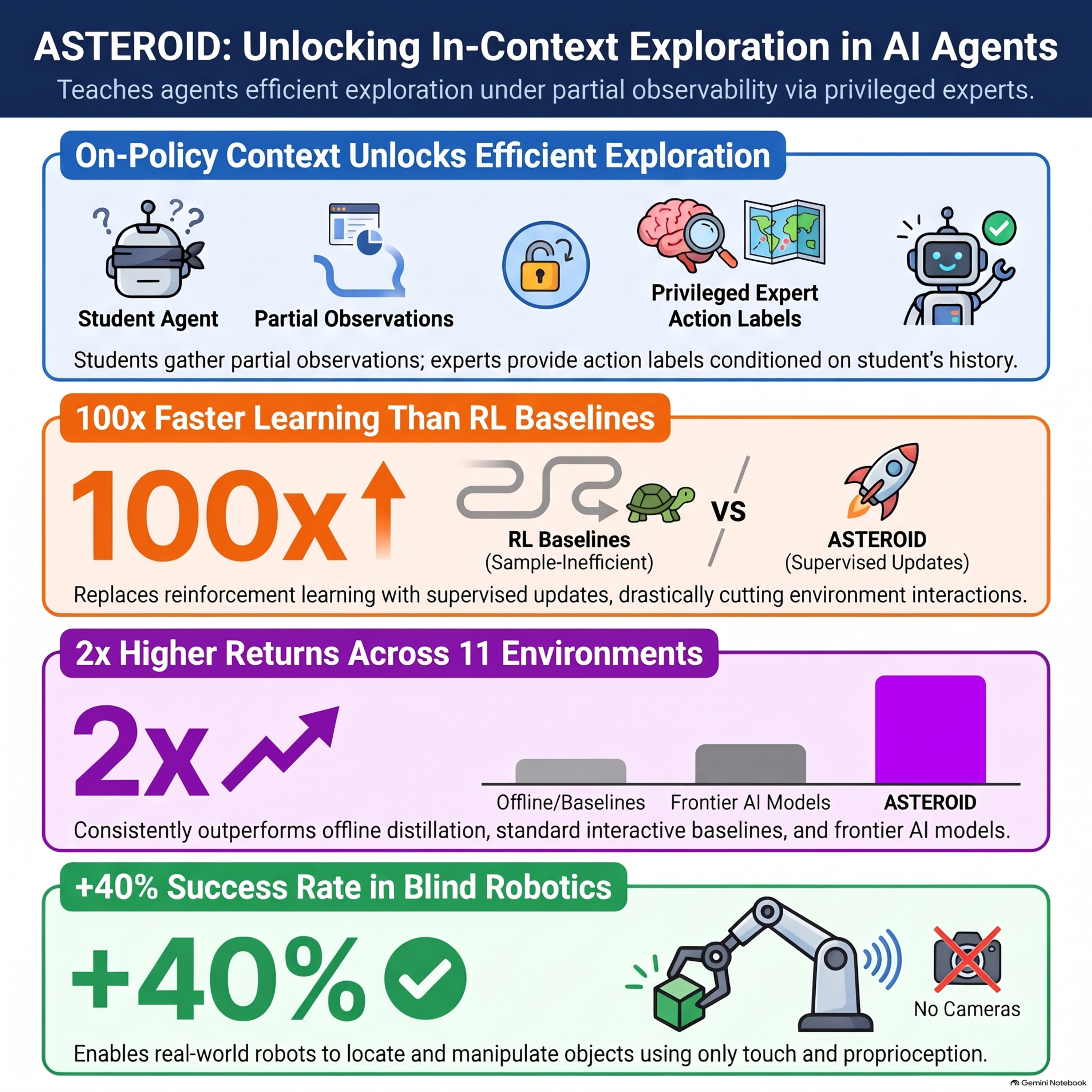
Asteroid (Asymmetric Student-Teacher Rollout in Context Distillation) trains robots to do in-context exploration under partial observability—systematically eliminating options after failures to infer hidden states—rather than copying an all-knowing expert.
No guests are named; the episode is presented as a “deep dive” by the hosts.
Standard RL is sample-inefficient for exploration; naive imitation learning fails because the privileged expert never explores or makes mistakes, causing students to average paths and crash. Asteroid flips training: the student acts first to generate on-policy context (its own local history), then a privileged expert labels the best next action given that messy state. This approximates Bayesian-style posterior sampling without explicit posterior tracking.
three-door process-of-elimination; 8-DOF simulated ant (2x return, 100x fewer interactions than RL); UR5E blind cube grasping via proprioception (finds cube in ~20s); wrist camera peg insertion where Claude Opus drops from ~65% (full coordinates) to ~50% (no coordinates), while Asteroid reaches ~78% by avoiding hallucinated peg locations and adapting to partial observations.
Written by AI. May contain mistakes.
Discover why standard reinforcement learning is inadequate for complex search tasks.
“We have been digging through a fascinating stack of recent robotics lab notes and AI research papers today, and our mission is to explore a massive breakthrough called the asteroid framework.”
Explore the issues with naive imitation learning and the importance of context in training.
“If a robot is trying to find your keys in a cluttered house, it operates entirely under partial observability.”
Learn how the Asteroid framework redefines the student-teacher dynamic in AI training.
“Yes, asteroid, which stands for Asymmetric Student-Teacher Rollout in Context Distillation.”
Examine the practical applications of the Asteroid framework in diverse environments.
“It searches methodically when it is uncertain, and it exploits the goal immediately once the hidden state is revealed.”
Learn how a robot arm uses proprioception to locate and grasp objects without vision.
“Wait, they turned the cameras off completely?”
Explore the differences in performance between Asteroid and Claude in physical tasks.
“Okay, but if this framework is so smart at searching, why do we need this specialized asteroid training at all?”
Understand the limitations of AI reliant on static data versus dynamic learning.
“Even the most advanced, massively funded AI text models lack this specific in-context exploration skill.”
Discuss potential applications of AI that can explore and adapt in real-time environments.
“Because if we want truly autonomous agents in our daily lives, they have to be able to handle reality.”

Get the gist, explore an idea or ask about something said.
 Claude
On Best AI papers explained, what are the key points of this episode?
Searching your listeningAutomatic transcript. May contain errors.
0:00Picture this. You wake up in the middle of the night. It's pitch black. Right. Total darkness. Yeah. You reach over to your nightstand to grab your phone, and it is not there. What do you do? You don't just, like, blindly grab at the exact same empty spot on the wood over and over again, hoping it magically appears. No, of course not. No. You never find it. Exactly. You feel around. You swipe your hand to the left. Nothing. So you mentally cross that area off your list. You reach a little further. Maybe feel the edge of a book. And you use that as a landmark. Yes. You use that landmark to figure out where the phone might have slid.
0:39You are using your memory of where you just checked and the context of what you just touched to systematically eliminate the wrong options until you find what you're looking for. It's a very basic, instinctual human behavior. We do it without even thinking. Right. But if you have ever wondered why you don't have, I mean, a helpful robot butler cleaning your kitchen yet, the answer is hiding right there in the dark. It really is. That instinct to systematically search is arguably the biggest hurdle in modern robotics right now. Welcome to our deep dive. We have been digging through a fascinating stack of recent robotics lab notes and AI research papers today, and our mission is to explore a massive breakthrough called the asteroid framework.
1:21Which is incredibly exciting. It is. We are going to look at how AI is finally learning to navigate the unknown, mastering a concept called partial observability. Right, which simply put is how a machine makes smart decisions when it can't see the whole picture. Because, let's face it, the real world is not a neatly organized chessboard where you can see every single piece at all times. No, the real world is messy. Things are hidden. Information is, you know, always incomplete. Always. The gap between simulated intelligence and real-world usefulness really all comes down to exploration. If a robot is trying to find your keys in a cluttered house, it operates entirely under partial observability.
1:59It doesn't have a magical map of the house. Exactly. It has to look in the living room, realize the keys aren't there, remember that it already checked the living room, and then logically update its search strategy for the kitchen. It has to gather information to reveal the hidden state of the world, right, before it can effectively act on it? Spot on. Okay, let's unpack this. Why can't we just use standard reinforcement learning for that? I mean, we hear about RL all the time. We do, yeah. Giving the AI a virtual reward when it does something right, punishing it when it does something wrong. It seems like a pretty straightforward way to teach a robot to find keys.
2:33Well, reinforcement learning works well for certain tasks, but it's incredibly slow. It's what we call in the field sample inefficient. Sample inefficient. Got it. Imagine trying to learn that phone searching strategy you mentioned from scratch, purely by trial and error. With a reward only when you finally happen to touch the phone. Exactly. You would have to flail around randomly, swatting at the air and the floor millions of times before you accidentally stumbled on the concept of systematic elimination. Oh, wow. Yeah, that sounds exhausting. In a complex environment like a robot navigating the geometry of a physical house, the number of interactions required to learn that kind of memory-based search behavior is just, it's entirely impractical.
3:17Right. Nobody has the time, the computing power, or frankly the budget to let a million-dollar robot crash into the drywall for 10 ,000 hours just to learn how to find a coffee mug. Exactly. So to speed things up, researchers often rely on a shortcut called imitation learning. Okay. This uses an asymmetric training setup. The researchers create what's called a privileged expert. A privileged expert. Mm-hmm. What does that mean exactly? It's basically a teacher algorithm that has access to all the hidden information in the simulation. It has magical x-ray vision, essentially. Okay. It does exactly where the target object is from the very first millisecond.
3:58And the idea is to have the student AI, which does not have x-ray vision, just watch the expert and copy its moves. Wait, if I'm learning to play chess from a grandmaster who already knows my entire strategy before I even move a piece, I'm never actually learning how to anticipate or search for clues on the board, right? Exactly. I'm just memorizing and copying their confident moves without understanding the underlying logic of why they moved there. That is the fundamental flaw of naive imitation learning. The expert teacher never actually has to explore. Because it already knows where everything is.
4:32Right. It never has to search for the hidden object because it possesses the global coordinates. It just walks in a straight, perfectly optimized line to the goal. Okay, so put yourself in the shoes of the student AI. Right. You can only see the immediate room you're standing in. You watch the teacher walk straight through a doorway to the hidden goal. But because you can't see the hidden goal yourself, you don't understand why the teacher chose that specific doorway over the other three options. You're just attempting to copy the physical action without the mental context. Precisely. Okay, so if I turn the student AI on and say, go find my keys, what does it actually do?
5:06It can't just walk in a perfect line because it doesn't have the x-ray vision. It dithers. It dithers. Yeah. It essentially takes a mathematical average of all the different perfect paths it watched the teacher take across different training scenarios. Oh, I see where this is going. Let's say the student remembers that when it stood in this spot before, the teacher went left around the dining room table 50 % of the time and right around the table 50 % of the time. But the student doesn't know why. Exactly. The student doesn't know why the teacher chose either direction, so it mathematically averages the two correct actions.
5:39The average of turning left 90 degrees and turning right 90 degrees is zero degrees. Straight ahead. Straight ahead. So it just confidently marches straight forward into the solid edge of the dining room table and breaks. Yep. It never learns the process of searching while uncertain because the teacher was never uncertain. Wow. Copying an all-knowing teacher creates a helpless student who just freezes or makes fatal geometric errors the second it lacks perfect information. Because the teacher never makes a mistake, the teacher never shows the student how to recover from a mistake. Exactly. Which means the researchers had to completely rethink the classroom dynamic, so to speak.
6:18Enter asteroid. Yes, asteroid, which stands for Asymmetric Student-Teacher Rollout in Context Distillation. That sounds like a mouthful. It really is. But the core mechanism flips that broken teacher-student relationship entirely on its head. How so? The brilliant twist here relies on something called on-policy context. On-policy context. Right. Instead of forcing the student to passively watch the teacher perform the task perfectly from start to finish, the researchers let the student attempt the task itself first. Oh, interesting. The student goes in completely blind under strict partial observability.
6:54So it has to make the mistakes. It inevitably makes mistakes. It takes actions, it observes the results, and it generates a localized history of what it just tried. Okay. This running history is the on-policy context. Only after the student generates this history do they pause the simulation. Then they ask the privileged expert teacher, based on the exact messy state the student has reached right now and the mistakes he just made, what is the best next move? That is exactly like a genuinely good driving instructor. Yeah? How so? Well, if you are learning to drive, an instructor who just grabs the steering wheel and flawlessly navigates the entire route teaches you absolutely nothing about handling a car.
7:34Right. You'd learn nothing. But if the instructor sits back, lets you accidentally take a wrong turn down a tight, dead-end street, and then pauses to say, okay, look at where we are now. Look at the mirrors. How do we navigate out of this specific mistake? That's a great analogy. That's when you actually build the neural pathways for driving. You learn to correct your own errors. And the student AI in Asteroid is learning exactly that kind of adaptation. Let's look at the three-door example from the research to see the specific mechanism. Okay, let's hear it. Imagine a simulated scenario where a hidden goal is placed behind one of three doors, A, B, or C.
8:10The student AI goes in blind. It decides to open door A. The room is empty. It fails. Okay. The simulator rewards it with a zero. The student's running history now officially rules out door A. At this exact moment, the simulation pauses. Enter the expert? Exactly. The expert teacher, which knows the goal is actually behind door C, steps in. It looks at the student's specific history, the failure at door A, and provides the correct action label for that moment. Go to door C. But the student isn't just learning that the goal is at C. It's learning a much deeper rule about the process of elimination.
8:48Yes. The student learns that when you possess a contextual history that includes a failure at door A, you never waste time trying door A again. You pick between the remaining variables, B and C. Right. If it subsequently tries B and fails, the history now rules out A and B. The expert label points to C again. So over thousands of these micro-interactions, the student systematically learns to eliminate inconsistencies. It develops in-context exploration. It searches methodically when it is uncertain, and it exploits the goal immediately once the hidden state is revealed. That's incredible. Mathematically, it's beautiful.
9:26Asteroid allows the AI to approximate Bayesian posterior sampling without the computational bottleneck of maintaining an explicit posterior state over long time horizons. It basically sidesteps the curse of dimensionality. Well, hold on. You're losing me in the math. Explicit posterior state? Let's translate that. Are you just saying that normally a computer trying to calculate every single possible hiding spot and track all those probabilities at once would just like freeze up and crash? Essentially, yes. In a simple three-door game, calculating every possibility is easy. But in a high-dimensional real-world task, like a house with thousands of objects, angles, and lighting conditions, keeping a running mathematical calculation of every possible hidden state requires an impossible amount of computing power.
10:14So how does Asteroid avoid that crash? Asteroid achieves the behavior of that complex calculation without actually doing the heavy math. It relies on the supervised training from the expert over these expanding histories to just naturally intuit the next best step. You mentioned expanding histories. The notes talk about a curriculum. The student doesn't just get a correction after one mistake, right? The leash gets longer? Yes, they use a rolling curriculum. In the first training iteration, the student might only act for one or two steps before the simulation pauses and the teacher provides a label.
10:48Okay, keeping it short. Right. In the next iteration, the student acts for five steps, generating a longer context window of successes and failures. As the horizon expands, the student learns to reason over increasingly long sequences. It builds a working memory. Okay, it is easy to play process of elimination with three imaginary doors in a pristine computer simulation. But my kitchen doesn't have three clean doors. It has a thousand variables. Oh, absolutely. Does this mathematical theory actually survive contact with physical reality? It does. The researchers tested the asteroid framework across 11 very diverse, highly complex environments to prove it wasn't just a parlor trick.
11:31Like what kind of environments? This included everything from navigating procedurally generated randomized mazes with very limited fields of view to an 8-degree-of-freedom robotic ant that had to explore a massive arena to find a hidden target. Let's focus on that ant. What does an 8-degree-of-freedom ant actually look like in these simulations? It is a complex quadruped robot. Think of a torso with four legs, and each leg has two distinct joints, a hip and a knee. Oh, wow. So the AI controlling it faces a dual optimization nightmare. It doesn't just have to figure out a logical search pattern to find the target.
12:08It has to walk. Exactly. It has to simultaneously calculate the exact torque required for eight different motors just to stand up, balance, and walk without falling over. Doing both of those things simultaneously while under partial observability usually breaks an AI. It does. But Asteroid crushed it. Across these tasks, it achieved roughly double the return rates of other leading methods, given the exact same exploration budget. Double the returns? Yes, and compared to standard reinforcement learning, it learned the task using up to 100 times fewer interactions. Wait, 100 times fewer interactions sounds incredibly impressive on paper, but standard RL takes tens of millions of tries.
12:49Isn't 100 times faster still taking hundreds of thousands of tries? Yes, it is. How is that practical for a real robot? You still wouldn't want a physical robot falling over 100 ,000 times. That is a critical distinction. You do not train this on the physical hardware right away. Oh, okay. You train the model in a physics simulation where 100 ,000 tries might only take a few hours of computational time on a server, rather than weeks of real-time movement. Got it. But the 100x sufficiency is vital because it limits the sim-to-real gap. Sim-to-real gap. Right. The fewer simulated interactions the model needs to learn the underlying logic, the less likely it is to overfit to the quirks of the simulation.
13:30When you finally transfer that brain into a physical robot, it is robust enough to handle the chaotic variables of the real world without needing to be retrained from scratch. And they did put this into a real robot. The crown jewel of these experiments was the real robot manipulation task. They took this asteroid brain, which learned to search in a computer, and put it into a UR5E robotic arm. A standard industrial robotic arm equipped with a simple two-finger gripper. And to make it a true test of partial observability, they removed all visual input. Wait, they turned the cameras off completely?
14:05Completely off. The robot was functionally blind. Here's where it gets really interesting. How does a blind robot arm pick up a random 3D cube sitting somewhere on a table? Doesn't it just flail around, knock the cube onto the floor, and declare failure? That is exactly what standard behavioral cloning models do. The moment they go out of their train distribution, they lose their spatial mapping, get confused, and wildly swing the arm. Right. But the asteroid robot relies entirely on proprioception. Proprioception. Like how I can reach up and touch my nose with my eyes perfectly closed because my brain inherently knows the physical coordinates of my own arm in space.
14:44Exactly the same principle. The robot arm knows the physical position of its own joints, and it measures the distance between its gripper jaws. Okay. The researchers place a cube somewhere on the table. The arm starts at a default position. It reaches down to attempt a grasp at a candidate location. The motors close the gripper jaws. If the jaws close all the way to zero centimeters with zero resistance, the arm knows it grabbed empty air. So it uses that physical failure as its on-policy context. It's literally mapping the empty space. It seamlessly adjusts. A standard AI would throw an error code here.
15:22Asteroid uses the closed gripper as new data. Incredible. It raises the arm, moves slightly to a different grid location on the table, and reaches down again. It systematically maps the empty space with its physical body. Until it hits the cube. Right. Eventually, it reaches down, and the gripper stops closing halfway, because it wraps around the solid plastic of the cube. the hidden state is suddenly revealed. It knows exactly where the cube is. It grips it and lifts it up. The robot successfully found and lifted the hidden cube within 20 seconds, purely by feeling its way through the dark. Wow.
15:59Okay, but if this framework is so smart at searching, why do we need this specialized asteroid training at all? Why don't we just use the massive frontier AI models everyone is talking about in the news? Ah, the large language models. Yeah, the multi-billion dollar language models that can write software and pass the bar exam. Just plug one of those into the robot arm. Let the text model write the code to find the cube. The researchers anticipated that exact question. They set up a head-to-head comparison between Asteroid and one of the most advanced frontier language models available, Claude Opus 5.5.
16:32Okay, on what kind of task? On a complex physical task called wrist camera peg insertion. Set the scene for us. What is the layout of this peg insertion task? You have a robotic arm. It needs to find a small peg on a table, pick it up, navigate to a separate block with a hole in it, and insert the peg. Seems simple enough. But the only way the AI can see the world is through a tiny camera mounted right on the wrist of the robotic arm. So instead of a wide overhead view of the whole table, it is looking through a narrow straw that only sees what the hand is pointing at. Exactly. They first tested the CLOD model under full observability.
17:13They gave the AI the global coordinates of the peg, the hole, and the arm in a text prompt. And how did it do? CLOD performed quite well. It achieved roughly a 65 % success rate at generating the Python control code to move the arm and insert the peg. Honestly, 65 % is impressive for an AI that is predominantly famous for writing emails and summarizing meetings. It is. But notice the difference when they took away those global coordinates. They forced Claude to rely solely on the partial view of the wrist camera. Oh, boy. It had to physically explore the table to find the peg first before it could grab it.
17:49Claude's success rate plummeted to about 50%. What exactly did Claude's generated code do wrong when it failed? Did it just freeze up? It struggled severely with sequential spatial reasoning. When Claude lost the global coordinates, the code it wrote often hallucinated the peg's location. Hallucinated it? Yeah. It would assume the peg was in a default starting spot, move the arm there, grasp at empty air, and simply assume it succeeded. So it's just moving around, holding nothing. Exactly. Moving on to the insertion phase with nothing in its hand. Or it would swing the camera wildly, catch a glimpse of the peg, but fail to translate that partial visual token into a logical next step to center the camera.
18:33It completely struggled to adapt to the missing information dynamically. Okay, so Claude is effectively flying blind and failing, but wouldn't Asteroid have the exact same problem? It is looking through the same tiny wrist camera. It doesn't have the global coordinates either. It is facing the exact same physical constraints, but the difference is in how it handles the lack of information. Asteroid achieved a 78 % success rate on that exact same wrist camera task. Wait, 78 %? Yes. It didn't hallucinate the peg. It calmly swept the arm across the table, processed the visual failures, updated its internal map, found the peg, centered it, picked it up, and inserted it.
19:15So what does this all mean? Even the most advanced, massively funded AI text models lack this specific in-context exploration skill. They do. They have ingested the entire text of the Internet, but they don't naturally know how to physically feel around in the dark to uncover hidden information in real time. That brings up a vital limitation of frontier models. They rely fundamentally on data that already exists. Right. They're trained on static text, static code snippets, and static images. But exploring an environment under partial observability requires dynamic, real-time reasoning. Asteroid succeeds precisely because it does not rely on a static data set of someone else's histories.
19:59Exactly. It generates its own on-policy data on the fly. It learns the specific rhythm of, you know, I try this action, I fail, the physical world pushes back, I update my belief about the world, and I try a new action based on that pushback. It is the difference between reading a dense physics textbook about how to ride a bicycle and actually getting on the bicycle, falling off, scraping your knee, and physically adjusting your balance. That's a perfect way to look at it. The text model read the book and thinks it knows how to ride. Asteroid actually fell off the bike and learned where its center of gravity is.
20:37And learning to dynamically adjust your balance from your own immediate failures is something you simply cannot memorize from a massive pre-training run on static data. You have to experience the context and learn to infer the hidden state through trial and error. This is a huge paradigm shift. Because if we want truly autonomous agents in our daily lives, they have to be able to handle reality. And reality is just one giant, endless exercise in partial observability. Things move. Things hide. Information changes constantly. Consider the applications. Whether that is a physical robot sorting out a messy kitchen where pots and pans are hidden in random cabinets, or a digital web assistant trying to book a complex multi-city vacation for you across five different airline websites that keep changing their prices.
21:25Right. The AI must be able to explore, remember its recent failures, and logically deduce hidden realities without a human holding its hand and feeding it the right answer at every single step. If that digital web assistant checks a flight database and the route is sold out, it can't just freeze and crash like Claude hallucinating the peg. No, it has to use that sold out failure as context, realize that specific hub is a dead end, and systematically search the next logical airport option. It is the exact same underlying math as the robot arm feeling the table for the hidden cube. Asteroid proves that you can successfully teach an AI not just the right answers, but the fundamental methodology for finding the right answers when they are purposefully obscured.
22:09Which leaves us with a pretty intense thought to chew on as we wrap up this deep dive. We have focused heavily today on physical robots feeling around tables and navigating rooms. But think about the digital application you just mentioned. The autonomous web agents? Yeah. If Asteroid allows an AI to perfectly map out its own failures to deduce hidden truths in a physical space, how long until these exact same search algorithms are unleashed in digital spaces? Implementing this in digital environments is definitely the logical next step for autonomous agent research. Imagine an AI that explores the internet deducing your hidden personal data or uncovering tightly held corporate secrets based entirely on the shape of the information that is missing or blocked.
22:50Oh, wow. If a digital agent checks a server and hits a firewall, it doesn't just stop and throw an error code. It uses that failure as on-policy context to meticulously map the perimeter of what you are hiding. If it figures out where the data must be based on where the security is. It maps the empty space. Exactly. If AI can now systematically and perfectly feel its way through the dark, what else is hiding in the dark that it's inevitably going to find? Something to think about the next time you are blindly reaching for your phone in the middle of the night.
We discuss ASTEROID, a novel student-teacher framework designed to address the challenges of sequential decision-making under partial observability. By combining on-policy context collection with expert supervision, the student policy learns effective in-context exploration without requiring expensive online reinforcement learning or impractical full-coverage offline datasets. Across various simulated and real-world environments, this iterative approach significantly outperforms traditional baselines and frontier models in sample efficiency and test-time performance.


