
In short
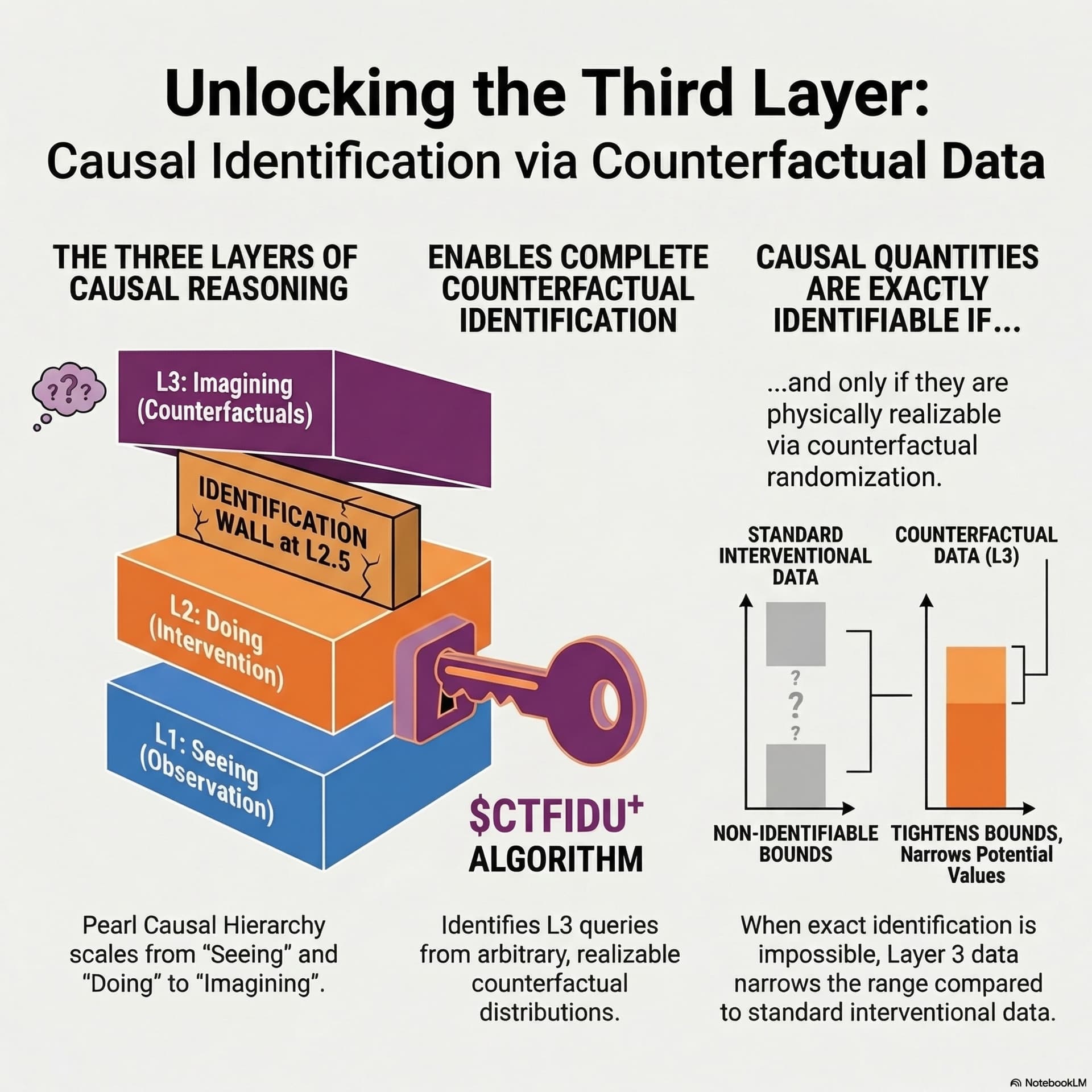
Causal AI for counterfactual identification, introducing “counterfactual randomization” (Layer 2.5) and a new algorithm (CTFIDU+) that is complete for realizable queries; when exact identification is impossible it outputs “fail,” shifting to bounding/partial identification.
Guest backgrounds
No guests are named; the episode is a host “Deep Dive” discussion with an unnamed co-speaker.
Key claims
Layer 1=observational, Layer 2=interventional, Layer 3=counterfactual “what if.” Layer 2.5 is physically realizable by pixel-swapping the AI’s input (not the real world). “Realizability equals identifiability” sets a hard limit: some effects (e.g., natural treatment effect under deep confounding) are only in Layer 3, so CTFIDU+ returns fail. Otherwise, CTFIDU+ exactly identifies or bounds causal effects.
Notable examples
Traffic-camera fairness audit (car color X, speed Z, ticket decision Y) using RGB pixel randomization to estimate natural direct effect; drug de-addiction therapy where Layer 2 bounds are wide (−1.3 to 1.6) but adding Layer 2.5 tightens bounds and identifies a “helped” subgroup with benefit score ≈20.
Written by AI. May contain mistakes. Listen to the episode to check what was said.
Chapters
Tap a time to open that second in VOImagining a Superpower
0:45 to 1:40
Discussion on the concept of altering a single detail in the past and its implications.
“But our mission for this deep dive is to explore a groundbreaking leap in causal artificial intelligence that essentially gives researchers this exact superpower in the real world.”
Causal Hierarchy Framework
1:40 to 2:47
Explaining Perl's causal hierarchy and its significance in causal AI.
“Because as our listeners likely know, any serious conversation about causal AI starts with Perl's causal hierarchy.”
Understanding Layer 3: Counterfactuals
2:47 to 3:55
Delving into the complexities of counterfactual data and its importance for AI.
“It is the complex realm of asking what would have happened if things had been different.”
AI Auditing Example
3:55 to 5:00
Using a traffic camera scenario to illustrate challenges in AI algorithm auditing.
“And looking at how an auditor would attempt to solve that bias mystery using our causal ladder reveals the historical limitations of the field.”
Limitations of Traditional Approaches
5:00 to 6:10
Examining the shortcomings of layers one and two in causal analysis.
“Because you aren't testing the actual driver who got the ticket.”
Introducing Counterfactual Randomization
6:10 to 7:20
Introduction to counterfactual randomization as a solution for Layer 3 data collection.
“They were forced to take their layer one observational data and their layer two experimental data and use complex modeling to essentially guess what the alternate reality might have looked like.”
Manipulating AI Perception
7:20 to 8:39
Describing the method of altering AI's perception without changing physical reality.
“So you intercept the live video footage being fed into the AI system.”
Layer 2.5: Realizable Counterfactual Data
8:39 to 9:39
Explaining the emergence of Layer 2.5 data as a bridge between layers 2 and 3.
“The video artifacts, the weather conditions the driver's psychology.”
CTFIDU+: The Master Algorithm
9:39 to 11:15
Introduction to the new algorithm, CTFIDU+, designed to process complex queries.
“Think of CTFID-US as the ultimate undefeated sorting machine for complex causal queries.”
Understanding Algorithm Outputs
11:15 to 12:23
Discussing the implications of receiving a 'fail' output from CTFIDU+.
“After CTFIDU plus processes all of your multilayered data, it might output a single word, fail.”
Show all 15 chapters
Bounding Technique for Queries
12:23 to 13:20
Explaining the strategy of bounding for scenarios where exact identification is impossible.
“The findings detail a specific scenario involving the natural treatment effect, or NTE, under conditions of deep confounding.”
Case Study: Drug De-addiction Programs
13:20 to 14:00
Exploring a real-world application of causal inference in drug therapy decisions.
“Do researchers just abandon the query and go back to guessing?”
Impact of Counterfactual Data on Decision Making
14:00 to 16:44
Learn how counterfactual data revolutionizes public health decision-making by providing precise insights.
“Imagine an official, a program officer tasked with making a high-stakes public health decision.”
Evolving Understanding of Reality through Data
16:44 to 18:25
Discover the evolution of data processing from simple observation to complex counterfactual analysis.
“to knowing precisely which individuals to treat to guarantee a positive clinical outcome.”
Legal Implications of Causal Algorithms
18:25 to 19:18
Explore how advancements in causal algorithms could transform our legal systems and concepts of liability.
“If we now possess the mathematical frameworks and the algorithms capable of rigorously tightening the bounds of what would have happened in alternate realities, how is this eventually going to reshape our legal systems?”
Transcript
Automatic transcript. May contain errors.0:00Welcome to the Deep Dive. I want you to start by just imagining for a second that you possess a very specific, almost surgical superpower. Oh, I like where this is going. Right, so not flight or invisibility or anything like that. Imagine you have the ability to change one highly specific detail in the past. So let's say the color of a car that just drove by your window right now. Okay, just the color. Exactly, just the color. But while keeping every single other factor of that exact moment completely and perfectly the same, you just want to see if changing that one tiny isolated detail changes the ultimate outcome of the situation.
0:39Which, I mean, it sounds like pure science fiction. Yeah, like the premise of a time travel movie where you step on a butterfly and suddenly the entire future is altered. Right, the classic butterfly effect. But our mission for this deep dive is to explore a groundbreaking leap in causal artificial intelligence that essentially gives researchers this exact superpower in the real world. It really is a massive shift. For years, scientists have been able to observe data and they've been able to intervene in data. But measuring these alternate realities... What statisticians call counterfactuals. Right, exactly.
1:11Measuring counterfactuals was considered mathematically impossible without a literal time machine. But today we are unpacking a massive breakthrough in the latest research. We are going to look at how researchers are now physically measuring these what ifs and will break down the master algorithm that finally makes it all possible. OK, let's unpack this. To truly grasp the magnitude of the findings in the latest research, we should probably do a quick refresher on the framework that governs all of this. Yeah, that's a good idea. Set the stage. Because as our listeners likely know, any serious conversation about causal AI starts with Perl's causal hierarchy.
1:49The PCH. Right, the PCH. It represents three progressively richer, deeper modes of reasoning for AI and statistics. You can kind of think of it as a ladder of intelligence. The ladder. Okay, I like that. So at the foundational level, layer one, we have seeing, this is purely observational data. Just watching things happen. Exactly. It's what our current machine learning models are already exceptional at. finding correlations, recognizing patterns in massive data sets. Then moving up, we reach layer two, which is doing. So interventional data. Yes, interventional. Yeah. We are no longer just passively watching.
2:25We are actively poking the system to see how it reacts. Running a randomized clinical trial for a new medical treatment is your classic layer two scenario. Because you're physically giving half the people the drug and half the placebo. Yeah. You're intervening. Precisely. And then at the very top of the ladder sits layer three. This is imagining. A tricky one. Very tricky. This deals strictly with counterfactual data. It is the complex realm of asking what would have happened if things had been different. Grounding that abstract ladder into a real-world scenario is where the data gets incredibly illuminating.
2:58The research provides this fantastic example involving an AI auditing system. Oh, the traffic camera example. Yes, the traffic camera. So imagine a city deploys an algorithm that is entirely in charge of issuing speeding tickets using traffic camera footage. We are tracking three main variables here for you listeners. Okay, let's lay them out. Variable X is the color of the car. Variable Z is the driving speed of that car. And variable Y is the AI's final decision on whether or not to issue a penalty ticket. Seems straightforward enough. You would think so. Yeah. But the major hurdle for anyone trying to audit this system for fairness is the presence of unobserved confounders in the real world.
3:38Always the unobserved confounders causing trouble. Always. Suppose there's a weird video artifact on the road, maybe a lens flare at a certain time of day or a shadow from an overpass that subtly confuses the AI's processing. Right. If the city's data shows that red cars are receiving a disproportionate amount of tuckets, the auditors have a massive blind spot. They really do. They cannot definitively say if the AI algorithm is mathematically biased against the color red, or if the people driving red cars just happen to be speeding more often because of some unrecorded psychological factor or external condition.
4:13And looking at how an auditor would attempt to solve that bias mystery using our causal ladder reveals the historical limitations of the field. How so? Well, if the auditor relies solely on layer one, seeing they might analyze 10 ,000 hours of traffic footage, and they can easily answer the question, are red cars getting more tickets? But correlation doesn't explain the cause. Exactly. So stepping up to layer two, they could design an experiment. They might recruit a diverse, randomly selected group of drivers, put them all in red cars, and instruct them to drive through the intersection at varying speeds to see how the AI reacts.
4:51That sounds like a solid test, though. It provides excellent interventional data, sure, but you are still only testing a general population average. You have not answered the ultimate question about algorithmic fairness in a specific localized instance. Ah, I see. Because you aren't testing the actual driver who got the ticket. Right. To achieve that, you require a layer 3 imagining. You have to ask a highly specific counterfactual query. Meaning you have to ask if this individual driver who just drove past right now in a blue car and received a ticket had been driving a red car instead, but their speed, the lighting and their mood remained exactly the same, would the AI still have issued the penalty?
5:32Yes. Which brings us to the historical brick wall. You cannot hit a rewind button on the universe. Unfortunately, no. You can't pause time, repaint that specific driver's car, recreate the exact wind resistance and the exact lens flare, and watch them drive through the intersection a second time. What's fascinating here is that for decades, the scientific community largely operated under the assumption that this kind of Layer 3 data was fundamentally inaccessible in a physical setting. Because of the whole lacking a time machine thing. Exactly. Because we lack time machines answering layer three questions required researchers to rely on heavy, incredibly dense mathematical assumptions.
6:10You had to basically guess right. Pretty much. They were forced to take their layer one observational data and their layer two experimental data and use complex modeling to essentially guess what the alternate reality might have looked like. Which seems risky. It is. When you are dealing with deeply tangled real-world variables relying on mathematical assumptions, leaves a massive margin for error. Well, here's where it gets really interesting. The latest research outlines a methodology to actually collect this supposedly impossible Layer 3 data in the real world. And they achieve this through a physical procedure called counterfactual randomization.
6:48Right. And the brilliance of it is that you don't actually need to build a time machine or physically alter the car out on the asphalt to test the alternate reality. You really don't. You just have to manipulate the reality that the artificial intelligence perceives. The elegance of that solution completely bypasses the physical constraints of the universe. When the findings discuss counterfactual randomization in the context of our traffic camera, they are detailing a process of manipulating the digital feed before it reaches the decision-making algorithm. Let's walk through the mechanics of that manipulation for everyone listening.
7:20So you intercept the live video footage being fed into the AI system. Okay, I'm with you. The system identifies a blue car approaching. You then run a script to isolate the pixels that make up that specific car. And you randomize the RGB pixel values so that the AI perceives a bright red car. So smart. Right. In the eyes of the decision maker, you have successfully fixed variable X, the car color. But out in the physical world, the actual driver is still behind the wheel of their blue car. So their natural real-world speeding behavior variable Z is completely unaffected by the digital manipulation happening inside the camera's processor.
8:01Exactly. You haven't altered the driver's reality. You've exclusively altered the AI's reality. By splitting the timeline in that manner, you have the natural world progressing, as it always would, running parallel to an intervened world being fed directly into the algorithm. It's like running two universes at the same time. It really is. And this specific setup allows researchers to calculate what is known as the natural direct effect. The NDE. Yes, the NDE. Because the procedure cleanly separates the driver's natural, uninfluenced speed from the car's digitally altered color auditors, can finally isolate whether the AI's algorithm harbors a direct bias against the color red.
8:36It systematically strips away all of the unobserved confounders. The video artifacts, the weather conditions the driver's psychology. It was gone. The capability to test the AI's isolated reaction without relying on theoretical assumptions generates an entirely new sub-layer of data. The sub-layer. Yes. The research formally defines this as Layer 2.5, realizable counterfactual data. Layer 2.5. I love that. It occupies a distinct space right between standard Layer 2 experiments and the full-blown, physically impossible imagination of Layer 3. Discovering layer 2.5 feels like finding a hidden floor in the architecture of logic.
9:15That's a great way to put it. But raw data is just noise without a mechanism to parse it, you know. How are researchers actually taking this influx of observational data, experimental data, and this brand new, realizable counterfactual data and combining them without breaking the math? That is the million-dollar question. And this is where the research introduces the master key of the entire process, a new algorithm called CTFIDU+. CTFIDU plus R. Think of CTFID-US as the ultimate undefeated sorting machine for complex causal queries. Prior to the development of CTFID-U +, the algorithms designed to identify counterfactuals were essentially operating with a blind spot.
9:53Because they couldn't handle Layer 2.5. Exactly. Older foundational algorithms in the field, like IDC-STAR or PSIDC, were revolutionary in their time, but they were built under the strict assumption that they would only ever receive Layer 1 or Layer 2 data as inputs. So they were entirely unprepared for pixel swapping. Completely. They were mathematically blind to the concept of counterfactual randomization because they assumed a rigid separation between observation and intervention. CTFIDU plus is engineered from the ground up to synthesize this new influx of layer 3 and layer 2.5 data. And the process of using it is remarkably comprehensive.
10:28You basically feed the algorithm absolutely everything you have on the system. You just dump it all in. Yeah. You input your observational data from watching the road. your interventional data from standard experiments, and your new counterfactual pixel swapping data. You present it with a deeply complex what-if query, and CTFIDU breaks that tangled question down into smaller mathematically digestible pieces. And it does it flawlessly. Right, because the research proves that this algorithm is complete. Which is a very specific term in this context. Yes. In the realm of computer science, completeness means the algorithm mathematically guarantees an exact answer to your query, provided that an exact answer actually exists in the universe.
11:08It completely subsumes those older algorithms like IDC star and PSIDC. But there is a massive caveat to the superpower. Oh, there always is. After CTFIDU plus processes all of your multilayered data, it might output a single word, fail. Fail. And getting a fail isn't a software glitch. It means something philosophically profound. It means the answer is genuinely mathematically impossible to find. If we connect this to the bigger picture, the fail output of the CTFIDU plus algorithm establishes the absolute fundamental limit of nonparametric causal inference. It's drawing a line in the sand. Exactly.
11:45The research reveals a brilliant mathematical duality here. The foundational rule established is realizability equals identifiability. Let's break down the weight of realizability equals identifiability for the listener, because that sounds like a law of physics for data. It functions very much like a law of physics. It dictates that if a real world situation is so hopelessly tangled, so deeply confounded by unobserved factors, that you couldn't even design a physical counterfactual pixel swapping experiment for it in principle. That what? Then no amount of computational power or advanced math can ever give you an exact answer.
12:22There is a hard, impenetrable wall to what human beings can know. That is heavy. The findings detail a specific scenario involving the natural treatment effect, or NTE, under conditions of deep confounding. Okay, the NTE. The mathematical proofs demonstrate that identifying the exact NTE in these highly specific tangled scenarios belongs firmly and exclusively in layer 3. So it's out of reach. Completely. It falls completely outside the boundaries of layer 2.5. It exists purely in the realm of imagination, entirely divorced from physical realizability. In those instances, CDFID MorePlus will output fail.
12:59It is the mathematical universe explicitly telling researchers that exact causal inference in that specific scenario has hit a hard limit. Exactly. Honestly, hitting a hard mathematical wall sounds incredibly bleak. You are handed this shiny new AI superpower. You boot up the master algorithm and it just looks at your data and tells you it's impossible. It can definitely feel like a letdown. So what is the next step when CTFIDU plus outputs fail? Do researchers just abandon the query and go back to guessing? Not at all. The incredible pivot in this research is that the answer is no. When exact identification is impossible, the strategy shifts to a technique called bounding, also known as partial identification.
13:35Right, partial identification. If the math refuses to give us the exact bullseye, we use the data to draw the tightest possible circle around the target. To see how powerful this is in practice, let's walk through example three from the findings, which moves away from traffic cameras and looks at drug de-addiction programs. The de-addiction scenario perfectly illustrates the life-altering practical impact of this data. So set the scene for us. Imagine an official, a program officer tasked with making a high-stakes public health decision. They need to determine whether or not to send a specific group of participants to a highly intensive therapy program.
14:11Got it. The intensive therapy is our variable X. the desired outcome, perhaps a specific clinical milestone of recovery is our variable Y. And a responsible program officer would start by looking at the standard layer 2 experimental data. Of course. They would pull up the results of past randomized clinical trials. But when you run the standard causal math on that layer 2 data, the results are shockingly broad. The math dictates that the average benefit of this intensive therapy for the entire population lands somewhere between a score of negative 1.3 and positive 1.6. For a decision maker dealing with human health and limited resources, an interval that wide is completely useless.
14:50It provides zero actionable insight. The intensive therapy might offer a positive benefit score of 1.6, meaning it is highly effective and saves lives. Yeah. But it could just as easily have a negative benefit score of 1.3, meaning the intensive therapy might actively harm the participant's recovery process and set them back. You really don't know. A program officer cannot confidently prescribe a treatment protocol based on a mathematical bound that crosses zero. With only Layer 2 data, they are effectively flipping a coin. The introduction of the new Layer 2.5 counterfactual data completely changes the calculus of that decision.
15:25How so? The research demonstrates that by injecting even a fraction of this realizable counterfactual data into the equation, the math shifts drastically. We are no longer trapped by that massive ambiguous interval of negative 1.3 to positive 1.6. That's a relief. By utilizing the counterfactual data, the algorithm can tighten the bounds significantly. We stop viewing the population as one blurry homogenized average, and we gain the ability to pinpoint exactly which subpopulations actually benefit from the intervention. The granularity of that data is what blew me away. Yeah. The researchers are able to isolate specific unit types within the population.
16:03All right. they can look at the math and identify the distinct subpopulation labeled as the helped unit type. These are the individuals who will achieve recovery only if they receive the intensive therapy and would fail otherwise. The exact people you want to target. Exactly. And for that specific TATO, helped group the benefit score isn't some wide unhelpful range. The counterfactual data reveals a specific highly positive benefit score of 20. Finding that score of 20 is the holy grail for a public health official. This additional counterfactual data pushes the confidence intervals incredibly tight.
16:38It strips away the ambiguity that plagued the standard experimental data. It's revolutionary. It really is. It elevates the program officer from guessing whether the treatment works on average to knowing precisely which individuals to treat to guarantee a positive clinical outcome. It transforms the decision-making process from wielding a blunt instrument into using a surgical scalpel. So what does this all mean? If we take a step back and look at the trajectory we've been on during this deep dive, the evolution of how we process reality is pretty staggering. It truly is. We started at the bottom of the ladder with merely observing data, passively watching the world go by.
17:16Then we moved up to running experiments, actively poking the world to see how it reacts. The doing phase. Right. And now we are physically testing alternate realities using counterfactual randomization, generating layer 2.5 data and feeding it all into the CTFIDU plus algorithm. Which is just incredible to think about. Think about how directly this applies to you, the listener. Whether you are a software engineer tasked with removing deep-seated bias from a corporate hiring algorithm, a business owner trying to optimize a marketing campaign to see what genuinely drives sales, or a healthcare professional trying to decode the complexities of personalized medicine.
17:57It applies to all of them. Knowing how to actually mathematically measure the what-if is the ultimate shortcut to being well-informed. You no longer have to guess if an alternate strategy would have yielded better results. We are entering an era where you can mathematically bound or even exactly identify what would have happened in a parallel scenario. This raises an important question, though, and it is a question that extends far beyond the realms of computer science and statistical analysis. But I'm intrigued. What is it? If we now possess the mathematical frameworks and the algorithms capable of rigorously tightening the bounds of what would have happened in alternate realities, how is this eventually going to reshape our legal systems?
18:36Oh, wow. The legal system. Consider a complex court case involving a self-driving car crash. If a new causal algorithm can ingest the telemetrics and prove mathematically without a shadow of a doubt utilizing layer 2.5 data that the crash would have occurred in that exact millisecond regardless of any human intervention or alternate software choice, does our fundamental definition of blame and liability have to evolve? That is a fascinating point. When the what-ifs of a tragedy are no longer theoretical thought experiments for lawyers to debate in front of a jury, but hard mathematical proofs generated by realizable counterfactuals, the entire foundation of legal responsibility might require a massive rewrite.
19:17Taking the guesswork out of what would have happened totally changes the fabric of how we assign responsibility. The mathematical truth might actually be harder for society to process than the mystery ever was. I'll leave you to mull that over. We've covered a massive amount of ground today, from the rigid ladder of causality to the frontier of pixel swapping alternate realities. Thank you so much for joining us on this deep dive. Keep questioning the data around you, keep asking what if, and we'll catch you next time.
From the publisher
This research establishes a complete algorithmic framework for identifying counterfactual quantities by utilizing a newly discovered family of physically realizable Layer 3 data. While traditional causal inference was restricted to observational and interventional data, the authors introduce the CTFIDU+ algorithm, which can determine if a counterfactual query is identifiable from arbitrary sets of counterfactual distributions. The study defines a fundamental limit to exact causal inference, proving a duality where a query is only point-identifiable if it is also physically realizable through counterfactual randomization. For queries that remain non-identifiable, the authors derive novel analytic bounds that are significantly tighter than previous methods. These theoretical advancements are validated through simulations in fairness and personalized decision-making, demonstrating that access to counterfactual data yields more precise results in practice.


