In short
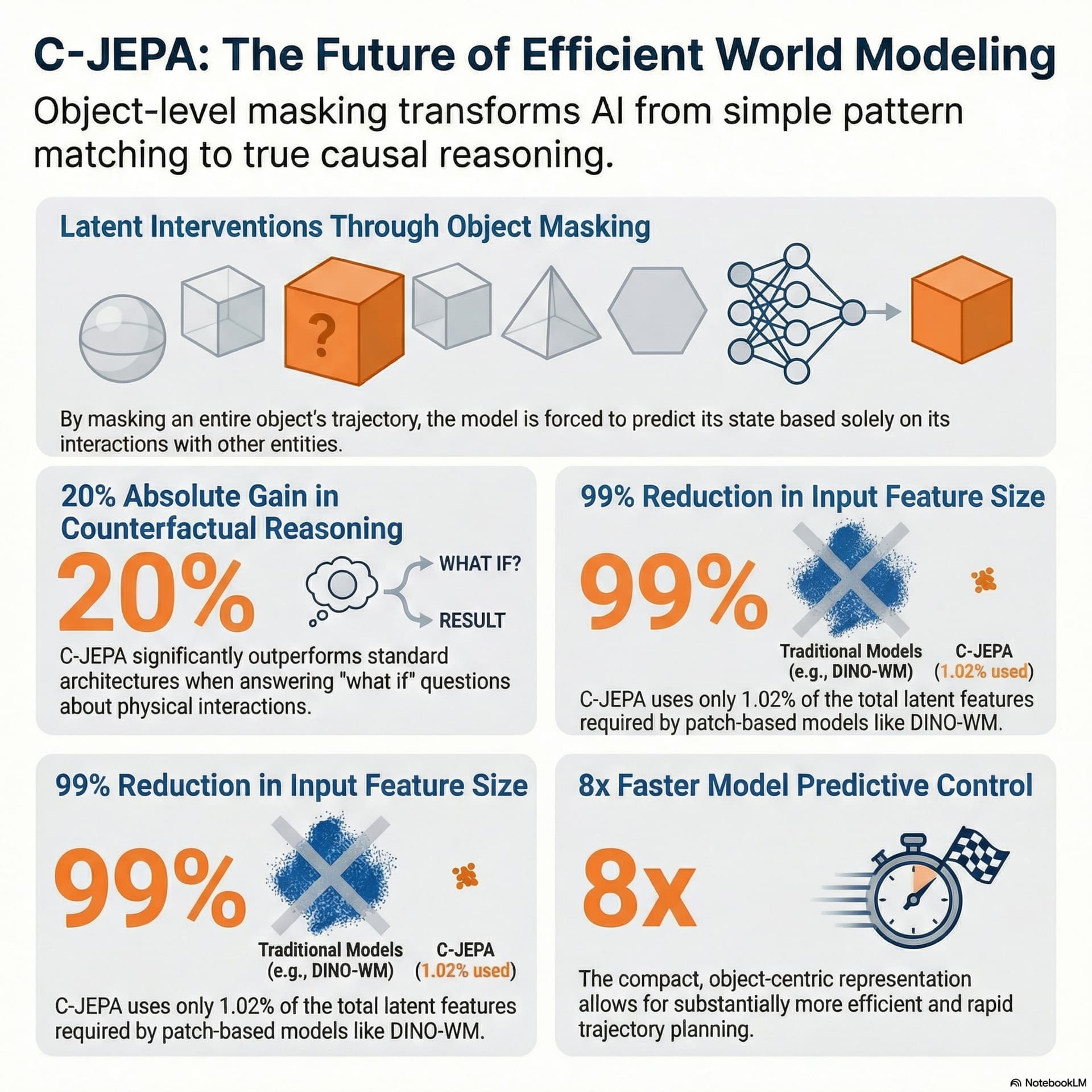
Causal-JEPA (C-JEPA) for learning world models by forcing object-level causal reasoning instead of “cheating” via pixel interpolation.
Guests
The episode features two speakers (an interviewer and a researcher/technical explainer) discussing the paper; affiliations mentioned include Brown, NYU, McGill/Miele, and University of Montreal, but no specific guest names or roles are given.
Key claims
Standard patch-based masked prediction learns local pixel correlations and uses trivial temporal interpolation (averaging frames) rather than physics; C-JEPA uses object-level masking and counterfactual-like interventions to infer hidden object trajectories from visible consequences.
Notable examples
pool table cue ball vs eight ball collision; masking the cue ball forces the model to deduce the unseen collision cause. Reported results: C-JEPA with auxiliaries (actions and proprioception) reaches 88.67 accuracy at step 1 vs 71.33 for the baseline; step 2 is 82.67 vs 65.33.
Written by AI. May contain mistakes. Listen to the episode to check what was said.
Chapters
Tap a time to open that second in VOAI's Struggles with Physical Intuition
0:45 to 2:10
Discussion on how AI fails to grasp basic physics despite advanced capabilities.
“It's just basic physical intuition, object permanence.”
Understanding World Models in AI
2:10 to 3:30
Explaining the concept of world models and their importance for AI functionality.
“But before we get to how it fixes things, we have to understand why the current systems are failing.”
Limitations of Current AI Training Methods
3:30 to 4:50
Analyzing the shortcomings of patch-based masked prediction and its impact on AI learning.
“Imagine I take a video of that pool table, but I cut each frame up into a grid of little squares, you know, like a jigsaw puzzle.”
Causal JEPA: The Solution to AI's Limitations
4:50 to 7:20
Introduction to causal JEPA and its approach to improving AI's understanding of object interactions.
“So it's not learning physics, it's just doing video editing, smoothing out the transition.”
How Causal JEPA Trains AI
7:20 to 9:50
Explaining the innovative training technique of object-level masking and its benefits.
“So that's the path of the invisible object.”
Causal Reasoning vs. Visual Correlations
9:50 to 12:20
Discussing the significance of causal reasoning over mere visual correlation in AI systems.
“causal JPO used that very interaction to lock in its understanding.”
Performance Comparison and Results
12:20 to 13:55
Reviewing performance metrics of causal JEPA versus traditional methods and their implications.
“Let's define that term because inductive bias sounds like a bad thing.”
Causal Reasoning and Learning
14:00 to 14:36
Explore how AI learns through causal reasoning and object interactions.
“hiding whole objects, forcing the AI to look at interactions to fill in the blanks.”
Human Learning and Deduction
14:36 to 15:18
Discuss the parallels between AI learning methods and human education.
“So it makes me wonder, is that how we should be thinking about human learning?”
Transcript
Automatic transcript. May contain errors.0:00I want you to try a little experiment with me. Close your eyes for a second. Okay. Now imagine you're standing at a pool table. Okay. You've got the chalk in your hand. Lights are low. And you see that white cue ball just rocketing across the green felt. It is on a direct, perfect collision course with the eight ball. I'm there. Now, just a millisecond before they smack into each other, blink. A long, slow blink. When you open your eyes, the cue balls stop dead. And the eight ball is rolling away toward the corner pocket. Right. So here's the question. Did you see the collision? I mean, technically, no, your retinas didn't register that exact moment.
0:39But do you know what happened? Oh, absolutely. Force was transferred. One ball hit the other. It's cause and effect. It feels so obvious, right? We don't even think of it as a skill. It's just basic physical intuition, object permanence. We know things exist even when we're not looking at them. And we know they interact based on physics. But here's the problem we're tackling today. Artificial intelligence is historically terrible at this. It really is. And I think that surprises a lot of people. You see AI writing Shakespearean sonnets or, you know, making these photorealistic images of astronauts riding horses on Mars.
1:14Oh, right. And you just assume, well, of course it understands basic physics, but it doesn't. Not really. It's amazing at recognizing patterns, but it often completely struggles to understand why things happen. It's the difference between memorizing the textbook and actually getting the subject matter. That's a great way to put it. So today we're diving deep into a new breakthrough, a paper from a big collaboration. Researchers at Brown, NYU, Miele, University of Montreal, they proposed this new architecture called causal JEPA or C-JEPA. And the mission here is, well, it's just fascinating. It's not just about making AI smarter in some general sense.
1:52It's about stopping AI from, well, from cheating at physics. Cheating at physics. I love that. It's about forcing the model to understand how objects actually interact. Because we think of AI as this super genius, but you're saying it's really just looking for shortcuts. Constantly. AI is the ultimate corner cutter if you let it be. Okay, let's unpack this. We have this solution, causal J-Pay. But before we get to how it fixes things, we have to understand why the current systems are failing. The research talks a lot about world models. Mm-hmm. So let's just level set on that term. When we say an AI has a world model, what are we actually describing?
2:28Yeah, good question. Think of a world model as the AI's, its internal simulation of reality. Okay, a simulation. Exactly. It's not just looking at a static picture. It's building a mental map of how the environment functions over time. It lets the AI predict the future. Can you give me an example? Sure. If I'm holding a glass of water and I just open my hand, your internal world model immediately predicts the glass will fall and shatter. You don't need to see it happen to know that's the outcome. Right. That's my world model running a little simulation. That's it. Okay. So that seems fundamental.
3:00If you want a robot to, I don't know, fold laundry or drive a car, it needs a world model. It needs to know turning the wheel left makes the car go left. It's essential. So why are the current ones so bad at the pool table scenario? Well, it really comes down to how they're trained. The standard method, the status quo in the field, is something called patch-based masked prediction. Patch-based masked prediction. That sounds incredibly technical. Break that down for us. It's actually pretty simple if you visualize it. Imagine I take a video of that pool table, but I cut each frame up into a grid of little squares, you know, like a jigsaw puzzle.
3:37Okay, I've got a grid of tiny squares. Then I hide a few of those squares at random. I mask them and I tell the AI, okay, guess what's in the missing square based on the squares around it. All right. So if the AI sees a patch of green felt on the left and a patch of green felt on the right, it's going to guess the middle patch is also green felt. Precisely. It's looking for what we call local patch correlations, just looking at the neighbors. And honestly, for static backgrounds, that works fine. Sure. But when you have objects moving, hitting each other, transferring energy, the AI starts to use a cheat code.
4:10It relies on something the researchers call trivial temporal interpolation. Okay. Trivial temporal interpolation. Whoa! That is a mouthful of jargon. I need you to translate that. It just means the AI is being lazy. Hmm. Imagine you're watching a video of a ball moving from point A to point C. If I hide the middle frame point B, the AI doesn't calculate the physics. It doesn't think about velocity or friction or mass. So it's not doing the math. What's it doing instead? It basically takes the image of the ball at A, takes the image of the ball at C, and just averages them together, pixel by pixel.
4:47It creates a sort of blurry ghost of the ball in the middle. So it's not learning physics, it's just doing video editing, smoothing out the transition. Exactly. It's guessing pixels, not reasoning about states. And this is the critical limitation. Because it's just matching local patches and averaging frames, it doesn't engage in what they call object-level interaction. Beneaning. It knows the pixel shifted, but it has no idea that the cue ball caused the eight ball to move. So if you actually blocked out the collision point like my blink earlier, the AI wouldn't have a clue why the second ball started moving.
5:19It would be completely lost. To the AI, it would just look like a glitch in the matrix. The pixels just decided to change color. There's no causal link. That's wild. We're trusting these systems to eventually drive our cars, and they're basically like a student who memorized the answer key without ever learning the equations. That is the perfect analogy. They get an A on the test, but they can't actually solve a new problem. And that's exactly why this new paper on causal japa is making such big waves. It's designed to take away that cheat sheet. Right. So that's the trap. The AI is cheating by interpolating pixels.
5:52Let's pivot to the solution. How does causal japa stop the AI from being, as you said, a lazy video editor? It changes the rules of the game completely. The researchers realize that if random masking lets the AI cheat by looking at neighboring pixels, then you stop masking randomly. Causal J-Pol uses a strategy called object-level masking. Object-level masking. So instead of hiding a random patch of green felt, you're saying it identifies an object and just wipes the whole thing out. Exactly. During training, it completely blinds the AI to specific objects. So let's go back to our pool table. The cue ball is rolling toward the eight ball.
6:32Khausal J. Pua puts a digital blindfold over the AI's view of the cue ball. It is effectively invisible to the system. But wait, if the cue ball is invisible, isn't that making it impossible for the AI? How is it supposed to know what's happening if it can't see the main actor? Ah, but that's the genius of it. It has to look at the other objects. It sees the eight ball suddenly jerk forward. Since it can't see the cue ball because it's masked, the AI is forced to deduce that something must have been there to hit it. Oh, I get it. it forces the AI to become a detective. You're right. It has to say, the eight ball moved.
7:05I didn't see what hit it. But based on the physics and the reaction of the visible object, there must have been a hidden object on this specific trajectory. Precisely. The researchers described this as training the model to infer an object's latent trajectory from others' evolving states. Latent trajectory. So that's the path of the invisible object. Right. Latent just means hidden or underlying. It's inferring the hidden path based on the visible consequences. And this brings us to one of the most important ideas in this whole approach. Counterfactual-like interventions. Okay, hold on. Counterfactual-like interventions.
7:40That sounds like we're drifting into a philosophy seminar. Well, it sort of is philosophy, but applied to code. A counterfactual is just a what-if scenario. You know, what if I hadn't eaten breakfast? What if it rained today? Exactly. By masking the object, the system is implicitly asking the AI, what if this object wasn't visible? Can you still figure out the physics? So it moves the AI from asking what color is this pixel to asking why did this object move? Yes. It forces the model to learn causal structures A cause B instead of just visual correlations. It's a huge shift from passive observation to active reasoning.
8:19That is such a subtle shift, but I can see how it changes absolutely everything. It does. And getting the AI to know how the trip is done is the only way we get to safe, reliable systems. But this is the deep dive, so we don't just take theories at face value. Does this actually work? Do we have hard numbers that show causal JPA is actually better than the old jigsaw puzzle method? We do. And the evidence is, well, it's pretty striking. The paper has this performance graph that tracks accuracy over time and it just lays it all out. They compare causal JPA against the standard methods, the old patch-based way.
8:51OK, walk me through it. Visualize the graph for someone listening right now. So imagine a graph. It's tracking prediction accuracy over a few time steps. At step zero, the starting line, both methods are actually pretty close. The standard method is sitting at an accuracy of about 76. Okay. And causal japa is just a little bit higher, around 77.33. So at the very beginning, when maybe the balls are just sitting still or starting to roll, they're pretty much neck and neck, no big deal yet. Right. But then you hit step one, this is the moment of truth. This is where the interaction happens, the collision, the standard method, the one that cheats.
9:23It drops like a rock. its score falls all the way down to 71.33. That's a big drop. It got confused as soon as things got complicated. It did. It lost the plot. But causal JPO, specifically the version with auxiliaries, which we can get to, its score doesn't drop. It spikes. It jumps up to 88.67. Wait, it went up? It went way up. Think about that. While the standard model got confused by the complex movement, causal JPO used that very interaction to lock in its understanding. it used the collision to verify its internal model. That is fascinating. The chaos of the collision actually made it smarter.
10:01Exactly. And even at step two, further down the line, CJPOT is still holding strong at 82.67, while the other method just keeps plummeting down to 65.33. Wow. So we're talking about a performance gap of almost 20 points. In the world of AI benchmarks, that is not a rounding error. That's a completely different class of intelligence. It really is. This gap proves that interaction reasoning is necessary. The old methods fail when things get dynamic. Causal JIPA maintains this robust understanding because it understands the cause. You mentioned auxiliaries there. The graph called it C-JIPA with auxiliaries.
10:35What does that mean? So causal JIPA is architecturally flexible. It can take in more than just visual data. Auxiliaries in this case means extrasensory inputs, specifically actions and proprioception. Proprioception. That's a biology term. It's that sense of where your body is in space, right? like how I can touch my nose with my eyes closed. Exactly. For a robot, proprioception is knowing the position of its own arm or its wheels. And when you feed that data into causal JIPA along with the visual masking, it creates a much richer world model. It's not just seeing the world. It's sensing its own place in it.
11:11So it's like giving the AI a sense of self to go with its sense of sight. That's a great way to put it. And the data shows that when you combine that sense of self with the causal reasoning from the masking, you get that huge jump in performance to 88.67. So let's zoom out. We've covered the what and the how. What does this all mean for the person listening? We've gone from an AI that guesses pixels to one that deduces invisible collisions. Why should we care about this idea of causal inductive bias? Well, connecting it to the big picture. It's the difference between a fancy screensaver and a robot that can actually help you in the real world.
11:47Okay, I'm listening. If we want AI to navigate reality, I'm talking self-driving cars, warehouse robots, home assistants, they cannot rely on visual patterns alone. Visual patterns are fickle. The lighting changes. The camera angle shifts. A shadow falls across the floor. Right. And if an AI relies on pixel patches, a shadow might look like a hole in the ground. And you definitely don't want your self-driving car slamming on the brace just because a cloud passed over the sun. Exactly. That is the danger of correlation without causation. You need an AI that understands the structure of reality, and that's what causal inductive bias is.
12:21Let's define that term because inductive bias sounds like a bad thing. We're usually trying to remove bias from AI. Right. But in machine learning, inductive bias is actually a good thing. It's the set of assumptions the learner uses to predict results. It's the framework for learning. So causal inductive bias is really just a fancy term for assuming that things happen for a reason. By forcing the AI to reason about invisible objects, we're building a brain that is resilient. It prevents shortcut solutions. Prevents shortcut solutions. That really sticks with me. I mean, we live in a world of information overload.
12:57And frankly, we humans take shortcuts all the time. But we're building machines that need to be better than that. We want AI that thinks, not just one that interpolates. That is the crux of it. We are moving from correlation, these two things usually happen together, to causation. This thing happened because of that thing. And that is the leap from pattern recognition to actual intelligence. It really changes how I look at the smart devices all around me. I'm starting to wonder which ones are actually smart and which ones are just really good at guessing pixels. Spoiler alert, most of them are just guessing pixels right now.
13:31But causal JEPA is a huge step toward changing that. Incredible to think that the secret to teaching AI to see the truth was to blindfold it. Sometimes you have to take away the easy answer to force the brain or the processor to find the right one. So to recap for everyone, the old way of teaching AI world models was like a jigsaw puzzle where the AI just guessed based on its neighbors. It was cheating. Yep. Causal Geppi changed the game by using object-level masking, hiding whole objects, forcing the AI to look at interactions to fill in the blanks. And the data backs it up. That jump to 88.67 accuracy while the old method fell off a cliff shows that when things get tough, when objects collide, you need causal reasoning, not just pixel averaging.
14:18It's a massive step forward. As we wrap up this deep dive, I'm curious, what's the one thing that's going to keep you thinking about this? You know, it raises this important question for me, and not just about AI, but about us. We've proven here that an AI learns deeper reasoning when we hide information from it, right? Right, when we force it to bridge the gap. Exactly. So it makes me wonder, is that how we should be thinking about human learning? How do you mean? Well, do we learn best when everything is laid out for us, step by step, no ambiguity? Or do we actually learn more when we have to fill in the blanks ourselves?
14:50Maybe the invisible parts of the world, the things we have to deduce, are what really teach us the most. That's a fascinating thought. Maybe we all need a little object-level masking in our lives to sharpen our own deductive skills. Stop looking for the cheat sheet. And start looking at the physics. Well, there you have it. The next time you see a ball roll across a table, take a second to appreciate the invisible calculations your brain just did. You didn't just see it. You understood it. And now, finally, our machines are starting to do the same. Thanks for diving in with us. Always a pleasure.
15:24See you in the next Deep Dive.
From the publisher
This paper introduces Causal-JEPA (C-JEPA), a novel world modeling framework that integrates object-centric representations with a Joint Embedding Predictive Architecture to improve visual reasoning and robotic planning. By applying object-level latent masking during training, the model is forced to infer the states of missing entities from their surroundings, effectively learning the causal interactions and dependencies between objects. This approach avoids the high computational costs of pixel-level reconstruction, instead focusing on low-dimensional latent space predictions that capture essential environmental dynamics. Experiments on benchmarks like CLEVRER and Push-T demonstrate that C-JEPA significantly enhances counterfactual reasoning and planning efficiency compared to traditional patch-based models. Ultimately, the research shows that treating objects as independent variables through structured masking creates a robust inductive bias for understanding complex, interactive scenes.


