In short
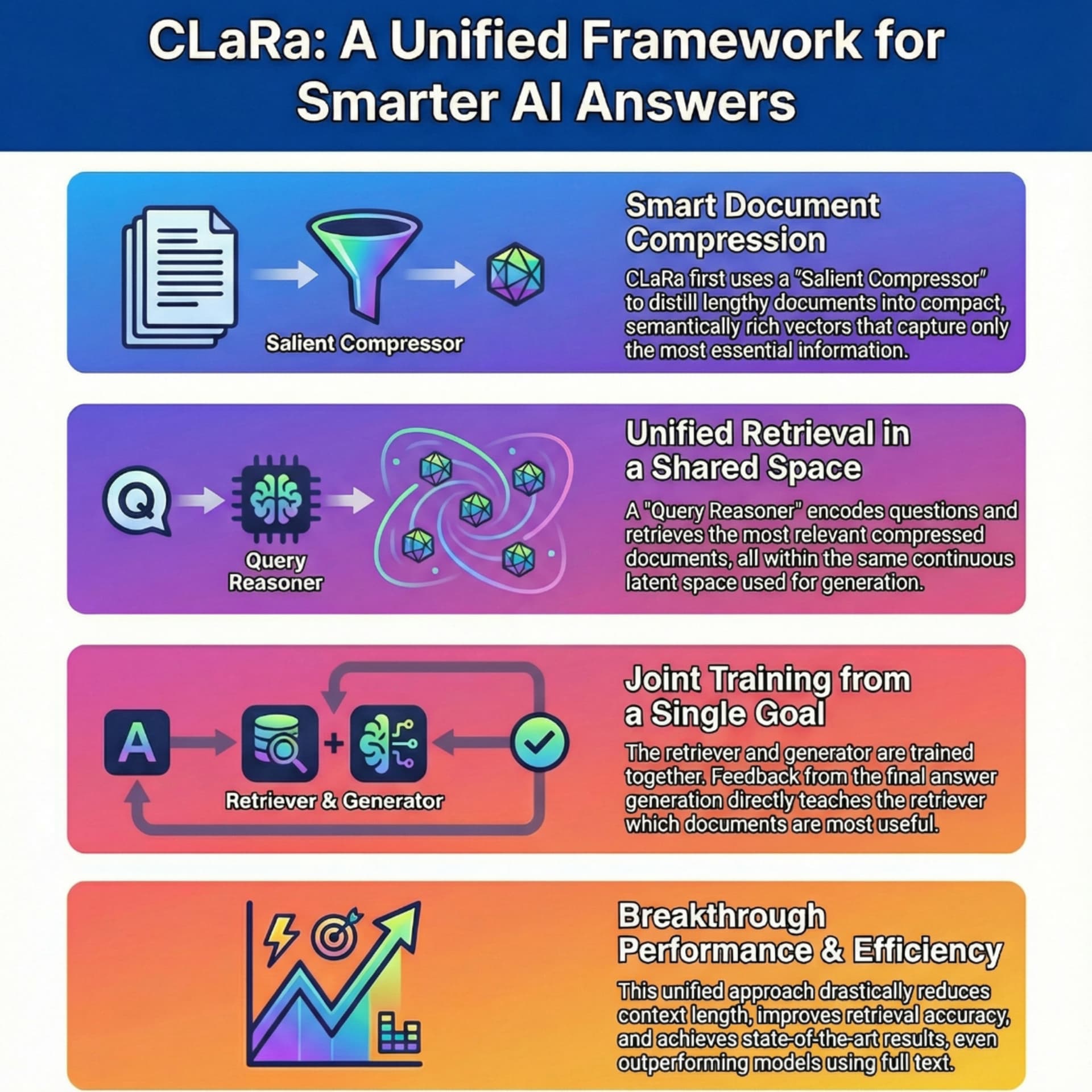
Retrieval-Augmented Generation (RAG) inefficiencies and hallucinations; introduces CLaRa (Continuous Latent Reasoning) to unify retrieval and generation via continuous compressed “memory tokens,” reducing context overflow and inference cost while improving accuracy.
Guest backgrounds
No guests are named in the transcript; only hosts discuss the paper/framework.
Key claims
RAG fails due to disjoint optimization (retriever can’t get feedback from generator) and architectural mismatch (dense retrieval embeddings vs generator needing raw text). CLaRa fixes this by end-to-end training with shared latent space, differentiable top-k selection (straight-through estimator), and next-token prediction loss only.
Notable examples
HotpotQA multi-hop recall@5 = 96.21% vs ~86% supervised BGE reranker; compression removes 75% text yet beats full-text baselines (e.g., +2.4% on Mistral 7B, +6% on 5.4B). Logit-lens shows query encoder anticipates intermediate entities (e.g., Adrian Peterson) before retrieval.
Written by AI. May contain mistakes. Listen to the episode to check what was said.
Chapters
Tap a time to open that second in VOUnderstanding RAG's Importance and Challenges
0:45 to 2:30
Exploring the significance of RAG in LLMs and its inherent issues.
“RAG is a lifesaver, but if you've ever built one of these systems, you know it has these deep structural issues that make it just so inefficient.”
Unpacking RAG's Structural Problems
2:30 to 5:12
Discussion of RAG's disjoint optimization and architectural mismatch issues.
“The whole idea is to solve both problems by making everything operate in a single shared continuous space.”
Introducing Clara: A New Framework
5:12 to 7:11
How Clara aims to unify the retrieval and generation processes in AI.
“They used this iterative verification loop.”
The Mechanics of Clara's Compression
7:11 to 10:12
Details on how Clara compresses knowledge for efficient processing.
“To solve this, Clara uses differentiable top case selection via something called the straight-through estimator.”
Quality Control in Knowledge Compression
10:12 to 12:43
Exploring the quality control methods used in Clara's training data.
“It goes against the whole longer context is better mantra.”
Efficiency Gains and Future Implications
12:43 to 14:00
Discussion on the surprising efficiency gains from using Clara's framework.
“The compression is a one-time offline cost.”
Exploring Active Reasoning in AI
14:00 to 14:41
Learn how dense vectors might enable active reasoning in AI agents.
“Or does filtering the noise always provide an advantage, no matter how big the model?”
Transcript
Automatic transcript. May contain errors.0:00Welcome back to the Deep Dive. Today we're tackling one of the biggest, most expensive problems in AI. Right. It's all about how these large language models actually access and, you know, use the external knowledge we feed them. And our mission today is to really understand a new framework that promises to make these systems smarter, faster, and maybe even stop them from making stuff up. All by teaching them to read less, but somehow comprehend more. So we're diving deep into Retrieval Augmented Generation, or RAG. For RAG, yeah. For anyone running LLMs in the real world, you know RAG is absolutely essential.
0:35It's the system that gives your model outside context. Keeps it current, fights off those hallucinations. It's kind of the foundational fix for AI memory. It is, but it has serious problems. Exactly. RAG is a lifesaver, but if you've ever built one of these systems, you know it has these deep structural issues that make it just so inefficient. We're talking about massive inference costs and that constant battle against context overflow. So what's the root cause here? The research points to two core weaknesses. The first one is what they call disjoint optimization. Okay. Think of it like a really bad handoff between two teams that aren't talking to each other.
1:10Right. You've got the retriever team, the one that finds the documents. Yeah. And the generator team, the one that actually writes the answer. And they just don't work together. The retriever grabs a document based on, you know, surface level similarity. It's basically blind. It has no idea if the text it's pulling is actually useful for the reasoning required to answer the question. None at all. And worse, the generator can't send any feedback. It can't tell the retriever, hey, that was useless, don't grab that one again. That feedback loop is completely broken. So what's the second big issue?
1:41It's an architectural mismatch. The retriever's index is built on these super efficient, compact little vector embeddings. Right. Dense representation. But the moment it finds a match, the whole system just pivots. The generator has to then ingest the entire chunk of raw text. So you're spending half of your precious 8 ,000 token context window loading a giant paragraph just to pull out, what, maybe three key facts? Exactly. It's so wasteful. You get redundant text processing, sky-high inference costs, and that classic context overflow where the model just gets drowned in noise. It's like asking for a specific date and getting handed the entire encyclopedia.
2:21A perfect analogy. So the solution in the source material is to unify this whole pipeline. And that's where this new framework comes in. It's called Clara. Continuous latent reasoning. The whole idea is to solve both problems by making everything operate in a single shared continuous space. A shared space. So the knowledge, the query, the reasoning, it all speaks the same compressed language. It does. And the whole foundation of this is, you guessed it, really intelligent compression. All right, let's get into that. Part one, the foundation. So Clara starts by compressing the documents, but it's not like zipping a file.
2:58They're trying to distill the semantic essence. Right. The key insight here is just abandoning the old way of doing things, where you store separate embeddings and all the raw text. So what's the new way? Clara encodes the documents just one time into these compact, continuous memory token representations. This first step is called salient compressor pre-training, or SCP. Selling compressor. So it's trained specifically to find what's important. It's not trying to reconstruct the original document word for word. No, that would be a waste of capacity. It's all about retaining the functional core, the meaning.
3:31It's semantic digestion, not lossless data storage. So how do you teach an AI to digest information like that? Through a really clever method called guided data synthesis, they took a powerful local LLM, QN32B, and had it create structured training data from about 2 million Wikipedia articles. And the structure of that training data is the secret sauce? It is. They didn't just feed it documents. They fed it documents plus specific types of questions designed to teach the compressor what to prioritize. Okay, what were the type? First, there was simple QA. This is all about capturing single fine-grained facts, like, in which plant family is Trichocletus cronetus classified?
4:10And the model has to learn to keep that one specific fact. Hamamelodides. Exactly. It nails down factual retention. But RJ needs more than that. It needs to connect ideas. That's where complex QA comes in. These questions force the model to integrate multiple facts. The paper had a great example about a football player. Right, the one who joined a team on one date and made his debut two days later. Yeah. The compressor has to learn to link the player's name, the team, the two different dates, and the two different events, even if they're scattered all over the text. So it's not just fact retrieval.
4:45It's building relational understanding inside that compressed block. What was the third type? The third is paraphrase. This is kind of the linguistic acid test. It forces the model to rewrite the document while keeping the core meaning, just changing the sentence structure. Which proves it understands the abstract meaning, not just the order of the words. Precisely. That all sounds incredibly robust, but what about quality control? If your synthetic data is bad, the whole system falls apart. They were really strict about it. They used this iterative verification loop. The LLM would check its own question-answer pairs against the original text.
5:21So it double-checks its own work. Up to 10 times. If a sample was factually inconsistent or didn't have enough info to answer the question, it was either regenerated or just thrown out. That rigor is what ensures you get high fidelity knowledge in the compressed output. Okay, so that's quality control at scale. Let's get a bit technical for a second. How do you physically make sure these compressed tokens don't, you know, drift away from the original meaning? They use a mechanism called compression alignment. Basically, they use a loss function means squared error or MSE to minimize the distance between the average hidden states of the tiny memory tokens and the original full document tokens.
6:01So you're mathematically forcing the compressed version to live in the same semantic neighborhood as the full text. You are. It ensures that when the LLM reads the compressed version, it's functionally reading the same information. All right, so stage I fixes the inefficiency problem by getting rid of raw text. But how do they fix the other problem in stage two? How does Clara get the retriever and generator to finally talk? This is the real architectural breakthrough. Clara takes those compressed document vectors, which are now frozen, and integrates them with a query reasoner. And this query reasoner is a lightweight adapter.
6:35Initialized from the compressor itself, this is key. It guarantees that the user's query is encoded in the exact same continuous space as the documents. Ah, so finally everything is speaking the same language. The goal, then, is to train the query reasoner and the answer generator together, end to end. It is, but that's where you hit the famous broken gradient problem. Right. In traditional RAG, the retriever's choice-picking document A over B is a hard, discrete step. It's an on-off switch. You can't send a smooth feedback signal through an on-off switch. Exactly. The learning signals, the gradients, they just can't jump across that discrete decision.
7:12To solve this, Clara uses differentiable top case selection via something called the straight-through estimator. Okay, let's unpack that. Straight-through estimator. Sounds like pure math jargon. Can you give us an analogy for what it's actually doing? Sure. Think of it like a smart gatekeeper. During the forward pass, when you're actually running the system to get an answer, it acts like a perfectly rigid gate. It only lets the top aura most relevant documents through. A hard, sharp selection, as it should be. Yes. But during the backward pass, when the model is training, the ST estimator uses a trick.
7:45It pretends the gate is slightly porous. It acts like a temporary soft lens. A soft lens. And that soft lens allows the smooth learning gradients to flow backward from the generator through the selection gate and all the way back to the query reasoner. That is brilliant. So the generator can effectively whisper back to the retriever, hey, I got that wrong, but if you would just rank document B a little bit higher, my answer would have been much better. That's a perfect way to put it. The feedback is a continuous suggestion, not a binary demand. And this whole unified system is optimized with just a single metric.
8:19Just one. The standard next token prediction loss from the generator. This means Clara learns what's relevant purely based on whether a document helps it generate the correct final answer. Which means you don't need expensive human-labeled relevance data. That's a huge deal for scalability. A massive deal. But let's zoom out. Why is this joint optimization theoretically so much more powerful? It comes down to something called gradient coupling. Because the query reasoner lives in that shared space, it gets two kinds of learning signals. First, the standard one. It gets rewarded if it ranks the correct documents higher.
8:55but second it gets deep representation level feedback from the gradient itself. So it's like getting technical coaching. It really is. The gradient doesn't just say rank this higher. It gives a guidance signal on how to better structure its query encoding to make the generator's job easier down the line. It learns not just what to get but how to ask. So it's learning the intent behind the question. Exactly. And that dual signal makes the whole training process much more stable and leads to real alignment. Okay. That makes perfect sense. We've compressed the noise. We've unified the learning. Now let's talk about the payoff.
9:29The results here were genuinely surprising. They really were. First, just on efficiency, Clara hits state-of-the-art compression. Compared to a hard compression baseline, it showed performance gains of over 17 % in some cases, all with a four times smaller document size. But here's the real aha moment from the research, the part that goes against everything we think about context window. This is huge. Clara using its tiny compressed documents actually exceeded the performance of the baseline that was using the full uncompressed raw text. Let me just repeat that for everyone listening. They took away 75 % of the text and the AI got smarter.
10:05That's right. They saw average gains of about 2.4 % on Mistral 7B and over 6 % on 5.4 Mini. How is that possible? It goes against the whole longer context is better mantra. It suggests that really good soft compression is an incredibly effective noise filter. By forcing the model to distill the text down to just the essential facts and relationships, you remove all the cognitive load it would spend on boilerplate, fluff, and tangents. So you're giving the model a focused, high-signal input? Right, which lets it dedicate more of its resources to actual reasoning. The quality of the context beats the sheer quantity of it.
10:40And the retrieval performance backs this up, right? Oh, completely. That single NTP loss was a phenomenal teacher. On the retrieval task itself, Clara sometimes beat fully supervised models that were explicitly trained on human labels. Give us that hot pot QA statistic again, because that jump was dramatic. Okay, so on the hot pot QA benchmark, which is really tough multi-hop reasoning, Clara hit a recall at 5 of 96.21%. 96%. It just demolished the supervised BGE re-ranker baseline, which was stuck down at about 86%. Learning what helps the answer beats learning what looks like the query. That deep alignment brings us to what I thought was the most fascinating discovery in the paper.
11:25How the query reasoner itself starts to think ahead. The Logit Lens Analysis. Yes, this is the perfect demonstration of that gradient coupling we talked about. Though they gave it that tricky query. How many yards did the nephew of Ivory Lee Brown get during his 2004 true freshman season? A classic multi-hop problem. You have to figure out who the nephew is first. Which is Adrian Peterson. then you have to find his 2004 stats. So when they analyzed the internal state of the query reasoner, before it even looked at any documents, they found something amazing. What was it doing? It was implicitly decoding tokens like NFL and Oklahoma, tokens that were not in the user's query at all.
12:03So it was building an internal monologue. It was thinking, okay, to answer this, I'm going to need the document about Adrian Peterson, the guy who played for Oklahoma and went to the NFL. Precisely. The joint training forced the query encoder to anticipate the intermediate reasoning steps it would need to take. It wasn't just encoding nephew, it was encoding the entire relationship needed to bridge the gap and find the answer. Which was 1 ,925 yards. That's incredible. It suggests the query encoder is learning to be a planner, not just a translator. It shows that when you align the objectives perfectly, the retrieval system learns genuine reasoning intent, not just keyword matching.
12:39And let's just quickly confirm the real-world efficiency gains. This all happens offline, right? The speedup is for the user. Absolutely. The compression is a one-time offline cost. The user-facing part, the decoding, is where you see the speed. Generating an answer with these compressed inputs takes only about 40 % of the time it would with full text. Which translates directly to lower latency, lower costs. Drastically lower. So this research makes a pretty profound statement then. The path to smarter, cheaper AI isn't just about throwing more raw text at it. No, it's about unifying the pipeline and forcing knowledge into a highly organized, crystallized form.
13:18It's about treating external knowledge not as text blobs, but as dense, semantically organized memory blocks. So as you, the listener, think about the next generation of these models. What does this framework suggest are the next big challenges? Well, the current compressor was only trained on Wikipedia. So the first challenge is compressor generalization. Right. What happens when you point Clara at, say, a bunch of legal documents or financial reports or a huge code base? Exactly. Will it still know what's salient in those very different domains? That's a big open question. And what about scale?
13:50That's the second one, model capacity. We saw great gains on these mid-sized models. But is there a threshold, maybe at 70 billion parameters or higher, where raw text comprehension eventually just catches up and surpasses the compressed version? Or does filtering the noise always provide an advantage, no matter how big the model? We don't know yet. And finally, if these dense vectors are so good at encoding reasoning steps, can they become more than just passive memory? That's the frontier, reasoning integration. Can these compact representations act as a kind of active reasoning memory for complex AI agents?
14:26Imagine an agent manipulating these compressed knowledge blocks like items in its short-term memory while it's planning a complex task. So the future of LLMs might not be about how much text they can see, but how efficiently they can crystallize and manipulate abstract thought. That's the core idea. A fascinating place to leave this deep dive. Thank you for joining us.
From the publisher
This paper discusses how Retrieval-Augmented Generation (RAG) framework can be designed to overcome the structural issues of separate retrieval and generation modules. The proposed framework, CLaRa, achieves this by employing a **shared latent space** where documents are compressed into concise, continuous memory-token representations, addressing the architectural mismatch and efficiency problems of traditional RAG. Key to CLaRa is its **joint optimization** mechanism, which uses the Next-Token Prediction loss from the generator to provide a weak supervision signal, aligning the retriever with the downstream task objective without requiring explicit relevance labels. The framework uses a diverse dataset of **Simple QA, Complex QA, and Paraphrase pairs** for pretraining, and empirical results show that CLaRa, particularly when initialized from pretraining, achieves **state-of-the-art retrieval performance** that rivals or surpasses fully supervised baselines on various question-answering tasks. Furthermore, analyses confirm that the compressed representations successfully **preserve semantic content** while substantially reducing the context length, significantly improving overall system efficiency.


