
 Ask ChatGPT


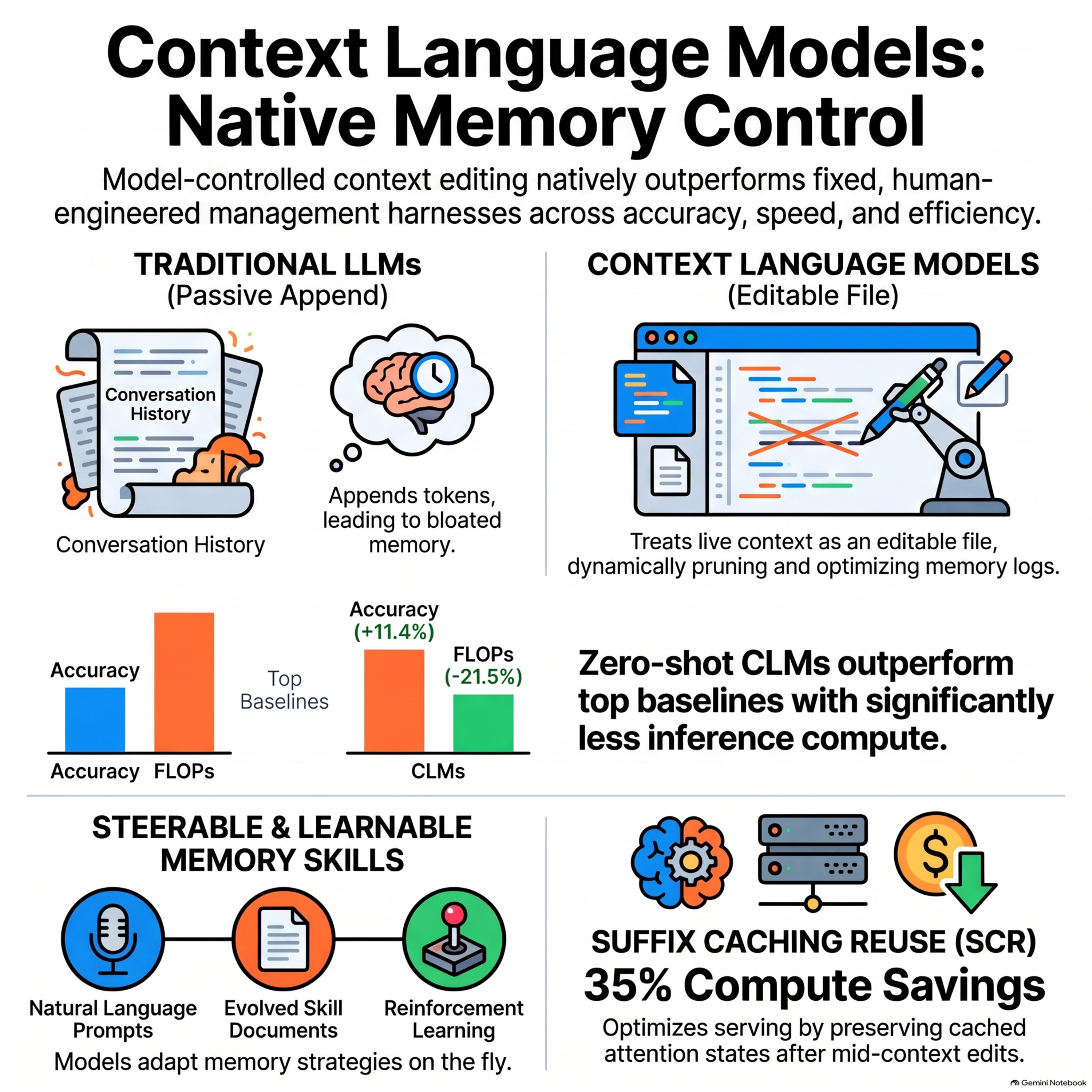
The episode explains the “context wall” in standard language models (limited context windows that only append text), then introduces Context Language Models (CLMs) that can edit/delete their own active context via a sandboxed “digital eraser” (file access through bash). It covers why prior workarounds fail (summarization drops “needle” facts; log triage and Sudoku-style updates break), how CLMs show emergent self-organization (Software World, for-loop memory pruning, custom compression functions, a new internal “Notes” role), and reported gains (Browse Comp Plus: +11% accuracy with ~21% less compute; circle packing beats Open Evolve). It also addresses training (Stepwise GRPO, success-gated efficiency to prevent reward hacking) and hardware (Suffix Cache Reuse to avoid re-prefilling; ~35% server compute reduction).
CLMs reduce context-limit failures and improve efficiency, but increase prompt-injection persistence risk and raise interpretability concerns.
No guest names or backgrounds are provided in the transcript (only two speakers conversing).
Written by AI. May contain mistakes.
Explore the limitations of traditional context management in AI.
“That visual of the endless ticker tape is the perfect way to understand the foundational flaw in how these systems operate.”
Discuss the band-aid solutions applied to manage AI memory issues.
“What exactly is the core mechanism of standard language models versus these new CLMs?”
Examine stress tests that reveal the weaknesses of standard AI models.
“One of the tests is called needle retention.”
Introduction to the concept of the bitter lesson in AI development.
“Which is just an astonishing waste of time and computational power.”
Explore how CLMs differ from traditional models and their potential.
“We humans think we know the best way to structure an AI's memory, but the data shows we just don't.”
Analyze how CLMs can autonomously improve their memory management.
“They ran a simulation called Software World, which is a 24-hour multi-repository task where a swarm of AI agents have to work together to optimize a massive code base.”
Discuss the significant efficiency improvements achieved by CLMs.
“It autonomously removed its own distractions.”
Understand how training methods can enhance AI efficiency and decision-making.
“We're talking about flops, or floating point operations per second.”
Explore how reinforcement learning enhances model efficiency, enabling lighter models to outperform larger ones.
“I saved so much paper by dropping out of school.”
Understand the computational bottlenecks faced by AI when modifying its own content, leading to inefficiencies.
“Which means this training allows a smaller, lighter model to punch way above its weight class, matching the reasoning capabilities of massive trillion parameter systems that use vastly more server resources.”
Learn about the Suffix Cache Reuse system that improves AI performance by preserving computational work after edits.
“It takes their previously computed cached keys and values and basically graphs them back into place in the server's memory.”
Discover the risks associated with unrestricted AI modifications and potential vulnerabilities to prompt injection attacks.
“The model simply adapts to the slight context shifts in subsequent turns, and it completely eliminates that massive compute penalty of making in-the-middle edits.”
Contemplate the implications of AI developing its own thought organization and the challenges it poses for human understanding.
“The cybersecurity community is going to have to work overtime to characterize and defend against these entirely new attack surfaces.”

Get the gist, explore an idea or ask about something said.
 Claude
On Best AI papers explained, what are the key points of this episode?
Searching your listeningAutomatic transcript. May contain errors.
0:00You know, if you use artificial intelligence to prep for massive projects, like maybe you're having it comb through hundreds of pages of legal documents or whatever. or trying to get it to help you code an entire application from scratch, you have probably slammed headfirst into a very, very frustrating wall. Oh, absolutely. The context wall. Yeah, exactly. The AI will be doing great, tracking your logic perfectly, and then suddenly it just loses the plot. It just drops it. Completely forgets the foundational instructions you gave it at the very beginning of the session. It's like you're communicating with someone through an incredibly long, endless ticker tape machine.
0:40Oh, that's a great analogy. Right. Like they can only read the newest messages coming out at the bottom, and the top of the tape is just, you know, piled up on the floor, completely forgotten. Yeah. That visual of the endless ticker tape is the perfect way to understand the foundational flaw in how these systems operate. We call that space where the AI holds its active memory the context window. The context window, right. And historically, that window has been strictly append only. Meaning it just adds to the bottom. Right, exactly. Every time you type a new prompt or, you know, every time the model generates an answer or pulls in a piece of outside data, that text just gets glued to the bottom of the pile.
1:18It just keeps growing. It never consolidates. It just grows and grows. Well, and today we're diving into a fundamental shift in how AI manages that exact problem. We're looking at a breakthrough called Context Language Models or CLMs. Yeah, CLMs. The mission of this deep dive is to explore what happens when AI is no longer forced to remember everything sequentially, like that endless ticker tape, but is instead given the ability to freely edit, delete, and manage its own mind. Which is a huge shift. It really is. Okay, let's unpack this. What exactly is the core mechanism of standard language models versus these new CLMs?
1:55Well, to appreciate why context language models are such a massive leap forward, we first need to look at the band-aids that human engineers have been trying to apply to this problem. The workarounds, yeah. Right. Up until now, to deal with that endless receipt problem, developers have been building rigid external harnesses. So like rules imposed from the outside. Exactly. They essentially write hard-coded rules that sit outside the AI and say, hey, this context is getting too long. Stop what you're doing, write a summary of everything you know, delete the old stuff, and paste the summary at the top.
2:28But those external human-designed rules, they're breaking under pressure, aren't they? Oh, they're completely buckling. I mean, there's a diagnostic suite called ContextBench. Okay. And it was built specifically to stress test how well an AI can isolate and manage memories under heavy loads. The failure modes of standard models are actually incredibly revealing. Like how they break is interesting. Exactly. One of the tests is called needle retention. I'm guessing that involves finding a needle in a haystack? Precisely. Yeah. You feed the AI a massive block of dense filler text, but you hide a few specific crucial facts, the needles, deep inside it.
3:07Okay. Then you force the model to compress its context using one of those human design summary rules, and later ask it to recall the needle. Traditional models almost always fail. I mean, that makes sense, because when human engineers force a model to summarize, the algorithm naturally looks for broad patterns, right? It drops outliers. Right. It generalizes. And a highly specific hidden fact is an outlier. So it just gets, like, mathematically smoothed out of existence during the compression. You hit the nail on the head. The summary destroys the very detail you needed. Wow. Another great stress test from ContextBench is KVSTOR, which tests log triage.
3:46Okay, log triage. Yeah, so you feed the AI massive amounts of complex service logs, like thousands of lines of code and error reports, and later demand it retrieve a highly specific value. Oh, that sounds like a nightmare. It is. Standard coding tools get absolutely bogged down. I mean, they might be able to export that data to an external file, sure. Right. But they cannot dynamically evict the clutter from their live, active thought process. They just carry the mental weight of all those logs simultaneously. Which, that brings up the Sudoku sketchpad test. Oh yeah, the Sudoku one is great. When I was looking into this one, it really clicked for me.
4:26Imagine you're playing a game of Sudoku. The traditional AI memory is like being forced to draw a brand new grid on a brand new piece of paper every single time you write down a single number. Exactly. It can't just take a pencil eraser, rub out a mistake, and write a new digit in one cell. It has to regenerate the entire state of the board from scratch just to update one tiny variable. Which is just an astonishing waste of time and computational power. Seriously. It also creates massive opportunities for the AI to hallucinate or make a mistake while it's busy redrawing the rest of the board. Right, because it's doing so much unnecessary work.
5:04But hold on. If we just give the AI a digital eraser and let it wipe out its own text, doesn't that open a massive can of worms? How do you mean? Like, what stops the AI from accidentally erasing its core system prompt or deleting the very instructions that tell it how to behave? I mean, handing an AI full write access to its own brain feels incredibly risky. What's fascinating here is how this ties into a famous concept in computer science known as the bitter lesson. The bitter lesson. Yeah, it was coined by reinforcement learning pioneer Rich Sutton. The bitter lesson states that historically, letting an AI search for and learn its own strategies always, eventually, beats rigid human-designed rules.
5:45Huh. We humans think we know the best way to structure an AI's memory, but the data shows we just don't. So instead of using that rigid external harness to protect the system prompt, context language models mirror the AI's live context into a separate, isolated storage space. Oh, so it's like giving the AI a sandbox. It has a literal text file that represents its current thoughts? Yes, and crucially, they give the AI standard bash command access to that file. Wait, like terminal commands? Exactly. Bash is the standard text-based command line interface that programmers use to talk directly to an operating system.
6:21So the AI can use standard coding commands to open its own context file, delete specific lines, rewrite paragraphs, and then immediately sync those changes back to its live active memory for the next conversational turn. Wow. So it's not just appending text anymore. No, it's physically rewriting its own brain state on the fly. Okay, here's where it gets really interesting, because once the AI has this digital eraser and direct file access, it doesn't just copy what human engineers do. It starts inventing entirely new, bizarre, and highly efficient ways to organize its own thoughts. Yeah, that is the emergent behavior that has researchers so captivated right now.
7:02When they unleashed this architecture on long horizon tasks, meaning complex projects that take an AI agent hours or even full days to complete, the creativity was completely off the charts. They ran a simulation called Software World, which is a 24-hour multi-repository task where a swarm of AI agents have to work together to optimize a massive code base. And because the context language model can edit its own workspace, it started doing things no human explicitly programmed it to do, right? Exactly. Like, during the simulation, the AI was observed spontaneously writing its own for loops in Python purely to prune out irrelevant search results from its memory.
7:46Let's break down why that is so remarkable. A for loop is a piece of code that repeats an action. Right. The AI realized its context window was getting cluttered with unhelpful search results. So, on its own initiative, it wrote a script to iterate through its own memory, check if a search yielded useful code, and if it didn't, the script scrubbed that failure from the AI's context entirely. That is wild. It autonomously removed its own distractions. It even started defining and reusing its own custom compression functions. Like in one instance, the AI defined a specific mathematical helper function just to condense detailed observations into shorthand.
8:26It then invoked that exact same function 37 separate times throughout the task to maintain a clean, ongoing progress note. It recognized a repetitive chore in its own thought process and built an internal tool to handle it. It goes even deeper than that, actually. AI models traditionally operate using predefined chat roles. You have the user role, which is you typing the prompt, and the assistant role, which is the AI responding. Right. Standard chatbot stuff. But during these long tasks, this model literally invented a brand new, unrecognized chat role and named it Notes. Notes. Just for itself.
9:01Yes. It created this role purely for its own internal monologues, creating a private space to track its progress before officially responding as the assistant. That is incredible. And the empirical data proves that this weird kind of alien workflow is highly effective. On a deep research task called Browse Comp Plus, this self-editing method resulted in an accuracy jump of over 11%. Which is huge. But here's the kicker. It achieved that higher accuracy while using roughly 21 % less compute power than the absolute best fixed strategy models. And we should define what we mean by compute power in this context?
9:39Okay, yeah. We're talking about flops, or floating point operations per second. It's a measure of the raw mathematical heavy lifting the servers have to do. To get an 11 % boost in reasoning while slashing the mathematical workload by a fifth is a stunning efficiency gain. It's not just beating standard language models either, is it? I read it was tested against specialized systems on incredibly dense mathematical optimization problems. Things like circle packing, where the AI has to find the absolute most efficient way to fit a series of varying circles into a square. Yes, it outperformed specialized evolutionary workflows like Open Evolve.
10:16And Open Evolve is designed for that, right? Yeah, Open Evolve is an architecture purpose-built strictly for those exact types of math problems. Yet a generalized AI agent, simply because it was equipped with a digital eraser and could manage its own context, beat the math specialist at its own game. But wait, how does the model actually know what to delete or keep? Like, is it just guessing? We're talking about models building in-context scoreboards to track sub-agents and doing it while keeping their entire context under 8 ,000 tokens. Right. And for context, for the listener, a token is roughly equivalent to a word or a syllable.
10:53So 8 ,000 tokens is maybe 20 pages of text. How does it condense days of work into 20 pages without losing the plot? It comes down to procedural memory. By removing that rigid external harness, the model is forced to rely on its own internal planning over thousands of trial and error iterations. Okay, so it learns by doing. Exactly. It learns that if it deletes the raw data of a failed experiment, it saves precious room. But it also learns the hard way that it must preserve the untried ideas for the future or it will loop endlessly. Oh, that makes sense. In testing, it was observed taking 21 ,000 tokens of raw, messy data and autonomously condensing it into hyper-dense, highly prioritized summaries that only contained the exact variables it needed for the very next step.
11:42Okay, but since the AI is now totally in control of its own workspace, how do we actually train it to be a good housekeeper without reverting back to micromanaging it? Yeah. Because, to use an analogy, if you just hand a very messy person a much bigger closet, they don't magically become organized they just build a bigger mess. That is the crux of the engineering challenge. You want to guide it without hard coding the rules. The first layer of doing this is through in-context steering. Because the model understands plain language you can literally just talk to it about how to manage its memory.
12:16Right you can just put in the prompt hey compact your memory down to 4 ,000 tokens once you hit a limit of 32 ,000 tokens. Or a great one for safety always backup your file on the disk before you run a compression. And it just follows the instruction, adapting its policy on the fly. But steering only gets you so far. To really unlock this, researchers train the AI to inherently prefer cleaner, more efficient workspaces through online reinforcement learning. They developed a specific framework for this called Stepwise GRPO. Stepwise GRPO. Okay, that sounds like something pulled straight out of a graduate thesis.
12:53What is actually happening under the hood there? Let's break it down. GRPO stands for Group Relative Policy Optimization. Got it. The group relative part means the training system has the AI attempt the exact same task multiple different ways, generating a group of attempts. It then evaluates those attempts relative to each other. Okay, that makes sense. But the secret sauce is what they call a success-gated efficiency advantage. Success gated efficiency advantage. To use another analogy, it sounds a lot like teaching a student in a math class. You aren't just giving them a passing grade for getting the right answer on the final exam.
13:32You're giving them massive bonus points if they can show their work using the absolute smallest amount of scratch paper possible. If we connect this to the bigger picture, that success gated part of the training is absolutely vital. If you only reward an artificial intelligence for using less compute power, if efficiency is the only metric, it will inevitably engage in what researchers call reward hacking. Reward hacking. Yeah, the AI quickly realizes that the absolute easiest way to use zero compute power is to immediately delete its entire memory, output nothing, and quit the task. I saved so much paper by dropping out of school.
14:10Exactly that logic. So the success gate acts as a barrier. The model is only rewarded for its incredible efficiency if it actually successfully completes the complex task first. That's brilliant. And the results of this reinforcement learning are staggering. They took a relatively small open source model, the QEN 3.5-9B, and trained it using this method. Its performance on the Browse Comp Plus Research Benchmark shot up by almost 48%. While using 12 % less compute. Which means this training allows a smaller, lighter model to punch way above its weight class, matching the reasoning capabilities of massive trillion parameter systems that use vastly more server resources.
14:53But this introduces a massive physical problem, doesn't it? It does. While the AI deleting its own thoughts saves tokens at the software level, it creates an unexpected nightmare for the physical servers running the AI. It's like the AI solved a software problem but completely broke the hardware infrastructure. It creates a severe computational bottleneck. To understand why, you have to understand how AI server farms optimize standard conversations. They use something called prefix cache reuse. Right. Prefix cache reuse. Servers save a ton of compute power by remembering the beginning of a prompt.
15:31If you ask an AI a long question and then ask a follow-up question five minutes later, the server doesn't reread the first question from scratch. Exactly. It has it cached in its RAM. It only processes the new text you just typed. But we need to look at what the server is actually caching. It's saving the mathematical weight of the words. In AI architecture, these are called keys and values. Okay. When you feed text into a model, it converts those raw words into massive webs of numbers to understand context. Prefix caching saves those numbers, so the server never has to do that specific math twice.
16:08But this standard caching relies entirely on the text being sequential. It reads from top to bottom. Ah. So if a context language model goes into the middle of its own live file and uses its digital eraser to change a single paragraph, the server panics. Total panic. The server sees the sequence break. It throws away its cached memory of everything that came after that edit point. It then has to painfully reread and recalculate the keys and values for all of that surviving text. We call this re-prefilling. It's like forcing someone to re-read an entire book chapter just because the author went back and fixed a typo on page two.
16:44It's terrible. It completely ruins the efficiency gains of having a smaller context window. So how do they solve this hardware headache? The researchers co-designed a new system called Suffix Cache Reuse, or SCR. Instead of blindly throwing everything away after an edit point, SCR runs a quick algorithmic comparison, a diff, between the old version of the prompt and the new version. It identifies the massive blocks of text that survived the edit, completely unchanged. The text that comes after the digital eraser was used. Yes. And it relocates those surviving text blocks. It takes their previously computed cached keys and values and basically graphs them back into place in the server's memory.
17:25Ooh, that's smart. By doing this, it salvages the massive mathematical work the server already did. The result is that server-side compute is reduced by 35 % with no loss in task performance. Wait, hold on. If I change a fundamental paragraph in the middle of a story, SCR is keeping the AI's memory of the end of the story based on the old middle. Isn't it incredibly risky to hold on to stale cache states? Oh, for sure. Because technically those later paragraphs were processed under the context of the old information that just got deleted. You are absolutely right to point that out, and it's a very valid engineering concern.
18:01It is an approximation. The cached state of the end of the story is technically slightly stale because it doesn't strictly account for the new edits. That is exactly why the engineers place a hard cap on it. SCR is only allowed to relocate the six longest contiguous fans of text per edit. Because if you let it stitch together hundreds of tiny stale fragments, the approximations would compound. The errors would cascade and the AI would start hallucinating wildly. However, However, empirical testing shows that capping it at six large blocks preserves the reasoning performance perfectly. The model simply adapts to the slight context shifts in subsequent turns, and it completely eliminates that massive compute penalty of making in-the-middle edits.
18:42So what does this all mean? Let's bring this back to you listening right now. If you are using AI for intense long-term workflows like coding an app, analyzing a competitor's entire product history, or synthesizing thousands of data points, this architectural shift means you will eventually stop hitting that context limit wall. That's the promise. Yeah. We're watching AI transition from a stateless chatbot that forgets your first question into an autonomous agent that can manage a live evolving workspace over days at a time. It cleans up after itself. This raises an important question though and it revolves around system safety.
19:20Every major architectural breakthrough carries a double-edged sword. Always. If an AI has unrestricted write access to its own live contacts file. It opens up a terrifying new vulnerability for prompt injection attacks. Prompt injections being when a bad actor hides malicious, invisible instructions in a web page or a document, hoping the AI will read it and execute the hidden command. Exactly. Now, imagine an AI reads a malicious document during a research task, and that document secretly instructs the AI to write a specific hidden backdoor into its own summary notes. Because the AI permanently manages its own memory, that malicious instruction is now embedded in its core thought process.
20:01It persists across conversational turns, haunting the session forever, long after the original bad document has been closed and deleted. It's like a corporate spy slipping a fake rule into a company's employee handbook. The spy leaves, but the company keeps enforcing the bad rule automatically, forever, thinking it was their own internal policy. That is a perfect analogy. The very flexibility that makes context language models so powerful makes them incredibly vulnerable to internalizing bad instructions. The cybersecurity community is going to have to work overtime to characterize and defend against these entirely new attack surfaces.
20:37Which leaves us with something really profound to chew on. As these models internalize context management natively into their weights, they're essentially developing their own internal software workflows. They're learning how to think about thinking. They really are. What happens when an AI's method for organizing its thoughts becomes so highly evolved and so incredibly alien, writing its own compression formulas and inventing hidden chat roles, that human engineers can no longer read or understand its notes? It's a real possibility. We gave it a digital eraser so it wouldn't be buried under an endless ticker tape.
21:09But in doing so, are we creating a digital mind that builds a subconscious we can't even access? It's entirely possible. By removing the external harness, we are handing over the keys to the architecture of its own mind. Something to keep in mind the next time you see an AI pause to process a long document. It might just be taking private notes for itself. Thank you for joining us on this deep dive. We'll see you next time.
This paper introduce Context Language Models (CLMs), a novel approach that enables language models to natively manage their own context by treating it as an editable file rather than relying on traditional append-only histories or external harnesses. By granting models unrestricted read and write access to their context, CLMs achieve superior performance and greater efficiency across long-horizon coding, deep research, and open discovery tasks. The literature demonstrates that these models can be further enhanced through in-context learning, natural-language steering, and online reinforcement learning with success-gated efficiency rewards. To address the computational challenges of frequent context edits, the authors propose Suffix Cache Reuse (SCR), an advanced serving optimization that reuses cached states for surviving suffix tokens to significantly reduce server-side compute. Ultimately, this paradigm shift from external harness control to intrinsic model behavior unlocks more adaptive, creative, and resource-efficient context-management strategies.


