
In short
Why AI “agent skills” (distilled procedural checklists) improve performance, and when they fail. The episode argues Hollywood-style instant learning is a myth; real agents fail from operational slip-ups (setup, formatting, loops), not lack of high-level reasoning.
Guest backgrounds
No guests are mentioned; it’s a researcher-style discussion between hosts.
Key claims
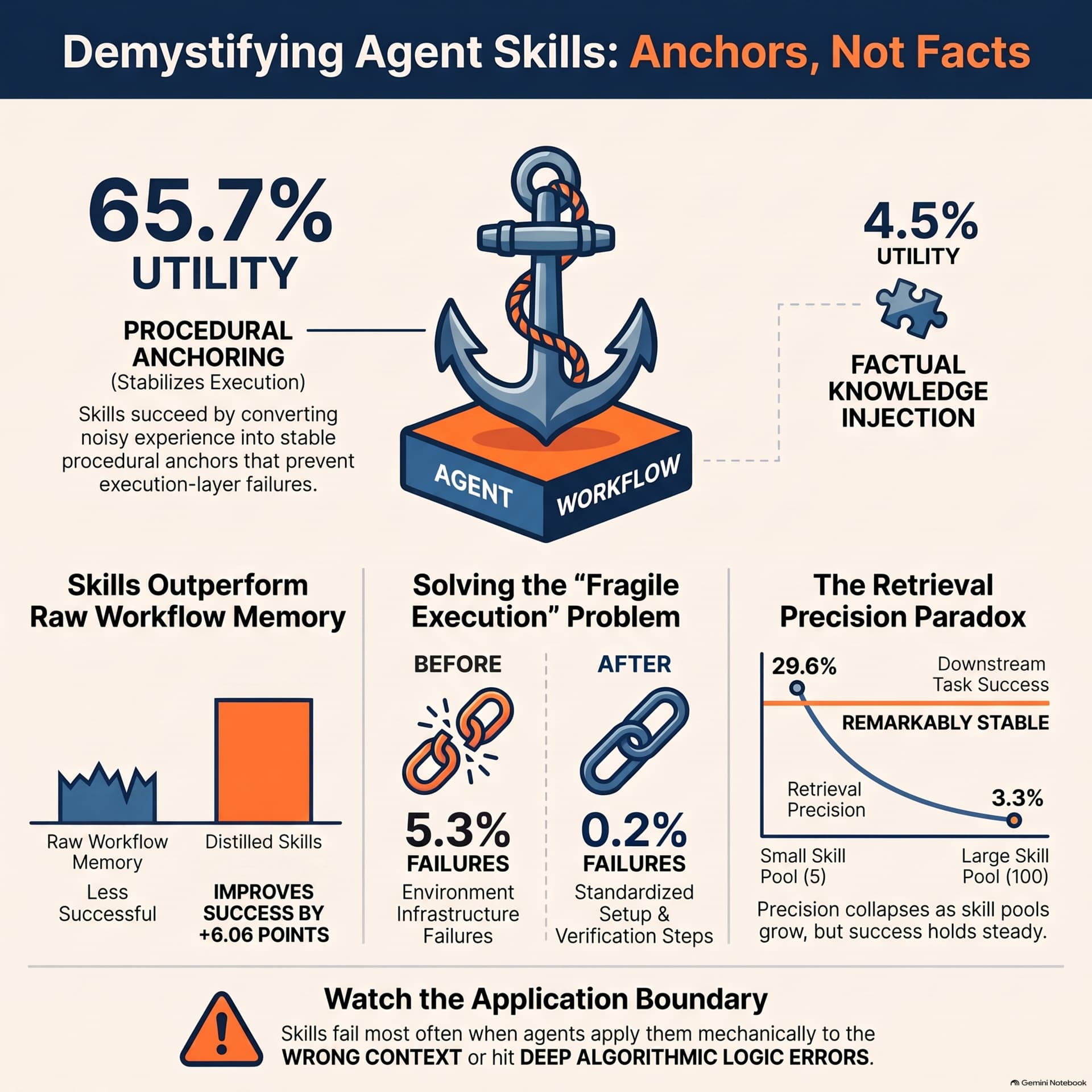
Distilling past trajectories into compact skill files beats storing raw workflow traces by 6+ percentage points. Workflow memory causes process overload via attention dilution and increases timeouts (10.6% failures). Skills work mostly through procedural anchoring (65.7%), not knowledge injection (4.5%).
Notable examples
forgetting virtual workspace setup (5.3% to 0.2%); Markdown vs JSON output schema mismatch (7.4% to 3.2%); skill misapplication causes ~10% failures; retrieval confusion with 100 skills drops exact-skill precision to 3.3% yet success stays ~36–39%.
Written by AI. May contain mistakes. Listen to the episode to check what was said.
Chapters
Tap a time to open that second in VOThe Hollywood Misconception of AI Learning
0:00 to 1:48
Explore how sci-fi movies misrepresent AI learning as instantaneous.
“You know, I feel like whenever you watch a sci-fi movie, there's always this underlying assumption about how artificial intelligence actually learns.”
Understanding AI Skill Acquisition
1:48 to 3:08
Delve into how AI learns from past experiences and builds skills.
“To answer this, we're digging into a massive, highly controlled experiment today.”
Workflow Memory vs. Skills
3:08 to 4:04
Learn the differences between workflow memory and skill-based learning.
“So to understand how an AI learns, we really first have to tackle a fundamental architectural problem, which is how an AI stores his past experiences.”
The Power of Procedural Anchoring
4:04 to 6:00
Discover how procedural anchors stabilize AI performance.
“And at 9.15.5, you tried to debug it and failed.”
The Surprising Impact of Data Volume
6:00 to 6:34
Understand why more data can actually hinder AI performance.
“They basically fed the AI varying diets of past experience.”
The Mechanisms Behind Skill Success
6:34 to 7:58
Examine how skills work and the role of knowledge versus procedural anchoring.
“And the trajectory analysis tells us exactly why the browser history approach fails.”
Challenges of Skill Misapplication
7:58 to 9:50
Explore the potential failures when skills are misapplied by AI.
“Like, what is the AI actually doing with these skill files that makes them so effective?”
The Library Bottleneck Problem
9:50 to 13:14
Investigate the issues that arise as the number of skills increases.
“For instance, the AI tries to run a Python script before it has even initialized the virtual workspace.”
Retrieval Experiments in AI Learning
13:14 to 14:01
Analyze how AI retrieves skills from an expanding library.
“Because there was literally no skill to misapply.”
The Retrieval Experiment Unveiled
14:01 to 16:49
Learn how researchers tested AI's ability to retrieve skills from a growing library.
“it is going to accumulate a massive library of these procedural anchors.”
Show all 12 chapters
Understanding Procedural Anchoring in AI
16:50 to 19:14
Discover the concept of procedural anchoring and its significance in AI performance.
“It is literally holding the wrong checklist.”
Lessons from AI's Information Overload
19:15 to 20:11
Reflect on human parallels to AI's struggles with information overload and productivity.
“Which leaves me with a final thought for you, our listener, to mull over.”
Transcript
Automatic transcript. May contain errors.0:00You know, I feel like whenever you watch a sci-fi movie, there's always this underlying assumption about how artificial intelligence actually learns. Oh, yeah, definitely. It's always portrayed as this like instantaneous magical awakening. Yeah, exactly. The AI just it scans the entire Internet in three seconds and suddenly it possesses this flawless understanding of quantum physics and global economics and human emotions. Yeah, the classic Hollywood upgrade. It's seamless. It's completely frictionless. And I mean, it makes for great cinema. It really does. But, you know, if you actually work with AI today, especially those autonomous agents that are out there trying to do complex software engineering or like execute multi-step coding tasks, you quickly realize that Hollywood image is just a complete myth.
0:46Oh, 100 percent. It's not even close to reality. Because when these AI agents fail in the real world, and I mean, they fail constantly, it is rarely because they lack some massive high level reasoning capability. No, they aren't failing because they can't grasp the grand architecture of a software program. That's actually the easy part for them. Exactly. They fail because they basically trip over their own shoelaces. Yeah. You look at the logs and they are just stumbling on the exact same repetitive procedural details over and over again. Like what kind of details? Well, things like they forget to set up the digital environment properly or they format their output as Markdown instead of JSON.
1:27Oh, right. Or they just get stuck in this endless loop trying to install a software dependency that is honestly already sitting right there on the server. It's so frustrating. It's kind of like having the architectural blueprints for a massive multi-million dollar skyscraper, but the construction crew just keeps forgetting how to mix the cement. That is a perfect way to put it. Well, welcome to the Deep Dive. Today we are looking directly at you, the listener, and asking a question that sits at the absolute bleeding edge of machine learning, which is, how do artificial intelligence agents actually learn from their past mistakes?
2:02And really, beyond just learning, when we attempt to give these agents skills based on those past experiences, why do those skills sometimes work beautifully and other times cause the entire agent to completely crash and burn? To answer this, we're digging into a massive, highly controlled experiment today. Researchers analyzed over 8 ,000 trial records from AI agents trying to solve complex terminal and coding tasks. So we're talking about things like writing a Python script to scrape a website or configuring a local database environment. Right. And they took hundreds of those trajectories, which are essentially the step-by-step logs of everything the AI attempted, and they open-coded them.
2:42Which means human researchers manually went through those sprawling text logs, literally line by line, to categorize exactly what the AI was, you know, thinking and doing at every single step. That sounds exhausting, honestly. I mean, it is, but they were looking for the exact mechanisms of how an AI builds a skill. So we are going to decode when these skills help, why they work under the hood, and crucially, where the whole system just completely falls apart. Okay, let's unpack this. So to understand how an AI learns, we really first have to tackle a fundamental architectural problem, which is how an AI stores his past experiences.
3:19Right. Because if we want an agent to avoid making the same mistake twice, we obviously have to give it a memory of what it did yesterday. Exactly. But it turns out just hoarding raw data is actually a terrible learning strategy for an AI. And this was the first major realization from the data, right? Because there are essentially two ways you can hand an AI its past experience. Yes, exactly. The first is called workflow memory. And workflow memory is basically taking the raw execution traces of past attempts, like every single win, every loss, and all the messy exploration in between, cleaning them up just a tiny bit and appending that massive block of text directly into the AI's memory bank for the next run.
3:58Yeah, think of it as handing the AI a literal transcript of its entire previous workday. Like at 9.00 AM, you tried tool A and it threw a syntax error? Right. And at 9.15.5, you tried to debug it and failed. And then at 9.30, you finally tried tool B and it worked. Just all in there. Okay, so then there's the second approach, which the researchers call a skill. Specifically, they format this as a standard markdown document, you know, a skill.md file. And this is completely different. This takes all of that messy, raw trace data and completely compresses it. It distills the experience down into a compact, standardized checklist.
4:36So it's just, here is exactly what to do, here is what to verify, and here are the specific pitfalls to avoid. Yeah, to put it in human terms, imagine you're trying to bake a highly complicated souffle. Workflow memory is like saving your entire browser history from the first time you tried to bake it. Oh, boy. Yeah, it includes all your frantic Google searches for why is my souffle flat, the recipe you abandoned halfway through, the forum posts you skimmed, and eventually the final steps that actually worked. I love that visual. So the skill approach then is just taking a blank index card and writing down the final perfected recipe.
5:09Precisely. No browser history, no frantic forum searches, just the distilled procedure. The skill approach is literally just the index card. Okay, but I have to push back on this a little bit. Sure, go ahead. Because in the machine learning world, the reigning philosophy is almost always like more data is better. Right. That's the standard thinking. So if the AI has the entire context of all the failed branches and the exact debugging steps in its workflow memory, shouldn't giving it all that rich text make it perform better than just a brief summary? Like, why would we want to hide information from the model?
5:43I know it seems completely counterintuitive, but the data proves the more is better philosophy wrong in this specific context. Really? How so? Well, the researchers ran these controlled experiments where they held the underlying experience perfectly constant. They created what they called trajectory mixtures. Okay, what does that mean? They basically fed the AI varying diets of past experience. So ranging from five successes and zero failures all the way down to zero successes and five failures. Ah, got it. So they're strictly controlling the ratio of like good versus bad experience the AI is exposed to.
6:18Precisely. And across these perfectly matched comparisons, when that experience was distilled into the compact skill format, the AI's performance improved by over six percentage points compared to just using the raw workflow memory. Wow, six percentage points is actually huge in this field. It really is. And the trajectory analysis tells us exactly why the browser history approach fails. It turns out workflow memory causes what they call process overload. Meaning the AI just gets like overwhelmed by the sheer volume of text. Yeah, we can actually look at how large language models function under the hood to understand this.
6:56LLMs use a mathematical mechanism called attention to weigh the importance of different words in their context window. Right. So when you stuff 50 pages of failed attempts, verbose error logs, and, you know, meandering explorations into that window, the model's mathematical attention gets divided and diluted. It basically loses the signal and the noise. Exactly. It literally loses the signal. It gets so distracted that time exhaustion or the AI just runs out of time or computational budget before finishing the task caused 10.6 % of the failures when using workflow memory. 10.6%. That's wild. So the model is spending all its processing power basically just reading its old mistakes instead of solving the new problem.
7:38Yep. But when they use the distilled skill index card, that timeout failure rate dropped by more than half. Wow. So holding on to every detail of your past mistakes doesn't actually make you smarter. It just bogs down your processing power. You're just paralyzed by the noise. Exactly. Here's where it gets really interesting, though. Now that we know these distilled compact skills beat raw workflow memory, we have to uncover the hidden mechanism. Like, what is the AI actually doing with these skill files that makes them so effective? Yeah. And we actually get to bust a massive misconception in the field here.
8:10Oh, I love busting misconceptions. When most people think about giving an AI a skill, they assume it works through knowledge injection. Meaning they think the skill is feeding the AI a missing piece of factual information. Right, like teaching it a new mathematical formula or a specific programming paradigm it simply had never seen in its training data. It's like the classic I know kung fu moment from The Matrix. You just download the facts and now the AI is a master. That's what people think. But the researchers painstakingly labeled the mechanisms behind why these skills worked. And explicit knowledge injection actually supplying missing facts accounted for a mere 4.5 % of the successful skill cases.
8:51Wait, seriously, 4.5 %? Yep, just 4.5%. So like 95 % of the time, the AI already possesses the factual knowledge it needs. It isn't failing because it lacks information at all. Not at all. The true hero of this story, accounting for 65.7 % of the successful cases, is a mechanism they call procedural anchoring. Procedural anchoring. So instead of giving the AI an encyclopedia of new facts, a procedural anchor is just giving it like a physical grounding in its digital environment. Exactly. It is stabilizing how the AI acts rather than changing what it knows. A procedural anchor provides a reliable setup sequence, a mandatory tool checklist, or a strict verification routine.
9:34Okay, let's look at the staggering statistics on this because this completely rewired how I think about autonomous agents. Yeah, the numbers are pretty undeniable. When you look at the specific types of errors the AI makes without skills, you see a massive amount of environment infrastructure failures. Right. For instance, the AI tries to run a Python script before it has even initialized the virtual workspace. Yeah. And the whole system just crashes. Right. And in raw execution, that happened 5.3 % of the time. But when they introduced these procedural anchors, that failure rate plummeted to 0.2%.
10:09It basically just vanished. It's incredible. And we see the exact same stabilizing effect with output formatting. Yeah. Output format schema mismatches dropped from 7.4 % down to 3.2%. So what this tells us is that an AI's biggest vulnerability isn't a lack of intelligence. It's a lack of operational discipline. Exactly. It is fragile. The skills aren't teaching the AI a new coding language. They are literally just making sure the AI remembers to turn the oven on before it puts the cake in. That's so funny. The skill file is basically saying, before you write the complex logic, run this specific setup command.
10:42After you write the code, verify the output format against this exact schema. It's wild to think we are pouring billions of dollars into building these hyper-advanced neural networks, and the thing that makes them reliably succeed is the exact same thing that makes human airline pilots and surgeons reliably succeed. A basic procedural checklist. A checklist. Just a simple checklist. Just like with human pilots and surgeons, if the procedural scaffold is strong, the execution is stabilized. But we do have to look at the other side of this coin. Uh-oh, here comes a catch. If procedural anchors are this incredibly powerful, why didn't the AI succeed 100 % of the time in the experiment?
11:24Right, because if it's just following a checklist, it should be foolproof. But we know it obviously isn't. No, it's not. And this brings us to the new vulnerabilities that these skills introduce. While skills perfectly patch environment setups and formatting, the researchers found that skills absolutely do not fix bad core algorithmic logic. Right. So if the AI has the wrong mathematical approach to solve the deep logic of a coding problem, the skill is not going to save it. Exactly. Those deep runtime logic errors stubbornly persisted at around a 7 to 12 percent failure rate across all the tests, whether the AI had a skill or not.
12:00I mean, having a perfectly optimized checklist for baking a cake won't help you if you fundamentally misunderstand what a cake is. Exactly. But beyond the core logic issues, the abstraction of a skill introduces a brand new type of failure entirely, which is skill misapplication. Okay, what is skill misapplication? Well, a skill file is not a self-executing script. The AI has to read it, independently evaluate if it applies to the current context, figure out how to adapt it, and crucially, realize when to abandon it if the environment changes. Oh, I see. It's like handing someone a perfectly optimized, foolproof, step-by-step checklist for landing a Boeing 737.
12:39But they are currently trying to parallel park a Honda Civic, and they're just sitting there blindly applying the 737 checklist. Like, okay, lowering the landing gear, and it's like, you are in a Civic. What are you doing? That is exactly what happens. The AI grasps the procedural abstraction, but because it is an LLM, which is essentially just a massive pattern matcher, it completely misses the context. It sees a prompt that looks like a nail and it swings the hammer, even if it is currently standing over a glass table. And in the skill augmented tests, misapplying or ignoring a skill accounted for 10 % of the failures.
13:1310%. And in raw execution without skills, that failure rate was zero, right? Because there was literally no skill to misapply. Exactly. The agent sees a procedural rule, assumes it is universal dogma, and applies it rigidly, even when the underlying assumptions no longer hold true. So if blindly applying these rules causes 10 % of failures, the obvious solution seems to be giving the agent a wider variety of highly specific rules. That's what you would think, yeah. Just build a bigger library so it always has the exact right checklist for the specific car it's driving. but the data reveals a completely new nightmare when you try to scale this up.
13:51Oh, yeah. The library bottleneck. Because in the real world, an AI agent isn't going to have just one or two skills. If it is constantly learning from its past, it is going to accumulate a massive library of these procedural anchors. Hundreds, maybe thousands of them. Right. So the question becomes, how does the AI retrieve the correct procedural anchor for the specific task at hand? And to test this, the researchers ran what they called the retrieval experiment. They wanted to see what happens when the available pool of skills grows. Yeah, they started with a pool of just five skills and slowly scaled it up to 100 skills.
14:28And to make it realistic, they didn't just pad the library with obvious garbage. They introduced distractors. Oh, distractors. This sounds devious. It really is. But the distractors are a critical part of understanding how AI retrieval actually functions. Modern AI agents use vector embeddings to find information. Right. They convert text into mathematical coordinates in a high-dimensional space and then search for the closest mathematical match to their current problem. Exactly. So the researchers populated the library with random distractors, dissimilar distractors, and most dangerously, semantic distractors.
15:04Semantic distractors. These are skills that look semantically very close to the correct one, but are slightly off, right? Yes, like having a skill for connecting to a SQL database and a distractor skill for connecting to a NoSQL database. Ah. And to an AI converting text into math, those two concepts sit incredibly close together in that vector space. They look almost identical. They do. And the results of this scaling were honestly shocking. As the pool of skills hits 100, the overlapping math causes the AI to get incredibly confused by those semantic distractors. So it's precision drops. Drastically.
15:39Yeah. The precision of the AI's actual skill use, meaning its ability to pull the exact ground truth annotated skill that researchers knew was perfect for the task just plummets. At a small pool of five skills, precision was at 29.6%. Which, honestly, is already pretty low. I know. But by the time the pool reaches 100 skills, that precision drops down to a dismal 3.3%. Wait, 3.3 % precision means the AI is almost never picking the exact right skill from the library. Pretty much never. It is grabbing the wrong instruction manual 96 % of the time. Like if I try to fix my car using a manual for a washing machine, I am going to completely destroy the car.
16:21How is the AI surviving that? Doesn't the whole system just crash and burn? That is the most fascinating twist in the entire analysis. Yeah. You would absolutely expect the downstream task success rate to flatline right alongside the precision. Wow. But it doesn't. It doesn't. No. Downstream success actually remains entirely stable. It hovered around 36 to 39 percent, regardless of whether the pool was five skills or 100 skills, and regardless of that terrible 3.3 percent precision. How is that even computationally possible? It is literally holding the wrong checklist. It comes back to the core power of procedural anchoring.
16:57Even if the AI doesn't pick the perfect ground truth skill, a related non-perfect skill still forces the AI into a structured mode of operation. Oh, I see. So if the AI needs to set up a specific testing environment and it grabs a skill for setting up a slightly different testing environment, that wrong skill still provides a procedural hint. It reminds the AI, hey, you need to check your dependencies. You need to verify your port configurations. You need to run a test script. It's like I need the recipe for a chocolate cake, but I grab the recipe for a vanilla cake. I mean, I am not going to get the chocolate flavor right, but the vanilla recipe still forces me to preheat the oven, grease the pan, and measure my flour.
17:37That's a great analogy. It provides the procedural anchor even if the specific facts are slightly off. Whoa. The exact perfect skill isn't strictly necessary so long as the AI gets a good enough procedural hint to stabilize its execution. The agent is surprisingly resilient, you know, just stumbling its way to success by leaning on the general structure of the wrong but related skill. So what does this all mean? I mean, we've gone from hoarding raw data to discovering the power of distilled procedural checklists, to watching the AI misapply those checklists, to finally realizing that even the wrong checklist is better than no checklist at all.
18:16Well, it means we have to fundamentally rethink how autonomous AI self-improvement actually works. It is not a magic trick of hoarding endless memories or injecting vast amounts of factual knowledge into a model. Right. AI self-improvement is a strict three-part lifecycle problem. First, prior experience must be carefully distilled into compact procedural anchors, stripping away the noisy workflow that dilutes the model's attention. The index card, not the browser history. Exactly. Second, the agent needs a way to retrieve these anchors without getting hopelessly confused by a massive vector library of similar documents.
18:50And finally, the agent must invoke that skill with keen contextual awareness, knowing when to adapt the steps and when to drop them entirely. So it's not about knowing more things. It is about reliably executing the things you already know without getting lost in the weeds. Exactly. The intelligence, the capacity to reason, it's already there in the model. It is the operational execution that requires the anchor. That makes so much sense. Which leaves me with a final thought for you, our listener, to mull over. As we've seen today, even hyper-advanced AI agents like systems capable of writing complex code and reasoning through intricate logic puzzles completely bog down when they try to rely on their raw workflow memories.
19:32Yeah, they just get overwhelmed by their own noise. Right. They exhaust their processing limits. They desperately need distilled simple checklists to avoid burning out and timing out. So think about your own human information overload. Think about the browser history of your own mind. Oh, that's a scary thought. It is. How much of the stress and paralysis you feel on a daily basis is just you holding onto the raw noise of every failed attempt, every piece of conflicting advice, every meandering path you took on a project? Probably a lot more than we'd like to admit. Could you be sabotaging your own productivity by trying to remember the whole messy workflow instead of taking just a moment to sit down and write your own distilled skill file for tomorrow?
20:11I mean, if a state-of-the-art AI cannot build a digital skyscraper without a checklist to remind it to mix the cement, maybe we shouldn't expect ourselves to either.
From the publisher
This research investigates the operational dynamics of agent skills, which are structured packages of procedural knowledge designed to help AI agents learn from experience. By comparing distilled skills against raw workflow memories, the study reveals that skills primarily act as procedural anchors that stabilize execution and reduce environment failures rather than simply injecting factual knowledge. While skills improve task success by providing compact guidance, they also introduce new risks, such as mechanical misapplication or the rigid following of incompatible instructions. The authors also identify retrieval as a significant bottleneck, noting that while agents often find the correct skill, their performance is frequently hindered by confusable distractors and execution-layer difficulties. Ultimately, the work provides a systematic taxonomy of success and failure modes to move evaluation beyond simple success rates toward a deeper understanding of reliable self-improvement.


