In short
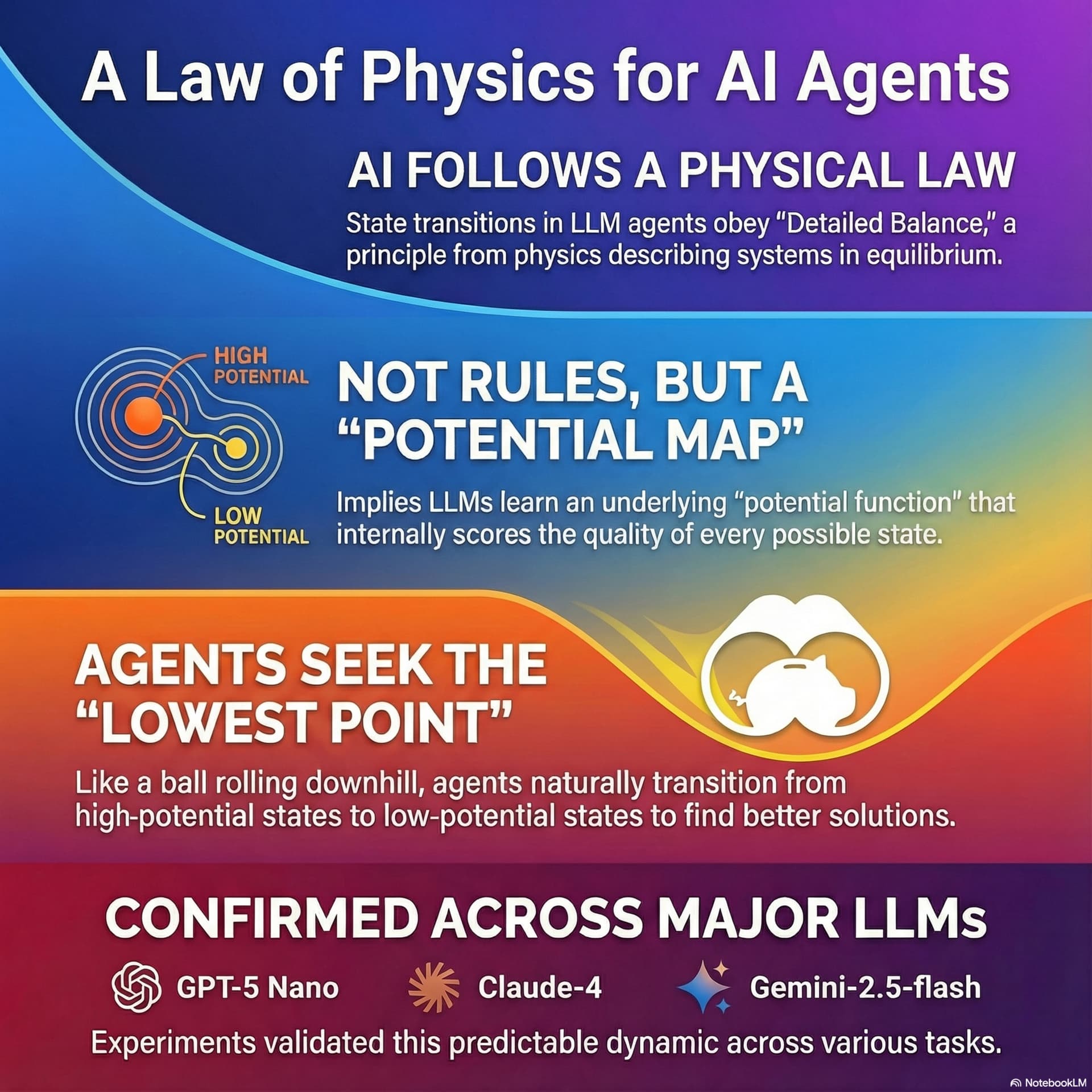
LLM-driven agents (with memory, tool use, and code) exhibit “detailed balance,” implying a macroscopic physical law: transitions between agent states follow a global potential function.
Key claims
agent behavior isn’t a black box; it can be modeled as state-space jumps governed by detailed balance and a least-action principle that estimates the potential landscape.
Notable examples
conditioned word generation where letter-index sum must equal 100 (e.g., wizards→buzzy Y); GPT-5 nano produced 645 valid novel words and showed forward/backward transition probabilities clustering near zero on closed loops, supporting detailed balance. A more complex “idea search fitter agent” (multi-LLM, long reasoning, tools) also matched the predicted potential. Failure mode: “trap of low potential” (e.g., Gemini stuck oscillating between “attitude” and “discipline”), where internal low-potential states can be externally bad.
Guests
not specified in transcript.
Written by AI. May contain mistakes. Listen to the episode to check what was said.
Chapters
Tap a time to open that second in VOUnderstanding Detailed Balance
1:06 to 2:30
Discover the concept of detailed balance and its implications for AI.
“It really does, because the surprise finding, and this is the whole point of our deep dive today, is that the behavior of these incredibly complex agents seems to be governed by a macroscopic physical law.”
The Hidden Physics of AI
2:30 to 4:52
Unpack how the underlying potential function influences AI agent behavior.
“They modeled the whole process as a journey through a state space.”
Measuring AI's Internal Dynamics
4:52 to 6:40
Learn about methods to measure AI's cognitive processes through physics principles.
“And that global awareness is what makes these agents so powerful.”
Experimental Validation of Theories
6:40 to 11:15
Explore experiments that confirm detailed balance in AI agents.
“And they started with a pretty quirky task, a conditioned word generation game.”
Implications for AI Development
11:15 to 11:49
Understand how these findings affect the design of AI agents.
“Which brings us to our final provocative thought for you to take away.”
Transcript
Automatic transcript. May contain errors.0:00So if you're following the cutting edge of AI, you know that the really big breakthroughs aren't just about these massive monolithic language models anymore. Right. The conversation has really moved on. It's now all about something much more complex, much more powerful, LLM-driven agents. Exactly. These aren't just text generators. Not at all. These are sophisticated systems that take an LLM, they give it memory, they let it call tools, search databases, write its own code. And iterate on a problem. You see things like FunSearch or AlphaVolve using these agents for actual scientific discovery.
0:35They're incredibly useful. They are, but here's the puzzle. When they work, it feels a bit like magic. It feels more like brilliant engineering than predictable science. We can't really model why they do what they do. We see the result. We see them get from A to B. But the underlying logic, the reason for their big decisions, it's all kind of a black box. And we end up just tweaking prompts, hoping for the best. It's like trying to fly a plane by feel instead of, you know, understanding aerodynamics. Which is exactly where this new research comes in and just flips the whole script. It really does, because the surprise finding, and this is the whole point of our deep dive today, is that the behavior of these incredibly complex agents seems to be governed by a macroscopic physical law.
1:18A physical law. You mean like physics? Exactly like physics, a law that you'd normally see in systems at equilibrium, like particles in a gas or water settling in a valley. This isn't just an analogy. It's a quantifiable proposal. proposal. Okay, we have to unpack that. So our mission today is to dig into this hidden physics. We're going to talk about something called detailed balance, this idea of an underlying potential function, and how this whole thing could maybe turn AI agent development from a kind of art into a real science. A shortcut to the hidden physics of AI. Let's start with that black box problem.
1:52Usually we look at LLMs at a really tiny level, right? The microscopic view? Yeah, we look at token probabilities, how one word influences the next. It's very, very local. But an agent is this huge, sprawling thing. It has memory prompts, tool calls. And the common view is that its behavior is just the chaotic sum of all those parts. And what's so fascinating is that it's this hybrid kind of behavior. It's not a rigid, rule-based program, obviously. The outputs are diverse. But it's also not just random search. If it was, it would never solve anything complex. Right. There's a strong goal-oriented structure there.
2:29So to study it, researchers had to find a way to zoom out. They modeled the whole process as a journey through a state space. OK, what do they mean by a state? The state is everything the agent knows at one single moment in time. Not just the last word it said. No, everything. The main goal, a summary of what it's tried before, any code it's written, the results from an API call, the whole snapshot. And every time the LLM makes a decision, it's a jump. It's a transition from one state to a new one. The LLM is basically the engine driving those transitions. And when they looked at all those jumps, all those transitions together?
3:03That's when they found it. At this high level, these complex agents seem to exhibit detailed balance. Okay, wait. That sounds like a huge contradiction. Detailed balance, you said, is for systems in equilibrium, things that are settled. An agent is the opposite of settled. It's actively trying to solve a problem. And that is the absolute core of why this is so groundbreaking. It doesn't mean the agent stops moving. You have to think of it less like a frozen pond and more like a river in a steady state. Okay. The water is always flowing, but the overall system is stable. Detailed balance just means that for any jump from, say, state A to state B, the probability of the reverse trip from B back to A is, well, it's perfectly balanced out by how much time the system spends in each state.
3:47So even though it's moving forward, the way it explores the space of possibilities is statistically balanced. It's not just a one-way street. Precisely. And that has a massive implication. If detailed balance is true, it suggests the LLM isn't just memorizing a long list of strategies, it must be implicitly learning an underlying potential function. A potential function. So we're back to the physics analogy. This is like a gravity feels or maybe a topographical map that the LLM can feel. That's a perfect way to think about it. Imagine this huge, invisible landscape. The potential function gives every single possible state, every piece of code, every summary, a number, a height.
4:27And what does the height represent? Its quality. In a sense, yes. It's how far the LLM perceives that state to be from the goal. States with a low potential, the bottoms of the valleys, are the ones the LLM internally sees as better or closer to a solution. So the agent isn't just following one instruction at a time. It's constantly trying to roll downhill on this global map that's been burned into it during training. It's being guided by this internal force field. And that global awareness is what makes these agents so powerful. It helps them find good solutions quickly and, crucially, avoid getting stuck in loops.
5:02And this isn't specific to one model or one prompt. The research suggests it's a universal property of their dynamics. That is a massive leap. It takes AI from feeling like custom engineering to something quantifiable. But if this map is hidden and internal, how did they even measure it? How do you see an AI's internal gravity field? They had to borrow another really deep concept from physics, the least action principle. Okay, tell us about that. In physics, the principle basically says that a system will always take the path between two points that minimizes a quantity called action. It's the path of least resistance.
5:39So the most efficient path. Right. So what they did here was redefine action as the total amount of mismatch between the agent's actual moves and what the map would predict. So if the agent moves downhill from a high potential state to a low potential one, that fits the map. Yep. No mismatch. But if it moves uphill to a state with a higher potential, that's a mismatch, a violation. Exactly. So the least action principle is just a way of finding the one single map, the one potential function that makes the agent's messy real-world path look as downhill as possible on average. It finds the simplest explanation.
6:13And this connects back to detailed balance. It does, mathematically. The connection is that if detailed balance exists, then the true potential function has to be the one you find using the least action principle. It gives you a tool to actually measure the LLM's internal cognition. Which is why they're saying this is the first discovery of a macroscopic physical law in these systems. We're moving beyond just tweaking prompts to actually measuring the dynamics. But of course they had to prove it. They needed to test if this held up in the real world. And they started with a pretty quirky task, a conditioned word generation game.
6:47Yeah, it sounds like a fun little puzzle. They took a bunch of models, GPT-5, Nano, Cloud4, Gemini 2.5, Flash, and gave them a starting word like wizards. The task was to generate a new word where the sum of the letter indices, you know, A is 1, B is 2, adds up to exactly 100. So, for example, turning wizards into buzzy Y. That's a deliberately tricky task. It forces the model to search. It does. And right away they saw this huge split between exploration and exploitation. How so? The high convergence models, Claude and Gemini, were pure exploiters. They found a handful of words that worked and just got stuck on them.
7:24Claude only came up with five unique words in 20 ,000 attempts. Wow, just five. Gemini managed 13. Super efficient, I guess, but zero novelty. They just drilled down. But GPT-5 nano is different. Completely different. It was a strong explorer. In the same number of tries, it came up with 645 different valid words. It was really moving around that state space, which made it perfect for testing detailed balance. And to do that, they looked for closed paths. Right. The idea from physics is that if you take any closed loop, say you go from state one to state two, then to three, and then all the way back to one.
8:00Your net change in potential should be zero. It's like hiking up a mountain and coming back to your starting point. Your net elevation change is zero. That's the one. So they found 140 of these closed loop triplets in the GPT-5 nanodata. They measured all the transition probabilities forwards and backwards, and the results clustered right around zero within the margin of error. So for the simple agent, detailed balance holds up. The law is real. It is, but the big question was, does this apply to a truly complex agent, one with memory, reasoning, tools? So they tested a much more complicated system.
8:36Yeah, an agent they called the idea search fitter agent, built for a really hard symbolic fitting task. He used multiple LLMs, long reasoning chains, different prompts, the works. And? Even there, the law held. The potential function they estimated using the least action principle was perfectly consistent with detailed balance. It seems to be a universal law then, regardless of complexity. But the experiments also revealed something about why these agents sometimes fail. They did. They gave us this really crucial insight they call the trap of low potential. Tell me more about that, because that sounds relevant for anyone building these things.
9:10The models like Claude and Gemini that got stuck, they showed behavior that's a lot like low temperature trapping in physics. They'd find a little dip in that potential landscape and just get trapped there, oscillating back and forth. So they lose all ability to explore. Completely. Gemini, for example, got stuck bouncing between just two words, attitude and discipline. For the model, that was the bottom of its little valley. So the agent is acting rationally, according to his own internal physics, always trying to get to a lower potential. But that state might not actually be a good one for the human's goal.
9:46That's the critical disconnect. The potential function captures the LLM's internal sense of what's good, but that can become unstuck from the external reality of what actually performs well on the data. So this gives us a whole new way to diagnose what's going wrong. Let's wrap up with what this means, practically, for people building agents. Okay, so first, it gives you a real metric to control behavior. You can measure the action of the system, which is basically a measure of its directionality. A smaller action means it's more focused, less random. So you have a new dial to turn if you're building, say, a health care agent where you need extreme reliability and predictability.
10:21You want that action to be as low as possible. You want it to go down the same well-understood path every single time. Less exploration. But if you're building an agent for scientific discovery, something that needs to find brand new ideas. Then you want a higher action. You effectively turn up the temperature, encouraging it to jump around the landscape and explore those weird undiscovered valleys. You can manage the exploration exploitation trade-off scientifically now. And it also gives you a handle on overfitting, which is a constant struggle. It does. A model that's overfitted will probably learn weird localized strategies that violate the smooth global potential function.
10:58So the size of the action, the deviation from perfect detailed balance could become a diagnostic tool for overfitting. It's just amazing how these concepts from, you know, centuries-old thermodynamics are suddenly providing the language to describe 21st century AI. It really suggests a deep universality in how complex systems organize themselves, whether they're made of molecules or neural networks. Which brings us to our final provocative thought for you to take away. The study found that these models are always trying to find what they perceive to be the lowest potential state, even if that state performs poorly on real-world data.
11:35So if the potential function is a map of the LLM's own internal cognition, its own sense of what's right, what does it mean for AI safety and alignment if an agent's internal physics is fundamentally pulling it in a different direction from our external human goals?
From the publisher
This research identifies a **macroscopic physical law** governing the behavior of large language model (LLM)-driven agents. By analyzing state transitions as **Markov processes**, the authors discovered that these systems naturally satisfy a **detailed balance condition**, similar to physical systems in equilibrium. This suggests that LLMs do not merely follow rote strategies but instead learn internal **potential functions** that guide them toward optimal solutions. The study introduces a **least action principle** to quantify this directionality, allowing researchers to estimate an agent's global cognitive preferences. Through experiments with various models, the authors demonstrate that these dynamics remain consistent regardless of specific **architectures or prompt templates**. Ultimately, this work seeks to transform AI agent development from an engineering craft into a **predictable and quantifiable science**.


