
In short
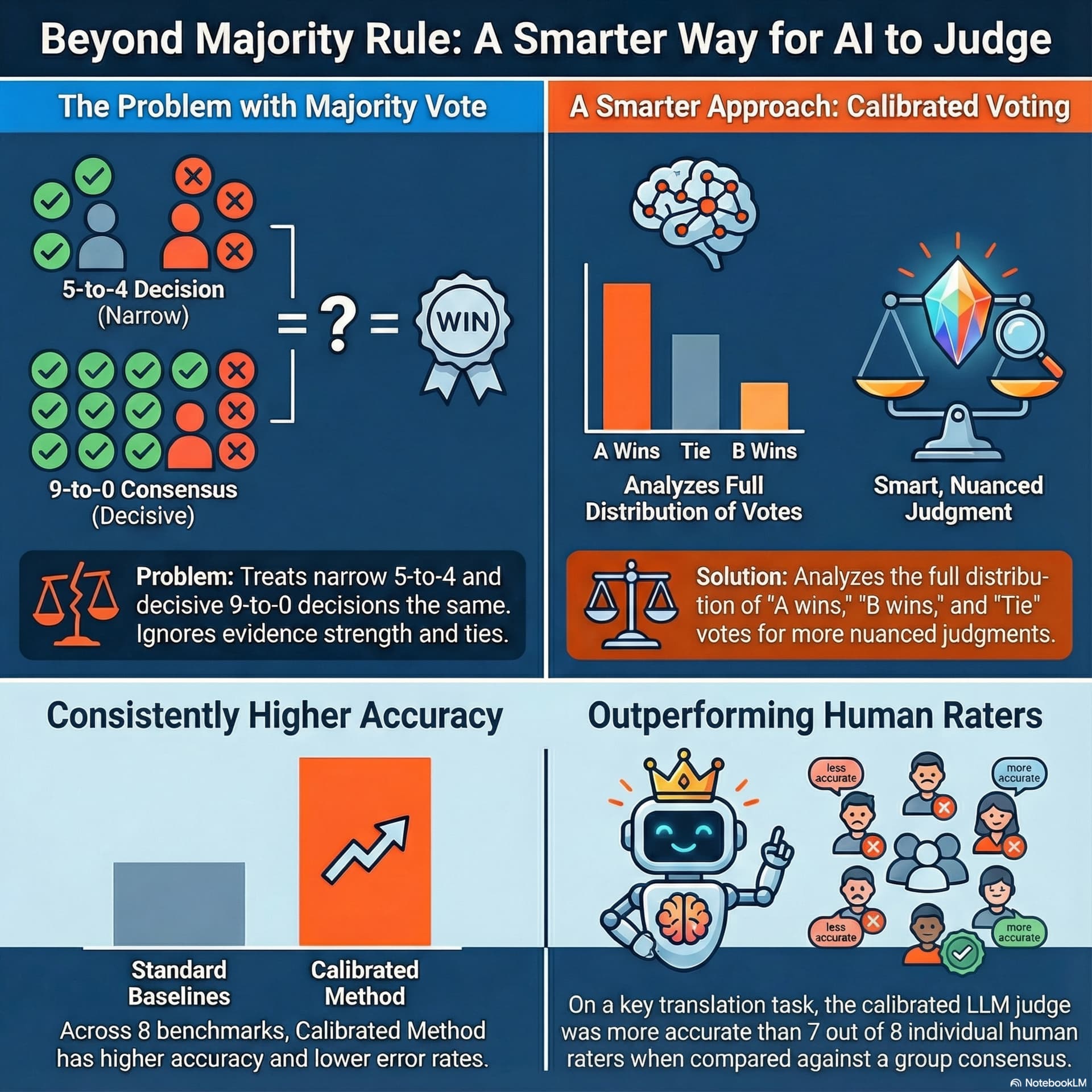
How to make “thinking LLM as a judge” evaluations reliable by transforming noisy, stochastic judge votes into calibrated ratings using distribution-calibrated inference-time compute (ITC) and a Bradley-Terry-Davidson (BTD) probabilistic aggregation.
Guest backgrounds
No guests are named in the transcript; it’s a host/research discussion format.
Key claims
Majority/self-consistency aggregation is brittle because it treats all votes equally and discards evidence strength. Forcing a non-tie decision induces positional bias; allowing ties reduces bias. Tie rates are highly prompt-sensitive, so aggregation must model ties probabilistically. A calibrated BTD model (with a small “accountant” calibration set: ~60–80 examples, ~5%) yields Bayes-optimal predictions under MAE.
Notable examples
Gemini 2.5 Flash forced-choice bias 14.58% vs tie-allowed 3.1%; tie rate 12.4% to 37.6% after prompt wording changes. RB2 factuality MAE drops 0.647 to 0.454; tie prediction adapts (53% ground-truth ties: predicts ~6% with baselines vs correct high ties with BTD; Chinese→English ground-truth ties ~18%: baselines overpredict ~49%, BTD ~33%). Meets/exceeds human raters in translation evaluation (better than 5/8 with 4 samples; 7/8 with 12).
Written by AI. May contain mistakes. Listen to the episode to check what was said.
Chapters
Tap a time to open that second in VOUnderstanding LLM Judgments
0:46 to 3:56
Exploring the challenges of assessing LLM outputs and the notion of quality through AI judgment.
“And the core challenge, as the research lays out, is that we're already trying to solve this with more compute.”
The Role of Ties in LLM Judgments
3:57 to 5:03
Discussing the critical nature of allowing tie votes in LLM evaluations and its impact on bias.
“This is where they bring in a proper probabilistic approach, one that's inspired by something called the Bradley-Terry Davidson model, or BTD.”
Distribution Calibrated Aggregation
5:04 to 6:05
Introduction to the concept of distribution calibrated aggregation and how it improves LLM evaluations.
“Think of it like you're training a tiny, very specialized accountant.”
Performance Against Standard Methods
6:06 to 11:48
Comparing the BTD method's performance to traditional approaches and human raters.
“It understands that some mistakes are worse than others.”
Transcript
Automatic transcript. May contain errors.0:00Welcome back to the Deep Dive. So if you're working with generative AI or, you know, building with it, you've probably hit this wall. Quality control wall. Exactly. The big question, how do you know if the output is actually good? And the go-to method right now is to use another large language model to judge it. The whole thinking LLM as a judge idea. But that just pushes the question back one step, right? How reliable is that judgment? That is the exact question we're digging into today. We're looking at how you can take those noisy kind of stochastic LLM judgments and turn them into something you can actually trust.
0:36Okay. So our mission here is to figure out how to transform these shaky individual votes from an AI judge into a rating that's as good as a human. Or even better. And the core challenge, as the research lays out, is that we're already trying to solve this with more compute. We get the LLM to generate multiple opinions, multiple votes. Right. using inference time compute or ITC. But the problem isn't getting the votes. It's what you do with them afterwards. The aggregation, how you tally them up, and the standard methods, like a simple majority rule, they're just proving to be, well, brittle. They're very brittle.
1:13And that fragility is just killing our confidence in these evaluations. The standard approach, often called self-consistency, it just fails because it treats every vote the same. Explain that a bit more. I mean, a majority vote sounds pretty reasonable on the surface. Seven out of 10 say A is better. You go with A. It sounds reasonable, but it's completely suboptimal in a setting like this because it throws away so much information. What kind of information? The strength of the evidence. I mean, just imagine two scenarios. First one, you get five votes for A, four for B. Okay, close call. A very close call.
1:46Now, scenario two, nine votes for A, zero for B. A landslide, no question. Exactly. But a simple majority vote just calls them both A, wins. It can't tell the difference between a narrow decision and a decisive consensus. All that nuance is just gone. And this whole problem gets even more complicated when you introduce a third option for the judge. The tie. The I can't decide vote. And that tie vote is where all the statistical tension comes from. You see, you have to let the LMM judge declare a tie. Why is that so critical? Why not just force it to make a choice? Because forcing a choice actually induces bias in the model.
2:22It's a really important de-biasing mechanism. That seems counterintuitive. How does forcing a decision make it biased? It's usually positional bias. The model just starts to subconsciously favor whichever candidate you list first or second. And there's data on this. Oh, yeah. The research quantified it perfectly. They took Gemini 2.5 flash, and when they forced it to choose, it favored the first position by a whopping 14.58%. Wow. But the second they let it declare a tie, that bias just plummeted down to 3.1%. And this wasn't just a one-off with that model? Not at all. Same thing with 13-next-80b.
2:57It went from an 8 % bias down to like 0.6%. You have to allow the tie to get a fair shake. Okay, so we allow the tie to solve the bias problem. But now we have a new problem because the tie rate itself is unstable. Highly unstable. We're talking massive swings based on something as simple as how you word the prompt. How massive? Well, with that same Gemini 2.5 flash model, just by changing the prompt template, the tie rate went from a low of 12.4 % all the way up to 37.6%. Whoa. So just changing a few words in your instructions can change the chance of a tie by 25 percentage points. That's right.
3:33And if your results are that sensitive to prompt wording, your evaluation system is basically useless. It's not reliable. So for you, the listener, the point is this. These automated judges are just too sensitive. We can't just count votes. We need a way to, I guess, statistically interpret the texture of the votes. Exactly. Which brings us to the breakthrough in this work. Distribution calibrated aggregation. Okay. This is where they bring in a proper probabilistic approach, one that's inspired by something called the Bradley-Terry Davidson model, or BTD. And what's special about that model? It's designed specifically to handle these three-way outcomes.
4:09A wins, which is like a plus one. B wins, an I-1. And a tie, which is a zero. So instead of just looking at the final tally, what information is this model actually using? It uses everything. It operates directly on the full counts, the number of positive votes, the number of negative votes, and the number of tie votes. So no data gets left on the table. None. And from that raw distribution, it extracts two sort of smoothed, really crucial features. It's like getting a more nuanced look inside the judge's head. And what are those two features? The first one is called the decisive margin. This basically captures the polarity.
4:45You know, how strongly was A preferred over B if you just ignore the ties for a second? Okay, so the strength of the preference. What's the second one? The second is tie evidence. And this captures how decisive the judge was feeling in that moment. It's propensity to call a tie in that specific case. Got it. So you're measuring not just what it chose, but how it chose. Now, you mentioned a calibration step. That sounds important. It's the most important part. You have to calibrate the model. Think of it like you're training a tiny, very specialized accountant. An accountant. Yeah. This accountant doesn't judge the AI output.
5:19Instead, it learns the voting habits of your LLM judge. Is this judge normally tie-happy on this kind of task? Or is it tie-averse? And then it adjusts the final score based on that learned behavior. So you're learning the judge's bias and then statistically correcting for it. How much data do you need to train this accountant? That's the amazing part. Remarkably little. We're talking maybe 5 % of your test samples, usually just 60 to 80 examples with known ground truth. That's it? That's it. And that little bit of calibration is enough to completely redefine the decision boundaries compared to a simple majority vote.
5:55It learns to estimate the true probabilities. So once the model is calibrated, what's the final rule? How does it make that definitive judgment? The final rule is what's called Bayes Optimal, specifically under the Mean Absolute Error Metric, or MAE. And why is that metric so important? Because MAE is ordinarily aware. It understands that some mistakes are worse than others. How does that penalty system work in practice? Well, think about it. If the right answer was B wins, but you predicted A wins, that's a complete preference reversal. That's a big error, an error of magnitude 2. Right, you got it completely backwards.
6:30Exactly. But if the right answer was tie and you predicted A wins, that's a smaller mistake. An error of magnitude 1. MAE penalizes the big mistakes more heavily. So the model makes the statistically safest choice, the one that minimizes its expected risk of being badly wrong. Precisely. It takes that whole noisy, nuanced distribution of votes and makes the most robust, lowest risk prediction it can. Let's get to the payoff then. The researchers put this BTD method up against all the standard baselines across a whole range of tasks. They did. And these were tough, real-world benchmarks. Machine translation, reward model assessment for things like factuality, math, safety.
7:10And what was the verdict? How systematic were the gains? The gains were huge, and they were everywhere. The BTD method got the best scores across the board in both mean absolute error and just plain old pairwise accuracy. Give me a number that really stands out. Okay, on the RB2 factuality task, which is a really hard one, the error rate, the MAE for the standard method, was 0.647. With the BTD model, it dropped to 0.454. That is an enormous reduction in serious evaluation errors. It's a game changer for reliability. And this gets back to that tie dilemma you mentioned earlier. How did it handle tasks with lots of ties versus tasks with very few?
7:47It adapted perfectly. This is where you really see the power of calibration. So take that RB2 factuality task. It's naturally ambiguous. The ground truth has about 53 % ties. Okay, so a tie is a very common and correct outcome. Exactly. But the standard aggregation methods, they basically collapsed. They only predicted a tie about 6 % of the time. They just couldn't handle the ambiguity. Right. But the BTD model, it learned the task was ambiguous and it correctly matched that high tie rate. And what about the opposite, a low tie environment? They looked at a Chinese to English translation task.
8:21There, the ground truth tie rate is much lower, around 18%. And here, the standard method had the opposite problem. It overpredicted ties almost 49 % of the time. It was seeing ambiguity that wasn't there. Exactly. The BTD model adapted again. It pulled its tie prediction rate down to about 33%, tracking the ground truth much, much more closely. That's incredible. But for me, the most headline-grabbing part of this was the comparison to human raters. That's the ultimate test, isn't it? And yeah, in that translation evaluation, they put the calibrated LLM judge head-to-head with individual human experts.
8:59And it met or exceeded their performance. Just like that. Well, with enough samples. Even with just four reasoning samples, the BTD method was already better than five out of the eight human raters. And if they use more samples? At 12 samples, it surpassed seven out of the eight humans. So what you're saying is if you properly calibrate this statistical layer, an LLM's noisy output can be turned into judgments that are as good as or even better than a single human expert. That's what the data shows. And it wasn't just one type of model. This held true for the Gemini family, for Jupiter, for Quinn.
9:32The method is systematic. So let's step back. What's the big picture takeaway here for everyone building with AI? The big lesson, I think, is that making LLM evaluation reliable isn't really a prompting problem. And it's not about just training a slightly bigger model. It's an aggregation and calibration problem. Fundamentally, it's about treating the multiple votes you get as a full statistical distribution and then using a smart model like BTD that's designed to minimize serious errors. That statistical layer on top is the secret weapon. So we're not trying to eliminate the LLM's uncertainty.
10:08We're learning how to interpret it efficiently. You've got it. And this opens up a whole new interesting question. The research found these distinct calibration regimes. What do you mean by that? Well, depending on the LLM and the task, you might be in a high correction regime where the stats layer has to do a lot of heavy lifting or a low correction one. So can you learn the calibration on one task and then just apply it to another? Can you train the accountant once and use it everywhere? That's the tricky part. Not always. They found, for example, that calibration learned on Chinese to English translation worked pretty well for English to German.
10:41Okay, that makes sense. Similar tasks. But the reverse wasn't true. Calibrating on English to German actually hurt performance on Chinese to English. And trying to transfer calibration from, say, a translation task to a factuality task, that was generally weak. Which suggests this statistical layer is highly tuned to the specific dynamics of the task and the judge's behavior on that task. It does. It's a complex interaction. Which leads us to our final provocative thought for you. Maybe the real breakthrough here is that we don't need to spend endless resources training bigger, perfect judges.
11:16We just need a smarter statistical lens to look through. The success of this really does suggest that the future of robust AI evaluation hinges less on scaling and more on designing these sophisticated, adaptive statistical layers. The new challenge, then, isn't just building the judge. It's predicting when the calibration you've learned for one task can be reliably transferred to another, saving everyone a huge amount of effort and compute. That transferability problem, that's the new frontier. A great challenge to keep in mind. Thank you for diving deep into this with us. We'll see you next time on The Deep Dive.
From the publisher
This paper discusses the Distribution-Calibrated Aggregation scheme designed to improve the reliability of "Thinking-LLM-as-a-Judge" systems, which are often used for evaluating generative AI outputs. The core problem addressed is that simply aggregating multiple, noisy individual judgments (e.g., via majority vote) is suboptimal, especially when the judge is allowed to declare a tie. The proposed method utilizes Inference-Time Compute (ITC) to generate multiple independent samples and then models the three-way preference outcomes (A preferred, B preferred, or Tie) using a Bradley–Terry–Davidson formulation that accounts for both the margin of preference and the decisiveness of the vote (non-tie rate). Extensive experiments across machine translation and reward model benchmarks demonstrate that this distribution-aware aggregation consistently reduces the Mean Absolute Error (MAE) and increases accuracy, frequently matching or exceeding individual human rater performance. The authors emphasize that this calibration step is crucial for turning stochastic, individual LLM judgments into robust and accurate final ratings.


