
 Ask ChatGPT


 Best AI papers explained
8 Oct 2026 · 24m · 12 chapters
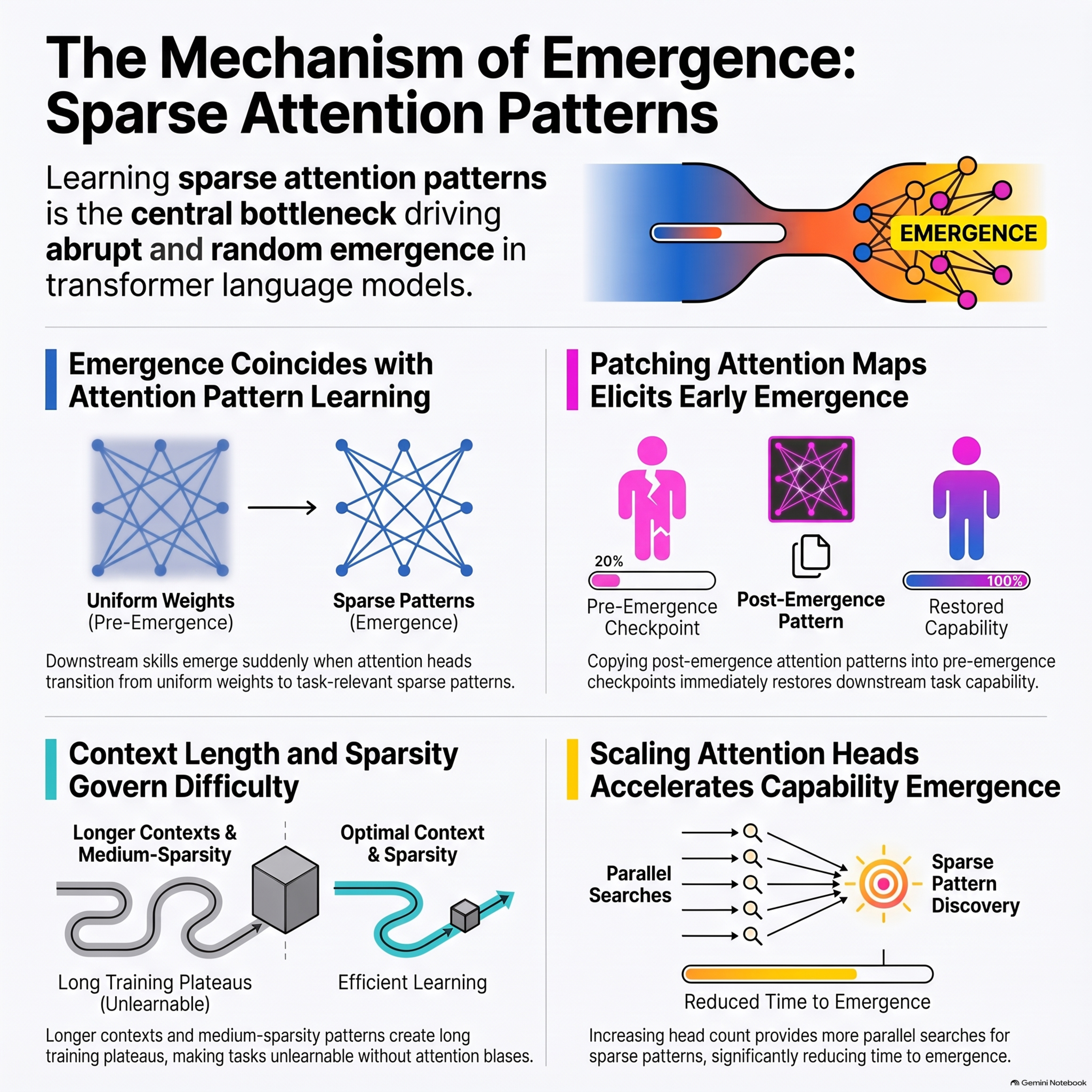
The episode explains “emergent capabilities” in transformer language models as abrupt, seemingly overnight skill gains caused by random alignment of attention patterns during training. It uses Pythia experiments to show emergence timing depends on random initialization seeds, not just model size or smooth loss curves.
(1) Specific skills’ accuracy stays near zero for thousands of steps, then spikes to near 100% in a tiny window while overall loss looks smooth only because many microskills spike at different times. (2) A causal “time travel” attention-map patch shows the model already had the needed knowledge; only attention wiring was missing. (3) Context length and medium sparsity make learning hardest.
in-context repetition (predict 9 after seeing 1–8), pattern completion (1 apple, 2 banana, 3 peach → 4), and indirect object identification (predict “Mary” in “John gave a drink to ___”).
No guest names or backgrounds are provided in the transcript.
Written by AI. May contain mistakes.
Learn about the Pythia model and its significance in AI research.
“And also why this process is totally random, which is the fascinating part.”
Discover how random initialization affects skill acquisition in AI.
“But the exact moment a specific skill clicks into place, that is completely tethered to that random starting seat.”
Explore the comparison between AI learning and a child's bike riding experience.
“Until it stumbles onto the precise mathematical configuration required for that specific skill.”
Understand how sudden learning spikes occur during training.
“The experiments tracked the AI's progression on a few highly specific tasks to see this.”
Examine why the overall training loss curve can be misleading.
“But wait, I have to push back on the math here for a second.”
Delve into the mechanics of attention mechanisms in neural networks.
“Okay, I want to get into the actual mechanics of that spike then.”
Explore the difficulties AI faces in understanding human language.
“The model needs a previous token head, which keeps track of the immediate past.”
Learn how varying context lengths affect the learning capacity of AI models.
“But imagine I take that exact same Waldo, and he doesn't get any bigger, but I put him on a page the size of a tennis court.”
Explore the challenges medium sparsity poses for AI learning and model performance.
“You want 128 rookie cops fanning out, looking everywhere at once.”
Discover architectural changes that enhance model performance in noisy environments.
“But when it comes to dynamic, context-dependent content mixing, transformers remain the undisputed kings.”
Understand the differences between MLP mixers and transformers in AI architectures.
“When they finally get on the bike, they don't wobble for weeks waiting for a random click.”
Learn about the concept of pre-pre-training and its implications for AI development.
“It might have been engineered from the very first synapse.”

Get the gist, explore an idea or ask about something said.
 Claude
On Best AI papers explained, what are the key points of this episode?
Searching your listeningAutomatic transcript. May contain errors.
0:00You know, we spend a lot of time on this deep dive talking about what AI can actually do, right? Oh, yeah, constantly. But there is this one phenomenon that has always felt a little bit like, well, like magic to me. I think I know exactly what you're talking about. Right? Yeah. Because, you know, we'll be watching a language model train, and for weeks it's just churning through data. And it's getting slightly better at predicting the next word. Uh-huh. It's a very slow grind. Exactly. It feels like this incredibly slow incremental grind. And then suddenly, literally overnight, it just acquires a completely new skill.
0:34Yeah, out of nowhere. It just wakes up and knows how to do something it absolutely could not do yesterday. It is deeply counterintuitive, honestly, because, you know, we are so conditioned to expect learning to be this gradual slope. Right, like getting 5 % better every day. Exactly. But in the world of neural networks, we often see these sheer cliffs. A model just goes from zero capability to complete mastery in a tiny fraction of its training time. And that random overnight jump is exactly what we are tearing apart today. So welcome to today's deep dive. We are going to unpack exactly what shifts inside a neural network when it suddenly gets a new skill.
1:13And also why this process is totally random, which is the fascinating part. Totally. So the mission here is to crack open the black box of these so-called emergent capabilities. We're looking at a ton of recent data and experiments today, specifically analyzing a suite of models called Pythia. Right. Okay, let's unpack this. Why Pythia? Well, the underlying mechanics here really challenge a lot of the assumptions we have about artificial intelligence. And the researchers use the Pythia model specifically because, well, because they are open source and they come in a really wide range of sizes.
1:48Okay. So they analyzed everything from tiny models with like 14 million parameters. And, you know, think of parameters as the artificial synapses, the connections in the AI's brain. Right, the basic building blocks. Exactly. All the way up to much larger 410 million parameter models. And they didn't just train one of each size, right? No, they didn't. They trained multiple versions of each size completely from scratch, feeding them the exact same data. Okay, so the exact same diet of Internet text and books. Yes. The only thing they changed was the random initialization seed. And just to clarify for everyone, the seed is essentially, it's a random number generator, right?
2:26Yeah, pretty much. It determines the very first blank slate configuration of all those artificial synapses before the model even reads a single word. Got it. And this is where the data gets weird, because larger models definitely learn these emergent skills faster on average. They do, yeah. But the exact moment a specific skill clicks into place, that is completely tethered to that random starting seat. It really is. I mean, you can have two identical 410 million parameter models. They are trained on the exact same data, and one might suddenly understand syntax on day 10. While the other one doesn't figure it out until day 20.
3:03It's wild. The hardware is identical, the data is identical, but the moment of emergence is literally just a roll of the dice. Which tells us that emergence isn't just a volume game, you know? What do you mean? Like, it's not simply about a model reaching a certain size or digesting enough text. It's actually about the network randomly shifting its internal connections over and over. Until it gets lucky. Until it stumbles onto the precise mathematical configuration required for that specific skill. Man, if it's just a random roll of the dice. I'm trying to picture what that actually looks like inside the data when the model finally hits the winning number.
3:40It's pretty dramatic. Behaviorally, I mean, it reminds me of watching a kid learn to ride a bike. Oh, that's a really good analogy. You know what I mean? you take them out to the driveway and for weeks it is just wobbling, it's falling over, scraped knees, lots of crying. Lots of crying. Right. And there is zero smooth progression. They don't get 5 % better at balancing every single day. They are at 0 % balance. Yeah, they just fall. But then one random Tuesday afternoon, something in their brain just clicks. They find the center of gravity, they pedal down the street and they just, they never forget how to do it.
4:19And the behavioral data from the AI perfectly maps to that. Really? Yeah. The experiments tracked the AI's progression on a few highly specific tasks to see this. Okay, what kind of tasks? One is in-context repetition. So you give the model a sequence, like the numbers one through nine. And then later in the prompt, you give it one through eight, and it has to predict the nine. Okay, simple enough. Another one is pattern completion, like a numbered list, one apple, two banana, three peach, and it needs to know that a four comes next. Oh, I see. Just basic logic continuation. Exactly. Then there is indirect object identification, which is a classic linguistics hurdle.
5:00How does that one work? You feed the model a sentence like, when John and Mary went to the store, John gave a drink to, and the model has to correctly predict, Mary. Oh, okay. So it has to understand the grammatical relationship. Right. It has to rule out John because he's the one giving the drink and pick the right person based on the structure of the sentence. And how do they perform on these? For all of these tasks, if you look at the model's probability of predicting the correct next token, so the 9, the 4, or Mary, that probability stays near absolute zero for thousands upon thousands of training steps.
5:36So it's just falling off the bike over and over. Exactly. Over and over. And then within this microscopic window of training steps, the probability violently spikes to near 100%. It just gets it. It just gets it. But wait, I have to push back on the math here for a second. Okay, sure. When we look at a model's overall training progress, like the main loss curve, it usually looks like this smooth ski slope going down, right? The overall error rate decreases steadily over time. Yes, the aggregate loss curve is very smooth. So if the model's overall loss is smoothly going down, how can these specific skills be violently flatlining and then spiking?
6:17That doesn't make sense. Ah, well, that smooth overall loss curve is actually an illusion. An illusion. Yeah. It is created by taking the average of thousands of these tiny abrupt microlearnings. Oh, wow. The model is constantly experiencing sudden spikes in capability, but it's happening across thousands of different isolated microskills at different times. So it's kind of like a stock market index? Exactly. Like the S &P 500 might look like a smooth, predictable upward curve over the course of a year. But underneath that surface, individual companies are violently skyrocketing or crashing on any given day?
6:55That perfectly captures the dynamic. The overall loss curve is just the index fund of the model's capabilities. Okay, that makes so much more sense. Right. But if you isolate one specific stock, like one specific skill, you see the violence of the spike. Okay, I want to get into the actual mechanics of that spike then. Moving from the behavioral analogy of the bike to the actual physical machinery of the neural network. What is physically clicking into place during that tiny window? Well, the core bottleneck here is that the model is learning task-relevant attention patterns. This is really the key to everything.
7:30Okay, so in practical terms, when we say attention, we are talking about the mechanism inside a transformer model, the thing that allows it to look at a whole paragraph and decide which words are mathematically most important to each other. Spot on, yeah. So when it tries to predict the next word, it uses attention heads, which kind of act like dynamic searchlights, right? Just scanning the previous text for clues. Yes. What's fascinating here is that the fundamental bottleneck holding the AI back from solving a task isn't knowledge. It's that it has to learn exactly where to point those searchlights.
8:03And to prove that this is the only bottleneck, the researchers ran a causal ablation experiment. Right. I saw this in the data. It's referred to as the time travel experiment, which sounds totally sci-fi. It really does. How did they actually pull this off? So they wanted to isolate the attention mechanism from the rest of the neural network. Okay. They took a model from after the emergence spike, so a model that had already learned how to solve the indirect object task, and they extracted its exact attention map. They recorded exactly how its searchlights were pointing and coordinating. Exactly.
8:36So they essentially took a snapshot of the post-emergence brain state. They took that snapshot, and then they time-traveled. Oh, man. They went back to an earlier checkpoint of that exact same model from before the emergence spike. When it was still failing. Right. At this point in the past, the model was still failing the task entirely. The researchers left all the other artificial synapses completely untouched, but they literally patched the future attention map into the past model's brain. They hotwired its attention mechanism. They hotwired it. And miraculously, the earlier failing model could suddenly solve the task perfectly.
9:12You're kidding. Nope. The spike in capability happened instantly without any further training. That is wild, because that proves the underlying neural machinery, like the vocabulary, the basic processing power, it was already sitting there in the past model. It was fully ready. It was completely capable of solving the problem. It was just paralyzed. Just waiting to randomly stumble onto the right place to shine its attention searchlights. That's exactly it. But wait, is it just one magic attention head that has to figure this out? Like, does one searchlight suddenly lock onto the word Mary and save the day?
9:51No, it's significantly more complex than that. The experiments found that to fully recover the performance in that time travel setup, they had to adjust the top 16 causal attention heads simultaneously. Sixteen. Yeah, often referred to as K equals 16 in the data. Okay, so 16 different searchlights, all having to click into the exact right formation at the exact same time. Yes. See, this is where the bike analogy breaks down for me. Because it's not just finding one center of gravity anymore. It's more like a bank vault with a combination safe. The combination safe is a much better mechanical analogy, honestly.
10:31Right. You have a vault with 16 different dials. And the network is just randomly spinning those dials during training. Just trial and error. And a few dials might temporarily land on the right numbers, but the vault doesn't open even a crack. The model gets zero reward, zero improvement in performance until all 16 dials randomly click into the exact mathematical alignment at the exact same fraction of a second. And that is precisely why the emergence takes so long and why it appears so violently abrupt when it finally happens. That makes total sense. Take the repetition task, for instance. Okay.
11:06The model needs a previous token head, which keeps track of the immediate past. And it also needs a copy head, which knows how to duplicate a token from earlier in the sequence. Oh, I see. These heads have to randomly initialize, slowly shift their mathematical weights through pure trial and error, and finally lock into the perfect configuration together. Here's where it gets really interesting, though. Yeah? Studying this dynamic in natural language is kind of a nightmare because human language is so messy. Oh, it is. There's no single ground truth map for how to understand a sentence about John and Mary, because grammar is subjective and contextual.
11:44Very true. So how do they isolate what makes finding these attention patterns so difficult? Well, to put this under a microscope, you have to strip away the ambiguity of human language completely. You have to move out of the wild and into the lab. Exactly. The researchers designed two highly controlled synthetic tasks. In these tasks, the perfect attention pattern is mathematically fixed and known in advance. Ah, the lab rats. The lab rats. The first synthetic lab rat is called a linear map task. Its goal is to compute bitwise parity from a sparse matrix. Whoa, okay, bitwise parity. Let me break that down for the audience because that sounds intense.
12:22Please do. In practical terms, that basically means the model is given a massive grid of zeros and ones. And it has a strict mathematical rule it has to follow. Right. It has to predict whether the sum of specific spots in that grid is even or odd. So it's told, to predict the next number, you only need to look at position 3, position 17, and position 42. Just ignore the hundreds of other numbers. Exactly. The model has to figure out exactly which specific spots to shine its searchlights on, out of an entire ocean of irrelevant noise. And the second lab rat is called cellular automata. Okay. This tests the model's ability to learn a lookup table for a local window.
13:02Think of it like a grid where a cell's survival or death in the next turn depends purely on the state of its immediate left and right neighbors. Oh, like Conway's Game of Life. Precisely like that. It's a perfectly fixed known attention pattern based on proximity. So by using these synthetic tasks, they could rigorously test what makes finding these patterns so agonizingly difficult for an AI. Yes. And they identified two primary culprits that make it so hard. Which are? Context length and sparsity. Okay. Let's tackle context length first. Because everyone in the AI industry right now is completely obsessed with giving models longer context windows.
13:41Oh, absolutely. Letting them process entire books or giant code bases all at once. But this data shows a massive hidden cost to that. It's basically the where's Waldo problem. The Waldo problem is a great way to frame it. Right, because if I give you a normal page of a Where's Waldo book, it takes a minute, but you find him. Your searchlight scan the page, you eliminate the noise, and you lock on. Sure. But imagine I take that exact same Waldo, and he doesn't get any bigger, but I put him on a page the size of a tennis court. Good luck. Right. The amount of irrelevant visual noise has just exploded.
14:14And we see that perfectly in the synthetic experiments. As they increased the state size, which is the context length, up to just 512 tokens, the linear map task went from being easily learnable to completely impossible. Wow. Just 512. Yeah. The model would hit a 10 ,000-step plateau where it made zero progress. It just flatlines. The mathematical feedback loop, the signal telling the model it was getting warmer or colder, completely degraded. It was paralyzed by the noise of the tennis court, totally unable to align at 16 dials. Okay, that makes sense. But the second variable, sparsity, is even weirder to me.
14:51How so? Because sparsity is basically how spread out the clues are in that grade of zeros and ones, right? Yes. You would intuitively think that a super sparse pattern, where you only have to find one or two clues, would be easy. And a highly dense pattern, where almost everything is a clue, would also be easy. You would think so. But the data shows the absolute hardest environment for an AI to learn is medium sparsity. Medium sparsity is the ultimate dead zone for a neural network. See, I picture medium sparsity like this. It's not finding Waldo on a blank tennis court. No. It's trying to find Waldo when he's hiding at a barber shop full of red and white striped candy canes.
15:30And all the barbers are wearing red and white striped shirts. That's a terrifying image, but yes. Right. There is just enough visual noise that shares the exact same shape and color as your target. It creates mathematical decoherence. The attention heads just thrash around. They constantly latch onto false signals that look almost correct. Which scrambles the combination safe just as it's about to open. Exactly. Okay, so if context length and medium sparsity are completely paralyzing these models, how do we fix the architecture? Well, we have to rewire the brain. Right, because we can't just run billion-parameter models for months and pray they randomly stumble onto the right candy cane.
16:09It's way too computationally expensive. Oh, the cost would be astronomical. So the most immediate architectural fix they looked at is scaling the width of the network. Scaling the width. What does that mean in practice? It means forcing the model to use significantly more attention heads. Even if you have to make each individual head smaller and less mathematically complex, they actually tested pushing the architecture up to 128 separate attention heads. Oh, wow. So it's like throwing more detectives at a cold case. Pretty much. If you have a massive, noisy crime scene, you don't just want one super detective with a magnifying glass taking three years to scan the room.
16:47You want 128 rookie cops fanning out, looking everywhere at once. Precisely. Because this is fundamentally a game of random initialization, having 128 independent searchlights vastly increases the probability that at least one of them will accidentally sweep across the correct pattern. And once one head finds the signal... The mathematical feedback loop strengthens rapidly, and the other heads can organize around it. That is so smart. It is. But the researchers didn't stop at just tweaking transformers. They threw a massive curveball into the experiment with an entirely different architecture.
17:21This was the part that really threw me. They introduced something called an MLP mixer. What actually is that, and why does it matter? So to understand the MLP mixer, you have to look at what a standard transformer does. Okay. A transformer uses dynamic dot product attention. Right. The searchlights. Yeah. Its searchlights move around based on the actual words, the content, its reading. An MLP mixer doesn't do that at all. It doesn't use attention. Not dynamic attention. No. It uses a static learned matrix. It hardwires its connections based purely on the physical position of the data. Wait. I'm trying to picture the difference between positional mixing and content mixing.
17:59If they are both just processing data, why does that distinction even matter? Think about it this way. A transformer uses content-based mixing. So if it's looking for the subject of a sentence, its searchlight scans for the word John, whether John is the first word in the sentence or the 20th word. It looks for the meaning. Right. But an MLP mixer uses positional mixing. It doesn't care what the word is. It just creates a permanent, hardwired mathematical bridge between, say, position three and position 17 in the sequence. Oh. So it's completely blind to the actual text. it just connects coordinates.
18:33Yes. And when they tested this MLP mixer on the synthetic lab rats... How did it do? The result was staggering. The MLP mixer learned the incredibly complex medium sparsity linear map task an order of magnitude faster than the standard transformer. An order of magnitude. It absolutely crushed the transformer at finding the hidden pattern. Well, yeah, because the relevant clues in a linear map are always in the exact same mathematical positions. Exactly. The MLP mixer doesn't get distracted by the barbershop full of candy canes because it isn't even looking at the candy canes. It just blindly connects coordinate A to coordinate B.
19:09You nailed it. So, wait, does that mean transformers are obsolete? Like, should we just build everything with MLP mixers now? Have we been doing this wrong? Not so fast. The researchers were very careful to test the limits of this. Okay. When they took that same high-performing MLP mixer and tested it on the cellular automata task, the game of life grid, it completely bombed. Really? It failed miserably. Why? If it's so good at math grids, why did it fail the game of life? Because the cellular automata task requires looking at local context that shifts dynamically depending on the state of the board.
19:44The relevant clues move around. A static positional matrix is completely blind to moving context. Oh, man. And human language is nothing but moving context. Exactly. The subject and the verb can be separated by a variable number of adjectives every single time you speak. Right. So the MLP Mixer proved that we can absolutely design faster, hyper-efficient architectures for specific fixed positional tasks. But when it comes to dynamic, context-dependent content mixing, transformers remain the undisputed kings. That makes total sense. Their greatest strength, those flexible dynamic searchlights, is also their greatest weakness because it takes forever for those searchlights to figure out where to point.
20:25It's a permanent tradeoff between flexibility and efficiency. It really is. So what does this all mean? We've looked at the random combination safes inside the neural network. We've seen the time-traveling attention maps, the expanding Waldo pages, and the difference between content and positional mix-in. We've covered a lot. For you, the listener, who is watching language models evolve at this crazy breakneck speed, what is the ultimate takeaway here? Well, the takeaway hinges on a final experimental hack that the researchers tried. It's called pre-pre-training. Pre-pre-training. Right. Or PBT.
21:01Right. Right. As if training a model for months wasn't expensive enough, now we have to pre-pre-train them. I know. It sounds redundant, but the theory behind it is brilliant. Okay, lay it on me. If the ultimate bottleneck to learning natural language is figuring out how to organize these complex 16-dial attention patterns, why don't we teach the model the underlying structure of attention before we ever show it a single human word? Oh, that is fascinating. But how do you teach attention without language? They took blank models and trained them purely on synthetic data first. Things like dyke formal languages, which are essentially just complex sequences of mathematically matched parentheses, or those cellular automata grids.
21:44So they force the attention heads to practice finding patterns, copying tokens, and identifying previous states in a perfectly clean, sterile environment? Exactly. They are training the network on pure logic puzzles. They are calibrating the searchlights. Calibrating the searchlights. And the preliminary evidence showed that when you take that pre-pretrained model, which now has a highly disciplined, well-structured set of dials, and then you feed it natural human language. The emergent capabilities happen significantly faster. Much faster. You completely bypass the random stumbling phase because the model already knows how to pay attention.
22:22Exactly. It's like teaching a kid the physics of gyroscopic balance on a sterile simulator before you ever put them on a real bicycle in traffic. That's a perfect way to look at it. When they finally get on the bike, they don't wobble for weeks waiting for a random click. They just apply the structure they already know, and they pedal. It fundamentally alters the timeline and the cost of AI development. We can engineer the foundation for emergence. And that leaves us with a truly provocative thought to mull over. Yeah. Up until now, the tech industry has treated AI emergence like a natural, uncontrollable phenomena, right?
23:00We scale up a model, we pour in mountains of data, and we just sit back waiting to discover what new skills it randomly stumbles upon overnight. Hoping for the best. Right? But if we now know that emergence is just a neural network randomly aligning its attention dials, and we now know how to pre-train those dials directly using synthetic logic puzzles, are we moving away from the era of discovering AI capabilities and entering an era where we can artificially inject these aha moments directly into the machine's brain? It completely reframes how we should view the next generation of models. It really does.
23:41Next time you see a language model suddenly acquire a magical new skill, remember, it might not be a random roll of the dice anymore. It might have been engineered from the very first synapse. Something to think about, for sure. Absolutely. Thanks for joining us on this deep dive. We'll see you next time.
This paper investigates why transformer language models display sudden, emergent capabilities during training by analyzing how they learn attention patterns. Through experiments on both real language models and synthetic tasks like linear maps and cellular automata, the authors demonstrate that acquiring downstream skills correlates with the abrupt mastery of sparse attention mechanisms. Furthermore, the study reveals that larger models overcome this learning bottleneck earlier because they acquire these essential attention maps more efficiently. The research also shows that activation patching can artificially trigger these capabilities at earlier training checkpoints, highlighting the crucial role that attention heads play in model performance.


