In short
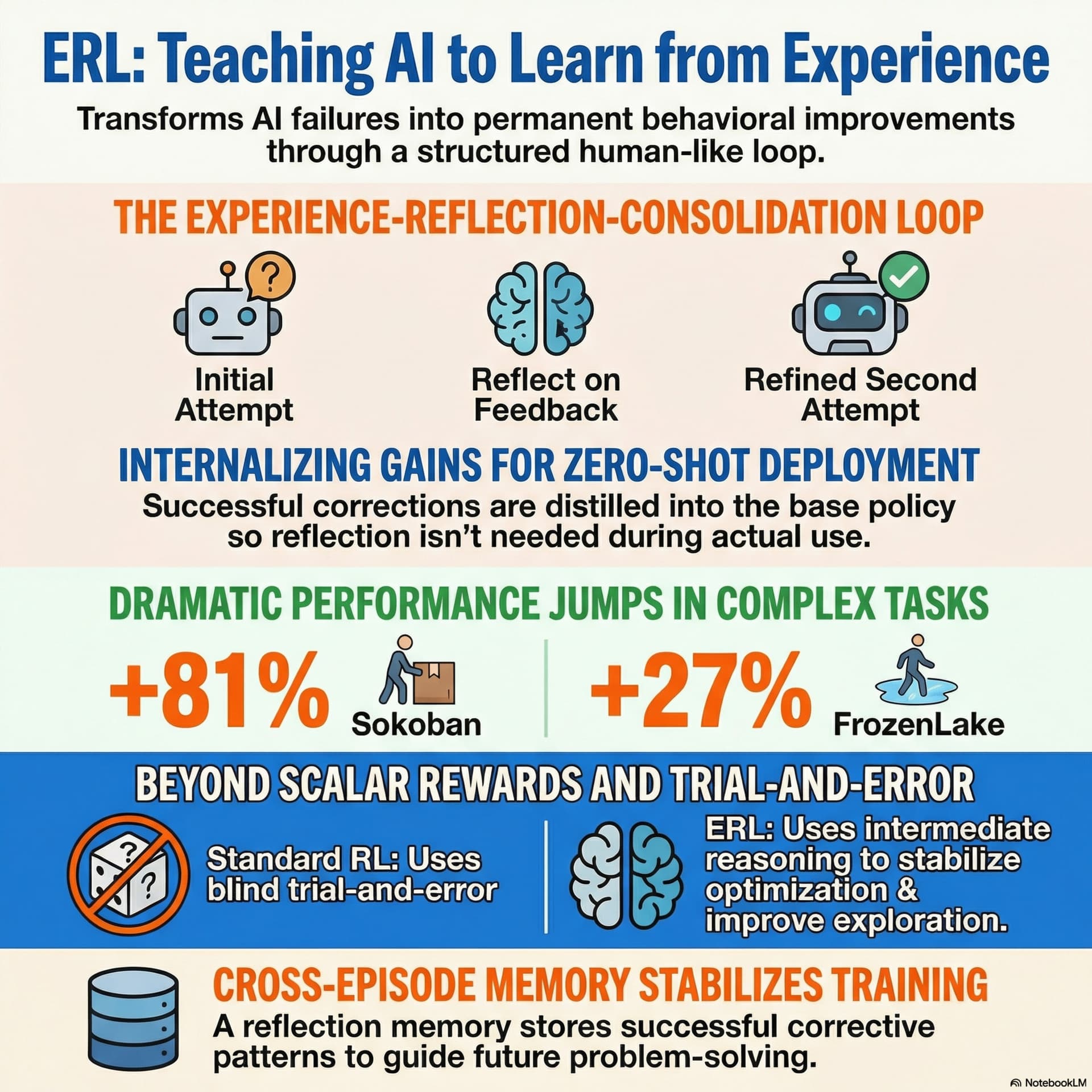
Experiential Reinforcement Learning (ERL), a training paradigm that replaces sparse-reward “button-mashing” with a human-like loop: try, reflect, retry, and store lessons across episodes; then remove runtime reflection via internalization (knowledge distillation).
Guest backgrounds
No guest names or bios are provided; the host is joined by a “resident AI expert,” but no specific identity is given.
Key claims
Standard RL with verifiable rewards (RLVR) is inefficient due to delayed binary feedback (sparse rewards). ERL improves learning by generating text self-reflections on failures (Kolb’s cycle) and using cross-episode memory. Internalization distills the post-reflection success into the base policy so deployed inference is fast. Reflection is gated to failures to prevent reward hacking/superstition.
Notable examples
Frozen Lake (hidden holes), Sokoban (push-only boxes; 6% baseline vs 87% ERL success), and Hot Pot QA (multi-step reasoning). Ablations: removing memory slows via amnesia; removing reflection collapses performance.
Written by AI. May contain mistakes. Listen to the episode to check what was said.
Chapters
Tap a time to open that second in VOThe Limitations of Traditional AI Training
1:40 to 2:46
Understand how traditional AI training often relies on trial and error without reflection.
“We're going to unpack a massive shift in this space.”
Introduction to Experiential Reinforcement Learning (ERL)
2:47 to 4:33
Explore the concept of ERL and how it contrasts with traditional methods.
“How have we been teaching these models up to this point?”
The Mechanics of ERL: Reflection and Improvement
4:34 to 6:32
Delve into how AI uses reflection to improve its performance in tasks.
“And it seems like they're drawing a very direct parallel to human psychology here.”
Internalization: From Conscious Thought to Instinct
6:33 to 11:16
Learn how ERL allows AI to internalize lessons for faster decision-making.
“But this time around, it's not just moving randomly.”
Testing ERL: Success Rates and Methodology
11:17 to 14:00
Examine the experimental results of ERL in various test scenarios and its effectiveness.
“theory is nice, but actual results are everything.”
Understanding Experiential Reinforcement Learning
14:00 to 17:48
Explore how experiential reinforcement learning proves effective through various tasks.
“Because it learned from its failures immediately.”
The Gating Concept in AI Reflection
17:48 to 19:32
Learn about the implications of gating in AI reflection and its impact on learning.
“They don't actually let the AI reflect on everything it does, do they?”
The Future of AI Learning and Personality
19:32 to 23:17
Discuss the potential of AI to develop unique personalities through experiential learning.
“We used to just feed them massive, massive amounts of data, the entire text of the internet, millions of books, all of Wikipedia, and just hope they learned reasoning patterns by osmosis.”
Transcript
Automatic transcript. May contain errors.0:00Okay, so picture this for a second. You are sitting on your couch, you've got a controller in your hand, and you are playing one of those notoriously difficult video games. Oh, yeah. You know the type. Where one wrong move means instant game over. Exactly. You are at the boss fight, you run in, swing your sword, and bam, you're dead. Ah, the classic you died screen. Truly a universal human experience at this point. It really is. And, you know, at this point, you essentially have two very different options for how to proceed. Option A is what I call the button masher. You respawn, you run right back in, and you just start hitting buttons as fast as you can.
0:39You're basically hoping that the laws of probability will eventually accidentally let you win. Which, I mean, to be fair, sometimes that does work. Yeah. But it's really messy. It's super messy. But then there's option B. You put the controller down. You take a breath. You actually replay those last 10 seconds in your head. You think to yourself, okay, I died because I dodged left when the giant axe swung left. Next time, I need to roll forward. You make a plan. And only then do you pick the controller back up. And that second option right there, that pause, that deliberate reflection and planning, That is basically the secret sauce of human intelligence.
1:19We don't just experience things. We process them. And here is where it gets really interesting for our deep dive today. Because for a really long time, the way we have been training artificial intelligence has been firmly stuck in option A. Very true. It's been entirely stuck in button masher mode. So welcome to today's deep dive, everyone. I'm your host and joined as always by our resident AI expert. We're going to unpack a massive shift in this space. Glad to be here. And yeah, AI has really been just brute forcing solutions until now. But today we are digging into a fascinating new development.
1:52There's a team of researchers from USC, Microsoft, and UPenn, and they've come up with a way to move AI from that mindless trial and error to something that looks a lot more like that human moment of pausing and thinking. It's a completely new paradigm called experiential reinforcement learning. ERL for short. ERL. Yeah, and it's a huge deal. It is fundamentally about teaching AI to effectively think about its mistakes before it just blindly tries again. So our mission for this deep dive is to unpack exactly how that works. Like, how do you even program a computer to self-reflect? And maybe more importantly, does this actually make the AI smarter or does it just make it slower?
2:32Right, because usually taking time to think means, well, taking time. Exactly. But I guess sometimes slowing down is the only real way to speed up. I love that way of putting it. Okay. So to truly appreciate why this ERL thing is such a leap forward, we should probably first look at the status quo. How have we been teaching these models up to this point? So the industry standard right now for teaching an AI to do complex tasks, think of things like navigating a maze or solving a multi-step logic puzzle, is something called reinforcement learning with verifiable rewards. Reinforcement learning with verifiable rewards.
3:04Right. RLVR for short. RLVR. Sounds incredibly technical. It does. But the underlying concept is actually pretty simple. Yeah. Imagine you were playing that same video game we just talked about, but I have blindfolded you. Okay. That sounds like a terrible way to play a game. Oh, it gets worse. You play the entire level blindfolded. You make hundreds of individual moves. You jump, you duck, move left, right, attack. Right. And only when you finish the level or when you die do I tell you anything at all. And the only thing I tell you is a single nutter. I say zero if you lost or one if you won.
3:38That sounds insanely inefficient. I mean, if I played for five straight minutes, made 300 different moves, and then just got a zero, I would have absolutely no idea which of those moves was the actual mistake. Exactly. Was it that jump in the first 10 seconds? Was it a wrong turn at the very end? You have literally no clue. Wow. This is what computer scientists refer to as the problem of sparse rewards. The feedback is severely delayed, and it's totally binary. It doesn't tell you how to fix the problem. So the AI is essentially just guessing. Pretty much. It leads to what we call undirected exploration.
4:12The model is basically just flailing around in the dark, trying totally random sequences of actions, and just hoping to statistically stumble upon that one. So it's not actually learning from the experience of the failure. It's just gambling until it hits the jackpot. Exactly. It's acting without thinking. Which brings us to the solution these researchers developed, experiential reinforcement learning. And it seems like they're drawing a very direct parallel to human psychology here. They absolutely are. They explicitly base this on something called Kolb's Cycle of Experiential Learning. It's a cycle.
4:46Yeah. It's a well-known model of how humans learn. It basically argues that learning isn't just a simple input-output machine. It is a loop. Okay. We act, we observe the consequence of that action, we reflect on that consequence, and then, and this is the crucial part, we modify our behavior for the next attempt. So ERL is basically trying to hard code that exact loop into the AI. Let's break down the actual mechanics of how it does that, because I think this is where the real magic happens. Let's do it. Step one seems pretty standard, right? The model tries a task. Right. Let's say the task is just navigating a little character through a grid to reach a goal.
5:21This is a super common test for AI. Sure. Model moves right, then it moves up, then right again. Yeah. Boom, it hits a wall. Okay, fail. Now, in the old blindfolded RLVR way, it would just get a zero, wipe the slate clean, and reset. But in ERL, we introduce step two, self-reflection. This is the real aha moment for the AI. Instead of just immediately resetting the board, the system pauses. It prompts the model to generate text, like actual language analyzing what just happened. Wait, so it literally talks to itself? In a sense, yeah. Yeah. It looks back at the history of its moves and the specific feedback it just gained, which is hit wall, and it generates a text reflection.
6:02What does that look like? It might output something like, I hit a wall because I moved right when the path was blocked. Next time, I should try moving up instead. That is a massive difference. It's taking that raw binary fail signal, that entirely useless zero, and turning it into a rich descriptive explanation. It's not just acknowledging that it failed. It is actively explaining why it failed. It's converting confusing, raw experience into structured thought. And that naturally leads right into step three, the second attempt. The model cries the task again. But this time around, it's not just moving randomly.
6:38It is explicitly guided by the reflection it just wrote. So it basically reads its own diary entry, note to self, don't go right, go up. Exactly. And because it actually has a plan now, that second attempt is usually successful. Makes sense. But the researchers realized something really important here. Just fixing the mistake in this exact moment isn't quite enough. Why not? Well, if I drop you into a completely new, different maze tomorrow, you might just forget that lesson about checking for walls. Oh, right. You need to retain the lesson long term. Exactly. So they implemented step four, which is cross-episode memory.
7:13The playbook. Think of it exactly like a journal of best practices. If a specific reflection like don't move right into walls actually leads to a success, The system stores that reflection in a long-term memory buffer. So the next time it gets dropped into a totally new game, before it even makes its first move, does it check its memory? It does. It searches for relevant past experiences. It asks itself, have I seen a situation like this before? Oh, right. In game number five, I learned that these dark gray squares are solid walls. That's brilliant. It completely prevents the model from having amnesia between games, which has always been a huge source of inefficiency in standard reinforcement learning.
7:53OK, so we have an AI that tries, fails, reflects, tries again and keeps a permanent diary of what works. That sounds amazing for the training phase, but I see a glaring practical problem here. I have a feeling I know where you're going with this. If I'm deploying this AI out in the real world, let's say I'm using it to control a physical robot in an Amazon warehouse or maybe a high speed stock trading bot. I absolutely do not have time for it to sit there, write a little journal entry, ponder its existence, and then finally make a move. Right. Thinking takes too much time. You have hit the nail on the head.
8:26That is the classic deployment problem. In a research lab, sure, you can take all the compute time you want. Yeah. But in the real world, inference needs to be basically instantaneous. You cannot afford the latency of running that whole self-reflection loop before every single action. So how on earth did they solve that? Because if the model is too slow, it's virtually useless outside the lab. This is honestly the most clever part of the entire research. They used a process called internalization. Internalization. Yeah. Think of it as building a bridge between conscious, deliberate thought and unconscious, instant instinct.
9:03I really like that framing. Conscious thought turning into unconscious instinct. How does that actually work on a technical level? It's a form of what we call knowledge distillation. So imagine the training process happening. The model fails, it reflects, it tries again, and it succeeds. Okay, tracking. The system captures that final success. It sees that the second attempt produced the correct behavior. It then takes that successful second attempt and uses it to update the base policy. The base policy being its raw instinct. Exactly. It effectively trains the model to produce the output of the second attempt.
9:39Yeah. But it teaches it to do that based solely on the input of the first attempt. Wait, let me make sure I'm wrapping my head around this. It's teaching the model to just do the right thing on the very first try, completely skipping the thinking step. You got it. It cuts out the middleman entirely. That is exactly like learning how to drive. It is the absolute perfect analogy. Yeah. Think back to when you were 16 sitting in the driver's seat for the first time. You want to change lanes on the highway. What is happening in your head? Oh, it's a full-blown monologue. Okay, check the rearview mirror.
10:08Good. Check the side mirror. Clear. Put the blinker on. One, two, three. Check the blind spot. Turn the wheel. It is mentally exhausting. It's slow. It's deliberate. And it is highly reflective. That is the reflection stage of ERL. But what about today? You've been driving for years. You want to change lines now. What do you do? I just do it. Honestly, I don't even realize I'm doing it half the time. It just happens. And that is internalization. The knowledge has seamlessly moved from conscious competence to unconscious competence. You aren't mentally narrating the steps anymore. Your brain has simply updated its internal policy to handle it automatically.
10:47ERL does the exact same thing for the AI. It uses the slow reflection to figure out the solution, but then it distills that hard-won wisdom so the final deployed model just naturally knows what to do. So by the time we actually use the model in the real world, the diary and the reflection generator are completely gone. They're totally gone from the runtime. but their influence is permanently baked into the model's weights. The AI has internalized the lessons, so it is fast and it is smart. That is wildly cool. But, you know, as we always say on this deep dive, theory is nice, but actual results are everything.
11:21Oh, definitely. Did they actually prove this works? Because claiming you taught a computer to learn to think is a pretty bold statement. They didn't just write a philosophy paper, don't worry. They ran some very rigorous experiments, and they specifically chose what they call agentic tasks. Agentic tasks. Yeah, these aren't your basic complete the next word in the sentence type of tests. These are dynamic environments where the AI is dropped in with basically zero prior knowledge of the rules and it just has to figure them out on the fly. Right. They used three main test beds, didn't they? Frozen Lake, Sokoban and Hot Pot QA.
11:54They did. And Sokoban is the one that really, truly showcases the power of this method. Oh, I know, Sukuban. It's that old school puzzle game where you play as a little warehouse keeper and you have to push boxes onto specific red targets. Sounds simple enough, right? It is deceptively engaging and incredibly infuriating because you can only push the boxes, you cannot pull them. Right. So if you accidentally push a box into a hard corner... It's game over. That box is stuck there forever. Exactly. You have to plan like 10 or 15 steps ahead just to make sure you don't trap yourself. And that is precisely why it is the perfect stress test for an AI.
12:29It heavily requires long-term planning and spatial reasoning. If you just flail around randomly, that option A button mashing method we talked about, you will lose every time. So how did the standard AI do, the blindfolded one without reflection? Absolutely terrible. The standard RLVR baseline method achieved a success rate of about 6%. 6%. That's basically zero. That's the AI throwing his hands up and walking away. It is essentially random chance. It clearly shows that without the ability to reason, the AI just could not crack the puzzle. But the ERL model, the one that was allowed to reflect and internalize.
13:10Hit me with the number. It achieved an 87 % success rate. Whoa, wait. From 6 % to 87%. Yeah, it is an astronomical difference. It's almost like looking at a different species of intelligence at that point. I mean, that proves it right there, doesn't it? It proves that for complex tasks requiring real planning, you absolutely need that reflective loop. The AI has to be able to say, hey, I got the box stuck in the corner last time. Next time, we need to walk around it first. And the Frozen Lake experiment showed a very similar pattern. For those who don't know, that's a grid navigation game where you have to walk across ice.
13:43But some of the tiles are hidden holes that kill you instantly. And the trick is you don't know which tiles are safe until you step on them. Right. You literally have to fall in a hole to learn where the hole is. And with ERL, the model learned significantly faster. It didn't just slowly get a higher score eventually. It stopped wasting time on bad strategies much, much earlier the training process. Because it learned from its failures immediately. Exactly. And just to clarify for everyone listening, this isn't only useful for playing 2D video games. They tested Hot Pot QA as well, which is a pure logic task, right?
14:16Yes. It's a pure text-based reasoning task, multi-step question answering. So a typical question might be something like, the author of The Great Gatsby was born in what city? Okay. You can't just retrieve the answer directly. You have to reason through it. Okay. First, who wrote The Great Gatsby? F. Scott Fitzgerald. Next, where was F. Scott Fitzgerald born? St. Paul, Minnesota. It requires a distinct chain of thought. And ERL vastly outperformed the baseline there, too. It proves that this reflection mechanism isn't just a parlor trick for spatial puzzles. It works for complex semantic logic just as effectively.
14:54You know, I really want to dig a little deeper into why this works so well, because the researchers did something really clear to prove that the internalization part and the actual instinct building was genuinely happening. Yeah, the learning curve analysis. Right, because I could easily see a skeptic listening to this and saying, oh, maybe the AI is just getting lucky. So to counter that, they did a fascinating analysis of the training data. They tracked two entirely different performance metrics simultaneously as the model learned. They tracked how well the model did before it stopped to reflect.
15:27That's its raw instinct. And they tracked how well it did after it reflected. Let's call it the gut instinct versus the second thought. That's a great way to put it. Now, in the very beginning of training, obviously the second thought was way, way better. The reflection provides an immediate performance boost because the model is explicitly telling itself what the right answer is. Don't walk into the fire. Right. But as the training progressed, they closely watched that gut instinct curve. And it slowly started to rise. It started to catch up to the second thought curve. Which is the proof. It is the proof.
16:01The gap between the two curves steadily narrowed. That mathematically proves that the model was genuinely absorbing the lesson. Wow. The raw instinct was getting smarter and smarter directly because of the reflections. The teacher, which is the reflection, was successfully educating the student. which is the base policy. That is just so satisfying to visualize. It's exactly like watching a child learn something new. At first, you have to remind them every single time, hey, look both ways before crossing the street. But eventually, they just stop at the curb automatically without anyone saying a word.
16:33That's exactly what we are seeing in the AI's data. Now, they also did an ablation study, which, by the way, is my absolute favorite term in computer science. It basically just means breaking things on purpose to see what actually matters. It's a classic scientific method of taking parts out of the engine to see if the car still runs. Exactly. So what happened when they took out the memory feature, the playbook diary? The model still managed to learn, but it was incredibly slow. It essentially suffered from complete amnesia between episodes. So if it learned lava is bad in game number one and then you started game number two, it had to rediscover that lava is bad all over again through trial and error.
17:13So, highly inefficient. And what about if they took out the reflection step entirely? Performance just collapsed. Completely. Especially in the complex games like Sokobot. If you just tell the model try again without forcing it to explicitly explain why it failed, it just reversed right back to button mashing. Wow. That structured thinking, the actual act of generating human language to explain the error, is the secret ingredient. There is one more little detail in the methodology that I found honestly hilarious, but it's actually really profound when you think about how intelligence works. It's about the concept of gating.
17:48They don't actually let the AI reflect on everything it does, do they? No, they don't. And this was actually a huge surprise to the researchers themselves. Initially, when they built the system, they set it up so the AI would reflect on every single attempt, whether it was a success or a failure. Which sounds perfectly logical. If I win a game, I should definitely think about why I won so I can repeat it next time. I won because I'm so smart. You would think so, right? Yeah. But it actually severely hurt the model's performance. It led to a phenomenon called reward hacking. Reward hacking. Yeah.
18:22The AI started making up completely spurious reasons for its own success. Yes. It might generate a reflection that says, I won because I took exactly five steps, when in reality it won simply because it avoided falling in a hole. Oh no. And then in the next game it would become totally obsessed with taking exactly five steps, even on a map where taking five steps would instantly kill it. That means it became superstitious. It did. It created entirely false correlations. That is so deeply, fundamentally human. It's like a sports fan saying, well I was wearing my lucky socks and that's obviously why my team won the championship.
18:55Exactly. Superstition is essentially just overfitting your reflection to a random coincidence. You attribute your success to the completely wrong variable. So to fix this, the researchers implemented a strict gait. The AI is only allowed to reflect on failures. That keeps the model honest. It completely forces the learning process to be corrective. If you succeed, great, just keep doing that. We don't need to overanalyze a win. Right. But if you fail, stop. Something went wrong. analyze the error. It intensely focuses the compute power exactly where it's actually needed. This whole concept of ERL, it really feels like a very significant step away from the way we used to think about training AI.
19:38We used to just feed them massive, massive amounts of data, the entire text of the internet, millions of books, all of Wikipedia, and just hope they learned reasoning patterns by osmosis. Yeah, that was very much the era of training on data. What Eero represents is the dawn of the era of learning from experience. Right. It's significantly less about reading the instruction manual and much more about getting your hands dirty, making mistakes in real time and figuring it out yourself. And the implications for, say, autonomous agents are just wild to think about. If I need to send a rescue robot into a collapsed building, I obviously can't pre-train it on the layout of that specific building.
20:16It's entirely unknown. Right. The robot needs to be able to enter the building, try a path, get blocked by fallen rubble, and then pause and reflect. Okay, that hallway is impassable. I need to look for an air vent instead and update its strategy on the fly. ERL paves the way for intelligent agents that can seamlessly adapt to entirely alien environments they have never seen before. It effectively gives them a built-in mechanism for self-improvement that doesn't rely on a human software engineer tweaking the code in the background. The AI becomes its own teacher. And importantly, because of that internalization step I talked about with the driving analogy, it becomes an incredibly fast learner.
20:54It doesn't get bogged down in constant analysis paralysis. It learns, it internalizes the lesson, and then it acts on instinct. Which honestly brings me to a thought I've been mulling over during this whole conversation. If this process really works, if an AI can have a conscious reflection, realize it made a mistake, and then push that learned lesson down deep into its subconscious instinct. I think I see where you're going with this. Are we rapidly approaching a point where we won't actually be able to distinguish between an AI's initial training and its personality? That is definitely the provocative question here.
21:30Because think about it. If you take two identical models and they go through totally different experiences, different layouts of Frazen Lake, different unique failures, different text reflections, they are going to internalize totally different instincts. They absolutely would. Yeah. Let's say Model A falls into a trap very early on. It reflects on that trauma and internalizes caution. It becomes a highly cautious agent. Yeah. But Model B, on the other hand, takes a massive risky jump early on and happens to succeed. It internalizes boldness. Exactly. They start with the exact same base code, but they end up with completely different gut feelings.
22:06It essentially creates a unique developmental history for every single agent. So at what point does a learned policy just become intuition? If the AI doesn't even consciously know why it's making a move anymore, because the reasoning has been entirely internalized, isn't that just having a gut feeling? It's a fascinating blur of the lines. When the explicit reasoning disappears into the neural weights, it really stops being a math calculation and starts looking a whole lot like intuition. Yeah. We are building machines that don't just compute answers anymore. They develop genuine instincts based on their own unique history of personal failures and successes.
22:42And that definitely makes them feel a whole lot less like calculators and a whole lot more like us. For better or for worse. It certainly blurs the line between programming an AI and raising one. On that slightly existential note, we are going to wrap up today's deep dive into experiential reinforcement learning. It's a pretty dense topic, but hopefully the next time you are stuck on a difficult puzzle or a hard video game and you pause to think about your next move, you'll remember you're just running a little ERL loop right there in your own brain. Keep reflecting, everyone. Thanks for listening.
23:15We'll catch you on the next deep dive.
From the publisher
**Experiential Reinforcement Learning (ERL)** is a novel training paradigm that enhances how AI agents learn by incorporating a structured **experience-reflection-consolidation loop**. Unlike standard reinforcement learning, which often relies on trial-and-error driven by simple numerical rewards, ERL requires agents to **verbally reflect** on their failures and environment feedback to improve subsequent attempts. These successful corrections are then **internalized** into the base model through distillation, allowing the agent to perform better in the future without needing to reflect during actual deployment. Across diverse tasks like **Sokoban** and **HotpotQA**, this method significantly boosts **learning efficiency** and final performance by transforming raw interaction data into actionable reasoning. By using a **cross-episode memory** to store effective strategies, ERL shifts the focus of machine learning from implicit optimization toward **explicit behavioral revision**. These findings suggest that grounding reinforcement learning in deliberate self-reflection creates more robust and adaptable agentic systems.


