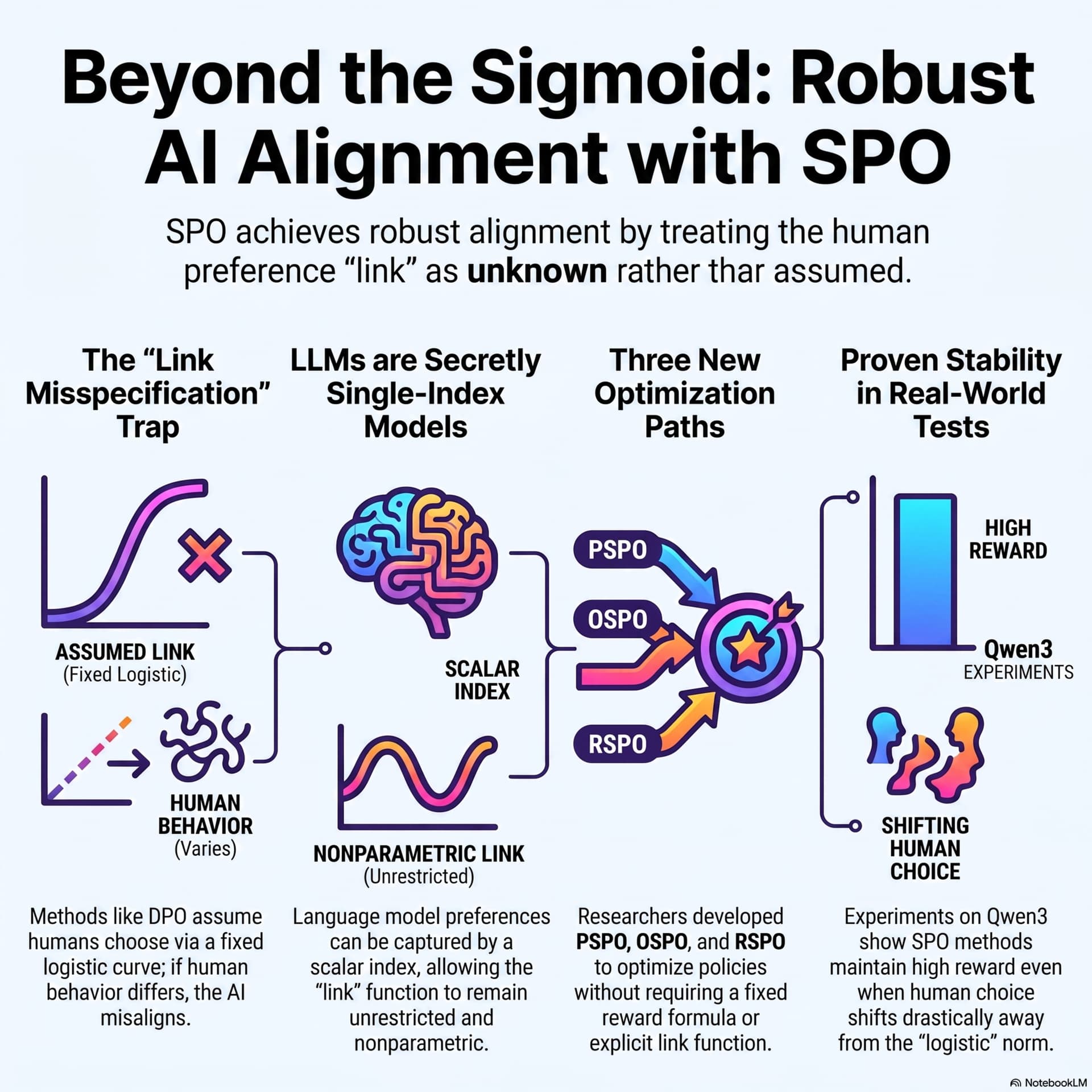

In short
How AI preference-alignment methods (used in chatbots via RLHF/DPO) can fail when they assume a fixed logistic “link function” for human choices, and how semi-parametric preference optimization (SPO) avoids this misspecification.
Key claims
DPO’s Bradley-Terry logistic assumption can infer the wrong latent rewards, especially for nuanced preferences; SPO replaces the rigid link with an unrestricted one.
Notable examples
forced binary personality-test analogy; pizza vs burger choice; car vibration diagnostic analogy; synthetic misspecification shift from 0 to 1.5 where DPO performance drops.
Guests
No guest names or backgrounds are provided in the transcript—only two unnamed speakers/hosts discussing the research.
Written by AI. May contain mistakes. Listen to the episode to check what was said.
Chapters
Tap a time to open that second in VOUnderstanding Preference Optimization
0:59 to 2:41
Exploring the frameworks of semi-parametric preference optimization in AI.
“We have a really fascinating stack of recent research in front of us, merging econometrics and AI alignment.”
Direct Preference Optimization Explained
2:41 to 4:35
Discussion on the direct preference optimization method and its assumptions.
“So to set the stage, the current industry standard for aligning AI is a method called direct preference optimization, or DPO.”
The Problem with Misspecification
4:35 to 6:04
Examining how misspecification affects AI alignment and human choice.
“Misspecification, meaning the fundamental map we are using to navigate is drawn wrong.”
Econometrics Meets AI
6:04 to 7:17
How econometrics from the past informs current AI training methods.
“When the space of possible preferences gets highly dimensional, forcing all human choices through a single rigid equation creates an artificial ceiling on how well the AI can truly align with us.”
The Semi-Parametric Model Explained
7:17 to 9:01
Breaking down the semi-parametric single index binary choice model.
“I am going to need you to translate that.”
Profiled SPO and Its Challenges
9:01 to 10:59
An exploration of PSPO, its benefits, and its rough loss surface issues.
“When you interact with a highly aligned AI in the near future, it will be because it stopped making rigid assumptions about how you value things and started learning your actual shape.”
Introducing OSPO: A New Approach
10:59 to 14:00
Discussion on OSPO and its innovative method to stabilize AI learning.
“The great thing about PSPO is its mathematical consistency.”
Understanding Quadratic Sensitivity
14:00 to 15:00
Learn about quadratic sensitivity and its impact on AI policy errors.
“Quadratic sensitivity sounds terrifying to me.”
Exploring RSPO Methodology
15:00 to 16:32
Discover the RSPO method and its focus on ranking over estimation.
“Yes, RSPO, which stands for Ranking SPO.”
Performance Comparison of Methods
16:32 to 18:25
Examine how different methods perform in controlled experiments.
“We have PSPO smoothing the bumpy rug, OSPO doing the elegant fractional math to vanish the static, and RSPO comparing the comparisons to bypass the mess altogether.”
Show all 14 chapters
Real-World Testing Challenges
18:25 to 19:45
Understand the challenges faced by methods in real-world applications.
“They took the QUIN3 model, specifically a 0.6 billion parameter reference model.”
RSPO as the Practical Solution
19:45 to 20:37
Learn how RSPO proved to be a stable and robust method in practice.
“RSPO, implemented as pairs of pairs DPO, emerged as the pragmatic hero.”
The Future of AI Mathematics
20:37 to 20:58
Explore the shift towards flexible mathematics in AI development.
“The next leap in artificial intelligence isn't just going to be about plugging in more GPUs or hoarding more training data or building bigger models.”
Philosophical Implications of AI Learning
20:58 to 22:02
Discuss the implications of AI learning human preferences without rigid formulas.
“It represents a fundamental shift in machine learning architecture, really.”
Transcript
Automatic transcript. May contain errors.0:00You know when you take one of those online personality tests and it just totally forces you to choose between two extreme statements Like you have to definitively click either I am the life of the party or, you know, I prefer to hide in a cave. Oh, yeah. The classic forced binary choice. It leaves absolutely no room for context. Exactly. And you're sitting there at your keyboard thinking, well, I mean, it really depends. Like, is it a Tuesday? Do I actually know anyone at this party? Am I just, you know, hungry? But the test doesn't care about your internal state. it forces your very messy, highly contextual human reality into this rigid little checkbox.
0:38Right. It creates this illusion of precision. We intuitively prefer things to be mathematically clean, you know, to fit on a neat little graph, even when the subject we're measuring, which is human behavior, is just inherently messy and unpredictable. And that exact tension, that friction between human messiness and mathematical checkboxes is exactly what we are unpacking for you today. So welcome to today's Deep Dive. If you're a curious learner trying to understand the invisible mechanics shaping our technology, you are in the exact right place. We have a really fascinating stack of recent research in front of us, merging econometrics and AI alignment.
1:12And our mission today is to explore this massive mathematical breakthrough in how artificial intelligence learns from human preferences. We are diving into a cutting edge framework called semi-parametric preference optimization or SPO. Yeah. And what's really fascinating about this research is that it directly impacts the chat box and digital assistants you interact with every single day. Right. Modern AI feels so conversational and intuitive, largely because it undergoes a training process called reinforcement learning from human feedback or RLHF. Which is everywhere right now. Exactly. Essentially, during training, human testers are shown two AI responses and they're just asked to give a thumbs up to the better one.
1:51Over millions of iterations, the AI learns to sound more human. But according to the research we're looking at today, there is a massive catch to that whole process. A very foundational one, yes. There is a hidden assumption baked into exactly how that human feedback is processed mathematically. It's an assumption that might be silently biasing how AI aligns with our actual goals. So today, we are tearing down that assumption and looking at the solution. So whether you are here to, you know, stay ahead of the curve on AI development or you just love a really satisfying aha moment, stick around.
2:27Because by the end of this deep dive, you are going to understand how a mathematical concept connects the most advanced neural networks of today with, of all things, 1970s economics. It's quite the journey. It really is. OK, let's unpack this. To understand this breakthrough, we first have to understand the invisible flaw in how large language models are currently trained. Right. So to set the stage, the current industry standard for aligning AI is a method called direct preference optimization, or DPO. In DPO, the AI doesn't just record what you chose. It actually tries to reverse engineer a hidden latent reward value for that choice.
3:03Okay, let's define latent reward really quickly so we don't lose anyone. That's essentially the unseen internal score the AI assigns to a response, right? It's trying to figure out the exact point value of your thumbs up. Yeah, that's a really good way to look at it. But to calculate that score, DPO relies on something called a known link function. A known link function. Right. Specifically, it uses something called the Bradley-Terry model, which relies on a logistic link. Basically, this model assumes that human preferences neatly follow a very specific mathematical curve. It assumes that if you pick response A over response B, the probability of that choice can be perfectly translated into a raw numerical reward using one predefined equation.
3:46Okay, wait, let's make this real. Is this like assuming that every time I choose, say, pizza over a burger for dinner, my brain is strictly calculating that the pizza is precisely 10 % better on some objective utility scale? Exactly. But in reality, it might just be a random craving because I saw a pizza commercial five minutes ago, right? It feels like we are forcing human messiness into a rigid mathematical box. You're on the exact right track, yeah. Mathematically, it looks a bit different, but the Bradley-Terry model basically states that the chance of you picking pizza over a burger is entirely determined by the distance between their absolute true values.
4:21So it's very literal. Right. If pizza's a 10 and a burger's an 8, it predicts you'll choose pizza with a very specific rigid probability. But as you pointed out, human choice is influenced by thousands of invisible variables. By forcing all that complexity into a predetermined logistic curve, we run into the danger of what statisticians call misspecification. Misspecification, meaning the fundamental map we are using to navigate is drawn wrong. Precisely. Think of it like this. If you are trying to understand why a car is vibrating at high speeds, but your diagnostic software strictly assumes all vibrations must come from the tires.
4:58You'll never even look at the engine. Exactly. You will never discover the failing transmission. If the AI assumes the wrong link function, if it assumes your choice perfectly mapped to that neat logistic curve when it actually didn't, it infers the wrong latent reward. And if it infers the wrong reward, it ultimately learns the completely wrong policy. OK, but I have to push back here for a second. DPO is the industry standard right now. We all use these large language models. And honestly, they are pretty great. I mean, they write code, they draft emails, they summarize huge documents for us.
5:30Does this misspecification really matter that much in practice? It's a completely fair question. And for basic tasks, DPO actually works wonderfully. If you just want an AI to write a polite email, a rigid logistic curve is a, well, it's a good enough approximation of human preference. But as AI tackles more complex, nuanced, and subjective tasks, think about reasoning through complex legal arguments or creative writing or navigating cultural sensitivities, that mathematical shortcut begins to crack. Because the nuance of human preference doesn't fit on a simple curve. Exactly. When the space of possible preferences gets highly dimensional, forcing all human choices through a single rigid equation creates an artificial ceiling on how well the AI can truly align with us.
6:17So the training wheels are going to snap off as we go faster and demand more from these models, which I guess sets up the need for a radically different approach. If forcing a known mathematical link is dangerous, how do we train the AI without it? And here's where the research gets incredibly interesting. Because the answer to this cutting-edge AI problem doesn't actually come from computer science. Right. It comes from classical econometrics. Okay, so we're going back to the 70s. We are. Specifically, the study of discrete-choice models from the 1970s and 80s. Decades ago, economists were trying to model how commuters choose between taking the bus or driving a car.
6:53And they ran into this exact same problem. They realized they couldn't force commuter choices into a perfect curve. Exactly. The AI alignment researchers essentially took that old econometric revelation and applied it to neural networks. They demonstrated that aligning an AI policy naturally induces what is called a semi-parametric single index binary choice model. OK, wow. I am going to need you to translate that. Semi-parametric single index binary choice model. That is quite the mouthful. It is dense, I know. Let's break it down, starting with single index. In an AI model, you have an incredibly complex web of data.
7:32You've got the user's prompt, the surrounding context, the exact phrasing, the tone of the two generated responses. Just a mountain of variables. Right. Single index means that all of those multidimensional dependencies can be mathematically boiled down and captured by one single dynamic scalar value. That value is the index. Oh, I see. So a massive web of data gets funneled down into one single highly concentrated number that represents the core difference between the choices. Right. Now for the semi-parametric part. In previous models like DPO, we took that index and forced it through a parametric curve like the logistic link we just talked about.
8:04We parameterized the whole thing. We boxed it in. Exactly. Semi-parametric means we only define part of the model, the index, and we leave the rest of the preference distribution completely unrestricted. It's unknown. We don't have to guess the mathematical shape of human choice anymore. We just let the raw data dictate its own shape. Okay, I think I've got a way to visualize this. It's like building a house where the foundation, the index, is poured perfectly out of concrete. It's structurally sound and it holds all the weight. But instead of building rigid wooden walls that might snap in a hurricane, the walls, which would be the link function, are made of a flexible adaptive fabric that just shifts based on which way the wind blows.
8:46That is a fantastic way to conceptualize it, actually. The foundation is mathematically rigorous, but the structure built on top of it is entirely adaptable to the environment. It completely sidesteps the misspecification trap because there is no rigid wall to break. Which brings us back to you, the listener. If you're using a future version of your favorite AI to help you draft an incredibly sensitive email to your boss, you wanted to understand the nuance of your specific intent, not just map your prompt onto a 1970s logistic curve. When you interact with a highly aligned AI in the near future, it will be because it stopped making rigid assumptions about how you value things and started learning your actual shape.
9:26It is a massive theoretical victory. But, as any engineer will tell you, a beautiful theory on a chalkboard is very different from functional code. Right. Knowing that we can use an unrestricted link is great. But how do developers actually code this flexible fabric into a massive neural network containing billions of parameters? The SPO framework provides three distinct mathematical learners to actually implement this theory. So let's look at the first one, PSPO, or profiled SPO. How does it work? Well, PSPO relies on a method called profiling the likelihood. To avoid guessing the curve, it uses a specific algorithm known as POVA, which stands for the Pool Adjacent Violators algorithm.
10:05Wait, Pool Adjacent Violators? That sounds like a neighborhood watch program. It does sound a bit aggressive, doesn't it? But mathematically, it's quite elegant. Essentially, it maximizes the fit over all possible monotone functions. Let's pause there. Monotone functions. I know monotone is a boring voice, but in math, that just means a line that is always moving in one general direction, right? Like it never reverses course. Correct. In this context, a monotone function just means that as the quality of an AI response goes up, the probability of a human choosing it must also go up or at least stay flat.
10:40It can't go down. That makes sense. Right. And PIVA enforces this rule. If it finds a data point that dips when it should rise, which is a violator, It pools it with the adjacent data points and averages them out to keep the line moving upward. It sorts the data and constantly recalibrates the link function to match the observed preferences. Wow. Okay. The great thing about PSPO is its mathematical consistency. It basically guarantees that given enough data, you will find the right policy. Okay. But I sense a but coming. If it guarantees the right policy, why don't we just use it and call it a day?
11:13Because it creates a very rough loss surface. A rough loss surface. Yeah. Which means what exactly for the AI trying to learn? Well, imagine the AI's learning process as a ball trying to roll down a hill into a valley where the valley represents the optimal policy. This process is called gradient descent. Okay, tracking. Ideally, you want a smooth hill. But because the PAV algorithm is constantly pooling and averaging points, it creates a hill made of jagged, uneven steps. The ball keeps getting stuck. The optimization landscape is super rocky, making gradient descent quite difficult in practice.
11:49Oh, I see. It sounds like trying to smooth out a bumpy rug. You push one wrinkle out, and because of how the fabric is connected, another one pops up somewhere else, making it just a nightmare to actually get the rug flat. That captures the frustration perfectly. So, if the rug is too bumpy, researchers needed another method. Which brings us to the second flavor, OSPO, or orthogonalized SPO. Orthogonalized. That word always makes me think of things moving at right angles. In a sense, they are. OSPO takes a radically different approach to avoid the jagged hill. It uses a quasi-likelihood with a univariate plug-in regression.
12:23Okay, my eyes just glazed over. Quasi-likelihood with a univariate plug-in regression. We need to unpack that entirely. Absolutely. Let's break it down. OSPO realizes that trying to learn the main AI policy and trying to learn the unknown flexible link function at the exact same time is what causes the jagged instability. So they're competing. Yeah. So it separates them. It treats the unknown link function as a nuisance parameter. A nuisance parameter, meaning it's something we have to deal with, but it's not the main thing we care about. Like trying to measure the exact volume of a singer's voice, but you have to account for the background static in the room.
12:58The static is the nuisance. Spot on. To isolate the singer's voice, OSPO uses a technique called orthogonal statistical learning. It basically says, let's estimate the background static, the nuisance link functions separately. And to do this, it often uses something called kernel regression. Kernel regression. For those of us who haven't taken an advanced stats class recently, how does that estimate the static? Imagine you're trying to guess the temperature of a specific city, but you only have the temperatures of a bunch of surrounding cities. Kernel regression lets you estimate the temperature by looking at the neighbors, giving more weight to the cities that are closest to you.
13:34Oh, clever. Yeah, it draws a smooth, flexible line through scattered data points without forcing them into a rigid equation. OSPO does this to estimate the link function and then plugs that estimate back into the main equation. Okay, so it estimates the flexible walls separately and plugs them back in. But what if that estimate is wrong? What if the kernel regression messes up? That is the brilliant part of OSPO. It is designed with what mathematicians call quadratic sensitivity to errors in that plug-in estimate. Wait, wait. Quadratic sensitivity sounds terrifying to me. If I have an error in my math, doesn't quadratic mean that the error explodes?
14:11Like, it gets squared and becomes huge. That is a very common intuition, and usually you'd be right. But here, we have to look at the numbers we are dealing with. The error rate in these estimates is a fraction. It's less than 1. Ah. And when you square a fraction? It gets smaller. Exactly. If your error is 0.1, squaring it makes it 0.01. So quadratic sensitivity means that any small errors in estimating that nuisance link function become exponentially smaller and effectively vanish. That is wild. It is. The nuisance error doesn't pollute the main AI policy. This gives OSPO incredible theoretical convergence rates.
14:49It basically isolates the noise and shrinks it to near zero. Okay, I love that. Turning a mathematical weakness into a strength. So OSPO separates the singer from the static and mathematically shrinks the static. But there is a third method in the framework, right? RSPO. Yes, RSPO, which stands for Ranking SPO. This method looks at the whole complex problem of estimating nuisance parameters and asks a very practical question. Why are we even bothering to estimate this unknown link function at all? Why do the math if you don't have to? Exactly. Instead of trying to calculate specific probabilities, RSPO uses bipartite ranking.
15:22It simply tries to maximize the area under the curve, or the AUC. So maximizing the AUC, the area under the curve, means you care more about the broader ranking of right versus wrong answers rather than pinpointing the exact mathematical distance between them? Precisely. It doesn't care how much you prefer the pizza over the burger. It just cares that the pizza is ranked higher. By focusing purely on the ranking of choices, it leads to a very practical implementation called pairs of pairs DPO or pop DPO. Pairs of pairs. Let me see if I can visualize this. Instead of just rating two movies against each other, like saying, I prefer The Godfather over Goodfellas, the AI is looking at two sets of movies.
16:02Right. It's looking at the gap in quality between my first pair and comparing it to the gap in quality between a second pair to see which scenario has a wider, more obvious gap. It's basically comparing the comparisons. That's exactly how it works. It evaluates the relative strength of preferences across different scenarios because it's just ranking these comparisons. It entirely bypasses the need to explicitly map out that messy unknown link function. It completely abandons trying to draw the flexible walls and just relies on the order of things. OK, so we have our three contenders. We have PSPO smoothing the bumpy rug, OSPO doing the elegant fractional math to vanish the static, and RSPO comparing the comparisons to bypass the mess altogether.
16:44But as we established earlier, beautiful math on a whiteboard is meaningless if it breaks a real server. So how did these three methods actually perform when researchers tested them against the industry standard DPO? To find out, the researchers put them through a real experimental gauntlet. They started with a synthetic experiment, a highly controlled digital environment where the true rewards were completely known to the researchers. Right. To keep the models from going completely off the rails and, you know, forgetting how to speak English, they held them to a KL divergence budget of 0.2. So basically a mathematical leash to keep the AI anchored to its original training while it learns these new preferences.
17:21Exactly. And within that controlled environment, they intentionally introduced misspecification. They took the standard rigid logistic link and intentionally shifted it, changing a variable as from 0 up to 1.5. In other words, they intentionally broke the rigid box to see how the algorithms would handle the chaos. They did. And the results were pretty stark. As the shift grew, as the misspecification increased, the standard DPO model's performance dropped off a cliff. Because its rigid assumptions were violated, it confidently learned completely wrong policies. Wow. And the flexible SPO methods, how did they fare against the broken box?
17:57Well, PSPO remained flat. It didn't degrade like DPO, but it suffered from a low signal-to-noise ratio. It was robust, but that jagged loss surface we talked about made it too noisy. OSPO, on the other hand, consistently performed the best across all variations. It matched its theoretical elegance perfectly, separating the static and finding the true policy. So OSPO is the undisputed champion. We found the perfect flexible math. In a synthetic vacuum, yes. But that was a highly controlled experiment. The real ultimate test was running this on a real-world large language model. Ah, right. The real world is messy.
18:31Very. They took the QUIN3 model, specifically a 0.6 billion parameter reference model. They evaluated it against 5 ,000 prompts from the ultra-feedback dataset using a proxy reward model called SkyWork Reward V2, and they trained it using a technique called a rank 16 LoRa. Okay, let's decipher that a bit. Our rank 16 LoRa is basically a lightweight way to fine-tune a massive neural network without having to rewrite every single one of its billions of parameters from scratch, right? Yes. It's like tweaking the engine tuning without rebuilding the entire car. So they put these algorithms into the messy, high-dimensional reality of human language.
19:08What happened? In the messy real world, OSPO and PSPO turned out to be quite unstable. Oh no, but OSPO was the theoretical champion. Why did it stumble? Because their training steps are incredibly intricate. Doing kernel regressions or isotonic profiling is fine on a small scale. But trying to execute those complex mathematical calculations inside the massive, multidimensional, constantly shifting space of a transformer neural network introduces a lot of computational instability. They are brilliant in theory, but currently very hard to tame in the real world of silicon and GPUs. I see. So all SPOs stumbled on the real world track.
19:45What about RSPO? RSPO, implemented as pairs of pairs DPO, emerged as the pragmatic hero. It was highly stable. Really? Yeah, because it just focuses on ranking. It was easy to optimize using a familiar logistic surrogate loss, which neural networks are already highly optimized to handle. And crucially, it was vastly more robust to misspecification than traditional DPO. So bringing it all together for you, the listener, the mathematical theory pointed to OSPO as the most elegant, perfect solution. But the practical, gritty reality of training massive neural networks crown RSPO as the pragmatic winner.
20:18It gives us the flexibility of the unrestricted link. It avoids the misspecification trap, but it does it without breaking the servers. Exactly. It proves that we can actually build AI that learns from our nuanced preferences without forcing us into a predetermined mathematical shape. We just have to be smart about how we measure the data. And that is the big takeaway here. The next leap in artificial intelligence isn't just going to be about plugging in more GPUs or hoarding more training data or building bigger models. it is going to be about smarter, more flexible mathematics. Math that respects the true complexity and nuance of human preference instead of shoehorning it into a rigid 1970s logistic curve.
20:58It represents a fundamental shift in machine learning architecture, really. Moving from dictating the shape of reality to observing the shape of reality. Which leaves us with a final thought for you to mull over as we wrap up today. We've established that AI can now mathematically learn our preferences without assuming how we value things. So what happens when we eventually apply this unrestricted approach to highly subjective, deeply human domains? Think about complex moral dilemmas or evaluating art or even providing emotional support. Could an AI eventually model a perfect, deeply nuanced map of human morality without ever forcing our ethics into a rigid, predetermined mathematical formula?
21:40If we stop forcing the human mind into a rigid checkbox, what kind of intelligence will we actually reflect back at ourselves? It's an incredible question and one that developers will definitely be grappling with as these semi-parametric models scale up. It really is. Well, thank you for joining us on this deep dive. Keep questioning the hidden assumptions in the tech around you and never let anyone force you into a rigid checkbox. We'll catch you next time.
From the publisher
This research paper explores the development of efficient recommendation systems, such as AI shopping assistants, that manage multi-round interactions between a platform, advertisers, and users. The authors address a fundamental challenge: advertisers possess private, multi-dimensional information about both their own profit values and the user's preferences, creating incentives to manipulate recommendations. To solve this, the study introduces data-driven dynamic team mechanisms that align these conflicting incentives by conditioning advertiser payments on real-time user feedback. By utilizing behavioral signals like purchases and follow-up queries, the platform can create unbiased estimators of user tastes to ensure the most socially beneficial products are suggested. The proposed framework guarantees that advertisers act truthfully while maintaining individual participation and budget surplus for the platform. Ultimately, the paper demonstrates how the conversational nature of generative AI provides a unique stream of data that overcomes traditional economic barriers to efficiency in digital marketplaces.


