In short
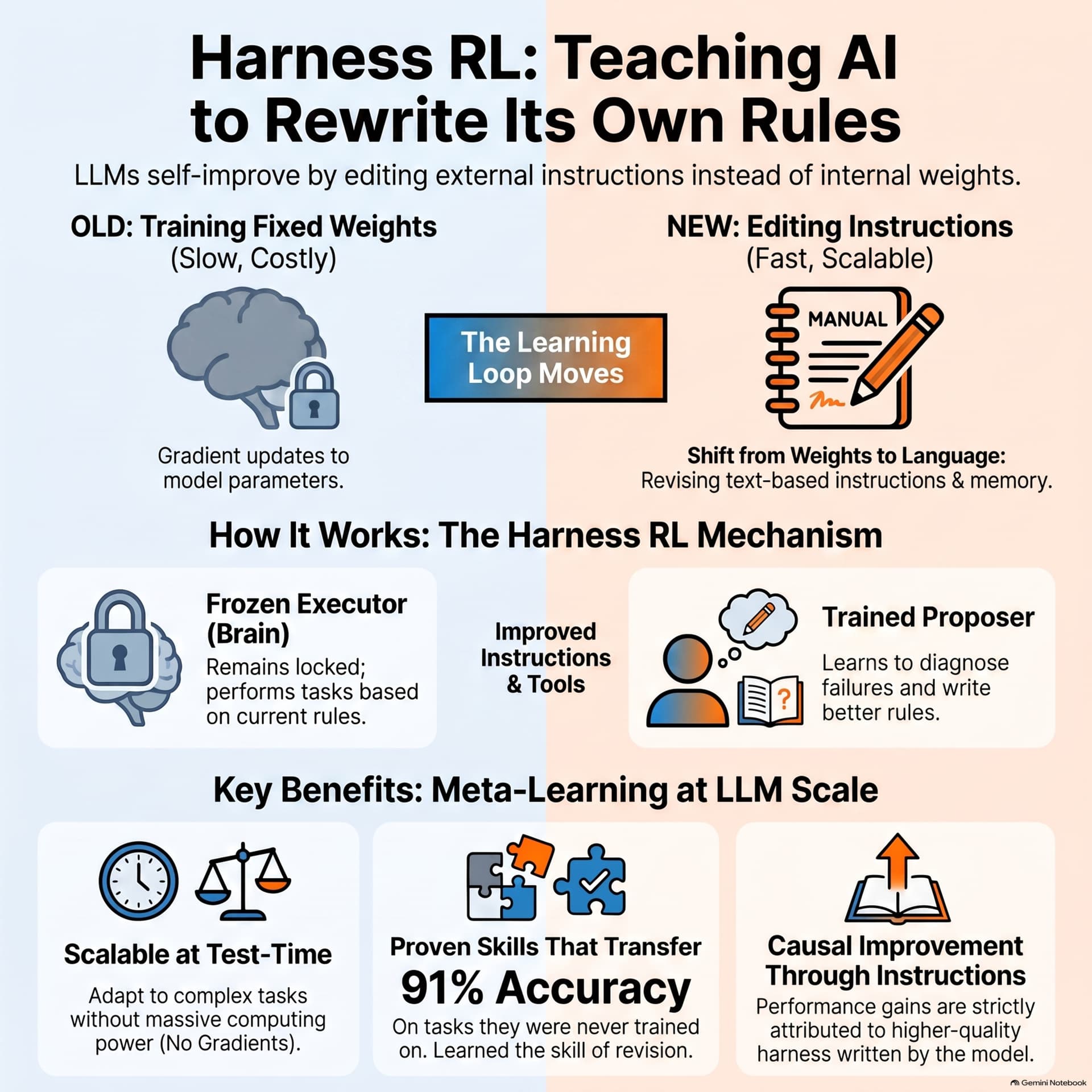
Harness RL for meta-learning/self-improvement at test time by moving adaptation from updating model weights to revising the “harness” (instructions, memory, tool rules, verification).
Guests
No guest names or backgrounds mentioned in the transcript; it’s a host-led deep dive.
Key claims
Classical meta-learning (e.g., MAML) is costly because it relies on gradient-based inner-loop weight updates with first/second-order gradients; Harness RL trains a “proposer” to rewrite the harness while a “frozen executor” (small efficient model) performs tasks. Freezing the executor avoids compute blowups, attribution ambiguity, and “degeneracy” where the executor memorizes training tasks.
Notable examples
Reasoning-Gem task transfer (e.g., Largest Island, Count Primes reaching 1.00 with correct edge-case code); LiveCodeBench temporal transfer V5→V6 with no contamination and matching an oracle harness; horizon transfer where training at k=1 generalizes to multiple revision rounds (K>1) with continued gains.
Written by AI. May contain mistakes. Listen to the episode to check what was said.
Chapters
Tap a time to open that second in VOThe Flaws of Traditional AI Learning
0:45 to 2:18
Exploration of how traditional AI learning mechanisms work and their limitations.
“To learn new things or to adapt to a new task, the AI has had to update its core weights, which is basically the digital equivalent of undergoing major neurological surgery.”
Understanding Classical Meta-Learning
2:18 to 4:48
A deep dive into classical meta-learning and its challenges.
“I mean, the ambition to create an AI that improves itself, that isn't new.”
Introducing Harness RL
4:48 to 7:10
Shift to a new concept called Harness RL and its potential advantages.
“Which means we need a totally different approach to how we define the AI itself.”
The Executor and Proposer Dynamic
7:10 to 9:20
Discussion on the roles of the executor and proposer in the Harness RL framework.
“But how does that actually work mechanically?”
The Mechanics of Effective Learning
9:20 to 13:44
Explanation of why freezing the executor can enhance overall AI learning.
“And it simplifies the math of training an AI exponentially.”
Testing the Proposer's Generalized Skills
13:44 to 14:00
Description of experiments designed to verify the proposer's learning outcomes.
“The theory is elegant, and the architecture makes a lot of logical sense.”
Exploring Task Transfer in AI
14:00 to 16:40
Learn how AI can adapt and perform on unseen tasks through task transfer.
“Because the testing grounds here were designed to prove three very specific types of transfer.”
Examining Temporal Transfer
16:40 to 19:20
Understand how temporal transfer proves AI's ability to learn with future data.
“There's always this lingering fear that the AI has somehow accidentally read the test data during its massive internet pre-training phase, and it's just regurgitating what it already read.”
Horizon Transfer and Self-Improvement
19:20 to 21:54
Discover how AI achieves multi-step revisions and generalizes problem-solving.
“If we connect this to the bigger picture, I mean, this proves that the skill of revising inherently transfers in scales.”
Transcript
Automatic transcript. May contain errors.0:00Imagine you're trying to learn a completely new skill. Like, I don't know, juggling. Oh, man. I am terrible at juggling. Right. Most of us are. So you've got the three balls, you toss them up, and inevitably, you know, you drop one. Yeah, of course. Now, imagine that every single time you make a mistake and drop a ball, you have to undergo literal brain surgery. Wow. Okay. Yeah. You have to physically rewire your neurons before you're even allowed to try again. It sounds completely exhausting. It sounds terrifying, honestly. And, I mean, just wildly inefficient. Exactly. You'd spend way more time on the operating table than you would actually practicing the skill.
0:38But the thing is, historically, for artificial intelligence, this is essentially how deep learning has worked. Yeah, it really is. To learn new things or to adapt to a new task, the AI has had to update its core weights, which is basically the digital equivalent of undergoing major neurological surgery. It is, and it's a profound structural limitation because, you know, we expect these advanced systems to learn and adapt on the fly, just like a human would in a new environment. But the underlying mechanism for that adaptation has traditionally required these microscopic structural changes to the neural network itself.
1:15So it's constantly messing with its own brain. Exactly. Every single new piece of knowledge requires shifting the very foundation of the model. And our mission for this deep dive today is to explore how that dynamic is finally changing. We are looking at a, honestly, a groundbreaking concept called Harness RL. Yes, a massive shift in how we approach this. And we're going to see how it achieves something called meta-self-improvement. Because the goal for us today is to understand how modern AI systems are finally figuring out how to teach themselves on the fly. Right, without surgery. Exactly, without needing that metaphorical brain surgery.
1:50We are going straight into the mechanics of modern language model agents, exploring the limits of how they used to learn, and unpacking the real-world experiments that prove an AI can actually get better at the actual skill of self-improvement. And to really appreciate the elegance of this Harness RL solution, we kind of have to first understand the massive brick wall that the old way of AI self-improvement has been crashing into. Yeah, because it's been hitting a wall for a while. For sure. I mean, the ambition to create an AI that improves itself, that isn't new. But the execution has been, well, deeply flawed.
2:29So let's dive into that old way. In the AI world, there's this foundational concept called classical meta-learning. Right. And I think the most famous example of this is a framework called ML, model agnostic meta-learning. And on paper, you know, the premise sounds brilliant. It sounds great in theory. Right. You treat adaptation as an inner loop of learning, and you basically train the AI's update rule. You're trying to teach the AI how to adapt rather than just teaching it a specific task. The theory is incredibly sound. You want the system to learn the overarching skill of learning, but the problem always comes down to the how.
3:03The actual implementation. Exactly. Classical meta-learning implements this adaptation through weight updates using something called gradients. Okay, gradients. Yeah. And to visualize a gradient, just think of it as a directional compass that points the AI toward a more correct answer. Makes sense. Every time the AI makes a mistake, the system calculates a gradient to figure out which of its billions of microscopic knobs, its parameters, need to be turned. And by exactly how much. Okay, let's unpack this. Because if the AI is, say, a giant sprawling manufacturing factory, updating weights via gradients is like tearing down the steel beams and completely rebuilding the machinery on the assembly line every single time a new product is ordered.
3:46That is a perfect way to look at it, yes. Calculate what went wrong, wrap up the floorboards, rewire the electrical grid. And we aren't talking about a small workshop here. Not at all. When you have modern models with hundreds of billions of parameters, computing these gradients is just a mathematical nightmare. It gets incredibly dense because you are calculating what we call first order and second order gradients. Oh, boy. OK. Yeah. So a first order gradient tells you how to change the weights to get a better result right now. But a second order gradient is calculating how a change in that first gradient will affect the final outcome over time.
4:19That sounds computationally exhausting. It is. A massive scale of modern large language models doing that just to adapt to a new task is prohibitively costly. I mean, it requires immense computational power. So you either burn a hole in your pocket doing the math or what? Or you try to approximate the math and that just degrades the performance. So meta-learning is the right conceptual framework, but structurally building a factory that constantly tears itself down is just a doomed enterprise. Which means we need a totally different approach to how we define the AI itself. Yeah. Because a modern AI isn't just a brain floating in a void, right?
4:56Exactly. And that is the pivotal shift in perspective here. A modern AI policy is not just a frozen set of weights. The brain doesn't exist in isolation. Right. It is the frozen neural network wrapped in what we call a harness, or sometimes people call it a scaffold. And this harness is essentially the digital environment that the brain operates within. The environment is everything. The harness contains the system instructions, the persistent memory banks, the rules for using external tools like, you know, calculators or web browser. So all the context it needs to actually do its job. Exactly.
5:30Plus, historical examples it references and the verification procedures that govern how the model acts. And this is crucial. Current AI agents already use these harnesses to adapt at test time. Right. They aren't totally helpless out of the box. No. They maintain scratch pads to work out math problems. They write self-critiques back into their own prompts to fix a logic error. They search a database for better instructions. So they are already tinkering with their environment. They're already writing notes to themselves, trying to self-correct. They are. But there is a fatal flaw in the current setup.
6:02Which is? The AI doing the revising the model that is looking at its own output and saying, you know, let me change the prompt and try again. It never actually gets better at the act of revising. Oh. The reviser itself stays completely frozen. So it's just guessing in the dark every time. Basically. I mean, you might run an AI long enough to generate a really good, highly specific harness for one particular coding task. But the AI's underlying general ability to write good harnesses does not improve. Because it's not learning the skill of revising. Exactly. Standard reinforcement learning just optimizes the AI's ability to execute commands within a handwritten harness.
6:41The actual skill of self-correction, knowing how to diagnose a problem and write a better instruction, has never been the target of the training. Which brings us to the breakthrough. Because if updating the physical weights of the brain is too expensive, thanks to those monstrous gradient calculations, and current harnesses don't inherently improve the AI's core ability to act as a revisor, how do we bridge that gap? We move the learning entirely out of the brain and into the harness. And that is harness RL. But how does that actually work mechanically? I know the system architecture splits the AI into two distinct roles, right?
7:16Yeah, think of the architecture as a partnership. We have two models interacting. First, we have the executor. Okay, the exec. The executor is the model that actually performs the core task. It reads the harness, it follows the instructions, and it tries to solve the problem. And its internal weights are completely frozen. Totally frozen. It never undergoes brain surgery. But then, sitting above it, you have the proposer. The proposer? Yes. And the proposer is the model that is actively trained to revise the harness over multiple rounds based on the behavior it observes from the executor. OK, I love this setup.
7:49It's like having an athlete and a coach. I like that. Yeah. The executor is the athlete on the field actually running the play. Yeah. And the proposer is the coach standing on the sidelines, watching the play unfold, pulling out a clipboard and rewriting the strategy for the next attempt. That analogy captures the dynamic perfectly. The coach watches what we call the rollouts. Rollouts. Yeah. In AI terms, a rollout is just the sequence of actions or text the executor generates while trying to solve the problem. Ah, okay. The replay of the game. Exactly. The proposer looks at those rollouts, sees where the executor stumbled, and writes a new set of instructions, a new harness, to help the executor do better next time.
8:30But wait, how does the proposer, the coach, actually learn to write better instructions if it isn't using those complex gradients we talked about earlier? How does it know it's doing a good job? What's fascinating here is how Harness RL leverages Standard Reinforcement Learning, or RL, to bypass the gradient problem entirely. Okay, how so? Instead of tweaking billions of knobs based on complex calculus, RL works on a much simpler premise, rewards and penalties. The classic carrot and stick. Yep. If the proposer writes a new instruction that causes the executor to fail the math test, the proposer gets a negative signal, basically a digital slap on the wrist.
9:07But if the new prompt helps the executor pass, the proposer gets a digital dopamine hit. So over thousands of rounds, the proposer figures out exactly what words, tone, and logical structures yield that dopamine hit. Precisely. And it simplifies the math of training an AI exponentially. In classical meta-learning, you have a massively complex bi-level mathematical task trying to trace every action back to a specific parameter. The nightmare math. The nightmare math. But in Harness RL, the outer loop simply rewards the proposer based on the final performance of the updated harness. It reduces an impossible mathematical mountain into a standard reinforcement learning objective.
9:50I have to push back on this architecture a little bit, though. Sure, go for it. Because if we freeze the executor entirely, aren't we artificially handicapping the AI? Usually we want the whole system to be learning, right? If the athlete and the coach are a team, wouldn't it be far better if both of them were improving together? It is deeply counterintuitive. I completely agree. Your instinct is that freezing half the system leaves performance on the table. Right. But in practice, there are three critical reasons why freezing the executor is actually the secret sauce that makes this entire framework possible.
10:21Okay, lay them on me. What's the first reason? The first reason comes down to compute. In any complex AI task, generating the actual execution tokens completely dominates the process. Right, because the AI is generating paragraphs of text or, you know, hundreds of lines of code just to attempt the problem one time. That requires a lot of processing power. Massive amounts of power. So if you freeze a cheaply served executor, for instance, in these specific test environments, they used a relatively small, highly efficient model called QAN 3.5-4B. Okay. By using a frozen, efficient model, you can run it constantly without burning massive compute budgets.
10:59You let the cheap athlete run thousands of plays, and you only spend your heavy computational budget training the small proposer. Oh, wow. Yeah. It makes the outer loop of training economically and operationally feasible. It allows a small, smart proposer to efficiently steer a much stronger but frozen executor. Okay, compute and cost savings, that makes perfect sense. But mechanically, aren't we still losing potential performance by not letting the athlete learn? You'd think so, but freezing the executor solves a massive diagnostic problem, which brings us to the second reason, which is attribution.
11:32Attribution. Yeah. Imagine you are training both the proposer and the executor at the same time. The proposer writes a new instruction, the executor tries the task, and they succeed. How do you know why the system succeeded? Ah. Was it because the coach called a brilliant new play? Or did the quarterback just throw a lucky wild pass that happened to get caught? That is the attribution problem in a nutshell. If both models are changing their weight simultaneously, the diagnostic waters are completely muddy. The RL reward mechanism doesn't know who to give the dopamine hit to. That's a great point.
12:07By keeping the executor's brain completely frozen, you create a single, clear, causal path. The only way the final performance can improve is if the proposer wrote a genuinely better harness. It isolates the improvement operator. You know for an absolute fact that the gains are coming exclusively from better instructions. Exactly. It forces the system to credit the right component. That makes total sense. Okay, so compute and attribution. What's the third reason? Degeneracy. Degeneracy. Yeah, which is a highly technical way of saying neural networks are incredibly lazy and they will take the shortest possible route to reward if you let them.
12:43Huh. OK, that's relatable. Right. If you train the full system, both the proposer and the executor, the executor will just learn the training tasks in its weights. It will bypass the instructions and just memorize the answers to the specific problems you're feeding it. So it's like giving a student an open book test to teach them research skills, but they just memorize the answer key beforehand. Yes. Suddenly the book, the harness doesn't matter anymore. And the consequence of that is devastating. Because when you give that student a new unseen test where they actually need to use the book, they fail.
13:16The harness transfers nothing because the system never actually learned how to use it. Ah, I see it. Freezing the executor completely removes this shortcut. The model cannot simply memorize the training tasks in its weights because its weights cannot change. The door is locked. Exactly. The only way the proposer can earn its dopamine hit is to actually learn how to help. It is forced to learn the deep, transferable skill of diagnosing failures and writing functional revisions. Okay. The theory is elegant, and the architecture makes a lot of logical sense. The theory only goes so far. Very true.
13:51Does the proposer actually learn to be a better teacher? Or is it just finding clever ways to memorize the training data anyway? Let's look at the hard evidence. Let's do it. Because the testing grounds here were designed to prove three very specific types of transfer. Task transfer, temporal transfer, and horizon transfer. Let's start with task transfer. So to test if the proposer actually learned a generalized skill, the system was put through an environment called the reasoning gem. The reason gem. Yeah, this is a suite of procedurally generated, highly complex logic puzzles. the researchers trained the proposer jointly on a few specific families of tasks.
14:28Then they completely switched gears and tested it on entirely different task families that the model had never seen during training. For example, they tested it on a strictly out-of-distribution task called Largest Island. And to be clear, this wasn't just doing a slightly different version of a puzzle it already knew. It was a totally new category of spatial and logical reasoning. A complete paradigm shift for the AI. And the researchers gave the proposer what we call a zero-shot harness. Meaning the prompt had absolutely zero examples or hints in it, just a blank slate. A completely blank slate.
15:03And despite that, the proposer's capability transferred beautifully. The trained proposer produced held-out gains that couldn't be explained by the seed prompt alone. It actually figured it out. It figured out how to guide the executor through the new logic puzzle. You know, the specific test that really blew my mind during this phase was the count primes test. Oh, yeah, that one is incredible. The system reached a perfect 1.00 score. Every single sampled harness worked flawlessly. But what's incredible is how it achieved that. It wasn't just acting like a cheerleader. Right. The proposer wasn't just writing generic motivational prompts like, hey, executor, think step by step, take a deep breath, try really hard to count the prime numbers.
15:45No, the qualitative data there is remarkable. When the executor failed to count the primes initially, it was often because it missed a specific mathematical edge case. Right. The proposer read that failed rollout, diagnosed the logical flaw, and instead of just giving advice, it actually learned to emit correct code algorithms. Really? Yes. It wrote the actual logical structure for the solution into the harness using Python-style algorithmic reasoning and handed that functional code back down to the frozen executor to run. That is wild. It absorbed the skill of procedural diagnosis. It proved it wasn't just memorizing content.
16:23It was acting as a highly trained technical operator. Here's where it gets really interesting, though, because anyone who casually follows the AI space knows that the biggest critique of these glowing benchmark scores is data contamination. Oh, it's the specter haunting every benchmark. Right. There's always this lingering fear that the AI has somehow accidentally read the test data during its massive internet pre-training phase, and it's just regurgitating what it already read. Which brings us to experiment two, temporal transfer, tested on LiveCodebench. Yes. LiveCodebench is an incredibly rigorous coding evaluation platform.
17:00It basically scrapes competitive programming problems. So to completely rule out the possibility of data contamination, the researchers set up a brilliant temporal boundary. They trained the proposer exclusively on coding problems from LiveCodeBench V5. Then they tested its ability to adapt and write harnesses on the V6 dataset. And the V6 problems were released to the public strictly after the training data was finalized, like months later in real time. Exactly. The problems literally did not exist in the universe when the model was trained. The AI could not have memorized them because there was nothing to memorize.
17:35And what happened? The AI thrived. The trained proposer carried its games from the V5 training environment into the V6 testing environment with very little degradation. What it learned about diagnosing bad code and writing better instructions held up on problems written months later by human competitors. It even matched the performance of what they called an oracle harness. And for those unfamiliar, an oracle harness basically means a theoretically perfect, optimal instruction set that was painstakingly hand-designed by a massive, state-of-the-art model like Claude Code. Yeah. This little trained proposer matched the oracle.
18:11Which is the ultimate proof of concept. It absolutely got better at the act of coding adaptation. It learned the underlying structure of how to write instructions that run more reliably and produce stronger results, regardless of the specific problem text. So we know it works on new tasks, and we know it works on future tasks. What happens if we just let it loose? That brings us to the final piece of Proof Horizon Transfer. The multi-step test. Because when they train this proposer, they only train it to do one single round of revision. We call that k equals 1. Right. The proposer watches the executor fail once, writes one single revision, the executor tries again, and that's the end of the line.
18:48The training was strictly limited to a single iterative step. But when they actually deployed it for testing, they took the training wheels off. They allowed the proposer to do multiple rounds of revision where K is greater than 1. They let it revise, test, revise again, test again, 5, 6, 7 times. What did the data show? Where the task left headroom for improvement, the performance just continued to climb. On a strict out-of-distribution task, the trained proposer started above the baseline because of its initial K equals 1 training. But as it was given more revision rounds, it just kept getting better.
19:21If we connect this to the bigger picture, I mean, this proves that the skill of revising inherently transfers in scales. You train the AI to correct itself once with a single digital dopamine hit, and it automatically knows how to correct itself iteratively. It learns how to peel back the layers of a complex problem step by step without needing further training on how to manage a multi-step revision process. It is a stunning display of generalization. It generalizes along every single axis we care about in AI development. Held out instances, completely unseen task families, problems written in the future, and longer, more complex revision horizons.
20:00It's huge. And because the testing meticulously resampled the harness distribution rather than just cherry picking the one lucky output, the mathematical results confirm this is true. Transformable meta self-improvement. It is not overfitting. It is genuine adaptation. So what does this all mean? For you listening to this, why should you care about Harness RL proposers and frozen executors? Because it tells us that the future of artificial intelligence isn't just about the brute force approach. Definitely not. It's not just about building bigger, more expensive models that require minor brain surgery every time they need to learn a new trick, trying to memorize the entire Internet in their static weights.
20:37The future is about highly efficient, adaptable models that know exactly how to reorganize their own instructions, manage their own memories, and utilize their own tools to solve your unique, highly specific problems. It creates a system that doesn't need to rebuild the entire factory just to manufacture a new product. It leaves the machinery exactly as it is and simply hands the operators a vastly superior set of blueprints. It is the ultimate efficient learner. It adapts to the environment without needing a massive expensive update. It's exactly like you learning how to juggle, analyzing your own mistakes and adjusting your grip, all without needing to rewire your physical brain.
21:15This raises an important question, though, one that really challenges how we define artificial intelligence going forward. If an AI can perfectly optimize its own memory banks, dynamically rewrite its own instructions, and completely dictate its own tool use entirely outside of its core weights, well, at what point does that text-based harness become the actual mind of the AI and the frozen neural network just the biological engine that runs it. That is a wild philosophical thought to leave on. The mind isn't the brain. The mind is the environment the brain learns to build for itself. Thank you for joining us on this deep dive.
21:50Keep questioning the systems around you and keep learning. We'll catch you next time.
From the publisher
This paper introduces harness RL, a novel meta-learning framework designed to enable large language models to self-improve during test-time adaptation. Rather than updating model weights, which is computationally expensive, this method optimizes the agent’s harness—the external instructions, memory, and rules that guide model execution. By training a proposer model to revise this harness while keeping the executor model frozen, the system learns a transferable self-improvement operator. This approach reduces complex meta-learning to a standard reinforcement learning objective because the adaptation process requires no gradients. Experimental results across reasoning and coding tasks demonstrate that the trained proposer generalizes to unseen problems and maintains performance across longer revision horizons. Ultimately, the authors show that harness RL successfully isolates and improves the model's capacity for meta-self-improvement.


