
 Ask ChatGPT

 Best AI papers explained
28 Oct 2026 · 20m · 15 chapters
How to train AI on noisy, spam-filled web data without deleting most of it, using “scalable data weighting” with metagradient descent, a small curated target dataset (“compass”), and cross-scale transfer plus parametric data weights for streaming updates.
No guests are named in the transcript; it’s a host-led episode with multiple speakers.
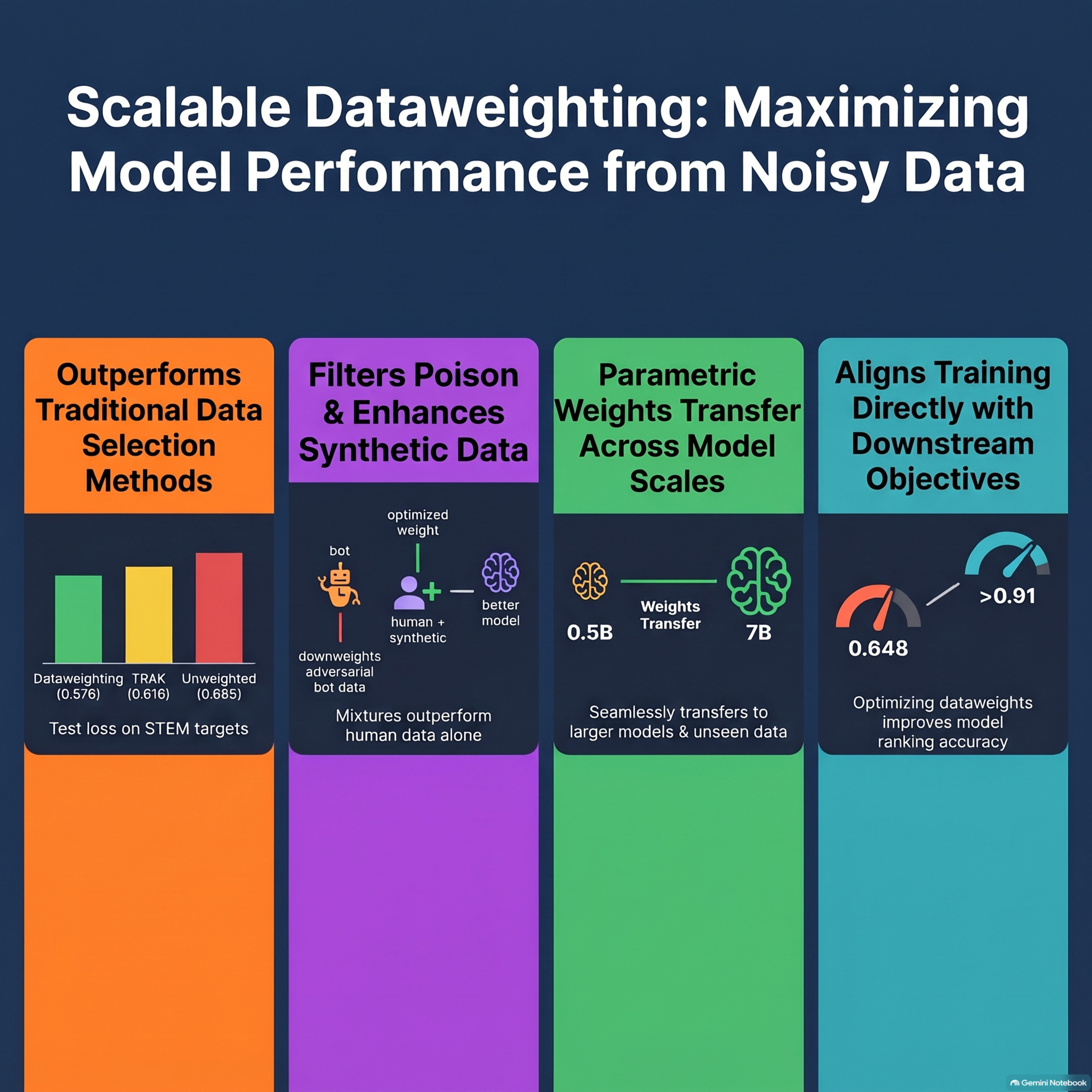
Traditional filtering/“chop out bad data” (e.g., Track/Track-in style) creates blind spots and can bias models toward longer answers. Data weighting instead downweights harmful examples by checking whether they improve performance on a tiny gold-standard target set, saving compute. The method can neutralize bot/adversarial poisoning and even make mixed human+Gemini synthetic data outperform human-only.
Chatbot Arena experiment with 30k human preference examples plus 10k injected bot/adversarial votes; synthetic data from Gemini 3 Flash; cross-scale transfer from 0.5B to 1.5B/3B/7B models; Spearman correlation vs Bradley-Terry loss.
Written by AI. May contain mistakes.
Discussing how quality of data is the biggest bottleneck in AI development.
“It's, well, it's the quality of the data.”
Exploring historical methods used by engineers to address noisy data issues.
“Well, traditionally, modern AI models, specifically the large language and vision models we interact with constantly, they're trained on these vast heterogeneous data sets scraped straight from the web.”
Highlighting the critical flaws in methods that aggressively delete data.
“When you aggressively delete data, you create massive blind spots.”
Explaining the concept of scalable data weighting and its importance.
“So instead of just throwing data away and risking these weird biases, the premise of data weighting is to turn down the volume on the bad stuff.”
Breaking down the complex concept of metagradient descent in AI.
“If I pay more attention to this specific piece of messy internet data, does my performance on my tiny gold standard test get better or worse?”
Examining the technique of segmentation for optimizing AI training.
“Through a really clever technique called segmentation.”
Discussing the impressive outcomes of using data weighting in AI training.
“But when they turned data weighting on, the system identified the bots and neutralized them entirely without human intervention.”
Understanding the concept of cross-scale transfer in AI training.
“If you can safely leverage dirt-cheap synthetic data to boost your model beyond expensive human limits, that is massive.”
Introducing parametric data weights to manage incoming data efficiently.
“The inherent utility of a piece of data, whether a coding tutorial is logical or a forum post is spam, is relatively universal across different scales of AI.”
Learn how a 4,600 parameter tool predicts weights based on new data.
“If this little intern process is just evaluating the data it already has, how does it handle a brand new Reddit post scraped a minute ago?”
Explore the gap between traditional AI training and real-world goals.
“Without needing to rerun the whole metagradient process.”
Discover how data weighting connects basic training to complex outcomes.
“Why don't engineers just train the AI directly on the Spearman Correlation from the start?”
Learn about a framework that improves AI data selection and quality.
“We started in a chaotic city square of Internet data, relying on these blunt deletion tools that accidentally taught our AI terrible habits, like confusing a long, rambling answer with a smart one.”
This technique ensures AI models remain accurate and reliable.
“It guarantees they are finely tuned to high-quality logic.”
Consider how AI frameworks could transform social media content moderation.
“Which leaves me with one final, slightly wild thought for you to mull over.”

Get the gist, explore an idea or ask about something said.
 Claude
On Best AI papers explained, what are the key points of this episode?
Searching your listeningAutomatic transcript. May contain errors.
0:00Imagine dropping a kindergarten student right into the middle of Times Square just surrounded by scammers people shouting complete gibberish con artists and then you know expecting that student to somehow learn advanced calculus yeah it is the absolute definition of an information free for all right i mean we desperately want to believe we are teaching our most advanced technology in this pristine curated classroom but the reality is just so chaotic which is exactly what makes our mission for this deep dive so incredibly vital today we are looking at how we actually teach ai using this messy, messy spam-filled internet without passing on all that garbage.
0:40Because as AI becomes a bigger part of your daily life, whether you are using it to write code, maybe diagnose an illness or draft a sensitive email, the biggest bottleneck isn't computing power anymore. It's, well, it's the quality of the data. And what's really fascinating here is that this research introduces this breakthrough machine learning concept. It's called scalable data weighting. Okay. It is just a highly elegant solution to poisoned or noisy information. It basically teaches an AI how to automatically filter out the bad data. Automatically. Right. And dial up the good stuff entirely on its own, which, as you can imagine, saves massive amounts of time and literally millions of dollars in compute costs.
1:19Okay, let's unpack this, because to understand how revolutionary this new method is, we really need to look at how engineers have been trying to solve this messy data problem up until now. Right. Well, traditionally, modern AI models, specifically the large language and vision models we interact with constantly, they're trained on these vast heterogeneous data sets scraped straight from the web. Just a giant net dragging the bottom of the Internet. Exactly. And this data is filled with highly subjective opinions, wildly noisy formatting and just low quality junk. Yeah. So to deal with this, engineers historically relied on bespoke heuristic filters.
1:57Heuristic meaning like human rules. Yes. Humans writing hard and fast rules about what constitutes good or bad data. Or they relied on data attribution methods, which are algorithms with names like TRACK and TRACK-IN. Those sound incredibly technical. How do methods like TRACK-IN actually handle the junk data in practice? Well, their ultimate action is remarkably blunt. Methods like TRACK or TRACK-IN attempt to estimate how much each training example contributes to a model's final performance. Okay. Then based on those estimates, the engineers simply chop out a huge percentage of the lower quality data entirely.
2:33They just delete it. They just aggressively delete it from the training pool before the model really even gets to work. So they just like look at the pile, decide half of it is trash and throw it straight in the digital incinerator? Yes. But this research highlights a critical flaw in that approach. Which is? When you aggressively delete data, you create massive blind spots. The model accidentally learns terrible habits from whatever happens to be left behind. Huh. The researchers actually found that if you cut out huge chunks of data using a method like track-in, the model starts heavily favoring longer text responses.
3:07Wait, why would deleting data make the AI care about the word count? That doesn't make sense. Well, it's because the model is desperately looking for patterns in the surviving data. Oh. Right? If a disproportionate amount of the high-quality data that survived the purge happens to be wordy, The model just uses length as a proxy for quality. Oh, wow. It stops evaluating the actual logic or helpfulness of a response and just assumes, well, this answer is five paragraphs long, so it must be the brilliant one. That is wild. Yeah, and it incurs massive performance losses because it prioritizes word count over factual accuracy.
3:42That makes total sense, though. It's like trying to bake a cake by telling someone to throw away half the pantry based on a quick glance, and they end up throwing away the baking powder just because the box looked boring. That's a perfect way to look at it. You're artificially skewing what the AI thinks good actually means. Exactly. And if we connect this to the bigger picture, it shows why deleting data is so dangerous. So instead of just throwing data away and risking these weird biases, the premise of data weighting is to turn down the volume on the bad stuff. Okay. And turn up the volume on the good stuff.
4:17The learning process itself should dictate the utility of a training sample, not some blunt human rule. But if the AI is swimming in this sea of internet garbage, how does it know what good looks like in the first place? I mean, it needs some kind of North Star, right? It does, and it uses a compass. The framework uses what is called a target data set. A target data set. Right. This is a very small, highly curated gold standard set of data that perfectly represents the domain you want the AI to master. Okay. Imagine just a few thousand perfectly vetted examples of expert level coding or complex logic.
4:58So you have billions of messy internet examples and just this tiny handful of perfect examples. Exactly. And during training, the algorithm constantly asks a simple question. If I pay more attention to this specific piece of messy internet data, does my performance on my tiny gold standard test get better or worse? If a messy data point actually helps improve the model's score on the target data set, its weight or its influence goes up. If it hurts the score, its weight goes down. That sounds brilliant in theory, but also, I mean, mathematically terrifying. It is complex, yeah. Calculating how every single piece of data affects a model with billions of parameters for millions or billions of data points, I have to imagine that would require a supercomputer running for a decade.
5:48This raises a very important question because it is the exact reason why this hasn't been widely implemented until now. Okay. The math behind this relies on a concept called metagradient descent. I am definitely going to need you to translate metagradient descent into plain English because that sounds like a sci-fi weapon. I know it does. Okay, think of a normal gradient as the AI learning the rules of chess. It moves a piece, sees what happens, and updates its internal parameters to get better at the game. Makes sense. A meta gradient goes one level deeper. It is the AI learning which chess books are actually helping it win.
6:26Oh, wow. Right. It looks at the final checkmate, traces its steps backward, and asks, did reading page 42 of that specific book actually help me win this specific game? That is incredible. Mathematically, it calculates how a tiny change in the weight of one single training example ripples through the entire training process, all the way to affect the final score on the gold standard test. That clarifies it perfectly, but tracing the impact of a single page of a book all the way to a final checkmate across billions of moves, that still sounds like a computational nightmare. How did they pull that off without melting in their servers?
7:02Through a really clever technique called segmentation. Segmentation. Yes. Instead of trying to calculate that massive meta-gradient across the entire training run, they break the training trajectory into small bite-sized segments called meta-epochs. Oh, okay. They run the training for a short segment, check the meta-gradient to see which data weights are helping or hurting, update those weights, and then continue to the next segment. So they just pause, check the compass, adjust the volume knobs on the data, and then hit play again? Exactly. And by doing this in segments, it becomes computationally feasible.
7:36And the results are stunning. They achieved what economists call Pareto optimal cost performance tradeoffs. Okay, meaning? In practical terms, this means they got a significantly smarter model for their computing budget than any traditional filtering method could offer. Well, here's where it gets really interesting to me. Because theory and math are great, but I want to see what happens when the rubber meets the road. Right. Did they test this on data that was actively trying to ruin the model? They did. They conducted a fascinating bot experiment using data from a platform called the Chatbot Arena.
8:13I've heard of that. Yeah. It is a massive open source project where humans chat with two different AI models side by side and vote on which one gave the better answer. Right. And it provides a huge trove of preference data to teach AI what humans actually like. But, I mean, the open internet being what it is, I imagine not all of those votes are from well-meaning humans. Precisely. The researchers took a clean data set of 30 ,000 human preference examples, and then they deliberately injected 10 ,000 known bot and adversarial examples. Oh, wow. These were votes generated by malicious scripts trying to skew the results or promote spam.
8:50They intentionally sabotaged their own AI's training pool. So when they ran that poison data through the standard training, the model must have gotten confused and started spitting out spam, right? Well, without data weights, the model performs understandably tanked. Yeah. It adopted the erratic, low-quality behaviors of the bots. But when they turned data weighting on, the system identified the bots and neutralized them entirely without human intervention. Wait, how did it know they were bots? It's just looking at math. Right. It didn't know they were bots in the human sense. It simply followed the feedback loop.
9:23Okay. The AI would adjust its parameters to agree with a spammy bot's answer. Then it would check its performance against the tiny golden target dataset. Right, the compass. And suddenly its score in the golden test would plummet. Oh. Exactly. That failure triggered the Metagradient algorithm, which traced the failure back to the bot's data point and said, hey, trusting this specific example just ruined our score. Dial its influence down to zero. That literally gives me chills. it's like the AI developed its own immune system. It really is. It recognized the infection because the infection was stopping it from passing its test.
9:59So it just mathematically zeroed out the virus. It completely muted their influence. It restored the model's performance to where it was before the poison was ever introduced. That is amazing. And building on that success, it pushed the system even further by testing it with synthetic data. Oh, synthetic data. So AI training AI. Yes. They utilized a massive data set generated by Gemini 3 Flash, essentially using a cheaper AI to generate training examples for a new AI. Okay, so when they blended that cheap AI-generated data with the human data, I have to imagine the model's overall performance took a bit of a hit.
10:35You would think so. I mean, you're diluting the pure human stuff with AI hallucinations, but maybe it's worth it because you're saving so much money by not paying human graders. That is the intuitive assumption, yeah. Synthetic data is notorious for introducing weird biases. But the research revealed a complete paradigm shift. Really? By using data weighting on a mix of human data and synthetic Gemini data, the resulting model didn't just hold its own, it actually outperformed a model trained purely on 100 % human data. You're saying a mix of human and AI data beat out a pure human data set? Yes.
11:10How is that even possible? Because the algorithm learned exactly which specific synthetic examples were brilliant, and which were garbage. Wow. Synthetic data is voluminous, but it's flawed. The data weights acted as a perfect SIF. So it filters it. Right. The AI dialed up the volume of the synthetic examples that captured pristine logic and reasoning, and mathematically discarded the examples where the Gemini model hallucinated. Unbelievable. It extracted a synergy that exceeded the capacity of human data alone. That changes the entire economics of building AI. If you can safely leverage dirt-cheap synthetic data to boost your model beyond expensive human limits, that is massive.
11:55It's a game changer. But okay, this brings up a logistical hurdle for me. Even with those bite-sized segments we talked about, doing this meta-optimization on the scale of something like chat GPT has to be prohibitively expensive. It would seem that way. You're talking about models with tens or hundreds of billions of parameters. That would be a roadblock, except the paper introduces a brilliant workaround called cross-scale transfer. Cross-scale transfer. Yes. The researchers proved that you do not need to calculate these complex data weights on the giant final model. Oh, thank goodness. Right.
12:28They ran their metagradient optimization on a tiny 0.5 billion parameter model, something small enough to run on a standard high-end laptop. And it learned which specific data points in the massive internet scrape were high quality and which were junk. Exactly. Then they took those exact weights, the volume settings for millions of data points, froze them and applied them to much larger 1.5 billion, 3 billion and 7 billion parameter models. Wait, a tiny model's opinion on what makes data good actually transfers to a massive model? The big models don't need different weights? It transferred flawlessly.
13:05That is crazy. The big models saw immediate performance improvements on their target tasks without the researchers having to recalculate a single metagradient for them. The inherent utility of a piece of data, whether a coding tutorial is logical or a forum post is spam, is relatively universal across different scales of AI. It's basically like having a junior intern sort through a massive mountain of mail to figure out what's junk and what's important, and then just handing the highly curated VIP stack to the CEO. Yes, exactly. You save all of the CEOs incredibly expensive time, but the CEO still gets the absolute best information.
13:42That perfectly captures the efficiency of it. They amortize the computational costs almost entirely. Right. But they also solve the problem of time. What do you mean? Well, what happens when new data streams in tomorrow? You can't just pause everything and run the intern process again from scratch every single time a new article is published. Oh, right. If this little intern process is just evaluating the data it already has, how does it handle a brand new Reddit post scraped a minute ago? They did all of something called parametric data weights. Okay. Instead of assigning a static number to a specific piece of text, they built a tiny 4 ,600 parameter linear mapping tool.
14:22That's tiny. Very small. They utilized text embeddings, which are essentially mathematical coordinates that represent the meaning of a text. Got it. Using frozen open AI models to generate these coordinates, they trained this tiny tool to predict what a weight should be, based purely on its mathematical signature. Hmm. So if a brand new coding tutorial drops tomorrow, this tiny mapping tool looks at its mathematical coordinate, recognizes it lives in the high-quality logic neighborhood, and instantly dials the weight up. Exactly. Without needing to rerun the whole metagradient process. Right. It acts as an automated, highly intelligent bouncer for all future streaming data.
15:02It proves this entire framework can scale indefinitely in real time. Okay, wait. If this little 4 ,600 parameter tool is just predicting weights based on math, how does it know what our ultimate goal is? That's a great question. Because what if we don't just want the AI to learn basic facts, but we want it to understand complex hierarchies? There's this fascinating disconnect in this research between what we traditionally train an AI to do and what we actually want it to do in the real world. Yes, and this is perhaps the most profound theoretical contribution of the paper, realigning the ultimate goal.
15:37Right. In standard machine learning, models are trained on a simple local loss function. A loss function is just the daily rule book the AI uses to update its parameters. Okay. Typically, they use something called the Bradley-Terry objective. Okay, let me translate Bradley Terry into human. That's essentially teaching the AI through binary choices, right? Like, given option A and option B, pick the winner. Correct. It is highly effective for teaching the basics. But as you pointed out, our big picture goal is really just A versus B. Right. When you interact with an AI, you want it to be capable of providing incredibly accurate, nuanced rankings across dozens of possibilities.
16:16Yeah, exactly. We measure that kind of global ranking accuracy using a metric called Spearman Correlation. Spearman Correlation. Yes. It evaluates how well the AI understands the relative distances and rankings of a whole list from 1 to 10. So we want the AI to be a master at ranking a whole tournament bracket, but we are only training it by asking it to play one-on-one matches. Exactly the problem. Why don't engineers just train the AI directly on the Spearman Correlation from the start? Just tell the AI, optimize for the global ranking. The researchers attempted exactly that, and it failed miserably.
16:52Really? Yes. Direct training on a complex global ranking objective is too noisy for the AI's step-by-step learning loop. Oh. To use an analogy, it is like trying to teach someone how to swing a tennis racket by only showing them the final Wimbledon tournament bracket at the end of the year. Oh, that makes sense. The signal is too detached from the immediate action. They need feedback on their individual swings. So if direct training fails, how does data weighting bridge the gap between those simple tennis swings and the final Wimbledon bracket? It separates the roles. The researchers kept the simple Bradley-Terry loss function, the A versus B choices, for the AI's internal parameter updates.
17:31They kept teaching the basic tennis swings. Right. But they used the complex Spearman correlation ranking purely as the target for the metagradients. Oh. So the data weights act as a translator. They serve as the bridge. The algorithm asks which data weights, when applied to our simple A versus B daily practice, will result in a model that ultimately masters the complex global rankings on the golden test. Wow. By divorcing the local training objective from the downstream target objective, the final model's ranking accuracy improved dramatically. So what does this all mean for us? Let's synthesize this journey.
18:08We started in a chaotic city square of Internet data, relying on these blunt deletion tools that accidentally taught our AI terrible habits, like confusing a long, rambling answer with a smart one. And through this research, we arrived at a highly scalable automated framework to sift gold from Internet sand. Right. Instead of paying humans to curate data or blindly dropping data and risking massive blind spots, we provide the AI with a tiny gold standard compass. And with that compass, the AI can automatically identify and mute poisoned bot data. It can find the perfect synergy to safely leverage cheap synthetic data by keeping the brilliance and discarding the hallucinations.
18:46And it does it all efficiently by transferring the heavy mathematical lifting from tiny models to massive ones. And if we connect this to why you, the listener, should care, as you interact with increasingly specialized AI tools, whether for advanced STEM research, complex software architecture, or nuanced legal analysis, this metagradient technique is likely the exact architecture that will ensure those models aren't hallucinating based on internet garbage. It guarantees they are finely tuned to high-quality logic. It is the immune system for our digital knowledge base. It really is. Which leaves me with one final, slightly wild thought for you to mull over.
19:26We've seen how this framework can automatically identify and downweight poison bot data just by comparing it to a tiny, clean target data set. It is highly effective at that, yes. So if it can do that for AI training, could we eventually use this exact same framework to immunize our social media algorithms? Oh, that's an interesting thought. All right. Imagine a world where our daily social feeds use a tiny target data set of well-researched factual journalism. The algorithm could automatically downlate human cognitive biases or entirely neutralize targeted disinformation campaigns without a single human sensor ever having to manually review a post.
20:02That would be revolutionary. We're moving from a world where we have to aggressively delete the bad stuff to a world where the system itself just quietly learns to turn down the volume on the noise. Thank you so much for joining us on this deep dive. We'll see you next time.
Training advanced machine learning models typically relies on vast, heterogeneous datasets containing noisy, adversarial, or mismatched data. To address this challenge, the authors introduce dataweighting, a scalable framework that assigns specific weights to training examples based on their actual impact on performance. Instead of relying on manual heuristics or aggressive data filtering, this method uses metagradient descent to dynamically optimize training weights against a small, high-quality target dataset. Furthermore, the approach implements parametric dataweights that successfully transfer across different model scales and generalize to previously unseen training inputs. Ultimately, this technique improves model performance across various applications, successfully integrating synthetic supervision and optimizing complex downstream objectives like ranking accuracy.


