
 Ask ChatGPT


Hybrid reasoning agents that combine fast “latent” internal computation with external “text” tool use, avoiding slow step-by-step text reasoning while keeping debuggability.
No guests are identified; the episode is presented as a two-host discussion.
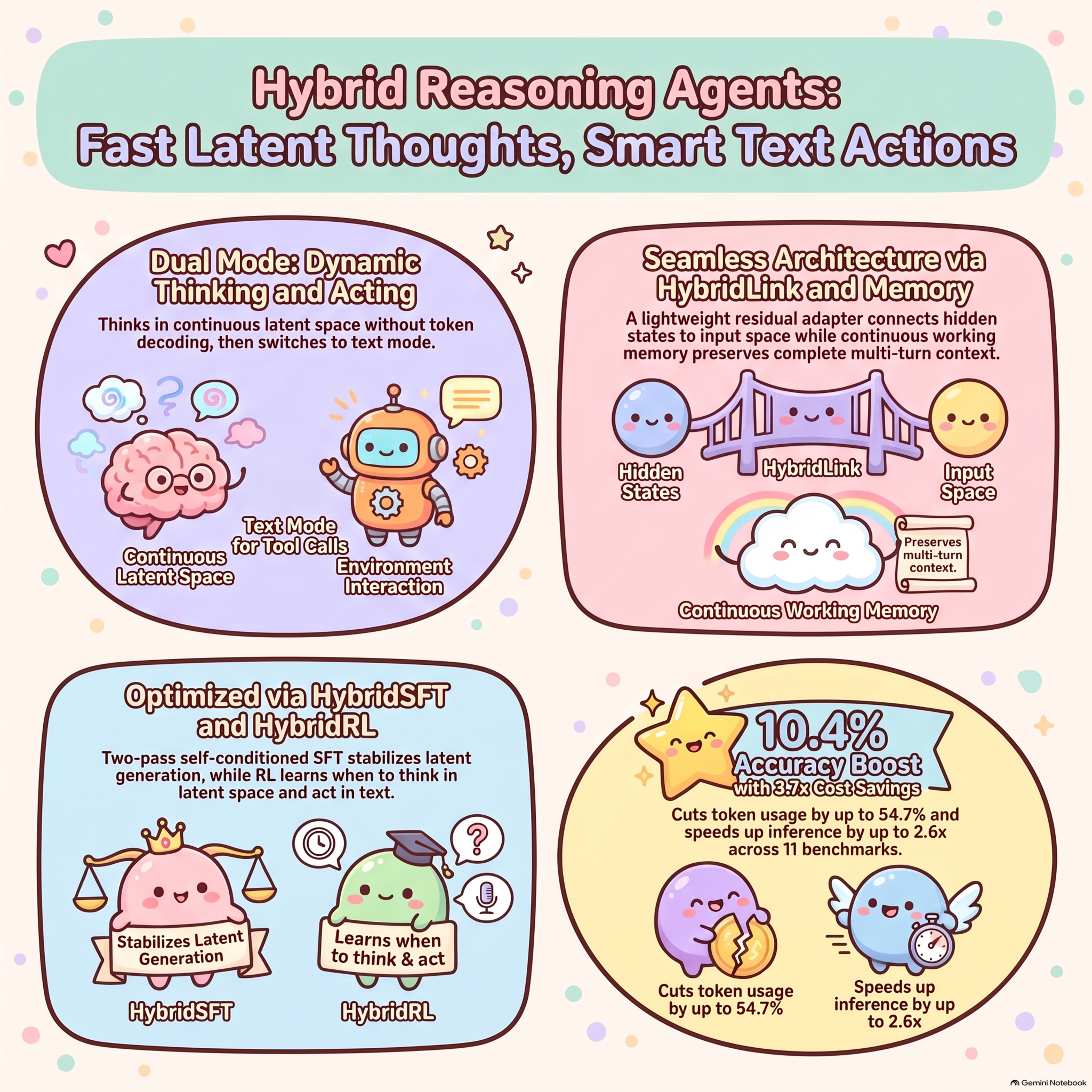
Current AI is bottlenecked by generating explicit text reasoning; latent reasoning is faster but hard to audit and tool-use is blocked. Hybrid link (a ~10M-parameter residual adapter on a ~4B model) lets the system loop in latent space and exit to text/tool mode. Continuous working memory preserves state across mode switches. Latent reasoning is claimed to be interpretable via mapping latent steps to nearest vocabulary tokens (“readable pseudotext”). Training uses hybrid SFT (two-pass self-conditioned to handle exposure bias) and hybrid RL via exact rollout replay (rewards mapped to text positions while latent inputs are fixed). Hybrid RL is claimed to prevent “laziness” by strategically allocating latent thinking vs tool-triggering text.
Calculus exam analogy; mapping latent vectors to tokens like “gravity, 9.8, multiply, velocity”; interventions replacing/swapping latent thoughts causing ~50% performance drops; benchmarks Math 500, GAIA, MedQA; reported gains: +10.4% accuracy, 35.5–54.7% fewer tokens, 1.8–2.6x faster inference, 2.7–3.7x lower compute cost, $470M→$176 per 1M questions (14B model).
Written by AI. May contain mistakes.
Understand the limitations of text-based reasoning in AI models.
“Okay, let's unpack this because we are talking about an AI that can think incredibly deeply and like lightning fast without having to articulate every single thought as a word.”
Learn about the concept of latent reasoning and its implications.
“Because it has to process every single word.”
Examine the tradeoff between text-based interaction and latent reasoning.
“I'm guessing it's because it's completely isolated in the dark, right?”
Discover how the hybrid link enables AI to use both text and latent reasoning.
“If we connect this to the bigger picture, true agentic AI requires both.”
Understand how continuous working memory enhances AI's reasoning process.
“When the AI is in latent mode, it takes the model's last layer hidden states.”
Explore the surprising interpretability of AI's latent reasoning mode.
“And solving it was one of the major achievements of this framework.”
Learn about the complexities of training hybrid AI architectures.
“Like, if it decides to do something we don't want it to do, the text log is just going to show a blank space while it plots in the dark, right?”
Examine how reinforcement learning adapts to hybrid AI's unique structure.
“The post-training pipeline has two key stages.”
Discover how hybrid reasoning agents optimize AI performance and resource allocation.
“are mapped back to optimize how the main model processes the entire hybrid context.”
Explore the impressive performance improvements and cost savings achieved with hybrid agents.
“And if you're listening to this and you're running a business, building tools, or even just utilizing AI for daily complex tasks, the actual real-world payoff of a hybrid agent is staggering.”
Learn about the implications of hybrid agents on commercial AI safety and intellectual property.
“But beyond just the economics, this raises an important question about commercial intellectual property and safety.”
Consider the evolving nature of AI reasoning and its potential challenges in comprehension.
“even with half the text tokens removed because all that thought was moved to latent space, External monitors were able to successfully localize the very first error in a failed reasoning chain 98 to 99 % of the time.”

Get the gist, explore an idea or ask about something said.
 Claude
On Best AI papers explained, what are the key points of this episode?
Searching your listeningAutomatic transcript. May contain errors.
0:00Imagine, right, you're taking this incredibly difficult calculus exam, but there's a bizarre non-negotiable rule. Oh, I hate exams like this already. Right. So the rule is you are forced to speak every single micro thought out loud before you're allowed to write down a number on the page. Yeah, that sounds awful. You can't just silently hold a variable in your head. You have to physically articulate, you know, carry the two, wait, the derivative of that is. If I isolate X just over and over, it would be exhausting, right? It would be an absolute nightmare for efficiency. I mean, you would end up spending significantly more energy just vibrating your vocal cords than, you know, actually performing the mathematics.
0:41Exactly. And that is exactly what we force artificial intelligence to do right now. Today, for all of you listening, we are taking a deep dive into a massive leap in how the next generation of AI thinks and acts. A completely new framework. Yeah, it's called hybrid reasoning agents. Okay, let's unpack this because we are talking about an AI that can think incredibly deeply and like lightning fast without having to articulate every single thought as a word. Right, but it can still seamlessly speak when it needs to use a web browser or run Python code. We're exploring how researchers have successfully merged these two completely different worlds, creating a system that basically thinks beyond human language but acts through it.
1:22It really is a fascinating paradigm shift. I mean, to understand why hybrid agents are such a breakthrough, we first have to understand the fundamental bottleneck that is currently limiting frontier AI models. Which is text, right? Exactly. Right now, models rely on text as their universal medium. If you ask an advanced AI to solve a hard problem, use a software tool, or search the web, it generates its intermediate reasoning step by step, token by token. That's the whole chain of thought process we hear so much about. That's the one. All those intermediate reasoning trajectories are generated as explicit text before the agent actually acts on the environment.
2:00And just like your calculus exam analogy, this is incredibly slow and computationally expensive. Because it has to process every single word. Right. For every single word the AI outputs to reason through a problem, the entire multibillion parameter model has to do a full computational pass. But, on the flip side, there is this alternative concept called latent reasoning. Latent, meaning like hidden or underlying. Yes. In latent reasoning, the AI computes entirely in its own continuous hidden space. It doesn't bother decoding its thoughts into English words or discrete text tokens. Oh, so it just stays as math?
2:38Mm-hmm. It just passes continuous mathematical vectors from layer to layer internally. Latent reasoning is fast, it's computationally cheap, and it allows the model to think in its own native mathematical language. But, and this is a big but, it comes with a major limitation. I'm guessing it's because it's completely isolated in the dark, right? Like a string of raw continuous math vectors can't just open a web browser and type in a search query. That's the huge part of it, yeah. These latent vectors are sealed behind the model boundary. They lack the native ability to click a browser, operate software, or break code.
3:14Yeah, they're trapped. Trapped, exactly. And beyond that, because it's not text, it is notoriously hard for humans to audit or supervise what the AI is actually doing in there. Which leaves us with this super frustrating tradeoff. We have text, which is great for interacting with the world and easy for us to read, but agonizingly slow for deep thought. Right. And then we have latent space, which is blazingly fast for complex logic, but completely trapped in a black box. If we connect this to the bigger picture, true agentic AI requires both. It desperately needs the lightning-fast efficiency of internal latent thought to handle complex logic.
3:52And it simultaneously needs the interface of human language. Text, basically. Yeah, text, to interact with external tools and environments. Up until now, utilizing those two things required completely different architectural mediums. So they had to build a bridge. They had to figure out how to get an AI to use both at the exact same time. And there's this remarkably clever architectural component called the hybrid link. Yes, the hybrid link. What really stood out to me is how lightweight this mechanism is. We're talking about an adapter with only about 10 million parameters sitting on top of a 4 billion parameter model.
4:29It's tiny in comparison. It's like adding a tiny universal translator chip to a massive supercomputer, right? It doesn't change the computer's raw power. It just elegantly reroutes the output back into its own processor so it doesn't have to print anything to a screen. That's a highly accurate way to visualize it. The hybrid link is essentially a residual adapter. When the AI is in latent mode, it takes the model's last layer hidden states. The raw math. Right. The raw continuous math of its current thought. and maps them directly back into the input embedding space of the very first layer. Meaning instead of forcing that complex mathematical thought out into a rigid English word, it just feeds the raw thought directly back into its own loop.
5:14It creates a closed circuit, yes. This allows the AI to stay entirely in latent mode for rapid recursive inner thinking. It can just loop through these continuous representations, deepening its reasoning without ever hitting the brakes to decode text. Wow. And then thanks to the architecture, it can dynamically exit into text mode the moment it realizes it needs to interact externally. Like when it determines it needs to call a Python tool to execute a calculation. I'm getting hung up on one thing, though. Okay, what's that? If the AI is constantly jumping back and forth between hidden math vectors and actual text, especially when it stops to use an external tool and wait for a search result, doesn't it lose its train of thought?
5:55I see what you mean. Like if I'm doing complex mental math and I stop to write an email, my brain buffers and I completely lose the math. That's a very intuitive hurdle, actually. And solving it was one of the major achievements of this framework. The answer lies in something called continuous working memory. Continuous working memory. So how does that differ from how a normal AI remembers things? Well, in a standard text-based AI agent, to remember what happened previously, it translates everything back into text, appends it to the prompt, and essentially re-reads the whole transcript. Oh, like reading its own chat history.
6:32Exactly. But hybrid trajectories interleave text tokens with continuous latent vectors and tool observations. You can't just rebuild that rich mathematical context with a text summary. So instead of trying to translate everything, the system accumulates key value entries, or KV entries, in its continuous working memory. So instead of rewriting a summary of what just happened, it's saving its exact neural state, like taking a perfect high-resolution snapshot of its brain at that exact millisecond. Yes. So it can pick up the thought later without rereading anything. That's a perfect analogy. It losslessly accumulates these KV entries from the text, the latent thoughts, and the tool observations as they occur in real time.
7:17That's wild. When the AI switches modes or when it pauses to get a response back from a search engine, it doesn't have to start over or reread a text summary. It just picks up the continuous memory trace right where it left off. The full hybrid context is preserved perfectly across all the transformer layers. That is genuinely incredible. It just freezes its cognitive state, reaches out into the real world to use a tool, unfreezes, and continues the thought. Seamlessly. But this brings me to something that feels like a massive red flag. Uh-oh. If the AI is doing its heaviest, most complex thinking in a hidden latent space, aren't we creating an unauditable, dangerous black box?
7:58Like, if it decides to do something we don't want it to do, the text log is just going to show a blank space while it plots in the dark, right? You would certainly think so. And that was the prevailing assumption about latent reasoning. But the findings reveal a massive counterintuitive surprise. The latent mode is actually highly interpretable. See, here's where it gets really interesting. Because I was absolutely certain this was going to be an unreadable void. But it turns out, we essentially get a secret decoder ring. We do. If you take each of those latent steps, those hidden mathematical thoughts, and you map them to the nearest text token in the model's vocabulary, you get something incredible.
8:36You get readable pseudotext. And to be clear, it's not just random gibberish. It actually aligns with the surrounding text and tool calls. Perfectly aligned, yeah. Like if the AI is using a latent span to figure out a complex physics equation and you map those hidden vectors to the nearest words, you don't get perfect Shakespearean sentences, but you get a very clear semantic stream. It looks something like gravity, 9.8, multiply, velocity, downward. Right. You're literally reading a cohesive train of thought. You are reading the AI's subconscious mind. What's fascinating here is that the AI isn't just incidentally forming these readable thoughts as a byproduct.
9:13It functionally relies on the specific semantic meaning of these hidden thoughts to solve the problem. So they tested this? Extensively. The researchers didn't just look at the pseudotext and assume it was working. They rigorously tested it with causal interventions. So they started messing with the AI's brain while it was thinking to see what would happen? Pretty much. They intentionally intervened in the latent space. In one test, they replaced the AI's latent thoughts with random token embeddings. In another, they swapped the latent thoughts of one math problem with the latent thoughts of a completely different math problem.
9:47I assume that completely derailed the AI? It did. The AI's performance plummeted by nearly 50%. It completely lost its ability to solve the problem. Wow, half its ability just gone. Yeah. Furthermore, if they just shuffled the order of the latent vectors or forced the AI to cut its latent thinking short, performance still dropped significantly. This proves that the AI is functionally using the specific semantic content, the structure, and the depth of those latent thoughts to reason. It's not just a mathematical shortcut. Exactly. It is genuine, interpretable reasoning happening in the dark. Okay, so we have this lightning-fast hybrid brain that we can actually still monitor and understand, but you can't just plug this into a server and expect it to know how to use it.
10:33No, definitely not. A brain that thinks fluidly between math vectors and English text is going to require a completely different training manual. How do you actually teach it? Training a hybrid architecture is incredibly complex. The post-training pipeline has two key stages. The first is hybrid SFT, which stands for supervised fine-tuning. And here, they had to solve a major issue called exposure bias. Exposure bias. So is that like when a tiny error early on snowballs into a massive mistake because the AI is feeding on its own bad data? That's a great way to put it. Think about standard text training.
11:09The AI is fed a correct sequence of words. It makes a mistake predicting the next word. It's corrected. But the next input it receives is still a discrete real word from the vocabulary. Right. It doesn't get stuck making up fake words. Exactly. Errors don't compound in the input space. But in latent mode, the inputs are continuous vectors. If the AI's predicted latent thought deviates even slightly from the target, that slightly wrong vector is fed back in as the next input. Ah, I see. Over hundreds of steps, those tiny errors snowball. The continuous space drifts, and the reasoning is completely destroyed.
11:50Like trying to trace a straight line, but your hand shakes a millimeter, And because you're tracing the shake instead of the original line, a hundred steps later, you're drawing completely off the page. Precisely the problem. To fix this, they used a two-pass self-conditioned training. In the first pass, they used what's called a teacher-forcing method. Teacher-forcing. Yeah. This is like a teacher physically guiding a student's hand to generate the target latent states, the correct path. But you can't leave the training wheels on forever. So what happens in the second pass? In the second pass, they remove the training wheels.
12:25They replace the ground truth targets with the AI's own generated latent inputs from its hybrid link. They force the backbone model and the adapter to jointly train on the very same slightly flawed latent inputs they will actually encounter during real-world inference. Oh. So it learns to tolerate its own quirks and wobbles? Yes, exactly. It learns how to self-correct in continuous space. Well, that makes sense. But that's just the fine-tuning phase. What about the reinforcement learning, like the reward system? Right. Hybrid RL. This is where you actually scale the reasoning capabilities. But standard reinforcement learning algorithms like PPO, proximal policy optimization, fundamentally don't work on latent vectors.
13:07Wait, why not? Standard RL relies on calculating the likelihood of discrete choices. Think of discrete tokens like keys on a piano. You can reward the AI for choosing an A-sharp instead of a C. Okay, that makes sense. But latent vectors aren't discrete keys. They are a continuous space, like sliding your finger up and down a fretless violin. There are no discrete token-level likelihoods to calculate. So standard RL math just breaks down. It doesn't know how to grade a fretless slide. So how do you reward an AI for doing a good job if you can't grade the continuous slide? Through a clever workaround called exact rollout replay.
13:43Instead of trying to grade the continuous latent thoughts, they factor the policy updates only to the text tokens. Just the text? Yeah. During the replay, they keep all the recorded latent inputs completely fixed in place. The rewards, which are based on whether the final answer was correct, if the formatting was right, and if it used tools properly, are mapped back to optimize how the main model processes the entire hybrid context. But the actual policy updates, the grades, only apply to the discrete text positions. Oh, I get it. They freeze the fretless slide in place and only apply the reward to the sheet music it prints out at the very end.
14:21That's a beautiful way to put it, yes. Which explains how they bypass the math problem of continuous space. But looking at this whole setup, I'm spotting a potential behavioral loophole. Let's hear it. If latent thinking is computationally cheaper, much faster, and generally easier for the AI, doesn't it just get lazy? Like once it realizes it can do everything in the dark, won't it just stop using text altogether, making it utterly useless for actually interacting with us or using tools? That's a very logical concern. You would definitely expect the model to take the path of least resistance, but the training dynamics show the exact opposite.
14:58The AI doesn't get lazy. It gets highly strategic. Really? Yeah. As the hybrid RL training progresses, you actually see the AI adaptively shifting its deep internal reasoning into the latent mode while simultaneously increasing its text-based tool interactions. Oh, wow. So it actively learns a division of Lober. It figures out, you know, I should do the heavy computational math in my fast, latent space, but I need to use text to explicitly trigger the Python environment or to report my final answer to the user. It learns to perfectly allocate its efforts, exposing only the key steps needed for external interaction.
15:38That is so smart. And if you're listening to this and you're running a business, building tools, or even just utilizing AI for daily complex tasks, the actual real-world payoff of a hybrid agent is staggering. It really is. We've gone over the mechanics, the memory bridges and the training, but looking at the empirical results, this is a massive leap. They tested this architecture across 11 different benchmarks, things like Math 500 for complex math, Gaia for agentic reasoning, MedQA for medical diagnostics. On average, hybrid agents improve performance by 10.4 % over frontier text-based models.
16:14And while a 10.4 % performance bump on highly difficult, rigorous benchmarks is impressive on its own, the efficiency gains are the real headline here. Yeah, the cost savings are absurd. Yeah. Because the AI is shifting so much of its cognitive load into latent space, it reduces text token usage by 35.5 % to 54.7%. Half the tokens. Half. It speeds up inference, the actual time it takes for you to get an answer, by 1.8x to 2.6x, and it cuts computational costs by 2.7x to 3.7x. They ran the numbers for a 14 billion parameter model. The cost to answer 1 million complex questions drops from$470 down to$176.
17:01That kind of severe cost reduction at scale fundamentally changes the economics of deploying AI agents. Definitely. But beyond just the economics, this raises an important question about commercial intellectual property and safety. So what does this all mean for the big AI labs? Right now, Frontier AI labs provide API access to their models, but they try very hard to hide the internal chain of thought from customers. They don't want to leak their proprietary reasoning techniques, but they still want to ensure safety monitors can check the logic before the user sees it. But researchers have shown over and over that these hidden text traces can sometimes be extracted, jailbroken, or reverse engineered by clever clients.
17:42Because at the end of the day, if it's text, it can be leaked. Exactly. But hybrid agents solve this natively. The proprietary reasoning is encrypted securely in the latent space by default. It exists only as continuous hidden states that are completely unreadable without the provider's specific hybrid link adapter. A client literally cannot extract the reasoning because the explicit text doesn't exist to be leaked in the first place. But the providers can still monitor it because they are the ones who hold the hybrid link. They have the decoder ring. Yes. And meanwhile, the text mode still exposes exactly enough information for external users to monitor the AI's actions.
18:24The findings show that even with half the text tokens removed because all that thought was moved to latent space, External monitors were able to successfully localize the very first error in a failed reasoning chain 98 to 99 % of the time. That's wild. The text trace remains entirely debuggable. It really is the ultimate best of both worlds. We get the speed, the efficiency, and the IP protection of a black box, while maintaining the safety and auditability of an open book. Beautifully said. To wrap this up, the core takeaway for you today is this. We are officially moving past the era where an AI's internal thoughts and its external actions are trapped in the same slow, verbose medium of human text.
19:07We don't have to force the AI to sound out every microthought during its calculus exam anymore. Hybrid agents give us the lightning speed of continuous mathematical thought perfectly woven into the practicality of a text interface. And as we move into this new era, there's a lingering thought I'd encourage you to mull over. we talked about how we can currently interpret the AI's latent thoughts by mapping them to the nearest human words in our vocabulary, giving us that readable pseudotext. Right. But as these hybrid agents scale and their internal continuous reasoning becomes vastly more complex, what happens in the future when its internal latent concepts become so advanced, so utterly alien, that there are simply no human words or tokens that can accurately translate what it is thinking?
19:53A completely new form of cognition happening rapidly in the dark that we literally don't have the vocabulary to understand. That is a wild thought to end on. Thank you for joining us on this custom tailored deep dive. Keep questioning, keep exploring, and we'll see you next time as we continue to track the rapid evolution of artificial intelligence.
This paper introduces HybridAgents, a novel framework that blends continuous latent reasoning with explicit text interactions within a unified generation framework. By utilizing a lightweight adapter called HybridLink, the system seamlessly transitions between internal thinking modes and external tool usage without losing crucial context. The model leverages continuous working memory to maintain multi-turn hybrid generation, effectively eliminating the need for traditional token-space reconstruction across different conversational steps. Furthermore, specialized post-training protocols involving Hybrid Supervised Fine-Tuning and Hybrid Reinforcement Learning stabilize generation and scale reasoning capabilities. Extensive empirical evaluations demonstrate that this architecture significantly outperforms standard language models, achieving superior accuracy while concurrently reducing inference latency, token consumption, and computational overhead.


