
In short
In-context reinforcement learning with SPICE-E (SPICY) to overcome behavior-policy bias and noisy offline data using Bayesian fusion of a context evidence term with a value prior, plus posterior-UCB exploration and regret guarantees.
Guests
No guest names or backgrounds are mentioned; the episode is presented as a single “Deep Dive” host/interviewer.
Key claims
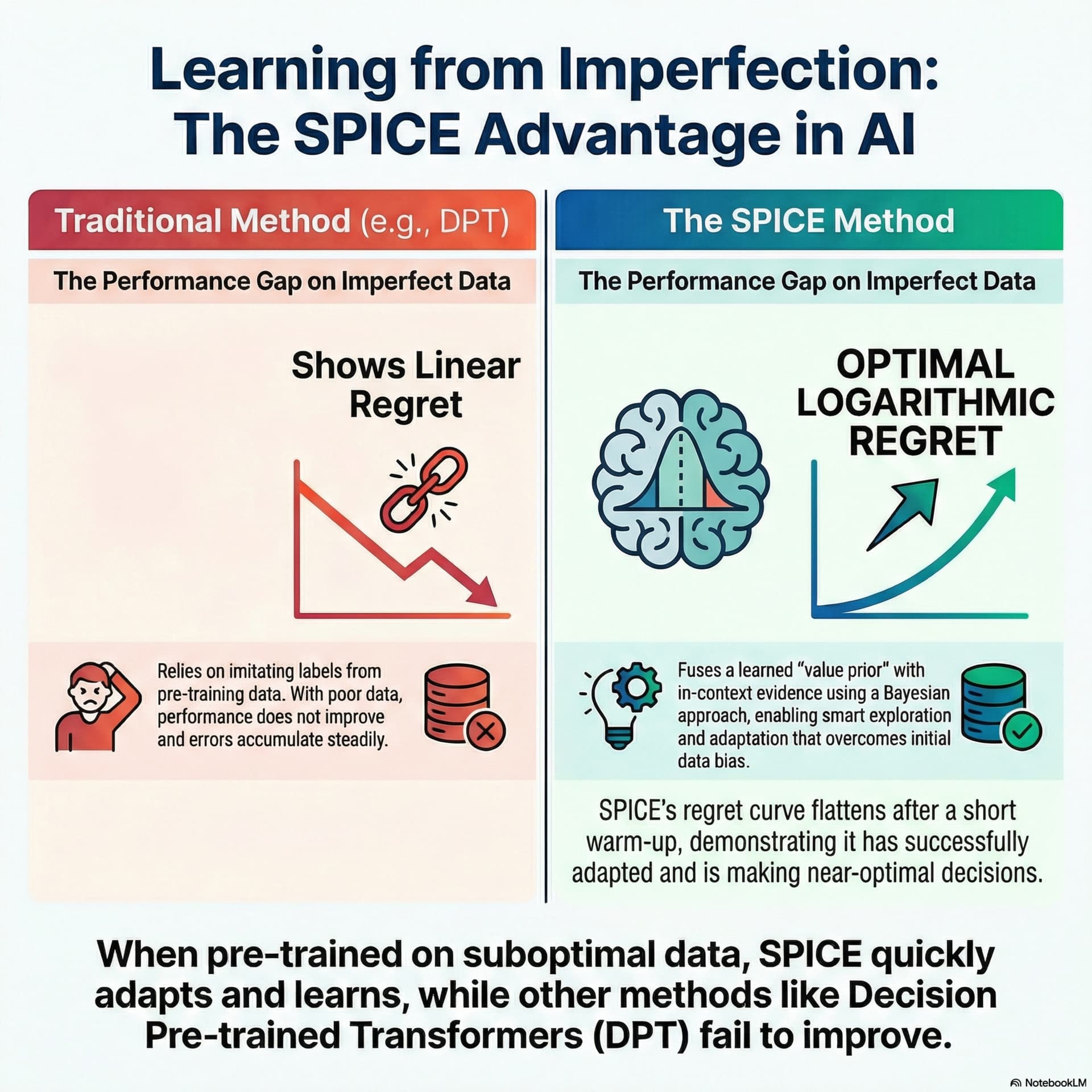
ICRL methods based on imitation (e.g., algorithm distillation/DPT) get trapped by suboptimal logging policies (behavior policy bias), lack calibrated uncertainty (no usable UCB), and require unrealistic optimal-policy logs. SPICE-E fixes this by learning an uncertainty-aware ensemble value prior and fusing it with new context at test time via closed-form Bayesian precision additivity.
Notable examples
“Darkroom MDP” worst-case setup with uniform-random data and weak/noisy labels; imitation models show near-linear regret, while SPICE adapts quickly with regret flattening after warm-up.
Written by AI. May contain mistakes. Listen to the episode to check what was said.
Chapters
Tap a time to open that second in VOUnderstanding In-Context Reinforcement Learning
0:46 to 1:30
Exploration of how ICRL works and its promise in adapting to new contexts.
“Real-world logs are full of suboptimal actions, bad habits.”
Challenges with Current Approaches
1:31 to 3:16
Discussion on the limitations of existing ICRL methods and their biases.
“The central flaw is something we call the behavior policy bias.”
Introducing SPICE-E Algorithm
3:17 to 4:22
An overview of the SPICE-E algorithm and its Bayesian approach to ICRL.
“So how does SPICY get past this imitation game and start focusing on actual value?”
Cleaning Data with Representation Shaping
4:23 to 6:27
Explanation of how representation shaping improves the data quality for SPICE.
“If you train this ensemble on the same messy data that biased DQT, won't the prior itself be biased?”
Test-Time Adaptation in SPICE
6:28 to 8:02
How SPICE adapts to new tasks using Bayesian fusion without slow updates.
“Instead of just copying every noisy step, Spice trains the Transformer to create this uncertainty-aware Mac of the world.”
Real-World Applications and Testing
8:03 to 10:32
A look at the testing scenarios and how SPICE outperforms imitation models.
“Which brings us to the final step, picking an action.”
Implications for Future ICRL Use
10:33 to 11:06
Discussion on the broader implications of SPICE's capabilities in real-world AI.
“Its regret curve flattens out after a really short warm-up.”
Transcript
Automatic transcript. May contain errors.0:00Welcome back to the Deep Dive. Today we are getting into one of the biggest, most persistent hurdles in modern AI deployment. What do you do when all your training data is just messy? It's the ultimate reality check for machine learning, isn't it? We're talking specifically about in-context reinforcement learning, or ICRL. Right. And the promise of ICRL is, well, it's intoxicating. Imagine a self-driving car that adapts to a sudden road closure just by observing the last few seconds of interaction. No retraining, no slow updates. That's the dream, right? Right. You pre-train one giant model, like a transformer, on tons of past experiences.
0:40Then at deployment, you just feed it a little bit of context, what's happening right now, and boom, it just knows what to do. Exactly. But that dream, it just hits a brick wall when historical data isn't perfect. Real-world logs are full of suboptimal actions, bad habits. So our mission today is to unpack an algorithm called SPICE-E that's shaping policies in context with Ensemble prior and see how it uses a really robust Bayesian approach to perform well, even when it starts with junk data. Spicy. A recipe for fixing bad data. I love it. So at a high level, how does it actually break that cycle?
1:13It pivots. It moves from just imitation to actual estimation. It learns this complex, uncertainty-aware prior over action values, so how good an action is, and then has a way to fuse that knowledge with fresh evidence. Okay, let's unpack that. But before we get to the solution, why do the established approaches like algorithm distillation or DPT, why do they struggle so badly with imperfect beta? The central flaw is something we call the behavior policy bias. These methods, at their core, are just doing imitation learning. They use maximum likelihood estimation, or MLE, which basically just tells the model to copy the actions it saw in the training data.
1:51So if I train a model on a logging truck driver who's always slamming on the brakes, my AI will also learn to slam on the brakes. That's a perfect analogy. Doesn't understand the value of the actions, just the frequency. If the policy that made the data was bad, the model is fundamentally trapped. It can't perform better than that low quality. The student can never outperform its worst teacher. OK, so what's the second big constraint that keeps them stuck? It's a total lack of what we call uncertainty quantification. For an agent to be smart, it has to know what it doesn't know. Right. But most of these methods, they don't give you a calibrated, actionable sense of uncertainty over the Q values, which is, you know, your estimate of future reward.
2:32And if they don't have that measure of uncertainty, does that mean their exploration is just basically guesswork? Precisely. It's just random noise. You can't use these really powerful principled exploration strategies like upper confidence bound or UCB because they depend entirely on having that quantified uncertainty. And the third limitation, the one that really hits home for real-world deployment. That's the unrealistic data requirements. I mean, if you want a model to learn an optimal policy, you need logs of an optimal policy. Which you almost never have. Exactly. In something like energy grid management, those optimal logs just don't exist in large quantities.
3:07You have a mess of data from all sorts of mediocre attempts. So to sum it up, current ICRL is stuck imitating mediocrity because it doesn't have the statistical insight to know when it should just ignore the past and try something new. That's it in a nutshell. Yeah. And that brings us to SPICY. So how does SPICY get past this imitation game and start focusing on actual value? SPICY is fundamentally a Bayesian solution. It's all designed to estimate the value function and crucially its uncertainty. And it starts by building a robust prior. But how do you build a reliable prior when the training data itself is unreliable?
3:42That seems like a paradox. You do it with a value ensemble prior. So spicy has a main transformer trunk and then attached to it are K independent value heads. It's a deep ensemble. So multiple little brains all trying to predict the Q values. Right. And the average of their predictions gives you the mean Q value. Right. But the real magic is in the variance, the disagreement between those heads. Ah, so that disagreement, that variance, that's your measure of confusion, right? Right. Where the model isn't sure. It is. That's our measure of epistemic uncertainty. The uncertainty that comes from not having enough data in some part of the world.
4:14Yeah. SPICE-C actively forces these heads to be diverse. So that variance is a really good, well-calibrated signal. Okay, but wait a minute. If you train this ensemble on the same messy data that biased DQT, won't the prior itself be biased? How do you clean up the information before it even gets to the ensemble? That is the absolute core innovation. It's called representation shaping. Okay. The model uses a GPT-2 style transformer trunk to take the history of interactions and condense it down into a shared latent feature representation. So the trunk is like a smart filter creating this useful summary of what's happened.
4:51Exactly. And to make sure that summary is high quality, SPICY adds a special policy head, which is only used for training. It's never used for control at test time. This head is trained with a very carefully designed weighted supervision loss. A training-only signal, but it's the key to cleaning the memory. It is. This weighted loss is what shapes the transformer trunk. It forces the trunk to learn features that are de-biased and focused on future rewards. It corrects the bias before the value ensemble even sees the features. Okay, this is where it gets really interesting. Tell us about those weights.
5:24What are they actually doing to the data? There are three critical factors, and they're applied multiplicatively. Right. First is importance weighting. This is a classic statistical tool to correct for the fact that the offline data came from a specific, maybe biased, policy. It re-weights the samples, downplaying common actions, and up-weighting rare but informative ones. So it rebalances the data set, makes rare good events count for more than common mediocre ones. What's the second weight? That's advantage weighting. This really focuses the learning on reward-relevant features. It gives more weight to samples where the action taken was surprisingly good, where it had a positive advantage.
6:05So it tells the model, pay attention to the times things went unexpectedly well. Exactly. And the third weight is maybe the most critical for exploration, epistemic weighting. This factor specifically emphasizes samples where the ensemble was most confused, where the standard deviation was high. By forcing the training to focus on these uncertain areas, the model builds a much more robust prior. It learns the boundaries of its own competence. That feels like a fundamental shift. Instead of just copying every noisy step, Spice trains the Transformer to create this uncertainty-aware Mac of the world.
6:39Precisely. And once that foundation is laid, Spice moves to its second phase, test time adaptation. And this happens entirely without any slow parameter updates. So how does Spice take that pre-trained uncertainty map and make it instantly useful for a brand new task? It uses a test-time Bayesian fusion policy. When a new task starts, the agent interacts a little, generates a small new context. Spice then extracts evidence from that context. And it doesn't just look at the raw state to do that, right? That seems like it would be brittle. Correct. It applies a kernel, like an RBF kernel, to the latent features coming out of the transformer trunk.
7:16Since the trunk is already shaped to find reward-relevant similarities, this is a much more robust way to figure out which bits of context are relevant to the current decision. Okay, so we have the prior from the ensemble and the new evidence from the context. How are those two combined? Through a clean, closed-form Bajan update called precision additivity. Think of precision as just the inverse of uncertainty. More certain means more precision. Exactly. And you can just add the precisions of the prior and the new evidence together. This gives you a mathematically exact posterior mean and posterior variance for each action.
7:51So the posterior mean combines all the knowledge, the big prior, plus a small new context. And the posterior variance tells you exactly how much uncertainty is left for this specific task. You've got it. And now that we have that quantified uncertainty, we can finally use it for smart exploration. Which brings us to the final step, picking an action. Right. SPICE uses a posterior UCB rule. It chooses an action optimistically. It's the action with the highest posterior mean plus an exploration bonus that's proportional to the posterior uncertainty. So it's directed exploration. It pushes the agent to try things that are either known to be good or things where the uncertainty is high, suggesting a potentially huge undiscovered reward.
8:32The theoretical result here is what really connects the dots for me. It's a formal guarantee that this whole complex system actually works, even with the bad training data. It's the ultimate safeguard. The paper proves that Spice and Sia achieves optimal logarithmic regret, which is the best possible performance guarantee, even when pre-trained entirely on suboptimal data. Wait, hold on. You're telling me that we can train on trash data, and the algorithm eventually just fixes its own bad memory? That feels like computational redemption. That's the idea behind the constant warm start guarantee.
9:04The math shows that any bias from that suboptimal prior only affects a temporary fixed early phase, the warm start. So if I deploy spice in a new factory, okay, the early mistakes might be influenced by the bad prior, but the bias vanishes quickly. I don't risk long-term failure. Precisely. As you collect more real rewards from the new task, the influence of the prior just fades away. Learning starts to rely entirely on what's actually being observed. In the worst case, if the prior was totally useless, the system just defaults back to a classical UCB, which is still guaranteed to be optimal in the long run.
9:41So what does this all mean for us? Let's bring this back to real-world applications, where data quality is the number one headache. Yeah, think about autonomous driving or robotics. Getting optimal training data is expensive, it's dangerous, sometimes impossible. In our testing, we saw this really clearly in an environment called the darkroom MDP. And how was that environment rigged to fail? Oh, we made it a worst-case scenario. The training data was generated by a policy that just took uniform random actions, and the actual labels themselves were weak last suboptimal, which means the supervised targets were basically just noise.
10:13And what happened to the imitation models? The methods that rely on imitation, like DPT, they exhibited near-linear regret. Their performance just got linearly worse over time because they were perfectly imitating garbage. They got basically zero return. Linear regret is a signal of complete unrecoverable failure. Total failure. In stark contrast, Spicye adapted almost immediately. Its regret curve flattens out after a really short warm-up. It showed it can completely disregard the noisy imitation data by focusing on the real rewards and its own principled exploration. That shift from an algorithm trapped by its bad data to one that uses uncertainty to guide itself is absolutely crucial.
10:53It feels like this is what could finally let ICRL move into domains where optimal data is just a fantasy. Beats deployment so much safer and more robust because the system always knows when it needs to be optimistic and explore to figure things out. That was a phenomenal deep dive. The key takeaway for you, our listener, is that SPICY really succeeded by breaking that simple supervised learning paradigm. It introduces Bayesian uncertainty with deep ensembles, fuses that knowledge with context, and guarantees it won't get stuck in the long run. And before we wrap up, here's a final provocative thought for you to explore.
11:28SPICY's whole fusion process relies on applying these RBF kernels to the latent features from the transformer trunk. This means the system is entirely dependent on the quality of that learned representation. Oh. So consider what happens if that trunk, despite all the shaping, systematically gets things wrong. What if it thinks two truly different states are similar? Could that flawed internal map lead the whole Bayesian process astray, causing it to combine evidence from situations that actually have nothing to do with each other? The system is designed to correct for a bad prior, but if the internal mapmaker itself is flawed, that's a whole new level of challenge, definitely something for us to mull over.
12:07Thank you for walking us through this research.
From the publisher
This paper introduces how we can adapt quickly to new tasks without updating model parameters using a framework called SPICE (Shaping Policies In-Context with Ensemble prior), a novel Bayesian In-Context Reinforcement Learning method.Unlike existing models that rely on optimal data, SPICE utilizes a deep ensemble to learn a value prior from suboptimal trajectories and refines this prior at test-time through Bayesian updates. This approach effectively addresses the behavior-policy bias found in traditional supervised learning by using an Upper-Confidence Bound (UCB) rule to encourage principled exploration. Theoretical analysis proves that SPICE achieves optimal regret bounds in both stochastic bandits and finite-horizon environments. Empirical results across various benchmarks confirm that the method is robust under distribution shifts and significantly outperforms prior meta-reinforcement learning approaches. Ultimately, the research offers a scalable framework for deploying reinforcement learning in real-world domains like robotics and autonomous driving where data may be limited or biased.


