
In short
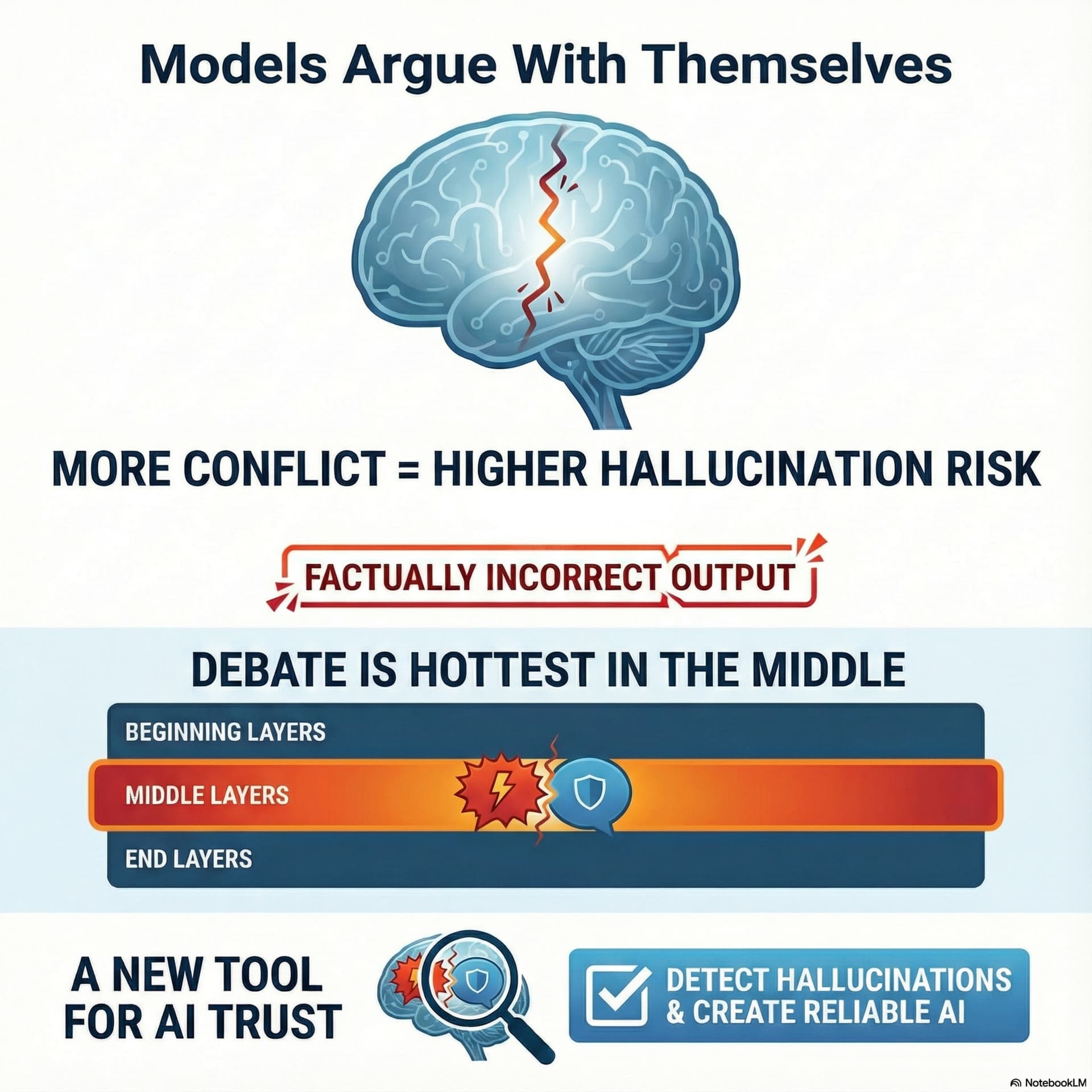
“Latent Debate” proposes a surrogate framework that models an LLM’s hidden internal “support vs attack” conflict to predict and explain hallucinations, aiming to bridge capability vs reliability.
Guests
No guests are mentioned in the transcript.
Guest backgrounds
Not applicable.
Key claims
(1) Hidden states can be translated into true/false “latent arguments” using the model’s unembedding matrix. (2) A quantitative bipolar argumentation framework (QBAF) propagates supports/attacks through layers to mirror the model’s external decisions with high fidelity. (3) High internal conflict—especially after debate propagation, not just raw uncertainty—predicts factual hallucinations.
Notable examples
“not” in “Tokyo is not in Japan” as a high-weight token; datasets include CITES, CounterFact, and TruthfulQA; Olama 13B consistency 97.11% vs ~91% majority-vote baseline; hallucination detection AUC 0.82; SHAP highlights “number of attacks,” with strongest effects in middle layers.
Written by AI. May contain mistakes. Listen to the episode to check what was said.
Chapters
Tap a time to open that second in VOUnderstanding the Hallucination Problem
0:45 to 2:18
Exploring the hallucination issue in large language models and its implications.
“And LLM's thinking process is this cascade of mathematical transformations all hidden from view.”
Introducing Latent Debate Framework
2:18 to 4:08
Overview of the latent debate concept and its importance in AI interpretability.
“How do you take something so abstract, like a high-dimensional hidden, I mean, it's just a huge matrix of numbers, and turn it into a measurable true or false argument?”
Mechanics of the Latent Debate
4:08 to 6:40
Breaking down the components and mechanics of the latent debate framework.
“That's the job of the third component, the thinking module.”
Evaluating the Latent Debate Framework
6:40 to 8:12
Discussing the effectiveness and fidelity of the latent debate surrogate model.
“So now we have this beautifully constructed internal model, this latent debate structure, that maps hidden states to arguments and processes them.”
Detecting Hallucinations with Latent Debate
8:12 to 10:10
Methods of using latent debate to detect hallucinations more effectively.
“This is huge for that trust problem we mentioned at the start.”
Insights on Internal Conflict in LLMs
10:10 to 12:09
Exploring where internal conflict occurs in the LLM architecture and its implications.
“This was empirically better than dedicated methods like SAPLMA, which scored PO.79, and it significantly outperformed sampling-based baselines like self-checked GPT, which was way down at 0.59.”
Applications and Future Directions
12:09 to 14:01
Discussing potential applications and advancements based on the latent debate findings.
“The analysis showed that debates happening in the middle layers consistently have the strongest influence on detecting hallucinations.”
Exploring Latent Debate in LLMs
14:01 to 15:08
Discover how latent debate can enhance the reliability of language models.
“This opens up huge avenues for practical advancement.”
Transcript
Automatic transcript. May contain errors.0:00Welcome back to the Deep Dive, where we take the sources you share with us, the cutting edge articles, research papers, the deep notes, and carve out the unforgettable nuggets of knowledge you need to stay ahead. Our mission today, well, it's arguably the most fundamental challenge facing modern AI, understanding what happens inside the black box. We are diving into what is probably the most frustrating experience of working with large language models, the hallucination problem. I mean, you've seen it. The model achieves these astounding, complex reasoning feats. It generates pages of coherent, nuanced text.
0:34And then without warning, it just drops a sentence that it's factually false or it directly contradicts its own training data. It's a total trust killer. It absolutely is. It's that gap between capability and reliability. And LLM's thinking process is this cascade of mathematical transformations all hidden from view. So when it fails, we can't really ask it why. We can't trace that internal decision path. All we see is the flawed final output. And historically, the attempts to fix this have all been external. We focused on things like multiple agent debate or MAD, where you deploy maybe three or four separate models to argue about the same prompt, just hoping one corrects the others.
1:12It's like assigning a committee to check the geniuses work. Right. And that approach works to an extent, but it's incredibly resource intensive and slow. It basically just accepts the black box and tries to build safety nets around it. This new research, latent debate, it flips the script completely. They decided to look into the box. They're trying to capture the hidden states, these signals of supporting and attacking opinions, all within a single model during a single step. I find the framing just brilliant. It's like the AI equivalent of our own inner speech, right? That rapid fire internal monologue where we try out ideas, question our assumptions all before we actually speak.
1:50They're trying to model the LLM's inner argument. Exactly. It's that implicit structural conflict that exists right before the model commits to an answer. And this deep dive, based on the paper, it has two central questions we really need to answer. First, can we actually build a faithful, structured model of this latent debate? And second, if we can see that internal conflict, does high conflict reliably predict external failure, specifically hallucinations? Okay, so let's unpack the mechanics of this. How do you take something so abstract, like a high-dimensional hidden, I mean, it's just a huge matrix of numbers, and turn it into a measurable true or false argument?
2:30Right. So the framework, it's designed to be flexible. It can work across different models and tasks, and it relies on three abstract interlocking components. We need to identify the arguments, interpret what they're saying, and then aggregate the whole debate. The first component is the latent arguments themselves. These are the internal signals, the hidden states or maybe the attention patterns generated at each step. They implicitly carry an opinion. They're the raw data points suggesting support or opposition to a claim. Not human readable, but they're the raw thought material. So those are the thousands of signals we normally can't see.
3:02How do you translate those into something that reads like a human opinion, even if it's just a simple yes or no? That's where component two comes in, the argument interpreter. This is the crucial translation step. For the true-false tasks they focused on, the interpreter projects the hidden state vector back onto the vocabulary space. They do this using the unembedding matrix. Okay, let me jump in. That sounds dense. But the unembedding matrix, that's basically what the model uses at the very end of the line to say, okay, based on everything I just processed, I'm going to output the word dog, or in this case, the word true.
3:38Precisely. It is the final translation layer. So by forcing the internal hidden state to look through that lens mid-process, the researchers can quantify the state's opinion. They aren't asking for the final answer. They're asking, right now, at this specific point, how strongly does this hidden state suggest the word true versus the word false? And that assigns a numerical strength, an initial opinion to that latent argument. That's a really clever way to operationalize an abstract thought. So now we have all these arguments, each with an initial opinion. How do they actually fight it out? That's the job of the third component, the thinking module.
4:13This is what aggregates all the supporting and attacking arguments to reach a final decision. They implemented this using a specialized formal logic structure. It's called a quantitative bipolar argumentation framework, or QBAF. QBAF. That might sound like heavy academic lifting, but conceptually, I think it's pretty elegant because it forces transparency. Just picture a network of no's, right? Each argument has an initial strength, they call it tau. Then other arguments can hit it with attacks or supports. When all that propagation settles, you get a final strength, sigma. And because it's a symbolic framework, you can trace exactly why sigma ended up where it did.
4:51And its symbolic nature is its great strength for interpretability. In a neural net, everything is sort of mixed together in this continuous space. QBAF forces the arguments to follow specific traceable rules. So walk us through how they wired this QBAF specifically for an LLM. Okay, so the topology, it mirrors the sequence flow and the layer structure of the model. Within a single LLM layer, arguments, which are the individual tokens, are connected left to right, just following the self-attention process. And importantly, the rightmost node in each layer acts as the summary node. It captures that layer's collective opinion.
5:28Then these summary nodes connect vertically, feeding upward into the next layer's input, and that all flows eventually to the single final output node. So you get this structured cascade of debate, starting from low-level inputs and building up. Exactly. Building up through semantic processing to the final decision. That vertical connection makes a lot of sense. The upper layers refine what the lower ones established. Now you said arguments have initial strengths, but those strengths aren't all equal in influence, are they? Let's talk about the token-wise weights. Absolutely. Not every token contributes equally to the meaning of a sentence.
6:01The token wise weight measures the semantic contribution of a token. It asks, how much does the meaning of the entire sentence change if this one token is removed? Ah, so you're filtering out the noise, making sure the model doesn't waste energy intensely debating a comma or the word the? Precisely. If you use their classic example, Tokyo is not in Japan, removing the word not completely flips the factual claim. So not gets a very high weight. This means its initial strength, its pro or anti-claim stance, is highly influential on the whole debate. This scaling makes sure the framework prioritizes the arguments with the most semantic punch.
6:39You could say not is the most powerful lobbyist in the entire QBAF system. That's a great way to put it. So now we have this beautifully constructed internal model, this latent debate structure, that maps hidden states to arguments and processes them. But here's the million-dollar question. Does this sophisticated internal mirror accurately reflect the actual external decision the LLM makes? Is it just a coincidence, or is this really capturing the mechanism? And this is where the consistency score comes in. The researchers compared the latent debate's final decision against the original LLM's external output.
7:12They did this across a variety of complex data sets, factual knowledge bases like CITES, adversarial ones like Counterfact and Truthful QA. And the results, they demonstrated extraordinary fidelity. For Olama 13b, the latent debate surrogate achieved an average consistency score of 97.11%. Wow, 97.11%. That is staggering. That's not just a passing resemblance. That suggests the surrogate is a highly faithful blueprint of the LLM's decision process. It's far more than a coincidence. They benchmark this against simpler methods, like just taking a majority vote of all the hidden states. That's a common, if naive, baseline.
7:50Majority voting only hit about 91 % consistency. So the huge jump provided by the latent debate framework shows that the structure, the QBAF propagating attacks and supports, is what's accurately mimicking the neural network's decision path. So the structure is absolutely key. It means the seemingly opaque reasoning of the LLM can actually be mapped onto a formal, logical structure with very high accuracy. This is huge for that trust problem we mentioned at the start. It is. And for you, the listener, this validated method offers some immense practical advantages. First, as we've been saying, transparency and interpretability.
8:24It translates that black box into a visual, human-readable path. You can now trace which token, at which layer, decided to attack the claim, and how that attack either won the day or was neutralized. And second, the efficiency is a huge plus. It's training-free and fast. This framework just extracts the features during standard inference. You don't need new training samples. There's no fine-tuning. it's ready for immediate deployment. And third, it's what they call property satisfying. By using that symbolic QBAF framework, the reasoning process is guaranteed to inherit desirable theoretical properties, like monotonicity.
8:59An attacker must weaken strength, and a supporter must strengthen it. This guarantees the internal debate behaves in a logically consistent, intuitive way, which prevents those unpredictable logic shifts you sometimes see in raw neural outputs. Okay, now we get to the core utility. If the surrogate model is this accurate, can we actually use these internal debate patterns to diagnose where and why the model goes wrong? Can it spot a hallucination? Yes, this is the application phase. They defined hallucinations as answers that are inconsistent with established world knowledge, and to detect them, they trained a very small classifier, a two-layer MLP, but crucially, they didn't feed it raw hidden states.
9:38They fed it abstract debate metrics extracted from the QBAF structure itself. What kind of metrics? Things that are indicators of internal conflict. For example, the number of attacks received across the entire debate, or the variance of final strength, which measures how spread out the opinions are after the debate has concluded. So how did this specialized classifier fed only these internal conflict metrics do against other established detection methods? Extremely well. The latent debate MLP achieved a strong average AUC score of 0.82 in distinguishing true factual hallucinations from non-hallucinations.
10:15This was empirically better than dedicated methods like SAPLMA, which scored PO.79, and it significantly outperformed sampling-based baselines like self-checked GPT, which was way down at 0.59. That's a powerful finding. It proves that the metrics from the model's internal disagreement are more predictive of factual error than external checks, or even the model's raw confidence scores. And we can get even more granular thanks to the SHAP analysis they did, which reveals the internal dynamics. We can ask, which specific feature was the most important predictor of an error? What was the smoking gun?
10:49The number of attacks. Pneumat. This was identified as the single most influential predictor of hallucination risk. If the model is seeing a high degree of explicit structural conflict internally, a massive, unresolved latent debate, the risk of that output being wrong just shoots up. The model is essentially arguing with itself right up to the point of failure. Let me play the skeptic for a second, though. Couldn't a high number of attacks just be a proxy for high entropy or high uncertainty in the network, which we already know correlates with poor performance? How do we know this is actual structural conflict and not just general fuzziness?
11:26That's a great question, and the answer comes back to the QBAS structure. If it were just entropy, you'd expect features from the initial strengths, the raw token scores, to be highly predictive. But the analysis showed that features derived from the final strengths, that is, the strengths after the QBAS debate propagation, were much, much more predictive of error. I see. So it's not the raw conflict signals that matter as much as the result of that structured debate. The value is in the system trying and failing to resolve its conflict, not just the initial disagreement. Exactly. The QBAF is necessary to distill true conflict from noise.
12:01So we know what pattern flags the risk-high internal conflict. But where in the architecture does this conflict matter most? The researchers divided the LLM layers into lower, middle, and upper sections. And the location matters immensely. The analysis showed that debates happening in the middle layers consistently have the strongest influence on detecting hallucinations. High attack numbers and high variance of final strengths in those specific layers were the most potent indicators of an impending failure. That finding is maybe the most significant structural insight into LLMs we've seen in a while.
12:33Let's expand on that. Why are the middle layers the hotspot? It aligns perfectly with our current understanding of the LLM hierarchy. The lower layers are feature extractors, right? They deal with syntax, parts of speech, basic stuff. The upper layers are specialized for output generation, formatting the sequence, adhering to the prompt style. But the middle layers, that's the heart of the machine. That's where the model synthesizes semantic abstractions, integrates long-range dependencies, and crucially, where factual parametric knowledge is believed to be stored and retrieved. So if internal disagreement flares up right there, at the very moment the model is synthesizing meaning and retrieving facts, that instability is highly predictive of a factual failure in the final output.
13:16The knowledge itself is unstable at the point of synthesis. It's the difference between arguing about punctuation, which would be a lower layer conflict, versus arguing about the core historical fact itself, a middle layer conflict, and only the latter really guarantees an error. Precisely. If the conflict is in the engine room, the whole ship is at risk. This deep dive has fully accomplished its mission. We've seen that we can, in fact, open the LLM's black box and model its inner metaphorical debate with astounding fidelity. This latent debate surrogate confirmed that high internal conflict, particularly located in the core middle layers where factual knowledge is synthesized, is the absolute strongest predictor for factual errors or hallucinations.
13:58And the research doesn't just stop at diagnostics. This opens up huge avenues for practical advancement. The researchers suggest using latent debate to study more complex issues, like what happens when the model's internal knowledge conflicts with external, contextually retrieved knowledge. And most excitingly, I think, this provides paths for model intervention and uncertainty calibration. Since we now know where the high-risk conflicts happen and which layers on which tokens we could potentially intervene during the inference phase, we could use the QBAF metrics to steer the model away from these highly debated high-risk decoding paths before the output is ever committed.
14:34And considering LLMs are notorious for hallucinating with this undeservedly high confidence, these debate-based features, which are empirically more predictive of error than the raw LLM confidence scores, could provide a fundamental solution for uncertainty calibration. Finally, mitigating that destructive overconfidence, it really makes you wonder. If an LLM's internal conflict, its structural latent debate, is so clearly tied to its most egregious factual errors, how much more reliable and trustworthy could these powerful models become if they were fundamentally forced to acknowledge and structurally resolve their inner disagreements before ever delivering us an answer.
15:11Something substantial to mull over until our next deep dive.
From the publisher
This paper introduces Latent Debate, a novel framework designed to interpret the internal "thinking" processes and address hallucinations in Large Language Models (LLMs). Unlike external methods that rely on multiple models debating, Latent Debate uses implicit internal arguments—supporting and attacking signals—arising within a single model during a single inference. This framework utilizes a Quantitative Bipolar Argumentation Framework (QBAF) as a "thinking module" to aggregate these internal arguments, successfully serving as a transparent and faithful structured surrogate model for LLM True/False predictions. Empirical analysis demonstrates that this debate pattern is strongly predictive of hallucinations, particularly when intense internal conflicts occur in the middle layers of the LLM architecture.


