In short
The episode explains the March 20, 2026 paper “Learning to Reason with Curriculum I” (Microsoft and UIUC) arguing that AI training for reasoning is hitting a compute wall, and proposing “autocurriculum” methods that cut expensive supervision and trial-and-error costs.
Guests
No specific guests are named in the transcript; it’s a two-host discussion.
Key claims
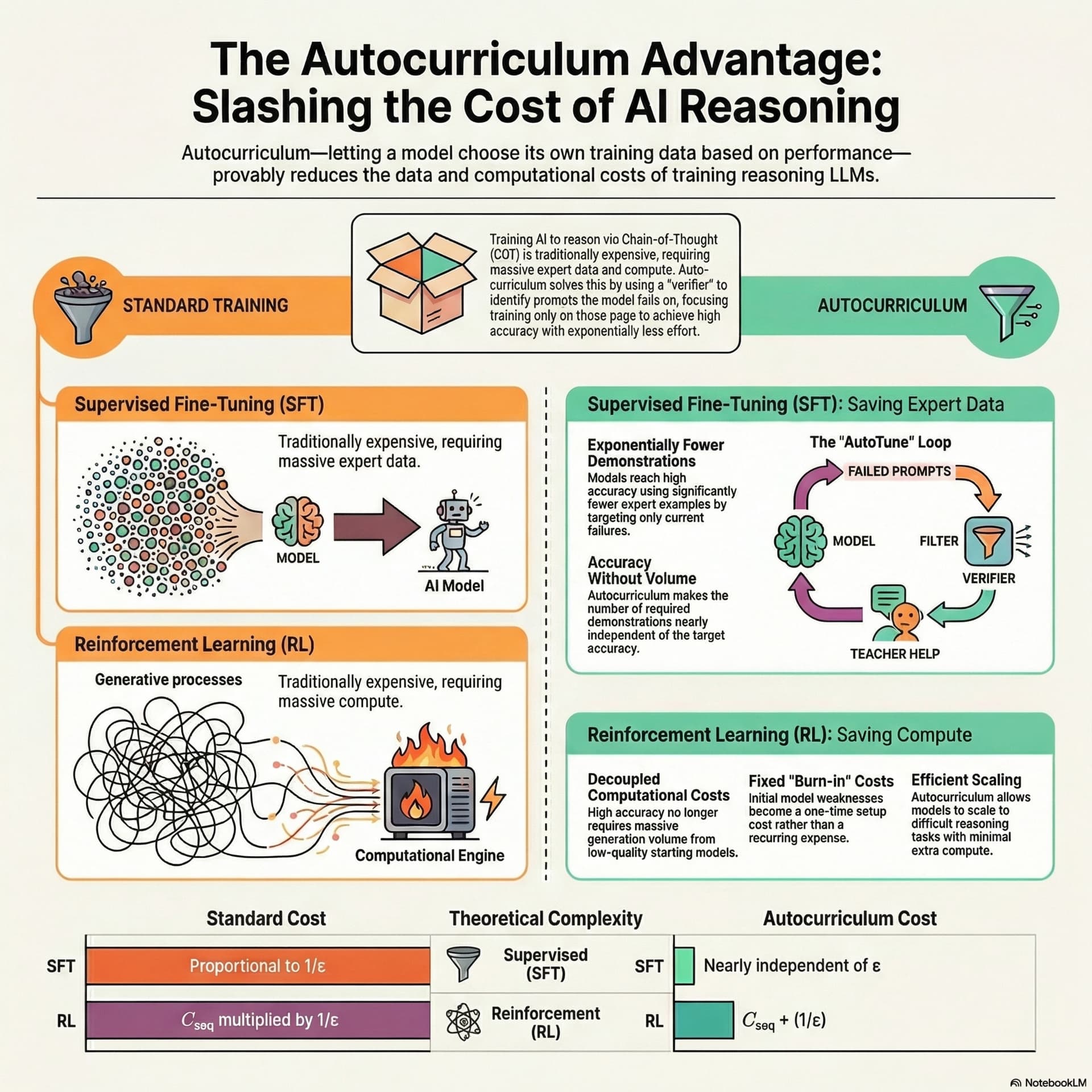
Non-adaptive baselines (SFT with full teacher traces; RLVR with rejection sampling) scale poorly as target error rates shrink, making near-perfect accuracy computationally explosive. Autotune (for SFT) gates costly teacher chain-of-thought behind cheap verifier checks, yielding exponentially fewer teacher demonstrations and near-independence from target accuracy. Autotune.rl (for RLVR) reweights hard prompts using verifier feedback, decoupling compute cost from reference-model quality via a “burn-in cost.”
Notable examples
unit-test verifiers; “practice test” analogy; trivia-student rereading an encyclopedia; plus-sign change in formulas; sequence-level coverage; ensemble of weak learners via phased specialization; historical links to 1997 boosting (Freund/Schapire) and 1987 learning from counterexamples (Angluin).
Written by AI. May contain mistakes. Listen to the episode to check what was said.
Chapters
Tap a time to open that second in VOAI's Accelerated Yet Unsustainable Progress
0:00 to 1:21
Discussion on the current state and limits of AI development.
“So right now, the artificial intelligence industry is basically driving a high performance sports car at like 200 miles an hour directly into a brick wall.”
Introduction to the Autocurriculum Paper
1:21 to 2:17
Exploration of a new paper proposing a solution to AI training bottlenecks.
“Okay, let's unpack this because today's deep dive is all about a potential escape route from that impending crash.”
Current AI Training Methods: SFT and RLVR
2:17 to 4:12
Comparison of supervised fine tuning and reinforcement learning in AI.
“We have to understand why the industry standard approach, what the researchers call the non-adaptive baseline, is failing us so spectacularly.”
The Limitations of Non-Adaptive Baseline Approaches
4:12 to 6:26
Critique of the brute force methods in current AI training practices.
“For the past few years, the strategy has basically been brute force.”
Understanding Autocurriculum and Autotune
6:26 to 7:48
Detailed explanation of how autocurriculum improves AI learning efficiency.
“If you want to improve your score from a 50 to a 51, maybe you just read a few random flashcards.”
Implementing Autotune in Supervised Learning
7:48 to 10:00
Insight into how autotune enhances supervised fine-tuning in AI.
“The model attempts to answer it using its current capabilities.”
Navigating Reinforcement Learning Challenges
10:00 to 12:10
Exploration of reinforcement learning's complexities and how to address them.
“It routes the supervision only to where it is mathematically guaranteed to be the most impactful.”
The Game-Changing Autotune.rl Algorithm
12:10 to 13:59
How the autotune.rl algorithm revolutionizes AI training efficiency.
“It applies the exact same verifier-guided concept, but adapted for self-discovery.”
Understanding Ensemble of Weak Learners
14:00 to 15:34
Explore how the algorithm builds an ensemble of weak learners through targeted phases.
“Under the hood, what the algorithm is actually doing is building an ensemble of weak learners.”
Historical Insights on Autocurriculum Techniques
15:34 to 16:57
Discover how historical computer science concepts influence modern AI techniques.
“I am so glad you brought that up because reading through this 2026 paper about cutting-edge LLMs, I expected to see citations exclusively from the last two or three years.”
Show all 13 chapters
Active Learning Limitations and Solutions
16:57 to 18:08
Learn about the limitations of traditional active learning and how autocurriculum overcomes them.
“They rely on theoretical bounds, things called a bounded star number or a bounded disagreement coefficient.”
Implications for AI Training and Democratization
18:08 to 19:14
Understand the impact of more efficient training on the AI landscape and its accessibility.
“It really is a triumph of algorithmic efficiency over brute force scale.”
Rethinking Learning through Autocurriculum
19:14 to 21:20
Consider how humans can apply AI principles to improve their own learning processes.
“But exponentially cheaper training means a radically more democratized AI landscape.”
Transcript
Automatic transcript. May contain errors.0:00So right now, the artificial intelligence industry is basically driving a high performance sports car at like 200 miles an hour directly into a brick wall. A massive wall. Right. And that wall is made entirely of data and electricity. It is a really severe physical and economic limit. I mean, we are quite literally running out of the computational power required to teach the next generation of AI how to actually think. Which is wild, right? Because from the outside, for you listening, it probably looks like AI is progressing faster than ever. Oh, absolutely. You know the experience. You sit down, you ask a modern AI to solve a complex logic puzzle or maybe a code and interactive website from scratch.
0:41And there's this distinct moment that happens now. It pauses. Yes. It doesn't just spit out an answer immediately anymore. It seems to like actually think before it speaks. You see those little reasoning tokens pop up detailing its step by step logic. Right. And generating that chain of thought is what allows the model to work through a problem. It's testing hypotheses internally before committing to a final output. It feels like magic to the end user. It does feel like magic. But underneath that magic is the core crisis in AI development today. Teaching a model to generate those brilliant reasoning traces requires this insatiable, completely unsustainable demand for computing power.
1:21Okay, let's unpack this because today's deep dive is all about a potential escape route from that impending crash. A very mathematically elegant escape ride. Exactly. We are looking at a brand new, highly anticipated paper dated March 20, 2026 from researchers at Microsoft and UIUC. It's titled Learning to Reason with Curriculum I. And their mission is fascinating. They are proving how AI can actually solve its own massive training bottleneck through a mathematical concept called an autocurriculum. The implications for anyone listening to this right now, I mean, they really cannot be overstated.
1:55Wow, really? Yeah, because this paper fundamentally changes the economics of how knowledge is built into artificial intelligence. It takes training processes that were practically doomed to become too expensive and makes them astonishingly efficient. But to really appreciate the genius of their solution, we kind of have to look at the wreckage of the current methods, don't we? We do. We have to understand why the industry standard approach, what the researchers call the non-adaptive baseline, is failing us so spectacularly. Right. So let's break that down. Yeah. Let's look at the two primary ways we currently teach an AI to reason.
2:31First, there is SFT or supervised fine tuning. OK. And second, RLVR, which stands for reinforcement learning with verifiable rewards. Got it. So starting with SFT, this is basically like the apprenticeship model, right? The AI learns by example. Precisely. But it needs absolutely pristine, perfect examples to learn from. Yeah. It relies on a massive data set of step-by-step reasoning traces. And where do those come from? They have to be generated. Right. Generated either by incredibly smart, expensive human experts or by an even more advanced, massively expensive teacher AI model. You're basically spoon feeding the student the exact perfect logic path for millions of questions.
3:12And collecting that pristine data is a colossal effort. It's slow and the cost is astronomical. So developers often lean heavily on the second method, which is RLVR. The reinforcement learning one? Exactly. In reinforcement learning with verifiable rewards, you don't use an expensive teacher at all. You just give the AI a problem and an outcome verifier. Like a test. Think of it like a unit test for a piece of code or an automated answer checker for a math equation. So you essentially lock the AI in a digital room and say, don't come out until you get the right answer. That's a great way to put it.
3:48The model has to generate a massive number of trial and error reasoning traces. It just throws spaghetti at the wall over and over until it finally stumbles onto the correct logical path that passes the verifier. So it saves you the cost of human data. But the tradeoff is that it requires generating an immense number of tokens. It just eats up staggering amounts of server time and electricity. Which brings us to the non-adaptive baseline approach. For the past few years, the strategy has basically been brute force. Just throw all the available data at it. Right. Throw all the data or all the computing power at the model.
4:23But the researchers point out a brutal mathematical reality about this baseline. The math is very unforgiving here. The cost scales in direct opposition to your target error rate. Mathematically, it's an inverse relationship. If you look at the equations governing the non-adaptive baseline, the target error rate, the margin of error you were trying to eliminate, sits in the denominator of the fraction. And for those of us who haven't taken calculus recently, what actually happens when that number shrinks? Well, as your target accuracy approaches 100%, that error rate gets smaller and smaller. And because it's at the bottom of the equation, the overall amount of data you need just explodes.
5:01Explodes how? Moving a model from, say, 50 % accuracy to 60 % might just take a few thousand examples. But trying to push a frontier model from 98 % to 99 % accuracy on highly complex reasoning tasks. That's the hard part. The data requirement doesn't just double, it scales asymptotically toward infinity. Wait, I have to push back here because I think you and I, well, everyone listening probably wonders this when they read the tech headlines. Sure. In the age of massive tech conglomerates, why is this actually a dead end? Like OpenAI, Microsoft, Google, they are spending tens of billions of dollars building gigawatt data centers.
5:41Oh, the spending is unprecedented. Tam Altman is out there talking about trillions of dollars in chip investments. So if the data requirement explodes, why can't we just build a bigger bomb? Surely sheer scale beats elegant math eventually, right? I mean, scale is incredibly powerful, yes. But you cannot outspend the laws of statistics indefinitely. Really? Think about the computational waste happening inside those gigawatt data centers under the non-adapted baseline. The model is blindly processing a massive random assortment of training data. Right, it doesn't know what it's looking at. It's wasting millions of compute hours repeatedly relearning concepts it already fully understands while simultaneously struggling inefficiently with edge cases it doesn't have the capacity for yet.
6:24Okay, I see. It's like, imagine you're a student trying to win a national trivia championship. Okay, I like this. If you want to improve your score from a 50 to a 51, maybe you just read a few random flashcards. But forcing a frontier AI model to learn via this brute force baseline is like forcing that trivia student to reread an entire 30 volume encyclopedia from page one every single time they want to improve their score by one additional point. Right. You would never study that way. It's completely irrational. It's massively inefficient. Which means the model needs to become a much smarter student.
7:00And that leads us directly into the heart of this paper. The concept of an autocurriculum. Exactly. And autocurriculum is a process where the model uses its own performance metrics to dynamically decide which specific problems it needs to focus its training on. So it's self-directed. It essentially curates its own personalized study guide in real time. And the researchers built a specific algorithm to do exactly this for supervised fine-tuning. They call it autotune. Yes, autotune. If you look at figure one in their paper, they lay out how this architecture flows, and it is a massive departure from the baseline.
7:36Huge departure. Instead of just blindly asking the expensive teacher model to explain every single prompt in the data set, the current model acts as its own initial verifier. And that shift in workflow is vital. The model looks at a training prompt. Let's say it's a complex logic puzzle. The model attempts to answer it using its current capabilities. Right. If the outcome verifier says the model got the final answer right, the model just moves on. It completely bypasses the need to see the expensive, step-by-step reasoning trace from the teacher model. But if it gets that logic puzzle wrong, only then does it raise its hand and ask the teacher model, hey, I actually need the full chain of thought demonstration for this specific problem.
8:19Exactly. And generating a single yes or no verification token is computationally cheap. Generating a 500-word step-by-step reasoning trace from a massive teacher model is incredibly expensive. Just saving tons of money. By gating the expensive queries behind a cheap verification step, the mathematical result is astounding. Auto-tune requires exponentially fewer reasoning demonstrations to reach the exact same target accuracy. Okay, here's where it gets really interesting. Remember that brutal non-adaptive math from earlier? The one with the shrinking error rate in the denominator? Yeah, the one causing the required data to explode toward infinity.
8:59The dependency practically vanishes. Wow. Under the autotune algorithm, the formula fundamentally changes. The amount of teacher data needed drops drastically, meaning it becomes almost entirely independent of the target accuracy. So whether you want 90 % accuracy or 99.9 % accuracy, the amount of expensive teacher demonstrations you need scales primarily with the complexity of the model itself, not the shrinking margin of error. Yes. Going back to your student analogy, this is exactly how a top-tier student actually prepares for an exam. Yes. They take a practice test first, and instead of rereading the entire massive math textbook from page one to try and get a perfect score...
9:37They just look at what they missed. Exactly. They look at their graded practice test, identify the specific calculus problems they got wrong, and focus their studying strictly on those blind spots. The verifier acts as a highly efficient filter. By saving the heavy computational lifting strictly for the model's blind spots, the algorithm curates the perfect personalized curriculum. It's so elegant. It routes the supervision only to where it is mathematically guaranteed to be the most impactful. It makes so much intuitive sense, but supervised fine-tuning is really only half the battle. True. I mean, SFT works great when you have a brilliant teacher model available to ask for help.
10:15But what if the AI is trying to discover new math entirely on its own? Right. Operating at the absolute frontier of human knowledge. Yeah. Where there is no teacher model that exists to provide the right answer. That transitions us into the much harder problem. And the second major setting the paper explores. RLVR or reinforcement learning with verifiable rewards. The trial and error one. Yes, this is the true environment of self-discovery. In this scenario, you start with what the researchers call a reference model. This is a model that has some basic foundational capability. And they measure this baseline capability using a metric called sequence-level coverage.
10:55Sequence-level coverage is an important concept to visualize here. Excellent. It essentially measures the statistical probability that your reference model can naturally stumble upon the correct reasoning trace for a given problem without any outside help. Oh, okay. If a model has good sequence-level coverage, it means it has a decent chance of generating a correct logical path if you just let it try enough times. But remember the baseline approach to reinforcement learning, that trial and error process called rejection sampling? Right. The model just generates trace after trace, guess after guess, throwing away all the bad logic paths until the verifier finally flags a correct final answer.
11:32The math here is even more punishing than it was for SFT. It's a compounding computational nightmare. In the baseline RL approach, you have the complexity of the model multiplied by the difficulty of finding a correct trace, that sequence level coverage metric we just talked about. Right. And all of that is still divided by your shrinking target accuracy margin. Every single step toward perfection requires an exponentially larger mountain of server compute. So how do these researchers fix it when there's no teacher to ask? They introduce the second half of their autocurriculum architecture. They call it the autotune.rl algorithm.
12:13Yes, autotune.rl. It applies the exact same verifier-guided concept, but adapted for self-discovery. Instead of queering a teacher when he gets a prompt wrong, the model flags that specific hard prompt and tells his own reinforcement learning engine to hyper-focus the rejection sampling right there. So it zeroes in on the hard stuff. It dynamically re-weights the training batch, forcing the trial and error generation to concentrate exclusively on the blind spots. And the massive breakthrough here, like the absolute game changer for the industry, is that Autotune.rl actually decouples the computational cost from the baseline quality of the reference model.
12:49This decoupling is the mathematical holy grail of the entire paper. Explain that for us. When you look at the new formula for Autotune.rl, the structure changes entirely. That difficulty metric, the sequence level coverage, it stops acting as a multiplier against your target accuracy. Multiplication sign literally changes to a plus sign in their proof. Yes. Because of that plus sign, the heavy lifting of stumbling on to the right answer becomes what the authors call a burn in cost. I was trying to think of a good way to picture this burn in cost concept for the listener. It's like, OK, think of it like paying a massive cover charge to get into a really exclusive club.
13:27Oh, that's a great way to look at it. Right, because the old bass line was like having no cover charge, but having to pay a massive, exponentially increasing fee for every single step you took once you were inside on the dance floor. Yeah, the longer you stayed and the closer you tried to get to the DJ, the faster you went bankrupt. Exactly. But with autotune.rl, you pay the steep cover charge once. That's the burn-in cost of establishing the sequence level coverage. And once you're inside the club, moving around, exploring, and getting closer to perfection is incredibly cheap. If we connect this to the bigger picture, it fundamentally shifts the economics of artificial intelligence.
14:05Under the hood, what the algorithm is actually doing is building an ensemble of weak learners. Okay, I've heard that phrase thrown around in machine learning circles, but let's break that down for the listener. What actually is an ensemble of weak learners, and how does autotune.rl build one? Well, imagine trying to build a single monolithic brain that perfectly understands every subject simultaneously. That's incredibly hard and expensive. Very. Instead, the algorithm breaks the training into phases. In the first phase, it trains a model that is maybe just okay overall, a weak learner. But then the autocurriculum identifies the specific subset of problems that this first model got wrong.
14:43It finds the blind spots. Yes. Then, in the second phase, it trains a new model only on those specific blind spots. Ah, I see. This second model might be terrible at the general stuff, but it becomes highly specialized at fixing the errors of the first model. That makes sense. The algorithm repeats this process, creating a sequence of these specialized, weak learners. When you stack them all together in ensemble, they form a highly accurate, robust system. It basically creates a geometric progression toward high accuracy. You are fixing a fraction of the remaining errors in each phase rather than trying to boil the ocean all at once.
15:22High-end reasoning becomes exponentially cheaper to achieve because you aren't paying the penalty of retraining the general knowledge over and over again. It is an incredibly elegant solution to a very modern problem. But, you know, if we look closely at the citations in this paper, it raises an important and fascinating question about the lineage of ideas in computer science. I am so glad you brought that up because reading through this 2026 paper about cutting-edge LLMs, I expected to see citations exclusively from the last two or three years. Not at all. The foundational architecture of this solution goes back decades.
15:56Decades. These cutting-edge autocurriculum techniques are heavily rooted in classical computer science from the 1980s and 90s. The researchers explicitly draw on the concept of boosting, specifically referencing a seminal 1997 paper by Joab Freund and Robert Schuppeier. Wow. So we are looking at mathematics published when dial-up internet was still a luxury. They also heavily reference a 1987 paper by Dana Angluin regarding learning from counterexamples. So cool. What's fascinating here is why those specific historical techniques are suddenly so perfectly suited for modern large language models, In classical machine learning, there is a subfield called active learning, where algorithms attempt to pick their own most useful training data.
16:39Which sounds exactly like an autocurriculum. So why hasn't everyone just been using active learning this whole time? Because traditional active learning comes with massive limitations. To guarantee the kind of exponential improvements we are seeing in this paper, classical active learning algorithms require highly restrictive structural conditions. Like what? They rely on theoretical bounds, things called a bounded star number or a bounded disagreement coefficient. Okay, so the algorithm basically had to already know a lot of specific rules about the shape, distribution, and difficulty of the data he was looking at before it could even start filtering it.
17:15Precisely. If the data was too messy or unpredictable, like human language and logic puzzles happened to be, the old active learning models would break down. They just couldn't handle the chaos. But the autocurriculum presented in this paper circumvents those old barriers entirely, simply by using the outcome verifier to extract information. So what does this all actually mean for the industry? It means this new method requires absolutely no assumptions about the distribution or the difficulty of the prompts. Wow. The curriculum emerges entirely organically from the model's own training dynamics and its interactions with the verifier.
17:51That's incredible. It shows that sometimes the solution to a bleeding edge computational bottleneck isn't to just build a bigger supercomputer. Sometimes the solution is to look back at the fundamental algorithms of computer science and apply them creatively to a new paradigm. By mathematically optimizing how errors are aggregated and corrected, which is exactly what that 1997 boosting concept does, we can simply bypass the brute force data wall. It really is a triumph of algorithmic efficiency over brute force scale. Okay, let's bring this all together. The learning to reason with curriculum, Aper, proves something that I think a lot of us really needed to hear.
18:30We don't just need more compute. We don't just need more data. We need smarter algorithms. Absolutely. By allowing models to self-select their hardest problems using AutoTune, and by completely decoupling the computational costs from the baseline quality using AutoTune.rl, we are entering an era of exponentially more efficient AI training. And this matters profoundly for you, the listener, regardless of whether you ever actually code a neural network. Why is that? Because as long as the cost of training reasoning AI scaled exponentially, this technology was going to be locked permanently behind the gates of only the most massively funded tech giants.
19:06The few companies that could afford to burn tens of billions of dollars on server farms. Yeah, the brute force baseline effectively creates a monopoly by default. But exponentially cheaper training means a radically more democratized AI landscape. It opens everything up. It means universities, open source communities, and smaller startups can actually compete in building highly capable reasoning AI. It levels the playing field by turning a multi-billion dollar hardware problem into an elegant mathematical solution. That democratization is vital. But before we wrap up, there is one final, somewhat provocative thought I want to leave you with.
19:43Stepping away from the silicon and the data centers entirely. Oh, I like where this is going. Lay it on us. Think about the core mechanism we just spent this deep dive unpacking. An artificial intelligence can now mathematically optimize its own learning trajectory. It does this by ruthlessly identifying its blind spots, using a simple verifier to filter out what it already knows, and focusing only its energy on the exact problems it struggles with. And it does this entirely without human intervention. It basically refuses to waste time on the easy stuff. Exactly. So what could we as humans achieve if we applied that exact same ruthless autocurriculum algorithm to how we consume information and learn new skills in our own lives?
20:27Oh, wow. Think about how often we reread the metaphorical encyclopedia of things we are already comfortable with just to feel productive. We highlight pages we already know. We watch tutorials on basics we've already mastered instead of forcing ourselves to sit down and face the one specific difficult problem we keep getting wrong. We really like the comfort of the things we already know. I mean, it feels good to get 100 % on a practice test of easy questions. We are basically running our own brains on the highly inefficient non-adaptive baseline. We are absolutely wasting our own biological compute.
20:59Wow. So maybe the next time you find yourself stuck trying to level up a skill or understand a complex topic, remember the AI. Stop brute forcing it. Build your own autocurriculum. Find your blind spots. Yes. Find your blind spots and only spend your energy there. Because whether it's an artificial neural network or the one inside your head, you don't always need more data to get smarter. Sometimes you just need a better curriculum.
From the publisher
This research paper explores autocurriculum, a training strategy that allows language models to autonomously identify and focus on the most challenging problems to improve their reasoning capabilities. By using an outcome verifier to prioritize prompts the model fails to solve, the authors prove that supervised fine-tuning requires exponentially fewer expert demonstrations than traditional non-adaptive methods. In the context of reinforcement learning, this approach decouples the computational cost of training from the quality of the initial reference model, significantly reducing the total number of reasoning traces needed. These theoretical improvements are achieved without making assumptions about problem difficulty or data distribution, relying instead on adaptive data selection inspired by classical boosting. Ultimately, the study provides a formal framework for understanding how self-designed curricula can make the development of high-performance reasoning models more statistically and computationally efficient.


