In short
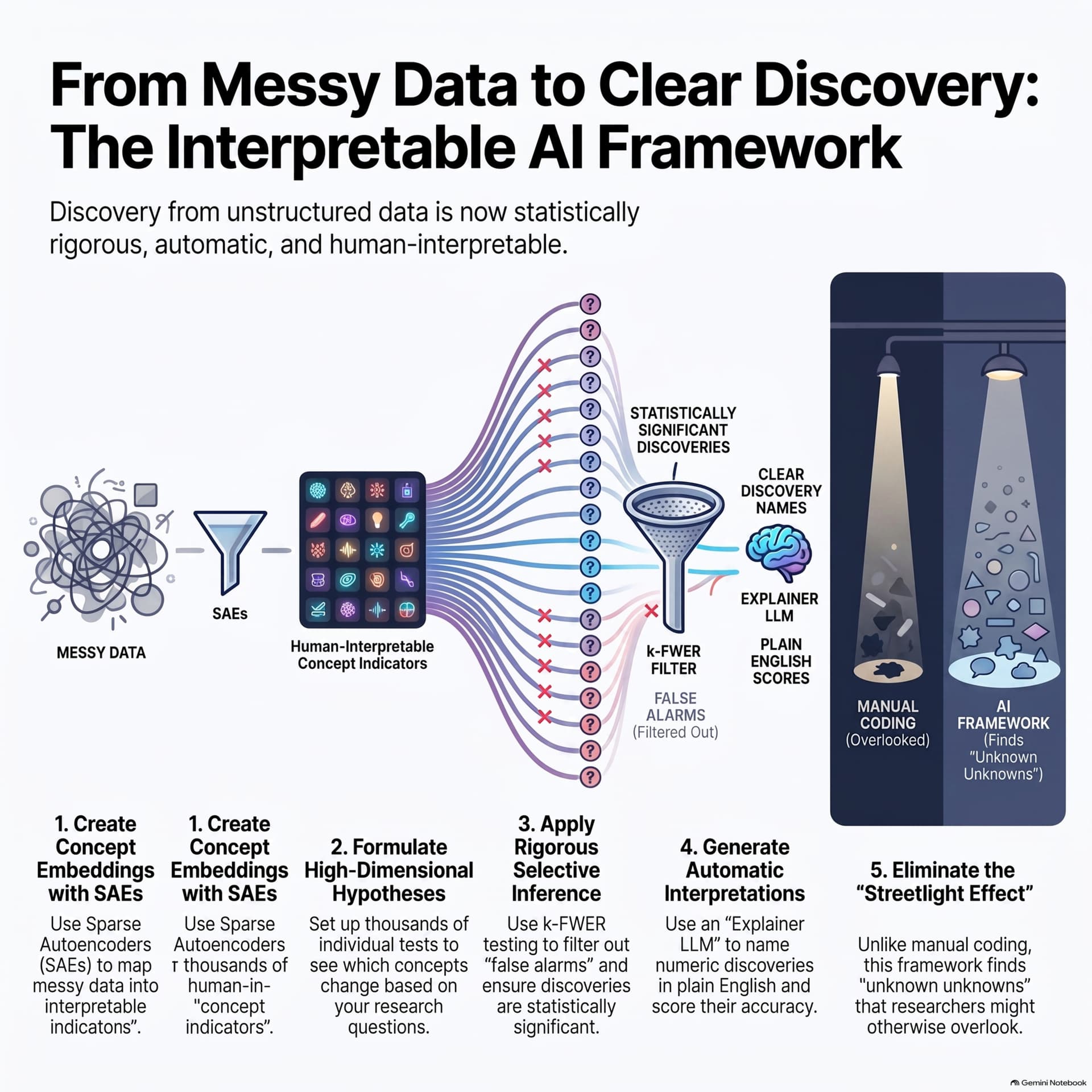
A July 2026 research framework for making interpretable, bias-resistant discoveries from unstructured text using sparse autoencoders, high-dimensional multiple-hypothesis testing (KFWER), Gaussian multiplier bootstrap, and LLM-based local interpretation with a detection-score safety check.
Guests
No guest names or backgrounds are provided in the transcript; it’s a host/interviewer-style discussion.
Key claims
Manual qualitative coding suffers from the streetlight effect and invalid “post-selection inference.” The proposed pipeline automates concept extraction (about 100,000 learned features), controls false discoveries under dependence, and translates significant concepts into English without trusting hallucinating explanations.
Notable examples
ChatGPT-assisted workplace emails show reduced informality (fewer exclamation points/openers) and more formal stock phrases (“I hope this email finds you well”). Inflation open-ends reveal “I’m not sure” hedging as a major overlooked signal. Defund-the-police writing with social cover increases academic/credential language (“research,” “evidence,” scholarly authority).
Written by AI. May contain mistakes. Listen to the episode to check what was said.
Chapters
Tap a time to open that second in VOUnderstanding the Streetlight Effect
0:45 to 2:39
Discussion on the limitations of data analysis caused by focusing only on obvious metrics.
“Because they're just looking under the lamp.”
Challenges of Unstructured Data
2:39 to 3:59
Exploring the difficulties of extracting meaningful insights from messy text data.
“Humans manually peruse the text, they highlight specific phrases, and they create what's called a codebook to categorize topics.”
Post-Selection Inference in Research
3:59 to 4:52
Explaining the risks of post-selection inference and its impact on research validity.
“If you fish your hypothesis out of a pool of data and then mathematically test your hypothesis on that same pool of data, well, your p-values become totally meaningless.”
High-Dimensional Multiple Hypothesis Testing
4:52 to 7:45
Introduction to the concept of multiple hypothesis testing and its implications.
“So the very first thing we have to do is automate the extraction of these concepts.”
KFWER and Its Importance
7:45 to 11:01
Understanding the KFWER method for managing statistical power in hypothesis testing.
“I have to throw a flag on the play here.”
The Gaussian Multiplier Bootstrap
11:01 to 12:35
Explaining the Gaussian Multiplier Bootstrap and its role in maintaining data relationships.
“If we connect this to the bigger picture, this is where the framework introduces a really brilliant piece of machinery.”
Local Automatic Interpretation Framework
12:35 to 13:50
Introducing the process for translating AI findings into understandable language.
“The alien super reader only speaks in abstract math.”
Ensuring Accuracy in AI Explanations
13:50 to 14:02
Discussion on validating AI-generated explanations to mitigate inaccuracies.
“What if the explainer just makes up a connection that sounds plausible but is completely wrong?”
Understanding Detection Scores in LLMs
14:02 to 15:21
Learn how detection scores ensure the accuracy of AI-generated explanations.
“The framework doesn't just take the explainer LLM's word for it.”
AI's Impact on Human Email Communication
15:24 to 17:14
Discover how AI tools alter the language and tone of workplace emails.
“and then translate those patterns into English while relentlessly testing the translation.”
Show all 14 chapters
Revealing Public Perceptions of Inflation
17:14 to 20:08
Learn how AI identifies public uncertainty regarding inflation causes.
“Concepts identifying phrases like, I hope this email finds you well, and words expressing formal assurance like, ensure and guarantee went through the roof.”
AI and Psychological Defense Mechanisms
20:08 to 22:08
Explore how AI analyzes language to reveal psychological defenses in discussions.
“I mean, picking up on human linguistic tics and behavioral quirks that we are entirely blind to ourselves.”
The Shift in Research Paradigms
22:08 to 23:04
Understand the transition from human bias in data analysis to AI-driven insights.
“It represents a massive paradigm shift for research.”
The Potential of AI in Personal Insights
23:04 to 24:11
Consider the implications of applying AI frameworks to personal data analysis.
“Which leaves me with a final, somewhat provocative thought for you to mull over as we wrap up today.”
Transcript
Automatic transcript. May contain errors.0:00Um, imagine you're walking home at night, right? and you drop your keys. Whereas like the very first place you look for them. Well, under the street lamp usually. Exactly. Under the street lamp. And not because that is necessarily where they fell out of your pocket, but simply because, well, that's where the light is shining. Right. It's just easier to see there. Yeah. We look for answers where it's easiest to see them. And in the world of data, I mean, that human tendency is just a massive blind spot. Oh, absolutely. It's actually known as the streetlight effect. The streetlight effect. Yeah.
0:31And in fields like social science, economics, or even just regular corporate data analysis, it's a chronic issue. For sure. When analysts dive into really messy, unstructured data, they tend to only measure what's obvious, you know, or what they are already predisposed to find. Because they're just looking under the lamp. Exactly. They completely miss the hidden patterns that are just kind of lurking in the dark right outside that pool of light. So today, we are looking at some really groundbreaking research from July 2026 that, well, it basically finally gives us a flashlight to see into that dark space.
1:08It's a huge step forward. It really is. We are unpacking a new framework today that sits at this wild intersection of artificial intelligence, high dimensional math, and social science. Yeah, a really fascinating mix of disciplines. And the mission for today's deep dive is to understand how researchers can now discover hidden insights within massive piles of messy, unstructured data. Right. Things like open-ended survey responses or text and speech. Yeah, all that messy stuff, but doing it without accidentally injecting their own human biases into the mix. Which I should add has historically been incredibly hard to do.
1:42Oh, I bet. I mean, unstructured data is a goldmine. It contains all the nuance of human thought, tone, contradiction, all of that. Yeah. But extracting that gold without, you know, melting it down and ruining it in the process is just a monumental challenge. To put this in perspective for you listening right now, just imagine your boss hands you 10 ,000 employee performance reviews. Oh, wow. That sounds like a nightmare. Right. 10 ,000 of them all written in plain unstructured text. And they ask you to summarize the main themes. Like, where do you even begin? You'd have to read for months. Exactly.
2:17And here's the kicker. if you already think morale is low in the company, you are going to subconsciously highlight every single complaint about, I don't know, the office coffee machine. Oh, totally. You just zero right in on it. And you completely skip over the paragraphs praising the management, right? You are basically shining your own little street lamp on the data. That perfectly describes the status quo in a lot of qualitative research today, actually. Really? Just people reading and highlighting? Basically, yeah. Humans manually peruse the text, they highlight specific phrases, and they create what's called a codebook to categorize topics.
2:50Okay. But the material we're unpacking today points out that this traditional approach is, well, it's fundamentally broken from a scientific perspective. Okay, let's unpack this. Because it seems like it's essentially just cloud gazing. Cloud gazing, I like that. Well, if a researcher is just reading text to find themes, aren't they basically looking up at the sky and seeing whatever shapes they subconsciously want to see? Pretty much. Like, oh, look, that cloud looks exactly like my underlying theory about workplace productivity. That is a great analogy. And this raises an important question about statistics, actually.
3:26Oh, math time. Lay it on me. It leads directly to this massive statistical danger known as post-selection inference. Post-selection inference. Yeah. It's a fatal flaw in research methodology. You cannot look at a data set to define what you want to measure and then take the actual measurement using that exact same data set. Ah, I see. It's basically Texas sharpshooting. Texas sharpshooting. Yeah. You know, you shoot a bullet into the side of a bar and you walk up to it and you paint the bullseye right around the hole so it looks like you hit a dead center shot. Yes, exactly. And that completely invalidates your statistical conclusions.
4:00Right, because you rig the game. Exactly. If you fish your hypothesis out of a pool of data and then mathematically test your hypothesis on that same pool of data, well, your p-values become totally meaningless. So it's an illusion of statistical significance. Completely. Plus, as we mentioned with the streetlight effect, you run into the problem of unknown unknowns. Right. The stuff in the dark. Yeah. By only looking for what you expect, you miss the really profound discoveries that you didn't even know you should be looking for. Man. So human cloud gazing ruins the math and our own biases limit our discovery.
4:36Correct. We obviously need a way to remove the human from the discovery process. But I mean, we can't just have a machine spit out a raw barcode of data. No, of course not. We still need human understandable concepts like, you know, anger or mentions of policy. Right. And to solve this, the research proposes a really rigorous four step computational framework. OK, four steps. Let's step one. So the very first thing we have to do is automate the extraction of these concepts. We have to map the data without any human interference. And how do they do that? The researchers do this by utilizing large language models equipped with something called sparse autoencoders or SAEs.
5:15Okay, wait, sparse autoencoders. Let's dig into the mechanics here because this is fascinating. It really is. When we normally think of an AI model, the concepts it understands are just sort of smeared across billions of dense artificial neurons, right? Yeah, they're highly entangled. Like a giant unreadable soup of numbers. So how does this SAE actually pull a distinct readable concept out of that soup? Well, you hit on the exact problem with standard neural networks. They are dense and, like you said, entangled. Yeah. And SAE acts almost like a prism. A prism. Yeah. So when you shine dense white light through a prism, what happens?
5:51It separates it into distinct individual colors. Oh, right. Like a rainbow. Exactly. The SAE takes the dense, tangled internal state of an AI model and forces it to map onto a much wider but incredibly sparse landscape. OK, so it spreads it all out. Yes. Yes. It untangles the soup into discrete, independent features. Here's where it gets really interesting for me. I like to think of this SAE-equipped model as like an ultra-observant alien super-reader. An alien super-reader. Okay, I can see that. Yeah, like this alien has read the entire internet and memorized every single possible human concept.
6:26Right, through its pre-training. Exactly. And it has this massive binary checklist. We are talking about dimensions on the order of 100 ,000 distinct concepts, right? Yes. 100 ,000 features that the AI learned entirely on its own. Wow. And this includes abstract ideas, tonal shifts, specific grammar structures, you name it. So for every single sentence in our 10 ,000 employee reviews, this alien super reader goes down its giant checklist. It's like, box 42, mentions of office politics, check. Box 8 ,900, apologetic tone, check. Exactly. And it does this universally without you, the human, ever giving it a specific list of things to look for.
7:07Which is crazy, but it makes sense. This is the vital first step, because it gives us a data independent ex-ante curation of measurements. So we've turned messy text into a massive objective binary matrix. The human didn't paint the bullseye after the fact. Precisely. And once we have that matrix, we move to the next phase, which is to formulate a statistical hypothesis for every single one of those 100 ,000 concepts. Wait, all 100 ,000? Every single one. Okay. For instance, if you are running an experiment on those employees, you might mathematically compare how often concept number four shows up in one department versus another.
7:47Okay, but hang on. I have to throw a flag on the play here. What's the issue? If we are mathematically testing 100 ,000 different hypotheses all at once on a pretty small group of people, say, a study with only a few hundred participants, aren't we basically guaranteed to find a bunch of fake phantom patterns just by pure random chance? Ah, yes. I mean, if I flip a coin 100 ,000 times, I am absolutely going to get some weird, seemingly impossible streaks of heads, right? Yep. And it might look like a profound pattern, but it's completely meaningless. You have zeroed in on the major statistical hurdle of the paper.
8:21Huh. Nice. It is a notorious problem in econometrics. It's called high-dimensional multiple hypothesis testing. High-dimensional multiple hypothesis testing. That is a mouthful. It is. Yeah. And basically when the number of variables in this case, the 100 ,000 concepts vastly outnumbers your sample size, the false positives just absolutely explode. So we have to somehow filter out the random coin flip streaks from the actual meaningful patterns. Exactly. How does the math actually accomplish that? Because it sounds impossible. Well, traditionally, statisticians use something called the Family Wise Air Rate, or FWER.
8:59Okay. FWE is incredibly strict. It controls for the probability of making even a single false discovery across all your tests. So what does this all mean? Let me try an analogy here. Go for it. Standard FWR is like an insanely strict nightclub bouncer at the door of our data party. A bouncer, okay. If this bouncer finds even one single fake ID in a line of 100 ,000 people, they shut down the entire club. Nobody gets in, the party is over. That is precisely how traditional FWR operates. Wow, harsh bouncer. Very harsh. It protects against fake discoveries perfectly, but in high-dimensional spaces like our 100 ,000 concept checklist, it completely ruins scientific discovery.
9:40Because nothing ever gets through. Right. It is far too conservative. So to keep the party going, this framework utilizes step-down algorithms developed by Romato and Wolf to control a variant called the KFWER. The KFWER bouncer. I'm guessing this bouncer is a little more relaxed. Much more practical. The KFW bouncer lets the party continue and lets discoveries through, as long as they can mathematically guarantee that the total number of fake IDs that slip through is kept strictly below a tiny, known threshold. Okay, so that threshold is the K. Exactly. If K is set to 5, you are knowingly allowing for a small controlled number of false discoveries.
10:18But in exchange, you maintain the statistical power necessary to actually make genuine discoveries in small data sets. Okay, that makes sense. You let the real guests in, you accept that maybe 5 people snuck in with fake IDs, but because you know exactly what your risk tolerance is, the math is still statistically sound. But wait, there is still a flaw here, isn't there? What are you thinking? The people in line at this club aren't strangers. They are highly connected. Oh, you mean the concepts. Yeah. If someone talks about banks in their text, they are incredibly likely to also talk about money or interest rates.
10:52Absolutely. So how does the bouncer account for the fact that these 100 ,000 concepts are deeply entangled and dependent on each other? If we connect this to the bigger picture, this is where the framework introduces a really brilliant piece of machinery. It's called the Gaussian Multiplier Bootstrap. The Gaussian Multiplier Bootstrap? Sounds like a sci-fi weapon. It kind of is, mathematically speaking. If you just assume all 100 ,000 concepts are independent coin flips, your math will be hopelessly wrong because of those deep dependencies you just mentioned. So how does the bootstrap fix that?
11:27It sounds incredibly intimidating. Think of it as simulating thousands of alternate realities of your data set. Alternate reality. Yeah. instead of breaking the data apart and losing the relationships between banks and money, the bootstrap applies random multipliers to the existing data points as a whole. Okay. And it does this across thousands of computational iterations. So it's basically simulating a multiverse of the data. Exactly. It generates a distribution of what the maximum test statistics should look like under the null hypothesis, while perfectly preserving all the complex underlying correlations between all 100 ,000 concepts.
12:04Wow. So the multiverse simulation keeps the underlying social networks of the concepts intact, which tells the KFW or bouncer exactly what a true statistical anomaly looks like in context. Precisely. It tackles the high dimensional problem without forcing researchers to naively pretend the concepts are independent of one another. I love that. So the math magic happens, the bootstrap does its multiverse simulation, the bouncer filters the line, and we are handed a statistically rock-solid list of discovered concepts. Yes, step three is complete. But there is a glaring problem here. What's that?
12:39The alien super reader only speaks in abstract math. Ah, true. It tells us, concept four is statistically significant, concept 8 ,900 is statistically significant. That doesn't help me write a research paper. I need to know what concept four actually means in the real world. And that requires translating the AI back into plain English. Which brings us to the next major step in the framework, local automatic interpretation. Local automatic interpretation, how do they do it? Well, the researchers deploy a second, entirely separate AI, an explainer large language model. Okay, so a second AI steps in.
13:16Right. They go back to the original text data set and isolate the specific sentences and paragraphs that caused Concept 4 to light up the brightest. The top hits. Exactly. They feed those top activating texts to the Explainer LLM, and they ask it a simple question. What do all of these texts have in common? Write a plain English description. So the Explainer AI might look at a bunch of sentences and say, oh, these are all instances of people using apologetic language to decline an invitation. But hold on, isn't it incredibly risky to trust one AI to grade another AI's homework? It's a huge risk.
13:50I mean, we know LLMs hallucinate. What if the explainer just makes up a connection that sounds plausible but is completely wrong? What's fascinating here is that the researchers anticipated that critical vulnerability. The framework doesn't just take the explainer LLM's word for it. Oh, it doesn't. No, it forces the explanation to pass a rigorous mathematical pass-fail test called a detection score. A detection score. Yeah. It takes that new English description, apologetic language declining an invitation, and treats it as a strict binary classifier. Okay, how does that actually work in practice?
14:25So the researchers use yet another LLM classifier, but they apply it to a held-out evaluation data set. Held-out meaning? Meaning it's completely unseen data. Neither the original alien super reader nor the explainer AI has ever looked at it. Oh, I see. They asked the classifier, does this new unseen text contain apologetic language declining an invitation? Ah, and if the English explanation is actually accurate, it should perfectly predict whether the original alien super reader is going to activate on that unseen text. Exactly. If the explainer LLM hallucinated the description, its predictions on the unseen data will completely fail to match the underlying math.
15:03Because it just made it up. Right. The detection score will just plummet, and the researchers will immediately know the English translation is garbage. That is brilliant. This mechanism keeps the LLMs strictly tethered to the actual real-world data distribution rather than wandering off into AI hallucinations. It is an incredibly tightly woven safety net. I mean, we embed the text into a massive checklist, form our hypotheses, use multiverse math and bouncers to find the real patterns, and then translate those patterns into English while relentlessly testing the translation. That's the four-step machine in a nutshell.
15:38So what actually happens when we feed real messy human behavior into this discovery machine? Like, what are the results? The authors of the research demonstrate the power of the framework by reanalyzing three recent major empirical studies. Oh, cool. They wanted to see if this automated process could discover the same things humans did, or, more importantly, if you could find the unknown unknowns that the human analysts completely missed. Let's walk through these because this is where it gets really applicable. First up, they looked at a study by Noy and Zhang about ChatGPT and workplace emails.
16:10What was the setup there? It was a randomized controlled trial involving working professionals. Half of them were given ChatGPT to help write sensitive, complex workplace emails. Okay. And the other half had to write them normally. The original human analysts found that the AI made the task faster, and independent human graders rated the AI-assisted emails as having higher overall quality. Which makes sense, honestly. AI cleans up typos, structures things nicely. But what did our ultra-observant digital anthropologist actually find when it scanned the text? Well, the framework discovered that while the AI made the emails better, it did so by aggressively homogenizing human expression.
16:49Homogenizing. It discovered massive causal effects on very specific linguistic concepts. For instance, informality was heavily penalized. Really? Yeah. The use of sentence-ending exclamation points completely plummeted in the AI-assisted group. So the enthusiasm just got flattened out. It did. Informal openers, like starting an email with good or high, largely disappeared. Interesting. And in their place, the framework detected a massive, undeniable spike in positively valenced stock corporate phrases. Oh, no. Like what? Concepts identifying phrases like, I hope this email finds you well, and words expressing formal assurance like, ensure and guarantee went through the roof.
17:33Oh, man. I hope this email finds you well. It is the ultimate filler sentence. It really is. For you listening right now, just think about your own daily emails. Like, are your communications slowly homogenizing into this polite, sterile AI speak without you even noticing? It's a very real possibility. It is wild that the framework surfaced that structural shift in human communication completely automatically. It highlights how AI tools don't just assist us. They subtly alter the actual flavor of our interactions. And the framework caught it without a human ever telling it to look for punctuation changes.
18:08That is so cool. Okay, let's look at the second study, which involves a survey about inflation. Right. And just to be clear for anyone listening, we are not taking a stance on the economics or the politics here at all. No, not at all. We are just fascinated by how the AI acts as an impartial mirror, right? Just showing us exactly what the public is saying without any spin. Absolutely. So the study by Stensheva asked representative Americans an open-ended question. Simply, high inflation is caused by... Just fill in the blank. Yeah. In the original analysis, human researchers manually read the responses and grouped them into expended economic buckets.
18:44They found people blamed corporate greed, the government, supply chain issues, and so on. So standard economic theories. And I assume the AI framework found those too. It did. It clearly identified concepts for blaming government and corporate greed entirely on its own. But because it doesn't have a human streetlight bias, it also found a massive unknown, unknown that the human economists completely overlooked. What was the blind spot? What did they miss? The framework discovered that a massive chunk of respondents triggered a concept that the explainer LLM described as first-person expressions of uncertainty.
19:20Like people just saying, I'm not sure. Exactly that. Phrases like, I don't know, or I couldn't tell you. the framework picked up on hedging language and admissions of ignorance. Wow. That was a huge defining signal in the raw data that a significant portion of the public simply doesn't know what causes inflation. But the human analysts missed it because, I don't know, isn't an economic theory? Exactly. If you are an economist looking at data to find economic theories, you are completely blind to the people who are just shrugging their shoulders. Yes. That is literally the streetlight effect in action.
19:53Precisely. The humans were looking for causes. So they ignored the lack of a cause. The AI just mapped the reality of the text, revealing a profound insight about public uncertainty that was sitting there in the dark the whole time. This tool really is like a digital anthropologist. I mean, picking up on human linguistic tics and behavioral quirks that we are entirely blind to ourselves. It really is. Does it see our psychological defense mechanisms, too? Well, that perfectly tees up the third reanalysis, actually. Perfect. It looked at an experiment by Burstyn involving how people express highly controversial political opinions.
20:31Specifically, the experiment looked at people opposing the movement to defund the police. And again, just purely looking at the data mechanics of how people argue here, not the topic itself. Right, completely neutral analysis of the language. So the experiment provided some participants with what is known as social cover. Social cover? What is that? They were given a justification, like a recent study or a news article, that they could point to when expressing their controversial opinion. Okay, so like a shield. Exactly. The goal was to see how having that cover changed the way they wrote about their views.
21:03Hmm. Well, if I had to guess, I would think having social cover makes people more aggressive. Oh, you think so? Yeah, maybe they hide behind emotional appeals or anger because they feel validated by the article. Is that what the AI caught? Actually, it found the exact opposite. Wait, really? Yeah. The framework detected a significant causal increase in concepts tied specifically to academic credentials and scholarly authority. Or academic language. Yes. Words related to articles, research, evidence, and phrases designed to coldly persuade. Wow. When people were given social cover, they didn't get angrier.
21:38They retreated into the language of authority. That is so interesting. And without any human telling the machine to look for scholarly phrasing, the math highlighted that humans instinctively use intellectual language as a shield to protect themselves when discussing contentious topics. That is deeply fascinating. It perfectly mapped the psychological defense mechanism. It did. The AI found the hidden shape in the clouds, but proved mathematically that the cloud was actually there, objectively, in the text. Exactly. It represents a massive paradigm shift for research. I can see why. We are moving from humans manually and often biasedly fishing for specific topics in the dark to using AI and high dimensional math to instantly and impartially illuminate the entire ocean of data.
22:26We have covered incredible ground today. We started with the streetlight effect and the statistical sins of human cloud gazing. We certainly did. We met the prism like AI that creates a 100 ,000 item checklist. we survived the KFW or nightclub bouncer using a multiverse simulation. A busy day for the math. And we saw how this framework caught AI speak creeping into our emails and even uncovered our hidden defense mechanisms. The ability to discover, test, and translate these patterns entirely computationally while remaining tethered to incredibly strict statistical rigor, it fundamentally changes what we can learn from human data.
23:02It really does. It makes the invisible visible. Which leaves me with a final, somewhat provocative thought for you to mull over as we wrap up today. Oh, I'm ready. If this combined statistical and AI framework can perfectly map, rigorously test, and clearly explain the hidden concepts, uncertainties, and defensive ticks in our public speech and professional writings, what happens when this type of unsupervised discovery is turned on our own private digital footprints? Oh, wow. That is a thought. Right. Like if you fed your entire text message history, your search queries, your private journals into this four step machine, what would it find?
23:41You'd probably find a lot of things you wouldn't want it to. Exactly. Are there hidden patterns and unknown unknowns about your own life, your behavior and your biases that a sparse autoencoder would discover long before you ever realized them yourself? It is a profound and slightly unsettling frontier. I mean, knowledge is most valuable when understood, but understanding ourselves through the impartial lens of high-dimensional math, well, it might reveal truths we aren't quite expecting. It definitely might. Keep asking questions about what the data isn't telling you. Thank you so much for joining us on this deep dive.
Read the full transcript
24:13Keep looking beyond the streetlights, and we will catch you next time.
From the publisher
This paper introduces a rigorous statistical framework for discovering human-interpretable insights from unstructured data, such as text, audio, and video. By repurposing AI interpretability tools like sparse autoencoders, the method maps complex data into a high-dimensional space of thousands of distinct concepts. The author utilizes advanced multiple hypothesis testing to ensure these discoveries remain statistically valid while avoiding the pitfalls of data snooping or researcher bias. To ensure the results are understandable, the system employs Large Language Models to generate and evaluate natural language descriptions of the identified patterns. Applications to empirical economics demonstrate that this approach can automatically recover nuanced findings that previously required intensive manual labor or separate experiments. Overall, the framework provides a principled, inexpensive, and replicable way to uncover "unknown unknowns" within large, unstructured datasets.


