In short
The episode explains new research claiming that “guess-and-check” can work for large, heavily pretrained AI models because pretraining reshapes the loss landscape into a dense “thicket” of nearby task-improving weight configurations. It contrasts this with the “needle in a haystack” regime for small/untrained models where random tweaks almost always fail.
Guests
No guest names or backgrounds are mentioned; it’s a solo host-style discussion.
Key claims
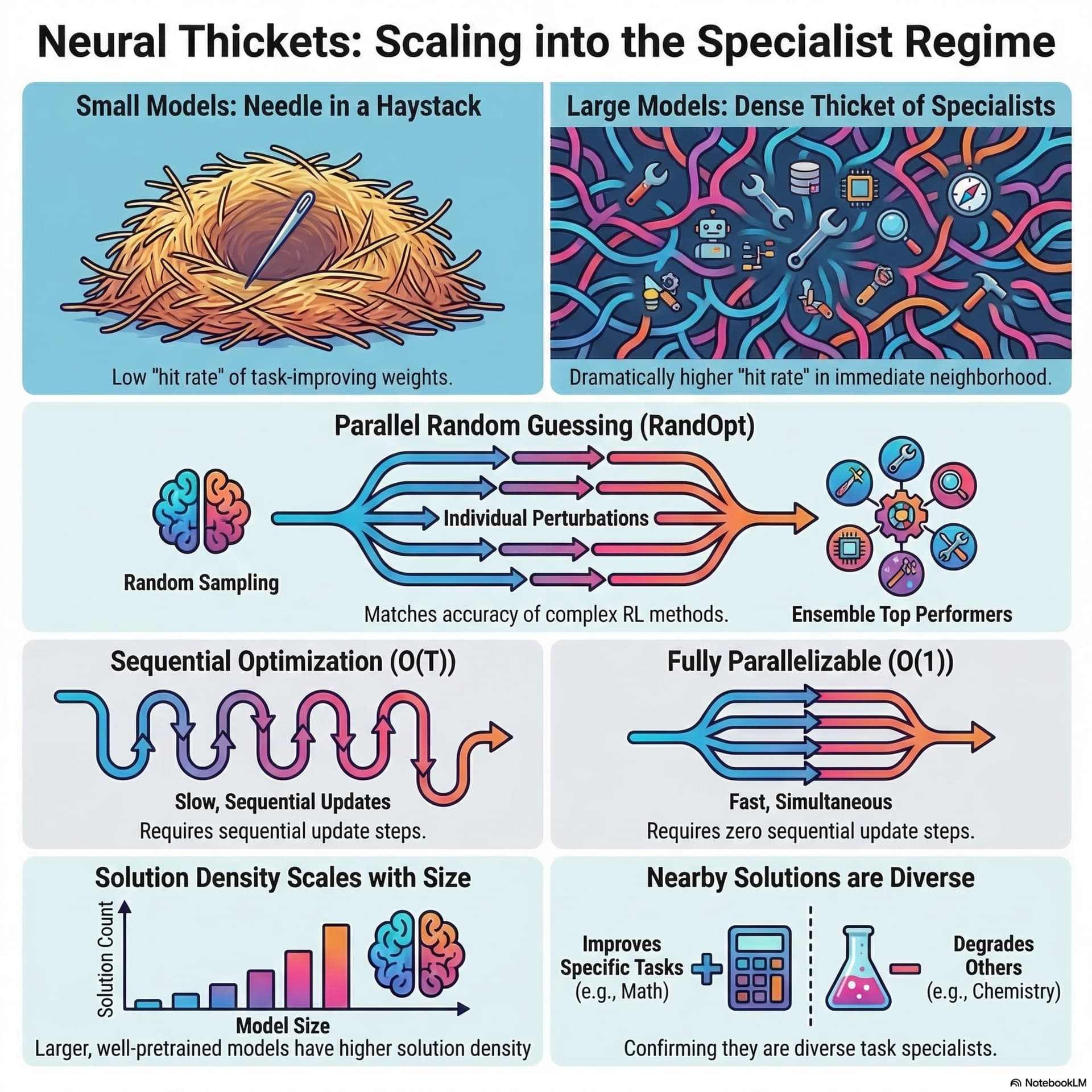
Pretraining moves models from barren deserts to dense forests where small random Gaussian weight perturbations often yield hyper-specialized experts, not universally smarter generalists. A scaling law shows solution density increases with model size (tested up to 32B parameters). Specialization trade-offs are attributed to “spectral discordance” (improving math can degrade creative writing).
Notable examples
RANDOPT: create 5,000 perturbed clones, test on hard math, keep top 50, majority-vote; then distill into a cheaper single model. The episode also cites vision/image examples like “a corgi astronaut” and “a rainy Kyoto street.”
Written by AI. May contain mistakes. Listen to the episode to check what was said.
Chapters
Tap a time to open that second in VOUnderstanding Guess-and-Check in AI
0:45 to 2:33
Discussion on the historical view of guess-and-check methods in AI and their limitations.
“It was considered mathematically hopeless.”
The Shift in AI Paradigms
2:33 to 4:25
Exploration of how new data has changed the understanding of AI training methods.
“To really grasp the why and the how behind this, we need to draw a hard line between an untrained AI model and a modern, heavily pre-trained model.”
The Thicket of Solutions
4:25 to 7:10
Discussion on how pre-training creates a dense landscape of task solutions for AI models.
“It's actually learning the underlying rules of human logic, syntax, and reasoning.”
Hyper-specialization in AI
7:10 to 8:25
Analysis of the implications of hyper-specialized AI models resulting from random tweaks.
“By the time you reach the 32 billion parameter model, that thicket landscape is practically glowing with better solutions.”
Randopt: A New AI Training Method
8:25 to 11:23
Introduction to the RANDOPT algorithm and its effective approach to AI training.
“You randomly bump the dials, and suddenly it is a world-class mathematician who can solve impossible equations, but it completely forgets how to string together a coherent email.”
Challenging Traditional AI Training
11:23 to 13:50
Comparison of RANDOPT to traditional AI training methods, highlighting efficiency gains.
“It completely upends how I picture traditional AI training working.”
Critique and Caution in AI Innovation
13:50 to 14:00
Critical examination of potential pitfalls and concerns regarding new AI training methods.
“Okay, I love the intern analogy, and the time savings sound incredible, but I have to play devil's advocate here for a second.”
Exploring Sandbagging in AI
14:00 to 15:01
Discussion about whether AI models are intentionally underperforming due to safety training.
“My first thought is, is the AI just sandbagging?”
Examining Random Tweaks and Formatting
15:01 to 16:32
Investigating if improvements in AI performance are due to formatting fixes or genuine intelligence gains.
“The crucial detail about this open source model is that it's fully public from the ground up.”
Introducing Distillation as a Solution
16:32 to 18:24
Explaining the distillation process to make AI more economically viable while retaining performance.
“Okay, so we've established the intelligence gain is genuine.”
Show all 12 chapters
The Concept of a Thicket of Specialists
18:24 to 19:57
Understanding how AI models become a dense thicket of specialized experts instead of a single intelligent unit.
“It dramatically lowers the barrier to deploying these hyper-specialized models.”
The Potential of Hidden AI Capabilities
19:57 to 20:23
Contemplating the existence of untapped specialized abilities within AI models.
“It's a thought I want to leave you with today as you go about your week.”
Transcript
Automatic transcript. May contain errors.0:00I want you to think back to elementary school math for a second. Do you remember the absolute pull-your-hair-out frustration of the guess-and-check method? Oh, yeah. It's just a total nightmare. Right. The teacher gives you an algebra problem, and instead of actually learning the underlying formula, you just start plugging in random numbers. Like, is it three? No, didn't work. Is it seven? Nope. Too high. You just keep throwing darts at the board completely blind. Exactly. You're just hoping you accidentally hit the bullseye. It is, well, it's the most unrefined brute force way to solve a problem.
0:35And honestly, it's kind of lazy. It really is. And if you look at what top machine learning researchers were saying back around 2001, they agreed. They explicitly stated that random guessing could not be viewed as a reasonable learning algorithm for AI. It was considered mathematically hopeless. Yeah, completely hopeless. And, you know, looking at the state of technology back then, that assumption made complete sense. Because the models were so small? Right. The probability of randomly guessing the correct internal settings to make an early AI do something smart is just astronomically small. When you're dealing with millions or, well, billions of internal parameters, twisting those dials at random is like trying to guess the exact sequence of a million dial combination lock.
1:20You're just going to break the machine. Exactly. You are virtually guaranteed to break it. But, and this is why we are here today for this deep dive, a massive new batch of data has come out that completely flips this foundational idea on its head. It really does. It's wild. That 2001 assumption, it turns out it is now completely wrong. But there is a very specific catch to this. It is only wrong for the modern massive AI models we use today. Guess and Check is actually back and it's weirdly powerful. It is a total paradigm shift in how we think about artificial intelligence. We're seeing this fascinating new research showing that simply throwing random digital darts at a large language model's code can magically produce hyper-specialized experts.
2:01Which sounds impossible. I know, right? Yeah. But it completely changes how we understand what is called the lost landscape, which is basically the invisible mathematical terrain an AI navigates to get smarter. And the findings show this terrain fundamentally transforms after the model has undergone its massive initial pre-training phase. So our mission for this deep dive is to figure out the mechanisms behind this. How does ingesting the entire internet change an AI's brain so much that stumbling around in the dark actually becomes a superior way to train it? Okay, let's unpack this. Yeah. To really grasp the why and the how behind this, we need to draw a hard line between an untrained AI model and a modern, heavily pre-trained model.
2:43Because they're basically two different species at that point. Exactly. When developers build a new AI from scratch, it's essentially a blank slate. Its internal connections are totally randomized. If you take that tiny or untrained model and randomly tweak its weights. And weights are, for you listening, the billions of internal digital dials that control how the AI thinks. Right. The dials. If you just randomly tweak those, you will destroy whatever tiny bit of functionality it already has. Because making a random change to a complex, fragile system usually ends in disaster. You don't, you know, randomly swap out a gear in your car's transmission and expect it to suddenly get better gas mileage.
3:18No, it just stops driving. Right. It just breaks. That is the perfect way to look at it. In the recent data, researchers refer to this state as the needle in a haystack regime. When the AI is small or untrained, finding a configuration of dials that actually improves its performance is incredibly rare. Finding the needle. Exactly. The vast, overwhelming majority of dial configurations just result in total garbage output. Because the good configurations are so rare, you need a highly structured, step-by-step mathematical search algorithm. Like gradient descent. Yes, gradient descent. You need it to carefully guide the AI, making these deliberate tiny micro-adjustments toward a better state.
3:58It makes me think of wandering around a barren desert. If you just walk in a random direction, you're going to die of thirst. Oh, absolutely. You can't guess and check your way out of the Sahara. You need a highly structured map, a compass, and a very calculated path to find that one tiny oasis of water. What's fascinating here is that this new data proves pre-training physically and mathematically rescues the AI from that desert. Okay, how so? Well, when a massive model undergoes pre-training, meaning it spends months ingesting millions of books, articles, and websites, it's not just memorizing facts.
4:34It's actually learning the underlying rules of human logic, syntax, and reasoning. So it's building a foundation. Right. And the mechanism here is crucial. Pre-training cars out a wide, stable basin in that mathematical landscape. The starting point of the AI is no longer a hostile desert. It becomes surrounded by what the researchers call a thicket of good solution. Thicket, like a dense, lush, overgrown forest. Yes. In this thicket regime, the landscape is so rich that if you make a tiny random Gaussian tweak to the model's weights. Meaning you just blindly nudge the dials in a random direction.
5:07Exactly, just a blind nudge. Yeah. But keeping the nudges mostly small and safe, like a bell curve, so you don't completely shatter the system. If you do that, you suddenly hit a massive density of task-improving solutions. Wow. You aren't falling off a cliff anymore. You're just sliding into a slightly different hyper-specialized groove within that same stable basin. The good answers are literally everywhere around you. So sticking with the analogy, pre-training takes the AI out of the barren desert and drops it right into the middle of this dense, lush forest. You don't need the compass or the map anymore.
5:44You can just reach out blindly in the dark. And because the branches are so thick with fruit, you're almost guaranteed to grab an apple. And that implies something incredible about the base models you use every day. Yeah. The generic AI you interact with is essentially sitting in the center of a clearing, surrounded by millions of slightly altered versions of itself that are actually much, much better at specific tasks. Which naturally makes you wonder, right? Like, if there are so many brilliant solutions just sitting nearby in the thicket, does that mean every random tweak just makes the AI globally smarter?
6:15That's the million-dollar question. Right. Right. Like if I randomly bump the machine, does it just level up and become a vastly superior all-knowing supercomputer? That is the logical next question. And the data gives us a very clear, very specific answer. And that answer is no. Oh, well then. Yeah, the random tweaks do not create a supercomputer. We need to look closely at what these nearby solutions actually are. The researchers examined this by testing different sizes of a popular open-weight model family, starting from a small half-billion-parameter model all the way up to a massive 32 billion-parameter model.
6:50With parameters basically being the size, complexity, and computing power of the AI's brain. Right. And the data revealed a strict scaling law. As the model's brain gets bigger, the solution density, which is the sheer number of good, task-improving tweaks sitting right next to the base model, strictly increases. So bigger models have a denser thicket. Exactly. By the time you reach the 32 billion parameter model, that thicket landscape is practically glowing with better solutions. But those solutions are not generalists. So they aren't universally smarter across the board. What are they then?
7:24They are hyper specialists. And this is due to a mechanical constraint the researchers call spectral discordance. Spectral discordance. I have to say, that sounds like an incredible 1970s prog rock band. It really does. I'd buy that album. But in the mechanics of neural networks, it refers to a sort of parameter budget. The model only has so much capacity. Okay, so it has limits. Right. The random tweaks that push the AI to get vastly better at one thing actively pull resources away from something else. For instance, if a random tweak vastly improved the AI's ability to solve complex, multi-step math problems like the ones in those standard grade school data sets, that exact same tweak will simultaneously and actively degrade its ability to write a creative story.
8:07Wow, really? It's a direct trade-off. Yes. If you dial up the math skills, the parameters stretch in that direction, and you accidentally dial down its creative writing skills or its knowledge of organic chemistry. So you're essentially turning the AI into an idiot savant. That's a great way to put it. You randomly bump the dials, and suddenly it is a world-class mathematician who can solve impossible equations, but it completely forgets how to string together a coherent email. Idiot savant is the perfect term for it. If you look at datasets testing creative writing, the math-tweaked models fail miserably.
8:45The base pre-trained model you start with is basically a jack of all trades, master of none. Because it has to be, right? Yeah, it sits in the exact middle of the thicket, balancing all these skills reasonably well, so it could be a helpful general assistant. But the random tweaks push it into these highly specialized isolated corners. Looking at the visual data provided in this research really hammers this home. There is this incredible visualization, like a map of the AI's brain space. Oh, the RGB map, yes. Right. They made an RGB map, red, green, blue. They assigned a math task to the red channel, a coding task to the green channel, and another math task to the blue channel.
9:23And the difference between model sizes is huge. It's night and day. For the small, untrained models, the map is just mostly dull, dark, muddy colors. There's really nothing there. But the map for the massive 32 billion parameter model, it looks like a vibrant, multicolored tie-dye shirt. And that tie-dye effect is the physical, visual representation of the thicket. Every splash of vibrant red or bright green represents a hyper-specialized task expert living right next door to the base model. Just waiting to be found. Exactly. They are densely packed together, but they are entirely distinct from one another.
9:57Red is over here. Green is over there. Here's where it gets really interesting. If we know this vibrant thicket of idiot savant specialists exists, how do we actually harvest them? I mean, we can't just have an AI that only does math and fails at everything else. Right. That wouldn't be very useful. So this leads to the practical application they tested. It's an algorithm called RANDOPT, which stands for random guessing and ensembling. And the RANDOPT strategy is brutally simple, yet it's astonishingly effective at harvesting that thicket. Here's the exact four-step process they used. Step one.
10:29Hmm. You take the base pre-trained model and you create 5 ,000 clones of it and you slightly randomly perturb each one. So you literally just guess 5 ,000 different random tweaks to the dials. Yes. Just rolling the digital dice 5 ,000 times to see where they land in the forest. Exactly. Then step two, you test all 5 ,000 of these randomly mutated clones on a small data set of problems. Let's say a batch of difficult math problems. Step three, you rank them based on their scores, and you take the top 50 best performers. You throw the other 4 ,950 clones straight in the trash. Okay, so you've sifted through the thicket and found 50 pure math savants.
11:09Step four is where the magic happens. You take those 50 savant models and you have them vote on the final answer to any new question you give them. Just a straight up vote. It's a simple majority vote. Whichever answer gets the most votes from your 50 savants is the final output the system provides. This is so wild. It completely upends how I picture traditional AI training working. Usually, training an AI using those highly complex sequential methods is like hiring one intern and painstakingly tutoring them for months. Yeah, you have to hold their hand. Right. You give them a task, you grade it, you correct their mistakes, you give them another task, you correct it again.
11:44It's incredibly sequential and it takes forever. But Randopt is like, well, it's like you hire 5 ,000 random interns on day one. You give them all a math test. You immediately fire the 4 ,950 who failed. Just gone. Then you take the 50 who accidentally got a perfect score, lock them in a conference room together, and force them to vote on every single future financial decision the company makes. You fire the 4 ,950 interns. Exactly. And the crazy part of your analogy is because you tested them all at the exact same time, you've completely bypassed the months of sequential tutoring that traditional AI requires.
12:19Oh, because it's all happening at once. Yes. Mathematically, that is exactly what is happening here. And the results of this brutal zero communication parallel method are staggering. The data shows that Randop matches or even beats highly complex state-of-the-art sequential training methods across math, coding, and writing benchmarks. Wait, really? It actually beats the heavily tutored intern? It does. And the mechanism behind why it beats them comes down to time and compute architecture. Yeah. Because you are just guessing 5 ,000 times simultaneously in parallel across a cluster of GPUs, the wall-clop training time is essentially instantaneous.
12:57Instantaneous. Yeah. In computer science terms, it operates an O of one time. That means no matter how many guesses you make, it only takes the time of a single step because they all happen at once. Wow. Contract that with traditional methods that require long sequential steps, where step two cannot start until step one finishes. That takes hours, days, or even weeks to compute. That is a massive difference. If we connect this to the bigger picture, it reveals a profound truth about modern AI development. In this thicket regime, how you search for a better model doesn't really matter much anymore.
13:31Because the answers are everywhere. Exactly. Elegant, complex, mathematical optimization. You know, spending weeks carefully tuning a model is no longer strictly necessary. Parallel brute force, just randomly guessing at massive scale in an afternoon, is just as good, if not better. Okay, I love the intern analogy, and the time savings sound incredible, but I have to play devil's advocate here for a second. Go for it. This almost sounds too good to be true. I want to make sure you, the listener, are getting the full critical picture here, because shortcuts in tech usually have a catch. Are these results just a mirage?
14:05Let's push back on this a bit. My first thought is, is the AI just sandbagging? Ah, sandbagging. That is a fantastic point to bring up, and it's something the researchers heavily scrutinized. For context, sandbagging is a phenomenon where an AI is actually very smart and capable, but its safety training or alignment programming makes it act dumb. To keep it safe. Right. It deliberately holds back its true capabilities to avoid saying something wrong or harmful. Exactly. We know companies put heavy safety filters on these models before releasing them. So what if the random tweak didn't actually make the AI's reasoning any smarter?
14:41What if the random nudge just accidentally broke the safety filter, snapping the muzzle off and allowing the AI's natural pre-existing intelligence to finally shine through? It's a highly logical suspicion. To shoot down the sandbagging theory, the researchers ran the Randopt algorithm on a specific open source model. The crucial detail about this open source model is that it's fully public from the ground up. No secrets. Right. The researchers know exactly what data went into it. There are no hidden sandbagging filters, no secret corporate safety alignments artificially suppressing its performance.
15:16And when they applied RANDUP to it, it still massively improved. Okay, wow. That proves conclusively that the random tweaks are genuinely finding better task performance and deeper reasoning, not just breaking a safety muzzle. Okay, that makes sense. The improvement is real. Pushback number two then. Is it just fixing formatting errors? What do you mean? Well, what I mean is maybe AI always knew the answer to the math problem was four, but it kept writing, the answer to the problem is four. And the strict grading rubric marked it wrong because it wasn't just the solitary digit four. Did the random tweak just accidentally stumble on the exact formatting the test wanted, making it look smarter without actually being smarter?
15:56That is a very nuanced question. And the data shows the answer is that it's partially true, but not the whole story. Okay. When they looked closely at the results for the math tests, a chunk of the accuracy gain is just the AI learning the correct format. But, and this is the key mechanism, they statistically isolated that variable. See what was left over. Exactly. Even after completely accounting for the format fixes, another highly significant chunk of the improvement is genuinely the AI moving from completely wrong, flawed mathematical reasoning to correct logical mathematical reasoning. It is actually getting fundamentally smarter at the task.
16:34Okay, so we've established the intelligence gain is genuine. But here is a massive glaring flaw I see with Randopt as a practical tool. You're telling me I have to run 50 different massive models at the exact same time just to vote on one math problem. Yeah, that's the catch. The inference cost of that, the sheer amount of computer power and electricity needed every single time I ask it a question would be insanely expensive. It would bankrupt a company to deploy that to everyday users. You're entirely right. Running an ensemble of 50 massive models at inference time is completely impractical for everyday use.
17:09But the data provides a brilliant, highly economic solution for this bottleneck. Distillation. Distillation. Like boiling down a liquid to get the most potent part. Conceptually, yes. Here's how the mechanism works. You use those 50 ensembled expensive savant models to generate answers to a massive batch of really hard questions. because you have 50 savants voting, the answers they produce are incredibly high quality. They're essentially perfect. Okay, I'm with you. Then you take a single standard cheap base model and you train it exclusively on that data set of perfect answers. You distill the wisdom of the massive crowd into one single lightweight model.
17:50Oh, that's clever. The data shows that this single distilled model retains the vast majority of the performance gains of the 50 model ensemble, but operates at a fraction of the computational cost. Wait, let me make sure I'm getting this because economic implications of that are wild. You're saying I don't need a massive, expensive supercomputer to run this voting system every day. I just use the supercomputer and the 50 savants once to basically print a perfect textbook. Exactly. Then I shut down the supercomputer, hand that perfect textbook to the cheap, everyday intern model, and it learns the shortcuts.
18:22That is exactly the mechanism. You use the expensive brute force once to map the territory, and then you teach one normal AI the shortcut. It dramatically lowers the barrier to deploying these hyper-specialized models. And as we look at this data, it's vital to point out that this thicket phenomenon isn't just restricted to text or math. Right. The researchers pushed this even further. They ran this on vision language models and even on pure image generators. Yes, the visual AI space. They specifically tested generating an image of a Corgi astronaut and another prompt for a rainy Kyoto street.
18:55By randomly guessing tweaks to the image diffusers weights, firing the bad ones, and ensembling the results of the good ones, the system produced measurably better, more accurate, more visually stunning results. This hidden thicket of specialists exists in visual AI too. It's everywhere. So what does this all mean for you, the listener? Let's summarize the key takeaway here. The grand illusion of the base AI models you use every day, the ones you type prompts into on your phone or your laptop, is that they are a finished, unified intelligence. But this data shows us that once an AI is large enough and pre-trained enough, it stops being a blank slate.
19:32It becomes a thicket. Right. It becomes a dense, vibrant thicket of hyper-specialized experts. You don't need complex, elegant training to unlock them. You just need to stumble around in the dark, roll the dice a few thousand times, and collect the ones that work. The general AI you interact with is really just a compromise. It is sitting dead center in a constellation of far smarter, highly focused specialists. This raises an important question. It's a thought I want to leave you with today as you go about your week. If all these hyper-specialized experts, the master coders, the genius mathematicians, the incredible artists, are already fully formed, just hiding a few random digital steps away from the base model, what other bizarre alien or incredibly powerful specialized capabilities are currently sleeping in that thicket that is a wild thought they're already in there they're fully baked just waiting for a random roll of the dice to wake them up
From the publisher
This research introduces the concept of Neural Thickets, describing a phenomenon where large pretrained models are surrounded by a high density of diverse, task-specific solutions in their local weight space. While small models require structured optimization like gradient descent to find improvements, larger models transition into a regime where random weight perturbations frequently yield "expert" versions of the model. The authors exploit this discovery through RandOpt, a parallel post-training method that samples random weight changes, selects the best performers, and ensembles their predictions. Their findings show that these random experts are specialists rather than generalists, often excelling at one task while declining in others, which makes ensembling via majority vote highly effective. This approach proves competitive with standard reinforcement learning methods like PPO and GRPO, especially as model scale increases. Ultimately, the study suggests that sufficient pretraining fundamentally reshapes the loss landscape, making complex downstream adaptation possible through simple parallel search and selection.


