
In short
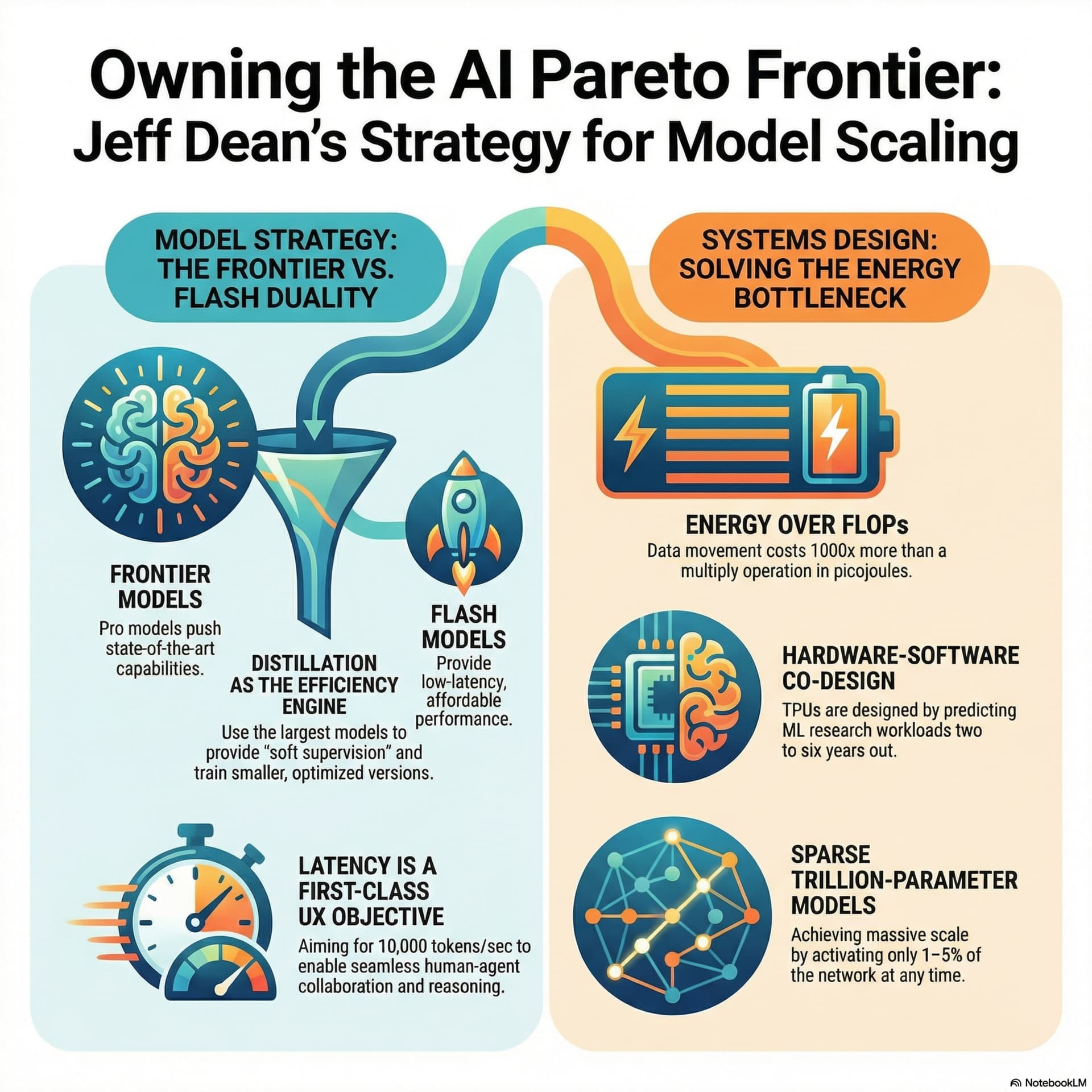
How to “own the AI Pareto frontier” by balancing capability vs cost/latency, using distillation, sparsity, low energy/data movement, retrieval over huge context windows, and fast agentic workflows.
Guest
Jeff Dean, Google Chief AI Scientist; earlier architect of Google search infrastructure (sharding, MapReduce, Bigtable) and now shaping the modern AI stack from chips to UI.
Key claims
Frontier vs flash models trade off intelligence and speed; small “flash” models become stronger via distillation using logits (soft probabilities). Energy is the bottleneck: moving data costs ~1000x more than compute. Prefer sparsity (only 1–5% activates) and retrieval to avoid “illusion of scale” from million-token prompts. Latency enables real-time conversation and multi-agent “interns” that require crisp specifications.
Notable examples
dog vs wolf probability “soft supervision”; pantry analogy for data movement; retrieving ~117 relevant documents; 50 interns/agent Slack negotiation needing ~10,000 tokens/sec.
Written by AI. May contain mistakes. Listen to the episode to check what was said.
Chapters
Tap a time to open that second in VOUnderstanding the Pareto Frontier
0:46 to 2:18
Exploring the concept of the Pareto frontier in AI and its implications.
“of someone who is arguably the architect of the modern internet.”
Distillation: Teaching Smaller Models
2:19 to 4:47
How large models can effectively teach smaller models through distillation.
“In AI, the two big things you're balancing are capability, how smart the model is, and cost or latency, how cheap and fast it is.”
Energy Costs in AI Computation
4:48 to 6:20
Discussion on energy consumption in AI, highlighting data movement costs.
“They punch way above their weight because they were tutored by giants.”
Sparsity in AI Models
6:21 to 8:31
The importance of sparsity in AI models to enhance efficiency and reduce costs.
“It's like if cooking a meal costs ten cents, but walking to the pantry to get the ingredients costs$100.”
The Future of AI Workflows
8:32 to 11:34
How the role of developers will change with AI advancements and agent-based computing.
“It stays smart, but it stops the data center from melting.”
Key Takeaways from Jeff Dean
11:35 to 14:01
Summarizing the key insights from Jeff Dean on AI models, energy, and workflow.
“I want to pivot to what this all means for jobs.”
Key Takeaways from AI Discussion
14:01 to 14:49
Explore the main takeaways regarding AI's future and its foundational principles.
“The hardware dictates the software and the software enables the workflow.”
Jeff Dean's Early Beliefs and Predictions
14:49 to 15:32
Learn about Jeff Dean's foresight into AI and his belief in agentic reasoning.
“He was a true believer in parallel training when everyone else was still doing symbolic AI.”
Transcript
Automatic transcript. May contain errors.0:00You know, we talk so much about scale in AI. We throw around numbers like billions of parameters, petabytes of data, and they just kind of wash over you.
0:08Jeff Dean:They become meaningless after a point. Exactly. But I came across a concept today that really stopped me in my tracks. Oh, yeah. What was that? It was this idea that we're asking these systems to process trillions of tokens, not someday, like right now. Yeah, it's a scale that is honestly hard to wrap your head around. It is. And we're talking about reasoning across everything, text, video code, all at once. And the kicker, we expect it to be instant, no loading bar, just thought. Well, that's the central tension of modern AI, isn't it? Everyone wants magic, but magic is incredibly expensive. Right.
0:43And that's why today we're doing a deep dive into the philosophy of someone who is arguably the architect of the modern internet. We are unpacking the insights of Jeff Dean.
0:53Jeff Dean:A legend in the field. I mean, for anyone who works in tech, he's a bit of a mythical figure. And for anyone listening who might not know the lore, let's just set the stage. He's Google's chief AI scientist now, but his resume is, well, it's wild. Back in the early 2000s, he basically wrote the code that allowed Google search to be Google. Yeah, he solved all the plumbing problems. Sharding, MapReduce, Bigtable, all the stuff that let search scale when everyone else's servers were just, you know, melting. And now he's quietly shaping the entire modern AI stack. from the silicon chips all the way up to the user interface.
1:30And his whole philosophy right now seems to circle around this one idea, owning the Pareto frontier.
1:36Jeff Dean:It's a fascinating concept, and it's not just about making the models bigger. It's about making them fast, efficient, and actually useful to a person. So let's unpack that. Today we're going to look at the strategy behind these frontier versus flash models. We're going to get into the physics of it, the actual energy cost of thinking. And there's a statistic in there about moving data that I promise will change how you look at your computer. And then we'll talk about 50 AI interns and what the future of coding might look like. So let's start there. The Pareto frontier. What does an economics term have to do with chatbots?
2:09Jeff Dean:So in engineering, the Pareto frontier is basically that optimal curve where you can't get better at one thing without sacrificing another. A trade-off. Exactly, a trade-off. In AI, the two big things you're balancing are capability, how smart the model is, and cost or latency, how cheap and fast it is. Okay, so you can have a genius model that costs a fortune and takes forever or a dumber model that's instant and cheap. Roughly, yes. And Jeff Dean splits this into two players. You have the frontier models. These are the huge pro models that are pushing the absolute boundaries of what's possible.
2:43The genius models, the ones we use for, I don't know, writing a novel or solving some complex science problem.
2:48Jeff Dean:Precisely. But then you have the flash models, and these are built for speed, low latency, high efficiency. So here's the question I think everyone has. If you have the genius model, why do you even need the flash model? I mean, why not just make the genius one faster? Why settle for less? Well, there's physics and economics, which we'll get to. But the really cool part is how they relate to each other. It turns out you don't just build a small model from scratch. You use the giant frontier model to teach the smaller flash model. This is distillation, right? I've heard that term. That's it. Distillation.
3:21But what does it really mean? Is it just compression? Like you take a huge image file and save it as a smaller JPEG?
3:27Jeff Dean:No. And this is where it gets really interesting. It's not about shrinking a file. It's about transferring the reasoning. So when the big model teaches the small one, it doesn't just give it the right answer. It uses something called logits as soft supervision. Logits as soft supervision. You have to translate that one. That sounds like Star Trek techno babble. It does, doesn't it? Okay, think of it this way. If you ask a standard AI, is this picture a dog? Simple training just says yes or no. The label is dog. Sure. Binary. One or zero? But a huge frontier model knows a lot more than that. It looks at the image and it sees probabilities.
4:05Jeff Dean:It might say, I'm 90 % sure this is a dog, but, you know, it has these pointy ears, so I'm 9 % sure it's a wolf, and maybe a 1 % chance it's a very strange looking cat. Ah, okay. So it has a soft opinion. It sees the gray area. Exactly. And those probabilities, those maybe answers, they contain a huge amount of information. It tells you that dogs are a lot more like wolves than they are like cats. That's the reasoning part. Right. That's the dark matter of intelligence. By sharing those probabilities, the logits, the big model, teaches the small model the nuance, the relationships between things, not just the final answer.
4:41So the small model isn't just memorizing facts. It's learning to think like the big model.
4:46Jeff Dean:Precisely. And the result is that today's small flash models are actually smarter than the giant frontee models from just a few years ago. They punch way above their weight because they were tutored by giants. That is a wildly effective way to scale intelligence. It's like having Einstein tutor a high school physics student. The student won't become Einstein, but they'll be way smarter than if they just read the textbook. It's a perfect analogy. But. There's always a but. Of course. While distillation helps with the software side, you eventually hit the hard wall of physical reality. And Dean is an engineer at heart.
5:21Jeff Dean:He's obsessed with the physical limits of computing. We always hear about FLPS, right? Floating point operations. Every new chip is just more FLPS. Right. That's the marketing metric. But Jeff Dean argues that's the wrong thing to focus on now. He says we have plenty of math power. The real bottleneck is energy. Energy. Specifically energy measured in picajoules. Because joules, okay, that sounds incredibly tiny. It is. A trillionth of a joule. But when you do trillions of operations, it adds up to megawatts. And here's the killer fact he always brings up. Doing the math, the actual multiplication is surprisingly cheap energy-wise.
5:58Really? I would have thought the thinking part, crunching the numbers, would be the most power-hungry.
6:03Jeff Dean:You'd think so. But it turns out, moving the data, just fetching it from memory to the processor, costs about a thousand times more energy than actually doing the math on that data. Wait, say that again? One thousand times? Yes. A thousand to one. Just moving the electrons from point A to point B is the expensive part. That is mind-blowing. It's like if cooking a meal costs ten cents, but walking to the pantry to get the ingredients costs$100. That's a fantastic analogy, and if that were true, you would completely redesign your kitchen. You'd probably sleep in the pantry. Right. You wouldn't care about a better stove.
6:40You'd just care about logistics.
6:41Jeff Dean:Exactly. And that physical reality dictates how Google designs their chips, their TPUs. They have to design hardware that minimizes data movement above everything else. And this is where that co-design idea comes in. Right. It's not like they just build a chip and then write software. They are trying to predict what machine learning will look like, too, even six years from now. They have to guess what the AI models of 2030 need so they can build the factories for the chips today. That's a high-stakes bet. Yeah. I mean, predicting tech six months out is hard. Six years is an eternity. It is. But because they know data movement is the enemy, it's led to a huge shift in the models themselves.
7:18Jeff Dean:It's led to this architecture called sparsity. Sparsity. We hear this a lot, usually with a mixture of experts. But what does it actually mean in this physical context? Well, think about your brain. You've got billions of neurons. But when you think about, I don't know, tying your shoe, do all of them fire at once? I really hope not. That sounds like a seizure. Exactly. It would be a grand mal seizure. You only use a tiny relevant fraction of your brain for any one task. Dean is applying that same logic to AI. Because traditional models are dense, right? Every part of the model fires for every single word.
7:53Jeff Dean:Historically, yes. In a dense model, if you ask what is 2 plus 2, the entire massive network lights up to process that. It's wildly inefficient. It's like searching the entire Library of Congress just to answer a yes or no question. So Dean's pushing for models that are huge in total capacity but tiny in terms of activation. Exactly. He talks about building outrageously large networks, trillions of parameters. But for any given prompt you type in, only maybe 1 % to 5 % of that model actually activates. So the model is huge, but it's lazy. It's efficient. It has the capacity of a giant brain. It knows about quantum physics and French poetry, but it only wakes up the parts it needs.
8:33Jeff Dean:It stays smart, but it stops the data center from melting. Okay, so we have distillation making small models smarter and sparsity making big models more efficient. It feels like everything is just converging on efficiency. And there's a reason. It's not just about saving on the electricity bill. It's about the user experience. Right. Latency. That's another huge thing for him. Yes. Jeff Dean views latency as a first-class objective. It is not just a nice-to-have. I think most of us are used to it, right? You type a prompt, you wait a few seconds, you see a little spinner, and then a paragraph appears.
9:04It feels like submitting a form.
9:05Jeff Dean:Exactly. And that wait just breaks the flow. Dean argues that if you can drop the latency by 10x or 50x, it doesn't just make the tool faster, it changes what the tool is. How so? It goes from being submit a query and wait to a continuous, fluid conversation. Imagine if I had to pause for five seconds before every sentence in this conversation to process. It would be a terrible show. Yeah. I'd probably just walk away. It would be unlistenable. That cognitive load of waiting just destroys the creative process. But because we respond instantly, we can interrupt. We can clarify. We can build on each other's ideas.
9:44Jeff Dean:That's the goal for AI. But to get that, don't you need the AI to know everything instantly? I keep hearing about these giant context windows, the ability to feed a whole book into the AI. And this is where it gets really interesting because Dean kind of pushes back on the hype there. There's a lot of excitement about million token windows, but he calls it the illusion of scale. The illusion of scale. That sounds pretty critical. It is. He says just because you can fit a million tokens in the prompt doesn't mean you should. Remember that energy cost of moving data? The pantry is far away. The pantry is very far away.
10:15Jeff Dean:Reading a million tokens for every single question is that dense computing nightmare all over again. It's incredibly wasteful and slow. So what's the alternative? If I want the AI to know about my 5 ,000 emails, how does it do that without reading all of them every time? Retrieval. It's an old idea, but it's critical. The system takes your massive pool of data, trillions of tokens, and first it narrows it down to, say, the 117 most relevant documents. 117. That's a weirdly specific number. It's an example, but yeah. It finds the needle in the haystack first, and then it applies the heavy, expensive reasoning to just those few documents.
10:55So it creates the illusion that it read the whole library, when really it just grabbed the right book off the shelf.
11:01Jeff Dean:Precisely. And that capability is what unlocks true personalization. This is the holy grail, isn't it? An AI that actually knows me. Yes. Dean talks about a future where the AI can, with your permission, attend to your emails, your photos, your documents, and you can ask it, where did I leave my keys? Or summarize my last week of work. See, that's practical. Summarize my last week of work would save me hours on a Monday. But if it had to reread every email I ever sent to do that, I'd be waiting until Tuesday. Exactly. So retrieval plus reasoning gives you that personalization, and sparsity keeps it fast enough to feel like a real conversation.
11:36I want to pivot to what this all means for jobs. Because if these things get faster, smarter and more personal, how we work with them has to change.
11:45Jeff Dean:Jeff Dean used a metaphor for coding that I found. Well, honestly, a little daunting. The 50 interns metaphor. Walk me through that because right now I use AI for coding like a super smart autocomplete. It's a tool in my hand. Right. That's the current model. But Dean sees a shift to what he calls agent-based computing. He says, imagine you don't have an autocomplete. Imagine you have 50 AI interns. Okay. Stop right there. Anyone who has ever managed people knows that managing 50 interns sounds like an absolute chaotic nightmare. It absolutely would be. I mean, the communication overhead alone.
12:18Jeff Dean:You'd spend your entire day just explaining what to do. And that is exactly his point. The workflow has to change. You're not writing code line by line anymore. You're reviewing the work of these agents. You become an editor, an architect. So I'm not the builder. I'm the foreman. You're the foreman. And he points out this requires a totally new skill. The most important skill for a developer in this world isn't knowing Python syntax. It's crisp specification. Crisp specification. Can you describe the problem clearly enough that 50 agents can go solve it without coming back to you every five seconds with a question?
12:54That is actually way harder than it sounds. It's easy to just start coding and figure it out as you go. It's really hard to articulate exactly what you want up front.
13:03Jeff Dean:It forces you to think more clearly about the what and the why, not just the how. And technically, this brings us right back to latency. How does that connect? Well, think about those 50 interns. They aren't just talking to you. They're talking to each other. Oh, God. The Slack channel from hell. Hey, I finished the database schema. Okay, I'll update the API. Wait, that breaks the front end. Let me rerun the tests. It requires a massive amount of communication. They're negotiating with each other. Constantly. Dean predicts these future reasoning workloads will need something like 10 ,000 tokens per second.
13:3510 ,000 tokens a second. just for the AIs to talk to themselves.
13:39Jeff Dean:To handle that back and forth negotiation between agents, if they're slow, if they have to wait five seconds between messages, the whole team just grinds to a halt. So we've come full circle. You need the extreme speed of the flash models and the sparsity and the low energy data movement all to enable this future where agents can talk to each other fast enough to do our work. Exactly. The hardware dictates the software and the software enables the workflow. It is all one connected system. It's a unified theory of where AI is headed. Okay, so let's try to wrap this up. What are the big takeaways for you?
14:14Jeff Dean:I think there are three things. First, distillation. We are getting smarter faster by having the giants teach the apprentices. It's a really powerful idea. Right. Second, the physics matter. It all comes back to energy picojoules and the cost of moving data. That's the hard physical constraint that everything else has to bend around. And third? The shift to agents. We are moving from a world of retrieving information to a world of doing work. And that future depends entirely on that low latency and on your ability to write a crisp specification. It's a lot to process. You know, Jeff Dean said something interesting about his own history, that back in the early 90s, he believed in bigger models, more data, decades before it actually worked.
14:58Jeff Dean:He did. He was a true believer in parallel training when everyone else was still doing symbolic AI. He was right, but he was very, very early. Not 15 years early, yeah. He was trying to push the rock up the hill before the engine really existed to do it. So here's the thought to leave everyone with. If his prediction window is that long, and he is now betting the farm on agentic reasoning and personalized context, are we really ready for an internet that doesn't just give us answers, but actively does our work for us? It feels like a question of when, not if. And if his track record is anything to go by, the infrastructure is already being built.
15:32Jeff Dean:The plumbing is going in the ground as we speak. Something to think about while you work on your crisp specifications. Thanks for listening to this deep dive. See you next time.
From the publisher
Today, instead of a paper review, we feature an in-depth interview with Google’s Chief AI Scientist, Jeff Dean, regarding the historical evolution and future trajectory of artificial intelligence. The discussion highlights the critical balance between high-performance frontier models and high-speed "Flash" models, which are optimized through knowledge distillation to reduce latency. Dean explores how energy consumption and hardware co-design with TPUs have replaced raw processing power as the primary industry bottleneck. Additionally, the conversation touches on the shift toward multimodal systems, the development of personal AI assistants, and the necessity of low-latency reasoning for coding agents. Ultimately, the text illustrates how architectural sparsity and strategic scaling continue to reshape how machines process trillions of tokens of information.


