
In short
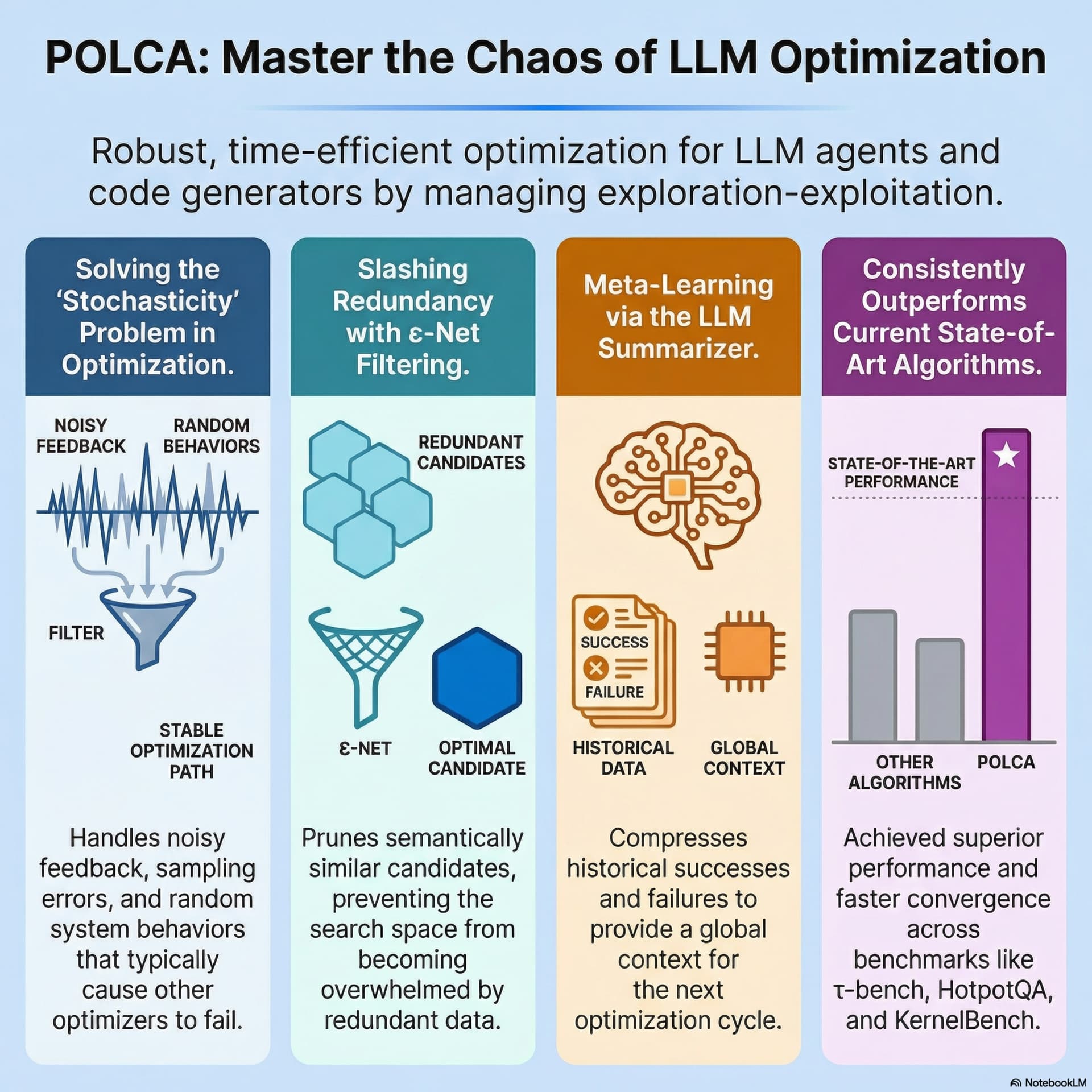
Generative optimization for LLM-based systems, focusing on PLCA (Prioritized Optimization with Local Contextual Aggregation) to improve AI prompts/agents despite noisy, stochastic evaluation loops.
Guest backgrounds
No guests are mentioned in the transcript; it’s a host-led discussion of a research paper/framework.
Key claims
Perfect logical critique of AI performance can fail to improve due to compounding variance from mini-batch sampling, agent randomness, and subjective LLM-judge scoring. PLCA works by (1) maintaining a priority queue of candidate programs with empirical-mean scores averaged over new mini-batches, (2) using UCB to balance exploration/exploitation, (3) using an external summarizer to synthesize global history into actionable meta-instructions, and (4) applying semantic filtering via an epsilon-net to reject redundant near-duplicate proposals.
Notable examples/benchmarks
TalBench (13% improvement over base prompt on 100+ held-out retail-agent tasks), HotPotQA (discovers that forcing documented reasoning improves multi-hop QA), Veribench (Lean4 compilation: >95% pass rate in mixed deterministic/stochastic judge signals), KernelBench (CUDA optimization; still benefits from parallel exploration even when deterministic). Ablation: regression-based prediction of future performance underperformed empirical means.
Written by AI. May contain mistakes. Listen to the episode to check what was said.
Chapters
Tap a time to open that second in VOThe Challenges of AI Optimization
0:45 to 2:52
Exploring the complexities and difficulties of optimizing AI using human intervention.
“We are essentially automating everything except the automation itself.”
Understanding Stochasticity in AI
2:52 to 5:07
Delving into the three main sources of stochasticity affecting AI performance.
“And that brings us to the second source of noise, agent randomness.”
Introducing the PLCA Framework
5:07 to 8:00
Detailing how PLCA addresses the challenges of AI optimization through a priority queue.
“This is the memory center of the system.”
The Role of the Summarizer in PLCA
8:00 to 10:30
Examining the external LLM component called the summarizer and its function in improving AI feedback.
“By learning from the trajectories of past evaluations, the search process can escape local optima.”
Addressing Memory Bloat with Epsilon Net
10:30 to 11:39
Explaining how PLCA uses semantic filtering to avoid memory overload from redundant ideas.
“But couldn't a tiny semantic change, a distance less than epsilon, actually be the magic tweak that fixes a broken code?”
Benchmarks and Real-World Performance of PLCA
11:39 to 14:03
Reviewing how PLCA performs in various complex environments through benchmark tests.
“By keeping the memory lean and diverse, the summarizer has a much clearer, more distinct set of successes and failures to learn from.”
Understanding Veribench and Its Significance
14:03 to 14:53
Learn about Veribench as a formal verification benchmark and its mixed signal environment.
“This is a formal verification benchmark, translating Python code into Lean4 code.”
Exploring Kernel Bench and PLCA's Advantages
14:53 to 16:21
Discover how PLCA excels in optimizing CUDA code and its unique architecture.
“These are the deep level instructions that run on computer GPUs.”
The Role of PLCA in AI Supervision
16:21 to 16:47
Understand how PLCA helps manage the chaos of LLMs and the future of AI development.
“That global context gives it a massive advantage, even when the environment itself isn't noisy at all.”
Ablation on Regression: Key Insights
16:47 to 18:59
Examine a revealing experiment that challenges the effectiveness of predictive models in AI.
“We cannot have humans hand-tuning thousands of prompts forever.”
Show all 11 chapters
Empirical Measurement vs. Prediction in AI
18:59 to 19:15
A provocative thought on the limits of theoretical prediction in understanding AI systems.
“Well, maybe the old-school scientific method, endless trial, error, and empirical measurement, is the only true path forward to understand the machines we are building.”
Transcript
Automatic transcript. May contain errors.0:00If you want to make an AI smarter, the worst thing you can do is, well, look at its last mistake. Yeah, which sounds completely backwards, I know. It really does. But today we're looking at a paradox in AI engineering. Why giving an artificial intelligence a perfect logical critique on its performance almost guarantees it will fail to improve? It's a huge bottleneck right now. Right. And you probably use AI to optimize your daily workflow, right? Use it to draft emails, summarize complex meetings, maybe even write some boilerplate code. But here is the modern irony. Who optimizes the AI? Historically humans.
0:37Exactly. Traditionally, it takes human engineers laboriously tweaking prompts and rewriting code to get these systems to actually behave. We are essentially automating everything except the automation itself. But, you know, that paradigm is beginning to shift with a concept called generative optimization. This is where we use a large language model, an LLM, to act as an automated optimizer for other complex systems like multi-turn agents or code generators. It's machines supervising machines. Okay, let's unpack this. The goal of today's deep dive is to explore a fascinating new framework from the research called PLCA.
1:12That stands for Prioritized Optimization with Local Contextual Aggregation. It's a mouthful, but the mechanics are brilliant. Oh, totally. We're going to uncover how PLCA tames the sheer chaos and noise of AI trying to optimize AI, acting as a shortcut to making these systems highly efficient. Because optimizing an AI right now is essentially like trying to tune a guitar while someone is constantly changing the temperature in the room. The feedback you get is just always shifting. That analogy hits a nail on the head. Before we can appreciate what the PLCA framework actually does, we need to understand why letting an LLM optimize another system is currently so incredibly difficult.
1:51The promise is there, but the reality is messy. Super messy. and the primary villain in this story is stochasticity, but specifically a compounding variance that standard algorithms just aren't built to handle. The paper breaks this down into three main sources of chaos. Right, and if you're training a model, you expect some stochasticity, you know there will be noise. But here you've got this compounding effect. Let's walk through those three sources. The first source is mini-batch sampling. If you have an AI agent designed to handle customer service, testing its performance on every single possible customer query would take forever.
2:30The compute cost would be astronomical. Exactly. So developers test the agent on small, random samples of tasks, which we call mini-batches, but because every batch is different, the performance scores bounce around wildly. Oh, I see. Yeah. One batch of easy queries might make the AI look like a total genius, and the next batch of edge cases might make it look incompetent. So the baseline feedback is already totally inconsistent. based purely on the test sample. And that brings us to the second source of noise, agent randomness. Right. LLMs are inherently probabilistic. If you ask the exact same customer service agent the exact same question twice, you might get two completely different behaviors.
3:09Especially if the temperature setting allows for any creativity, right? Yes. The agent itself is a moving target. And then the third source of stochasticity takes those first two and compounds them into a real mess, and that's noisy feedback. The subjective judge. You got it. In these generative optimization loops, we often use another LLM as a judge to score the agent and provide critiques on how to improve. But language models are subjective. The LLM judge might give a score of an 8 today and a 6 tomorrow for the exact same output. Along with wildly different advice on how to fix it, I bet. Exactly.
3:45So just to review the nightmare scenario we're dealing with here, We are testing on a random shifting sample of tasks using an agent that behaves unpredictably, being graded by an AI judge that scores subjectively. So standard optimizers must just chase their own tails here, right? They absolutely do. Standard methods often take that noisy score at face value. They run a test, get a score from the judge, and immediately update the system based on that single data point. Yeah. Or they suffer from a lack of long-term vision. They only look at the immediate previous step to decide what to do next.
4:17This leaves to them getting stuck in loops with the LLM repeating the exact same mistakes over and over. Because it has no broader context of what it tried like three steps ago. Exactly. Wait, if the feedback is inherently noisy and changing, how can any optimizer figure out if a tweak to a prompt was actually an improvement or if it just got lucky on that specific test? This raises an important question and it gets to the very heart of the research. Without a long-term memory, an optimizer is just flying blind. Yeah, that sounds like it. If you only look at the last test, you have no way to average out the noise.
4:51You are completely at the mercy of the variance, and that is exactly where PLCA steps in to change the architecture of how we do this. Because a single test run is too noisy to trust, the researchers designed PLCA to never truly throw away an idea, but rather track it continuously. Correct. PLCA introduces a priority queue. This is the memory center of the system. Instead of testing a proposed program once and either keeping it or discarding it, which is what older frameworks do, PLLCA maintains a running list of all accepted programs. Like a living database. Yes. As it tests those new mini-batches of tasks we talked about, it continuously evaluates the programs in its queue against those new tasks.
5:34So it's constantly gathering new data points on the same ideas. It continuously updates what the study calls the empirical means score of these programs. So by averaging the performance over multiple different mini-batches, the noise slowly cancels out. The true performance of the program kind of reveals itself. Right, and it re-ranks the queue based on these updated scores. This queue is guided by a UCB score, which is an upper confidence bound. Okay, what does that mean in practice? It's a mathematical principle that balances exploitation using the programs we already know are good, with exploration testing programs we haven't tested enough yet to be sure about.
6:10Oh, I like that. Yeah, it ensures we systematically explore the possibilities instead of getting stuck on early lucky successes. It allows high potential but currently unlucky programs to be revisited. Just because a prompt failed on one weird batch of tasks doesn't mean it's a bad prompt. The priority queue gives it a chance to prove itself over time. Exactly. Okay, so the memory handles the noisy scores. I have a question here. If the feedback from the judge LLM is already noisy, how does PLCA figure out what to actually change in the code or the prompt? Aren't we just piling on more noise? It's a great observation.
6:48To solve that, the framework introduces an external LLM component called the summarizer. The summarizer. Yeah. The summarizer doesn't just look at the last piece of feedback from the noisy judge. It operates on a macro level. It looks at the entire history of successes and failures sitting in the priority queue. Wow. It partitions this history, looking at what worked across the board and what repeatedly failed, and it synthesizes a global context summary. Here's where it gets really interesting. If you think about it, the summarizer is kind of like a seasoned sports coach. How so? Well, imagine you have a star player who just had one terrible game.
7:23A bad coach, like those older sequential algorithms, would look at that local observation, panic, and bench the player entirely. Right. But the summarizer coach looks at the player's stats for the whole season, the global history. The coach sees the broader patterns, realizes it was just a statistical blip, and gives the player high-level advice on how to adjust their swing rather than overreacting to one bad night. That perfectly illustrates the paradigm shift here. We are moving from local reactive optimization to global historical synthesis. In mathematical terms, the authors note that this mimics the concept of momentum in gradient descent.
8:01Momentum. Yes. By learning from the trajectories of past evaluations, the search process can escape local optima. Hold on. Momentum in gradient descent. For listeners who aren't actively training neural nets, let's translate that. You're essentially saying that if you're rolling a ball down a bumpy hill trying to find the lowest valley, momentum ensures the ball doesn't get stuck in the very first tiny ditch it hits, right? Exactly. It uses its accumulated speed to roll over the small bumps to find the true bottom of the mountain. That's spot on. It isn't just reacting to the last iteration. It's being steered by the accumulated wisdom of the entire search history.
8:35It distills all those messy, contradictory judge critiques into clear, actionable meta-instructions for the optimizer to follow. Okay, the priority queue and the summarizer sound incredible, but I'm seeing a massive bottleneck looming here. Uh-oh, what is it? If I ask an LLM for 10 prompt variations, half of them usually just synonyms. It might propose changing a prompt from, please do this, to kindly do this. If PLCA remembers every single idea the LLM proposes, won't its memory queue explode with these useless semantic tweaks? You've identified the exact problem of unconstrained expansion. LLM optimizers are, by nature, very eager to please.
9:17Yeah, they really are. And they will endlessly churn out structurally identical programs clothed in different vocabulary. The search space grows linearly, meaning the system is storing more and more programs and eating up your computing budget to test them. But the actual usefulness of the ideas doesn't grow at all. No, the system just drowns in its own redundant variations. So how does PLCA stop the memory from getting bogged down with endless variations of please and kindly? It uses a mechanism called semantic filtering, specifically an epsilon net. Every time the optimizer proposes a new parameter, like a new prompt or a block of code, that proposal is mapped into a dense vector space.
9:57It creates an embedding. Right, so it takes the raw text and turns it into mathematical coordinates. And once it's plotted in that vector space, PLCA measures the semantic distance between the new proposal and the existing programs already stored in the memory queue. Yes. And if the semantic distance between the new idea and an old idea is less than a specific threshold, which is represented by the Greek letter epsilon, PLLCA simply rejects it before it's ever evaluated. It acts as a bouncer at the club. Pretty much. Keeping redundant ideas out before they waste the system's time and money. But let me push back on this.
10:31Okay, go for it. But couldn't a tiny semantic change, a distance less than epsilon, actually be the magic tweak that fixes a broken code? Aren't we throwing the baby out with the bathwater by filtering them out? You're absolutely right. Right. We probably do lose out on some magic, highly specific tweaks. But in generative optimization, it is a numbers game. Right. The research directly addresses this using ablation studies. That's where they remove a part of the system to see how vital it is. The researchers tested PULCA with epsilon set to zero. This means the bouncer lets everyone in, no matter how redundant they are, specifically to catch those magic tiny tweaks you mentioned.
11:09And what was the result? Let me guess. It was a mess. It yielded the absolute worst learning performance across the board. Wait, really? Worse than standard methods? Yes, because the system completely wasted its finite computational budget. It spent all its time and resources testing and evaluating those meaningless pleas versus kindly variations, instead of exploring genuinely novel architectural structures. Wow. The researchers found that trading a tiny bit of theoretical precision for a massive gain in efficiency is what makes PLCA scalable. By keeping the memory lean and diverse, the summarizer has a much clearer, more distinct set of successes and failures to learn from.
11:47That makes a lot of sense. Yeah. So we've solved the memory bloat with the epsilon net, and we've solved the noisy scores with the priority queue. But, you know, surviving a theoretical math test on paper is very different than surviving in the wild. Did the authors actually force PLCA to operate in complex, varied environments? Let's look at the benchmarks. They did, and they benchmarked PLCA against state-of-the-art baselines like GPT and OpenEvolve. The first major test was Talbench. This is an environment for optimizing a multi-step retail agent. It involves an AI interacting with simulated human users and using various API tools to solve complex queries.
12:24To give you an idea of how chaotic this is, imagine a simulated user wants to return a shirt, apply a 15 % discount to a new pair of shoes, and change their shipping address all in one chat session. The AI agent has to use different tools, and if it fails one step, the whole task often fails. So this is an environment with extreme stochasticity. Extreme. And PLCA absolutely crushed the baselines. It achieved a 13 % improvement over the base prompt across over 100 held-out tasks. That's huge. Yeah, the older methods failed here because they evaluated a complex task like the one you described once, trusted that noisy score, and moved on.
13:03PLC's ability to constantly re-evaluate and update its empirical memes allowed it to find genuinely robust solutions that generalize to new problems. They also tested it on HotPod QA. This is optimizing a prompt for complex, multi-hop question answering. For those unfamiliar, a multi-hop question is something like, who is the president of the country where the Eiffel Tower is located? Right. The AI can't just look up one fact. Exactly. It has to first determine where the tower is, then determine who the president of that specific country is. It requires connecting disjointed paragraphs and ignoring distractors.
13:37And in this benchmark, the study noted a fascinating detail. Through its historical memory, PLCA generated a highly disciplined prompt that explicitly commanded the AI to meticulously document the entire reasoning path before providing the final answer. It figured out that forcing the AI to show its work, what we call chain of thought reasoning, led to better outcomes. It discovered that entirely on its own, through trial and error guided by the summarizer. Then there was Veribench. This is a formal verification benchmark, translating Python code into Lean4 code. Lean4 is intense. It is a highly rigorous, unforgiving mathematical programming language.
14:15What is vital to note about Veribench is that it is a mixed signal environment. What does a mixed signal environment actually look like in practice? It means it mixes deterministic signals with stochastic ones. The deterministic signal is binary. Does the Lean4 code compile or not? It's strict math. But the stochastic signal is the noisy feedback from the LLM judge trying to interpret Lean4's obscure compiler errors and explain why the code didn't compile. It's a chaotic feedback loop layered on top of a rigid binary outcome. PLCA navigated that mixed signal environment perfectly, achieving a compile pass rate of over 95%.
14:52Which brings us to the final benchmark, kernel bench. This is optimizing CUDA computer code. These are the deep level instructions that run on computer GPUs. So what does this all mean? Wait, writing CUDA kernels is deterministic. There is no random noise in whether code compiles or runs fast. It's purely mathematical. If there's no noise to average out, why do you even need the priority queue in the summarizer? But PLCA is still one. What's fascinating here is that even in a completely deterministic environment without noise, PLCA's architecture is still superior because of parallel starting points and global failure context.
15:27Let's break that down. Sequential algorithms, the traditional ones, pick a starting point, make a tweak, test it, and move forward. If you tweak a memory allocation parameter and it slows down the GPU, traditional optimizers revert and try a tiny micro-tweak nearby. If they go down a dead-end path, they are stuck. They only learn from their own narrow sequential failures. It's like wandering a maze with a flashlight, only seeing what's right in front of you. Precisely. PLCA, however, explores multiple candidate programs in parallel from its queue. It is looking at 10 totally different architectural approaches at once.
16:03It is walking multiple paths through the maze simultaneously. And more importantly, the summarizer gathers the failure data from all of those different paths at once. It learns from the failures of Path A, Path B, and Path C collectively, synthesizing a map of the entire maze to propose a vastly superior Path D. That global context gives it a massive advantage, even when the environment itself isn't noisy at all. That is brilliant. It uses the diverse failures forced by the EpsilonNet bouncer to continuously teach the LLM what not to do across a wide spectrum of ideas. So to bring this all back to your daily life as we enter an era where AI builds and refines other AI, managing the unconstrained chaos of LLMs is the primary bottleneck.
16:47We cannot have humans hand-tuning thousands of prompts forever. We simply cannot scale human oversight to match the complexity of the generative systems we are building today. Frameworks like PLCA, using a memory cue to average out the noise, a summarizer to act as a seasoned coach looking at the whole season, and a semantic filter to bounce redundant ideas, they represent the blueprint for the next generation of AI development. It is how we get machines to reliably supervise machines. It really is. But before we wrap up, there is one final provocative thought from the research that I want to leave you with.
17:18It's hidden in a section called ablation on regression. Yes. This was a very revealing experiment by the researchers that touches on the philosophy of AI development. They tried an alternative approach to the priority queue. Instead of just taking the simple empirical mean score, which is literally just averaging the past test results, they tried training a complex regression model. Right. They built an advanced predictive model, fed it the semantic features of the prompts, and tried to predict which generated programs would perform the best in the future. It is a very logical assumption in computer science.
17:52You would think a sophisticated predictive math model could look at the semantic features of a prompt and accurately predict its success, saving you the trouble of having to empirically test it so many times. But it failed. The advanced predictive model actually performed worse than just relying on the simple empirical mean scores from the priority queue. Trying to mathematically predict the AI's behavior was less effective than just running it and recording what happened. And if we connect this to the bigger picture, the regression model failed because of the nonlinear, unpredictable nature of LLM latent spaces.
18:28These models are essentially black boxes whose outputs exhibit chaotic divergence based on microscopic input changes. Standard predictive math simply breaks down. It couldn't generalize reliably enough to beat simple, real-world observation. Which leaves you with a thought. As we build these incredibly complex generative AI systems, is it possible that their behavior is becoming fundamentally irreducible? If an AI cannot even mathematically predict its own future performance based on its underlying code and prompts? Well, maybe the old-school scientific method, endless trial, error, and empirical measurement, is the only true path forward to understand the machines we are building.
19:08It suggests that at a certain level of complexity, theoretical prediction breaks down entirely, and rigorous observation is all we have left. You can't just stare at the guitar and calculate how it will sound. You have to pluck the string, hear the note in the chaotic temperature-shifting room, and turn the peg. Over and over again. Until next time, keep diving deep.
From the publisher
This paper introduces POLCA, a scalable framework designed to automate the optimization of complex systems like LLM prompts and multi-turn agents. The authors formalize this challenge as stochastic generative optimization, where an LLM acts as the optimizer but must contend with noisy feedback, random system behaviors, and an ever-expanding solution space. To ensure efficiency, POLCA utilizes a priority queue to balance exploration and exploitation alongside an $\epsilon$-Net mechanism that prunes semantically redundant candidates. A specialized LLM Summarizer also performs meta-learning by compressing historical successes and failures into a global context for future iterations. Theoretical analysis proves the framework converges to near-optimal solutions despite stochasticity, and experimental results across benchmarks like $\tau$-bench and VeriBench show it consistently outperforms existing state-of-the-art algorithms. Ultimately, the research highlights how embedding-based memory and systematic filtering are essential for making generative optimization robust and computationally feasible.


