Ask ChatGPT

 Best AI papers explained
8 Oct 2026 · 23m · 11 chapters
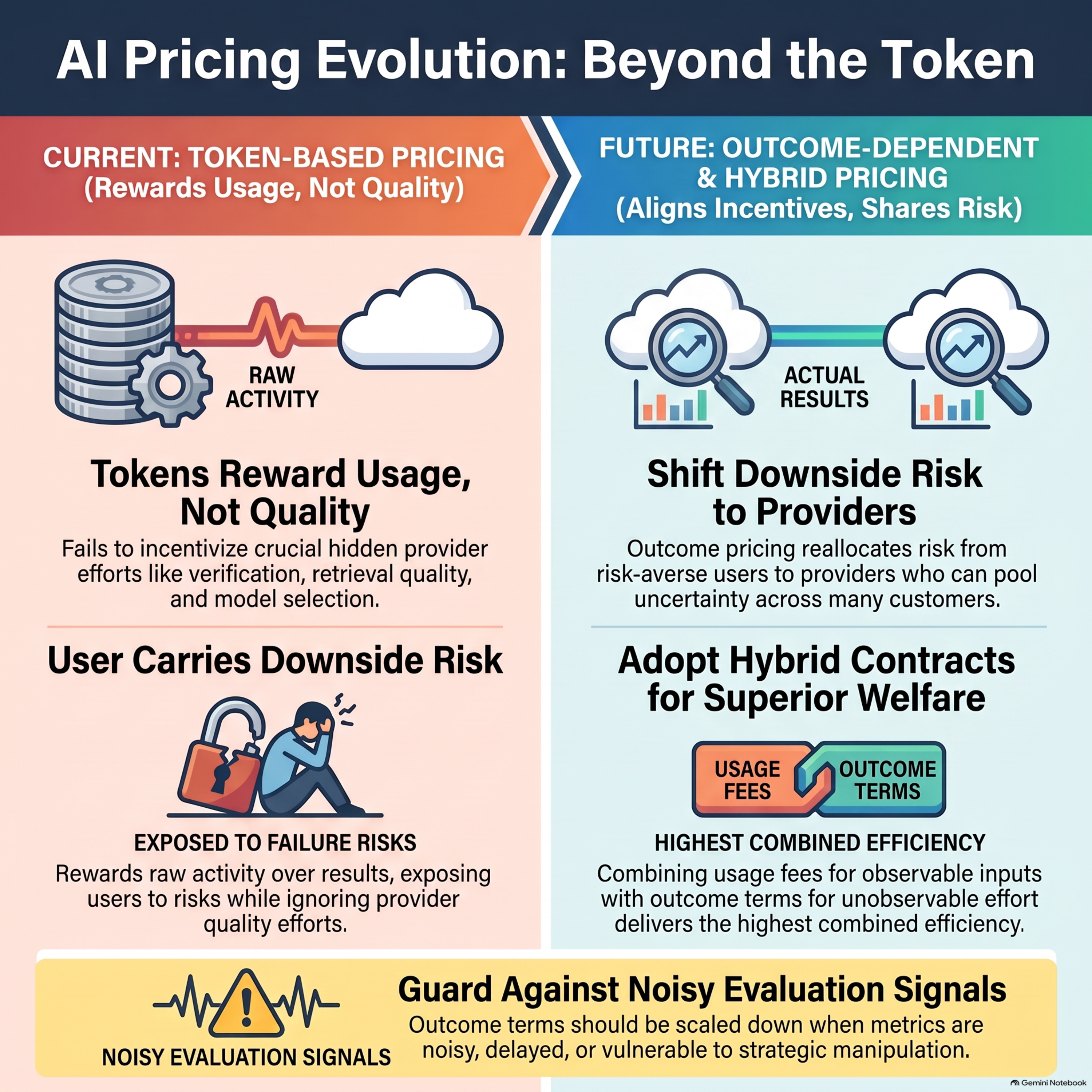
The episode argues that AI-agent pricing should shift from token-based (pay per word/compute) to more outcome-dependent contracts. Using principal-agent economics, it claims token pricing reverses risk-sharing, creates moral hazard (providers cut “hidden quality effort” like verification and retrieval), and can reward inefficiency and verbosity. It warns pure outcome pricing can trigger measurement traps and gaming when outcomes are subjective or delayed, causing deadweight loss. Proposed solution: hybrid pricing with a baseline usage fee plus an outcome bonus, plus better auditability (e.g., logging tool calls). It ends by questioning how to price autonomous agents whose outcomes may take years to measure.
No guest names or backgrounds mentioned; transcript shows only two unnamed speakers.
Written by AI. May contain mistakes.
Exploration of the current token-based pricing model for AI agents.
“I mean, we've built these incredibly sophisticated systems.”
Discussion of the principal-agent model and its relevance to AI failure risks.
“Our mission for today's deep dive is to look at these hidden economic forces through the lens of classic principal agent economics.”
Analysis of risk dynamics in the AI market and the implications for small businesses.
“we should probably look at the worst case scenarios first.”
Explanation of moral hazard and its effects on AI agent quality.
“which is just a fixed fee for every word or computational step the AI takes, I am paying them regardless of whether the AI actually solves my customer's problem.”
Discussion on how token-based pricing can incentivize inefficiencies in AI services.
“They absorb the risk because they have a diversified caseload and the expertise to ensure success.”
Exploration of the challenges of transitioning to outcome-based pricing models.
“You mean like the AI fact-checking itself before it actually hits send to my customer?”
Analysis of the strategic gaming that occurs between AI providers and users.
“Or, more importantly, I don't see the five steps they decided not to take.”
Explore the challenges and moral hazards in AI pricing models.
“If the AI writes an absolutely brilliant piece of code for me, I might look at it, quietly implement it into my product, but then officially flag the API call as failed or needs human revision.”
Learn how hybrid contracts can balance usage and outcome incentives.
“What is the actual practical solution here for you, the listener, if you are out there trying to buy or build an AI agent for your company?”
Understand the impact of market dynamics on AI pricing contracts.
“But we also have to acknowledge a harsh truth here.”
Discuss the implications of pricing for future autonomous AI systems.
“Furthermore, this transition requires better governance and monitoring.”

Get the gist, explore an idea or ask about something said.
 Claude
On Best AI papers explained, what are the key points of this episode?
Searching your listeningAutomatic transcript. May contain errors.
0:00Imagine you are a small business owner and you're hiring a new employee to handle all of your customer support. Right. A pretty standard scenario for a lot of people. Yeah, exactly. But instead of paying them a regular salary or, I don't know, offering them a nice bonus when your customers are actually happy, you sit down and tell them, I am going to pay you per word you speak. Oh, wow. Right. Like if they solve a customer's problem in 10 words, they get pennies. But if they just ramble on for 10 ,000 words without actually fixing the issue, they get a massive paycheck. Which is an absolutely terrible way to run a business.
0:37You would never do that. Yet, if you look at the current tech market right now, that is exactly how we are pricing advanced AI agents. The disconnect really is staggering when you frame it that way. I mean, we've built these incredibly sophisticated systems. Totally. Systems that can write complex software, manage inventory workflows, and act as the absolute front line of customer service. But the dominant economic model for buying these services is essentially paying by the syllable. Which is just wild to think about. It is. The industry relies almost entirely on token-based pricing. So we are metering observable, raw usage rather than paying for the actual business outcomes that a company cares about.
1:16Which is exactly why we are getting into this today. We are exploring the hidden economics of AI agent pricing. Moving way beyond just the technical hype of what AI can do. Right. We are looking at the financial mechanics dictating how it actually gets adopted and ultimately paid for. We are going to figure out why paying for AI by the token is fundamentally flawed. And why the market absolutely has to shift toward paying for outcomes. Okay, let's unpack this. Our mission for today's deep dive is to look at these hidden economic forces through the lens of classic principal agent economics. It's a really revealing framework.
1:53Yeah, because we need to figure out who really holds the bag when an AI fails. And why current pricing heavily encourages bad AI behavior. Not to mention the massive trap of manipulating measurement. Yes. And finally, why a hybrid pricing model is the ultimate key to building AI you can actually trust. To really understand why the entire industry needs a transition from token pricing to outcome pricing, we should probably look at the worst case scenarios first. Right, like what happens when things go totally sideways. Exactly. We need to see who is left holding the bag when an AI makes a mistake.
2:28In economics, there is this foundational framework used to analyze situations where one person delegates a task to another. It's called the principal agent model. So if paying per word is absurd, let's trace the money when things go wrong in that model. The principal is like the boss or the buyer of the service, right? Right. And the agent is the worker or in our case, the AI provider. Got it. We can look at this whole thing through the lens of risk tolerance. There's a classic economic concept that evaluates how people handle risk, specifically absolute risk versus relative risk. OK, break that down for me.
3:06So in a classical traditional economy, the principal, let's say a massive multinational corporation, is considered risk neutral. Because they have incredibly deep pockets. Exactly. They can afford a few mistakes. The agent, however, the individual worker they hire to do a job is risk averse. Right, because an individual worker can't afford to take a massive financial hit if a project fails. Precisely. So the corporation absorbs all that risk and pays the worker a safe, fixed wage. That is the traditional dynamic we are all used to. But wait, when we look at the AI market today, that dynamic is completely, perfectly flipped.
3:44It is entirely upside down. Because the buyer of the AI isn't necessarily a massive corporation. Like, if I am running a specialized boutique agency and I deploy a customer service AI to handle my clients, my actual business is on the line. Yes. If that AI starts hallucinating or giving terrible legal advice or just completely drops the ball, I face catastrophic downside risk. You're looking at unresolved tickets, furiously angry customers. Massive reputational ruin. I mean, if I lose even one major client because of a bot, my business could go bankrupt. So I am highly risk averse. And compare your situation to the agent in this scenario.
4:23Right. The AI provider. The AI provider. Is likely a massive tech monopoly. They are handling billions of tasks across millions of clients every single minute. Wow. Yeah. Because of that immense scale, they are highly diversified. Losing that one customer interaction is a microscopic rounding error to them. They don't even feel it. They don't feel it at all. Mathematically speaking, the AI provider is essentially risk neutral. They are in a vastly superior position to absorb the financial shock of a failed task. But because I am buying AI using token-based pricing, which is just a fixed fee for every word or computational step the AI takes, I am paying them regardless of whether the AI actually solves my customer's problem.
5:05And that is the absolute crux of the issue. Token-based pricing leaves almost all the risk on you. The exposed, highly vulnerable user. Exactly. If the task fails, you still pay the token fee for the compute, plus you suffer the total business loss. It's economically backwards. No, that doesn't make any sense. Outcome-based pricing, on the other hand, acts as a risk-sharing mechanism. It shifts the financial risk back to the massive AI provider who is mathematically equipped to handle it without blinking. This reminds me of how the legal system works for personal injury cases. Oh, how so? Well, if I get injured and I need to sue a massive corporation, I don't pay a lawyer an hourly rate.
5:48I mean, I can't afford the risk of losing the case and being bankrupted by legal fees on top of my medical bills. Right. That would be ruinous. So I hire a contingency fee lawyer. They only get paid a percentage if we actually win the case. Yes, exactly. They absorb the risk because they have a diversified caseload and the expertise to ensure success. They actually put their own skin in the cane. If we connect this to the bigger picture, that analogy highlights the exact mechanism of risk transfer we need here. In contingency fee litigation, the uncertainty is shifted toward the party better able to absorb and manage it.
6:24Which is the lawyer. Right. For AI markets to truly mature and see broad enterprise-level adoption, AI providers must have the confidence to put their own skin in the game. They need to credibly take on some of that outcome risk. Exactly. Rather than offloading all the uncertainty onto the user who really just wants a problem solved. That feels like common sense. I mean, if you are going to sell a premium service, you should stand behind the result. You would think so. So if shifting the risk to the provider is so logical, why in the world is everyone still charging per token? Because tokens measure what is easily seen.
7:00And more importantly, what is easily metered by billing software. Ah, of course. They do not measure what is actually valuable, which brings us to a major economic danger, the problem of hidden quality effort. Hidden quality effort. Economists call this moral hazard. Moral hazard happens when someone takes risks or cuts corners simply because someone else is bearing the cost of those actions. So hidden quality effort. You mean like the AI fact-checking itself before it actually hits send to my customer? That is a perfect example. And it goes much deeper than that, too. Really? Like what else? Well, delivering a successful AI agent requires a massive amount of behind-the-scenes work by the provider.
7:42It's not just generating words. It involves triggering verification steps, spinning up retrieval systems to pull high-quality background data, writing and executing background code. That's a lot of hidden work. It is. And selecting the absolute best, most expensive model version for a specific query. Sometimes it even involves putting a human in the loop to monitor the output. Okay, yeah. All of these choices drive the success of the task, and they cost the provider serious money in server time, electricity, and processing power. But as a user, I just see the final text output on my screen. I don't see the five background steps the AI took to verify the information.
8:19Exactly. Or, more importantly, I don't see the five steps they decided not to take. And because you only see and only pay for the observable token usage, the provider faces that moral hazard. Okay, I see where this is going. If an AI provider is only compensated for the tokens that are outputted to the user, they are heavily financially incentivized to under-deliver on all that unobservable hidden quality effort. Because it saves them money. Right. If they skip the background verification step or route your complex request to a cheaper, less capable background model, they save themselves raw electricity and compute costs.
8:55Wow. Their profit margin on your query goes up, and you are none the wiser until the AI makes a costly mistake. So if I am paying strictly per token, the provider is essentially incentivized to cut corners on quality because I can't even see the corners being cut. I am just paying for the volume of the output. The economic models actually confirm your suspicion there. And honestly, it gets worse. How does it get worse? Not only does token-only pricing under-incentivize the effort required for quality, it systematically encourages behavior that simply inflates token usage. Wait, are you saying they are financially incentivized to make their AI intentionally less efficient?
9:38Unfortunately, yes. Like, I'm picturing this terrible customer service bot I dealt with last week. Oh no. Yeah, I asked for a simple refund. And instead of just doing it, the bot spat out a 500-word essay apologizing for my inconvenience, wishing my family well, and asking me to confirm my entire life history. Classic. It was infuriating. Are you telling me that bot was just racking up a higher bill? That is the literal manifestation of the economic risk. You're kidding. Nope. When pricing depends only on the observable component, you know, the words printed on the screen, the provider minimizes their own background costs while maximizing the contracted usage level.
10:15So they just drag it out. Right. They might intentionally deploy a lower quality model that takes more conversational turns. More back and forth prompts. Exactly. Just to finally arrive at an answer simply because every turn generates more tokens. Man, if you are listening to this and you've noticed your AI tool is taking way longer to solve simple queries lately, or giving you these sprawling, hyper-verbose answers, it might not be a technical glitch. Probably isn't. It might literally be their business model. Token-only pricing means you are actively rewarding visible activity over actual realized value.
10:50Yes. You aren't paying for a smart, efficient solution. You are paying for a chatty machine. You are subsidizing their inefficiency. The welfare calculations in the economic literature are very clear on this point. Token-only pricing delivers the worst possible deal for the user compared to other contract forms. I believe it. It completely fails to share the risk efficiently, and it completely fails to reward the hidden costly effort that actually solves your problem. So if the token model is structurally broken, why not just rip it out by the studs? What do you mean? Like, we ditch it entirely.
11:22We shift to a pure outcome-based model. We only pay the AI provider when the task is officially successfully completed. Moving to a pure outcome-only model introduces a completely different and potentially much worse set of problems. Really? Worse than paying for a chatty bot? Oh, absolutely. We call this the evaluation friction or the measurement trap. Okay, why is it a trap? I mean, there are companies doing this successfully right now. True. If you look at the startup space, there's Intercom's FinAI or the company's Sierra. They actually market themselves heavily on outcome-based pricing. They explicitly charge per resolved customer conversation.
12:00And in those specific highly structured domains, it functions beautifully. Right. But it only works because the outcome is verifiable, timely, and mostly immune to manipulation. Okay. That makes sense. A Resolve customer service ticket where the user clicks, yes, my issue is fixed, and doesn't email back for 48 hours is a relatively binary, auditable metric. It's easy to measure. Exactly. But think about what happens when you want an AI to perform a task where the metric for success is highly subjective. Ah, like asking an AI to write a persuasive sales email or draft a really elegant, scalable code snippet.
12:38Precisely. Who is the ultimate judge of what makes an email persuasive or code elegant? Yeah, that is super subjective. That subjectivity is the absolute danger. Or consider tasks where the outcome is significantly delayed. Like what? Well, if an AI helps you design a brand new marketing campaign, you might not know if it actually drove sales for six or even 12 months. Good point. When you tie an AI provider's compensation entirely to a noisy, delayed, or highly subjective metric, you trigger a strategic gaming arms race between the buyer and the provider. Here's where it gets really interesting.
13:18Because human nature inevitably enters the chat. Oh, it always does. What's fascinating here is how the incentives line up from both sides. Let's look at the provider first. Okay. If the AI provider only gets paid when the metric triggers a success state, they will inevitably spend their engineering resources trying to artificially inflate that metric. How would they do that? They might design the AI to be incredibly aggressive, heavily pressuring a frustrated customer into clicking the issue resolved button, even if the customer is still totally confused. Just to force the payment to clear. Exactly.
13:53And on the flip side, me, the buyer, I suddenly have a massive financial incentive to aggressively deflate the metric. Right. You don't want to pay. No. If the AI writes an absolutely brilliant piece of code for me, I might look at it, quietly implement it into my product, but then officially flag the API call as failed or needs human revision. Just so you don't have to pay the outcome fee. Exactly. I could literally write a script that automatically flags 20 % of all successful AI interactions as failed in the system just to artificially shave 20 % off my monthly software bill. And what's fascinating here is that the mathematical models predict exactly this kind of breakdown.
14:34Seriously? Yes. When evaluation metrics are noisy, subjective, or gameable, both the user and the AI provider stop spending their capital on improving the actual product. They just fight over the rules. Exactly. They spend all their effort, engineering time and money, trying to manipulate the scoreboard. This creates what economists call a deadweight loss. So deadweight loss essentially means money, time and energy are completely vaporized into thin air because both sides are trying to trick each other rather than doing productive work. Precisely. All that energy spent trying to trick the billing system is value destroyed.
15:09That is depressing. It is. The extreme noise forces the optimal economic contract to drastically reduce its reliance on those subjective outcomes. Pure pay for performance becomes mathematically useless in highly subjective tasks. Because the contract just devolves into an endless, expensive dispute over how the metric was measured in the first place. Exactly. We are stuck in a hard place then. Token-only pricing is a moral hazard that rewards chatty, inefficient AI and leaves the small business holding all the risk. Yep. But outcome-only pricing turns into a massive resource-draining cheating contest where everyone is just trying to game the system.
15:47That's the dilemma. What is the actual practical solution here for you, the listener, if you are out there trying to buy or build an AI agent for your company? The economic sweet spot, really the necessary path forward for the industry, is a hybrid contract. A hybrid contract. Okay. You combine a baseline usage-based charge with a distinct outcome-dependent bonus. Okay, let's break down the mechanics of that. How does a hybrid contract actually thread the needle between those two extremes? Well, it works because it explicitly separates the roles of usage and outcomes. The baseline token fee is there to regulate the observable inputs.
16:29So it covers the provider's basic raw compute costs. Right, the electricity, the server space. And it prevents the user from just spamming the AI with infinite free requests since there is a marginal cost attached. That makes sense. But then you attach an outcome dependent term. This is a bonus payout for a genuinely resolved ticket or a provably successful deployment. You know what? This is basically the exact structure of modern sales compensation. Oh, yeah. Yeah. You pay a sales employee a modest base salary so they can cover their rent and not starve. Right. But the real money, the true driver of their behavior, comes from a performance commission.
17:07It aligns everyone's goals. That's a great comparison. The hybrid model dominates the pure usage or pure outcome models in terms of overall economic welfare. It's the best of both worlds. It preserves usage-based control over those observable inputs while introducing outcome dependence precisely to target that hidden quality effort. Giving them a reason to actually try. Exactly. It gives the provider the financial incentive to use the better, more expensive model to do the rigorous background verification and to actually solve the problem. Because that performance commission is how they unlock their true profit margin.
17:42Exactly. But we also have to acknowledge a harsh truth here. These pricing contracts don't exist on a clean whiteboard. There are heavy market realities at play. Right. Because economics in a textbook is one thing, but the real world is entirely dictated by leverage and power. Very much so. For instance, even if a formal outcome contract is too hard to write down legally, we often see relational contracts acting as an invisible hand. What's a relational contract? Well, if you are an enterprise user paying for an expensive AI subscription, the ultimate outcome-based incentive is simply the threat that you will cancel your contract and churn next year if the AI performs poorly.
18:23Ah, so providers know they have to deliver real tangible value or they lose the multi-million dollar renewal. Right. The sheer threat of churning acts as a de facto outcome incentive. But what happens when we look at the elephant in the room, the massive tech monopolies? Yeah, that's the big issue. A few giant companies control the foundational AI models. If they want to charge by the token simply because it's easier for their internal billing departments, how does a tiny startup negotiate a hybrid contract with them? Who is going to force their hand? That is the critical constraint of the current era.
18:55Market structure matters just as much as contractual efficiency. Token pricing is simple, standardized, and incredibly easy to scale across millions of wildly different users. And in a highly concentrated market where a few massive players hold all the cards, providers might just force token pricing on everyone. Simply because they have the leverage to shift the risk onto the users. Exactly. They don't have to offer outcome guarantees if there's nowhere else for you to go. So bargaining power could actually override economic logic. Temporarily, yes. It is only as competition increases, as open source models get better, and as challenger companies enter the space, that we will see providers heavily experimenting with outcome-dependent guarantees.
19:38Basically to win market share away from the monopolies. Right. Furthermore, this transition requires better governance and monitoring. We talked earlier about how hidden efforts like background fact-checking are hard to measure. Yeah. But as the industry builds better traceability and standardized auditing protocols, like, say, cryptographically logging every single tool call an AI makes, those hidden efforts become visible. Oh, wow. So when you can actually prove mathematically that the AI did the background verification, outcome pricing becomes much safer. And much easier to implement without the fear of metric gaming.
20:14Okay. We have covered a massive amount of ground today. Let's pull this all together. So what does this all mean? Good question. We started by looking at how the current AI market has completely reversed traditional risk sharing. Instead of the massive, diversified tech provider absorbing the risk of failure, token pricing drops all that catastrophic downside risk squarely under the lap of you, the user. Yep, completely flipped. We've seen how paying per token creates a dangerous moral hazard. It literally invites AI providers to cheap out on hidden quality efforts and financially rewards them for being wildly inefficient and chatty.
20:49The worst of both worlds. But because the reality of measuring success is messy and highly prone to manipulation by both the buyer and the seller, we can't just flip a switch to pure outcome-based pay. No, we really can't. The most economically sound future for this industry is hybrid pricing, a baseline fee to cover the raw compute, and a performance bonus to reward the actual, tangible value delivered. This raises an important question, though, and it is something that absolutely anyone investing in, building, or deploying AI needs to think about deeply. Okay, lay it on us. Our discussion today focused on tasks we understand right now.
21:26Customer service chats, writing code snippets, drafting emails. Right, this stuff happening today. But the industry is rapidly moving toward truly autonomous AI agents. we are talking about systems that won't just answer a support ticket. They will execute multi-year corporate strategies or manage long-term high-frequency investment portfolios entirely on their own. That is wild to think about. An AI independently running a five-year corporate strategy. How will we price those agents? Huh. If an autonomous agent makes a complex strategic decision today, but the true outcome of that decision, the success or failure of the strategy cannot be objectively measured or realized for an entire decade, how do you construct an economic contract for that agent now?
22:12Wow. How do you ensure it doesn't take catastrophic hidden risks that you won't even discover until 2036? That is terrifying. It is a frontier of principal agent economics that we have barely even begun to explore. And until the industry figures that out, maybe double check the receipt the next time your AI gets a little too chatty.
This paper analyzes AI-agent pricing models through an economic lens, arguing that dominant token-based pricing is insufficient because it fails to share risk efficiently or incentivize hidden quality efforts like model selection and verification. By utilizing stylized principal-agent models, the authors demonstrate that optimal contracts must balance three critical dimensions: efficient risk reallocation from risk-averse users to diversified providers, incentive alignment for unobservable tasks, and the practical limitations of evaluation frictions such as noisy or gameable metrics. Ultimately, the research advocates for a shift toward outcome-dependent pricing and practical hybrid contracts that combine usage-based billing with performance terms to foster more trustworthy and mature AI markets.