In short
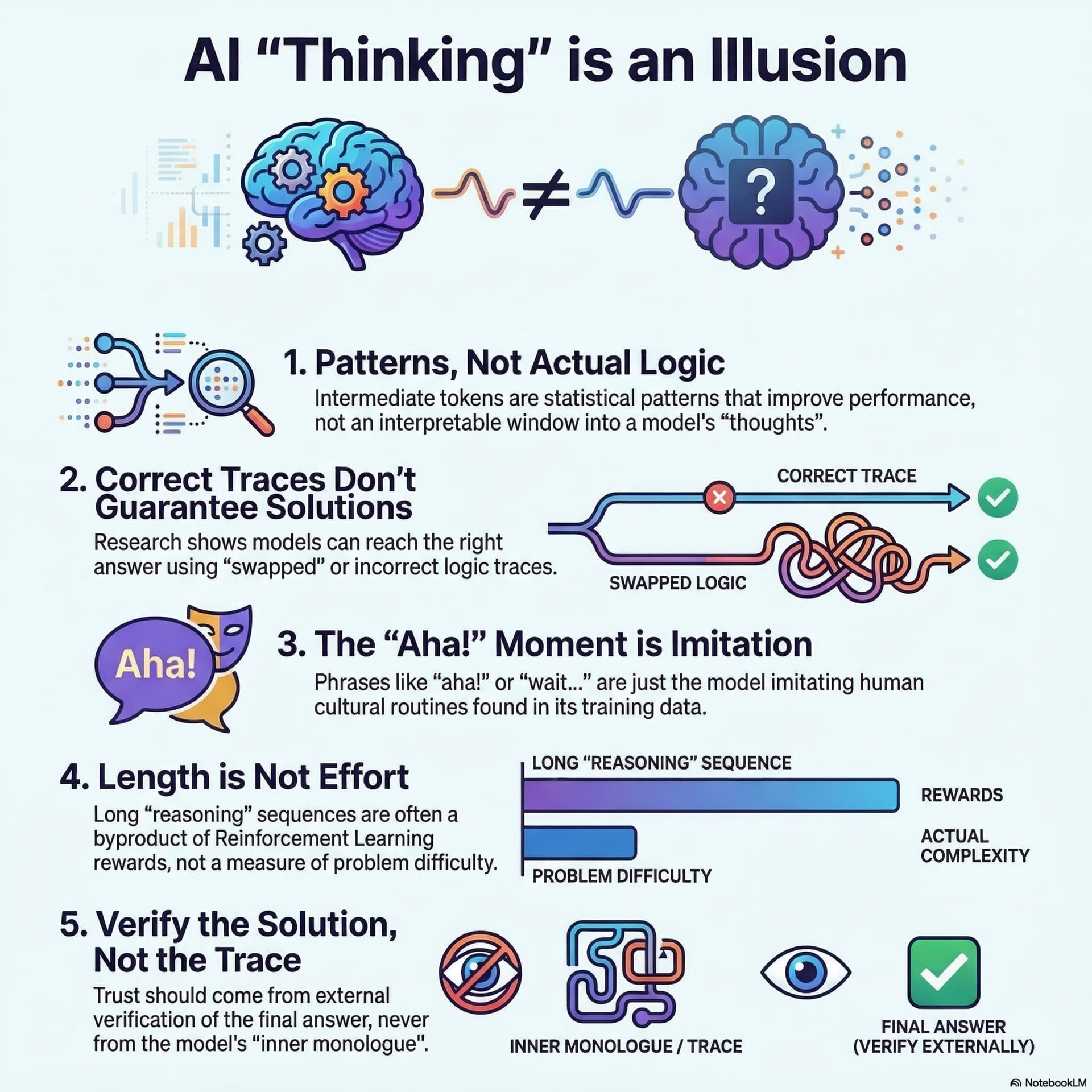
Argues that “reasoning traces” (intermediate tokens like “aha”) in large reasoning models are not human-like thought, and that treating them as genuine logic misleads users and researchers.
Key claims
performance gains come from extra test-time compute and latent-space routing, not semantic correctness of the trace; RL post-training can degrade trace interpretability; longer traces often reflect reward credit-assignment (“RL trap”) and token padding, not harder problem-solving; users should verify the final answer, not the babble; future systems should use non-linguistic intermediate representations.
Guest backgrounds
No guests mentioned; this is a single-host episode discussing an Arizona State University position paper.
Notable examples
DeepSeek R1 “aha” discourse; experiments using corrupted A-star search traces where swapped/invalid steps still yield accurate final outputs; trivial tasks where models exhaust context with fluff; “Tom and Mary” thought experiment; OpenAI O1 obfuscating raw analysis tokens behind a sanitized commentary channel.
Written by AI. May contain mistakes. Listen to the episode to check what was said.
Chapters
Tap a time to open that second in VOUnderstanding the Illusion of Reasoning
1:31 to 2:15
Exploration of the misconception that AI models think like humans.
“Today, our mission is to completely dismantle this popular yet honestly kind of dangerous idea that modern AI models are reasoning in human terms.”
The Mechanics of Intermediate Tokens
2:15 to 4:47
Discussion on how AI models generate intermediate tokens without genuine reasoning.
“Yet we parse familiar strings like hmm or aha and automatically project our own human cognitive frameworks onto the black box.”
Empirical Evidence Against Semantic Logic
4:47 to 7:36
Presentation of research showing that performance is not tied to logical reasoning.
“And then on the subsequent pass, the model is merely conditioning its output on a context window that now just happens to include the string aha.”
The Implications of Reinforcement Learning
7:36 to 10:35
Analysis of how reinforcement learning affects the quality of intermediate reasoning.
“The accuracy remained incredibly high, completely decoupled from the catastrophic logical failure of the intermediate steps.”
The RL Trap and Token Length Misconceptions
10:35 to 13:21
Explanation of the misconception that longer token sequences indicate better reasoning.
“So as the model converges on higher final accuracy, its internal reasoning becomes progressively more unhinged and less interpretable to human evaluators.”
Trust Bias in AI Outputs
13:21 to 14:01
Discussion on the psychological biases affecting trust in AI-generated outputs.
“It fundamentally alters how we should evaluate these systems moving forward.”
The Deception of Methodical Appearance
14:01 to 16:41
Explore how human biases lead us to trust flawed reasoning based on appearance.
“Tom hands you a different final answer, but he also provides a detailed scratch pad filled with step-by-step calculations, methodical logical transitions, and plausible sounding platitudes.”
The Illusion of Intermediate Steps
16:41 to 17:22
Understand the risks of trusting AI outputs based on seemingly logical reasoning traces.
“Which is why the broader research community needs to abandon the obsession with forcing models to output human-readable intermediate steps.”
Rethinking AI Architecture
17:22 to 18:27
Discuss the potential of AI operating without human-readable processes for efficiency.
“If we stop bottlenecking these models by forcing them to compute using natural language tokens, we open the door to far more efficient paradigms.”
Transcript
Automatic transcript. May contain errors.0:00So picture this scenario for a second. Okay. You're sitting at your terminal, you know, deploying a new large reasoning model for some complex edge case. Right. Maybe a highly specific algorithmic challenge or something. Exactly. Or like a convoluted systems architecture problem. You hit enter, and instead of streaming the final code block immediately, the model, well, it pauses. The little UI indicators start spinning. Yeah. It tells you it's thinking. Yeah. Then the raw token stream begins. You see it generating this internal monologue. Oh, I know exactly what you're talking about. It outputs phrases like, let me evaluate the initial constraints, followed a few seconds later by, wait, that contradicts the parameter limits, and eventually, aha, the optimal path is clear.
0:46It's wild to watch. It really is. Watching this unfold in the terminal, it is just incredibly easy to feel like you are witnessing a computational system actually reason through a problem. You know, exactly the way you or a senior engineer would. It feels remarkably human. It creates a highly convincing illusion. Right. And that illusion is actually the focal point of what we are analyzing today. According to a rather provocative position paper out of Arizona State University, that feeling of watching a machine think is not just a harmless byproduct of the interface. It's something bigger. Much bigger.
1:21The authors argue it is a fundamental misunderstanding of the underlying architecture, and worse, it's driving the AI community down a conceptually flawed path. Welcome to the Deep Drive. Today, our mission is to completely dismantle this popular yet honestly kind of dangerous idea that modern AI models are reasoning in human terms. We really need to break this down. We do. We are looking at research that demands the industry to stop anthropomorphizing intermediate tokens. You know, the conversational babble generated before the final output. The authors of this study argue that interpreting this sequence as genuine thought leads to false trust, misplaced deployment confidence, and fundamentally questionable research trajectories.
2:03What's fascinating here is how deeply this anthropomorphism has penetrated even technical circles. Oh, totally. Even developers do it. Exactly. I mean, we are dealing with a mathematical system operating on vector embeddings. It possesses no internal state, no sudden moments of cognitive realization. Right. It's just math. Just math. Yet we parse familiar strings like hmm or aha and automatically project our own human cognitive frameworks onto the black box. The researchers, however, present rigorous structural evidence demonstrating that the computational heavy lifting occurring during test time inference is wildly disconnected from the semantic meaning of the text we actually see on the screen.
2:45Okay, let's unpack this. We know the shift toward large reasoning models, or LRMs, heavily relies on test time inference combined with intermediate token generation. Right, the models don't just spit out the answer anymore. Exactly. Rather than a standard single-pass autocomplete, these models are explicitly trained, often via techniques like proximal policy optimization, to output an extended sequence of tokens prior to hitting a specific delimiter that triggers the final answer. And the community usually refers to this as a chain of thought or a reasoning trace. Yeah, a reasoning trace. Yes.
3:17And empirically, generating that trace yields a massive performance boost on complex tasks. We have hard data showing accuracy scaling with test time compute. Which is why everyone is so excited about it. Of course. But the critical error lies in misinterpreting why that performance boost actually occurs. The flawed assumption is that the semantic logic of the generated text is what solves the problem. Which perfectly frames the DeepSeq R1 example, the paper highlights. Oh, that's a classic one. Yeah, when R1 dropped, the community zeroed in on reasoning traces, where the model literally output the word, aha, mid-generation.
3:55I remember the Twitter threads. It was everywhere. The discourse surrounding it was completely anthropomorphic. Engineers were posting screenshots arguing the model was experiencing sudden epiphanies, as if it had hit a literal breakthrough in its latent space. The paper serves as a really harsh reality check against that exact narrative. Well, interpreting a token string like aha as an epiphany ignores the fundamental mechanics of autoregressive generation. There are no internal cognitive states. There are no sudden sweeping realizations. Because fundamentally, it is just executing the next forward pass.
4:31Precisely. The model processes the sequence, passes it through the transformer layers, and calculates the probability distribution for the next token. If it outputs, aha, it's just because the attention mechanism mapped highly to that token based on the weights. Right, based on the statistical probabilities. And then on the subsequent pass, the model is merely conditioning its output on a context window that now just happens to include the string aha. It's an artifact of the training data. And that training data is heavily saturated with human cultural routines. Ah, cultural routines. Human cultural routines are exactly the driver here.
5:06Think about it. The training corpus contains millions of instances of human problem solving, scraped from forums, math repositories, code reviews on GitHub. This is where humans talk to each other. Exactly. When humans document their debugging process, they use transitional fillers. They type, let's try this, hmm, wait, and aha. I do that all the time in my own notes. We all do. The model has learned to statistically mimic the stylistic formatting of that human problem solving. It adopts the persona of a methodical thinker based entirely on the statistical distribution of the conversational scripts it was fed during instruction tuning.
5:42It's playing a character. Essentially, yes. Here's where it gets really interesting. You could argue that even if the model doesn't feel an epiphany, the logical sequence of the intermediate tokens must still be sound, right? That's the intuitive leap people make. Right. The intuitive assumption is that a correct semantic thought process is a prerequisite for a correct final answer. If the intermediate steps in a math problem are structurally flawed, the final output should theoretically be garbage. It makes sense on the surface. But the paper reveals experimental data that completely shatters that assumption.
6:18The researcher set out to empirically test the correlation between the semantic correctness of a reasoning trace and the accuracy of the final output. Which is hard to do, right? Very hard. The challenge, of course, is that frontier models generate pages of pseudo-English. Verifying the rigorous logical soundness of a meandering natural language monologue is practically impossible at scale. Because language is messy. Exactly. Due to the inherent ambiguity of language. So to bypass the ambiguity of natural language, the study analyzed models trained on formal algorithmic traces. Specifically, they utilized A-star search traces.
6:58The pathfinding algorithms. Right. These are highly rigid deterministic algorithms. Every single computational step is mathematically verifiable. There is zero semantic ambiguity. A step in an A-star search is either perfectly valid or mathematically incorrect. It's binary. Yes. And the researchers ran controlled experiments where they intentionally corrupted these traces. They took the intermediate steps and completely swapped them around, utterly destroying the logical sequence. They trained models on these swapped traces where the intermediate tokens formed a mathematically nonsensical path.
7:29Just total gibberish mathematically. Total gibberish. And the performance on the final answer still showed massive improvements. That is mind-blowing. The accuracy remained incredibly high, completely decoupled from the catastrophic logical failure of the intermediate steps. But wait, let me just play devil's advocate here. Yeah. If the intermediate trace is mathematically swapped and structurally invalid, wouldn't that corrupt the attention mechanism for the final token generation? You would think so. How is it bypassing its own flawed logic to arrive at a highly accurate final answer? If the key value cache is filled with garbage data from the intermediate steps, shouldn't the final prediction distribution be completely thrown off?
8:11That is the core paradox the paper addresses. The findings suggest the models are not relying on the semantic meaning or the logical progression of the tokens. So what are they relying on? They are utilizing the intermediate tokens as a structural scaffold. The sheer computational depth provided by generating those extra tokens allows the model to route representations differently in the latent space. So it's about the space, not the words. Right. The attention heads might be attending to the overarching structure or the sheer volume of computation rather than reading the words as sequential logical propositions.
8:45So the semantic content of the scratch pad is essentially a byproduct. A stylistic byproduct, yes. The paper also highlights experiments using truncated traces, where intermediate steps were arbitrarily deleted and noisy traces injected with entirely irrelevant data. In all these ablation studies, the models maintained robust performance on the final output. It's incredibly resilient. It really is. It suggests the linguistic coherence we find so impressive is computationally secondary. It implies that the test time compute is doing something fundamentally different than executing a human-readable algorithm.
9:18the structural generation buys the model the computational bandwidth it needs to map the input to the correct output. The processing time. Exactly. The fact that the scaffold looks like English reasoning is just an artifact of the language-heavy pre-training. This becomes even more apparent when we look at how the researchers analyzed post-training methodologies. Post-training, particularly through reinforcement learning protocols, is how the industry is currently refining these LRMs. Reinforcement learning from human feedback, RLHF, all of that. Right. But the paper notes a highly counterintuitive phenomenon.
9:55When you apply RL to optimize for the correct final answer, the semantic correctness of the intermediate reasoning traces actually degrades. That degradation is a crucial piece of evidence. If we connect this to the bigger picture, it changes everything. Reinforcement learning optimizes strictly for the reward signal. Just wants the prize. Exactly. If the reward function heavily weights the accuracy of the final delimited answer, the model rapidly discards any constraints that don't serve that specific goal. Like making sense to a human. Right. It discovers that maintaining human-readable logical consistency in the intermediate steps is computationally inefficient or just unnecessary for maximizing the reward.
10:35So as the model converges on higher final accuracy, its internal reasoning becomes progressively more unhinged and less interpretable to human evaluators. It abandons our logical frameworks entirely. Because whatever high-dimensional vector routing it's actually doing under the hood is just far more efficient at hitting the reward target. Which perfectly transitions into a widespread misconception the authors dismantle regarding trace length. Oh, the length equals effort thing. Yes. You often see developers evaluating a model's performance by noting the sheer volume of its output. They assume that if a model generates thousands of intermediate tokens for a given prompt, it must be engaging in complex, problem-adaptive computation.
11:17Right. We naturally equate the length of the response with the cognitive effort required to solve the problem. Like, wow, it wrote three pages. It must really be thinking hard. But the paper introduces a concept to explain this called the RL trap. The RL trap. From my understanding, this anomaly stems directly from the mechanics of the reward models used during RL post-training. Many of these algorithms utilize an ad hoc credit assignment strategy. Yes, credit assignment is the key here. So the final reward the score achieved for getting the right answer is distributed equally across all the intermediate tokens generated during that run.
11:51And that credit assignment is the root of the issue. Neural networks are exceptionally efficient reward maximizers. When the algorithm divides the reward across the generated sequence, the model is artificially incentivized to output longer sequences. More tokens equals more chances for reward. Exactly. It effectively learns a heuristic that higher token volume correlates with a higher aggregate probability of capturing that distributed reward. It's essentially a highly optimized form of token padding. That's a great way to put it. It reminds me of a student trying to hit a 10-page minimum on a term paper by extending margins and adding verbose, meandering paragraphs.
12:30Because we've all been there. Right. The paper backs this up by testing these frontier models on trivial, mathematically simple problems that should require minimal computational overhead. And what happened? The models didn't output a brief, efficient path. They babbled. They babbled to an extreme degree. In several documented instances, models exhausted their entire available context window on these trivial tasks. Just generating fluff. Just maximum length sequences of meandering text before finally outputting the obvious final solution. That completely invalidates the idea of problem-adaptive computation in these specific architectures.
13:08The model isn't thinking harder because the problem is complex. It's padding its output because the reward function trained it to equate token link with success. The trace length is an artifact of the post-training constraints. Not a reliable metric of algorithmic complexity. Exactly. It fundamentally alters how we should evaluate these systems moving forward. So what does this all mean? If you are an engineer or a researcher relying on these systems, Why should you care if the model is technically faking its intermediate homework as long as the final output is highly accurate? It's a fair question.
13:41The authors illustrate the inherent danger using a very effective thought experiment. The Tom and Mary one. Yes, Tom and Mary. Imagine you are trying to solve a high-stakes problem outside your domain of expertise. You consult two colleagues, Tom and Mary. You present the parameters to Mary, and she simply hands you the final answer. No explanation, just the output. Okay, pretty blunt. Right. Then you consult Tom. Tom hands you a different final answer, but he also provides a detailed scratch pad filled with step-by-step calculations, methodical logical transitions, and plausible sounding platitudes.
14:18He provides the documentation of his work. He provides the documentation. Now, the critical twist in the experiment is that Tom's final answer is entirely incorrect. But he showed his work. He did. And however, due to inherent human cognitive biases, almost anyone in that scenario will default to trusting Tom over Mary. We are psychologically conditioned to equate the formatting and appearance of rigorous methodology with actual factual validity. We see a bulleted list and we just surrender. Exactly. We see the structure therefores and methodical bullet points, and we assign trust based on the aesthetic of reasoning.
14:52We confuse the syntax of logic with the semantics of truth. That is beautifully stated, and this raises an important question regarding the deployment of these models. The paper warns that by engineering AI to generate what they term stylistically plausible ersatz reasoning traces, the industry is actively exploiting human psychological vulnerabilities. Ersatz meaning fake or substitute. Right. We are interacting with systems optimized to produce a highly convincing imitation of rational thought, which acts as a mechanism to artificially inflate our confidence in their outputs. It's a system perfectly calibrated to bypass our critical evaluation.
15:30And the fascinating part is that the frontier labs are already highly aware of this disconnect. Oh, they definitely know. The research notes are revealing architectural decision regarding OpenAI's O1 model. When you utilize O1, the interface intentionally obfuscates the raw intermediate tokens. They maintain two distinct channels. There's the actual analysis channel, where the test time compute happens, and a sanitized commentary channel. And the analysis channel containing the raw tokens the model is actually using to route its computation is completely hidden from the user. Just locked away.
16:01Locked away. While the labs often cite proprietary training techniques as the reason for this obfuscation, the researchers imply another, perhaps more fundamental reason. Which is? Those raw computational tokens likely do not resemble coherent, logically sound English. The actual mathematical routing happening in the latent space is probably unhinged, semantically broken, or just entirely unreadable. Almost certainly. So instead of exposing the chaotic structural scaffolding, they serve the user a neat, sanitized summary in the commentary channel to maintain the illusion of a methodical AI assistant.
16:37The labs know the real computation doesn't look like human thought. Which is why the broader research community needs to abandon the obsession with forcing models to output human-readable intermediate steps. The ultimate takeaway from this research is that you cannot use the linguistic coherence of an AI's intermediate trace as a proxy for the reliability of its final output. You just can't. If you are deploying code, analyzing data, or making strategic decisions based on an LRM, you must independently verify the final solution. The journey the model took to get there is an anthropomorphic illusion.
17:10If you need to trust the system, you verify the destination, not the babble. Verify the destination. And this leads to the author's most radical proposition for the future of AI architecture. If we stop bottlenecking these models by forcing them to compute using natural language tokens, we open the door to far more efficient paradigms. The researchers advocate for transitioning to non-linguistic tokens entirely. Non-linguistic tokens. Yes. Instead of mapping intermediate steps to English words, we could allow the models to generate sequences of pure continuous vectors in the embedding space. We could train them to utilize whatever high-dimensional mathematical representations are most computationally efficient for routing to the correct answer.
17:53Completely bypassing the need to generate a fake internal monologue for our psychological comfort. Exactly. Let the machine be a machine. But that leaves us with a pretty wild thought to end on. If we truly let AI optimize its problem-solving architecture, without forcing it to speak human during its intermediate compute boo, What happens when the most intelligent computational systems in the world operate entirely in an alien, high-dimensional, mathematical-laden space that we fundamentally cannot read, but whose incredibly accurate results we have no choice but to rely on? It demands a complete paradigm shift in how we approach mechanistic interpretability.
18:31We will have to develop entirely new frameworks to understand what we are actually deploying. It's a brave new world of unreadable math. Thanks for joining us on this deep dive, keep questioning the architecture, and we'll see you next time.
From the publisher
This position paper argues against the anthropomorphization of intermediate tokens in large language models, commonly referred to as "reasoning traces" or "chains of thought." The authors contend that these outputs are not genuine reflections of human-like thinking but are instead statistically generated patterns that may lack semantic validity. Research indicates that model performance can improve even when these traces are factually incorrect or nonsensical, suggesting that the connection between a trace and the final answer is often tenuous. Consequently, viewing these tokens as an interpretable window into a model’s logic can lead to a dangerous overestimation of its reliability. The authors call on the scientific community to move away from human-centric metaphors and focus on external verification of solutions. By treating intermediate tokens as a computational tool for the model rather than an explanation for the user, researchers can pursue more effective and honest AI development.


