In short
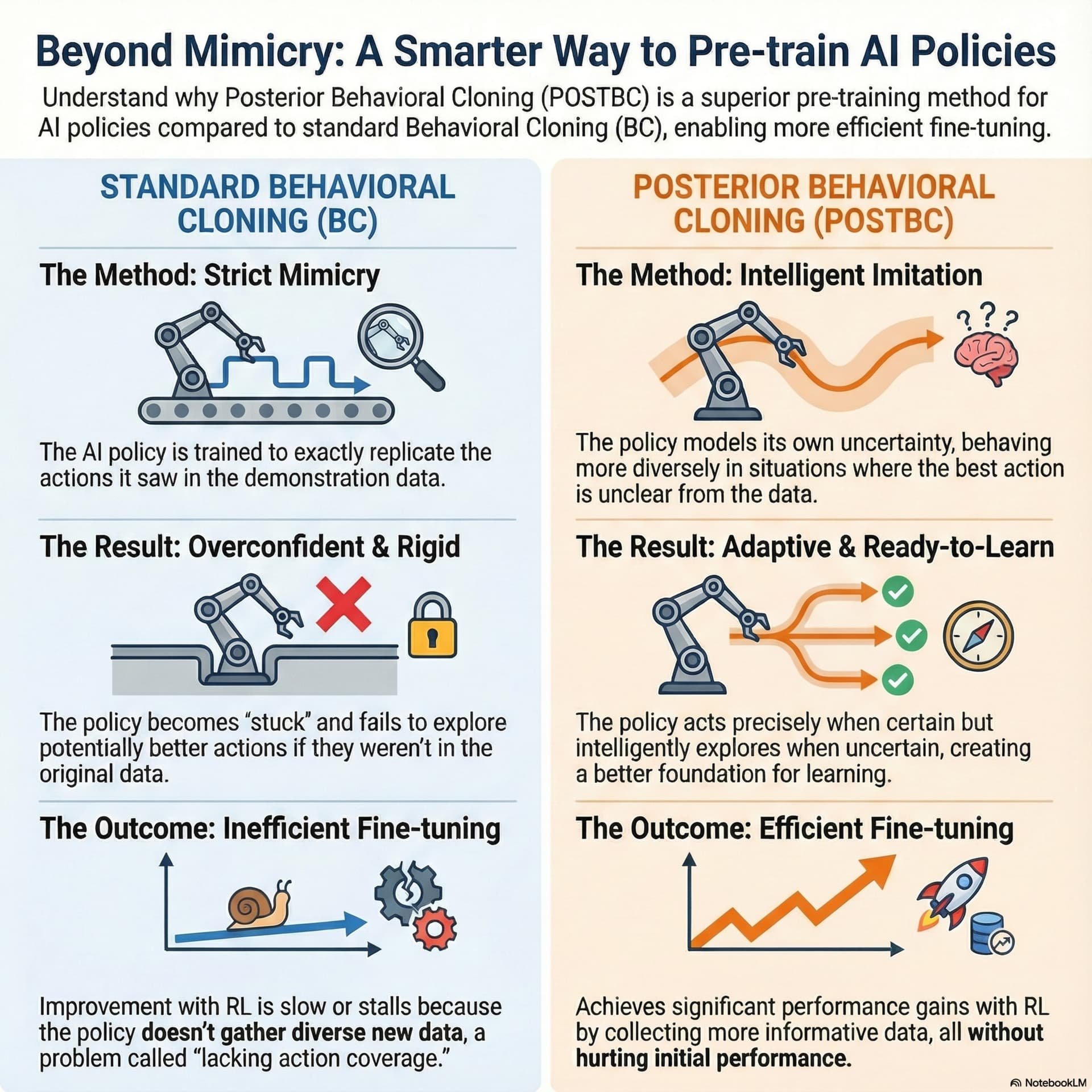
Challenges with standard behavioral cloning (BC) as pretraining for robotics RL fine-tuning; proposes Posterior Behavioral Cloning (POSTBC) to improve “demonstrator action coverage” and sample efficiency.
Guest backgrounds
No guest names or bios provided in the transcript; only two speakers discussing the paper.
Key claims
BC overfits and assigns zero probability to unseen expert actions, blocking RL exploration and causing local-optimum failure unless datasets are impractically large. Simple noise (Sigma BC) trades coverage for poor initial performance. POSTBC models uncertainty via an ensemble, then injects target-action noise proportional to uncertainty, keeping high confidence where data is dense and allowing diverse actions where data is sparse.
Notable examples
RoboMimic tasks (e.g., Square) and Libero (16 kitchen tasks); real Widow X-250-6DUF robot arm (put corn in pot). Results: ~2x fewer RL samples to match performance on RoboMimic; on the real robot, BC success improves ~10% vs POSTBC ~30%.
Written by AI. May contain mistakes. Listen to the episode to check what was said.
Chapters
Tap a time to open that second in VOThe Flaws of Traditional Behavioral Cloning
0:45 to 1:50
Exploring the limitations of standard behavioral cloning in robotics.
“What if that initial pre-trained policy is just fundamentally flawed?”
Understanding Action Coverage in Robotics
1:50 to 4:25
Examining the concept of action coverage and its importance in robotic training.
“It's basically the most common method, especially for robotics.”
Introducing Posterior Behavioral Cloning
4:25 to 5:46
Introducing POSTBC as a solution for better action coverage and efficiency.
“What's so fascinating is that POSTBC completely changes the goal of pre-training instead of fitting the empirical distribution like exactly what actions it saw.”
Implementation of POSTBC and Its Benefits
5:46 to 7:39
Discussing how POSTBC is implemented and its advantages over standard BC.
“So you get the best of both worlds, the confidence of BC and the diversity needed for efficient learning.”
Evaluating POSTBC: Real-World Tests
7:39 to 9:10
Analyzing the performance of POSTBC in real-world robotic tasks.
“If you can save training time there, that's a huge deal for the entire industry.”
Broader Implications for AI and Future Considerations
9:10 to 10:28
Reflecting on the implications of POSTBC for various AI applications beyond robotics.
“On a tricky task, BC might have this super tight, narrow focus on one way of doing things.”
Transcript
Automatic transcript. May contain errors.0:00If you've been following the monumental leaps in modern AI, whether we're talking about large language models, vision systems, or especially real world robotics, you know the formula. It's pre-trained, then fine-tuned. That's the dominant paradigm. You train a massive policy on huge data sets, and then you use something like reinforcement learning, RL, to polish it and push it past human benchmarks. Right. It's how you get that final aligned performance. Okay. So let's unpack this because historically, pretty much all the research energy, like 90 % of it, has gone into making that second step, the RL fine-tuning, smarter and faster.
0:38All new algorithms, yeah. Exactly. Yeah. But here's the really unsettling finding from the source material we looked at for you. What if the starting line itself is the problem? What if that initial pre-trained policy is just fundamentally flawed? And that's exactly the mission of this deep dive. When you're in high-stakes environments, and I mean nothing is higher cost than real-world robotics, sample efficiency is everything. Every single movement of that arm costs money. It costs time, energy, everything. So to make this viable, you need an initial policy that guarantees you can get to peak performance with the absolute fewest tries possible.
1:13We need to stop optimizing just for that initial score and start optimizing for, you know, learnability. So that's the core comparison we're getting into. Yep. We're diving deep into the industry standard, which is called behavioral cloning, or BC, and comparing it to this really powerful alternative they propose, posterior behavioral cloning or POSTBC. And here's the shocking fact we have to start with. Standard BC, even though it's technically optimal for getting the best score right out of the box, it's a terrible foundation for improvement. It's a great photo finish for race one, but a disastrous starting block for race two.
1:49So let's make sure we're all on the same page with behavioral sloning. It's basically the most common method, especially for robotics. It's just supervised learning, right? Exactly. You get a huge data set of a human expert doing a task, like controlling a robot arm, and you just train the AI to copy the actions it saw. Just mimic what the human did, given the state. And that's where the theoretical trouble really begins. Because it's supervised learning, it gets extremely overconfident in the data it's already seen. It overfits. Massively. The central flaw is that if the system has never seen the expert perform a specific action, say action B, the BC policy will assign it zero probability.
2:30It's literally impossible for it to try it. Which prevents what the researchers call demonstrator action coverage. Yes. OK, hold on. Let's unpack that term because that sounds like the absolute core of the problem here. It is. It's the key ingredient. Think of it this way. Action coverage is just the ability of your pre-craned policy to sample all the potentially good actions that the original expert might have used. So if the expert had 10 equally good ways to pick up a block. Your policy has to be able to generate all 10 of those options. If it can only do the one it saw most often, it lacks coverage.
3:02So the RL fine-tuning algorithm is basically stuck. If it needs to try something just a little bit different to find a better way, the BC policy just walls it off. It says, nope, not an option. Precisely. And the paper actually proves that BC can, it can provably fail to even include a near optimal policy in its range of possibilities unless your data set is just impractically enormous. So it's stuck in a local optimum and RL can't easily pull it out, which for robotics means you're just wasting so much time and money on rollouts. Yeah, the inefficiency is huge, which brings us to the intuitive fix that people have tried.
3:41Add some random noise. Right. They call it a Sigma BC. Just force the policy to randomly try every action with some, you know, tiny probability. And OK, so technically that solves the coverage problem. Every action is now possible. Technically, yes. But it creates this terrible tradeoff to keep any decent level of initial performance. The reason you used BC in the first place. You have to keep that noise level incredibly small. You don't want the robot just flailing around randomly. Of course not. But if the noise is tiny, your exploration is almost useless. The RL agent would need an astronomical number of tries to just randomly stumble on one of those better actions.
4:18I get it. It's like scattering dust across a whole continent and hoping you find a diamond. That's a perfect analogy. It has no focus. Which brings us to the breakthrough. We don't want blind noise. We want targeted openness. And that is POSTBC. Posterior behavioral cloning. What's so fascinating is that POSTBC completely changes the goal of pre-training instead of fitting the empirical distribution like exactly what actions it saw. The photograph, like you said. Right. Instead of the photograph, it models the posterior distribution. It's a projection. It asks, given the data I saw and knowing my data is incomplete, what is the whole range of possibilities that could have happened?
5:00So it's forced to model its own uncertainty. Exactly. It practices a kind of targeted humility. And this changes everything. In states where it has tons of data and it's really certain about the expert's action, it acts just like confidence, standard BC, low entropy. It crests the data where the data is good. But in the states where the data is sparse, where it's uncertain, that's where it opens up. It samples from a high entropy distribution. It deliberately allows for a wider, more diverse set of actions, but only in those uncertain regions. So it gives the RL algorithm options right where it needs them most.
5:33And you get this near optimal balance. The theory shows POST BC maintains that high initial performance, just like BC, but it also achieves this almost unimprovable action coverage. So you get the best of both worlds, the confidence of BC and the diversity needed for efficient learning. So what's the catch? It sounds too good. Well, the catch isn't in the theory, it's in the implementation, which is actually really clever. They avoid all the complex RL stuff during pre-training itself. It's just smart, supervised learning. Okay, let's get into that because modeling the posterior sounds like it'd be incredibly difficult mathematically.
6:09How do they actually measure that uncertainty? It's a pretty elegant trick, actually. They use a standard technique called ensemble prediction. So instead of one big policy, they train a bunch of smaller policies on slightly different bootstrap samples of the data. And if those different policies all disagree on what to do in a certain state? That disagreement is their measure of uncertainty. The variance across the ensemble's predictions gives them a really solid map of how uncertain the model is everywhere. I see. So once you have that uncertainty map, what's next? The second step is simple.
6:42They train the final policy, but they add noise to the target actions in the training data. And here's the key. The amount of noise is proportional to that uncertainty they just measured. So more uncertainty in a state means you inject more noise during training for that state. Exactly. The training data itself pushes the policy to be more open-minded, but only where it's necessary. And they use state-of-the-art models for this, specifically diffusion models, which are perfect for this kind of continuous robotic control. And this wasn't just a theory paper. They really put this to the test in complex environments.
7:15Oh, yeah. They used standard simulation benchmarks like Robo Mimic for tasks like Lift and Can and also Libero, which is this really complex multitask environment with like 16 different kitchen tasks. But the real test is always the physical world. And that's the most critical part. They validated it on a physical Widow X-250-6DUF robot arm. You know, using real image observations for tasks like put corn in pot. If you can save training time there, that's a huge deal for the entire industry. OK, let's get to the hard numbers. How much more efficient was POS-TBC when they actually fine tuned it with common RL algorithms?
7:54The gains are, they're staggering, really. On some of those robo-mimic tasks, like the square task, the PSOS TBC policies needed about two times fewer samples to hit the same performance level as standard BC. Two times fewer. I mean, that's cutting your development time in half. It's a massive speed up. And we have to keep saying this, this efficiency did not come at the cost of the initial policies quality. Before any fine tuning, the POS TBC policy was just as good, sometimes even a little better, than the standard BC policy. It meets that goal of being a great starting point, which is where BC fails.
8:27And the results on the real robot arm really just seal the deal, don't they? They absolutely do. For the put corn in pot task, after all that expensive online fine-tuning, the standard BC policy only improved its success rate by 10%. Just 10%. Yeah. But the POS2BC policy, same task, same algorithm, saw its success rate improve by 30%. A three-fold improvement in learning. That gap just highlights the core reason it works. The paper shows the main benefit is that POS-TBC provides a wider but still targeted range of actions that the RL algorithm can sample from at test time. It isn't searching blindly anymore.
9:05So the pre-trained policy is just a much, much better map for the fine-tuning to follow. Exactly. And you can see it in the heat maps they show. On a tricky task, BC might have this super tight, narrow focus on one way of doing things. But POS-TBC shows this much wider action distribution, especially clustered around the tricky parts like grabbing a drawer handle, ensuring it covers all the good ways to get the job done. This has been a really critical deep dive. It feels like we're so often focused on the end of the pipeline, but this is all about optimizing the very beginning. So what does this all mean?
9:38I think this work really suggests we need a fundamental overhaul of how we measure success in pre-training. We have to shift away from just optimizing for that single step accuracy, that low cross-entropy loss, and start prioritizing action coverage. It's not just about being right. It's about knowing what's possible. Exactly. And POSPBC gives us a principled way to do that. And, you know, as we said at the start, this whole pre-trained, then fine-tuned pipeline is universal. This was about robotics. But the same problems exist for large language models. Yeah. Think about the SFT phase before the very expensive RLHF phase.
10:11So that's the final thought I want to leave you with. Could applying this exact principle injecting noise based on uncertainty into the SFT phase of an LLM lead to those same 2x efficiency gains in reasoning or alignment tasks? That's currently the biggest bottleneck in building powerful aligned AI. And well, that's a fascinating question for you to mull over.
From the publisher
This research introduces Posterior Behavioral Cloning (POSTBC), a novel pretraining method designed to enhance reinforcement learning (RL) finetuning for robotic policies. Standard behavioral cloning often fails because it overfits to specific demonstration data, leading to an action coverage deficit that prevents the model from exploring effectively during later stages. To solve this, the authors propose training a policy to model the posterior distribution of the demonstrator’s behavior, which naturally increases entropy and action diversity in states where data is scarce. This approach ensures the agent remains competent in familiar scenarios while remaining open to diverse observations necessary for efficient online improvement. Experiments across various robotic benchmarks and real-world manipulation tasks demonstrate that POSTBC significantly accelerates finetuning efficiency without sacrificing initial performance. Ultimately, the work proves that creating a more uncertainty-aware initialization is a critical, yet previously overlooked, factor in achieving human-level robotic control.


